
Lecture Outline
Introduction to Network Model.
Terminology of Networks.
The Maximum Flow Problem.
The Minimum Cost Flow Problem.
Conclusions.
IntroductionIntroduction
The term network flow program describes a type of model that is a special case
of the more general linear program. The class of network flow programs includes
such:
The Transportation Problem.
The Transshipment Problem.
The Assignment Problem.
The Maximum Flow Problem.The Maximum Flow Problem.
The Minimum Cost Problem.The Minimum Cost Problem.
The Minimum Spanning Tree Problem.
The Shortest Path Problem.
Etc.
Network Flow Problems is important because many aspects of actual
situations are readily recognized as networks and the representation of the
model is much more compact than the general linear program.
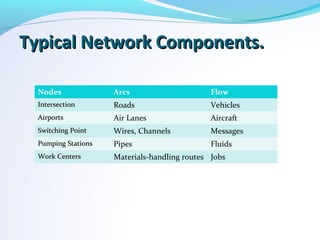
Typical Network Components.Typical Network Components.
Nodes Arcs Flow
IntersectionIntersection Roads Vehicles
AirportsAirports Air Lanes Aircraft
Switching PointSwitching Point Wires, Channels Messages
Pumping StationsPumping Stations Pipes Fluids
Work CentersWork Centers Materials-handling routes Jobs
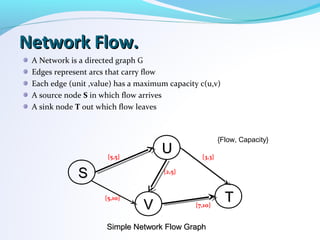
Network Flow.Network Flow.
SS
TT
VV
UU
Simple Network Flow GraphSimple Network Flow Graph
{5,5}
{5,10}
{3,3}
{2,5}
{7,10}
{Flow, Capacity}
A Network is a directed graph G
Edges represent arcs that carry flow
Each edge (unit ,value) has a maximum capacity c(u,v)
A source node S in which flow arrives
A sink node T out which flow leaves
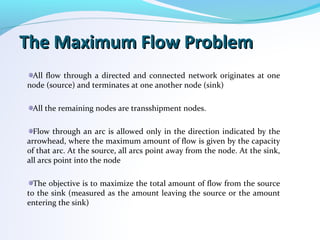
The Maximum Flow ProblemThe Maximum Flow Problem
All flow through a directed and connected network originates at one
node (source) and terminates at one another node (sink)
All the remaining nodes are transshipment nodes.
Flow through an arc is allowed only in the direction indicated by the
arrowhead, where the maximum amount of flow is given by the capacity
of that arc. At the source, all arcs point away from the node. At the sink,
all arcs point into the node
The objective is to maximize the total amount of flow from the source
to the sink (measured as the amount leaving the source or the amount
entering the sink)
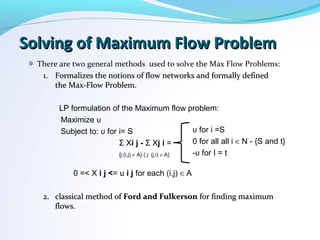
Solving of Maximum Flow ProblemSolving of Maximum Flow Problem
There are two general methods used to solve the Max Flow Problems:
1.1. Formalizes the notions of flow networks and formally definedFormalizes the notions of flow networks and formally defined
the Max-Flow Problem.the Max-Flow Problem.
LP formulation of the Maximum flow problem:
Maximize υ
Subject to: υ for i= S
Σ Xi j - Σ Xj i =
{j:(i,j) A} { j: (j,i) A}∈ ∈
0 =< X i j <= u i j for each (i,j) A∈
2.2. classical method ofclassical method of Ford and FulkersonFord and Fulkerson for finding maximumfor finding maximum
flows.flows.
υ for i =S
0 for all all i N - {S and t}∈
-υ for I = t
Ford and Fulkerson Method to solveFord and Fulkerson Method to solve
Maximum Flow ProblemMaximum Flow Problem
Ford-Fulkerson method encompasses several implementations with
different running times.
The Ford-Fulkerson method depends on three important ideas that
transcend the method and are relevant to many flow algorithms and
problems: residual networks, augmenting paths, and cuts. These
ideas are essential to the important max-flow min-cut theorem, which
characterizes the value of maximum flow in terms of cuts of the flow
network.
Ford- Fulkerson method assumption :
 initialize flow f to zero
 while there exists an augmenting path P
 do augment flow F along path P
 return F
Residual NetworkResidual Network
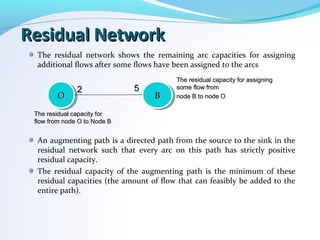
The residual network shows the remaining arc capacities for assigning
additional flows after some flows have been assigned to the arcs
OOOO BBBB
22 55
The residual capacity forThe residual capacity for
flow from node O to Node Bflow from node O to Node B
The residual capacity for assigningThe residual capacity for assigning
some flow fromsome flow from
node B to node Onode B to node O
An augmenting path is a directed path from the source to the sink in the
residual network such that every arc on this path has strictly positive
residual capacity.
The residual capacity of the augmenting path is the minimum of these
residual capacities (the amount of flow that can feasibly be added to the
entire path).
The Maximum Flow Problem –The Maximum Flow Problem –
Solution Steps:Solution Steps:
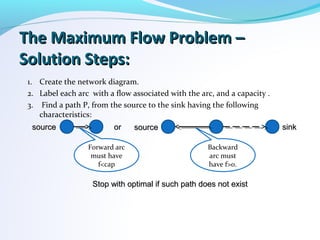
1. Create the network diagram.
2. Label each arc with a flow associated with the arc, and a capacity .
3. Find a path P, from the source to the sink having the following
characteristics:
Stop with optimal if such path does not existStop with optimal if such path does not exist
sinksinksourcesourcesourcesource oror
Forward arc
must have
f<cap
Backward
arc must
have f>0.
ExampleExample
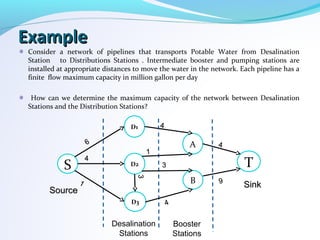
Consider a network of pipelines that transports Potable Water from Desalination
Station to Distributions Stations . Intermediate booster and pumping stations are
installed at appropriate distances to move the water in the network. Each pipeline has a
finite flow maximum capacity in million gallon per day
How can we determine the maximum capacity of the network between Desalination
Stations and the Distribution Stations?
S D2
D3
D1
B
A
T
SourceSource
SinkSink
Desalination
Stations
Booster
Stations
66
11
11
33
33
44
99
44
44
44
ExampleExample
S D2
D3
D1
B
A
T
0, 6
0, 6
0, 1
0, 1
0, 40, 4
0, 10, 1
0,30,3
0, 30, 3
0, 40, 4
0, 40, 4
0, 40, 4
0, 90, 9
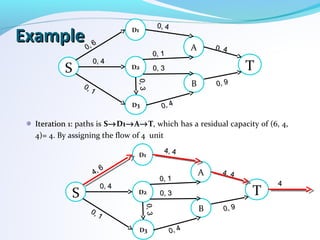
Iteration 1:Iteration 1: paths is S→D1→A→T, which has a residual capacity of (6, 4,
4)= 4. By assigning the flow of 4 unit
S D2
D3
D1
B
A
T
4, 6
4, 6
0, 1
0, 1
0, 40, 4
0, 10, 1
0,30,3
0, 30, 3
0, 40, 4
4, 44, 4
4, 44, 4
0, 90, 9
44
ExampleExample
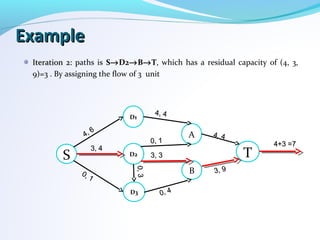
Iteration 2:Iteration 2: paths is S→D2→B→T, which has a residual capacity of (4, 3,
9)=3 . By assigning the flow of 3 unit
S D2
D3
D1
B
A
T
4, 6
4, 6
0, 1
0, 1
3, 43, 4
0, 10, 1
0,30,3
3, 33, 3
0, 40, 4
4, 44, 4
4, 44, 4
3, 93, 9
4+3 =74+3 =7
ExampleExample
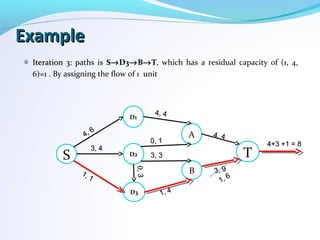
Iteration 3:Iteration 3: paths is S→D3→B→T, which has a residual capacity of (1, 4,
6)=1 . By assigning the flow of 1 unit
S D2
D3
D1
B
A
T
4, 6
4, 6
1, 1
1, 1
3, 43, 4
0, 10, 1
0,30,3
3, 33, 3
1, 41, 4
4, 44, 4
4, 44, 4
3, 93, 9
4+3 +1 = 84+3 +1 = 8
1, 6
1, 6
ExampleExample
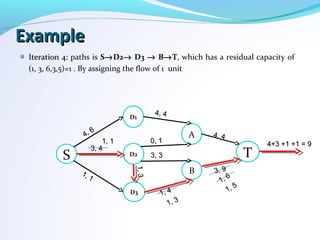
Iteration 4:Iteration 4: paths is S→D2→ D3 → B→T, which has a residual capacity of
(1, 3, 6,3,5)=1 . By assigning the flow of 1 unit
S D2
D3
D1
B
A
T
4, 6
4, 6
1, 1
1, 1
3, 43, 4
0, 10, 1
1,31,3
3, 33, 3
1, 41, 4
4, 44, 4
4, 44, 4
3, 93, 9
4+3 +1 +1 = 94+3 +1 +1 = 9
1, 6
1, 6
1, 11, 1
1, 31, 3
1, 51, 5
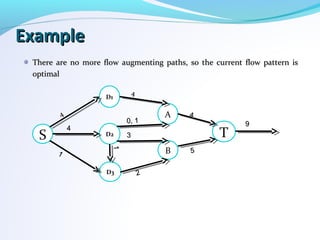
ExampleExample
There are no more flow augmenting paths, so the current flow pattern isThere are no more flow augmenting paths, so the current flow pattern is
optimaloptimal
S D2
D3
D1
B
A
T
44
11
44
0, 10, 1
11
33
22
44
44
55
99
The Minimum Cost Flow ProblemThe Minimum Cost Flow Problem
All flow through a directed and connected network originates at one
node (source) and terminates at one another node (sink)
All the remaining nodes are transshipment nodes.
Flow through an arc is allowed only in the direction indicated by the
arrowhead, where the maximum amount of flow is given by the capacity
of that arc. At the source, all arcs point away from the node. At the sink,
all arcs point into the node
The objective is to maximize the total amount of flow from the source
to the sink (measured as the amount leaving the source or the amount
entering the sink)
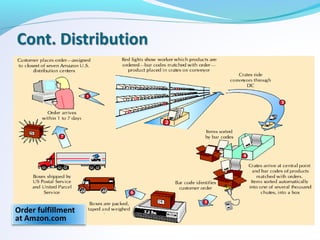
DistributionDistribution
Distribution is encompasses all channels, processes, and
functions, including warehousing and transportation, that a
product passes on its way to final customer often called
“logistics”
Logistics
Transportation and distribution of goods and services.
Order Fulfillment
Process of ensuring on-time delivery of an order.
The Maximum Flow Problem –The Maximum Flow Problem –
Solution Steps:Solution Steps:
Create the network diagram.
Label each arc with a lower flow bound of zero, the upper flow bound
associated with the arc, and a cost per unit flow of zero. For example,
an arc with an upper flow bound of 25 litter per minute will be
labeled {0,25,0}.
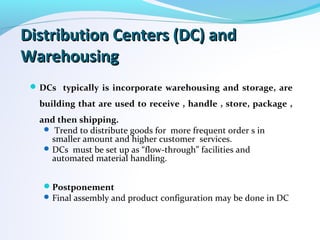
Distribution Centers (DC) andDistribution Centers (DC) and
WarehousingWarehousing
DCs typically is incorporate warehousing and storage, are
building that are used to receive , handle , store, package ,
and then shipping.
 Trend to distribute goods for more frequent order s in
smaller amount and higher customer services.
DCs must be set up as “flow-through” facilities and
automated material handling.
Postponement
Final assembly and product configuration may be done in DC
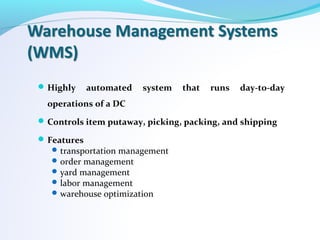
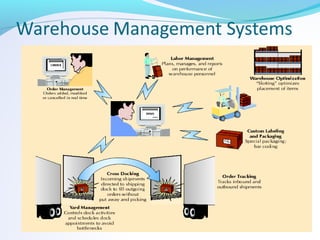
Highly automated system that runs day-to-day
operations of a DC
Controls item putaway, picking, packing, and shipping
Features
transportation management
order management
yard management
labor management
warehouse optimization
Vendor - Managed Inventory (VMI)Vendor - Managed Inventory (VMI)
With VMI Manufacturer generate orders, not distributors
or retailers.
Stocking information is accessed using Electronic Data
Interchange (EDI).
 Manufacturer receive information via EDI about distributor
s’ sales and stock level .
Manufacturer can use this information to create and
maintain a forecast and inventory plan.
VMI a first step toward supply chain collaboration.
VMI increased processing speed, reduced data entry
errors, and improved services.
Collaborative Logistics andCollaborative Logistics and
Distribution OutsourcingDistribution Outsourcing
Collaborative planning, forecasting, and replenishment
create greater economies of scale.
Internet – based exchange of data and information.
Significant decrease in inventory levels and costs and
more efficient logistics.
Companies focus on core competencies.
TransportationTransportation
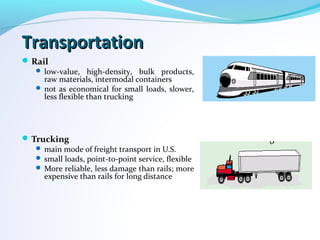
Rail
 low-value, high-density, bulk products,
raw materials, intermodal containers
 not as economical for small loads, slower,
less flexible than trucking
Trucking
 main mode of freight transport in U.S.
 small loads, point-to-point service, flexible
 More reliable, less damage than rails; more
expensive than rails for long distance
Cont. TransportationCont. Transportation
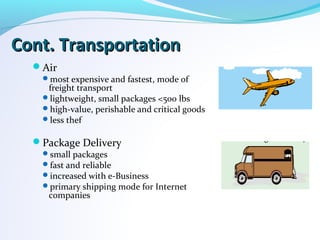
Air
most expensive and fastest, mode of
freight transport
lightweight, small packages <500 lbs
high-value, perishable and critical goods
less thef
Package Delivery
small packages
fast and reliable
increased with e-Business
primary shipping mode for Internet
companies
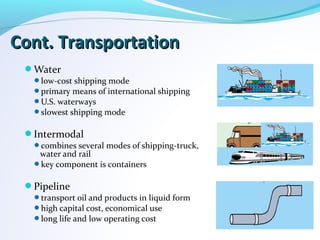
Water
low-cost shipping mode
primary means of international shipping
U.S. waterways
slowest shipping mode
Intermodal
combines several modes of shipping-truck,
water and rail
key component is containers
Pipeline
transport oil and products in liquid form
high capital cost, economical use
long life and low operating cost
Cont. TransportationCont. Transportation
Internet Transportation ExchangeInternet Transportation Exchange
Internet transportation exchanges bring together shipper
who post loads and carriers who post their available
capacity in order to arrange shipments.
Examples..
 www.nte.com
 www.freightquote.com
Global Supply ChainGlobal Supply Chain
There are a number of factors have combined to create a
global marketplace such as:
International trade barriers have fallen.
New trade agreements between countries and nations have
been established.
To compete globally requires an effective supply chain.
Information technology I an “enabler” of global supply chain.
No tariffs or duties
Obstacles to Global ChainObstacles to Global Chain
TransactionsTransactions
Increased documentation for invoices, cargo insurance, letters
of credit, ocean bills of lading or air waybills, and inspections.
Ever changing regulations that vary from country to country
that govern the import and export of goods.
Trade groups, tariffs, duties, and landing costs.
Limited shipping modes.
Differences in communication technology and availability
Cont. Obstacles to Global ChainCont. Obstacles to Global Chain
TransactionsTransactions
Different business practices as well as language barriers.
Government codes and reporting requirements that vary from
country to country.
Numerous players, including forwarding agents, custom house
brokers, financial institutions, insurance providers, multiple
transportation carriers, and government agencies.
Since 9/11, numerous security regulations and requirements
Duties and TariffsDuties and Tariffs
Tariffs (duties) is taxes on imported goods.
Proliferation of trade agreements.
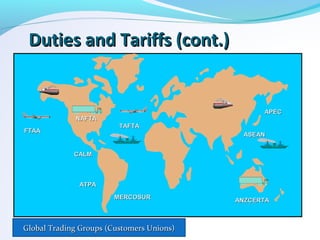
Nations form trading groups.
No tariffs or duties within group.
Charge uniform tariffs to nonmember.
Member nations have a competitive advantage within
the group.
Trade specialists
include freight forwarders, customs house brokers, export
packers, and export management and trading companies
Duties and Tariffs (cont.)Duties and Tariffs (cont.)
APECAPEC
ASEANASEAN
ANZCERTAANZCERTA
FTAAFTAA
NAFTANAFTA
CALMCALM
ATPAATPA
MERCOSURMERCOSUR
TAFTATAFTA
Global Trading Groups (Customers Unions)Global Trading Groups (Customers Unions)
Landed CostLanded Cost
Total cost of producing, storing, and transporting a product to
the site of consumption or another port.
Value added tax (VAT)
an indirect tax assessed on the increase in value of a good at any
stage of production process from raw material to final product.
Web-based International TradeWeb-based International Trade
logistic Systemlogistic System
International trade logistics web-based software systems reduce
obstacles to global trade.
Convert language and currency.
Provide information on tariffs, duties and customers processes.
Attach appropriate weights, measurements, and unit price to
individual products ordered over the web.
Incorporate transportation costs and conversion rates.
Calculate shipping costs online while a company enters an order.
Track global shipments.
Recent Trends in Globalization forRecent Trends in Globalization for
U.S. CompaniesU.S. Companies
Two significant changes promoted many USA Companies to
expand globally.
passage of North America Free Trading Agreement NAFTA
admission of China in WTO
Electronic Industry
70% of cost is in components
major supply chains have moved to China
Proliferation of counterfeit parts
China’s Increasing Role in theChina’s Increasing Role in the
Global Supply ChainGlobal Supply Chain
World’s major source of supply.
Abundance of low –wage labor.
World’s fastest growing market.
Regulatory changes have liberalized its market.
Increased exporting of higher technology products.
Models in Doing Business in ChinaModels in Doing Business in China
Employ local third-party trading agents.
Wholly-owned foreign enterprise.
Develop your own international procurement offices.
Challenges of sourcing from chinaChallenges of sourcing from china
Getting reliable information in more difficult than in the U.S.
Information technology is much less advanced and
sophisticated than in U.S.
Work turnover rates among low skilled workers is extremely
high.
Global Terrorism and GlobalGlobal Terrorism and Global
ChainsChains
Increase Security Measures.
Added time to supply chain schedules.
Increased supply chain costs.
24 hours rules for “risk screening”.
Extended documentation.
Extend time by 3-4 days.
Inventory Levels have increased 5%.
Other Costs include: new people, technologies, equipment,
surveillance, communication, and security systems.. etc.
Network problems 1 (1)

Network problems 1 (1)

  • 2.
    Lecture Outline Introduction toNetwork Model. Terminology of Networks. The Maximum Flow Problem. The Minimum Cost Flow Problem. Conclusions.
  • 3.
    IntroductionIntroduction The term networkflow program describes a type of model that is a special case of the more general linear program. The class of network flow programs includes such: The Transportation Problem. The Transshipment Problem. The Assignment Problem. The Maximum Flow Problem.The Maximum Flow Problem. The Minimum Cost Problem.The Minimum Cost Problem. The Minimum Spanning Tree Problem. The Shortest Path Problem. Etc. Network Flow Problems is important because many aspects of actual situations are readily recognized as networks and the representation of the model is much more compact than the general linear program.
  • 4.
    Typical Network Components.TypicalNetwork Components. Nodes Arcs Flow IntersectionIntersection Roads Vehicles AirportsAirports Air Lanes Aircraft Switching PointSwitching Point Wires, Channels Messages Pumping StationsPumping Stations Pipes Fluids Work CentersWork Centers Materials-handling routes Jobs
  • 5.
    Network Flow.Network Flow. SS TT VV UU SimpleNetwork Flow GraphSimple Network Flow Graph {5,5} {5,10} {3,3} {2,5} {7,10} {Flow, Capacity} A Network is a directed graph G Edges represent arcs that carry flow Each edge (unit ,value) has a maximum capacity c(u,v) A source node S in which flow arrives A sink node T out which flow leaves
  • 6.
    The Maximum FlowProblemThe Maximum Flow Problem All flow through a directed and connected network originates at one node (source) and terminates at one another node (sink) All the remaining nodes are transshipment nodes. Flow through an arc is allowed only in the direction indicated by the arrowhead, where the maximum amount of flow is given by the capacity of that arc. At the source, all arcs point away from the node. At the sink, all arcs point into the node The objective is to maximize the total amount of flow from the source to the sink (measured as the amount leaving the source or the amount entering the sink)
  • 7.
    Solving of MaximumFlow ProblemSolving of Maximum Flow Problem There are two general methods used to solve the Max Flow Problems: 1.1. Formalizes the notions of flow networks and formally definedFormalizes the notions of flow networks and formally defined the Max-Flow Problem.the Max-Flow Problem. LP formulation of the Maximum flow problem: Maximize υ Subject to: υ for i= S Σ Xi j - Σ Xj i = {j:(i,j) A} { j: (j,i) A}∈ ∈ 0 =< X i j <= u i j for each (i,j) A∈ 2.2. classical method ofclassical method of Ford and FulkersonFord and Fulkerson for finding maximumfor finding maximum flows.flows. υ for i =S 0 for all all i N - {S and t}∈ -υ for I = t
  • 8.
    Ford and FulkersonMethod to solveFord and Fulkerson Method to solve Maximum Flow ProblemMaximum Flow Problem Ford-Fulkerson method encompasses several implementations with different running times. The Ford-Fulkerson method depends on three important ideas that transcend the method and are relevant to many flow algorithms and problems: residual networks, augmenting paths, and cuts. These ideas are essential to the important max-flow min-cut theorem, which characterizes the value of maximum flow in terms of cuts of the flow network. Ford- Fulkerson method assumption :  initialize flow f to zero  while there exists an augmenting path P  do augment flow F along path P  return F
  • 9.
    Residual NetworkResidual Network Theresidual network shows the remaining arc capacities for assigning additional flows after some flows have been assigned to the arcs OOOO BBBB 22 55 The residual capacity forThe residual capacity for flow from node O to Node Bflow from node O to Node B The residual capacity for assigningThe residual capacity for assigning some flow fromsome flow from node B to node Onode B to node O An augmenting path is a directed path from the source to the sink in the residual network such that every arc on this path has strictly positive residual capacity. The residual capacity of the augmenting path is the minimum of these residual capacities (the amount of flow that can feasibly be added to the entire path).
  • 10.
    The Maximum FlowProblem –The Maximum Flow Problem – Solution Steps:Solution Steps: 1. Create the network diagram. 2. Label each arc with a flow associated with the arc, and a capacity . 3. Find a path P, from the source to the sink having the following characteristics: Stop with optimal if such path does not existStop with optimal if such path does not exist sinksinksourcesourcesourcesource oror Forward arc must have f<cap Backward arc must have f>0.
  • 11.
    ExampleExample Consider a networkof pipelines that transports Potable Water from Desalination Station to Distributions Stations . Intermediate booster and pumping stations are installed at appropriate distances to move the water in the network. Each pipeline has a finite flow maximum capacity in million gallon per day How can we determine the maximum capacity of the network between Desalination Stations and the Distribution Stations? S D2 D3 D1 B A T SourceSource SinkSink Desalination Stations Booster Stations 66 11 11 33 33 44 99 44 44 44
  • 12.
    ExampleExample S D2 D3 D1 B A T 0, 6 0,6 0, 1 0, 1 0, 40, 4 0, 10, 1 0,30,3 0, 30, 3 0, 40, 4 0, 40, 4 0, 40, 4 0, 90, 9 Iteration 1:Iteration 1: paths is S→D1→A→T, which has a residual capacity of (6, 4, 4)= 4. By assigning the flow of 4 unit S D2 D3 D1 B A T 4, 6 4, 6 0, 1 0, 1 0, 40, 4 0, 10, 1 0,30,3 0, 30, 3 0, 40, 4 4, 44, 4 4, 44, 4 0, 90, 9 44
  • 13.
    ExampleExample Iteration 2:Iteration 2:paths is S→D2→B→T, which has a residual capacity of (4, 3, 9)=3 . By assigning the flow of 3 unit S D2 D3 D1 B A T 4, 6 4, 6 0, 1 0, 1 3, 43, 4 0, 10, 1 0,30,3 3, 33, 3 0, 40, 4 4, 44, 4 4, 44, 4 3, 93, 9 4+3 =74+3 =7
  • 14.
    ExampleExample Iteration 3:Iteration 3:paths is S→D3→B→T, which has a residual capacity of (1, 4, 6)=1 . By assigning the flow of 1 unit S D2 D3 D1 B A T 4, 6 4, 6 1, 1 1, 1 3, 43, 4 0, 10, 1 0,30,3 3, 33, 3 1, 41, 4 4, 44, 4 4, 44, 4 3, 93, 9 4+3 +1 = 84+3 +1 = 8 1, 6 1, 6
  • 15.
    ExampleExample Iteration 4:Iteration 4:paths is S→D2→ D3 → B→T, which has a residual capacity of (1, 3, 6,3,5)=1 . By assigning the flow of 1 unit S D2 D3 D1 B A T 4, 6 4, 6 1, 1 1, 1 3, 43, 4 0, 10, 1 1,31,3 3, 33, 3 1, 41, 4 4, 44, 4 4, 44, 4 3, 93, 9 4+3 +1 +1 = 94+3 +1 +1 = 9 1, 6 1, 6 1, 11, 1 1, 31, 3 1, 51, 5
  • 16.
    ExampleExample There are nomore flow augmenting paths, so the current flow pattern isThere are no more flow augmenting paths, so the current flow pattern is optimaloptimal S D2 D3 D1 B A T 44 11 44 0, 10, 1 11 33 22 44 44 55 99
  • 17.
    The Minimum CostFlow ProblemThe Minimum Cost Flow Problem All flow through a directed and connected network originates at one node (source) and terminates at one another node (sink) All the remaining nodes are transshipment nodes. Flow through an arc is allowed only in the direction indicated by the arrowhead, where the maximum amount of flow is given by the capacity of that arc. At the source, all arcs point away from the node. At the sink, all arcs point into the node The objective is to maximize the total amount of flow from the source to the sink (measured as the amount leaving the source or the amount entering the sink)
  • 18.
    DistributionDistribution Distribution is encompassesall channels, processes, and functions, including warehousing and transportation, that a product passes on its way to final customer often called “logistics” Logistics Transportation and distribution of goods and services. Order Fulfillment Process of ensuring on-time delivery of an order.
  • 19.
    The Maximum FlowProblem –The Maximum Flow Problem – Solution Steps:Solution Steps: Create the network diagram. Label each arc with a lower flow bound of zero, the upper flow bound associated with the arc, and a cost per unit flow of zero. For example, an arc with an upper flow bound of 25 litter per minute will be labeled {0,25,0}.
  • 21.
    Distribution Centers (DC)andDistribution Centers (DC) and WarehousingWarehousing DCs typically is incorporate warehousing and storage, are building that are used to receive , handle , store, package , and then shipping.  Trend to distribute goods for more frequent order s in smaller amount and higher customer services. DCs must be set up as “flow-through” facilities and automated material handling. Postponement Final assembly and product configuration may be done in DC
  • 22.
    Highly automated systemthat runs day-to-day operations of a DC Controls item putaway, picking, packing, and shipping Features transportation management order management yard management labor management warehouse optimization
  • 24.
    Vendor - ManagedInventory (VMI)Vendor - Managed Inventory (VMI) With VMI Manufacturer generate orders, not distributors or retailers. Stocking information is accessed using Electronic Data Interchange (EDI).  Manufacturer receive information via EDI about distributor s’ sales and stock level . Manufacturer can use this information to create and maintain a forecast and inventory plan. VMI a first step toward supply chain collaboration. VMI increased processing speed, reduced data entry errors, and improved services.
  • 25.
    Collaborative Logistics andCollaborativeLogistics and Distribution OutsourcingDistribution Outsourcing Collaborative planning, forecasting, and replenishment create greater economies of scale. Internet – based exchange of data and information. Significant decrease in inventory levels and costs and more efficient logistics. Companies focus on core competencies.
  • 26.
    TransportationTransportation Rail  low-value, high-density,bulk products, raw materials, intermodal containers  not as economical for small loads, slower, less flexible than trucking Trucking  main mode of freight transport in U.S.  small loads, point-to-point service, flexible  More reliable, less damage than rails; more expensive than rails for long distance
  • 27.
    Cont. TransportationCont. Transportation Air mostexpensive and fastest, mode of freight transport lightweight, small packages <500 lbs high-value, perishable and critical goods less thef Package Delivery small packages fast and reliable increased with e-Business primary shipping mode for Internet companies
  • 28.
    Water low-cost shipping mode primarymeans of international shipping U.S. waterways slowest shipping mode Intermodal combines several modes of shipping-truck, water and rail key component is containers Pipeline transport oil and products in liquid form high capital cost, economical use long life and low operating cost Cont. TransportationCont. Transportation
  • 29.
    Internet Transportation ExchangeInternetTransportation Exchange Internet transportation exchanges bring together shipper who post loads and carriers who post their available capacity in order to arrange shipments. Examples..  www.nte.com  www.freightquote.com
  • 30.
    Global Supply ChainGlobalSupply Chain There are a number of factors have combined to create a global marketplace such as: International trade barriers have fallen. New trade agreements between countries and nations have been established. To compete globally requires an effective supply chain. Information technology I an “enabler” of global supply chain. No tariffs or duties
  • 31.
    Obstacles to GlobalChainObstacles to Global Chain TransactionsTransactions Increased documentation for invoices, cargo insurance, letters of credit, ocean bills of lading or air waybills, and inspections. Ever changing regulations that vary from country to country that govern the import and export of goods. Trade groups, tariffs, duties, and landing costs. Limited shipping modes. Differences in communication technology and availability
  • 32.
    Cont. Obstacles toGlobal ChainCont. Obstacles to Global Chain TransactionsTransactions Different business practices as well as language barriers. Government codes and reporting requirements that vary from country to country. Numerous players, including forwarding agents, custom house brokers, financial institutions, insurance providers, multiple transportation carriers, and government agencies. Since 9/11, numerous security regulations and requirements
  • 33.
    Duties and TariffsDutiesand Tariffs Tariffs (duties) is taxes on imported goods. Proliferation of trade agreements. Nations form trading groups. No tariffs or duties within group. Charge uniform tariffs to nonmember. Member nations have a competitive advantage within the group. Trade specialists include freight forwarders, customs house brokers, export packers, and export management and trading companies
  • 34.
    Duties and Tariffs(cont.)Duties and Tariffs (cont.) APECAPEC ASEANASEAN ANZCERTAANZCERTA FTAAFTAA NAFTANAFTA CALMCALM ATPAATPA MERCOSURMERCOSUR TAFTATAFTA Global Trading Groups (Customers Unions)Global Trading Groups (Customers Unions)
  • 35.
    Landed CostLanded Cost Totalcost of producing, storing, and transporting a product to the site of consumption or another port. Value added tax (VAT) an indirect tax assessed on the increase in value of a good at any stage of production process from raw material to final product.
  • 36.
    Web-based International TradeWeb-basedInternational Trade logistic Systemlogistic System International trade logistics web-based software systems reduce obstacles to global trade. Convert language and currency. Provide information on tariffs, duties and customers processes. Attach appropriate weights, measurements, and unit price to individual products ordered over the web. Incorporate transportation costs and conversion rates. Calculate shipping costs online while a company enters an order. Track global shipments.
  • 37.
    Recent Trends inGlobalization forRecent Trends in Globalization for U.S. CompaniesU.S. Companies Two significant changes promoted many USA Companies to expand globally. passage of North America Free Trading Agreement NAFTA admission of China in WTO Electronic Industry 70% of cost is in components major supply chains have moved to China Proliferation of counterfeit parts
  • 38.
    China’s Increasing Rolein theChina’s Increasing Role in the Global Supply ChainGlobal Supply Chain World’s major source of supply. Abundance of low –wage labor. World’s fastest growing market. Regulatory changes have liberalized its market. Increased exporting of higher technology products.
  • 39.
    Models in DoingBusiness in ChinaModels in Doing Business in China Employ local third-party trading agents. Wholly-owned foreign enterprise. Develop your own international procurement offices.
  • 40.
    Challenges of sourcingfrom chinaChallenges of sourcing from china Getting reliable information in more difficult than in the U.S. Information technology is much less advanced and sophisticated than in U.S. Work turnover rates among low skilled workers is extremely high.
  • 41.
    Global Terrorism andGlobalGlobal Terrorism and Global ChainsChains Increase Security Measures. Added time to supply chain schedules. Increased supply chain costs. 24 hours rules for “risk screening”. Extended documentation. Extend time by 3-4 days. Inventory Levels have increased 5%. Other Costs include: new people, technologies, equipment, surveillance, communication, and security systems.. etc.