OVERVIEW OF
NERVOUS SYSTEM
Presented By- Amrit Kour
Kriya Sharir Dept.
R.G.G.P.G Ayurvedic College &
Hospital ,Paprola
INDEX
Important Terminolgy
Overview of Brain & its Parts
Spinal cord & it’s cross – section
 Peripheral Nervous System & it’s further
division.
Meninges
Clinical importance of meninges.
Introduction
Nervous system is one of the control
systems of the body that control various
activities of the body, the other one
being the endocrine system .
Nervous system is quicker than the
endocrine system.
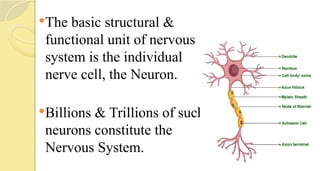
The basic structural &
functional unit of nervous
system is the individual
nerve cell, the Neuron.
Billions & Trillions of such
neurons constitute the
Nervous System.
Nervous System controls the activities of
the body
By generating and sending electrical signals
in the form of impulses to various organs
and regions of the body .
It coordinates these activities by receiving
input signals from different types of
receptors present throughout the body.
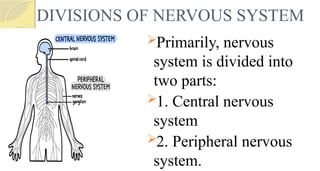
DIVISIONS OF NERVOUS SYSTEM
Primarily, nervous
system is divided into
two parts:
1. Central nervous
system
2. Peripheral nervous
system.
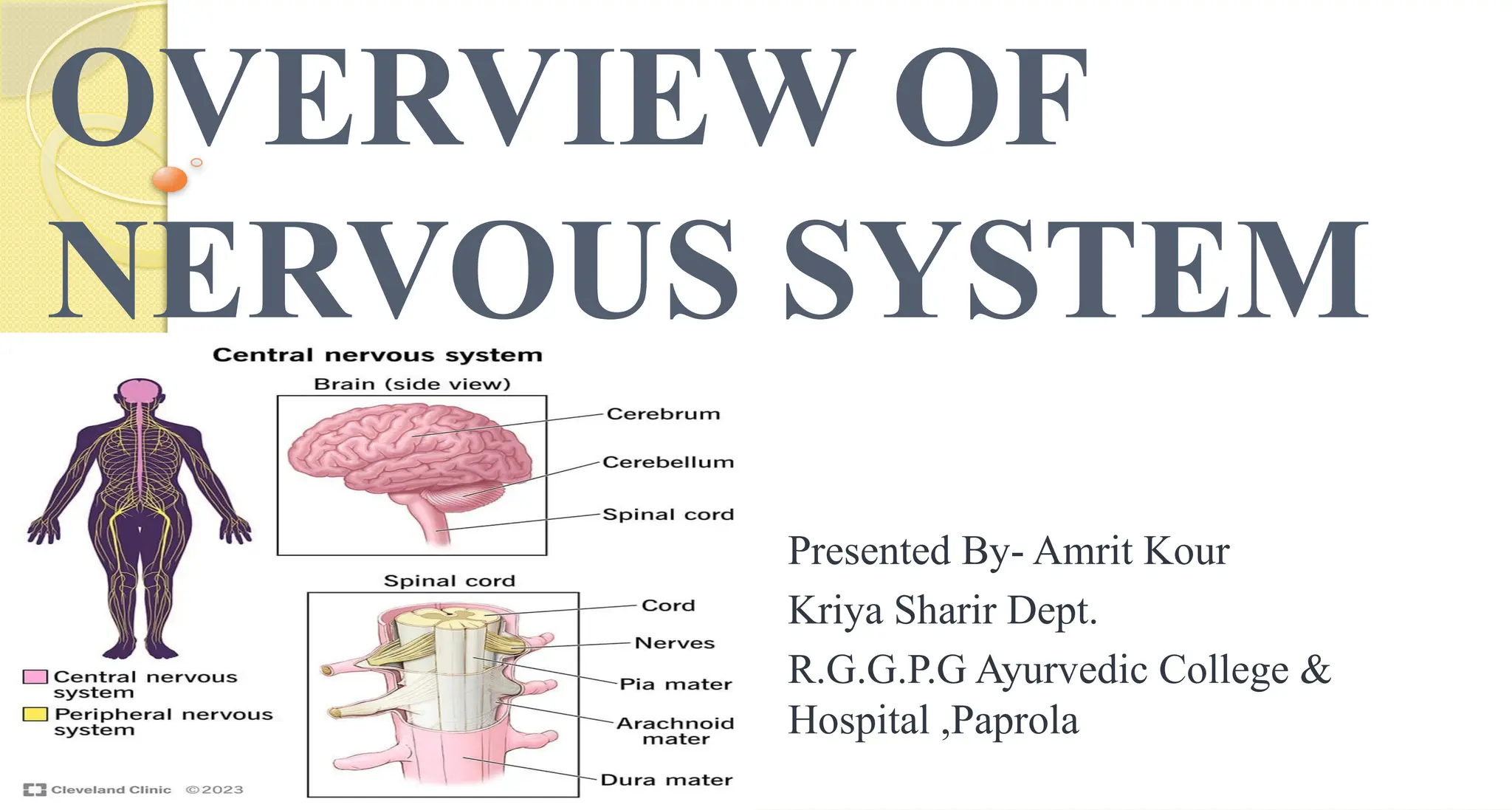
CENTRAL NERVOUS
SYSTEM
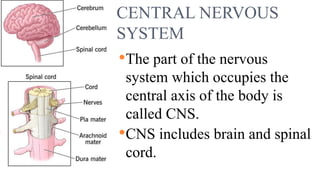
The part of the nervous
system which occupies the
central axis of the body is
called CNS.
CNS includes brain and spinal
cord.
Main Functions of CNS
Receive the Sensory information from
P.N.S
Process that Information & make the
decision
Send processed information output
through motor nerves.
IMPORTANT
TERMINOLOGY
CNS -
 Formed by neurons and supporting cells
called neuroglia.
Structures of brain and spinal cord are
arranged in two layers, namely
 Gray matter &
White matter.
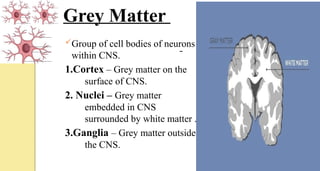
Grey Matter
Group of cell bodies of neurons
within CNS.
1.Cortex – Grey matter on the
surface of CNS.
2. Nuclei – Grey matter
embedded in CNS
surrounded by white matter .
3.Ganglia – Grey matter outside
the CNS.
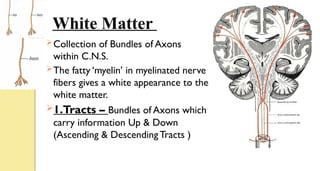
White Matter
Collection of Bundles of Axons
within C.N.S.
The fatty ‘myelin’ in myelinated nerve
fibers gives a white appearance to the
white matter.
1.Tracts – Bundles of Axons which
carry information Up & Down
(Ascending & Descending Tracts )
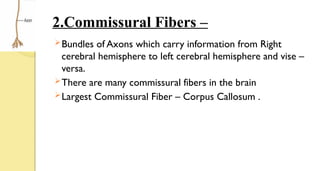
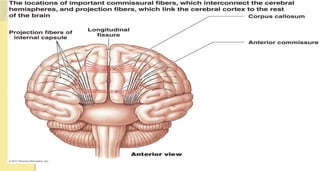
2.Commissural Fibers –
Bundles of Axons which carry information from Right
cerebral hemisphere to left cerebral hemisphere and vise –
versa.
There are many commissural fibers in the brain
Largest Commissural Fiber – Corpus Callosum .
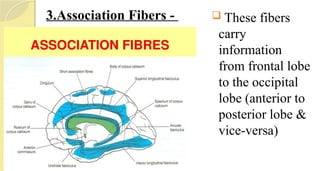
3.Association Fibers -  These fibers
carry
information
from frontal lobe
to the occipital
lobe (anterior to
posterior lobe &
vice-versa)
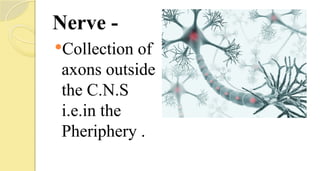
Nerve -
Collection of
axons outside
the C.N.S
i.e.in the
Pheriphery .
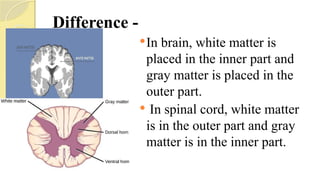
Difference -
In brain, white matter is
placed in the inner part and
gray matter is placed in the
outer part.
 In spinal cord, white matter
is in the outer part and gray
matter is in the inner part.
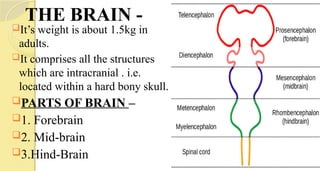
THE BRAIN -
It’s weight is about 1.5kg in
adults.
It comprises all the structures
which are intracranial . i.e.
located within a hard bony skull.
PARTS OF BRAIN –
1. Forebrain
2. Mid-brain
3.Hind-Brain
The brain also contains 4
interconnected cavities , the cerebral
ventricles , that contain cerebrospinal
fluid (CSF).
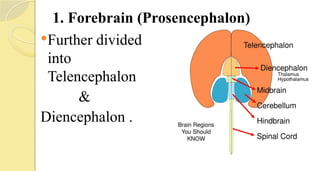
1. Forebrain (Prosencephalon)
Further divided
into
Telencephalon
&
Diencephalon .
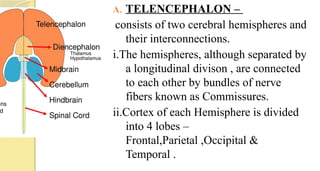
A. TELENCEPHALON –
consists of two cerebral hemispheres and
their interconnections.
i.The hemispheres, although separated by
a longitudinal divison , are connected
to each other by bundles of nerve
fibers known as Commissures.
ii.Cortex of each Hemisphere is divided
into 4 lobes –
Frontal,Parietal ,Occipital &
Temporal .
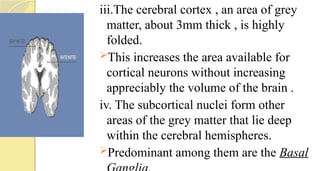
iii.The cerebral cortex , an area of grey
matter, about 3mm thick , is highly
folded.
This increases the area available for
cortical neurons without increasing
appreciably the volume of the brain .
iv. The subcortical nuclei form other
areas of the grey matter that lie deep
within the cerebral hemispheres.
Predominant among them are the Basal
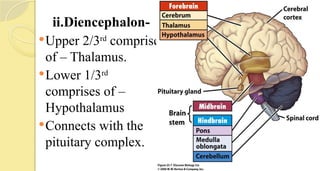
ii.Diencephalon-
Upper 2/3rd
comprises
of – Thalamus.
Lower 1/3rd
comprises of –
Hypothalamus
Connects with the
pituitary complex.
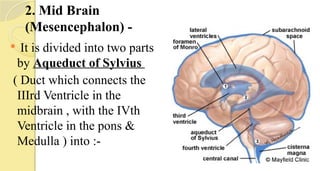
2. Mid Brain
(Mesencephalon) -
 It is divided into two parts
by Aqueduct of Sylvius
( Duct which connects the
IIIrd Ventricle in the
midbrain , with the IVth
Ventricle in the pons &
Medulla ) into :-
It is Divided into two parts -
i] Ventral Part, called Cerebral Peduncle , chiefly of
white matter, uniting the Pons with the thalamic region
of the cerebrum.
 It comprises the – tegmentum, Substantia nigra & basis
peduncle.
 ii] Dorsal part, called tectum which constitutes two
elevations, superior and inferior colliculi.
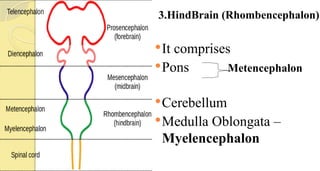
3.HindBrain (Rhombencephalon)
It comprises
Pons Metencephalon
Cerebellum
Medulla Oblongata –
Myelencephalon
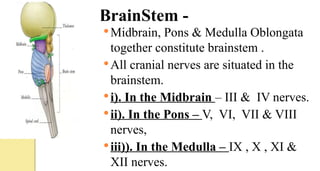
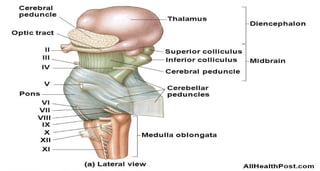
BrainStem -
Midbrain, Pons & Medulla Oblongata
together constitute brainstem .
All cranial nerves are situated in the
brainstem.
i). In the Midbrain – III & IV nerves.
ii). In the Pons – V, VI, VII & VIII
nerves,
iii)). In the Medulla – IX , X , XI &
XII nerves.
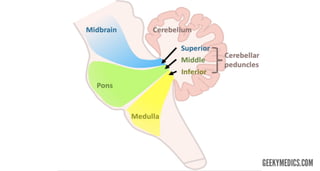
The cerebellum is connected by three large
bundles of nerve fibres, the cerebellar
peduncles with the dorsal side of the brain
stem :
i). Via Superior Cerebellar Peduncle with
the midbrain,
ii) via Middle cerebellar Peduncle with the
pons ,&
iii) Via Inferior cerebellar Peduncle with
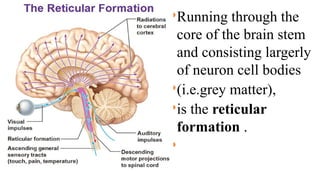
Running through the
core of the brain stem
and consisting largerly
of neuron cell bodies
(i.e.grey matter),
is the reticular
formation .

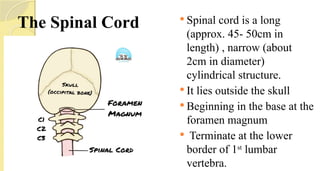
The Spinal Cord  Spinal cord is a long
(approx. 45- 50cm in
length) , narrow (about
2cm in diameter)
cylindrical structure.
 It lies outside the skull
 Beginning in the base at the
foramen magnum
 Terminate at the lower
border of 1st
lumbar
vertebra.
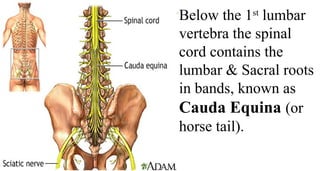
Below the 1st
lumbar
vertebra the spinal
cord contains the
lumbar & Sacral roots
in bands, known as
Cauda Equina (or
horse tail).
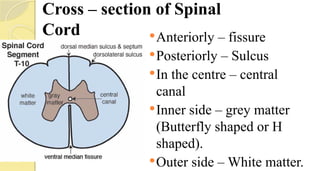
Cross – section of Spinal
Cord Anteriorly – fissure
Posteriorly – Sulcus
In the centre – central
canal
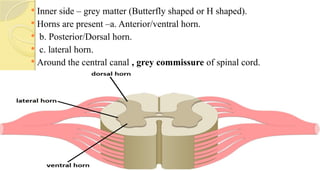
Inner side – grey matter
(Butterfly shaped or H
shaped).
Outer side – White matter.
 Inner side – grey matter (Butterfly shaped or H shaped).
 Horns are present –a. Anterior/ventral horn.
 b. Posterior/Dorsal horn.
 c. lateral horn.
 Around the central canal , grey commissure of spinal cord.
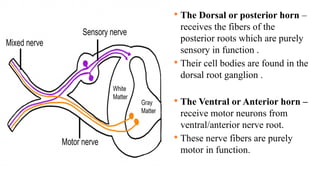
 The Dorsal or posterior horn –
receives the fibers of the
posterior roots which are purely
sensory in function .
 Their cell bodies are found in the
dorsal root ganglion .
 The Ventral or Anterior horn –
receive motor neurons from
ventral/anterior nerve root.
 These nerve fibers are purely
motor in function.
Major columns of Spinal Cord
1. Dorsal / Posterior Column
2. Anterolateral / ventrolateral
column
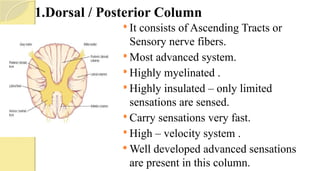
1.Dorsal / Posterior Column
 It consists of Ascending Tracts or
Sensory nerve fibers.
 Most advanced system.
 Highly myelinated .
 Highly insulated – only limited
sensations are sensed.
 Carry sensations very fast.
 High – velocity system .
 Well developed advanced sensations
are present in this column.
Examples of Dorsal column sensations-
Very fine touch sensation,
Sense of positioning,
Pressure
Sense of Proprioreception – from locomotor
system.
Sense of two point Discrimination.
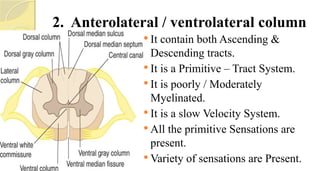
2. Anterolateral / ventrolateral column
 It contain both Ascending &
Descending tracts.
 It is a Primitive – Tract System.
 It is poorly / Moderately
Myelinated.
 It is a slow Velocity System.
 All the primitive Sensations are
present.
 Variety of sensations are Present.
 Example ventrolateral column-
 Crude touch ,
Sensation of Itching,
Sexual sensation
Tickling sensation
Pain
Temp .
Peripheral Nervous System
The part of the Nervous System which lies
outside the CNS.
It consists of the nerves extending from the
brain & Spinal Cord out to all parts of the
body.
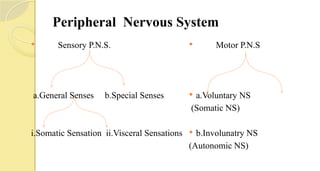
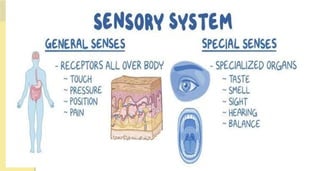
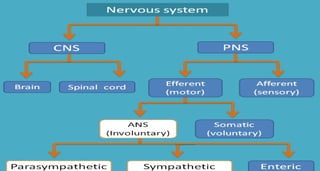
Peripheral Nervous System
 Sensory P.N.S.
a.General Senses b.Special Senses
i.Somatic Sensation ii.Visceral Sensations
 Motor P.N.S
 a.Voluntary NS
(Somatic NS)
 b.Involunatry NS
(Autonomic NS)
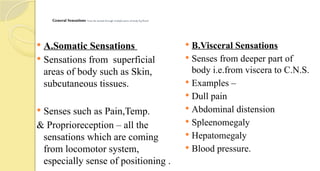
General Sensations –can be sensed through multiple parts of body. E.g Touch
 A.Somatic Sensations
 Sensations from superficial
areas of body such as Skin,
subcutaneous tissues.
 Senses such as Pain,Temp.
& Proprioreception – all the
sensations which are coming
from locomotor system,
especially sense of positioning .
 B.Visceral Sensations
 Senses from deeper part of
body i.e.from viscera to C.N.S.
 Examples –
 Dull pain
 Abdominal distension
 Spleenomegaly
 Hepatomegaly
 Blood pressure.
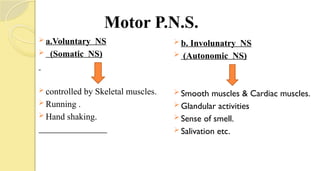
Motor P.N.S.
 a.Voluntary NS
 (Somatic NS)
 controlled by Skeletal muscles.
 Running .
 Hand shaking.
 b. Involunatry NS
 (Autonomic NS)
 Smooth muscles & Cardiac muscles.
 Glandular activities
 Sense of smell.
 Salivation etc.
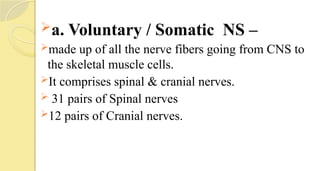
a. Voluntary / Somatic NS –
made up of all the nerve fibers going from CNS to
the skeletal muscle cells.
It comprises spinal & cranial nerves.
 31 pairs of Spinal nerves
12 pairs of Cranial nerves.
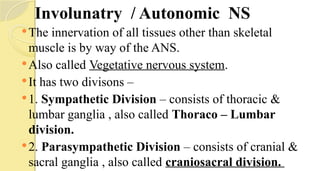
Involunatry / Autonomic NS
The innervation of all tissues other than skeletal
muscle is by way of the ANS.
Also called Vegetative nervous system.
It has two divisons –
1. Sympathetic Division – consists of thoracic &
lumbar ganglia , also called Thoraco – Lumbar
division.
2. Parasympathetic Division – consists of cranial &
sacral ganglia , also called craniosacral division.
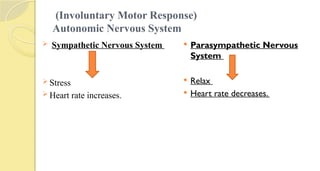
(Involuntary Motor Response)
Autonomic Nervous System
 Sympathetic Nervous System
 Stress
 Heart rate increases.
 Parasympathetic Nervous
System
 Relax
 Heart rate decreases.
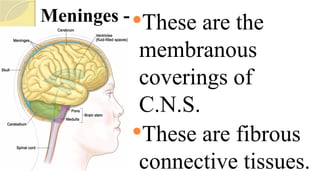
Meninges
Meninges -These are the
membranous
coverings of
C.N.S.
These are fibrous
connective tissues.
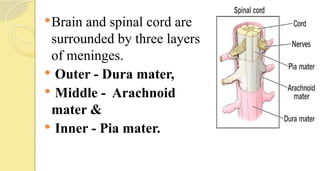
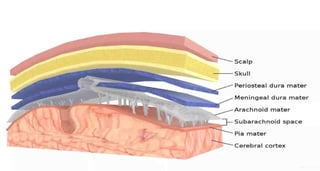
Brain and spinal cord are
surrounded by three layers
of meninges.
 Outer - Dura mater,
 Middle - Arachnoid
mater &
 Inner - Pia mater.
The space between arachnoid mater and
pia mater is known as subarachnoid
space.
This space is filled with a fluid called
cerebrospinal fluid.
Brain and spinal cord are actually
suspended in the cerebrospinal fluid.
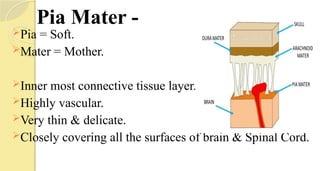
Pia Mater -
Pia = Soft.
Mater = Mother.
Inner most connective tissue layer.
Highly vascular.
Very thin & delicate.
Closely covering all the surfaces of brain & Spinal Cord.
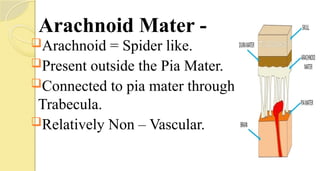
Arachnoid Mater -
Arachnoid = Spider like.
Present outside the Pia Mater.
Connected to pia mater through
Trabecula.
Relatively Non – Vascular.
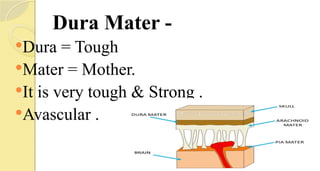
Dura Mater -
Dura = Tough
Mater = Mother.
It is very tough & Strong .
Avascular .
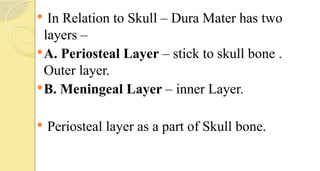
 In Relation to Skull – Dura Mater has two
layers –
A. Periosteal Layer – stick to skull bone .
Outer layer.
B. Meningeal Layer – inner Layer.
 Periosteal layer as a part of Skull bone.
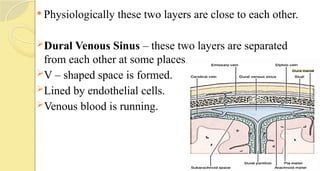
 Physiologically these two layers are close to each other.
Dural Venous Sinus – these two layers are separated
from each other at some places.
V – shaped space is formed.
Lined by endothelial cells.
Venous blood is running.
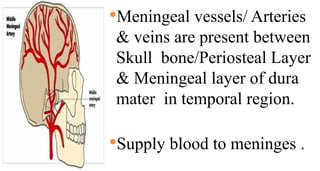
Meningeal vessels/ Arteries
& veins are present between
Skull bone/Periosteal Layer
& Meningeal layer of dura
mater in temporal region.
Supply blood to meninges .
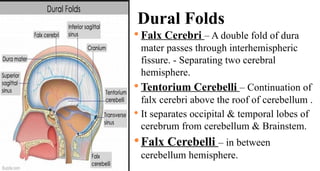
Dural Folds
 Falx Cerebri – A double fold of dura
mater passes through interhemispheric
fissure. - Separating two cerebral
hemisphere.
 Tentorium Cerebelli – Continuation of
falx cerebri above the roof of cerebellum .
 It separates occipital & temporal lobes of
cerebrum from cerebellum & Brainstem.
 Falx Cerebelli – in between
cerebellum hemisphere.
Clinical Importance of
Meninges
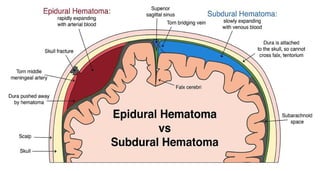
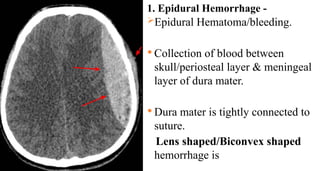
1. Epidural Hemorrhage -
Epidural Hematoma/bleeding.
 Collection of blood between
skull/periosteal layer & meningeal
layer of dura mater.
 Dura mater is tightly connected to
suture.
Lens shaped/Biconvex shaped
hemorrhage is
Cause of Epidural Hemorrhage -
occur due to trauma to the
skull ,mostly on temporal side.
There is rupture of meningeal arties
& veins.
2. Subdural Hemorrhage -
Collection of blood below the dura mater/outer
layer of dura mater & Arachnoid membrane.
Cause- injury to cerebral vein.
Cresent/sickle shaped hemorrhage with H/O fall
after intoxication or injury due to neck movement
(with increasing age = grey mater shrinks)
Cerebral vein passes through – pia mater-
arachnoid matter – dura mater- dural veinous sinus.
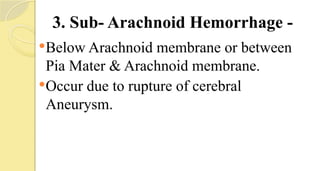
3. Sub- Arachnoid Hemorrhage -
Below Arachnoid membrane or between
Pia Mater & Arachnoid membrane.
Occur due to rupture of cerebral
Aneurysm.
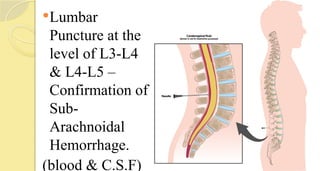
Lumbar
Puncture at the
level of L3-L4
& L4-L5 –
Confirmation of
Sub-
Arachnoidal
Hemorrhage.
(blood & C.S.F)
NERVOUS SYSTEM - OVERVIEW, CLASSIFICATION, DIVISION

NERVOUS SYSTEM - OVERVIEW, CLASSIFICATION, DIVISION

  • 1.
    OVERVIEW OF NERVOUS SYSTEM PresentedBy- Amrit Kour Kriya Sharir Dept. R.G.G.P.G Ayurvedic College & Hospital ,Paprola
  • 2.
    INDEX Important Terminolgy Overview ofBrain & its Parts Spinal cord & it’s cross – section  Peripheral Nervous System & it’s further division. Meninges Clinical importance of meninges.
  • 3.
    Introduction Nervous system isone of the control systems of the body that control various activities of the body, the other one being the endocrine system . Nervous system is quicker than the endocrine system.
  • 4.
    The basic structural& functional unit of nervous system is the individual nerve cell, the Neuron. Billions & Trillions of such neurons constitute the Nervous System.
  • 5.
    Nervous System controlsthe activities of the body By generating and sending electrical signals in the form of impulses to various organs and regions of the body . It coordinates these activities by receiving input signals from different types of receptors present throughout the body.
  • 6.
    DIVISIONS OF NERVOUSSYSTEM Primarily, nervous system is divided into two parts: 1. Central nervous system 2. Peripheral nervous system.
  • 7.
    CENTRAL NERVOUS SYSTEM The partof the nervous system which occupies the central axis of the body is called CNS. CNS includes brain and spinal cord.
  • 8.
    Main Functions ofCNS Receive the Sensory information from P.N.S Process that Information & make the decision Send processed information output through motor nerves.
  • 9.
  • 10.
    CNS -  Formedby neurons and supporting cells called neuroglia. Structures of brain and spinal cord are arranged in two layers, namely  Gray matter & White matter.
  • 11.
    Grey Matter Group ofcell bodies of neurons within CNS. 1.Cortex – Grey matter on the surface of CNS. 2. Nuclei – Grey matter embedded in CNS surrounded by white matter . 3.Ganglia – Grey matter outside the CNS.
  • 12.
    White Matter Collection ofBundles of Axons within C.N.S. The fatty ‘myelin’ in myelinated nerve fibers gives a white appearance to the white matter. 1.Tracts – Bundles of Axons which carry information Up & Down (Ascending & Descending Tracts )
  • 13.
    2.Commissural Fibers – Bundlesof Axons which carry information from Right cerebral hemisphere to left cerebral hemisphere and vise – versa. There are many commissural fibers in the brain Largest Commissural Fiber – Corpus Callosum .
  • 15.
    3.Association Fibers - These fibers carry information from frontal lobe to the occipital lobe (anterior to posterior lobe & vice-versa)
  • 16.
    Nerve - Collection of axonsoutside the C.N.S i.e.in the Pheriphery .
  • 17.
    Difference - In brain,white matter is placed in the inner part and gray matter is placed in the outer part.  In spinal cord, white matter is in the outer part and gray matter is in the inner part.
  • 18.
    THE BRAIN - It’sweight is about 1.5kg in adults. It comprises all the structures which are intracranial . i.e. located within a hard bony skull. PARTS OF BRAIN – 1. Forebrain 2. Mid-brain 3.Hind-Brain
  • 19.
    The brain alsocontains 4 interconnected cavities , the cerebral ventricles , that contain cerebrospinal fluid (CSF).
  • 20.
    1. Forebrain (Prosencephalon) Furtherdivided into Telencephalon & Diencephalon .
  • 21.
    A. TELENCEPHALON – consistsof two cerebral hemispheres and their interconnections. i.The hemispheres, although separated by a longitudinal divison , are connected to each other by bundles of nerve fibers known as Commissures. ii.Cortex of each Hemisphere is divided into 4 lobes – Frontal,Parietal ,Occipital & Temporal .
  • 22.
    iii.The cerebral cortex, an area of grey matter, about 3mm thick , is highly folded. This increases the area available for cortical neurons without increasing appreciably the volume of the brain . iv. The subcortical nuclei form other areas of the grey matter that lie deep within the cerebral hemispheres. Predominant among them are the Basal
  • 23.
    ii.Diencephalon- Upper 2/3rd comprises of –Thalamus. Lower 1/3rd comprises of – Hypothalamus Connects with the pituitary complex.
  • 24.
    2. Mid Brain (Mesencephalon)-  It is divided into two parts by Aqueduct of Sylvius ( Duct which connects the IIIrd Ventricle in the midbrain , with the IVth Ventricle in the pons & Medulla ) into :-
  • 25.
    It is Dividedinto two parts - i] Ventral Part, called Cerebral Peduncle , chiefly of white matter, uniting the Pons with the thalamic region of the cerebrum.  It comprises the – tegmentum, Substantia nigra & basis peduncle.  ii] Dorsal part, called tectum which constitutes two elevations, superior and inferior colliculi.
  • 26.
    3.HindBrain (Rhombencephalon) It comprises PonsMetencephalon Cerebellum Medulla Oblongata – Myelencephalon
  • 27.
    BrainStem - Midbrain, Pons& Medulla Oblongata together constitute brainstem . All cranial nerves are situated in the brainstem. i). In the Midbrain – III & IV nerves. ii). In the Pons – V, VI, VII & VIII nerves, iii)). In the Medulla – IX , X , XI & XII nerves.
  • 29.
    The cerebellum isconnected by three large bundles of nerve fibres, the cerebellar peduncles with the dorsal side of the brain stem : i). Via Superior Cerebellar Peduncle with the midbrain, ii) via Middle cerebellar Peduncle with the pons ,& iii) Via Inferior cerebellar Peduncle with
  • 31.
    Running through the coreof the brain stem and consisting largerly of neuron cell bodies (i.e.grey matter), is the reticular formation . 
  • 32.
    The Spinal Cord Spinal cord is a long (approx. 45- 50cm in length) , narrow (about 2cm in diameter) cylindrical structure.  It lies outside the skull  Beginning in the base at the foramen magnum  Terminate at the lower border of 1st lumbar vertebra.
  • 33.
    Below the 1st lumbar vertebrathe spinal cord contains the lumbar & Sacral roots in bands, known as Cauda Equina (or horse tail).
  • 34.
    Cross – sectionof Spinal Cord Anteriorly – fissure Posteriorly – Sulcus In the centre – central canal Inner side – grey matter (Butterfly shaped or H shaped). Outer side – White matter.
  • 35.
     Inner side– grey matter (Butterfly shaped or H shaped).  Horns are present –a. Anterior/ventral horn.  b. Posterior/Dorsal horn.  c. lateral horn.  Around the central canal , grey commissure of spinal cord.
  • 36.
     The Dorsalor posterior horn – receives the fibers of the posterior roots which are purely sensory in function .  Their cell bodies are found in the dorsal root ganglion .  The Ventral or Anterior horn – receive motor neurons from ventral/anterior nerve root.  These nerve fibers are purely motor in function.
  • 37.
    Major columns ofSpinal Cord 1. Dorsal / Posterior Column 2. Anterolateral / ventrolateral column
  • 38.
    1.Dorsal / PosteriorColumn  It consists of Ascending Tracts or Sensory nerve fibers.  Most advanced system.  Highly myelinated .  Highly insulated – only limited sensations are sensed.  Carry sensations very fast.  High – velocity system .  Well developed advanced sensations are present in this column.
  • 39.
    Examples of Dorsalcolumn sensations- Very fine touch sensation, Sense of positioning, Pressure Sense of Proprioreception – from locomotor system. Sense of two point Discrimination.
  • 40.
    2. Anterolateral /ventrolateral column  It contain both Ascending & Descending tracts.  It is a Primitive – Tract System.  It is poorly / Moderately Myelinated.  It is a slow Velocity System.  All the primitive Sensations are present.  Variety of sensations are Present.
  • 41.
     Example ventrolateralcolumn-  Crude touch , Sensation of Itching, Sexual sensation Tickling sensation Pain Temp .
  • 42.
    Peripheral Nervous System Thepart of the Nervous System which lies outside the CNS. It consists of the nerves extending from the brain & Spinal Cord out to all parts of the body.
  • 43.
    Peripheral Nervous System Sensory P.N.S. a.General Senses b.Special Senses i.Somatic Sensation ii.Visceral Sensations  Motor P.N.S  a.Voluntary NS (Somatic NS)  b.Involunatry NS (Autonomic NS)
  • 44.
    General Sensations –canbe sensed through multiple parts of body. E.g Touch  A.Somatic Sensations  Sensations from superficial areas of body such as Skin, subcutaneous tissues.  Senses such as Pain,Temp. & Proprioreception – all the sensations which are coming from locomotor system, especially sense of positioning .  B.Visceral Sensations  Senses from deeper part of body i.e.from viscera to C.N.S.  Examples –  Dull pain  Abdominal distension  Spleenomegaly  Hepatomegaly  Blood pressure.
  • 46.
    Motor P.N.S.  a.VoluntaryNS  (Somatic NS)  controlled by Skeletal muscles.  Running .  Hand shaking.  b. Involunatry NS  (Autonomic NS)  Smooth muscles & Cardiac muscles.  Glandular activities  Sense of smell.  Salivation etc.
  • 47.
    a. Voluntary /Somatic NS – made up of all the nerve fibers going from CNS to the skeletal muscle cells. It comprises spinal & cranial nerves.  31 pairs of Spinal nerves 12 pairs of Cranial nerves.
  • 48.
    Involunatry / AutonomicNS The innervation of all tissues other than skeletal muscle is by way of the ANS. Also called Vegetative nervous system. It has two divisons – 1. Sympathetic Division – consists of thoracic & lumbar ganglia , also called Thoraco – Lumbar division. 2. Parasympathetic Division – consists of cranial & sacral ganglia , also called craniosacral division.
  • 49.
    (Involuntary Motor Response) AutonomicNervous System  Sympathetic Nervous System  Stress  Heart rate increases.  Parasympathetic Nervous System  Relax  Heart rate decreases.
  • 51.
  • 52.
    Meninges -These arethe membranous coverings of C.N.S. These are fibrous connective tissues.
  • 53.
    Brain and spinalcord are surrounded by three layers of meninges.  Outer - Dura mater,  Middle - Arachnoid mater &  Inner - Pia mater.
  • 54.
    The space betweenarachnoid mater and pia mater is known as subarachnoid space. This space is filled with a fluid called cerebrospinal fluid. Brain and spinal cord are actually suspended in the cerebrospinal fluid.
  • 55.
    Pia Mater - Pia= Soft. Mater = Mother. Inner most connective tissue layer. Highly vascular. Very thin & delicate. Closely covering all the surfaces of brain & Spinal Cord.
  • 56.
    Arachnoid Mater - Arachnoid= Spider like. Present outside the Pia Mater. Connected to pia mater through Trabecula. Relatively Non – Vascular.
  • 57.
    Dura Mater - Dura= Tough Mater = Mother. It is very tough & Strong . Avascular .
  • 58.
     In Relationto Skull – Dura Mater has two layers – A. Periosteal Layer – stick to skull bone . Outer layer. B. Meningeal Layer – inner Layer.  Periosteal layer as a part of Skull bone.
  • 60.
     Physiologically thesetwo layers are close to each other. Dural Venous Sinus – these two layers are separated from each other at some places. V – shaped space is formed. Lined by endothelial cells. Venous blood is running.
  • 61.
    Meningeal vessels/ Arteries &veins are present between Skull bone/Periosteal Layer & Meningeal layer of dura mater in temporal region. Supply blood to meninges .
  • 62.
    Dural Folds  FalxCerebri – A double fold of dura mater passes through interhemispheric fissure. - Separating two cerebral hemisphere.  Tentorium Cerebelli – Continuation of falx cerebri above the roof of cerebellum .  It separates occipital & temporal lobes of cerebrum from cerebellum & Brainstem.  Falx Cerebelli – in between cerebellum hemisphere.
  • 63.
  • 64.
    1. Epidural Hemorrhage- Epidural Hematoma/bleeding.  Collection of blood between skull/periosteal layer & meningeal layer of dura mater.  Dura mater is tightly connected to suture. Lens shaped/Biconvex shaped hemorrhage is
  • 65.
    Cause of EpiduralHemorrhage - occur due to trauma to the skull ,mostly on temporal side. There is rupture of meningeal arties & veins.
  • 66.
    2. Subdural Hemorrhage- Collection of blood below the dura mater/outer layer of dura mater & Arachnoid membrane. Cause- injury to cerebral vein. Cresent/sickle shaped hemorrhage with H/O fall after intoxication or injury due to neck movement (with increasing age = grey mater shrinks) Cerebral vein passes through – pia mater- arachnoid matter – dura mater- dural veinous sinus.
  • 68.
    3. Sub- ArachnoidHemorrhage - Below Arachnoid membrane or between Pia Mater & Arachnoid membrane. Occur due to rupture of cerebral Aneurysm.
  • 69.
    Lumbar Puncture at the levelof L3-L4 & L4-L5 – Confirmation of Sub- Arachnoidal Hemorrhage. (blood & C.S.F)