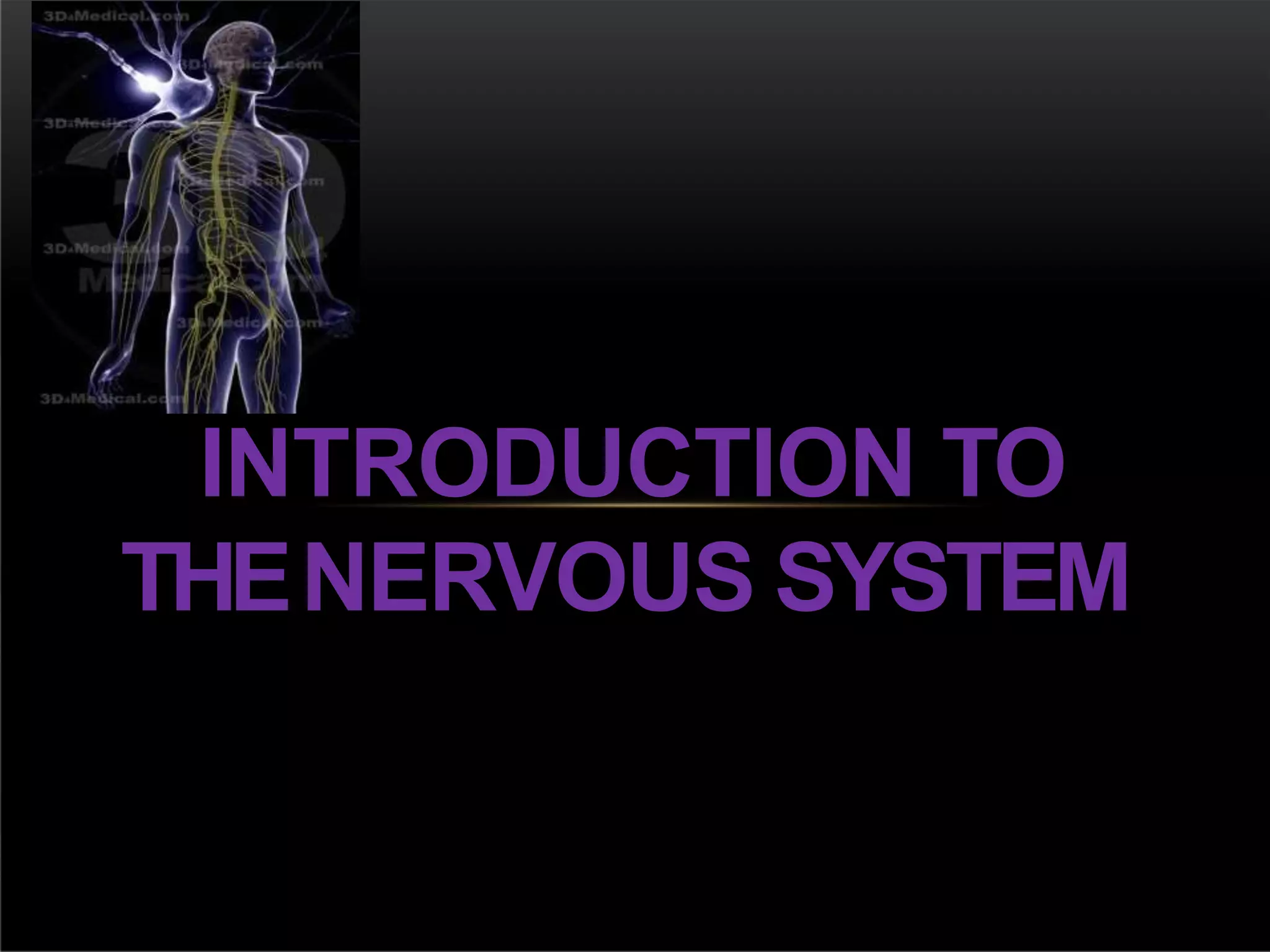
INTRODUCTION TO
THENERVOUS SYSTEM
LEARNING OBJECTIVES
The students should be able;
• Demonstrate an understanding towards the concept of major divisions of the
Nervous system.
• Enlist different components of the Central, Peripheral , & Autonomic Nervous
systems.
• Enlist the names of main cells in the Nervous tissue.
• Enlist different parts of the Brain.
• Understand the concept of General vs Special and Somatic vs Visceral.
• Define the terms Ganglion, White matter, & Grey Matter.
“The human nervous system is a control
system which regulates the body’s response to
internal & external stimuli”
It is composed of two components;
• Central
• Peripheral
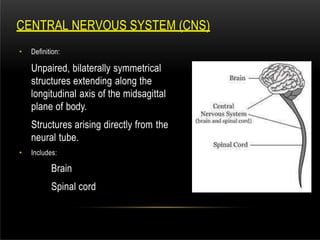
CENTRAL NERVOUS SYSTEM (CNS)
• Definition:
Unpaired, bilaterally symmetrical
structures extending along the
longitudinal axis of the midsagittal
plane of body.
Structures arising directly from the
neural tube.
• Includes:
Brain
Spinal cord
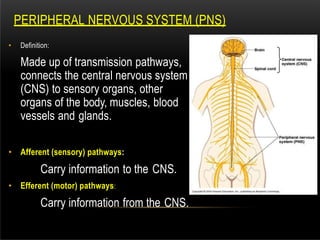
PERIPHERAL NERVOUS SYSTEM (PNS)
• Definition:
Made up of transmission pathways,
connects the central nervous system
(CNS) to sensory organs, other
organs of the body, muscles, blood
vessels and glands.
• Afferent (sensory) pathways:
Carry information to the CNS.
• Efferent (motor) pathways:
Carry information from the CNS.
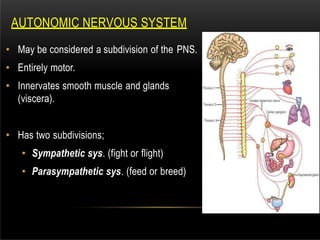
AUTONOMIC NERVOUS SYSTEM
• May be considered a subdivision of the PNS.
• Entirely motor.
• Innervates smooth muscle and glands
(viscera).
• Has two subdivisions;
• Sympathetic sys. (fight or flight)
• Parasympathetic sys. (feed or breed)
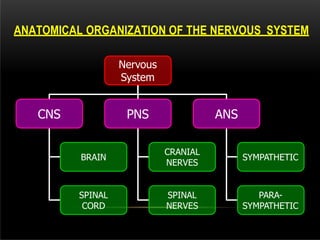
ANATOMICAL ORGANIZATION OF THE NERVOUS SYSTEM
Nervous
System
CNS PNS ANS
BRAIN
SPINAL
CORD
CRANIAL
NERVES
SPINAL
NERVES
SYMPATHETIC
PARA-
SYMPATHETIC
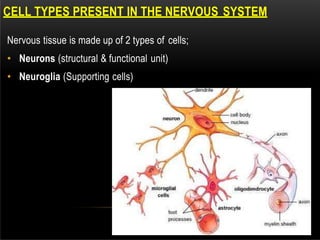
CELL TYPES PRESENT IN THE NERVOUS SYSTEM
Nervous tissue is made up of 2 types of cells;
• Neurons (structural & functional unit)
• Neuroglia (Supporting cells)
NEURONS
• The neurons are the main structural and functional unit of the
Nervous system making up the brain, spinal cord, and nerves.
• Human body contains about 200 billion neurons. Almost half of
them are located in the brain.
• They are held together & supported by another type of tissue,
Neuroglia= Nerve glue.
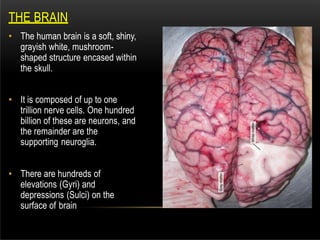
• The human brain is a soft, shiny,
grayish white, mushroom-
shaped structure encased within
the skull.
• It is composed of up to one
trillion nerve cells. One hundred
billion of these are neurons, and
the remainder are the
supporting neuroglia.
• There are hundreds of
elevations (Gyri) and
depressions (Sulci) on the
surface of brain
THE BRAIN
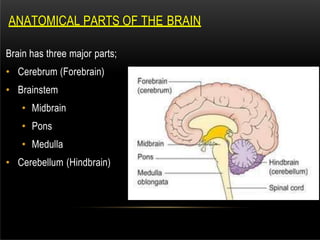
ANATOMICAL PARTS OF THE BRAIN
Brain has three major parts;
• Cerebrum (Forebrain)
• Brainstem
• Midbrain
• Pons
• Medulla
• Cerebellum (Hindbrain)
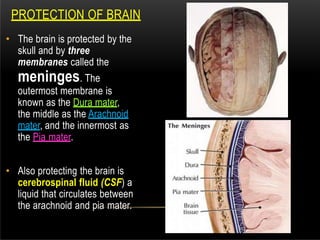
• The brain is protected by the
skull and by three
membranes called the
meninges. The
outermost membrane is
known as the Dura mater,
the middle as the Arachnoid
mater, and the innermost as
the Pia mater.
• Also protecting the brain is
cerebrospinal fluid (CSF) a
liquid that circulates between
the arachnoid and pia mater.
PROTECTION OF BRAIN
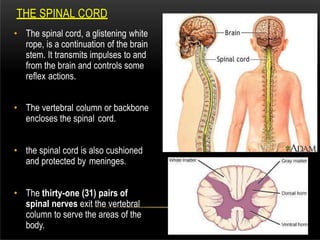
• The spinal cord, a glistening white
rope, is a continuation of the brain
stem. It transmits impulses to and
from the brain and controls some
reflex actions.
• The vertebral column or backbone
encloses the spinal cord.
• the spinal cord is also cushioned
and protected by meninges.
• The thirty-one (31) pairs of
spinal nerves exit the vertebral
column to serve the areas of the
body.
THE SPINAL CORD
GENERAL VS SPECIAL
• If a nervous element is found throughout the body is said to
be ‘general’
• A nervous element restricted to just one part of the body is
said to be ‘special.’
Examples:
• senses of pain, touch, temperature are present
everywhere. Their receptors are present throughout the
body (general)
• Sense of Vision, hearing, taste, smell can only be felt by
specific organs. Their receptors are present only in those
organs like eyes, ear, tongue, nose (special).
SOMATIC VS VISCERAL:
• Somatic nerves/ innervation are related to the body wall
(soma=body). Thus somatic innervation means the supply
to the skin, muscles, & joints.
• Visceral nerves/innervation are related to the organs
(viscera=organs). Thus visceral innervation means supply
to the organ system including glands.
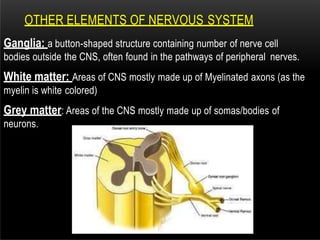
OTHER ELEMENTS OF NERVOUS SYSTEM
Ganglia: a button-shaped structure containing number of nerve cell
bodies outside the CNS, often found in the pathways of peripheral nerves.
White matter: Areas of CNS mostly made up of Myelinated axons (as the
myelin is white colored)
Grey matter: Areas of the CNS mostly made up of somas/bodies of
neurons.

overview of nervous system.pptx

  • 1.
  • 2.
    LEARNING OBJECTIVES The studentsshould be able; • Demonstrate an understanding towards the concept of major divisions of the Nervous system. • Enlist different components of the Central, Peripheral , & Autonomic Nervous systems. • Enlist the names of main cells in the Nervous tissue. • Enlist different parts of the Brain. • Understand the concept of General vs Special and Somatic vs Visceral. • Define the terms Ganglion, White matter, & Grey Matter.
  • 3.
    “The human nervoussystem is a control system which regulates the body’s response to internal & external stimuli” It is composed of two components; • Central • Peripheral
  • 4.
    CENTRAL NERVOUS SYSTEM(CNS) • Definition: Unpaired, bilaterally symmetrical structures extending along the longitudinal axis of the midsagittal plane of body. Structures arising directly from the neural tube. • Includes: Brain Spinal cord
  • 5.
    PERIPHERAL NERVOUS SYSTEM(PNS) • Definition: Made up of transmission pathways, connects the central nervous system (CNS) to sensory organs, other organs of the body, muscles, blood vessels and glands. • Afferent (sensory) pathways: Carry information to the CNS. • Efferent (motor) pathways: Carry information from the CNS.
  • 6.
    AUTONOMIC NERVOUS SYSTEM •May be considered a subdivision of the PNS. • Entirely motor. • Innervates smooth muscle and glands (viscera). • Has two subdivisions; • Sympathetic sys. (fight or flight) • Parasympathetic sys. (feed or breed)
  • 7.
    ANATOMICAL ORGANIZATION OFTHE NERVOUS SYSTEM Nervous System CNS PNS ANS BRAIN SPINAL CORD CRANIAL NERVES SPINAL NERVES SYMPATHETIC PARA- SYMPATHETIC
  • 8.
    CELL TYPES PRESENTIN THE NERVOUS SYSTEM Nervous tissue is made up of 2 types of cells; • Neurons (structural & functional unit) • Neuroglia (Supporting cells)
  • 9.
    NEURONS • The neuronsare the main structural and functional unit of the Nervous system making up the brain, spinal cord, and nerves. • Human body contains about 200 billion neurons. Almost half of them are located in the brain. • They are held together & supported by another type of tissue, Neuroglia= Nerve glue.
  • 10.
    • The humanbrain is a soft, shiny, grayish white, mushroom- shaped structure encased within the skull. • It is composed of up to one trillion nerve cells. One hundred billion of these are neurons, and the remainder are the supporting neuroglia. • There are hundreds of elevations (Gyri) and depressions (Sulci) on the surface of brain THE BRAIN
  • 11.
    ANATOMICAL PARTS OFTHE BRAIN Brain has three major parts; • Cerebrum (Forebrain) • Brainstem • Midbrain • Pons • Medulla • Cerebellum (Hindbrain)
  • 12.
    • The brainis protected by the skull and by three membranes called the meninges. The outermost membrane is known as the Dura mater, the middle as the Arachnoid mater, and the innermost as the Pia mater. • Also protecting the brain is cerebrospinal fluid (CSF) a liquid that circulates between the arachnoid and pia mater. PROTECTION OF BRAIN
  • 13.
    • The spinalcord, a glistening white rope, is a continuation of the brain stem. It transmits impulses to and from the brain and controls some reflex actions. • The vertebral column or backbone encloses the spinal cord. • the spinal cord is also cushioned and protected by meninges. • The thirty-one (31) pairs of spinal nerves exit the vertebral column to serve the areas of the body. THE SPINAL CORD
  • 14.
    GENERAL VS SPECIAL •If a nervous element is found throughout the body is said to be ‘general’ • A nervous element restricted to just one part of the body is said to be ‘special.’ Examples: • senses of pain, touch, temperature are present everywhere. Their receptors are present throughout the body (general) • Sense of Vision, hearing, taste, smell can only be felt by specific organs. Their receptors are present only in those organs like eyes, ear, tongue, nose (special).
  • 15.
    SOMATIC VS VISCERAL: •Somatic nerves/ innervation are related to the body wall (soma=body). Thus somatic innervation means the supply to the skin, muscles, & joints. • Visceral nerves/innervation are related to the organs (viscera=organs). Thus visceral innervation means supply to the organ system including glands.
  • 16.
    OTHER ELEMENTS OFNERVOUS SYSTEM Ganglia: a button-shaped structure containing number of nerve cell bodies outside the CNS, often found in the pathways of peripheral nerves. White matter: Areas of CNS mostly made up of Myelinated axons (as the myelin is white colored) Grey matter: Areas of the CNS mostly made up of somas/bodies of neurons.