DISEASES OF SUNFLOWER
-Helianthus annuus
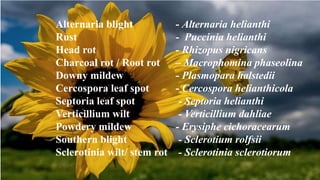
Alternaria blight - Alternaria helianthi
Rust - Puccinia helianthi
Head rot - Rhizopus nigricans
Charcoal rot / Root rot – Macrophomina phaseolina
Downy mildew - Plasmopara halstedii
Cercospora leaf spot - Cercospora helianthicola
Septoria leaf spot - Septoria helianthi
Verticillium wilt - Verticillium dahliae
Powdery mildew - Erysiphe cichoracearum
Southern blight - Sclerotium rolfsii
Sclerotinia wilt/ stem rot - Sclerotinia sclerotiorum
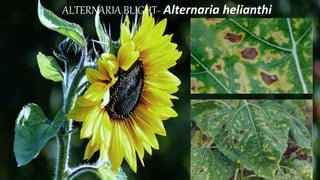
ALTERNARIA BLIGHT- Alternaria helianthi
symptoms :
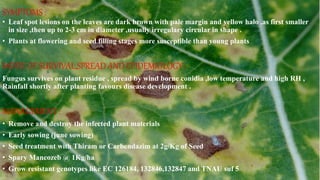
• Leaf spot lesions on the leaves are dark brown with pale margin and yellow halo ,as first smaller
in size ,then up to 2-3 cm in diameter ,usually irregulary circular in shape .
• Plants at flowering and seed filling stages more susceptible than young plants
MODE OF SURVIVAL,SPREAD AND EPIDEMIOLOGY :
Fungus survives on plant residue , spread by wind borne conidia ,low temperature and high RH ,
Rainfall shortly after planting favours disease development .
MANAGEMENT :
• Remove and destroy the infected plant materials
• Early sowing (june sowing)
• Seed treatment with Thiram or Carbendazim at 2g/Kg of Seed
• Spary Mancozeb @ 1Kg/ha
• Grow resistant genotypes like EC 126184, 132846,132847 and TNAU suf 5
SYMPTOMS :
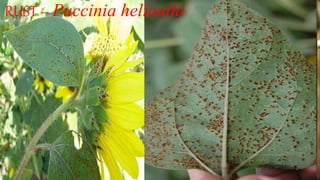
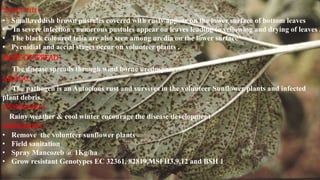
RUST – Puccinia helianthi
Symptoms :
• Small,reddish brown pustules covered with rusty appear on the lower surface of bottom leaves
• In severe infection , numerous pustules appear on leaves leading to yellowing and drying of leaves .
• The black coloured telia are also seen among uredia on the lower surface
• Pycnidial and aecial stages occur on volunteer plants .
MODE OF SPREAD:
The disease spreads through wind borne uredospores
SURVIVAL:
The pathogen is an Autocious rust and survives in the volunteer Sunflower plants and infected
plant debris.
EPIDEMIOLOGY:
Rainy weather & cool winter encourage the disease development
MANAGEMENT:
• Remove the volunteer sunflower plants
• Field sanitation
• Spray Mancozeb @ 1Kg/ha
• Grow resistant Genotypes EC 32361, 82819,MSFH3,9,12 and BSH 1
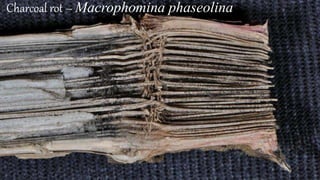
Charcoal rot – Macrophomina phaseolina
Symptoms :
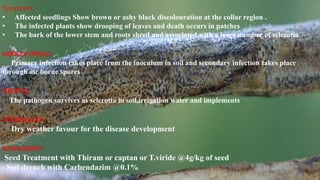
• Affected seedlings Show brown or ashy black discolouration at the collar region .
• The infected plants show drooping of leaves and death occurs in patches
• The bark of the lower stem and roots shred and associated with a large number of sclerotia
MODEOF SPREAD:
Primary infection takes place from the inoculum in soil and secondary infection takes place
through air borne spores
SURVIVAL:
The pathogen survives as sclerotia in soil,irrigation water and implements
EPIDEMIOLOGY:
Dry weather favour for the disease development
MANAGEMENT:
Seed Treatment with Thiram or captan or T.viride @4g/kg of seed
Soil drench with Carbendazim @0.1%
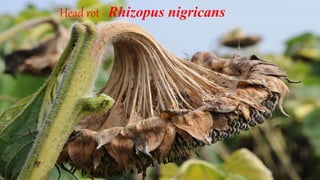
Head rot - Rhizopus nigricans
Symptoms
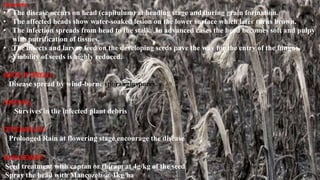
• The disease occurs on head (capitulum) at heading stage and during grain formation.
• The affected heads show water-soaked lesion on the lower surface which later turns brown.
• The infection spreads from head to the stalk. In advanced cases the head becomes soft and pulpy
with putrification of tissues.
• The insects and larvae feed on the developing seeds pave the way for the entry of the fungus.
Viability of seeds is highly reduced.
MODEOF SPREAD:
Disease spread by wind-borne sporangiospores.
SURVIVAL:
Survives in the infected plant debris
EPIDEMIOLOGY:
Prolonged Rain at flowering stage encourage the disease
MANAGEMENT:
Seed treatment with captan or thiram at 4g/kg of the seed
Spray the head with Mancozeb @ 1kg/ha
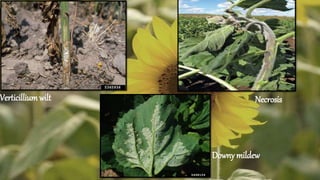
Verticilliumwilt Necrosis
Downy mildew
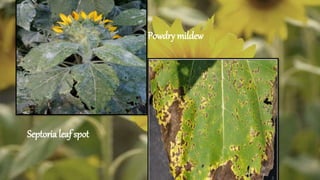
Powdry mildew
Septoria leaf spot
Presented by
K.VIGNESH ,M.Sc(Ag),DCA,DABM,DOLG.,
THANK YOU …

Sunflower diseases

  • 1.
  • 2.
    Alternaria blight -Alternaria helianthi Rust - Puccinia helianthi Head rot - Rhizopus nigricans Charcoal rot / Root rot – Macrophomina phaseolina Downy mildew - Plasmopara halstedii Cercospora leaf spot - Cercospora helianthicola Septoria leaf spot - Septoria helianthi Verticillium wilt - Verticillium dahliae Powdery mildew - Erysiphe cichoracearum Southern blight - Sclerotium rolfsii Sclerotinia wilt/ stem rot - Sclerotinia sclerotiorum
  • 3.
  • 4.
    symptoms : • Leafspot lesions on the leaves are dark brown with pale margin and yellow halo ,as first smaller in size ,then up to 2-3 cm in diameter ,usually irregulary circular in shape . • Plants at flowering and seed filling stages more susceptible than young plants MODE OF SURVIVAL,SPREAD AND EPIDEMIOLOGY : Fungus survives on plant residue , spread by wind borne conidia ,low temperature and high RH , Rainfall shortly after planting favours disease development . MANAGEMENT : • Remove and destroy the infected plant materials • Early sowing (june sowing) • Seed treatment with Thiram or Carbendazim at 2g/Kg of Seed • Spary Mancozeb @ 1Kg/ha • Grow resistant genotypes like EC 126184, 132846,132847 and TNAU suf 5 SYMPTOMS :
  • 5.
  • 6.
    Symptoms : • Small,reddishbrown pustules covered with rusty appear on the lower surface of bottom leaves • In severe infection , numerous pustules appear on leaves leading to yellowing and drying of leaves . • The black coloured telia are also seen among uredia on the lower surface • Pycnidial and aecial stages occur on volunteer plants . MODE OF SPREAD: The disease spreads through wind borne uredospores SURVIVAL: The pathogen is an Autocious rust and survives in the volunteer Sunflower plants and infected plant debris. EPIDEMIOLOGY: Rainy weather & cool winter encourage the disease development MANAGEMENT: • Remove the volunteer sunflower plants • Field sanitation • Spray Mancozeb @ 1Kg/ha • Grow resistant Genotypes EC 32361, 82819,MSFH3,9,12 and BSH 1
  • 7.
    Charcoal rot –Macrophomina phaseolina
  • 8.
    Symptoms : • Affectedseedlings Show brown or ashy black discolouration at the collar region . • The infected plants show drooping of leaves and death occurs in patches • The bark of the lower stem and roots shred and associated with a large number of sclerotia MODEOF SPREAD: Primary infection takes place from the inoculum in soil and secondary infection takes place through air borne spores SURVIVAL: The pathogen survives as sclerotia in soil,irrigation water and implements EPIDEMIOLOGY: Dry weather favour for the disease development MANAGEMENT: Seed Treatment with Thiram or captan or T.viride @4g/kg of seed Soil drench with Carbendazim @0.1%
  • 9.
    Head rot -Rhizopus nigricans
  • 10.
    Symptoms • The diseaseoccurs on head (capitulum) at heading stage and during grain formation. • The affected heads show water-soaked lesion on the lower surface which later turns brown. • The infection spreads from head to the stalk. In advanced cases the head becomes soft and pulpy with putrification of tissues. • The insects and larvae feed on the developing seeds pave the way for the entry of the fungus. Viability of seeds is highly reduced. MODEOF SPREAD: Disease spread by wind-borne sporangiospores. SURVIVAL: Survives in the infected plant debris EPIDEMIOLOGY: Prolonged Rain at flowering stage encourage the disease MANAGEMENT: Seed treatment with captan or thiram at 4g/kg of the seed Spray the head with Mancozeb @ 1kg/ha
  • 11.
  • 12.
  • 13.