PROXIMAL HUMERUS FRACTURE
AND
ITS MANAGEMENT
DR.VIGNESHWAR A
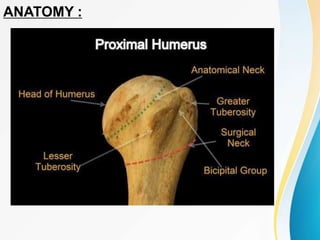
ANATOMY :
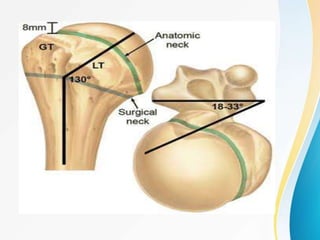
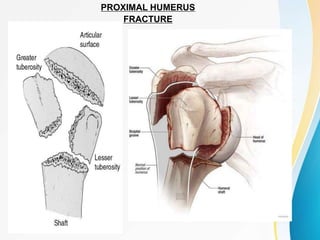
• Proximal humerus comprises of four
major segments
• The Articular head
• The greater tuberosity
• Lesser tuberosity and
• The shaft
• Articular segment almost spherical, with a
diameter of curvature averaging 46 mm
(ranging from 37 to 57 mm)
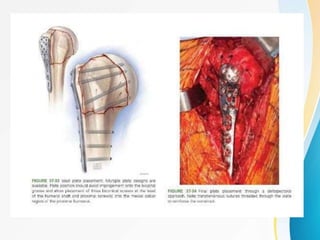
• Humeral head shaft angle : 130 degrees
• Retroversion of the head : 18 to 40 deg
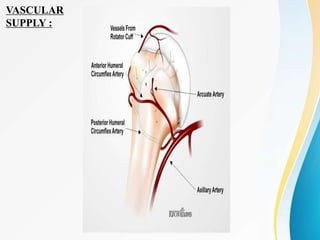
VASCULAR
SUPPLY :
• The ascending branch of the anterior
circumflex humeral artery has been considered
to provide most of the blood flow to the articular
segment.
• Several studies have shown branches from
PCHA to the posteromedial head to be equally
important.
• Arcuate artery of Liang – supplies Humeral
head.
• If the medial calcar of the humerus is spared
by the fracture, the vessel is spared.
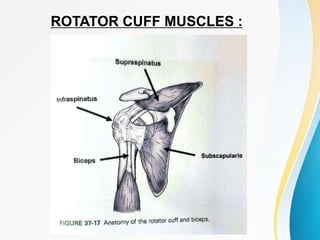
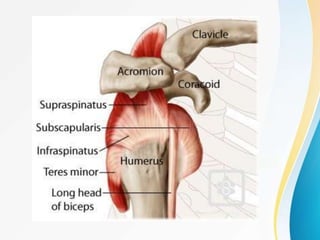
ROTATOR CUFF MUSCLES :
• Muscle insertions on these segments and the
magnitude and direction of the forces causing
injury determine the pattern of fracture lines
,displacement and angulation.
• Greater tuberosity : supraspinatus,
infraspinatus & teres minor insertion.
• Lesser tuberosity : Subscapularis muscle
insertion.
LT separated from the GT by BICIPITAL
GROOVE
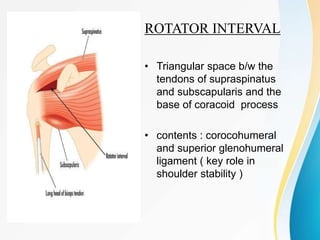
ROTATOR INTERVAL
• Triangular space b/w the
tendons of supraspinatus
and subscapularis and the
base of coracoid process
• contents : corocohumeral
and superior glenohumeral
ligament ( key role in
shoulder stability )
PROXIMAL
HUMERUS
FRACTURES
PROXIMAL HUMERUS
FRACTURE
• Defined as Fx occurring at or proximal to
surgical neck of humerus.
• 80 % of all humeral # and 7% of all #..
• Pt > 65 yrs – Second most common
fracture of the upper extremity
• 65% of # occur in Pt’s > 60 yrs
• F:M – 3:1
• Incidence increases with age.
Mechanism :
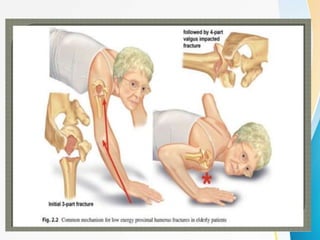
• Old Pts low energy trauma. [FOOSH]
• Young Pts – High energy trauma
• Most # are nondisplaced, good prognosis –
nonsurgical
• Risk factors: osteoporotic bone ,impaired
vision & balance, medical comorbidities,
decreased muscle tone and Seizures &
electric shock (indirect causes)
• Severe soft tissue disruption always
require surgical intervention
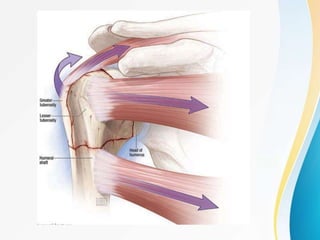
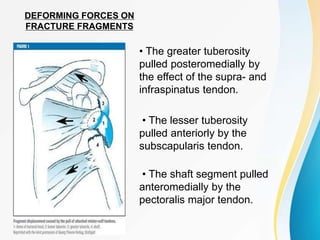
DEFORMING FORCES ON
FRACTURE FRAGMENTS
• The greater tuberosity
pulled posteromedially by
the effect of the supra- and
infraspinatus tendon.
• The lesser tuberosity
pulled anteriorly by the
subscapularis tendon.
• The shaft segment pulled
anteromedially by the
pectoralis major tendon.
Clinical Evaluation :
• A complete history and physical
examination must be obtained about the
mechanism of injury and velocity of
fracture.
• Shoulder pain and limitation of
movement.
• Ecchymosis appears within 24-48 hrs.
• Look for rib, scapular, cervical # in high
energy trauma.
• Concurrent brachial plexus injury 5%
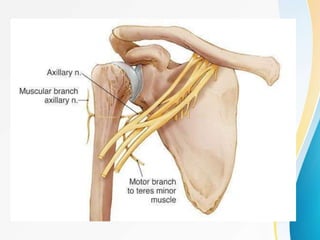
• Axillary nerve susceptible in anterior #
dislocation.
• Association of arterial injury rare.
• The patient will hold the arm in internal
rotation.
• Radial pulse and capillary refill of fingers
should be assessed
Imaging and other Diagnostic studies :
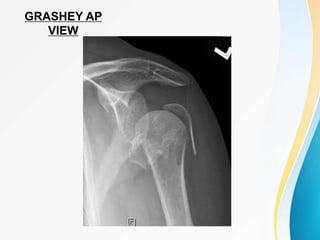
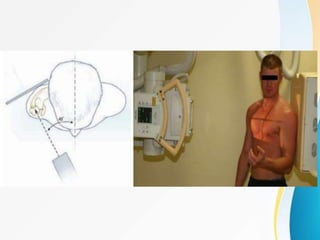
• Radiographs :- consist of three views :
• AP- Perpendicular to the plane of scapula(Grashey view)
Taken in neutral arm rotation with torso rotated 30 to 45
degrees
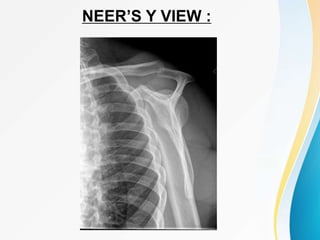
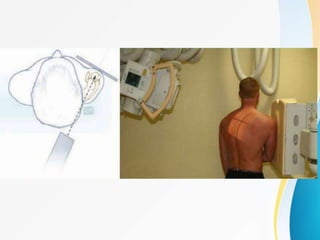
• Neer view : Scapula imaged perpendicular to Grashey view
(scapular y view )
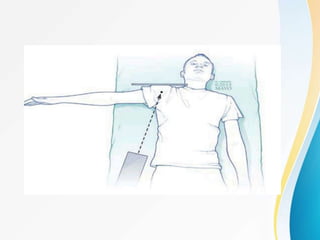
• Axillary view : Arm in neutral rotation and abducted as much
as possible, with the pt. supine and X-ray beam projected
from axilla.
GRASHEY AP
VIEW
NEER’S Y VIEW :
SCAPULAR Y VIEW
• In acute trauma to evaluate for anterior and
posterior dislocations
• Fractures of coracoid process, scapula, acromion
process,proximal humeral shaft.
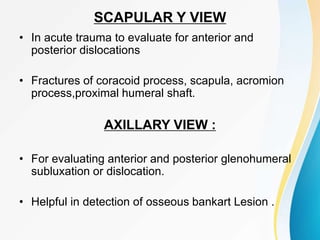
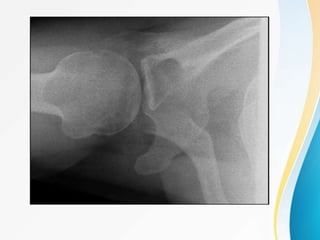
AXILLARY VIEW :
• For evaluating anterior and posterior glenohumeral
subluxation or dislocation.
• Helpful in detection of osseous bankart Lesion .
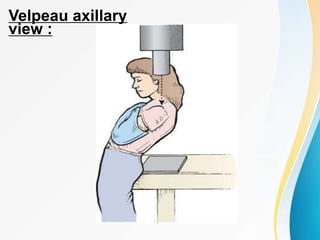
Velpeau axillary
view :
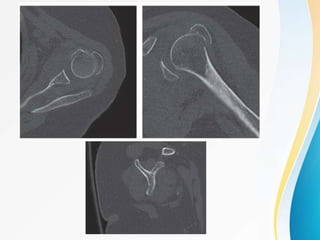
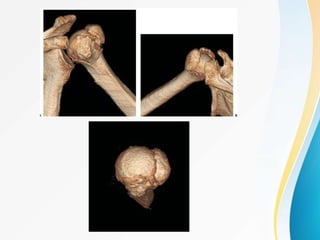
CT Scan :
Allows more detailed understanding of fracture
configuration, degree of osteopenia, presence and location
of bone impaction and extent of fracture comminution.
• MRI - Is rarely indicated in trauma setting.
• Angiography : Vascular imaging is required when there is
suspicion of vascular injury.
• CT Angiography- Diagnostic modality of choice.
It allows rapid evaluation of vascular system, while
simultaneously allowing assessment of bone and soft
tissues.
Proximal Humeral Fracture
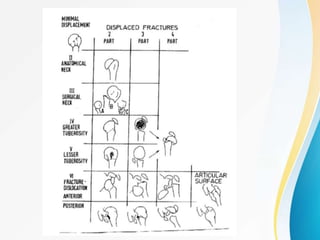
Classfication- Neer’S Classification
(1970)
• REFINEMENT OFCODMAN’S SYSTEM.
• BASED ON ANATOMICAL,BIOMECHANICAL AND
DEGREE OF DISPLACEMENT .
• TWO MAIN COMPONENTS :
1.number of fracture parts { humeral
head,GT,LT,shaft }
2.displacement { angulation > 45 deg or
displacement>1 cm }
• Classified as One part, Two part, Three Part and Four
part Fractures.
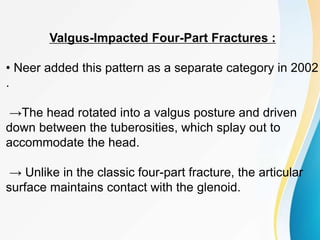
Valgus-Impacted Four-Part Fractures :
• Neer added this pattern as a separate category in 2002
.
→The head rotated into a valgus posture and driven
down between the tuberosities, which splay out to
accommodate the head.
→ Unlike in the classic four-part fracture, the articular
surface maintains contact with the glenoid.
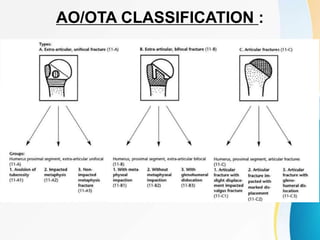
AO/OTA CLASSIFICATION :
• Fracture Dislocation :
Fractures combined with glenohumeral
dislocation are classified as fracture dislocation.
• Articular surface injuries :
Fractures involving articular surface can be of
two varieties-
1. head-splitting fractures
2. impaction fractures.
They are included in group of fracture dislocations.
Risk of Avascular Necrosis
Highest risk for humeral head ischaemia & necrosis :
1.Four-part fractures
2.Fracture dislocations
Hertel’s criteria
1. Metaphyseal extension of the humeral head > 9
mm
2. Medial hinge disruption of >2 mm, and
3. Fracture through anatomical neck .
• The combination of above factors had 97% positive
predictive value for humeral head ischemia.
MANAGEMENT :
NON-OPERATIVE TREATMENT FOR
1.undisplaced or minimally displaced.
2.stable fractures.
3.elderly patients
4.patient unfit for surgery
5.four part valgus impacted fracture
6.poor bone quality.
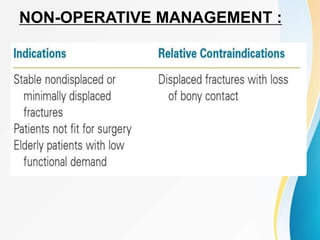
NON-OPERATIVE MANAGEMENT :
CONSERVATIVE MANAGEMENT :
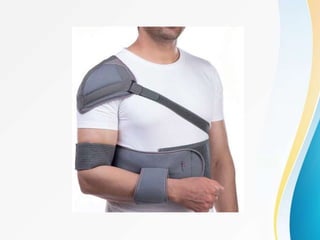
• Shoulder immobilised for 4 to 6 weeks .
• Using cuff and collar ,Gilchrist or Velpeau
shoulder immobilizer .
• Regular follow up with radiographs
• Codman pendulum exercises
Passive ROM at 3 weeks
Active ROM at 6 weeks
Strengthening exercises at 12 weeks
according to radiographic and clinical healing
.
FUNCTIONAL OUTCOME SCALES :
• DASH
• Constant-Murley scale
• ASES scale
• Neer Criteria
• UCLA shoulder scale
• OSS
• SST
• SPADI
DASH
• Disabilities of the Arm, shoulder, and Hand
scale [ DASH ]
• Most widely used shoulder scale for
outcome assessment .
• Pt based , 6 domains {Daily activity ,
symptoms ,social Fn,Work Fn ,sleep,
confidence}.
• 30 questions and each question rated on a
likert scale 1 to 5 .
• Quick DASH - 11 questions
• DISPLACED 2-PART , 3 PART , 4 PART
- Closed reduction with percutaneous k-
wire fixation
- Proximal humerus locking
plate(phlp/philos)
- Tension band wiring
- Hemiarthroplasty
- Reverse total shoulder arthroplasty
FIXATION OF PHF USING PHILOS(3 PART
AND 4 PART)
-Principles of fixation
-Approaches
-Exposures
-Surgical steps
-Intraop image intensifier(c-arm)
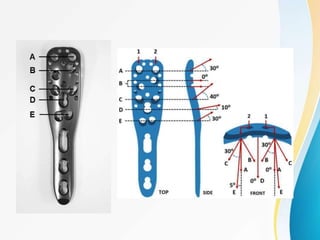
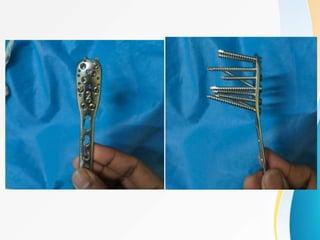
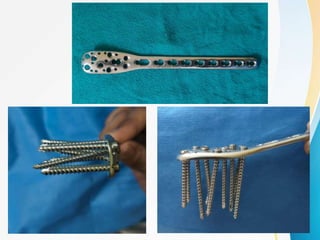
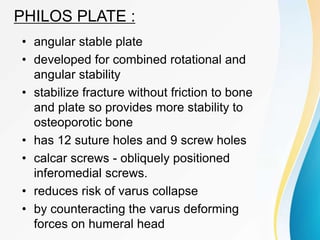
PHILOS PLATE :
• angular stable plate
• developed for combined rotational and
angular stability
• stabilize fracture without friction to bone
and plate so provides more stability to
osteoporotic bone
• has 12 suture holes and 9 screw holes
• calcar screws - obliquely positioned
inferomedial screws.
• reduces risk of varus collapse
• by counteracting the varus deforming
forces on humeral head
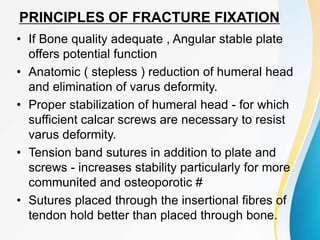
PRINCIPLES OF FRACTURE FIXATION
• If Bone quality adequate , Angular stable plate
offers potential function
• Anatomic ( stepless ) reduction of humeral head
and elimination of varus deformity.
• Proper stabilization of humeral head - for which
sufficient calcar screws are necessary to resist
varus deformity.
• Tension band sutures in addition to plate and
screws - increases stability particularly for more
communited and osteoporotic #
• Sutures placed through the insertional fibres of
tendon hold better than placed through bone.
APPROACHES :
• Deltopectoral approach (or) anterior approach .
• Anterolateral/acromial or deltoid splitting
approach.
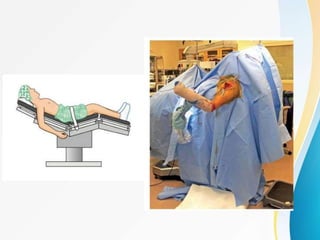
POSITIONS :
1.Beach-chair position - hip at 45 deg and knee 30
deg bent.
2.Supine position in radiolucent table.
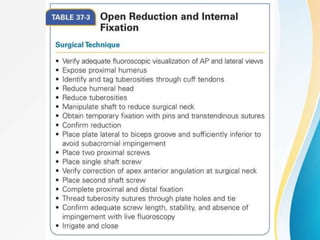
SURGICAL TECHNIQUES FOR ORIF OF
AN UNSTABLE DISPLACED 3 PART PHF
• for succesful reduction – 3 part converted to 2 part at the humeral
head i.e humeral articular part with the attached lt and gt
into 1 part with the shaft
4 steps
• surgical approach and axillary nerve identification
• long head of biceps tendon,rotator cuff suture and humeral head
assesment
• reduction with temporary k wire fixation and fluoroscopc assesment
• final fixation and suturing of rotator cuff to plate.
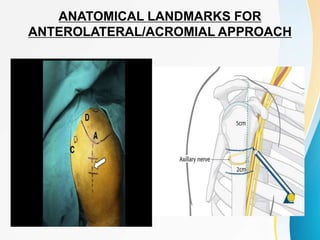
ANATOMICAL LANDMARKS FOR
ANTEROLATERAL/ACROMIAL APPROACH
STEP 1
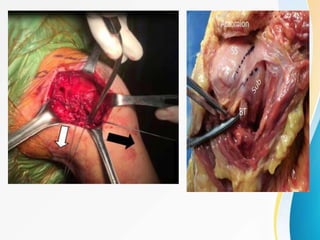
• supero lateral approach choosen
• provides greater access to gt , requires minimal soft
tissue dissection
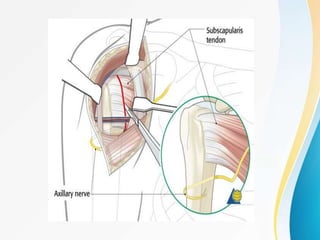
• at first the deltoid is split between the anterior and
middle fibres in line with the skin incicsion
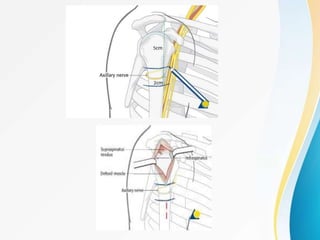
• axillary nerve lies in the deep layer of the deltoid
located 5cm below the acromian process
• to avoid the injury nerve is identified and looped
with umbilical tape.
STEP 2
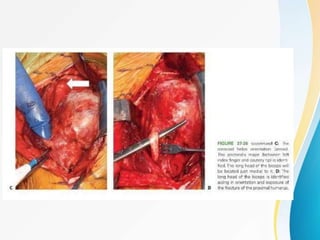
• Long head of biceps tendon is identified at the
bicipital groove .
• no 2 ethibond placed at Lt and GT to mobilise the
# fragments which assist with the reduction
• suture at Lt pulled laterally to correct retroversion
of the humeral head
• suture at Gt pulled into downward direction to
correct varus deformity
• subscapularis tendon attached to Lt should be
carefully protected to avoid avn of articular part.
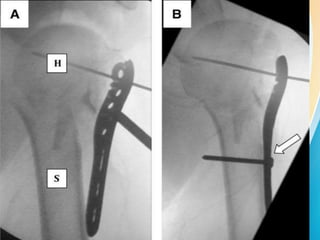
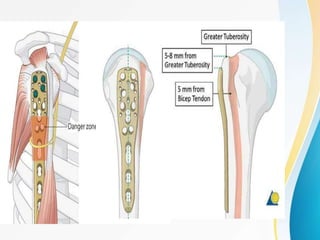
STEP 3
• the plate is placed 5mm lateral to the bicipital
groove
• 5-8mm below the tip of GT.
• k wire is used for temporary fixation of the
reduced 2 part # of the head with the aid of suture
traction
• a simple compression screw is placed at the oval
hole of the plate.
• plate is used to assist in reduction of the head and
shaft part
STEP 4
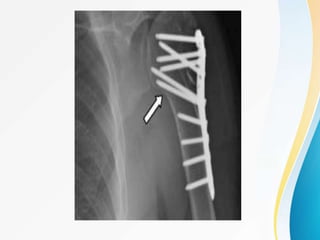
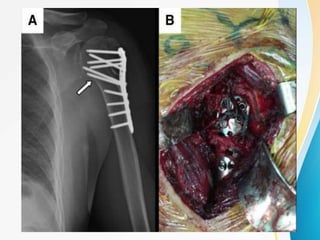
• once the reduction is confirmed remaining
screws are placed at the head and shaft.
• calcar screws are placed supporting the reduced
calcar area.
• sutures attached to the rotator cuff are secured
to the plate holes.
ADVANTAGES
• superolateral approach
gives greater access to
the # and gives minimal
dissection
• rotator cuff suturing
provides # segments
mobilisation
• articular frgament checked
by gloved index finger
• intra op flouroscopic
performed in refernce to
the phlp position rather
than patients position .
DISADVANTAGES
• not a true internervous
approach
• axillary nerve is at more
risk for injury
• cannot be used in 4 part
#(articular fragmnet lacks
control),impacted #s
because of bone loss.
• Anterior deltoid
dysfunction.
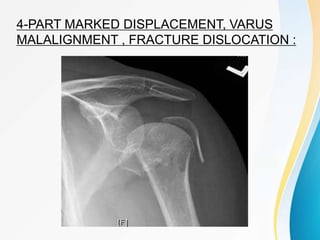
4-PART MARKED DISPLACEMENT, VARUS
MALALIGNMENT , FRACTURE DISLOCATION :
4 STEPS
• Incision through deltopectoral approach
• Reduction and preliminary fixation
• Plate fixation
• Rotator cuff tendon suturing to the plate .
STEP 1 :
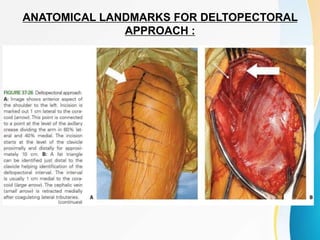
• Incision given from coracoid and extended
through deltopectoral groove
• Fascia cut
• Deltoid along retracted laterally pectoralis major
towards medially
• Coracobrachialis retracted to visualize
subscapular tendon
ANATOMICAL LANDMARKS FOR DELTOPECTORAL
APPROACH :
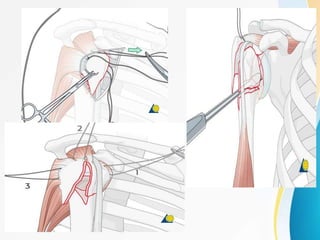
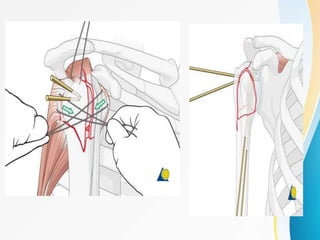
STEP 2 :
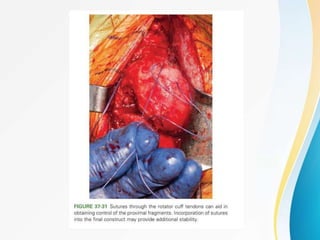
• Place rotator cuff sutures
• supraspinatus ,infraspinatus and subscapularis
• pull them and head split reduced using periostome
• preliminary k-wires are inserted into head through
gt
• shaft of humerus is fixed to the head using k-wires
placed anteriorly
• temporary reduction achieved
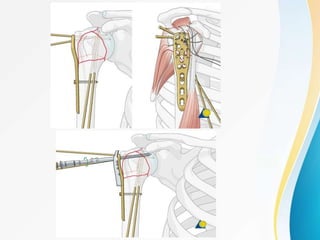
STEP 3 :
• Attach plate to humeral shaft
• and fix the plate by passing a compression screw on the
shaft
• now make drill holes through drill sleeves into the humeral
head
• drill the near cortex only ,woodpecker drilling technique
• minimum of 5 screws placed
• check screw size under c-arm
• calcar screws are essential in all varus displaced fractures
STEP 4 :
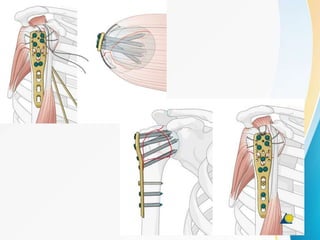
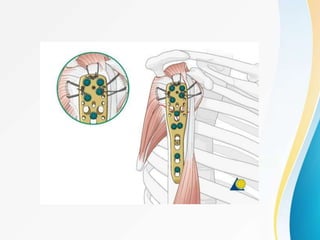
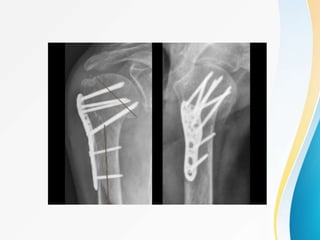
• if needed , a lag screw can be inserted into
lesser tuberosity .
• additional shaft screws are inserted (bicortical
screws)
• Rotator cuff tendon sutures are placed through
the suture holes and secured { ↑ stability }
INTRA OPERATIVE IMAGE
INTENSIFIER(C-ARM)
2 views
1) plate view :-
• arm is placed on an internally rotated position
• allows us to see the full profile of the plate
• plate should lie opposite and be centered over
the humeral head-should have light bulb
appearance.
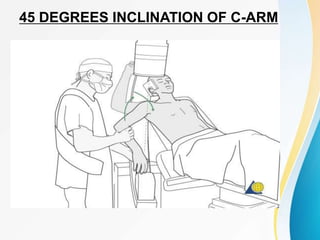
45 DEGREES INCLINATION OF C-ARM
2) screw view :-
• it is the position in which articular surface
maximally purchased to the glenoid.
• arm is externally roatated to approximately
20-30degrees
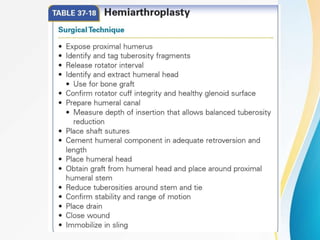
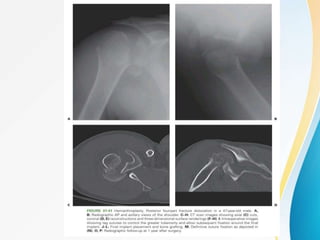
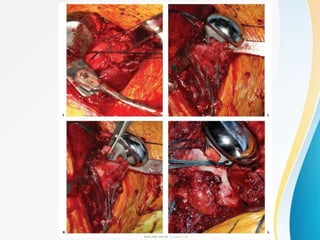
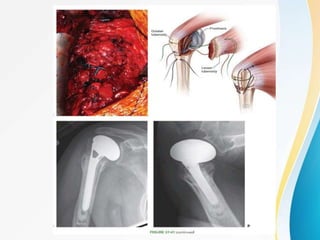
HEMIARTHROPLASTY :
• Also known as Humeral Head Replacement .
• Indications :
1. unreconstructable humeral head
- comminuted head splitting #
- Head depression # involving >40 articular surface
2. biologic viability severely compromised .
• Hertel → # at anatomic neck of humerus had
increased risk of humeral head ischaemia .
• Glenoid erosion → delayed shoulder pain
REVERSE TOTAL SHOULDER
ARTHROPLASTY :
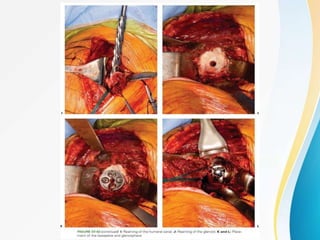
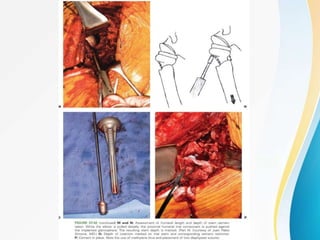
• Reverse total shoulder arthroplasty - Implant of
choice for the management of several conditions
significant rotator cuff dysfunction
rotator cuff tear arthropathy
massive irreparable rotator cuff tears with
painful pseudoparesis
Glenohumeral joint artritis with advanced
rotator cuff pathology .
Proximal humerus malunion / nonunion
• Alternative for management of acute complex
proximal humerus fractures .
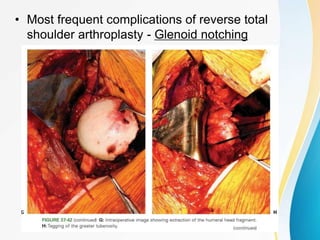
• Most frequent complications of reverse total
shoulder arthroplasty - Glenoid notching
THANK YOU !

1PROXIMAL_HUMERUS_FRACTURES_SURGICAL_MANAGEMENT_PHILOS_PLATING_FINAL.pptx

  • 1.
    PROXIMAL HUMERUS FRACTURE AND ITSMANAGEMENT DR.VIGNESHWAR A
  • 2.
  • 3.
    • Proximal humeruscomprises of four major segments • The Articular head • The greater tuberosity • Lesser tuberosity and • The shaft • Articular segment almost spherical, with a diameter of curvature averaging 46 mm (ranging from 37 to 57 mm) • Humeral head shaft angle : 130 degrees • Retroversion of the head : 18 to 40 deg
  • 5.
  • 6.
    • The ascendingbranch of the anterior circumflex humeral artery has been considered to provide most of the blood flow to the articular segment. • Several studies have shown branches from PCHA to the posteromedial head to be equally important. • Arcuate artery of Liang – supplies Humeral head. • If the medial calcar of the humerus is spared by the fracture, the vessel is spared.
  • 8.
  • 10.
    • Muscle insertionson these segments and the magnitude and direction of the forces causing injury determine the pattern of fracture lines ,displacement and angulation. • Greater tuberosity : supraspinatus, infraspinatus & teres minor insertion. • Lesser tuberosity : Subscapularis muscle insertion. LT separated from the GT by BICIPITAL GROOVE
  • 11.
    ROTATOR INTERVAL • Triangularspace b/w the tendons of supraspinatus and subscapularis and the base of coracoid process • contents : corocohumeral and superior glenohumeral ligament ( key role in shoulder stability )
  • 12.
  • 13.
    • Defined asFx occurring at or proximal to surgical neck of humerus. • 80 % of all humeral # and 7% of all #.. • Pt > 65 yrs – Second most common fracture of the upper extremity • 65% of # occur in Pt’s > 60 yrs • F:M – 3:1 • Incidence increases with age.
  • 14.
    Mechanism : • OldPts low energy trauma. [FOOSH] • Young Pts – High energy trauma • Most # are nondisplaced, good prognosis – nonsurgical • Risk factors: osteoporotic bone ,impaired vision & balance, medical comorbidities, decreased muscle tone and Seizures & electric shock (indirect causes) • Severe soft tissue disruption always require surgical intervention
  • 17.
    DEFORMING FORCES ON FRACTUREFRAGMENTS • The greater tuberosity pulled posteromedially by the effect of the supra- and infraspinatus tendon. • The lesser tuberosity pulled anteriorly by the subscapularis tendon. • The shaft segment pulled anteromedially by the pectoralis major tendon.
  • 18.
    Clinical Evaluation : •A complete history and physical examination must be obtained about the mechanism of injury and velocity of fracture. • Shoulder pain and limitation of movement. • Ecchymosis appears within 24-48 hrs. • Look for rib, scapular, cervical # in high energy trauma.
  • 19.
    • Concurrent brachialplexus injury 5% • Axillary nerve susceptible in anterior # dislocation. • Association of arterial injury rare. • The patient will hold the arm in internal rotation. • Radial pulse and capillary refill of fingers should be assessed
  • 20.
    Imaging and otherDiagnostic studies : • Radiographs :- consist of three views : • AP- Perpendicular to the plane of scapula(Grashey view) Taken in neutral arm rotation with torso rotated 30 to 45 degrees • Neer view : Scapula imaged perpendicular to Grashey view (scapular y view ) • Axillary view : Arm in neutral rotation and abducted as much as possible, with the pt. supine and X-ray beam projected from axilla.
  • 21.
  • 23.
  • 25.
    SCAPULAR Y VIEW •In acute trauma to evaluate for anterior and posterior dislocations • Fractures of coracoid process, scapula, acromion process,proximal humeral shaft. AXILLARY VIEW : • For evaluating anterior and posterior glenohumeral subluxation or dislocation. • Helpful in detection of osseous bankart Lesion .
  • 28.
  • 29.
    CT Scan : Allowsmore detailed understanding of fracture configuration, degree of osteopenia, presence and location of bone impaction and extent of fracture comminution. • MRI - Is rarely indicated in trauma setting. • Angiography : Vascular imaging is required when there is suspicion of vascular injury. • CT Angiography- Diagnostic modality of choice. It allows rapid evaluation of vascular system, while simultaneously allowing assessment of bone and soft tissues.
  • 32.
    Proximal Humeral Fracture Classfication-Neer’S Classification (1970) • REFINEMENT OFCODMAN’S SYSTEM. • BASED ON ANATOMICAL,BIOMECHANICAL AND DEGREE OF DISPLACEMENT . • TWO MAIN COMPONENTS : 1.number of fracture parts { humeral head,GT,LT,shaft } 2.displacement { angulation > 45 deg or displacement>1 cm } • Classified as One part, Two part, Three Part and Four part Fractures.
  • 34.
    Valgus-Impacted Four-Part Fractures: • Neer added this pattern as a separate category in 2002 . →The head rotated into a valgus posture and driven down between the tuberosities, which splay out to accommodate the head. → Unlike in the classic four-part fracture, the articular surface maintains contact with the glenoid.
  • 35.
  • 36.
    • Fracture Dislocation: Fractures combined with glenohumeral dislocation are classified as fracture dislocation. • Articular surface injuries : Fractures involving articular surface can be of two varieties- 1. head-splitting fractures 2. impaction fractures. They are included in group of fracture dislocations.
  • 37.
    Risk of AvascularNecrosis Highest risk for humeral head ischaemia & necrosis : 1.Four-part fractures 2.Fracture dislocations Hertel’s criteria 1. Metaphyseal extension of the humeral head > 9 mm 2. Medial hinge disruption of >2 mm, and 3. Fracture through anatomical neck . • The combination of above factors had 97% positive predictive value for humeral head ischemia.
  • 38.
    MANAGEMENT : NON-OPERATIVE TREATMENTFOR 1.undisplaced or minimally displaced. 2.stable fractures. 3.elderly patients 4.patient unfit for surgery 5.four part valgus impacted fracture 6.poor bone quality.
  • 39.
  • 40.
    CONSERVATIVE MANAGEMENT : •Shoulder immobilised for 4 to 6 weeks . • Using cuff and collar ,Gilchrist or Velpeau shoulder immobilizer . • Regular follow up with radiographs • Codman pendulum exercises Passive ROM at 3 weeks Active ROM at 6 weeks Strengthening exercises at 12 weeks according to radiographic and clinical healing .
  • 42.
    FUNCTIONAL OUTCOME SCALES: • DASH • Constant-Murley scale • ASES scale • Neer Criteria • UCLA shoulder scale • OSS • SST • SPADI
  • 43.
    DASH • Disabilities ofthe Arm, shoulder, and Hand scale [ DASH ] • Most widely used shoulder scale for outcome assessment . • Pt based , 6 domains {Daily activity , symptoms ,social Fn,Work Fn ,sleep, confidence}. • 30 questions and each question rated on a likert scale 1 to 5 . • Quick DASH - 11 questions
  • 44.
    • DISPLACED 2-PART, 3 PART , 4 PART - Closed reduction with percutaneous k- wire fixation - Proximal humerus locking plate(phlp/philos) - Tension band wiring - Hemiarthroplasty - Reverse total shoulder arthroplasty
  • 45.
    FIXATION OF PHFUSING PHILOS(3 PART AND 4 PART) -Principles of fixation -Approaches -Exposures -Surgical steps -Intraop image intensifier(c-arm)
  • 49.
    PHILOS PLATE : •angular stable plate • developed for combined rotational and angular stability • stabilize fracture without friction to bone and plate so provides more stability to osteoporotic bone • has 12 suture holes and 9 screw holes • calcar screws - obliquely positioned inferomedial screws. • reduces risk of varus collapse • by counteracting the varus deforming forces on humeral head
  • 50.
    PRINCIPLES OF FRACTUREFIXATION • If Bone quality adequate , Angular stable plate offers potential function • Anatomic ( stepless ) reduction of humeral head and elimination of varus deformity. • Proper stabilization of humeral head - for which sufficient calcar screws are necessary to resist varus deformity. • Tension band sutures in addition to plate and screws - increases stability particularly for more communited and osteoporotic # • Sutures placed through the insertional fibres of tendon hold better than placed through bone.
  • 51.
    APPROACHES : • Deltopectoralapproach (or) anterior approach . • Anterolateral/acromial or deltoid splitting approach. POSITIONS : 1.Beach-chair position - hip at 45 deg and knee 30 deg bent. 2.Supine position in radiolucent table.
  • 54.
    SURGICAL TECHNIQUES FORORIF OF AN UNSTABLE DISPLACED 3 PART PHF • for succesful reduction – 3 part converted to 2 part at the humeral head i.e humeral articular part with the attached lt and gt into 1 part with the shaft 4 steps • surgical approach and axillary nerve identification • long head of biceps tendon,rotator cuff suture and humeral head assesment • reduction with temporary k wire fixation and fluoroscopc assesment • final fixation and suturing of rotator cuff to plate.
  • 55.
  • 56.
    STEP 1 • superolateral approach choosen • provides greater access to gt , requires minimal soft tissue dissection • at first the deltoid is split between the anterior and middle fibres in line with the skin incicsion • axillary nerve lies in the deep layer of the deltoid located 5cm below the acromian process • to avoid the injury nerve is identified and looped with umbilical tape.
  • 58.
    STEP 2 • Longhead of biceps tendon is identified at the bicipital groove . • no 2 ethibond placed at Lt and GT to mobilise the # fragments which assist with the reduction • suture at Lt pulled laterally to correct retroversion of the humeral head • suture at Gt pulled into downward direction to correct varus deformity • subscapularis tendon attached to Lt should be carefully protected to avoid avn of articular part.
  • 60.
    STEP 3 • theplate is placed 5mm lateral to the bicipital groove • 5-8mm below the tip of GT. • k wire is used for temporary fixation of the reduced 2 part # of the head with the aid of suture traction • a simple compression screw is placed at the oval hole of the plate. • plate is used to assist in reduction of the head and shaft part
  • 64.
    STEP 4 • oncethe reduction is confirmed remaining screws are placed at the head and shaft. • calcar screws are placed supporting the reduced calcar area. • sutures attached to the rotator cuff are secured to the plate holes.
  • 66.
    ADVANTAGES • superolateral approach givesgreater access to the # and gives minimal dissection • rotator cuff suturing provides # segments mobilisation • articular frgament checked by gloved index finger • intra op flouroscopic performed in refernce to the phlp position rather than patients position . DISADVANTAGES • not a true internervous approach • axillary nerve is at more risk for injury • cannot be used in 4 part #(articular fragmnet lacks control),impacted #s because of bone loss. • Anterior deltoid dysfunction.
  • 67.
    4-PART MARKED DISPLACEMENT,VARUS MALALIGNMENT , FRACTURE DISLOCATION :
  • 68.
    4 STEPS • Incisionthrough deltopectoral approach • Reduction and preliminary fixation • Plate fixation • Rotator cuff tendon suturing to the plate .
  • 69.
    STEP 1 : •Incision given from coracoid and extended through deltopectoral groove • Fascia cut • Deltoid along retracted laterally pectoralis major towards medially • Coracobrachialis retracted to visualize subscapular tendon
  • 70.
    ANATOMICAL LANDMARKS FORDELTOPECTORAL APPROACH :
  • 73.
    STEP 2 : •Place rotator cuff sutures • supraspinatus ,infraspinatus and subscapularis • pull them and head split reduced using periostome • preliminary k-wires are inserted into head through gt • shaft of humerus is fixed to the head using k-wires placed anteriorly • temporary reduction achieved
  • 77.
    STEP 3 : •Attach plate to humeral shaft • and fix the plate by passing a compression screw on the shaft • now make drill holes through drill sleeves into the humeral head • drill the near cortex only ,woodpecker drilling technique • minimum of 5 screws placed • check screw size under c-arm • calcar screws are essential in all varus displaced fractures
  • 80.
    STEP 4 : •if needed , a lag screw can be inserted into lesser tuberosity . • additional shaft screws are inserted (bicortical screws) • Rotator cuff tendon sutures are placed through the suture holes and secured { ↑ stability }
  • 84.
    INTRA OPERATIVE IMAGE INTENSIFIER(C-ARM) 2views 1) plate view :- • arm is placed on an internally rotated position • allows us to see the full profile of the plate • plate should lie opposite and be centered over the humeral head-should have light bulb appearance.
  • 85.
  • 86.
    2) screw view:- • it is the position in which articular surface maximally purchased to the glenoid. • arm is externally roatated to approximately 20-30degrees
  • 87.
    HEMIARTHROPLASTY : • Alsoknown as Humeral Head Replacement . • Indications : 1. unreconstructable humeral head - comminuted head splitting # - Head depression # involving >40 articular surface 2. biologic viability severely compromised . • Hertel → # at anatomic neck of humerus had increased risk of humeral head ischaemia . • Glenoid erosion → delayed shoulder pain
  • 92.
    REVERSE TOTAL SHOULDER ARTHROPLASTY: • Reverse total shoulder arthroplasty - Implant of choice for the management of several conditions significant rotator cuff dysfunction rotator cuff tear arthropathy massive irreparable rotator cuff tears with painful pseudoparesis Glenohumeral joint artritis with advanced rotator cuff pathology . Proximal humerus malunion / nonunion • Alternative for management of acute complex proximal humerus fractures .
  • 93.
    • Most frequentcomplications of reverse total shoulder arthroplasty - Glenoid notching
  • 98.

Editor's Notes

  • #19 vas visual analog acale 0 to 10