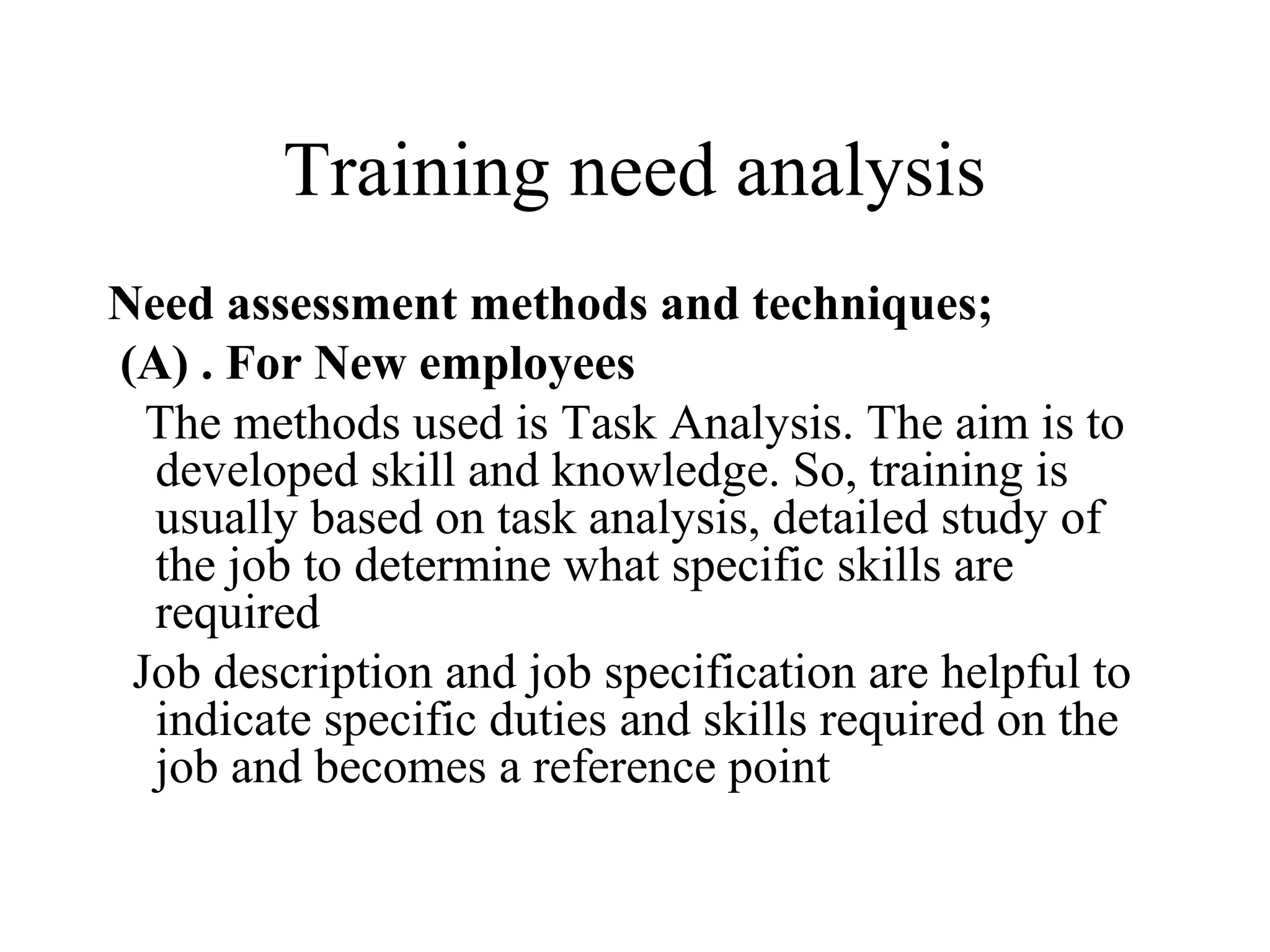
Training need analysis
Need assessment methods and techniques;
(A) . For New employees
  The methods used is Task Analysis. The aim is to
  developed skill and knowledge. So, training is
  usually based on task analysis, detailed study of
  the job to determine what specific skills are
  required
 Job description and job specification are helpful to
  indicate specific duties and skills required on the
  job and becomes a reference point
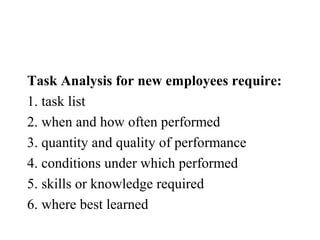
Task Analysis for new employees require:
1. task list
2. when and how often performed
3. quantity and quality of performance
4. conditions under which performed
5. skills or knowledge required
6. where best learned
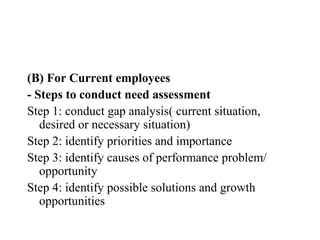
(B) For Current employees
- Steps to conduct need assessment
Step 1: conduct gap analysis( current situation,
   desired or necessary situation)
Step 2: identify priorities and importance
Step 3: identify causes of performance problem/
   opportunity
Step 4: identify possible solutions and growth
   opportunities
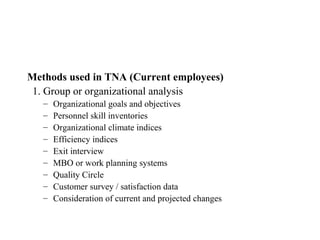
Methods used in TNA (Current employees)
 1. Group or organizational analysis
   –   Organizational goals and objectives
   –   Personnel skill inventories
   –   Organizational climate indices
   –   Efficiency indices
   –   Exit interview
   –   MBO or work planning systems
   –   Quality Circle
   –   Customer survey / satisfaction data
   –   Consideration of current and projected changes
2. Job/ task analysis
   –   Job description
   –   Job specification
   –   Performance standards
   –   Work sampling
   –   Review literature on job
   –   Asking questions about job
   –   Training committees
   –   Analysis of operating problems
3.Individual/ person analysis
   –   Performance Appraisal data
   –   Work sampling
   –   Interview
   –   Questionnaire
   –   Test (KASOC)
   –   Attitude survey
   –   Training progress
   –   Assessment center
   –   Critical incidence
ability -- it referes to demonstrated competence
to perform an observable behavior or a behavior
that results in an observable product
 skill -- it is a competence to perform or learned,
psychomotor act, and may include a manual,
verbal or mental manipulation of data, people or
things.
 other personal characteristics-- it includes
personality factors( attitudes), aptitudes, or
physical or mental traits needed to perform the job
Information
Can be provided in the form of study material or
 documents in advance or part of training kit
  Examples of training need involving lack of
  information are:
   –   Legal provisions or legislation
   –   Job specification
   –   Staff rules and regulations
   –   Performa for competing performance report
Knowledge means dynamic and analytical
 understanding of theories, concepts, principles and
 issues related to the job of the participants and
 their applications to specific situations in
 performance of jobs. Examples are:
  - Principles of effective management
   – Concepts like Kaizen, six sigma, etc.
   – Dynamics of human behavior
   – Theories on leadership, team building, conflict
     management , reward system, etc
Changes
  The areas of change which have a major impact on organizations ,
  fall into four main categories
   - Economic changes: short term (part of a process) and long term
     (growth rate, local & world market place, communities &
     neighboring countries, and competition)
   - Political changes:
     legislation- changes in health and safety
     trade relations( union laws)
     public spending
     peace
- Social changes:
   * personal security (law and order situation)
   * women's rights
   * religion
   * the environment
   * health and safety
   * demographics
- Technological changes:
   * changing what we make
   * changing the way we make and distribute
   * changing the way we communicate & store information

Training and dev 2

  • 1.
    Training need analysis Needassessment methods and techniques; (A) . For New employees The methods used is Task Analysis. The aim is to developed skill and knowledge. So, training is usually based on task analysis, detailed study of the job to determine what specific skills are required Job description and job specification are helpful to indicate specific duties and skills required on the job and becomes a reference point
  • 2.
    Task Analysis fornew employees require: 1. task list 2. when and how often performed 3. quantity and quality of performance 4. conditions under which performed 5. skills or knowledge required 6. where best learned
  • 3.
    (B) For Currentemployees - Steps to conduct need assessment Step 1: conduct gap analysis( current situation, desired or necessary situation) Step 2: identify priorities and importance Step 3: identify causes of performance problem/ opportunity Step 4: identify possible solutions and growth opportunities
  • 4.
    Methods used inTNA (Current employees) 1. Group or organizational analysis – Organizational goals and objectives – Personnel skill inventories – Organizational climate indices – Efficiency indices – Exit interview – MBO or work planning systems – Quality Circle – Customer survey / satisfaction data – Consideration of current and projected changes
  • 5.
    2. Job/ taskanalysis – Job description – Job specification – Performance standards – Work sampling – Review literature on job – Asking questions about job – Training committees – Analysis of operating problems
  • 6.
    3.Individual/ person analysis – Performance Appraisal data – Work sampling – Interview – Questionnaire – Test (KASOC) – Attitude survey – Training progress – Assessment center – Critical incidence
  • 7.
    ability -- itreferes to demonstrated competence to perform an observable behavior or a behavior that results in an observable product skill -- it is a competence to perform or learned, psychomotor act, and may include a manual, verbal or mental manipulation of data, people or things. other personal characteristics-- it includes personality factors( attitudes), aptitudes, or physical or mental traits needed to perform the job
  • 8.
    Information Can be providedin the form of study material or documents in advance or part of training kit Examples of training need involving lack of information are: – Legal provisions or legislation – Job specification – Staff rules and regulations – Performa for competing performance report
  • 9.
    Knowledge means dynamicand analytical understanding of theories, concepts, principles and issues related to the job of the participants and their applications to specific situations in performance of jobs. Examples are: - Principles of effective management – Concepts like Kaizen, six sigma, etc. – Dynamics of human behavior – Theories on leadership, team building, conflict management , reward system, etc
  • 10.
    Changes Theareas of change which have a major impact on organizations , fall into four main categories - Economic changes: short term (part of a process) and long term (growth rate, local & world market place, communities & neighboring countries, and competition) - Political changes: legislation- changes in health and safety trade relations( union laws) public spending peace
  • 11.
    - Social changes: * personal security (law and order situation) * women's rights * religion * the environment * health and safety * demographics - Technological changes: * changing what we make * changing the way we make and distribute * changing the way we communicate & store information