




Joven Botin Bilbao, BSN-RN
Deputy Chief Nursing Officer
Al Hayat National Hospital-Jizan Branch
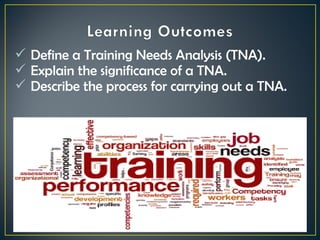
 Define a Training Needs Analysis (TNA).
 Explain the significance of a TNA.
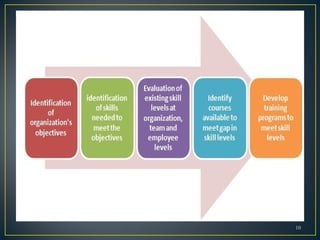
 Describe the process for carrying out a TNA.
2
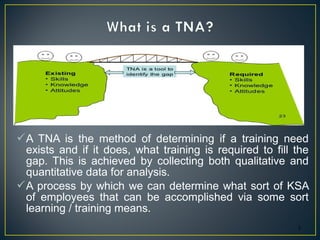
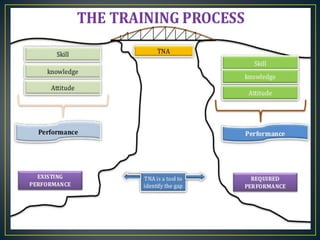
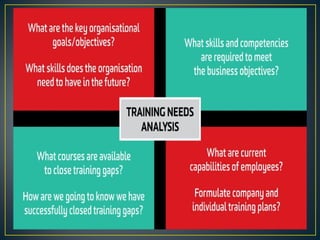
A TNA is the method of determining if a training need
exists and if it does, what training is required to fill the
gap. This is achieved by collecting both qualitative and
quantitative data for analysis.
A process by which we can determine what sort of KSA
of employees that can be accomplished via some sort
learning / training means.
3
4
5
6
7
8
9
10
11
12
13

TRAINING NEEDS ASSESSMENT (TNA)

  • 1.
    Joven Botin Bilbao,BSN-RN Deputy Chief Nursing Officer Al Hayat National Hospital-Jizan Branch
  • 2.
     Define aTraining Needs Analysis (TNA).  Explain the significance of a TNA.  Describe the process for carrying out a TNA. 2
  • 3.
    A TNA isthe method of determining if a training need exists and if it does, what training is required to fill the gap. This is achieved by collecting both qualitative and quantitative data for analysis. A process by which we can determine what sort of KSA of employees that can be accomplished via some sort learning / training means. 3
  • 4.
  • 5.
  • 6.
  • 7.
  • 8.
  • 9.
  • 10.
  • 11.
  • 12.
  • 13.

Editor's Notes

  • #2 There are times when a TNA is not necessary. For example, the organization will communicate a new vision or address a legal concern – it is advisable to train ALL employees regarding those. However, teams who have been working for so many years who have attended a couple of team-building trainings who have an EFFICIENCY problem can benefit from a TNA. The TNA will identify what is causing the performance problem and as well as the training program that will allow them to become more productive.
  • #4 There are 2 kinds of TNA Proactive – problems are not yet identified. The TNA is conducted to identify what will cause the future performance gaps. Reactive – problems are already present. The TNA is conducted to know what causes the performance gaps and will determine if these gaps can be remedied by a training or can be addressed by taking other measures.