Training Need AnalysisTraining Need Analysis
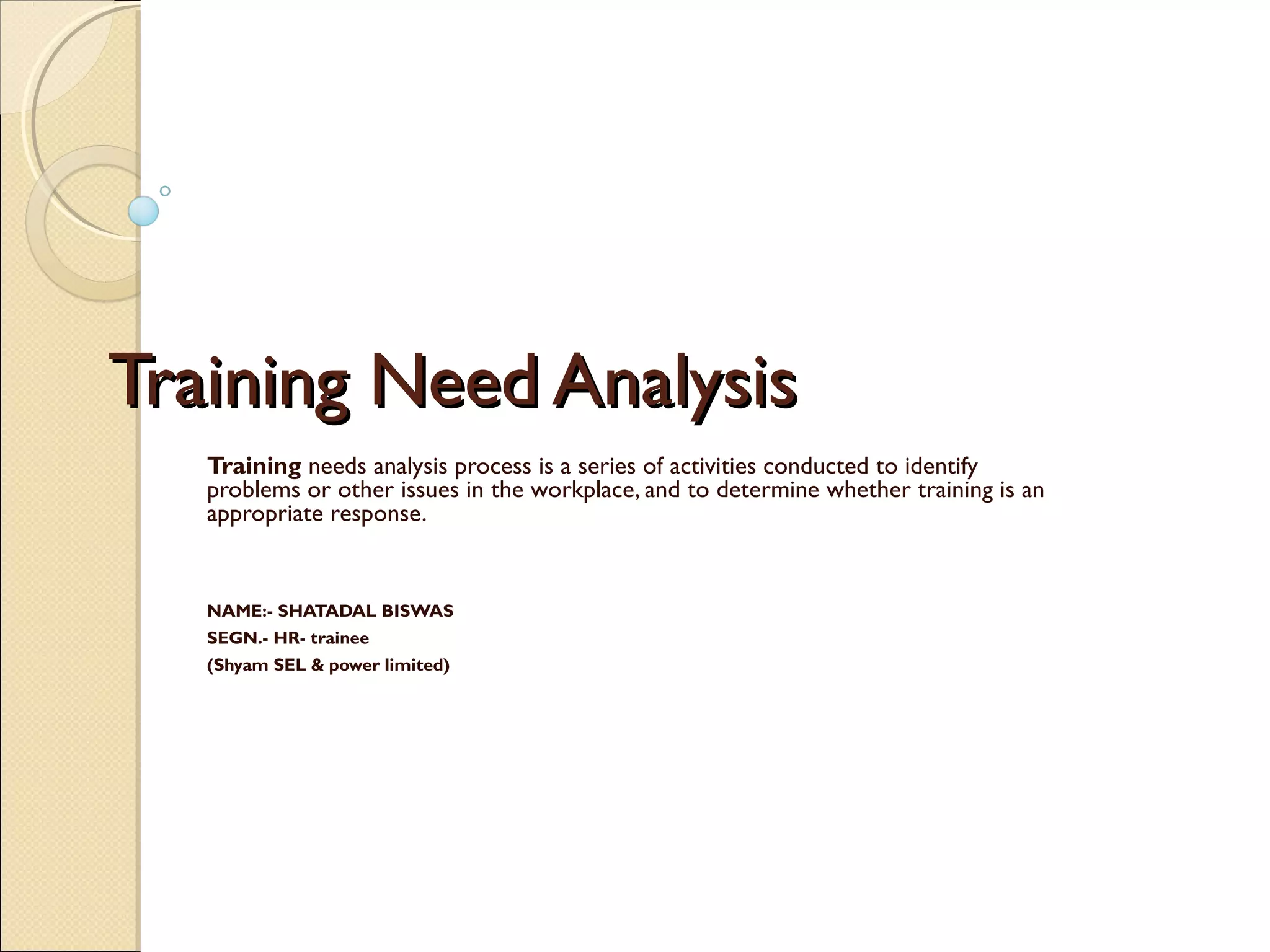
Training needs analysis process is a series of activities conducted to identify
problems or other issues in the workplace, and to determine whether training is an
appropriate response.
NAME:- SHATADAL BISWAS
SEGN.- HR- trainee
(Shyam SEL & power limited)
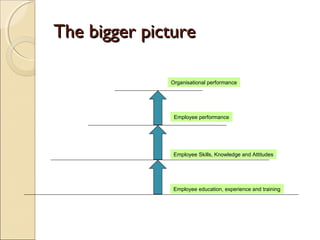
The bigger pictureThe bigger picture
Organisational performance
Employee performance
Employee Skills, Knowledge and Attitudes
Employee education, experience and training
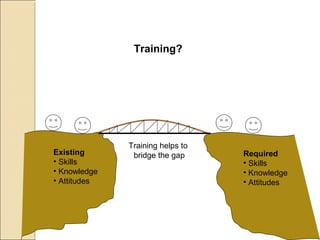
Training?
Training helps to
bridge the gapExisting
• Skills
• Knowledge
• Attitudes
Required
• Skills
• Knowledge
• Attitudes
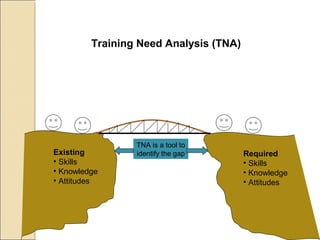
Training Need Analysis (TNA)
TNA is a tool to
identify the gapExisting
• Skills
• Knowledge
• Attitudes
Required
• Skills
• Knowledge
• Attitudes
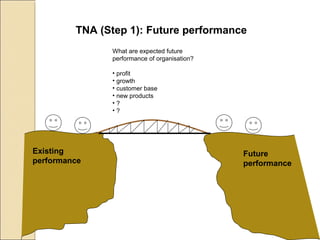
TNA (Step 1): Future performance
Existing
performance
Future
performance
What are expected future
performance of organisation?
• profit
• growth
• customer base
• new products
• ?
• ?
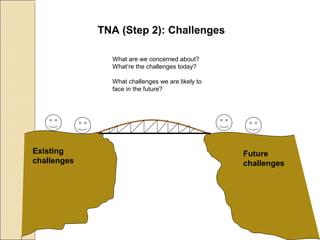
TNA (Step 2): Challenges
Existing
challenges
Future
challenges
What are we concerned about?
What’re the challenges today?
What challenges we are likely to
face in the future?
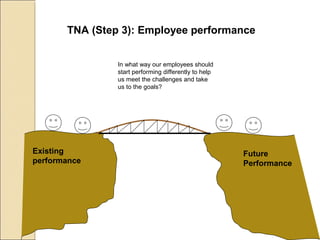
TNA (Step 3): Employee performance
Existing
performance
Future
Performance
In what way our employees should
start performing differently to help
us meet the challenges and take
us to the goals?
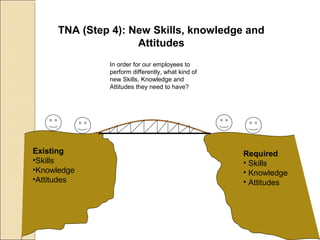
TNA (Step 4): New Skills, knowledge and
Attitudes
Existing
•Skills
•Knowledge
•Attitudes
Required
• Skills
• Knowledge
• Attitudes
In order for our employees to
perform differently, what kind of
new Skills, Knowledge and
Attitudes they need to have?
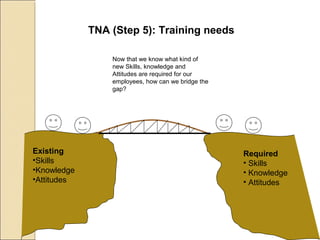
TNA (Step 5): Training needs
Existing
•Skills
•Knowledge
•Attitudes
Required
• Skills
• Knowledge
• Attitudes
Now that we know what kind of
new Skills, knowledge and
Attitudes are required for our
employees, how can we bridge the
gap?
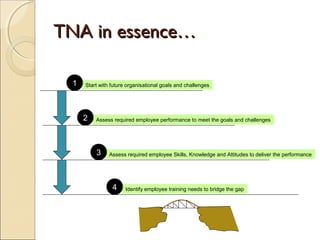
TNA in essence…TNA in essence…
Start with future organisational goals and challenges
Assess required employee performance to meet the goals and challenges
Assess required employee Skills, Knowledge and Attitudes to deliver the performance
Identify employee training needs to bridge the gap
1
2
3
4
Who Conducts Needs Analysis &Who Conducts Needs Analysis &
Why?Why?
An in-house trainer or a consultant performs a needs analysis to
collect and document information concerning any of the following
issues :
1. Performance problems
2.Anticipated introduction of new system, task or technology
3.A desire by the organization to benefit from a perceived opportunity
Techniques for DeterminingTechniques for Determining
Specific Training NeedsSpecific Training Needs
Observation
In this approach, an employee’s
performance itself is source of
information. You evaluate a worker’s
performance through first-hand
observation and analysis.
InterviewsInterviews
Interviews allow you to meet employees
face to face. Because you are in
conversation with workers, you can
explore their responses in depth. You
can ask for clarification of comments and
for examples of what they mean. In this
way, you obtain a full understanding of
their performance deficiencies.
QuestionnairesQuestionnaires
A questionnaire is a sort of interview on
paper. You create your own
questionnaire by writing down all the
questions you want employees to answer
for you.
Questionnaires can be useful in obtaining
a ‘ big picture ’ of what a large number of
employees think.
Job DescriptionsJob Descriptions
When an employee’s job description has
been defined, the trainer can easily tailor
his training curriculum to a very close
proximity.
The Difficulty AnalysisThe Difficulty Analysis
The Difficulty Analysis establishes which
of the duties cause the employee the
greatest amount of troubles and how this
trouble can be reduced through better
training.
Problem Solving ConferenceProblem Solving Conference
Another time-tested technique for gathering
needs analysis material from employees is to
conduct periodic problem solving conferences.
It is always helpful to utilize an outside
consultant to moderate such sessions. This
outside sponsorship has a tendency of letting
the workers express their feelings about his
organization, and the session can then be
geared to training needs.
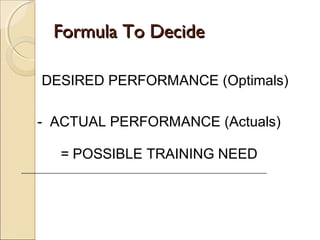
Formula To DecideFormula To Decide
DESIRED PERFORMANCE (Optimals)
- ACTUAL PERFORMANCE (Actuals)
= POSSIBLE TRAINING NEED
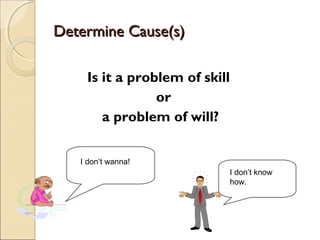
Determine Cause(s)Determine Cause(s)
Is it a problem of skill
or
a problem of will?
I don’t wanna!
I don’t know
how.
I don’t wanna!
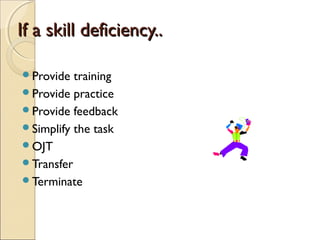
If a skill deficiency..If a skill deficiency..
Provide training
Provide practice
Provide feedback
Simplify the task
OJT
Transfer
Terminate
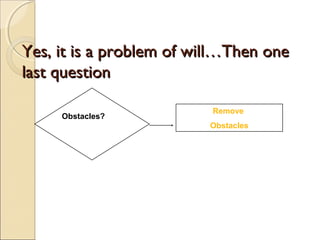
Yes, it is a problem of will…Then oneYes, it is a problem of will…Then one
last questionlast question
Obstacles?
Remove
Obstacles
Thank
You!

Training need analysis

  • 1.
    Training Need AnalysisTrainingNeed Analysis Training needs analysis process is a series of activities conducted to identify problems or other issues in the workplace, and to determine whether training is an appropriate response. NAME:- SHATADAL BISWAS SEGN.- HR- trainee (Shyam SEL & power limited)
  • 2.
    The bigger pictureThebigger picture Organisational performance Employee performance Employee Skills, Knowledge and Attitudes Employee education, experience and training
  • 3.
    Training? Training helps to bridgethe gapExisting • Skills • Knowledge • Attitudes Required • Skills • Knowledge • Attitudes
  • 4.
    Training Need Analysis(TNA) TNA is a tool to identify the gapExisting • Skills • Knowledge • Attitudes Required • Skills • Knowledge • Attitudes
  • 5.
    TNA (Step 1):Future performance Existing performance Future performance What are expected future performance of organisation? • profit • growth • customer base • new products • ? • ?
  • 6.
    TNA (Step 2):Challenges Existing challenges Future challenges What are we concerned about? What’re the challenges today? What challenges we are likely to face in the future?
  • 7.
    TNA (Step 3):Employee performance Existing performance Future Performance In what way our employees should start performing differently to help us meet the challenges and take us to the goals?
  • 8.
    TNA (Step 4):New Skills, knowledge and Attitudes Existing •Skills •Knowledge •Attitudes Required • Skills • Knowledge • Attitudes In order for our employees to perform differently, what kind of new Skills, Knowledge and Attitudes they need to have?
  • 9.
    TNA (Step 5):Training needs Existing •Skills •Knowledge •Attitudes Required • Skills • Knowledge • Attitudes Now that we know what kind of new Skills, knowledge and Attitudes are required for our employees, how can we bridge the gap?
  • 10.
    TNA in essence…TNAin essence… Start with future organisational goals and challenges Assess required employee performance to meet the goals and challenges Assess required employee Skills, Knowledge and Attitudes to deliver the performance Identify employee training needs to bridge the gap 1 2 3 4
  • 11.
    Who Conducts NeedsAnalysis &Who Conducts Needs Analysis & Why?Why? An in-house trainer or a consultant performs a needs analysis to collect and document information concerning any of the following issues : 1. Performance problems 2.Anticipated introduction of new system, task or technology 3.A desire by the organization to benefit from a perceived opportunity
  • 12.
    Techniques for DeterminingTechniquesfor Determining Specific Training NeedsSpecific Training Needs Observation In this approach, an employee’s performance itself is source of information. You evaluate a worker’s performance through first-hand observation and analysis.
  • 13.
    InterviewsInterviews Interviews allow youto meet employees face to face. Because you are in conversation with workers, you can explore their responses in depth. You can ask for clarification of comments and for examples of what they mean. In this way, you obtain a full understanding of their performance deficiencies.
  • 14.
    QuestionnairesQuestionnaires A questionnaire isa sort of interview on paper. You create your own questionnaire by writing down all the questions you want employees to answer for you. Questionnaires can be useful in obtaining a ‘ big picture ’ of what a large number of employees think.
  • 15.
    Job DescriptionsJob Descriptions Whenan employee’s job description has been defined, the trainer can easily tailor his training curriculum to a very close proximity.
  • 16.
    The Difficulty AnalysisTheDifficulty Analysis The Difficulty Analysis establishes which of the duties cause the employee the greatest amount of troubles and how this trouble can be reduced through better training.
  • 17.
    Problem Solving ConferenceProblemSolving Conference Another time-tested technique for gathering needs analysis material from employees is to conduct periodic problem solving conferences. It is always helpful to utilize an outside consultant to moderate such sessions. This outside sponsorship has a tendency of letting the workers express their feelings about his organization, and the session can then be geared to training needs.
  • 18.
    Formula To DecideFormulaTo Decide DESIRED PERFORMANCE (Optimals) - ACTUAL PERFORMANCE (Actuals) = POSSIBLE TRAINING NEED
  • 19.
    Determine Cause(s)Determine Cause(s) Isit a problem of skill or a problem of will? I don’t wanna! I don’t know how. I don’t wanna!
  • 20.
    If a skilldeficiency..If a skill deficiency.. Provide training Provide practice Provide feedback Simplify the task OJT Transfer Terminate
  • 21.
    Yes, it isa problem of will…Then oneYes, it is a problem of will…Then one last questionlast question Obstacles? Remove Obstacles
  • 22.