Dr.T.V.Rao MD
NEEDLE STICK
INJURIES
CONCERNS AND PREVENTION
DR.T.V.RAO MD 1
THE BASIS OF THIS PRESENTATION
• This presentation is designed to assist with the training of
staff on sharps management including safety devices
• The information relates to prevention of hollow-bore needle
stick injuries (NSI) and should be used in combination with
other training material
• The information includes the NACO guidelines concerning
the Indian law/ Supreme court guidelines and other
concerns.
• The Drug regimes for Post exposure practices should
be followed as per current guidelines
DR.T.V.RAO MD 2
THE PROBLEM
• CDC estimates ~385,000 sharps injuries annually
among hospital-based healthcare personnel
(>1,000 injuries/day)
• Many more in other healthcare settings (e.g., emergency
services, home care, nursing homes)
• Increased risk for blood borne virus transmission
• Costly to personnel and healthcare system
DR.T.V.RAO MD 3
4
Exposures which place health
personnel at risk of blood borne
infection –
• A percutaneous injury e.g. Needle stick injury (NSI) or
cut with a sharp instrument
• Contact with the mucous membrane of eye or mouth
• Contact with non-intact skin (abraded skin or with
dermatitis)
• Contact with intact skin when the duration of contact is
prolonged with blood or other potential infected body
fluids
DR.T.V.RAO MD 4
WHO IS AT RISK ? -
• Nursing Staff
• Emergency Care Providers
• Labor & delivery room
personnel
• Surgeons and operation
theater staff
• Lab Technicians
• Dentists
• Health cleaning/ mortuary
staff / Waste Handlers
DR.T.V.RAO MD 5
WHO GETS INJURED?
Nurse
43%
Technician
15%
Student
4%
Dental
1%
Housekeeping/
Maintenance
3%
Clerical /
Admin
1%
Other
5%
Physician
28%
Occupational
Groups of
Healthcare
Personnel Exposed
to Blood/Body
Fluids,
NaSH June 1995—
December 2003
(n=23,197)
DR.T.V.RAO MD 6
HOW DO INJURIES OCCUR WITH HOLLOW-BORE
NEEDLES?
During Sharps
Disposal
13%
During Clean Up
9%
In Transit to
Disposal
4%
Handle/Pass
Equipment
6%
Improper
Disposal
9%
Access IV Line
5%
Transfer/Process
Specimens
5%
Recap Needle
6%
Collision
W/Worker or
Sharp
10%
Manipulate
Needle in Patient
28%
Other
5%
Circumstances Associated with Hollow-Bore Needle Injuries NaSH June
1995—December 2003 (n=10,239)
Disposal
Related:
35%
DR.T.V.RAO MD 7
8
WORK PRACTICES WHICH INCREASE THE
RISK OF NEEDLE STICK INJURY
• Recapping needles (Most important)
• Performing activities involving needles and sharps in a
hurry
• Handling and passing needles or sharp after use
• Failing to dispose of used needles properly in puncture-
resistant sharps containers
• Poor healthcare waste management practices
• Ignoring Universal Work Precautions
DR.T.V.RAO MD 8
9
Potentially infectious body fluids -
Exposure to body fluids
considered at risk
Exposure to body fluids
considered not at risk unless they
contain visible blood
Blood, Semen, Vaginal
secretions, CSF, Synovial,
Pleural and Pericardial fluid,
Amniotic fluid & other body
fluids contaminated with
visible blood
Tears, Sweat, Urine and
faeces, Saliva, Sputum and
vomitus
DR.T.V.RAO MD 9
• Hypodermic
needles
• Blood collection
needles
• Suture needles
• Needles used in IV
delivery systems
• Scalpels
WHAT KINDS OF DEVICES USUALLY
CAUSE SHARPS INJURIES?
DR.T.V.RAO MD 10
WHAT INFECTIONS CAN BE CAUSED
BY SHARP INJURIES?
Sharps injuries can expose workers to a
number of blood borne pathogens that can
cause serious or fatal infections. The
pathogens that pose the most serious health
risks are
• Hepatitis B virus (HBV)
• Hepatitis C virus (HCV)
• Human immunodeficiency virus (HIV)
DR.T.V.RAO MD 11
RISKS OF SEROCONVERSION DUE TO SHARPS
INJURY
FROM A KNOWN POSITIVE SOURCE
Virus
HBV
HCV
HIV
Risk (Range)
6-30%*
~ 2%
0.3%
(*Risk for HBV applies if not HB vaccinated)
DR.T.V.RAO MD 12
WHAT IS THE RISK FOR HIV ALONE?
• Percutaneous 0.3%
• Mucous membrane 0.1%
• Non-intact skin <0.1%
DR.T.V.RAO MD 13
• Who gets injured?
• Where do they happen?
• When do injuries
occur?
• What devices are
involved?
• How can they be
prevented?
HOW DO SHARPS INJURIES HAPPEN?
DR.T.V.RAO MD 14
15
WORK PRACTICES WHICH INCREASE THE
RISK OF NEEDLE STICK INJURY
• Recapping needles (Most important)
• Performing activities involving needles and sharps in a
hurry
• Handling and passing needles or sharp after use
• Failing to dispose of used needles properly in puncture-
resistant sharps containers
• Poor healthcare waste management practices
• Ignoring Universal Work Precautions
DR.T.V.RAO MD 15
RISK FACTORS FOR HIV
SEROCONVERSION IN HCWS
Risk Factor Adjusted Odds Ratio*
Deep Injury 15.0
Visible Blood on Device 6.2
Terminal Illness in Source Patient 5.6
Needle in Source Vein/Artery 4.3
From: NEJM 1997;337:1485-90.
*All Risk Factors were significant (P < 0.01)
DR.T.V.RAO MD 16
HIV: SEROCONVERSION IN HEALTH CARE
WORKERS IN USA (CONTD.)
 Primary HIV Infection
- in 81% of HCWs
- median 25 days after exposure
 Seroconversion
- Median 46 days
- by 6 months in 95% of HCWs
- 3 persons Seroconversion at 6-12 months
From: CDC. MMWR 1998;47:No. RR-7.DR.T.V.RAO MD 17
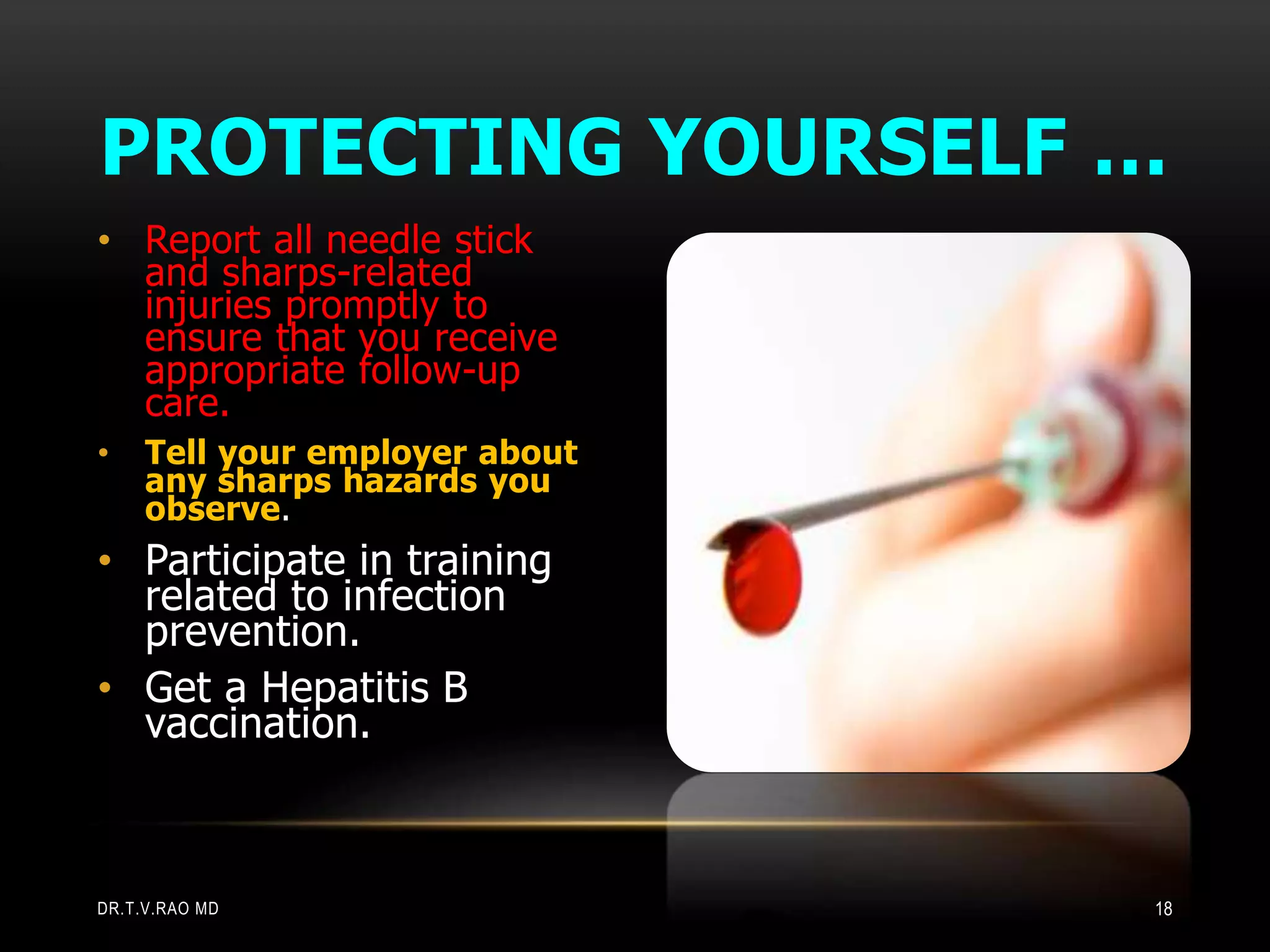
• Report all needle stick
and sharps-related
injuries promptly to
ensure that you receive
appropriate follow-up
care.
• Tell your employer about
any sharps hazards you
observe.
• Participate in training
related to infection
prevention.
• Get a Hepatitis B
vaccination.
PROTECTING YOURSELF …
DR.T.V.RAO MD 18
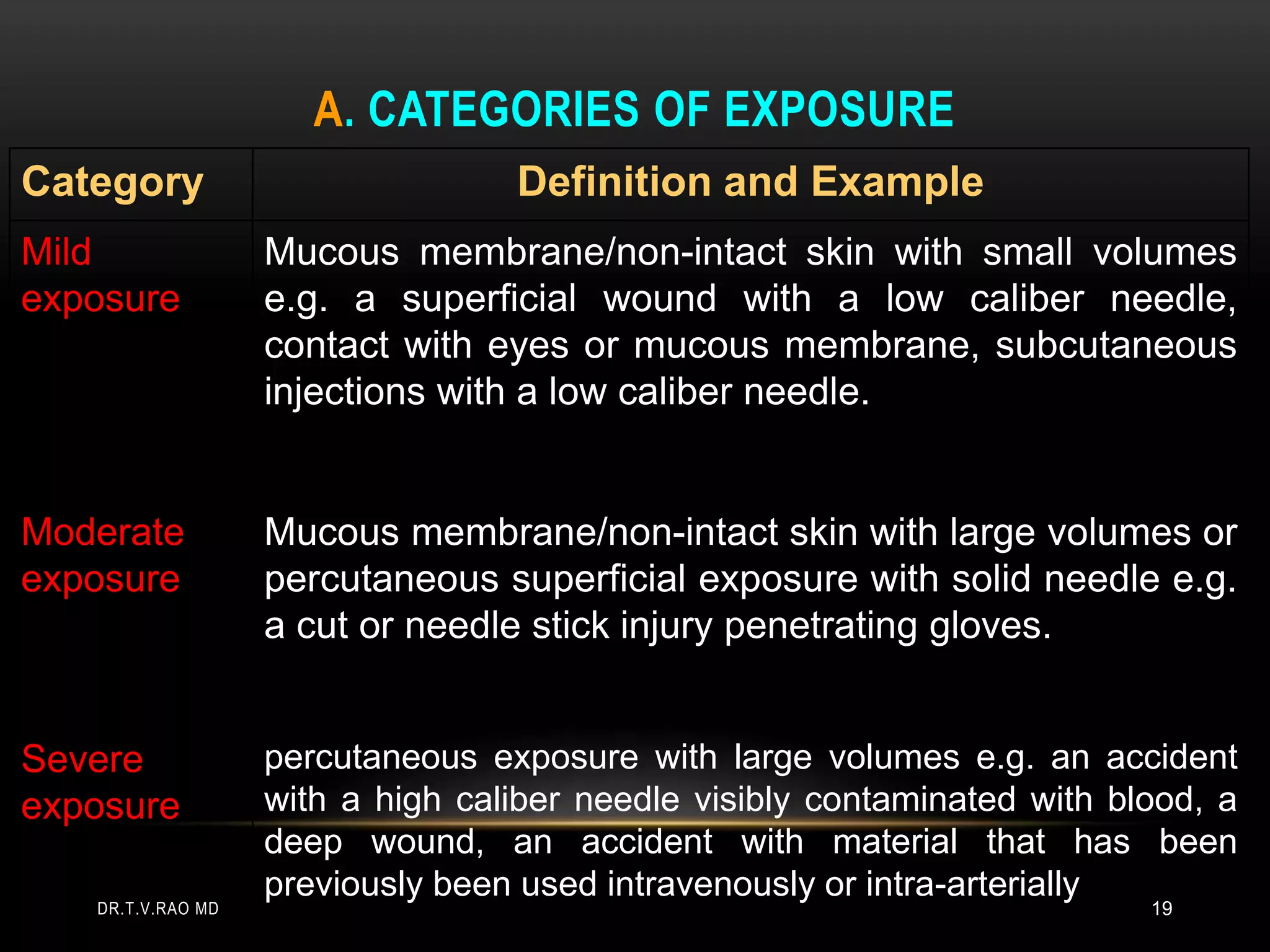
A. CATEGORIES OF EXPOSURE
19
Category Definition and Example
Mild
exposure
Mucous membrane/non-intact skin with small volumes
e.g. a superficial wound with a low caliber needle,
contact with eyes or mucous membrane, subcutaneous
injections with a low caliber needle.
Moderate
exposure
Mucous membrane/non-intact skin with large volumes or
percutaneous superficial exposure with solid needle e.g.
a cut or needle stick injury penetrating gloves.
Severe
exposure
percutaneous exposure with large volumes e.g. an accident
with a high caliber needle visibly contaminated with blood, a
deep wound, an accident with material that has been
previously been used intravenously or intra-arterially
DR.T.V.RAO MD
20
POST EXPOSURE PROPHYLAXIS (PEP)
It refers to the comprehensive management to minimize the
risk of infection following potential exposure to blood borne
pathogens (HIV, HBV, HCV ).It includes –
 First Aid
 Risk Assessment
 Counseling
 PEP drugs (4Weeks) depending upon risk assessment
 Relevant Lab Investigation on informed consent of the
source and exposed person
 Follow up and support
DR.T.V.RAO MD
21
MANAGEMENT OF EXPOSED PERSON
1st step: Management of exposed site - First Aid
 Skin: Do not squeeze the wound to bleed it, do not put
the pricked finger in mouth. Wash with soap &water,
don’t scrub, no antiseptics or skin washes (bleach,
chlorine, alcohol, betadine).
 Eye: wash with water/ normal saline/ don’t remove
contact lens immediately if wearing, no soap or
disinfectant.
 Mouth: spit fluid immediately, repeatedly rinse the
mouth with water and spit / no soap/ disinfectant.
DR.T.V.RAO MD
22
2ND STEP: ESTABLISH ELIGIBILITY FOR PEP
Evaluation must be made rapidly so as to start
treatment as soon as possible-ideally within 2hours
but certainly within 72 hours of exposure. However all
exposed cases don’t require prophylactic treatment.
Factors determining the requirement of PEP-
 Nature/Severity of exposure and risk of
transmission
 HIV status of the source of exposure
 HIV status of the exposed individual
DR.T.V.RAO MD
QUICK FACT:
HBV VACCINATION IS RECOMMENDED FOR ALL
HEALTHCARE WORKERS (UNLESS THEY ARE
IMMUNE BECAUSE OF PREVIOUS EXPOSURE).
HBV VACCINE HAS PROVEN TO BE HIGHLY
EFFECTIVE IN PREVENTING INFECTION IN
WORKERS EXPOSED TO HBV. HOWEVER, NO
VACCINE EXISTS TO PREVENT HCV OR HIV
INFECTION.
DR.T.V.RAO MD 23
SUPREME COURT DIRECTIVE TO ENSURE PEP
DRUGS IN ALL GOVERNMENT HOSPITALS IN INDIA
1. Universal Work Precautions (UWP) and PEP guidelines should be followed by
HCPs to prevent occupational transmission of HIV, Hepatitis B and hepatitis
C.
2. This will develop confidence in HCPs while working with patients some of
whom might be infected with HIV/HBV/HCV.
3. PEP drugs should be available in all Govt Hospitals to
enable protection of HCPs dealing with potentially infected
patients to make sure that no patients suffering from HIV
be denied treatment/surgery/ procedures etc
4. Availability of UWP and PEP can minimize the stigma and discrimination
against PLHIVs in Health Care facilities.
5. Above regulations to be practiced in Private hospitals and Establishments
DR.T.V.RAO MD 24
ROLE OF PEP IN PREVENTING TRANSMISSION
OF HIV- INDIAN STUDIES (CONTD.)2. LTM Hospital, Sion, Mumbai -2002
• Over a period of one year, June 2000 - 2001, a total number of 38 cases of
accidental exposures were self reported
• Of the 38 reported cases; 34 were NSIs, 2 were scalpel cuts, and 1 was exposure
to body fluids (vitreous humor) by splashing and 1 was a human bite, from a
psychiatric patient.
• The 38 source cases were also tested for HIV 1,2 antibodies and HBsAg. Ten
were HIV seropositive and 28 HIV seronegative and four were HBsAg positive
and 34 HBsAg seronegative.
• Majority of the 34 needle stick injuries were by hollow bore needles. Of these, 20
were during blood collection procedure by hollow bore needle, 5 during
angioplasty procedure, 4 during central venous puncture line cut down
procedures, 2 during suturing of contused lacerated wound and 3 while recapping
the needle. PEP was received regularly by 10 cases.
• All the HCWs were HIV and HBsAg seronegativee after one and half years.
- DR.T.V.RAO MD 25
26
RESPONSIBILITY OF HEAD OF THE INSTITUTION
• To ensure that the hospital has a written protocol to
handle exposure and the same is displayed at
prominent locations within the hospital for information of
staff.
• Sensitization of Doctors, Nurses, Paramedics & waste
handlers
• To ensure that Universal precautions are followed.
• Availability of Personal protective equipment.
• Dissemination of procedure to be followed in case of
accidental exposure to Blood and Body fluids
• Availability of Rapid HIV test kits.
• Availability of other preventive measures including
vaccinations.
DR.T.V.RAO MD
27
AVAILABILITY OF PEP AT HEALTHCARE FACILITY
It is recommended that PEP drugs be kept available round-
the-clock in any of the three locations - Emergency room,
Labor room and ICU.
Drug Stock at the Healthcare facility
PEP kit comprises of 2 drug regimen:
Zidovudine(AZT) 300mg + Lamivudine (3TC)
150 mg as a fixed dose combination
DR.T.V.RAO MD
WHAT ARE STRATEGIES TO ELIMINATE SHARPS INJURIES?
• Eliminate or reduce the use of needles
and other sharps
• Use devices with safety features to
isolate sharps
• Use safer practices to minimize risk for
remaining hazards
DR.T.V.RAO MD 28
DO NOT FORGET HEPATITIS B VACCINATION AND
UNIVERSAL PRECAUTIONS ……..
DR.T.V.RAO MD 29
REFERENCES
1. Centers for Disease Control and Prevention. Workbook for Designing,
Implementing and Evaluating a Sharp Injury Prevention Program. 2004.
Atlanta: US Department of Health and Human Services.
2. Whitby R, McLaws M. Hollow bore needle stick injuries in a tertiary
teaching hospital: epidemiology, education and engineering. Med J Aust
2002; 177(8): 418-422.
3. Centers for Disease Control and Prevention. Updated U.S. Public Health
Service Guidelines for the Management of Occupational Exposures to
HBV, HCV, and HIV and Recommendations for Post exposure Prophylaxis.
MMWR 2001; 50(No. RR-11): 1-7.
4. Delhi AIDS control Society India
DR.T.V.RAO MD 30
DR.T.V.RAO MD 31
• Programme Created by Dr.T.V.Rao MD for
Basic understanding on Needle sticks
Injuries and Human and Legal concerns
• Email
• doctortvrao@gmail.com

Needle stick Injuries concerns and prevention

  • 1.
    Dr.T.V.Rao MD NEEDLE STICK INJURIES CONCERNSAND PREVENTION DR.T.V.RAO MD 1
  • 2.
    THE BASIS OFTHIS PRESENTATION • This presentation is designed to assist with the training of staff on sharps management including safety devices • The information relates to prevention of hollow-bore needle stick injuries (NSI) and should be used in combination with other training material • The information includes the NACO guidelines concerning the Indian law/ Supreme court guidelines and other concerns. • The Drug regimes for Post exposure practices should be followed as per current guidelines DR.T.V.RAO MD 2
  • 3.
    THE PROBLEM • CDCestimates ~385,000 sharps injuries annually among hospital-based healthcare personnel (>1,000 injuries/day) • Many more in other healthcare settings (e.g., emergency services, home care, nursing homes) • Increased risk for blood borne virus transmission • Costly to personnel and healthcare system DR.T.V.RAO MD 3
  • 4.
    4 Exposures which placehealth personnel at risk of blood borne infection – • A percutaneous injury e.g. Needle stick injury (NSI) or cut with a sharp instrument • Contact with the mucous membrane of eye or mouth • Contact with non-intact skin (abraded skin or with dermatitis) • Contact with intact skin when the duration of contact is prolonged with blood or other potential infected body fluids DR.T.V.RAO MD 4
  • 5.
    WHO IS ATRISK ? - • Nursing Staff • Emergency Care Providers • Labor & delivery room personnel • Surgeons and operation theater staff • Lab Technicians • Dentists • Health cleaning/ mortuary staff / Waste Handlers DR.T.V.RAO MD 5
  • 6.
    WHO GETS INJURED? Nurse 43% Technician 15% Student 4% Dental 1% Housekeeping/ Maintenance 3% Clerical/ Admin 1% Other 5% Physician 28% Occupational Groups of Healthcare Personnel Exposed to Blood/Body Fluids, NaSH June 1995— December 2003 (n=23,197) DR.T.V.RAO MD 6
  • 7.
    HOW DO INJURIESOCCUR WITH HOLLOW-BORE NEEDLES? During Sharps Disposal 13% During Clean Up 9% In Transit to Disposal 4% Handle/Pass Equipment 6% Improper Disposal 9% Access IV Line 5% Transfer/Process Specimens 5% Recap Needle 6% Collision W/Worker or Sharp 10% Manipulate Needle in Patient 28% Other 5% Circumstances Associated with Hollow-Bore Needle Injuries NaSH June 1995—December 2003 (n=10,239) Disposal Related: 35% DR.T.V.RAO MD 7
  • 8.
    8 WORK PRACTICES WHICHINCREASE THE RISK OF NEEDLE STICK INJURY • Recapping needles (Most important) • Performing activities involving needles and sharps in a hurry • Handling and passing needles or sharp after use • Failing to dispose of used needles properly in puncture- resistant sharps containers • Poor healthcare waste management practices • Ignoring Universal Work Precautions DR.T.V.RAO MD 8
  • 9.
    9 Potentially infectious bodyfluids - Exposure to body fluids considered at risk Exposure to body fluids considered not at risk unless they contain visible blood Blood, Semen, Vaginal secretions, CSF, Synovial, Pleural and Pericardial fluid, Amniotic fluid & other body fluids contaminated with visible blood Tears, Sweat, Urine and faeces, Saliva, Sputum and vomitus DR.T.V.RAO MD 9
  • 10.
    • Hypodermic needles • Bloodcollection needles • Suture needles • Needles used in IV delivery systems • Scalpels WHAT KINDS OF DEVICES USUALLY CAUSE SHARPS INJURIES? DR.T.V.RAO MD 10
  • 11.
    WHAT INFECTIONS CANBE CAUSED BY SHARP INJURIES? Sharps injuries can expose workers to a number of blood borne pathogens that can cause serious or fatal infections. The pathogens that pose the most serious health risks are • Hepatitis B virus (HBV) • Hepatitis C virus (HCV) • Human immunodeficiency virus (HIV) DR.T.V.RAO MD 11
  • 12.
    RISKS OF SEROCONVERSIONDUE TO SHARPS INJURY FROM A KNOWN POSITIVE SOURCE Virus HBV HCV HIV Risk (Range) 6-30%* ~ 2% 0.3% (*Risk for HBV applies if not HB vaccinated) DR.T.V.RAO MD 12
  • 13.
    WHAT IS THERISK FOR HIV ALONE? • Percutaneous 0.3% • Mucous membrane 0.1% • Non-intact skin <0.1% DR.T.V.RAO MD 13
  • 14.
    • Who getsinjured? • Where do they happen? • When do injuries occur? • What devices are involved? • How can they be prevented? HOW DO SHARPS INJURIES HAPPEN? DR.T.V.RAO MD 14
  • 15.
    15 WORK PRACTICES WHICHINCREASE THE RISK OF NEEDLE STICK INJURY • Recapping needles (Most important) • Performing activities involving needles and sharps in a hurry • Handling and passing needles or sharp after use • Failing to dispose of used needles properly in puncture- resistant sharps containers • Poor healthcare waste management practices • Ignoring Universal Work Precautions DR.T.V.RAO MD 15
  • 16.
    RISK FACTORS FORHIV SEROCONVERSION IN HCWS Risk Factor Adjusted Odds Ratio* Deep Injury 15.0 Visible Blood on Device 6.2 Terminal Illness in Source Patient 5.6 Needle in Source Vein/Artery 4.3 From: NEJM 1997;337:1485-90. *All Risk Factors were significant (P < 0.01) DR.T.V.RAO MD 16
  • 17.
    HIV: SEROCONVERSION INHEALTH CARE WORKERS IN USA (CONTD.)  Primary HIV Infection - in 81% of HCWs - median 25 days after exposure  Seroconversion - Median 46 days - by 6 months in 95% of HCWs - 3 persons Seroconversion at 6-12 months From: CDC. MMWR 1998;47:No. RR-7.DR.T.V.RAO MD 17
  • 18.
    • Report allneedle stick and sharps-related injuries promptly to ensure that you receive appropriate follow-up care. • Tell your employer about any sharps hazards you observe. • Participate in training related to infection prevention. • Get a Hepatitis B vaccination. PROTECTING YOURSELF … DR.T.V.RAO MD 18
  • 19.
    A. CATEGORIES OFEXPOSURE 19 Category Definition and Example Mild exposure Mucous membrane/non-intact skin with small volumes e.g. a superficial wound with a low caliber needle, contact with eyes or mucous membrane, subcutaneous injections with a low caliber needle. Moderate exposure Mucous membrane/non-intact skin with large volumes or percutaneous superficial exposure with solid needle e.g. a cut or needle stick injury penetrating gloves. Severe exposure percutaneous exposure with large volumes e.g. an accident with a high caliber needle visibly contaminated with blood, a deep wound, an accident with material that has been previously been used intravenously or intra-arterially DR.T.V.RAO MD
  • 20.
    20 POST EXPOSURE PROPHYLAXIS(PEP) It refers to the comprehensive management to minimize the risk of infection following potential exposure to blood borne pathogens (HIV, HBV, HCV ).It includes –  First Aid  Risk Assessment  Counseling  PEP drugs (4Weeks) depending upon risk assessment  Relevant Lab Investigation on informed consent of the source and exposed person  Follow up and support DR.T.V.RAO MD
  • 21.
    21 MANAGEMENT OF EXPOSEDPERSON 1st step: Management of exposed site - First Aid  Skin: Do not squeeze the wound to bleed it, do not put the pricked finger in mouth. Wash with soap &water, don’t scrub, no antiseptics or skin washes (bleach, chlorine, alcohol, betadine).  Eye: wash with water/ normal saline/ don’t remove contact lens immediately if wearing, no soap or disinfectant.  Mouth: spit fluid immediately, repeatedly rinse the mouth with water and spit / no soap/ disinfectant. DR.T.V.RAO MD
  • 22.
    22 2ND STEP: ESTABLISHELIGIBILITY FOR PEP Evaluation must be made rapidly so as to start treatment as soon as possible-ideally within 2hours but certainly within 72 hours of exposure. However all exposed cases don’t require prophylactic treatment. Factors determining the requirement of PEP-  Nature/Severity of exposure and risk of transmission  HIV status of the source of exposure  HIV status of the exposed individual DR.T.V.RAO MD
  • 23.
    QUICK FACT: HBV VACCINATIONIS RECOMMENDED FOR ALL HEALTHCARE WORKERS (UNLESS THEY ARE IMMUNE BECAUSE OF PREVIOUS EXPOSURE). HBV VACCINE HAS PROVEN TO BE HIGHLY EFFECTIVE IN PREVENTING INFECTION IN WORKERS EXPOSED TO HBV. HOWEVER, NO VACCINE EXISTS TO PREVENT HCV OR HIV INFECTION. DR.T.V.RAO MD 23
  • 24.
    SUPREME COURT DIRECTIVETO ENSURE PEP DRUGS IN ALL GOVERNMENT HOSPITALS IN INDIA 1. Universal Work Precautions (UWP) and PEP guidelines should be followed by HCPs to prevent occupational transmission of HIV, Hepatitis B and hepatitis C. 2. This will develop confidence in HCPs while working with patients some of whom might be infected with HIV/HBV/HCV. 3. PEP drugs should be available in all Govt Hospitals to enable protection of HCPs dealing with potentially infected patients to make sure that no patients suffering from HIV be denied treatment/surgery/ procedures etc 4. Availability of UWP and PEP can minimize the stigma and discrimination against PLHIVs in Health Care facilities. 5. Above regulations to be practiced in Private hospitals and Establishments DR.T.V.RAO MD 24
  • 25.
    ROLE OF PEPIN PREVENTING TRANSMISSION OF HIV- INDIAN STUDIES (CONTD.)2. LTM Hospital, Sion, Mumbai -2002 • Over a period of one year, June 2000 - 2001, a total number of 38 cases of accidental exposures were self reported • Of the 38 reported cases; 34 were NSIs, 2 were scalpel cuts, and 1 was exposure to body fluids (vitreous humor) by splashing and 1 was a human bite, from a psychiatric patient. • The 38 source cases were also tested for HIV 1,2 antibodies and HBsAg. Ten were HIV seropositive and 28 HIV seronegative and four were HBsAg positive and 34 HBsAg seronegative. • Majority of the 34 needle stick injuries were by hollow bore needles. Of these, 20 were during blood collection procedure by hollow bore needle, 5 during angioplasty procedure, 4 during central venous puncture line cut down procedures, 2 during suturing of contused lacerated wound and 3 while recapping the needle. PEP was received regularly by 10 cases. • All the HCWs were HIV and HBsAg seronegativee after one and half years. - DR.T.V.RAO MD 25
  • 26.
    26 RESPONSIBILITY OF HEADOF THE INSTITUTION • To ensure that the hospital has a written protocol to handle exposure and the same is displayed at prominent locations within the hospital for information of staff. • Sensitization of Doctors, Nurses, Paramedics & waste handlers • To ensure that Universal precautions are followed. • Availability of Personal protective equipment. • Dissemination of procedure to be followed in case of accidental exposure to Blood and Body fluids • Availability of Rapid HIV test kits. • Availability of other preventive measures including vaccinations. DR.T.V.RAO MD
  • 27.
    27 AVAILABILITY OF PEPAT HEALTHCARE FACILITY It is recommended that PEP drugs be kept available round- the-clock in any of the three locations - Emergency room, Labor room and ICU. Drug Stock at the Healthcare facility PEP kit comprises of 2 drug regimen: Zidovudine(AZT) 300mg + Lamivudine (3TC) 150 mg as a fixed dose combination DR.T.V.RAO MD
  • 28.
    WHAT ARE STRATEGIESTO ELIMINATE SHARPS INJURIES? • Eliminate or reduce the use of needles and other sharps • Use devices with safety features to isolate sharps • Use safer practices to minimize risk for remaining hazards DR.T.V.RAO MD 28
  • 29.
    DO NOT FORGETHEPATITIS B VACCINATION AND UNIVERSAL PRECAUTIONS …….. DR.T.V.RAO MD 29
  • 30.
    REFERENCES 1. Centers forDisease Control and Prevention. Workbook for Designing, Implementing and Evaluating a Sharp Injury Prevention Program. 2004. Atlanta: US Department of Health and Human Services. 2. Whitby R, McLaws M. Hollow bore needle stick injuries in a tertiary teaching hospital: epidemiology, education and engineering. Med J Aust 2002; 177(8): 418-422. 3. Centers for Disease Control and Prevention. Updated U.S. Public Health Service Guidelines for the Management of Occupational Exposures to HBV, HCV, and HIV and Recommendations for Post exposure Prophylaxis. MMWR 2001; 50(No. RR-11): 1-7. 4. Delhi AIDS control Society India DR.T.V.RAO MD 30
  • 31.
    DR.T.V.RAO MD 31 •Programme Created by Dr.T.V.Rao MD for Basic understanding on Needle sticks Injuries and Human and Legal concerns • Email • doctortvrao@gmail.com