   History Of CANCER
   Anatomy of HEAD & NECK
   LYMPH NODE levels
   Staging of CANCER
    NECK DISSECTIONS
   COMPLICATIONS
   1880  Kocher advocates wide margin
    lymphadenectomy

   1881  Kocher and Packard recommend
         dissection of submandibular triangle
    for lingual cancer

   1885  Butlin questions RND for oral N 0
    disease

   1888  Jawdynski describes en bloc
    resection with resection of carotid,
    IJV, SCM.


       Ferlito, A et al. Neck Dissection: past, present and future? J. Laryngol Otol. 2005 (1) 1-6.
   1901  Solis-Cohen advocate
    lymphadenectomy for N0 laryngeal
    CA

   1905 -1906  Crile describes en
    bloc resection in JAMA

   1926  Bartlett and Callander
    advocate preservation of XI, IJV,
    SCM, platysma, stylohyoid, digastric

   1933  Blair and Brown advocate
    removal of XI.


    Ferlito, A et al. Neck Dissection: past, present and future? J. Laryngol Otol. 2005 (1) 1-6.
    1951  Martin advocates Radical Neck Dissection after analysis of
         1450 cases
      ›   Advocated RND for N+ cases.


    1952 – Suarez describes a functional neck dissection
      ›   Preservation of SCM, omohyoid, submandibular gland, IJV, XI.
      ›   Enables protection of carotid.

    1960’s – MD Anderson advocate selective ND of highest risk nodal
         basins

    1967 - Bocca and Pignataro describe the “functional neck
     dissection”

    1975 – Bocca establishes oncologic safety of the FND compared to
         the RND
    Ferlito, A et al. Neck Dissection: past, present and future? J. Laryngol Otol. 2005 (1) 1-6.
   The region of the
    body that lies
    between:
      The LOWER BORDER
       OF THE MANDIBLE&
      The SUPRASTERNAL
       NOTCH and the
      UPPER BORDER OF
      CLAVICLE.
• Superficial cervical fascia
• Deep cervical fascia
   – Superficial layer
 • SCM, strap muscles, trapezius
   – Middle or Visceral Layer
• Thyroid
• Trachea
• esophagus
   – Deep layer (also prevertebral fascia)
• Vertebral muscles
• Phrenic nerve
Sup. thyroid


Ext. jugular
                      Int. jugular

                                            Middle
                                            thyroid


                                     Inf. thyroid
               Ant. jugular
• Origin – fascia overlying the pectoralis
  major and deltoid muscle
• Insertion – 1) depression muscles of the
 corner of the mouth, 2) the mandible, and
   3) the SMAS layer of the face
• Function –
1) wrinkles the the neck
2) depresses the corner of the mouth
3) increases the diameter of the neck
4) assists in venous return
platysma
platysma


           Sternoclei-
           domastoid
   Surgical considerations
   – Increases blood supply to skin flaps
   – Absent in the midline of the neck
   – Fibers run in an opposite direction to the SCM
pretracheal fascia

                          Infrahyoid m.
                                          trachea esophagu
                thyroid                              s
                                                    Internal jugular
  Pretracheal layer
                                                       vein
        s.c.                                             Common carotid
           m
 Carotid sheath                                            a.
                                                          Vagus n.
Buccopharynge                                            scalenus
  al fascia

 Investing
    layer

                                                       Prevertebral
      Trapezius                                          layer
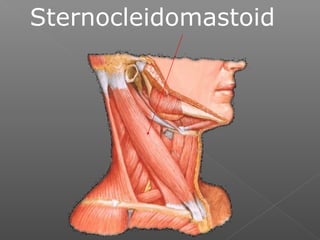
• Origin – 1) medial third of the clavicle
(clavicular head)
2) manubrium (sternal head)
 • Insertion – mastoid process
 • Nerve supply – spinal accessory nerve (CN
 XI)
 • Blood supply –
1) occipital a. or direct from ECA
2) superior thyroid a.
3) transverse cervical a.
Sternocleidomastoid
  Function – turns head toward opposite side
 and tilts head toward the ipsilateral shoulder
 • Surgical considerations

– Leave overlying fascia (superficial layer of deep
   cervical fascia down)
– Lateral retraction exposes the submuscular recess
• Origin – upper border of the scapula
• Insertion –
 1) via the intermediate tendon onto the clavicle and
   first rib
 2) hyoid bone lateral to the sternohyoid muscle
 • Blood supply – Inferior thyroid a.
 • Function –
 1) depress the hyoid
2) tense the deep cervical fascia
  Surgical considerations
 – Absent in 10% of individuals
 – Landmark demarcating level III from IV
 – Inferior belly lies superficial to

• The brachial plexus
• Phrenic nerve
• Transverse cervical vessels
 – Superior belly lies superficial to

• IJV
  • Origin –
1) medial 1/3 of the sup. Nuchal line
2) external occipital protuberance
3) ligamentum nuchae
4) spinous process of C7 and T1-T12
 • Insertion –
1) lateral 1/3 of the clavicle
2) acromion process
3) spine of the scapula
 • Function – elevate and rotate the scapula and
stabilize the shoulder
   Surgical considerations
   – Posterior limit of Level V neck dissection
   – Denervation results in shoulder drop and winged
    scapula
• Origin – digastric fossa of the mandible (at the
   symphyseal border
• Insertion –
1) hyoid bone via the intermediate tendon
2) mastoid process
• Function –
1) elevate the hyoid bone
2) depress the mandible (assists lateral pterygoid)
  – Posterior belly is superficial to:
• ECA
• Hypoglossal nerve
• ICA
• IJV
 – Anterior belly
• Landmark for identification of mylohyoid for
   dissection of the submandibular triangle
Division of the neck
Anterior triangle

Suprahyoid region: submental triangle
                     submandibular triangle
Infrahyoid region: muscular triangle
                       carotid triangle
Posterior triangle
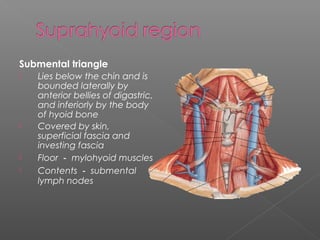
Submental triangle
   Lies below the chin and is
    bounded laterally by
    anterior bellies of digastric,
    and inferiorly by the body
    of hyoid bone
   Covered by skin,
    superficial fascia and
    investing fascia
   Floor - mylohyoid muscles
   Contents - submental
    lymph nodes
Suprahyoid muscles


                  stylohyoid
                  digastric (anterior
                    and posterior belly)


mylohyoid
Submandibular triangle
   Bounded by anterior and posterior bellies of digastric
    and lower border of the body of the mandible
   Covered by skin, superficial fascia, platysma and
    investing fascia
   Floor - mylohyoid, hyoglossus and middle
    constrictor of pharynx
   Contents - submandibular gland, facial
      a., v., hypoglossal n. and v., lingual n.,
    submandibular ganglion and submandibular lymph
    nodes
Carotid triangle
    sternocleidomastoid,
    superior belly of omohyoid
    and posterior belly of
    digastic muscles
   Covered by skin, superficial
    fascia, platysma and
    investing fascia
   Floor - prevertebral fascia
    and lateral wall of pharynx
   Contents - common
    carotid a. and its branches,
    internal jugular v. and its
    tributaries, hypoglossal n.
    with its descending
    branches, the accessory
    and vagus nerves, and part
    of the chain of deep
    cervical lymph nodes
Muscular triangle
   Bounded by midline of the
    neck, superior belly of the
    omohyoid and anterior
    border of the
    sternocleidomastoid.
   Covered by skin, superficial
    fascia, platysma, anterior
    jugular v., coutaneous n. and
    investing fascia
   Floor - prevertebral fascia
   Contents - sternohyoid,
    sternothyroid, thyrohyoid,
    thyroid gland, parathyroid
    gland, cervical part of
    trachea and esophagus
 Bounded by
  posterior border of
  sternocleidomastoid,
  anterior border of
  trapezius and middle
  third of clavicle
 Divided by inferior
  belly of omohyoid
  into occipital and
  supraclavicular
  triangles
   Arteries:
     Subclavian (3rd part)
     Superficial cervical &
       suprascapular
       (branches of
       thyrocervical trunk, a
       branch of 1st part of
       subclavian artery
     Occipital, a branch
       of external carotid
       artery
   Nerves:
     Branches of
     cervical
     plexus

     Spinal part of
     accessory
     nerve


     Brachial
     plexus
Occipital triangle
   Bounded by posterior
    border of
    sternocleidomastoid,
    anterior border of
    trapezius and superior
    border of inferior belly of
    omohyoid
   Covered by skin,
    superficial fascia, and
    investing fascia
   Floor - prevertebral
    fascia and scalenus
    anterior, scalenus medius,
    scalenus posterior,
    splenius capitis and
    levator scapulae
   Contents

    › Accessory n. - emerges above the middle of
      the posterior border of sternocleidomastoid and
      crosses the occipital triangle to trapezius
    › Cervical and brachial PLEXUS
Supraclavicular triangle
 Bounded by posterior
  border of
  sternocleidomastoid,
  inferior belly of omohyoid
  and middle third of
  clavicle
 Covered by skin,
  superficial fascia, and
  investing fascia
 Floor - prevertebral
  fascia and inferior parts of
  scalenus
 Contents
   › Subclavian v. and
     venous angle
   › Subclavian a.
   › Brachial plexus
   Most commonly injury
    dissection level Ib
   Landmarks:
    › 1cm anterior and inferior to
      angle of mandible
    › Mandibular notch
   Subplatysmal
   Deep to fascia of the
    submandibular gland
   Superficial to facial vein
   Motor nerve to the
    tongue
   • Cell bodies are in the
    Hypoglossal nucleus of
    the
   Medulla oblongata
   • Exits the skull via the
    hypoglossal canal
   • Lies deep to the IJV,
    ICA, CN IX, X, and XI
  • Curves 90 degrees and passes between the IJV
   and ICA
– Surrounded by venous plexus
 • Extends upward along hyoglossus muscle and
   into the genioglossus to the tip of the tongue.
 Iatrogenic injury
 – Most common site - floor of the submandibular
   triangle, just deep to the duct
   Penetrates deep surface of
    the SCM
   Exits posterior surface of
    SCM deep to Erb’s point
   Traverses the posterior                                         Accessory n. (XI)


    triangle on the levator    Hypoglossal n. (XII)


    scapulae
                                     Ansa cervicalis
   Enters the trapezius about 5
    cm above the clavicle
                                       Vagus n. (X)


                                                       Phrenic n.
   CN XI – Relationship with the IJV
   Crosses the IJV
   • Crosses lateral to the transverse process of
       the atlas
   • Occipital artery crosses the nerve
   • Descends obliquely in level II (forms Level IIa and
    IIb
   Developed by Memorial Sloan-Kettering
    Cancer Center
    Ease and uniformity in describing
    regional nodal involvement in cancer of
    the head and neck
LYMPH NODES acts as a barrier to the
 spread of the disease .

                     Virchow in 1860
 CAN BE DIVIDED INTO;
a) SUPERFICIAL CHAIN OF LYMPH NODES…..
b) VERTICAL DEEP CHAIN OF LYMPH NODES
    This consists of nodes lying in relation to
  carotid sheath.These lie along the
  vessels,trachea,oesophagusand extend from
  base of skull to root of neck.
1.   Submental
2.   Submandibular
3.   Parotid / tonsilar
4.   Preauricular
5.   Postauricular
6.   Occipital
7.   Anterior cervical superficial
     and deep
8.   Supraclavicular
9.   Posterior cervical
   Ia    Submental
   Ib    Submandibular

   IIa Upper jugular (Anterior to XI)
   IIb Upper jugular (Posterior to XI)

   III   Middle jugular

   IVa Lower jugular (Clavicular)
   IVb Lower jugular (Sternal)

   Va Posterior triangle (XI)
   Vb Posterior triangle (Transverse
    cervical)

   VI    Central compartment
   Submental triangle
    (Ia)
    › Anterior digastric
    › Hyoid
    › Mylohyoid

   Submandibular
    triangle (Ib)
    › Anterior and posterior
      digastric
    › Mandible.
   Ia
    ›    Chin
    ›    Lower lip
    ›    Anterior floor of mouth
    ›    Mandibular incisors
    ›    Tip of tongue

   Ib
    ›    Oral Cavity
    ›    Floor of mouth
    ›    Oral tongue
    ›    Nasal cavity (anterior)
    ›    Face
   Upper Jugular Nodes
        Anterior  Lateral border of
         sternohyoid, posterior
         digastric and stylohyoid
        Posterior  Posterior border
         of SCM
        Skull base
        Hyoid bone
        Carotid bifurcation


   Level IIa anterior to XI
   Level IIb posterior to XI
   Oral Cavity
   Nasal Cavity
   Nasopharynx
   Oropharynx
   Larynx
   Hypopharynx
   Parotid
   Middle jugular nodes
    › Anterior  Lateral border of
      sternohyoid
    › Posterior  Posterior border
      of SCM
    › Inferior border of level II
    › Cricoid cartilage lower
      border
   Oral cavity
   Nasopharynx
   Oropharynx
   Hypopharynx
   Larynx
   Lower jugular nodes
    › Anterior  Lateral border
        of sternohyoid
    ›   Posterior  Posterior
        border of SCM
    ›   Cricoid cartilage lower
        border
    ›   Omohyoid muscle
    ›   Clavicle
   Hypopharynx
   Larynx
   Thyroid
   Cervical esophagus
   Posterior triangle of neck
    › Posterior border of SCM
    › Clavicle
    › Anterior border of trapezius
    › Va Spinal accessory
      nodes
    › Vb  Transverse cervical
      artery nodes
    › Supraclavicular nodes
   Nasopharynx
   Oropharynx
   Posterior neck and scalp
   Anterior compartment
    › Hyoid
    › Suprasternal notch
    › Medial border of carotid
      sheath
    › Perithyroidal lymph nodes
    › Paratracheal lymph
      nodes
    › Precricoid (Delphian)
      lymph node
   Thyroid
   Larynx (glottic and subglottic)
   Pyriform sinus apex
   Cervical esophagus
Face and Scalp Anterior                  Facial, Ib
                 Lateral                 Parotid
                 Posterior               Occipital, V
Eyelids          Medial                  Ib
                 Lateral                 Parotid, II
Chin                                     Ia, Ib, II
External Ear     Anterior                Parotid, II
                 Posterior               Post auricular, II, V
Middle Ear                               Parotid, II
Floor of mouth   Anterior                Ia, Ib, IIa > IIb
                 Lower incisors          Ia, Ib, IIa > IIb
                 Lateral                 Ib, IIa > IIb, III
                 Teeth except incisors Ib, IIa > IIb, III
Nasal Cavity     Anterior                Ib
                 Posterior               Retropharyngeal, II, V
Nasal Cavity   Posterior      Retropharyngeal, II, V

Nasopharynx                   Retropharyngeal, II, III, V

Oropharynx                    IIb > IIa, III, IV, V

Larynx         Supraglottic IIa > IIb, III, IV

               Subglottic     VI, IV
Cervical
   esophagus                  IV, VI

Thyroid                       VI, IV, V, Mediastinal

Tongue         Tip            Ia, Ib, IIa > IIb, III, IV

               Lateral        Ib, IIa > IIb, III, IV
  • “N” classification – AJCC (1997)
 • Consistent for all mucosal sites except the
 nasopharynx
 • Thyroid and nasopharynx have different staging
   based on tumor behavior and prognosis
 • Based on extent of disease prior to first treatment
   Nx: Regional lymph nodes cannot be
    assessed.


   N0: No regional lymph node metastases.


   N1: Single ipsilateral lymph node, < 3 cm
   N2a: Single ipsilateral lymph node 3 to 6
    cm
   N2b: Multiple ipsilateral lymph nodes > 6
    cm
   N2c: Bilateral or contralateral nodes >
    6cm


   N3: Metastases > 6 cm
   • Standardized until 1991
   • Academy’s Committee for Head and
    Neck Surgery and Oncology publicized
    standard classification system
  Academy’s classification
 – Based on 4 concepts

• 1) RND is the standard basic procedure for cervical
   lymphadenectomy against which all other
   modifications are compared

• 2) Modifications of the RND which include
   preservation of any non-lymphatic structures are
   referred to as modified radical neck dissection
  (MRND)
   Academy’s classification

• 3) Any neck dissection that preserves one or more
  groups or levels of lymph nodes is referred to as a
  selective neck dissection (SND)


• 4) An extended neck dissection refers to the
   removal of additional lymph node groups or non-
   lymphatic structures relative to the RND
  Academy’s classification(1991)
– 1) Radical neck dissection (RND)
– 2) Modified radical neck dissection (MRND)
– 3) Selective neck dissection (SND)
 • Supra-omohyoid type
 • Lateral type
 • Posterolateral type
 • Anterior compartment type

– 4) Extended radical neck dissection
   Medina classification (1989)

 – Comprehensive neck dissection
 • Radical neck dissection
 • Modified radical neck dissection

 – Type I (XI preserved)
 – Type II (XI, IJV preserved)
 – Type III (XI, IJV, and SCM preserved)
 – Selective neck dissection
  Spiro’s classification
 – Radical (4 or 5 node levels resected)
 • Conventional radical neck dissection
 • Modified radical neck dissection
 • Extended radical neck dissection
 • Modified and extended radical neck dissection
 – Selective (3 node levels resected)
 • SOHND
 • Jugular dissection (Levels II-IV)
  -• Any other 3 node levels resected
 – Limited (no more than 2 node levels resected)
 • Paratracheal node dissection
 • Mediastinal node dissection
 • Any other 1 or 2 node levels resected
   1. Presence of clinically positive N1, N2a,
    N2b & N3 nodes
     Treatment of No neck is still a
    controversy.
   2. Extra nodal spread (including skin
    involvement)
   3. Recurrence after RT treatment
   1. Uncontrolled primary lesion
   2. Involvement of internal / common
    carotid artery
   3. Presence of distant metastasis.
   4. Poor anaesthetic risk patient.
   TYPES
   - Apron incision
   -Half apron incision
   -Conley incision
   -Double Y incision
   -H incision
   -Macfee incision
   - Y incision
   -Modified Schobinger incision
   -Schobinger
 
   1.Good exposure of the neck and
    primary disease.
   2. Ensure viability of the skin flaps. Avoid
    acute angles
   3. Protect carotid artery even in the
    cases of wound infection.
   4. Facilitate reconstruction Example, if
    pectoral muscle is used a lower limb
    should be near the clavicle to enable
    flap accommodation.
   5. It should be cosmetically acceptable.
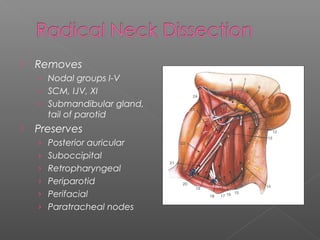
   Removes
    › Nodal groups I-V
    › SCM, IJV, XI
    › Submandibular gland,
      tail of parotid
   Preserves
    › Posterior auricular
    › Suboccipital
    › Retropharyngeal
    › Periparotid
    › Perifacial
    › Paratracheal nodes
   Removes
    › Nodal groups I-V
   Preserves
    › SCM, IJV, XI (any
      combination)


    › TYPE A MRND
   Three types (Medina 1989) commonly referred to
    not specifically named by committee.

• Type I: Preservation of SAN
• Type II: Preservation of SAN and IJV
• Type III: Preservation of SAN, IJV, and SCM
   ( “Functional neck dissection”)
  • Indications
 – Clinically obvious lymph node metastases
– SAN not involved by tumor
–Intraoperative decision
   • Indications

– Rarely planned
– Intraoperative tumor found adherent to the
   SCM, but not IJV and SAN
  • Rationale
– Suarez (1963) – necropsy and surgery specimens of
   larynx and hypopharynx – lymph nodes do not
   share the same adventitia as adjacent BV’s
– Nodes not within muscular aponeurosis or glandular
   capsule (submandibular gland)
– Sharpe (1981) showed ) 0% involvement of the SCM
   in 98 RND specimens despite 73 have nodal
   metastases
 – Survival approximates MRND Type I assuming IJV,
   and SCM not involved
 Widely accepted in Europe
• Neck dissection of choice for N0 neck
  Rationale
– Reduce postsurgical shoulder pain and
   shoulder dysfunction
– Improve cosmetic outcome
– Reduce likelihood of bilateral IJV
   resection - Contralateral neck
   involvement
  Definition
– Cervical lymphadenectomy with
   preservation of one or more lymph node
   groups
– Four common subtypes:
 • Supraomohyoid neck dissection
 • Posterolateral neck dissection
 • Lateral neck dissection
 • Anterior neck dissection
  Also known as an elective neck dissection
• Rate of occult metastasis in clinically negative neck
   20-30%
• Indication: primary lesion with 20% or greater risk of
   occult metastasis
• Studies by Fisch and Sigel (1964) demonstrated
   predictable routes of lymphatic spread from
   mucosal surfaces of the H&N
• Need for post-op RT
• Most commonly performed SND
• Definition
 – En bloc removal of cervical lymph node groups I-
   III
 – Posterior limit is the cervical plexus and posterior
   border of the SCM
 – Inferior limit is the omohyoid muscle overlying the
   IJV
  Indications
– Oral cavity carcinoma with N0 neck
 • Boundaries – Vermillion border of lips to
   junction of hard and soft palate,
   circumvallate papillae
 • Subsites - Lips, buccal mucosa, upper and
   lower
  alveolar ridges, retromolar trigone, hard
   palate, and anterior 2/3s of the tongue and
   FOM
– Medina recommends SOHND with T2-T4 NO
   or TX N1 (palpable node is <3cm, mobile,
   and in levels I or II)
Bilateral SOHND
 • Anterior tongue
 • Oral tongue and FOM that approach the midline

 – SOHND + parotidectomy
 • Cutaneous SCCA of the cheek
 • Melanoma (Stage I – 1.5 to 4mm) of the cheek

• Byers does not advocate elective neck dissection
   for buccal carcinoma
 – Adjuvant RT given to patients with > 2- 4 positive
   nodes +/- ECS.
• Definition
 – En bloc removal of the jugular lymph
  nodes including Levels II-IV.
 Indications
 – N0 neck in carcinomas of the oropharynx,
  hypopharynx, supraglottis, and larynx
  • Definition
– En bloc excision of lymph bearing tissues in
   Levels II-IV and additional node groups –
   suboccipital and postauricular.
 Indications
– Cutaneous malignancies
• Melanoma
• Squamous cell carcinoma
• Merkel cell carcinoma
– Soft tissue sarcomas of the scalp and neck
   • Definition
   – En bloc removal of lymph structures in
    Level VI
   • Perithyroidal nodes
   • Pretracheal nodes
   • Precricoid nodes (Delphian)
   • Paratracheal nodes along recurrent
    nerves
   – Limits of the dissection are the hyoid
    bone, suprasternal notch and carotid
    sheaths
 Indications
 – Selected cases of thyroid carcinoma
 – Parathyroid carcinoma
 – Subglottic carcinoma
 – Laryngeal carcinoma with subglottic
  extension
 – CA of the cervical esophagus
   • Definition
   – Any previous dissection which includes removal
    of one or more additional lymph node groups
    and/or non-lymphatic structures.
   – Usually performed with N+ necks in MRND or RND
    when metastases invade structures usually
    preserved
   Indications
   – Carotid artery invasion
   – Other examples:
   • Resection of the hypoglossal nerve resection or
    digastric muscle,

   • dissection of mediastinal nodes and central
    compartment for subglottic involvement, and

   • removal of retropharyngeal lymph nodes for
    tumors originating in the pharyngeal walls.
   SUPERSELECTIVE NECK DISSECTION OF
    HEAD AND NECK cancer –
            Yet to come
   4 TYPES
-   INTRA OP
-   IMMEDIATE POST OP
-   LATE POST OP
-   DELAYED COMPLICATIONS
 Inadequate planning
 Inadvertent injury to local blood vessels
  and nerves .
-marginal mandibular N.
- Spinal accessory N.
- Cervical plexus
- Brachial plexus
- Thoracic duct injury .
   Haemorrhage: Needs evaluation of the
    extent of bleeding and occasionally
    may need re-exploration.
   Lymph leak: When the drainage is of
    milky fluid and is persistently high
    >100ml /day after 2days.A possibility of
    lymph leak has to be considered.
   Carotid blow out: A dreaded
    complication that occurs secondary to
    wound break down. If exposed the
    carotids have to be covered using
    vascularised flaps.
   Facial oedema: A common occurrence
    usually settles down in 4-6 weeks.
   Wound infection
   Fistulae
   Devitalisation of the reconstructed flap
   Dysphagia ( CN V,IX, X, XI)
   Shoulder weakness
   Trismus
   Pectoralis major myocutaneous flap
   Free fibula flap
   Deltoid muscle flap
   Forehead flap
   Cervical flap
   Radial forearm flap
   • Cervical metastasis in SCCA of the upper
    aerodigestive tract continues to portend a poor
    prognosis
   • Staging will help determine what type neck
    dissection should be performed
   • Unified classification of neck nodal levels and
    classification of neck dissection has to understood
    well.
   • Indications for neck dissection and type of neck
    dissection, especially in the N0 neck, is a still
    controversial
THANK YOU
            HAVE A NICE DAY

Neck dissections

  • 2.
    History Of CANCER  Anatomy of HEAD & NECK  LYMPH NODE levels  Staging of CANCER  NECK DISSECTIONS  COMPLICATIONS
  • 4.
    1880  Kocher advocates wide margin lymphadenectomy  1881  Kocher and Packard recommend dissection of submandibular triangle for lingual cancer  1885  Butlin questions RND for oral N 0 disease  1888  Jawdynski describes en bloc resection with resection of carotid, IJV, SCM. Ferlito, A et al. Neck Dissection: past, present and future? J. Laryngol Otol. 2005 (1) 1-6.
  • 5.
    1901  Solis-Cohen advocate lymphadenectomy for N0 laryngeal CA  1905 -1906  Crile describes en bloc resection in JAMA  1926  Bartlett and Callander advocate preservation of XI, IJV, SCM, platysma, stylohyoid, digastric  1933  Blair and Brown advocate removal of XI. Ferlito, A et al. Neck Dissection: past, present and future? J. Laryngol Otol. 2005 (1) 1-6.
  • 6.
    1951  Martin advocates Radical Neck Dissection after analysis of 1450 cases › Advocated RND for N+ cases.  1952 – Suarez describes a functional neck dissection › Preservation of SCM, omohyoid, submandibular gland, IJV, XI. › Enables protection of carotid.  1960’s – MD Anderson advocate selective ND of highest risk nodal basins  1967 - Bocca and Pignataro describe the “functional neck dissection”  1975 – Bocca establishes oncologic safety of the FND compared to the RND Ferlito, A et al. Neck Dissection: past, present and future? J. Laryngol Otol. 2005 (1) 1-6.
  • 8.
    The region of the body that lies between:  The LOWER BORDER OF THE MANDIBLE&  The SUPRASTERNAL NOTCH and the UPPER BORDER OF CLAVICLE.
  • 9.
    • Superficial cervicalfascia • Deep cervical fascia  – Superficial layer • SCM, strap muscles, trapezius  – Middle or Visceral Layer • Thyroid • Trachea • esophagus  – Deep layer (also prevertebral fascia) • Vertebral muscles • Phrenic nerve
  • 11.
    Sup. thyroid Ext. jugular Int. jugular Middle thyroid Inf. thyroid Ant. jugular
  • 12.
    • Origin –fascia overlying the pectoralis major and deltoid muscle • Insertion – 1) depression muscles of the corner of the mouth, 2) the mandible, and 3) the SMAS layer of the face • Function – 1) wrinkles the the neck 2) depresses the corner of the mouth 3) increases the diameter of the neck 4) assists in venous return
  • 13.
  • 14.
    platysma Sternoclei- domastoid
  • 15.
    Surgical considerations  – Increases blood supply to skin flaps  – Absent in the midline of the neck  – Fibers run in an opposite direction to the SCM
  • 18.
    pretracheal fascia Infrahyoid m. trachea esophagu thyroid s Internal jugular Pretracheal layer vein s.c. Common carotid m Carotid sheath a. Vagus n. Buccopharynge scalenus al fascia Investing layer Prevertebral Trapezius layer
  • 19.
    • Origin –1) medial third of the clavicle (clavicular head) 2) manubrium (sternal head)  • Insertion – mastoid process  • Nerve supply – spinal accessory nerve (CN XI)  • Blood supply – 1) occipital a. or direct from ECA 2) superior thyroid a. 3) transverse cervical a.
  • 20.
  • 21.
     Function– turns head toward opposite side and tilts head toward the ipsilateral shoulder  • Surgical considerations – Leave overlying fascia (superficial layer of deep cervical fascia down) – Lateral retraction exposes the submuscular recess
  • 22.
    • Origin –upper border of the scapula • Insertion – 1) via the intermediate tendon onto the clavicle and first rib 2) hyoid bone lateral to the sternohyoid muscle  • Blood supply – Inferior thyroid a.  • Function – 1) depress the hyoid 2) tense the deep cervical fascia
  • 24.
     Surgicalconsiderations  – Absent in 10% of individuals  – Landmark demarcating level III from IV  – Inferior belly lies superficial to • The brachial plexus • Phrenic nerve • Transverse cervical vessels  – Superior belly lies superficial to • IJV
  • 25.
     •Origin – 1) medial 1/3 of the sup. Nuchal line 2) external occipital protuberance 3) ligamentum nuchae 4) spinous process of C7 and T1-T12  • Insertion – 1) lateral 1/3 of the clavicle 2) acromion process 3) spine of the scapula  • Function – elevate and rotate the scapula and stabilize the shoulder
  • 27.
    Surgical considerations  – Posterior limit of Level V neck dissection  – Denervation results in shoulder drop and winged scapula
  • 28.
    • Origin –digastric fossa of the mandible (at the symphyseal border • Insertion – 1) hyoid bone via the intermediate tendon 2) mastoid process • Function – 1) elevate the hyoid bone 2) depress the mandible (assists lateral pterygoid)
  • 30.
     –Posterior belly is superficial to: • ECA • Hypoglossal nerve • ICA • IJV  – Anterior belly • Landmark for identification of mylohyoid for dissection of the submandibular triangle
  • 31.
    Division of theneck Anterior triangle Suprahyoid region: submental triangle submandibular triangle Infrahyoid region: muscular triangle carotid triangle Posterior triangle
  • 33.
    Submental triangle  Lies below the chin and is bounded laterally by anterior bellies of digastric, and inferiorly by the body of hyoid bone  Covered by skin, superficial fascia and investing fascia  Floor - mylohyoid muscles  Contents - submental lymph nodes
  • 34.
    Suprahyoid muscles stylohyoid digastric (anterior and posterior belly) mylohyoid
  • 35.
    Submandibular triangle  Bounded by anterior and posterior bellies of digastric and lower border of the body of the mandible  Covered by skin, superficial fascia, platysma and investing fascia  Floor - mylohyoid, hyoglossus and middle constrictor of pharynx  Contents - submandibular gland, facial a., v., hypoglossal n. and v., lingual n., submandibular ganglion and submandibular lymph nodes
  • 37.
    Carotid triangle sternocleidomastoid, superior belly of omohyoid and posterior belly of digastic muscles  Covered by skin, superficial fascia, platysma and investing fascia  Floor - prevertebral fascia and lateral wall of pharynx  Contents - common carotid a. and its branches, internal jugular v. and its tributaries, hypoglossal n. with its descending branches, the accessory and vagus nerves, and part of the chain of deep cervical lymph nodes
  • 38.
    Muscular triangle  Bounded by midline of the neck, superior belly of the omohyoid and anterior border of the sternocleidomastoid.  Covered by skin, superficial fascia, platysma, anterior jugular v., coutaneous n. and investing fascia  Floor - prevertebral fascia  Contents - sternohyoid, sternothyroid, thyrohyoid, thyroid gland, parathyroid gland, cervical part of trachea and esophagus
  • 39.
     Bounded by posterior border of sternocleidomastoid, anterior border of trapezius and middle third of clavicle  Divided by inferior belly of omohyoid into occipital and supraclavicular triangles
  • 40.
    Arteries:  Subclavian (3rd part)  Superficial cervical & suprascapular (branches of thyrocervical trunk, a branch of 1st part of subclavian artery  Occipital, a branch of external carotid artery
  • 41.
    Nerves:  Branches of cervical plexus  Spinal part of accessory nerve  Brachial plexus
  • 42.
    Occipital triangle  Bounded by posterior border of sternocleidomastoid, anterior border of trapezius and superior border of inferior belly of omohyoid  Covered by skin, superficial fascia, and investing fascia  Floor - prevertebral fascia and scalenus anterior, scalenus medius, scalenus posterior, splenius capitis and levator scapulae
  • 43.
    Contents › Accessory n. - emerges above the middle of the posterior border of sternocleidomastoid and crosses the occipital triangle to trapezius › Cervical and brachial PLEXUS
  • 44.
    Supraclavicular triangle  Boundedby posterior border of sternocleidomastoid, inferior belly of omohyoid and middle third of clavicle  Covered by skin, superficial fascia, and investing fascia  Floor - prevertebral fascia and inferior parts of scalenus  Contents › Subclavian v. and venous angle › Subclavian a. › Brachial plexus
  • 45.
    Most commonly injury dissection level Ib  Landmarks: › 1cm anterior and inferior to angle of mandible › Mandibular notch  Subplatysmal  Deep to fascia of the submandibular gland  Superficial to facial vein
  • 47.
    Motor nerve to the tongue  • Cell bodies are in the Hypoglossal nucleus of the  Medulla oblongata  • Exits the skull via the hypoglossal canal  • Lies deep to the IJV, ICA, CN IX, X, and XI
  • 48.
     •Curves 90 degrees and passes between the IJV and ICA – Surrounded by venous plexus  • Extends upward along hyoglossus muscle and into the genioglossus to the tip of the tongue.  Iatrogenic injury  – Most common site - floor of the submandibular triangle, just deep to the duct
  • 49.
    Penetrates deep surface of the SCM  Exits posterior surface of SCM deep to Erb’s point  Traverses the posterior Accessory n. (XI) triangle on the levator Hypoglossal n. (XII) scapulae Ansa cervicalis  Enters the trapezius about 5 cm above the clavicle Vagus n. (X) Phrenic n.
  • 50.
    CN XI – Relationship with the IJV
  • 51.
    Crosses the IJV  • Crosses lateral to the transverse process of the atlas  • Occipital artery crosses the nerve  • Descends obliquely in level II (forms Level IIa and IIb
  • 54.
    Developed by Memorial Sloan-Kettering Cancer Center  Ease and uniformity in describing regional nodal involvement in cancer of the head and neck
  • 55.
    LYMPH NODES actsas a barrier to the spread of the disease . Virchow in 1860
  • 56.
     CAN BEDIVIDED INTO; a) SUPERFICIAL CHAIN OF LYMPH NODES….. b) VERTICAL DEEP CHAIN OF LYMPH NODES This consists of nodes lying in relation to carotid sheath.These lie along the vessels,trachea,oesophagusand extend from base of skull to root of neck.
  • 57.
    1. Submental 2. Submandibular 3. Parotid / tonsilar 4. Preauricular 5. Postauricular 6. Occipital 7. Anterior cervical superficial and deep 8. Supraclavicular 9. Posterior cervical
  • 58.
    Ia Submental  Ib Submandibular  IIa Upper jugular (Anterior to XI)  IIb Upper jugular (Posterior to XI)  III Middle jugular  IVa Lower jugular (Clavicular)  IVb Lower jugular (Sternal)  Va Posterior triangle (XI)  Vb Posterior triangle (Transverse cervical)  VI Central compartment
  • 60.
    Submental triangle (Ia) › Anterior digastric › Hyoid › Mylohyoid  Submandibular triangle (Ib) › Anterior and posterior digastric › Mandible.
  • 61.
    Ia › Chin › Lower lip › Anterior floor of mouth › Mandibular incisors › Tip of tongue  Ib › Oral Cavity › Floor of mouth › Oral tongue › Nasal cavity (anterior) › Face
  • 62.
    Upper Jugular Nodes  Anterior  Lateral border of sternohyoid, posterior digastric and stylohyoid  Posterior  Posterior border of SCM  Skull base  Hyoid bone  Carotid bifurcation  Level IIa anterior to XI  Level IIb posterior to XI
  • 63.
    Oral Cavity  Nasal Cavity  Nasopharynx  Oropharynx  Larynx  Hypopharynx  Parotid
  • 64.
    Middle jugular nodes › Anterior  Lateral border of sternohyoid › Posterior  Posterior border of SCM › Inferior border of level II › Cricoid cartilage lower border
  • 65.
    Oral cavity  Nasopharynx  Oropharynx  Hypopharynx  Larynx
  • 66.
    Lower jugular nodes › Anterior  Lateral border of sternohyoid › Posterior  Posterior border of SCM › Cricoid cartilage lower border › Omohyoid muscle › Clavicle
  • 67.
    Hypopharynx  Larynx  Thyroid  Cervical esophagus
  • 68.
    Posterior triangle of neck › Posterior border of SCM › Clavicle › Anterior border of trapezius › Va Spinal accessory nodes › Vb  Transverse cervical artery nodes › Supraclavicular nodes
  • 69.
    Nasopharynx  Oropharynx  Posterior neck and scalp
  • 70.
    Anterior compartment › Hyoid › Suprasternal notch › Medial border of carotid sheath › Perithyroidal lymph nodes › Paratracheal lymph nodes › Precricoid (Delphian) lymph node
  • 71.
    Thyroid  Larynx (glottic and subglottic)  Pyriform sinus apex  Cervical esophagus
  • 72.
    Face and ScalpAnterior Facial, Ib Lateral Parotid Posterior Occipital, V Eyelids Medial Ib Lateral Parotid, II Chin Ia, Ib, II External Ear Anterior Parotid, II Posterior Post auricular, II, V Middle Ear Parotid, II Floor of mouth Anterior Ia, Ib, IIa > IIb Lower incisors Ia, Ib, IIa > IIb Lateral Ib, IIa > IIb, III Teeth except incisors Ib, IIa > IIb, III Nasal Cavity Anterior Ib Posterior Retropharyngeal, II, V
  • 73.
    Nasal Cavity Posterior Retropharyngeal, II, V Nasopharynx Retropharyngeal, II, III, V Oropharynx IIb > IIa, III, IV, V Larynx Supraglottic IIa > IIb, III, IV Subglottic VI, IV Cervical esophagus IV, VI Thyroid VI, IV, V, Mediastinal Tongue Tip Ia, Ib, IIa > IIb, III, IV Lateral Ib, IIa > IIb, III, IV
  • 75.
     •“N” classification – AJCC (1997)  • Consistent for all mucosal sites except the nasopharynx  • Thyroid and nasopharynx have different staging based on tumor behavior and prognosis  • Based on extent of disease prior to first treatment
  • 76.
    Nx: Regional lymph nodes cannot be assessed.  N0: No regional lymph node metastases.  N1: Single ipsilateral lymph node, < 3 cm
  • 77.
    N2a: Single ipsilateral lymph node 3 to 6 cm  N2b: Multiple ipsilateral lymph nodes > 6 cm  N2c: Bilateral or contralateral nodes > 6cm  N3: Metastases > 6 cm
  • 79.
    • Standardized until 1991  • Academy’s Committee for Head and Neck Surgery and Oncology publicized standard classification system
  • 80.
     Academy’sclassification  – Based on 4 concepts • 1) RND is the standard basic procedure for cervical lymphadenectomy against which all other modifications are compared • 2) Modifications of the RND which include preservation of any non-lymphatic structures are referred to as modified radical neck dissection (MRND)
  • 81.
    Academy’s classification • 3) Any neck dissection that preserves one or more groups or levels of lymph nodes is referred to as a selective neck dissection (SND) • 4) An extended neck dissection refers to the removal of additional lymph node groups or non- lymphatic structures relative to the RND
  • 82.
     Academy’sclassification(1991) – 1) Radical neck dissection (RND) – 2) Modified radical neck dissection (MRND) – 3) Selective neck dissection (SND)  • Supra-omohyoid type  • Lateral type  • Posterolateral type  • Anterior compartment type – 4) Extended radical neck dissection
  • 83.
    Medina classification (1989) – Comprehensive neck dissection  • Radical neck dissection  • Modified radical neck dissection – Type I (XI preserved) – Type II (XI, IJV preserved) – Type III (XI, IJV, and SCM preserved) – Selective neck dissection
  • 84.
     Spiro’sclassification – Radical (4 or 5 node levels resected)  • Conventional radical neck dissection  • Modified radical neck dissection  • Extended radical neck dissection  • Modified and extended radical neck dissection – Selective (3 node levels resected)  • SOHND  • Jugular dissection (Levels II-IV) -• Any other 3 node levels resected – Limited (no more than 2 node levels resected)  • Paratracheal node dissection  • Mediastinal node dissection  • Any other 1 or 2 node levels resected
  • 85.
    1. Presence of clinically positive N1, N2a, N2b & N3 nodes Treatment of No neck is still a controversy.  2. Extra nodal spread (including skin involvement)  3. Recurrence after RT treatment
  • 86.
    1. Uncontrolled primary lesion  2. Involvement of internal / common carotid artery  3. Presence of distant metastasis.  4. Poor anaesthetic risk patient.
  • 87.
    TYPES  - Apron incision  -Half apron incision  -Conley incision  -Double Y incision  -H incision  -Macfee incision  - Y incision  -Modified Schobinger incision  -Schobinger
  • 92.
       1.Good exposure of the neck and primary disease.  2. Ensure viability of the skin flaps. Avoid acute angles  3. Protect carotid artery even in the cases of wound infection.
  • 93.
    4. Facilitate reconstruction Example, if pectoral muscle is used a lower limb should be near the clavicle to enable flap accommodation.  5. It should be cosmetically acceptable.
  • 94.
    Removes › Nodal groups I-V › SCM, IJV, XI › Submandibular gland, tail of parotid  Preserves › Posterior auricular › Suboccipital › Retropharyngeal › Periparotid › Perifacial › Paratracheal nodes
  • 101.
    Removes › Nodal groups I-V  Preserves › SCM, IJV, XI (any combination) › TYPE A MRND
  • 104.
    Three types (Medina 1989) commonly referred to not specifically named by committee. • Type I: Preservation of SAN • Type II: Preservation of SAN and IJV • Type III: Preservation of SAN, IJV, and SCM ( “Functional neck dissection”)
  • 105.
     •Indications – Clinically obvious lymph node metastases – SAN not involved by tumor –Intraoperative decision
  • 106.
    • Indications – Rarely planned – Intraoperative tumor found adherent to the SCM, but not IJV and SAN
  • 107.
     •Rationale – Suarez (1963) – necropsy and surgery specimens of larynx and hypopharynx – lymph nodes do not share the same adventitia as adjacent BV’s – Nodes not within muscular aponeurosis or glandular capsule (submandibular gland) – Sharpe (1981) showed ) 0% involvement of the SCM in 98 RND specimens despite 73 have nodal metastases  – Survival approximates MRND Type I assuming IJV, and SCM not involved  Widely accepted in Europe • Neck dissection of choice for N0 neck
  • 108.
     Rationale –Reduce postsurgical shoulder pain and shoulder dysfunction – Improve cosmetic outcome – Reduce likelihood of bilateral IJV resection - Contralateral neck involvement
  • 109.
     Definition –Cervical lymphadenectomy with preservation of one or more lymph node groups – Four common subtypes:  • Supraomohyoid neck dissection  • Posterolateral neck dissection  • Lateral neck dissection  • Anterior neck dissection
  • 110.
     Alsoknown as an elective neck dissection • Rate of occult metastasis in clinically negative neck 20-30% • Indication: primary lesion with 20% or greater risk of occult metastasis • Studies by Fisch and Sigel (1964) demonstrated predictable routes of lymphatic spread from mucosal surfaces of the H&N • Need for post-op RT
  • 111.
    • Most commonlyperformed SND • Definition  – En bloc removal of cervical lymph node groups I- III – Posterior limit is the cervical plexus and posterior border of the SCM – Inferior limit is the omohyoid muscle overlying the IJV
  • 112.
     Indications –Oral cavity carcinoma with N0 neck  • Boundaries – Vermillion border of lips to junction of hard and soft palate, circumvallate papillae • Subsites - Lips, buccal mucosa, upper and lower alveolar ridges, retromolar trigone, hard palate, and anterior 2/3s of the tongue and FOM – Medina recommends SOHND with T2-T4 NO or TX N1 (palpable node is <3cm, mobile, and in levels I or II)
  • 113.
    Bilateral SOHND  •Anterior tongue  • Oral tongue and FOM that approach the midline – SOHND + parotidectomy  • Cutaneous SCCA of the cheek  • Melanoma (Stage I – 1.5 to 4mm) of the cheek • Byers does not advocate elective neck dissection for buccal carcinoma  – Adjuvant RT given to patients with > 2- 4 positive nodes +/- ECS.
  • 114.
    • Definition  –En bloc removal of the jugular lymph nodes including Levels II-IV.  Indications  – N0 neck in carcinomas of the oropharynx, hypopharynx, supraglottis, and larynx
  • 115.
     •Definition – En bloc excision of lymph bearing tissues in Levels II-IV and additional node groups – suboccipital and postauricular.  Indications – Cutaneous malignancies • Melanoma • Squamous cell carcinoma • Merkel cell carcinoma – Soft tissue sarcomas of the scalp and neck
  • 116.
    • Definition  – En bloc removal of lymph structures in Level VI  • Perithyroidal nodes  • Pretracheal nodes  • Precricoid nodes (Delphian)  • Paratracheal nodes along recurrent nerves  – Limits of the dissection are the hyoid bone, suprasternal notch and carotid sheaths
  • 117.
     Indications  –Selected cases of thyroid carcinoma  – Parathyroid carcinoma  – Subglottic carcinoma  – Laryngeal carcinoma with subglottic extension – CA of the cervical esophagus
  • 118.
    • Definition  – Any previous dissection which includes removal of one or more additional lymph node groups and/or non-lymphatic structures.  – Usually performed with N+ necks in MRND or RND when metastases invade structures usually preserved
  • 119.
    Indications  – Carotid artery invasion  – Other examples:  • Resection of the hypoglossal nerve resection or digastric muscle,  • dissection of mediastinal nodes and central compartment for subglottic involvement, and  • removal of retropharyngeal lymph nodes for tumors originating in the pharyngeal walls.
  • 120.
    SUPERSELECTIVE NECK DISSECTION OF HEAD AND NECK cancer – Yet to come
  • 121.
    4 TYPES - INTRA OP - IMMEDIATE POST OP - LATE POST OP - DELAYED COMPLICATIONS
  • 122.
     Inadequate planning Inadvertent injury to local blood vessels and nerves . -marginal mandibular N. - Spinal accessory N. - Cervical plexus - Brachial plexus - Thoracic duct injury .
  • 123.
    Haemorrhage: Needs evaluation of the extent of bleeding and occasionally may need re-exploration.  Lymph leak: When the drainage is of milky fluid and is persistently high >100ml /day after 2days.A possibility of lymph leak has to be considered.
  • 124.
    Carotid blow out: A dreaded complication that occurs secondary to wound break down. If exposed the carotids have to be covered using vascularised flaps.  Facial oedema: A common occurrence usually settles down in 4-6 weeks.
  • 125.
    Wound infection  Fistulae  Devitalisation of the reconstructed flap
  • 126.
    Dysphagia ( CN V,IX, X, XI)  Shoulder weakness  Trismus
  • 127.
    Pectoralis major myocutaneous flap  Free fibula flap  Deltoid muscle flap  Forehead flap  Cervical flap  Radial forearm flap
  • 128.
    • Cervical metastasis in SCCA of the upper aerodigestive tract continues to portend a poor prognosis  • Staging will help determine what type neck dissection should be performed  • Unified classification of neck nodal levels and classification of neck dissection has to understood well.  • Indications for neck dissection and type of neck dissection, especially in the N0 neck, is a still controversial
  • 130.
    THANK YOU HAVE A NICE DAY