Head and neck
Anatomy
Dr Anupama Soman
Blood vessels of head and
neck
Arterial & venous system
 Carry blood away from
heart
 Arteries carry
oxygenated blood
except
 Blood flow depends on
pumping action of heart
 No valves
 Branches of arteries
supplying adjacent areas
anastomose
 Carry blood to the heart
 Veins carry
deoxygenated blood
except
 Veins have got valves
 Two types of veins
 Superficial which are
close to the surface of
body & no
corresponding arteries
 Deep veins which are
deeper into the body
and travels along with
their corresponding
arteries
Arterial system Venous system
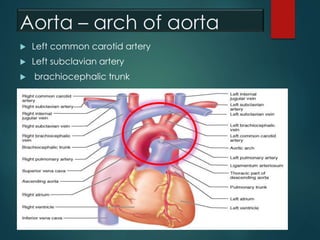
Aorta – arch of aorta
 Left common carotid artery
 Left subclavian artery
 brachiocephalic trunk
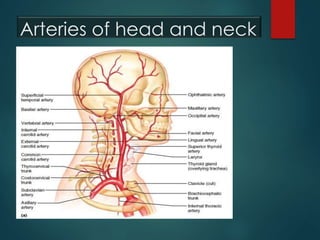
Arteries of head & neck
ARTERIES
1. Common carotid arteries
2. Subclavian artery
 CCA
ECA & its branches
ICA & its branches
 SUBCLAVIAN ARTERY
Vertebral Artery
ECA,ICA
 Branches of the External Carotid Artery (ECA)
 Branches in neck
STAPLe OF PAM ST
Superior Thyroid – thyroid & parathyroid glands
Ascending Pharyngeal – pharyngeal muscles
Lingual - tongue
Occipital – scalp
Facial - face
Posterior Auricular
Maxillary – maxilla and mandible
Superficial Temporal -scalp
 Branches of the Internal Carotid Artery (ICA)
No branches in neck and enters cranial cavity
Supplies brain, eyes, nose, scalp
OPAAM
Ophthalmic artery
Posterior Communicating
Ant Choroidal Artery
Ant cerebral Artery
Middle Cerebral Artery
Subclavian artery
 Rt SCA arises from brachiocephalic trunk
 Lt SCA arises directly from arch of aorta
 SCA gives its contribution to CNS through one of its
major branches,
vertebral artery – supplies CNS
Arteries of head and neck
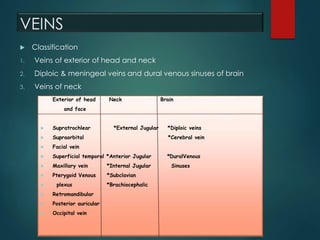
VEINS
 Classification
1. Veins of exterior of head and neck
2. Diploic & meningeal veins and dural venous sinuses of brain
3. Veins of neck
Exterior of head Neck Brain
and face
 Supratrochlear *External Jugular *Diploic veins
 Supraorbital *Cerebral vein
 Facial vein
 Superficial temporal *Anterior Jugular *DuralVenous
 Maxillary vein *Internal Jugular Sinuses
 Pterygoid Venous *Subclavian
 plexus *Brachiocephalic
 Retromandibular
 Posterior auricular
 Occipital vein
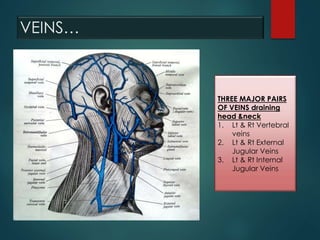
VEINS…
THREE MAJOR PAIRS
OF VEINS draining
head &neck
1. Lt & Rt Vertebral
veins
2. Lt & Rt External
Jugular Veins
3. Lt & Rt Internal
Jugular Veins
NERVE SUPPLY
Olfactory
Optic
Oculomotor
Trochlear
Trigeminal
Abducent
Facial
Vestibulocochlear
Glossopharyngeal
Vagus
Accessory
Hypoglossal
Cranial
nerves
C1-C8 CERVICAL NERVES
T1-T12 THORACIC NERVES
L1-L5 LUMBAR NERVES
S1-S5 SACRAL NERVES
COCCYGEAL (1PAIR)
Spinal
nerves
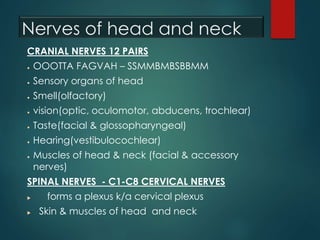
Nerves of head and neck
CRANIAL NERVES 12 PAIRS
● OOOTTA FAGVAH – SSMMBMBSBBMM
● Sensory organs of head
● Smell(olfactory)
● vision(optic, oculomotor, abducens, trochlear)
● Taste(facial & glossopharyngeal)
● Hearing(vestibulocochlear)
● Muscles of head & neck (facial & accessory
nerves)
SPINAL NERVES - C1-C8 CERVICAL NERVES
 forms a plexus k/a cervical plexus
 Skin & muscles of head and neck
Muscles of head and neck
 Muscles of facial expression
 Muscles of mastication
 Tongue muscles
 Extra ocular muscles
 Muscles of ear
 Neck muscles
 Muscles soft palate
 Muscles of pharynx
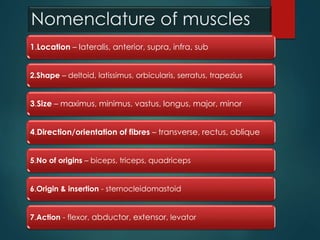
Nomenclature of muscles
1.Location – lateralis, anterior, supra, infra, sub
2.Shape – deltoid, latissimus, orbicularis, serratus, trapezius
3.Size – maximus, minimus, vastus, longus, major, minor
4.Direction/orientation of fibres – transverse, rectus, oblique
5.No of origins – biceps, triceps, quadriceps
6.Origin & insertion - sternocleidomastoid
7.Action - flexor, abductor, extensor, levator
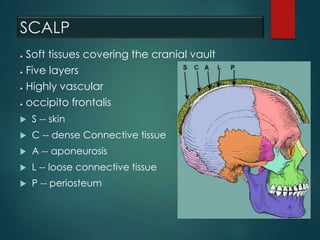
SCALP
● Soft tissues covering the cranial vault
● Five layers
● Highly vascular
● occipito frontalis
 S -- skin
 C -- dense Connective tissue
 A -- aponeurosis
 L -- loose connective tissue
 P -- periosteum
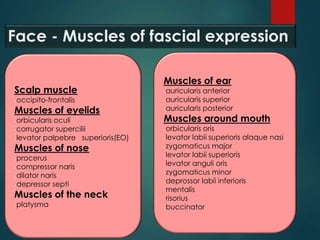
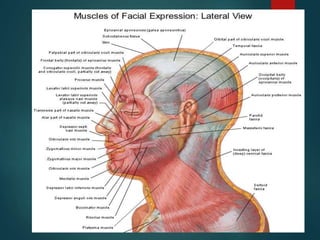
Face - Muscles of fascial expression
Scalp muscle
●occipito-frontalis
Muscles of eyelids
●orbicularis oculi
●corrugator supercilii
●levator palpebre superioris(EO)
Muscles of nose
●procerus
●compressor naris
●dilator naris
●depressor septi
Muscles of the neck
●platysma
Muscles of ear
●auricularis anterior
●auricularis superior
●auricularis posterior
Muscles around mouth
●orbicularis oris
●levator labii superioris alaque nasi
●zygomaticus major
●levator labii superioris
●levator anguli oris
●zygomaticus minor
●deprossor labii inferioris
●mentalis
●risorius
●buccinator
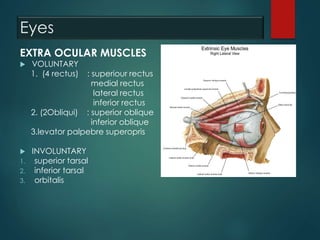
Eyes
EXTRA OCULAR MUSCLES
 VOLUNTARY
1. (4 rectus) : superiour rectus
medial rectus
lateral rectus
inferior rectus
2. (2Obliqui) : superior oblique
inferior oblique
3.levator palpebre superopris
 INVOLUNTARY
1. superior tarsal
2. inferior tarsal
3. orbitalis
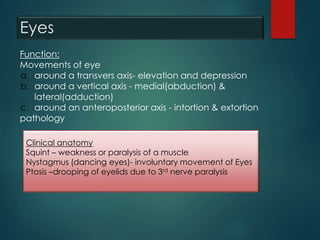
Function:
Movements of eye
a. around a transvers axis- elevation and depression
b. around a vertical axis - medial(abduction) &
lateral(adduction)
c. around an anteroposterior axis - intortion & extortion
pathology
Eyes
Clinical anatomy
Squint – weakness or paralysis of a muscle
Nystagmus (dancing eyes)- involuntary movement of Eyes
Ptosis –drooping of eyelids due to 3rd nerve paralysis
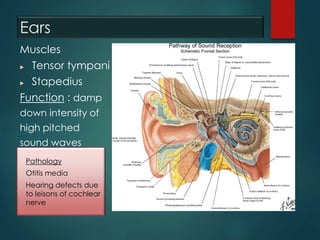
Ears
Muscles
 Tensor tympani
 Stapedius
Function : damp
down intensity of
high pitched
sound waves
● Pathology
● Otitis media
● Hearing defects due
to leisons of cochlear
nerve
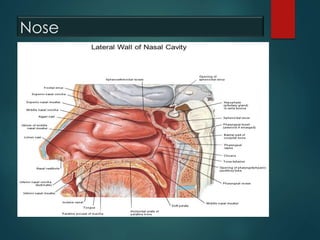
Nose
Paranasal sinuses
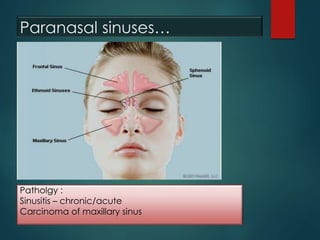
 Air filled cavities of skull bones, situated around nose
which are actually extensions of respiratory part of
nasal cavity& also open into the nasal cavity
 Functions : humidify the air, reduce the weight of
skull and resonance of voice
 Four paired sinuses
1. Frontal
2. Maxillary
3. Ethmoidal
4. Sphenoidal
Paranasal sinuses…
Patholgy :
Sinusitis – chronic/acute
Carcinoma of maxillary sinus
Mouth
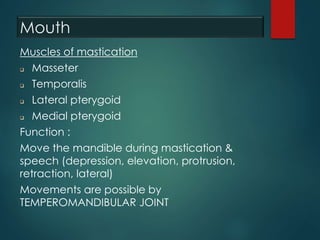
Muscles of mastication
 Masseter
 Temporalis
 Lateral pterygoid
 Medial pterygoid
Function :
Move the mandible during mastication &
speech (depression, elevation, protrusion,
retraction, lateral)
Movements are possible by
TEMPEROMANDIBULAR JOINT
Mouth …
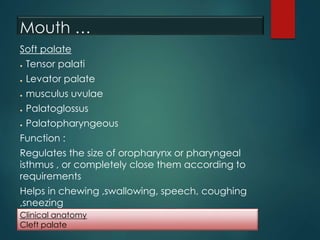
Soft palate
● Tensor palati
● Levator palate
● musculus uvulae
● Palatoglossus
● Palatopharyngeous
Function :
Regulates the size of oropharynx or pharyngeal
isthmus , or completely close them according to
requirements
Helps in chewing ,swallowing, speech, coughing
,sneezing
Clinical anatomy
Cleft palate
Tongue
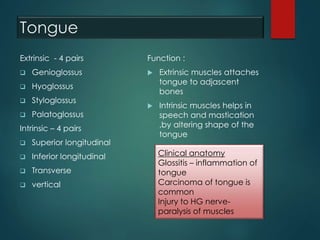
Extrinsic - 4 pairs
 Genioglossus
 Hyoglossus
 Styloglossus
 Palatoglossus
Intrinsic – 4 pairs
 Superior longitudinal
 Inferior longitudinal
 Transverse
 vertical
Function :
 Extrinsic muscles attaches
tongue to adjascent
bones
 Intrinsic muscles helps in
speech and mastication
,by altering shape of the
tongue
Clinical anatomy
Glossitis – inflammation of
tongue
Carcinoma of tongue is
common
Injury to HG nerve-
paralysis of muscles
Pharynx
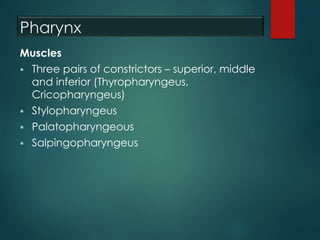
Muscles
 Three pairs of constrictors – superior, middle
and inferior (Thyropharyngeus,
Cricopharyngeus)
 Stylopharyngeus
 Palatopharyngeous
 Salpingopharyngeus
Neck
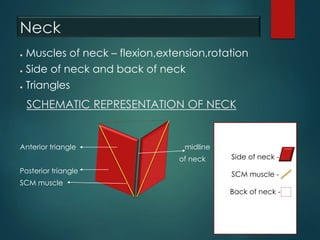
● Muscles of neck – flexion,extension,rotation
● Side of neck and back of neck
● Triangles
Anterior triangle midline
of neck
Posterior triangle
SCM muscle
SCHEMATIC REPRESENTATION OF NECK
Side of neck -
SCM muscle -
Back of neck -
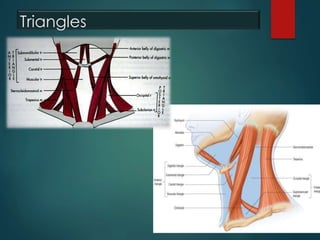
Triangles
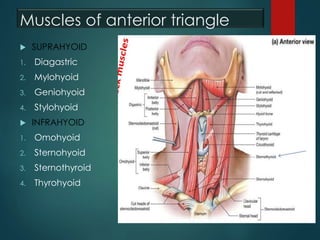
Muscles of anterior triangle
 SUPRAHYOID
1. Diagastric
2. Mylohyoid
3. Geniohyoid
4. Stylohyoid
 INFRAHYOID
1. Omohyoid
2. Sternohyoid
3. Sternothyroid
4. Thyrohyoid
Muscles of posterior triangle
 Platysma
 Splenius capitus
 Levator scapulae
 Scalenus (anterior, medius,posterior)
Muscles of back of neck
 Trapezius
 Splenius capitis, splenius cervicis
 Semispinalis capitis, semispinalis cervicis
 Longissimus capitis, longissimus cervicis
Larynx
Cartilagenous
Three paired(arytenoid, corniculate, cuneiform)&
three unpaired(thyroid, cricoid ,epiglottic) cartilages
Muscles of larynx:
 Cricothyroid
 Lateral and posterior cricoarytenoid
 Transverse and oblique arytenoid
 Aryepiglotticus
 Thyroarytenoid, thyroepiglotticus, vocalis
Function: movement of cartilages and abduction and
adduction of vocal cords producing sound
Pathology: laryngitis, characterised by hoarseness of voice
Thyroid and parathyroid glands
Thyroid gland
 an endocrine gland situated in the lower
part of the neck in the midline
 Regulates basal metabolic rate,stimulates
somatic and psychic growth & controls
Ca metabolism
Parathyroid gland
Two pairs of endocrine glands, lying on the
posterior border of tthyroid
Regulates Ca & P metabolism by secreting
parathormone
Thyroid and parathyroid glands
Pathology :
enlargement of thyroid- goitre
hyperthyroidism
hypothyroidism
benign & malignant tumors of the glands
hypoparathyroidism - tetany
hyperparathyroidism
Salivary glands
● Parotid - largest
● Submandibular
● Sublingual
● Minor – palatal , buccal
Clinical anatomy
Mumps – viral infection of parotid gland
Sialolithiasis
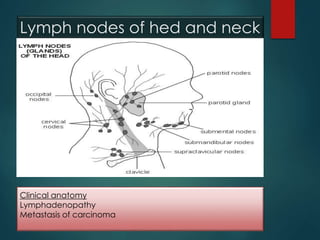
Lymph nodes of hed and neck
Clinical anatomy
Lymphadenopathy
Metastasis of carcinoma
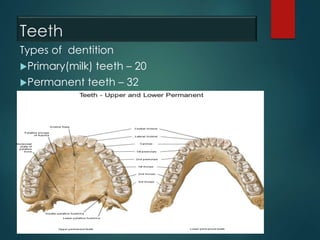
Teeth
Types of dentition
Primary(milk) teeth – 20
Permanent teeth – 32
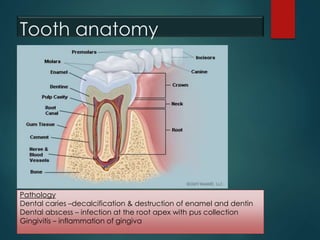
Tooth anatomy
Pathology
Dental caries –decalcification & destruction of enamel and dentin
Dental abscess – infection at the root apex with pus collection
Gingivitis – inflammation of gingiva
THANK YOU… 

Head and neck anatomy

  • 1.
  • 2.
    Blood vessels ofhead and neck
  • 3.
    Arterial & venoussystem  Carry blood away from heart  Arteries carry oxygenated blood except  Blood flow depends on pumping action of heart  No valves  Branches of arteries supplying adjacent areas anastomose  Carry blood to the heart  Veins carry deoxygenated blood except  Veins have got valves  Two types of veins  Superficial which are close to the surface of body & no corresponding arteries  Deep veins which are deeper into the body and travels along with their corresponding arteries Arterial system Venous system
  • 4.
    Aorta – archof aorta  Left common carotid artery  Left subclavian artery  brachiocephalic trunk
  • 5.
    Arteries of head& neck ARTERIES 1. Common carotid arteries 2. Subclavian artery  CCA ECA & its branches ICA & its branches  SUBCLAVIAN ARTERY Vertebral Artery
  • 6.
    ECA,ICA  Branches ofthe External Carotid Artery (ECA)  Branches in neck STAPLe OF PAM ST Superior Thyroid – thyroid & parathyroid glands Ascending Pharyngeal – pharyngeal muscles Lingual - tongue Occipital – scalp Facial - face Posterior Auricular Maxillary – maxilla and mandible Superficial Temporal -scalp  Branches of the Internal Carotid Artery (ICA) No branches in neck and enters cranial cavity Supplies brain, eyes, nose, scalp OPAAM Ophthalmic artery Posterior Communicating Ant Choroidal Artery Ant cerebral Artery Middle Cerebral Artery
  • 7.
    Subclavian artery  RtSCA arises from brachiocephalic trunk  Lt SCA arises directly from arch of aorta  SCA gives its contribution to CNS through one of its major branches, vertebral artery – supplies CNS
  • 8.
  • 9.
    VEINS  Classification 1. Veinsof exterior of head and neck 2. Diploic & meningeal veins and dural venous sinuses of brain 3. Veins of neck Exterior of head Neck Brain and face  Supratrochlear *External Jugular *Diploic veins  Supraorbital *Cerebral vein  Facial vein  Superficial temporal *Anterior Jugular *DuralVenous  Maxillary vein *Internal Jugular Sinuses  Pterygoid Venous *Subclavian  plexus *Brachiocephalic  Retromandibular  Posterior auricular  Occipital vein
  • 10.
    VEINS… THREE MAJOR PAIRS OFVEINS draining head &neck 1. Lt & Rt Vertebral veins 2. Lt & Rt External Jugular Veins 3. Lt & Rt Internal Jugular Veins
  • 11.
  • 12.
    Nerves of headand neck CRANIAL NERVES 12 PAIRS ● OOOTTA FAGVAH – SSMMBMBSBBMM ● Sensory organs of head ● Smell(olfactory) ● vision(optic, oculomotor, abducens, trochlear) ● Taste(facial & glossopharyngeal) ● Hearing(vestibulocochlear) ● Muscles of head & neck (facial & accessory nerves) SPINAL NERVES - C1-C8 CERVICAL NERVES  forms a plexus k/a cervical plexus  Skin & muscles of head and neck
  • 13.
    Muscles of headand neck  Muscles of facial expression  Muscles of mastication  Tongue muscles  Extra ocular muscles  Muscles of ear  Neck muscles  Muscles soft palate  Muscles of pharynx
  • 14.
    Nomenclature of muscles 1.Location– lateralis, anterior, supra, infra, sub 2.Shape – deltoid, latissimus, orbicularis, serratus, trapezius 3.Size – maximus, minimus, vastus, longus, major, minor 4.Direction/orientation of fibres – transverse, rectus, oblique 5.No of origins – biceps, triceps, quadriceps 6.Origin & insertion - sternocleidomastoid 7.Action - flexor, abductor, extensor, levator
  • 15.
    SCALP ● Soft tissuescovering the cranial vault ● Five layers ● Highly vascular ● occipito frontalis  S -- skin  C -- dense Connective tissue  A -- aponeurosis  L -- loose connective tissue  P -- periosteum
  • 16.
    Face - Musclesof fascial expression Scalp muscle ●occipito-frontalis Muscles of eyelids ●orbicularis oculi ●corrugator supercilii ●levator palpebre superioris(EO) Muscles of nose ●procerus ●compressor naris ●dilator naris ●depressor septi Muscles of the neck ●platysma Muscles of ear ●auricularis anterior ●auricularis superior ●auricularis posterior Muscles around mouth ●orbicularis oris ●levator labii superioris alaque nasi ●zygomaticus major ●levator labii superioris ●levator anguli oris ●zygomaticus minor ●deprossor labii inferioris ●mentalis ●risorius ●buccinator
  • 18.
    Eyes EXTRA OCULAR MUSCLES VOLUNTARY 1. (4 rectus) : superiour rectus medial rectus lateral rectus inferior rectus 2. (2Obliqui) : superior oblique inferior oblique 3.levator palpebre superopris  INVOLUNTARY 1. superior tarsal 2. inferior tarsal 3. orbitalis
  • 19.
    Function: Movements of eye a.around a transvers axis- elevation and depression b. around a vertical axis - medial(abduction) & lateral(adduction) c. around an anteroposterior axis - intortion & extortion pathology Eyes Clinical anatomy Squint – weakness or paralysis of a muscle Nystagmus (dancing eyes)- involuntary movement of Eyes Ptosis –drooping of eyelids due to 3rd nerve paralysis
  • 20.
    Ears Muscles  Tensor tympani Stapedius Function : damp down intensity of high pitched sound waves ● Pathology ● Otitis media ● Hearing defects due to leisons of cochlear nerve
  • 21.
  • 22.
    Paranasal sinuses  Airfilled cavities of skull bones, situated around nose which are actually extensions of respiratory part of nasal cavity& also open into the nasal cavity  Functions : humidify the air, reduce the weight of skull and resonance of voice  Four paired sinuses 1. Frontal 2. Maxillary 3. Ethmoidal 4. Sphenoidal
  • 23.
    Paranasal sinuses… Patholgy : Sinusitis– chronic/acute Carcinoma of maxillary sinus
  • 24.
    Mouth Muscles of mastication Masseter  Temporalis  Lateral pterygoid  Medial pterygoid Function : Move the mandible during mastication & speech (depression, elevation, protrusion, retraction, lateral) Movements are possible by TEMPEROMANDIBULAR JOINT
  • 25.
    Mouth … Soft palate ●Tensor palati ● Levator palate ● musculus uvulae ● Palatoglossus ● Palatopharyngeous Function : Regulates the size of oropharynx or pharyngeal isthmus , or completely close them according to requirements Helps in chewing ,swallowing, speech, coughing ,sneezing Clinical anatomy Cleft palate
  • 26.
    Tongue Extrinsic - 4pairs  Genioglossus  Hyoglossus  Styloglossus  Palatoglossus Intrinsic – 4 pairs  Superior longitudinal  Inferior longitudinal  Transverse  vertical Function :  Extrinsic muscles attaches tongue to adjascent bones  Intrinsic muscles helps in speech and mastication ,by altering shape of the tongue Clinical anatomy Glossitis – inflammation of tongue Carcinoma of tongue is common Injury to HG nerve- paralysis of muscles
  • 27.
    Pharynx Muscles  Three pairsof constrictors – superior, middle and inferior (Thyropharyngeus, Cricopharyngeus)  Stylopharyngeus  Palatopharyngeous  Salpingopharyngeus
  • 28.
    Neck ● Muscles ofneck – flexion,extension,rotation ● Side of neck and back of neck ● Triangles Anterior triangle midline of neck Posterior triangle SCM muscle SCHEMATIC REPRESENTATION OF NECK Side of neck - SCM muscle - Back of neck -
  • 29.
  • 30.
    Muscles of anteriortriangle  SUPRAHYOID 1. Diagastric 2. Mylohyoid 3. Geniohyoid 4. Stylohyoid  INFRAHYOID 1. Omohyoid 2. Sternohyoid 3. Sternothyroid 4. Thyrohyoid
  • 31.
    Muscles of posteriortriangle  Platysma  Splenius capitus  Levator scapulae  Scalenus (anterior, medius,posterior) Muscles of back of neck  Trapezius  Splenius capitis, splenius cervicis  Semispinalis capitis, semispinalis cervicis  Longissimus capitis, longissimus cervicis
  • 32.
    Larynx Cartilagenous Three paired(arytenoid, corniculate,cuneiform)& three unpaired(thyroid, cricoid ,epiglottic) cartilages Muscles of larynx:  Cricothyroid  Lateral and posterior cricoarytenoid  Transverse and oblique arytenoid  Aryepiglotticus  Thyroarytenoid, thyroepiglotticus, vocalis Function: movement of cartilages and abduction and adduction of vocal cords producing sound Pathology: laryngitis, characterised by hoarseness of voice
  • 33.
    Thyroid and parathyroidglands Thyroid gland  an endocrine gland situated in the lower part of the neck in the midline  Regulates basal metabolic rate,stimulates somatic and psychic growth & controls Ca metabolism Parathyroid gland Two pairs of endocrine glands, lying on the posterior border of tthyroid Regulates Ca & P metabolism by secreting parathormone
  • 34.
    Thyroid and parathyroidglands Pathology : enlargement of thyroid- goitre hyperthyroidism hypothyroidism benign & malignant tumors of the glands hypoparathyroidism - tetany hyperparathyroidism
  • 35.
    Salivary glands ● Parotid- largest ● Submandibular ● Sublingual ● Minor – palatal , buccal Clinical anatomy Mumps – viral infection of parotid gland Sialolithiasis
  • 36.
    Lymph nodes ofhed and neck Clinical anatomy Lymphadenopathy Metastasis of carcinoma
  • 37.
    Teeth Types of dentition Primary(milk)teeth – 20 Permanent teeth – 32
  • 38.
    Tooth anatomy Pathology Dental caries–decalcification & destruction of enamel and dentin Dental abscess – infection at the root apex with pus collection Gingivitis – inflammation of gingiva
  • 39.