Surgery of the Parotid gland
Superficial parotidectomy
Indications for lateral lobectomy
(superficial parotidectomy)
• Benign parotid tumours
• Low grade malignant tumours of small size,
• Refractory sialolithiasis,
• sialoadenitis (chronic parotitis), and
• chronic sialorrhea;
Other indications
• As part of lymph node dissection for other
head and neck primary tumors, primarily
cutaneous malignancies of the face and scalp
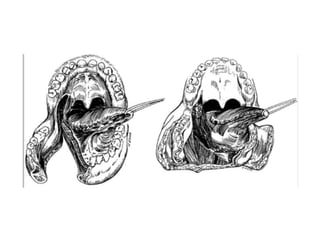
The anatomic landmarks
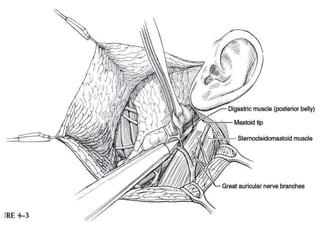
◆ The mastoid process with the insertion of the
sternocleidomastoid (SCM) muscle
◆ Posterior belly of the digastric muscle
◆ Tragal pointer
◆ Temporoparotid fascia
◆ Tympanomastoid fissure
◆ Styloid process
• Pre-operative patient counselling
after work up
Patient positioning
• The patient is placed supine, with the head at
the top of the table and the ipsilateral shoulder
as close to the edge of the operating table as
possible.
• A shoulder roll is used to extend the neck, and
the head is supported with a foam rubber
doughnut-shaped ring
• Local anaesthesia with 1 in 100000 adrenaline
can be used.
Incision
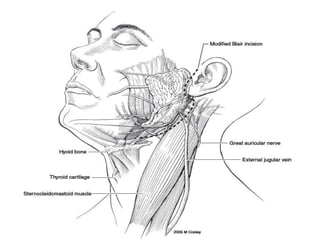
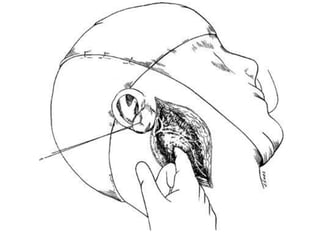
• Cervicomastoidfacial incision(CMFI)
Given by Blair in 1912 and modified by Bailey in
1941
• Modified rhytidectomy
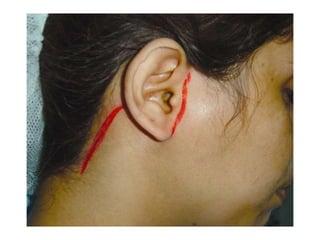
• The incision is made in a relaxed preauricular
skin crease, curves around the lobule toward
the mastoid tip and then anteriorly along a
natural skin crease, curving approximately 2
finger breadths below the angle of mandible
• The ear lobule is retracted posteriorly using a
2-0 silk suture to visualize the mastoid tip and
cartilaginous ear canal.
Two techniques of raising skin flaps
1)Flap over the periparotid fascia
Adv: less bleeding
2)Flap under the periparotid fascia
(Adv: fascia acts as a barrier ,avoids Frey
syndrome)
Approach for dissection
• Antegrade approach
• Retrograde approach
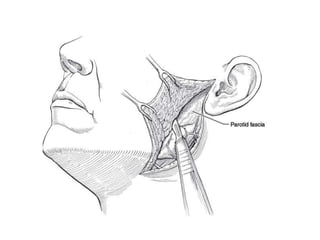
• The anterior skin flap is raised sharply in a
supra platysmal plane, above the parotid
fascia, to the anterior border of gland.
• The subcutaneous fat is elevated with the skin
flap.
• The posterior skin flap is then elevated,
exposing the anterior border of the SCM
muscle and the mastoid process.
• Dissetion begins in the plane deep to the tail
of the parotid.
• The fascia along the anterior border of the
SCM muscle is incised, exposing the muscle
toward the level of the mastoid process.
• Electrocautery can be used in this dissection
• The great auricular nerve and external
jugular vein are identified at this time.
• If the nerve has multiple branches, the
posterior branch is preserved to maintain
sensation to the external ear.
• As the dissection proceeds anteriorly, the tail
of the parotid is dissected from the SCM
muscle and mastoid process, and the posterior
belly of the digastric muscle is exposed.
• The gland is retracted using an Allis clamp or
hemostats
• Separation of parotid tissue from
external auditory canal
• Identification of tragal cartilage( tragal
pointer) with the blunt dissection
• Hemostasis is crucial identify facial nerve
clearly
Landmarks to identify facial nerve
• approximately 1 cm deep to the tip of tragal
pointer (anterior and inferior),
• 6 to 8 mm below the end of the
tympanomastoid fissure (groove palpated
separating the mastoid tip from the tympanic
portion of the temporal bone), and
• just above and on the same plane as the
attachment of the digastric muscle in the
digastric groove.
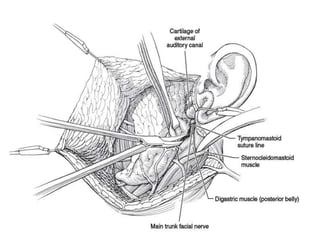
• Exposure of superior part of posterior belly
of digastric
• Identification of facial nerve trunk
• Use of nerve stimulator
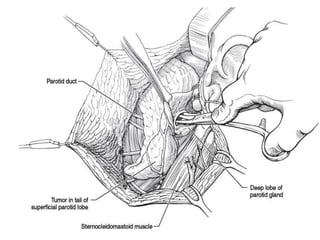
• A curved hemostat or scissors, with tips facing
upward, is used to spread the tissue
immediately superficial to the nerve, keeping
the nerve under direct vision at all times.
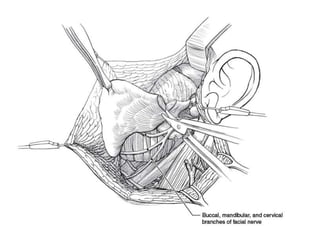
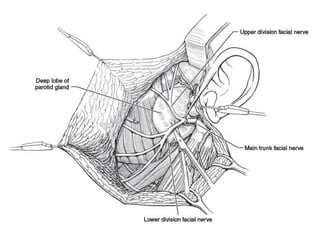
• The main trunk is dissected anteriorly.
• The upper (zygomaticotemporal) and lower
(cervicofacial) divisions are identified
• Dissection of individual facial nerve
branches
• The tissue is cut in a horizontal plane
parallel to the nerve.
• Once a nerve branch is completely
exposed, the surgeon again returns to the
major division and next branch in sequence
is exposed.
DEEP LOBE PAROTIDECTOMY
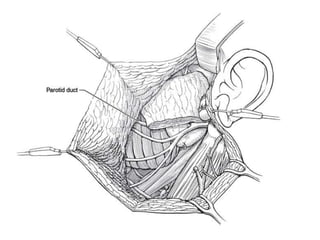
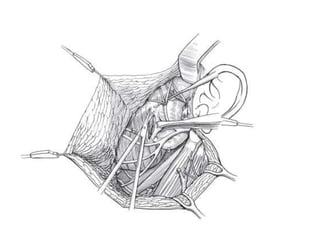
• Separation of superficial lobe
• Exposure of all the branches of the facial nerve
• Stensen’s duct dissection
• Meticulous separation of facial nerve branches
from the deep lobe
• Gentle retraction of nerves and vessels
• The gland may be dissected from the
stylohyoid and stylopharyngeus muscles
Vessels encountered
• the superficial temporal vessels,
• the internal maxillary artery (running deep
to mandibular ramus),
• the occipital artery,
• the posterior auricular artery, and
• the pterygoid plexus of veins.
• Extention of cervical incision more anteriorly may
be required for dissection of retromandibular
gland.
• In rare instances, retromandibular deep parotid
tumors are too large or too inaccessible for
transcervical removal.
• incision is extended anteriorly over the mentum
and a paramedian mandibulotomy is performed.
Removal of masseter:
• Partial
• Total
Frozen section to confirm negative margins
Radical Parotidectomy
• resection of overlying skin, adjacent mandible
and soft tissue, temporal bone, and a portion
of the adjacent external ear.
• free tissue transfer may be necessary for
repair.
• Facial n.is invariably sacrificed
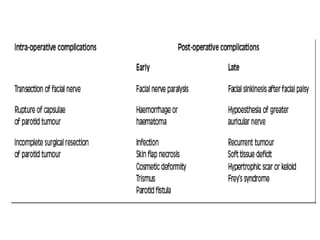
FACIAL PALSY
• most frequent early complication of parotid
gland surgery.
• Neurapraxia(temporary paresis)
Resolves spontaneously 3-4wks
• Permanent paralysis
May be more than a year
• Reassurance
• Eye protection
moist eye drops
Tarsorrhaphy
Botox injection for artificial ptosis
HYPOESTHESIA OF GREATER
AURICULAR NERVE
• The area of numbness will improve within
one year of the operation but a small area
of skin may remain anaesthetized.
• Preserve the posterior branch of greater
auricular nerve
AMPUTATION NEUROMA
• greater auricular nerve
• Managed by:
simple excision
COSMETIC PROBLEMS
• The “surgical depression” caused by
removal of the parotid gland is most
noticeable
• SCM interposition
• dermal-fat interposition grafts
• temporo-parietal fascia flaps
• free tissue transfer
Frey’s syndrome
(gustatory sweating)
- Sweating, redness and warmth in the
preauricular region while eating
.
• aberrant regeneration of sectioned
parasympathetic secretomotor fibres of
the auriculotemporal nerve with
inappropriate innervation of the cutaneous
facial sweat glands that are normally
innervated by sympathetic cholinergic
fibres
Diagnosis
Minor’s test (iodine test)
Iodine applied over affected area
Dry starch applied over it
Turns blue in the presence of sweat.
Surgical treatment for prevention
• Sternocleidomastoid transfer and
• dermis-fat grafts and the
• use of various materials, as interpositional
barriers such as temporalis fascia flap
Management of established Frey’s syndrome
- Antiperspirants
- Anticholinergic lotion
- Denervation by tympanic neurectomy
-Cervical sympathectomy,
- Injection of botulinum toxin into the
affected skin.
• local injection of botulinum toxin (BTX)
• chemical denervation is effective both for
striated muscle and eccrine glands
Other complications of parotidectomy
• Haemorrhage or haematoma
• Infection and Wound seroma
• Trismus
• Skin flap necrosis
Parotid salivary fistula
• is a relatively common complication after
parotidectomy.
• Salivary fistula or sialocele occurs if the
resected edge of the remaining salivary gland
leaks saliva and drains through the wound or
collects beneath the flap (sialocele).
• Flow through the fistula increases during
meals, particularly during mastication
Management
• Amylase level to confirm
• Initial management is conservative
• reduce oral intake by means of enteral or
parenteral feeding.
• Repeated needle aspiration and pressure
dressing are carried
• SOS drain placement
• Fistulas and sialocoeles are managed with
botulinum toxin injection after conventional
conservative management techniques fail.
Thank
you

Parotid surgeries

  • 1.
    Surgery of theParotid gland
  • 2.
  • 3.
    Indications for laterallobectomy (superficial parotidectomy) • Benign parotid tumours • Low grade malignant tumours of small size, • Refractory sialolithiasis, • sialoadenitis (chronic parotitis), and • chronic sialorrhea;
  • 4.
    Other indications • Aspart of lymph node dissection for other head and neck primary tumors, primarily cutaneous malignancies of the face and scalp
  • 5.
    The anatomic landmarks ◆The mastoid process with the insertion of the sternocleidomastoid (SCM) muscle ◆ Posterior belly of the digastric muscle ◆ Tragal pointer ◆ Temporoparotid fascia ◆ Tympanomastoid fissure ◆ Styloid process
  • 6.
    • Pre-operative patientcounselling after work up
  • 7.
    Patient positioning • Thepatient is placed supine, with the head at the top of the table and the ipsilateral shoulder as close to the edge of the operating table as possible. • A shoulder roll is used to extend the neck, and the head is supported with a foam rubber doughnut-shaped ring
  • 8.
    • Local anaesthesiawith 1 in 100000 adrenaline can be used.
  • 9.
    Incision • Cervicomastoidfacial incision(CMFI) Givenby Blair in 1912 and modified by Bailey in 1941 • Modified rhytidectomy
  • 12.
    • The incisionis made in a relaxed preauricular skin crease, curves around the lobule toward the mastoid tip and then anteriorly along a natural skin crease, curving approximately 2 finger breadths below the angle of mandible
  • 13.
    • The earlobule is retracted posteriorly using a 2-0 silk suture to visualize the mastoid tip and cartilaginous ear canal.
  • 14.
    Two techniques ofraising skin flaps 1)Flap over the periparotid fascia Adv: less bleeding 2)Flap under the periparotid fascia (Adv: fascia acts as a barrier ,avoids Frey syndrome)
  • 15.
    Approach for dissection •Antegrade approach • Retrograde approach
  • 16.
    • The anteriorskin flap is raised sharply in a supra platysmal plane, above the parotid fascia, to the anterior border of gland. • The subcutaneous fat is elevated with the skin flap. • The posterior skin flap is then elevated, exposing the anterior border of the SCM muscle and the mastoid process.
  • 18.
    • Dissetion beginsin the plane deep to the tail of the parotid. • The fascia along the anterior border of the SCM muscle is incised, exposing the muscle toward the level of the mastoid process. • Electrocautery can be used in this dissection
  • 19.
    • The greatauricular nerve and external jugular vein are identified at this time. • If the nerve has multiple branches, the posterior branch is preserved to maintain sensation to the external ear.
  • 20.
    • As thedissection proceeds anteriorly, the tail of the parotid is dissected from the SCM muscle and mastoid process, and the posterior belly of the digastric muscle is exposed. • The gland is retracted using an Allis clamp or hemostats
  • 22.
    • Separation ofparotid tissue from external auditory canal • Identification of tragal cartilage( tragal pointer) with the blunt dissection • Hemostasis is crucial identify facial nerve clearly
  • 23.
    Landmarks to identifyfacial nerve • approximately 1 cm deep to the tip of tragal pointer (anterior and inferior), • 6 to 8 mm below the end of the tympanomastoid fissure (groove palpated separating the mastoid tip from the tympanic portion of the temporal bone), and
  • 24.
    • just aboveand on the same plane as the attachment of the digastric muscle in the digastric groove.
  • 25.
    • Exposure ofsuperior part of posterior belly of digastric • Identification of facial nerve trunk • Use of nerve stimulator
  • 27.
    • A curvedhemostat or scissors, with tips facing upward, is used to spread the tissue immediately superficial to the nerve, keeping the nerve under direct vision at all times. • The main trunk is dissected anteriorly. • The upper (zygomaticotemporal) and lower (cervicofacial) divisions are identified
  • 29.
    • Dissection ofindividual facial nerve branches • The tissue is cut in a horizontal plane parallel to the nerve. • Once a nerve branch is completely exposed, the surgeon again returns to the major division and next branch in sequence is exposed.
  • 32.
    DEEP LOBE PAROTIDECTOMY •Separation of superficial lobe • Exposure of all the branches of the facial nerve • Stensen’s duct dissection • Meticulous separation of facial nerve branches from the deep lobe • Gentle retraction of nerves and vessels
  • 35.
    • The glandmay be dissected from the stylohyoid and stylopharyngeus muscles Vessels encountered • the superficial temporal vessels, • the internal maxillary artery (running deep to mandibular ramus), • the occipital artery, • the posterior auricular artery, and • the pterygoid plexus of veins.
  • 37.
    • Extention ofcervical incision more anteriorly may be required for dissection of retromandibular gland. • In rare instances, retromandibular deep parotid tumors are too large or too inaccessible for transcervical removal. • incision is extended anteriorly over the mentum and a paramedian mandibulotomy is performed.
  • 39.
    Removal of masseter: •Partial • Total Frozen section to confirm negative margins
  • 40.
    Radical Parotidectomy • resectionof overlying skin, adjacent mandible and soft tissue, temporal bone, and a portion of the adjacent external ear. • free tissue transfer may be necessary for repair. • Facial n.is invariably sacrificed
  • 42.
    FACIAL PALSY • mostfrequent early complication of parotid gland surgery. • Neurapraxia(temporary paresis) Resolves spontaneously 3-4wks • Permanent paralysis May be more than a year
  • 43.
    • Reassurance • Eyeprotection moist eye drops Tarsorrhaphy Botox injection for artificial ptosis
  • 44.
    HYPOESTHESIA OF GREATER AURICULARNERVE • The area of numbness will improve within one year of the operation but a small area of skin may remain anaesthetized. • Preserve the posterior branch of greater auricular nerve
  • 45.
    AMPUTATION NEUROMA • greaterauricular nerve • Managed by: simple excision
  • 46.
    COSMETIC PROBLEMS • The“surgical depression” caused by removal of the parotid gland is most noticeable • SCM interposition • dermal-fat interposition grafts • temporo-parietal fascia flaps • free tissue transfer
  • 47.
    Frey’s syndrome (gustatory sweating) -Sweating, redness and warmth in the preauricular region while eating .
  • 48.
    • aberrant regenerationof sectioned parasympathetic secretomotor fibres of the auriculotemporal nerve with inappropriate innervation of the cutaneous facial sweat glands that are normally innervated by sympathetic cholinergic fibres
  • 49.
    Diagnosis Minor’s test (iodinetest) Iodine applied over affected area Dry starch applied over it Turns blue in the presence of sweat.
  • 50.
    Surgical treatment forprevention • Sternocleidomastoid transfer and • dermis-fat grafts and the • use of various materials, as interpositional barriers such as temporalis fascia flap
  • 51.
    Management of establishedFrey’s syndrome - Antiperspirants - Anticholinergic lotion - Denervation by tympanic neurectomy -Cervical sympathectomy, - Injection of botulinum toxin into the affected skin.
  • 52.
    • local injectionof botulinum toxin (BTX) • chemical denervation is effective both for striated muscle and eccrine glands
  • 53.
    Other complications ofparotidectomy • Haemorrhage or haematoma • Infection and Wound seroma • Trismus • Skin flap necrosis
  • 54.
    Parotid salivary fistula •is a relatively common complication after parotidectomy. • Salivary fistula or sialocele occurs if the resected edge of the remaining salivary gland leaks saliva and drains through the wound or collects beneath the flap (sialocele). • Flow through the fistula increases during meals, particularly during mastication
  • 55.
    Management • Amylase levelto confirm • Initial management is conservative • reduce oral intake by means of enteral or parenteral feeding. • Repeated needle aspiration and pressure dressing are carried • SOS drain placement
  • 56.
    • Fistulas andsialocoeles are managed with botulinum toxin injection after conventional conservative management techniques fail.
  • 57.

Editor's Notes