Near and Far Contemplating (NFC) the future trends in Mobile and what’s happening right here right now    @andyjb  http//andysblackhole.blogspot.com
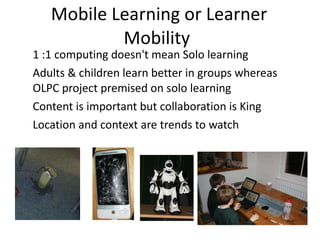
Mobile Learning or Learner Mobility  1 :1 computing doesn't mean Solo learning  Adults & children learn better in groups whereas OLPC project premised on solo learning Content is important but collaboration is King  Location and context are trends to watch
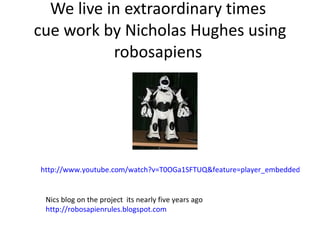
We live in extraordinary times  cue work by Nicholas Hughes using robosapiens  http://www.youtube.com/watch?v=T0OGa1SFTUQ&feature=player_embedded   Nics blog on the project  its nearly five years ago  http://robosapienrules.blogspot.com
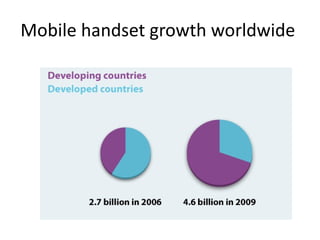
Mobile handset growth worldwide
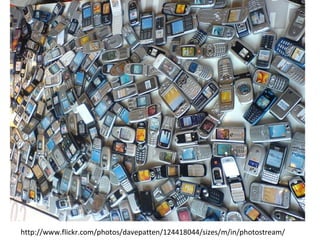
http://www.flickr.com/photos/davepatten/124418044/sizes/m/in/photostream/
 
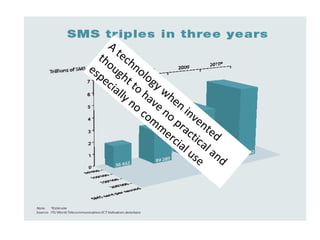
A technology when invented  thought to have no practical and especially no commercial use
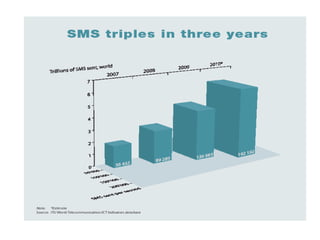
1.6 trillion text messages sent in 2010 That is roughly 200,000 a second  Data source  http://www.itu.int/ITU-D/ict/material/FactsFigures2010.pdf
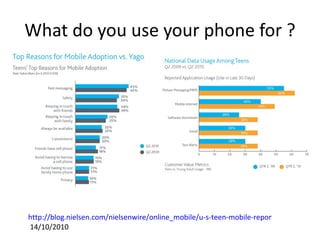
What do you use your phone for ? What d http://blog.nielsen.com/nielsenwire/online_mobile/u-s-teen-mobile-report-calling-yesterday-texting-today-using-apps-tomorrow/  14/10/2010
When most everyone shouts, few listen. How about electronic publishing? Try reading a book on disc. At best, it's an unpleasant chore: the myopic glow of a clunky computer replaces the friendly pages of a book. And you can't tote that laptop to the beach. Yet Nicholas Negroponte, director of the MIT Media Lab, predicts that we'll soon buy books and newspapers straight over the Intenet. Uh, sure.
When most everyone shouts, few listen. How about electronic publishing? Try reading a book on disc. At best, it's an unpleasant chore: the myopic glow of a clunky computer replaces the friendly pages of a book. And you can't tote that laptop to the beach. Yet Nicholas Negroponte, director of the MIT Media Lab, predicts that we'll soon buy books and newspapers straight over the Intenet. Uh, sure. http://www.newsweek.com/1995/02/26/the-internet-bah.html
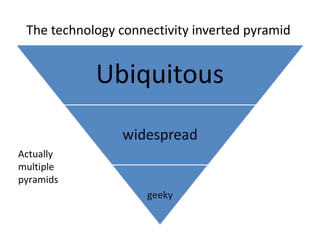
The technology connectivity inverted pyramid  Actually multiple pyramids
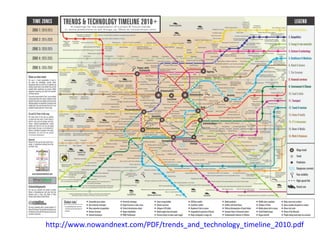
http://www.nowandnext.com/PDF/trends_and_technology_timeline_2010.pdf
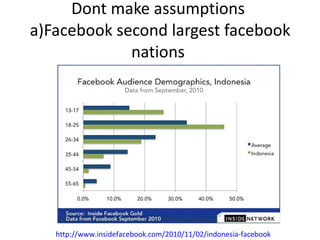
Dont make assumptions  a)Facebook second largest facebook nations  http://www.insidefacebook.com/2010/11/02/indonesia-facebook
Dont make assumptions b) Leading the SMS pack are the U.S. and the Philippines, who combined to account for 35-percent of all texts sent in the world.
After the presentation spend some time looking at  Google spreadsheet of International Telecoms Union (ITU) data on mobile phone penetration for all countries from 1998-2008 Live chart player  http://delivr.com/14bmo
Trends change  Handset in countries are fashion items amongst many groups. UK the trend is towards Blackberry (driven by BBM)] New Zealand Iphone still desired item  North America Blackberry
Most of the developing world still use Symbian phones  Often phones supplied by developed world reseller selling on the old phones you upgrade
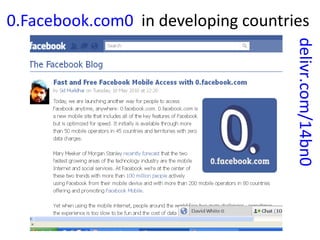
0.Facebook.com0   in developing countries  delivr.com/14bn0
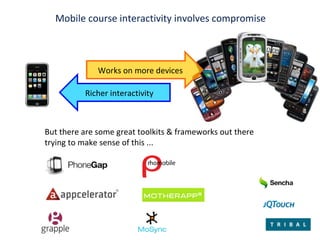
Works on more devices Richer interactivity Mobile course interactivity involves compromise But there are some great toolkits & frameworks out there trying to make sense of this ...
The future answer for rich content  across devices is the browser (I might be wrong )  The solutions for now  Apps (native) Downloading/preloading content  Top rate instructional design Simple but clever . Complicated and clever road to disaster  Robust delivery platforms for and in the future (you choose ?)
Project in Wolverhampton in the UK  Phase 1 2003 with 120 devices in four schools.  Phase 2 2005 more than 1000 pupils plus teachers in 18 schools  Phase Three  2006 with an  additional 1000 devices across all Key Stages.  Phase Four 2008 further rollout of over 1500 devices. This last phase includes devices rolled out within the "Computers for Pupils" initiative and the national MoLe Net scheme.
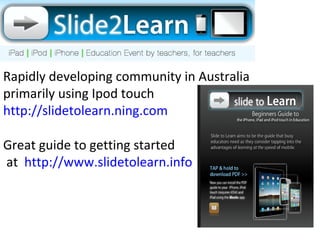
Rapidly developing community in Australia primarily using Ipod touch  http://slidetolearn.ning.com Great guide to getting started at  http://www.slidetolearn.info
Things to do now  SMS communication  School to parents and where appropriate learners  Library reminders Timetable changes Snow days flooding ( disaster recovery)
Using mobile phones in secondary  as  Countdown timers Stopwatch Video experiments Still pictures of art experiments etc Elizabeth Hartnell-Young and Nadja Heym University Nottingham 2008  delivr.com/14bnq
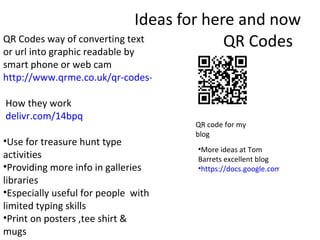
Ideas for here and now QR Codes  QR Codes way of converting text or url into graphic readable by smart phone or web cam  http://www.qrme.co.uk/qr-codes-explained.html   How they work delivr.com/14bpq  Use for treasure hunt type activities  Providing more info in galleries libraries  Especially useful for people  with limited typing skills  Print on posters ,tee shirt & mugs  QR code for my blog  More ideas at Tom Barrets excellent blog  https://docs.google.com/present/view?id=dhn2vcv5_765hsdw5xcr
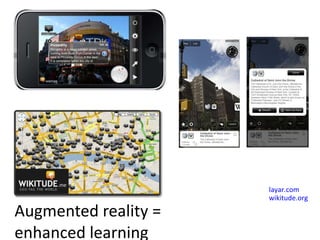
Augmented reality = enhanced learning layar.com wikitude.org
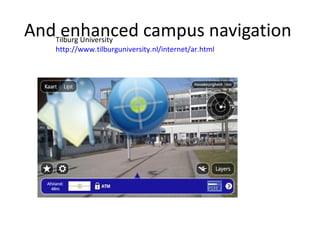
And enhanced campus navigation  Tilburg University  http://www.tilburguniversity.nl/internet/ar.html
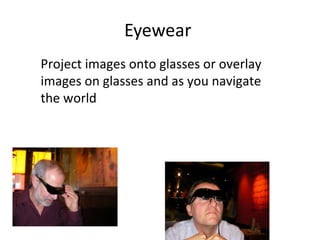
Eyewear  Project images onto glasses or overlay images on glasses and as you navigate the world
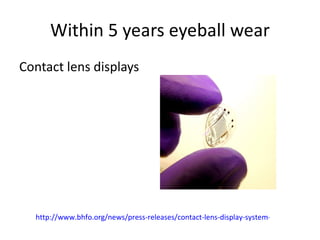
Within 5 years eyeball wear Contact lens displays  http://www.bhfo.org/news/press-releases/contact-lens-display-system-2.html
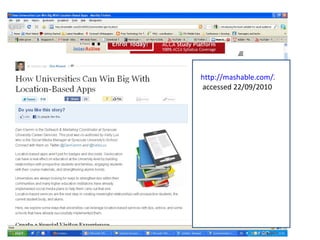
http://mashable.com/2010/09/22/universities-geo-location/  accessed 22/09/2010
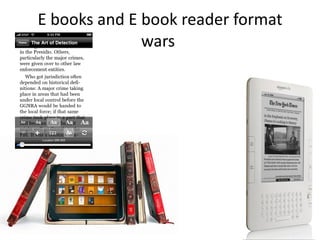
E books and E book reader format wars
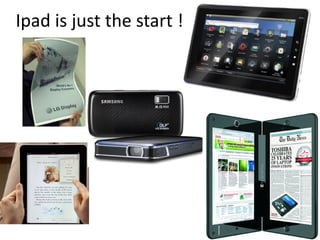
Ipad is just the start !
The book will re invent itself or at least the content will  Reinventing the book  http://www.youtube.com/watch?v=ISxgVmRnFq8
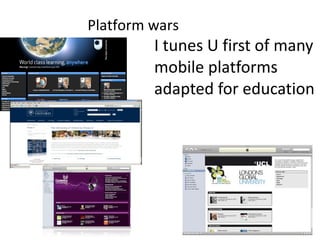
I tunes U first of many mobile platforms adapted for education  Platform wars
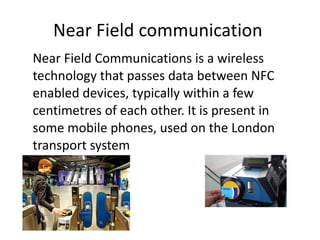
Near Field communication  Near Field Communications is a wireless technology that passes data between NFC enabled devices, typically within a few centimetres of each other. It is present in some mobile phones, used on the London transport system
NFC in education  Transferring homework or other data from/to learners device  Registration Paying for lunch/printing Jetstream is coming like NFC currently operates only over 10centimtres but transmits 530megabytes of data a second
NFC explained  Youtube clip explaining NFC commercial uses http://youtu.be/Bp82H3koH3Q
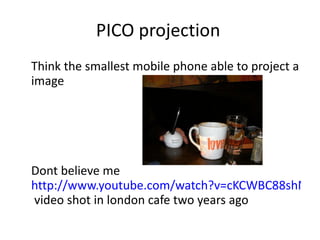
PICO projection Think the smallest mobile phone able to project a image  Dont believe me  http://www.youtube.com/watch?v=cKCWBC88shM  video shot in london cafe two years ago
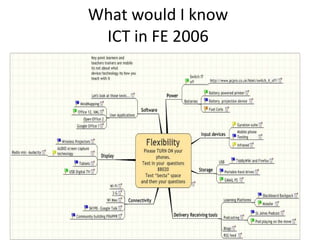
What would I know  ICT in FE 2006
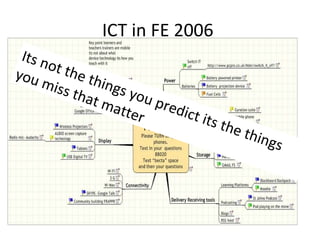
ICT in FE 2006  Its not the things you predict its the things you miss that matter
The question to ask?  Where do you want to be in the long term 5 year Where do you want to be in the short term 3 years Where are you now ? Plus your own specific ones
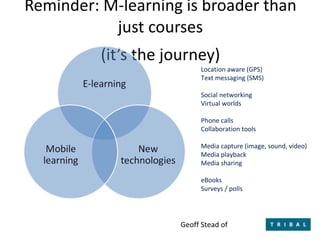
Reminder: M-learning is broader than just courses (it’s the journey) Location aware (GPS) Text messaging (SMS) Social networking Virtual worlds Phone calls Collaboration tools Media capture (image, sound, video) Media playback Media sharing eBooks Surveys / polls Geoff Stead of
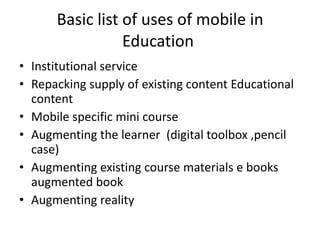
Basic list of uses of mobile in Education  Institutional service  Repacking supply of existing content Educational content Mobile specific mini course  Augmenting the learner  (digital toolbox ,pencil case) Augmenting existing course materials e books augmented book  Augmenting reality
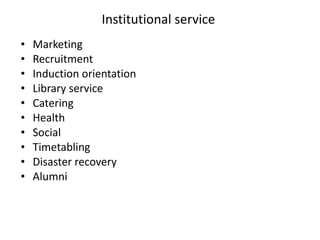
Institutional service  Marketing Recruitment Induction orientation  Library service Catering  Health Social  Timetabling Disaster recovery  Alumni
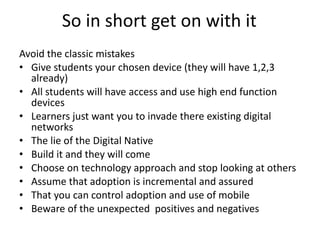
So in short get on with it  Avoid the classic mistakes Give students your chosen device (they will have 1,2,3 already) All students will have access and use high end function devices Learners just want you to invade there existing digital networks The lie of the Digital Native  Build it and they will come Choose on technology approach and stop looking at others  Assume that adoption is incremental and assured  That you can control adoption and use of mobile Beware of the unexpected  positives and negatives
Helpful tips Digital residents and digital visitors Learners are individuals and don't make assumptions  Learners aren't always your biggest challenge or you biggest threat  Collaboration and shared approaches with local variation are good thing
Futures Uncertain but what the heck ! @andyjb  http//andysblackhole.blogspot.com

Near and far contemplating (nfc)

  • 1.
    Near and FarContemplating (NFC) the future trends in Mobile and what’s happening right here right now   @andyjb http//andysblackhole.blogspot.com
  • 2.
    Mobile Learning orLearner Mobility 1 :1 computing doesn't mean Solo learning Adults & children learn better in groups whereas OLPC project premised on solo learning Content is important but collaboration is King Location and context are trends to watch
  • 3.
    We live inextraordinary times cue work by Nicholas Hughes using robosapiens http://www.youtube.com/watch?v=T0OGa1SFTUQ&feature=player_embedded Nics blog on the project its nearly five years ago http://robosapienrules.blogspot.com
  • 4.
  • 5.
  • 6.
  • 7.
    A technology wheninvented thought to have no practical and especially no commercial use
  • 8.
    1.6 trillion textmessages sent in 2010 That is roughly 200,000 a second Data source http://www.itu.int/ITU-D/ict/material/FactsFigures2010.pdf
  • 9.
    What do youuse your phone for ? What d http://blog.nielsen.com/nielsenwire/online_mobile/u-s-teen-mobile-report-calling-yesterday-texting-today-using-apps-tomorrow/ 14/10/2010
  • 10.
    When most everyoneshouts, few listen. How about electronic publishing? Try reading a book on disc. At best, it's an unpleasant chore: the myopic glow of a clunky computer replaces the friendly pages of a book. And you can't tote that laptop to the beach. Yet Nicholas Negroponte, director of the MIT Media Lab, predicts that we'll soon buy books and newspapers straight over the Intenet. Uh, sure.
  • 11.
    When most everyoneshouts, few listen. How about electronic publishing? Try reading a book on disc. At best, it's an unpleasant chore: the myopic glow of a clunky computer replaces the friendly pages of a book. And you can't tote that laptop to the beach. Yet Nicholas Negroponte, director of the MIT Media Lab, predicts that we'll soon buy books and newspapers straight over the Intenet. Uh, sure. http://www.newsweek.com/1995/02/26/the-internet-bah.html
  • 12.
    The technology connectivityinverted pyramid Actually multiple pyramids
  • 13.
  • 14.
    Dont make assumptions a)Facebook second largest facebook nations http://www.insidefacebook.com/2010/11/02/indonesia-facebook
  • 15.
    Dont make assumptionsb) Leading the SMS pack are the U.S. and the Philippines, who combined to account for 35-percent of all texts sent in the world.
  • 16.
    After the presentationspend some time looking at Google spreadsheet of International Telecoms Union (ITU) data on mobile phone penetration for all countries from 1998-2008 Live chart player http://delivr.com/14bmo
  • 17.
    Trends change Handset in countries are fashion items amongst many groups. UK the trend is towards Blackberry (driven by BBM)] New Zealand Iphone still desired item North America Blackberry
  • 18.
    Most of thedeveloping world still use Symbian phones Often phones supplied by developed world reseller selling on the old phones you upgrade
  • 19.
    0.Facebook.com0 in developing countries delivr.com/14bn0
  • 20.
    Works on moredevices Richer interactivity Mobile course interactivity involves compromise But there are some great toolkits & frameworks out there trying to make sense of this ...
  • 21.
    The future answerfor rich content across devices is the browser (I might be wrong ) The solutions for now Apps (native) Downloading/preloading content Top rate instructional design Simple but clever . Complicated and clever road to disaster Robust delivery platforms for and in the future (you choose ?)
  • 22.
    Project in Wolverhamptonin the UK Phase 1 2003 with 120 devices in four schools. Phase 2 2005 more than 1000 pupils plus teachers in 18 schools Phase Three  2006 with an  additional 1000 devices across all Key Stages. Phase Four 2008 further rollout of over 1500 devices. This last phase includes devices rolled out within the "Computers for Pupils" initiative and the national MoLe Net scheme.
  • 23.
    Rapidly developing communityin Australia primarily using Ipod touch http://slidetolearn.ning.com Great guide to getting started at http://www.slidetolearn.info
  • 24.
    Things to donow SMS communication School to parents and where appropriate learners Library reminders Timetable changes Snow days flooding ( disaster recovery)
  • 25.
    Using mobile phonesin secondary as Countdown timers Stopwatch Video experiments Still pictures of art experiments etc Elizabeth Hartnell-Young and Nadja Heym University Nottingham 2008 delivr.com/14bnq
  • 26.
    Ideas for hereand now QR Codes QR Codes way of converting text or url into graphic readable by smart phone or web cam http://www.qrme.co.uk/qr-codes-explained.html How they work delivr.com/14bpq Use for treasure hunt type activities Providing more info in galleries libraries Especially useful for people with limited typing skills Print on posters ,tee shirt & mugs QR code for my blog More ideas at Tom Barrets excellent blog https://docs.google.com/present/view?id=dhn2vcv5_765hsdw5xcr
  • 27.
    Augmented reality =enhanced learning layar.com wikitude.org
  • 28.
    And enhanced campusnavigation Tilburg University http://www.tilburguniversity.nl/internet/ar.html
  • 29.
    Eyewear Projectimages onto glasses or overlay images on glasses and as you navigate the world
  • 30.
    Within 5 yearseyeball wear Contact lens displays http://www.bhfo.org/news/press-releases/contact-lens-display-system-2.html
  • 31.
  • 32.
    E books andE book reader format wars
  • 33.
    Ipad is justthe start !
  • 34.
    The book willre invent itself or at least the content will Reinventing the book http://www.youtube.com/watch?v=ISxgVmRnFq8
  • 35.
    I tunes Ufirst of many mobile platforms adapted for education Platform wars
  • 36.
    Near Field communication Near Field Communications is a wireless technology that passes data between NFC enabled devices, typically within a few centimetres of each other. It is present in some mobile phones, used on the London transport system
  • 37.
    NFC in education Transferring homework or other data from/to learners device Registration Paying for lunch/printing Jetstream is coming like NFC currently operates only over 10centimtres but transmits 530megabytes of data a second
  • 38.
    NFC explained Youtube clip explaining NFC commercial uses http://youtu.be/Bp82H3koH3Q
  • 39.
    PICO projection Thinkthe smallest mobile phone able to project a image Dont believe me http://www.youtube.com/watch?v=cKCWBC88shM video shot in london cafe two years ago
  • 40.
    What would Iknow ICT in FE 2006
  • 41.
    ICT in FE2006 Its not the things you predict its the things you miss that matter
  • 42.
    The question toask? Where do you want to be in the long term 5 year Where do you want to be in the short term 3 years Where are you now ? Plus your own specific ones
  • 43.
    Reminder: M-learning isbroader than just courses (it’s the journey) Location aware (GPS) Text messaging (SMS) Social networking Virtual worlds Phone calls Collaboration tools Media capture (image, sound, video) Media playback Media sharing eBooks Surveys / polls Geoff Stead of
  • 44.
    Basic list ofuses of mobile in Education Institutional service Repacking supply of existing content Educational content Mobile specific mini course Augmenting the learner (digital toolbox ,pencil case) Augmenting existing course materials e books augmented book Augmenting reality
  • 45.
    Institutional service Marketing Recruitment Induction orientation Library service Catering Health Social Timetabling Disaster recovery Alumni
  • 46.
    So in shortget on with it Avoid the classic mistakes Give students your chosen device (they will have 1,2,3 already) All students will have access and use high end function devices Learners just want you to invade there existing digital networks The lie of the Digital Native Build it and they will come Choose on technology approach and stop looking at others Assume that adoption is incremental and assured That you can control adoption and use of mobile Beware of the unexpected positives and negatives
  • 47.
    Helpful tips Digitalresidents and digital visitors Learners are individuals and don't make assumptions Learners aren't always your biggest challenge or you biggest threat Collaboration and shared approaches with local variation are good thing
  • 48.
    Futures Uncertain butwhat the heck ! @andyjb http//andysblackhole.blogspot.com