1
ART RECORD
2
MOUNT TABOR TRAINING COLLEGE
PATHANAPURAM
2019-2021
THIRD SEMESTER
RECORD OF ART EDUCATION
Certified Bonafied Record of
Name : Medha Rani S
Optional : Mathematics
Candidate code: 18019303007
Internal Examiner External Examiner
TOP 10 RITUAL
3
The ritual art forms of Kerala are important
cultural benchmarks that have helped and shaped the very
conscience of the State. From depicting our legends, distinctive
traditions, historical yarns and mythical beings, to providing
commentary on social injustices in the form of satirical plays and
skits, they have moulded the conventions and conversations on
our shores for centuries.
4
ritual art forms of Kerala
Arjuna Nritham (the dance of Arjuna) is
a ritual art performed by men and is
prevalent in the Bhagavathy temples of
Kerala. Arjuna nritham is also called
Mayilppeeli nritham as the costume
includes a characteristic garment made
of mayilppeeli (peacock feathers).Arjuna,
the most valiant of the five heroic
brothers - the Pandavas - of the epic Mahabharatha, was also a renowned singer
and dancer and is said to have propitiated goddess Bhadrakaali by a devotional
presentation.
ARJUNA NRITHAM
5
Kalamezhuthu festivals held at Bhagavathy
Temples across Kerala. Maestros combine
coloured powders to draw beautiful drawings
on the floor, exalting and worshipping the
great Gods of the land including Bhadrakaali,
Ayyappan,Serpent or Vettakkorumakan. From
temples to noble households, one sees these
unique portraits accompanied by the
Kalamezhuthupattu. These are erased at the end of the ritual, with the rhythms of
various musical instruments like the ilathalam, veekkanchenda, kuzhal, kombu and
chenda, acting as accompaniment.
KALAMEZHUTHU
6
Kavadiyattam, a colourful ritual art, is a votive offering
to Lord Subramanya. Basically of Tamil origin,
Kavadiyattam is widely prevalent in the Subramanya
temples all over Kerala during the festival seasons.
Kavadiyattam literally means dance carrying a kavadi
(a richly decorated huge bow). Kavadies are usually of
different sizes and shapes, each with its own
significance.A Pookavadi is one decorated with brightly
coloured artificial flowers, a mayilpeeli kavadi decorated
using only peacock feathers and ambalakavadi, one
shaped like the gopuram (tower) of a temple. A kavadi can rise up to a height of
10-18 feet.
7
KAVADIYATTAM
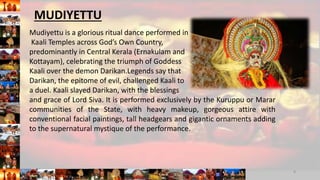
Mudiyettu is a glorious ritual dance performed in
Kaali Temples across God’s Own Country,
predominantly in Central Kerala (Ernakulam and
Kottayam), celebrating the triumph of Goddess
Kaali over the demon Darikan.Legends say that
Darikan, the epitome of evil, challenged Kaali to
a duel. Kaali slayed Darikan, with the blessings
and grace of Lord Siva. It is performed exclusively by the Kuruppu or Marar
communities of the State, with heavy makeup, gorgeous attire with
conventional facial paintings, tall headgears and gigantic ornaments adding
to the supernatural mystique of the performance.
8
MUDIYETTU
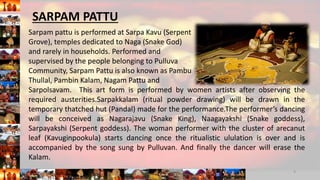
Sarpam pattu is performed at Sarpa Kavu (Serpent
Grove), temples dedicated to Naga (Snake God)
and rarely in households. Performed and
supervised by the people belonging to Pulluva
Community, Sarpam Pattu is also known as Pambu
Thullal, Pambin Kalam, Nagam Pattu and
Sarpolsavam. This art form is performed by women artists after observing the
required austerities.Sarpakkalam (ritual powder drawing) will be drawn in the
temporary thatched hut (Pandal) made for the performance.The performer’s dancing
will be conceived as Nagarajavu (Snake King), Naagayakshi (Snake goddess),
Sarpayakshi (Serpent goddess). The woman performer with the cluster of arecanut
leaf (Kavuginpookula) starts dancing once the ritualistic ululation is over and is
accompanied by the song sung by Pulluvan. And finally the dancer will erase the
Kalam.
9
SARPAM PATTU
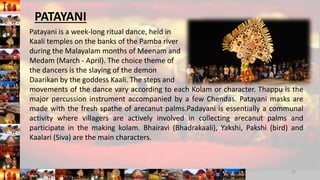
Patayani is a week-long ritual dance, held in
Kaali temples on the banks of the Pamba river
during the Malayalam months of Meenam and
Medam (March - April). The choice theme of
the dancers is the slaying of the demon
Daarikan by the goddess Kaali. The steps and
movements of the dance vary according to each Kolam or character. Thappu is the
major percussion instrument accompanied by a few Chendas. Patayani masks are
made with the fresh spathe of arecanut palms.Padayani is essentially a communal
activity where villagers are actively involved in collecting arecanut palms and
participate in the making kolam. Bhairavi (Bhadrakaali), Yakshi, Pakshi (bird) and
Kaalari (Siva) are the main characters.
10
PATAYANI
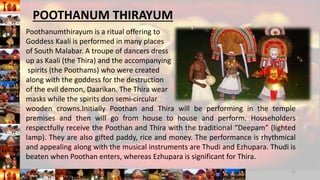
Poothanumthirayum is a ritual offering to
Goddess Kaali is performed in many places
of South Malabar. A troupe of dancers dress
up as Kaali (the Thira) and the accompanying
spirits (the Poothams) who were created
along with the goddess for the destruction
of the evil demon, Daarikan. The Thira wear
masks while the spirits don semi-circular
wooden crowns.Initially Poothan and Thira will be performing in the temple
premises and then will go from house to house and perform. Householders
respectfully receive the Poothan and Thira with the traditional “Deepam” (lighted
lamp). They are also gifted paddy, rice and money. The performance is rhythmical
and appealing along with the musical instruments are Thudi and Ezhupara. Thudi is
beaten when Poothan enters, whereas Ezhupara is significant for Thira.
11
POOTHANUM THIRAYUM
Theeyattu is a solo dance-drama performed
in front of the Kalam or Dhooli Chitram
(ritual drawing with coloured powders). It is
enacted in some Bhagavathy temples of
Thiruvalla, Kottayam, Thripunithura and
neighbouring areas. The ritual starts with the
invocation of Lord Ganapathy, Lord Siva and
Goddess Saraswathy, after which the
performer dons a crown smaller but similar to the one used in Mudiyettu.The most
popular story narrated through a Theeyattu performance is that of the duel between
goddess Kaali and the demon Daarikan. The dance form is usually performed by a
small group of temple bound communities called the Unni. Theeyattu is still a ritual
offering made every Friday at the Pallippurathu Kaavu temple near Kottayam town.
12
THEEYATTU
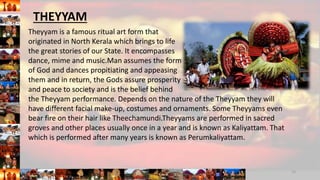
Theyyam is a famous ritual art form that
originated in North Kerala which brings to life
the great stories of our State. It encompasses
dance, mime and music.Man assumes the form
of God and dances propitiating and appeasing
them and in return, the Gods assure prosperity
and peace to society and is the belief behind
the Theyyam performance. Depends on the nature of the Theyyam they will
have different facial make-up, costumes and ornaments. Some Theyyams even
bear fire on their hair like Theechamundi.Theyyams are performed in sacred
groves and other places usually once in a year and is known as Kaliyattam. That
which is performed after many years is known as Perumkaliyattam.
13
THEYYAM
Tholppavakkoothu, literally meaning 'leather
puppet play', is a ritual art performed during the
annual festivals in the Kaali temples of Palakkad
district. The theme of the play is based on the
Kamba Ramayana, narrated in a diction that is a
mixture of Malayalam and Tamil dialectical
variations. The play covers the whole gamut of events from Lord Sree Rama's birth to
his coronation as the King of Ayodhya. The shadow play is presented in the
'Koothumadam', a specially constructed oblong play house on the temple
premises.The puppets are arranged behind a long white curtain stretched across the
Koothumadom. Behind this, on a split bamboo pole, is placed a row of wick lamps
burning inside coconut halves. The light from these lamps cast the silhouettes of the
puppets on the curtain. The chief puppeteer is known as 'Pulavar'. At present this
ritual art is confined to Ottapalam and Kavalappara in Palakkad district.
14
THOLPPAVAKKOOTHU
15
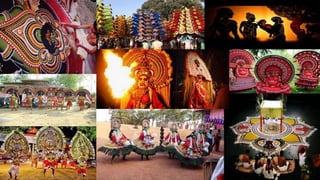
PHOTO ALBUM
16
17
18

Ritual arts

  • 1.
  • 2.
    2 MOUNT TABOR TRAININGCOLLEGE PATHANAPURAM 2019-2021 THIRD SEMESTER RECORD OF ART EDUCATION Certified Bonafied Record of Name : Medha Rani S Optional : Mathematics Candidate code: 18019303007 Internal Examiner External Examiner
  • 3.
  • 4.
    The ritual artforms of Kerala are important cultural benchmarks that have helped and shaped the very conscience of the State. From depicting our legends, distinctive traditions, historical yarns and mythical beings, to providing commentary on social injustices in the form of satirical plays and skits, they have moulded the conventions and conversations on our shores for centuries. 4 ritual art forms of Kerala
  • 5.
    Arjuna Nritham (thedance of Arjuna) is a ritual art performed by men and is prevalent in the Bhagavathy temples of Kerala. Arjuna nritham is also called Mayilppeeli nritham as the costume includes a characteristic garment made of mayilppeeli (peacock feathers).Arjuna, the most valiant of the five heroic brothers - the Pandavas - of the epic Mahabharatha, was also a renowned singer and dancer and is said to have propitiated goddess Bhadrakaali by a devotional presentation. ARJUNA NRITHAM 5
  • 6.
    Kalamezhuthu festivals heldat Bhagavathy Temples across Kerala. Maestros combine coloured powders to draw beautiful drawings on the floor, exalting and worshipping the great Gods of the land including Bhadrakaali, Ayyappan,Serpent or Vettakkorumakan. From temples to noble households, one sees these unique portraits accompanied by the Kalamezhuthupattu. These are erased at the end of the ritual, with the rhythms of various musical instruments like the ilathalam, veekkanchenda, kuzhal, kombu and chenda, acting as accompaniment. KALAMEZHUTHU 6
  • 7.
    Kavadiyattam, a colourfulritual art, is a votive offering to Lord Subramanya. Basically of Tamil origin, Kavadiyattam is widely prevalent in the Subramanya temples all over Kerala during the festival seasons. Kavadiyattam literally means dance carrying a kavadi (a richly decorated huge bow). Kavadies are usually of different sizes and shapes, each with its own significance.A Pookavadi is one decorated with brightly coloured artificial flowers, a mayilpeeli kavadi decorated using only peacock feathers and ambalakavadi, one shaped like the gopuram (tower) of a temple. A kavadi can rise up to a height of 10-18 feet. 7 KAVADIYATTAM
  • 8.
    Mudiyettu is aglorious ritual dance performed in Kaali Temples across God’s Own Country, predominantly in Central Kerala (Ernakulam and Kottayam), celebrating the triumph of Goddess Kaali over the demon Darikan.Legends say that Darikan, the epitome of evil, challenged Kaali to a duel. Kaali slayed Darikan, with the blessings and grace of Lord Siva. It is performed exclusively by the Kuruppu or Marar communities of the State, with heavy makeup, gorgeous attire with conventional facial paintings, tall headgears and gigantic ornaments adding to the supernatural mystique of the performance. 8 MUDIYETTU
  • 9.
    Sarpam pattu isperformed at Sarpa Kavu (Serpent Grove), temples dedicated to Naga (Snake God) and rarely in households. Performed and supervised by the people belonging to Pulluva Community, Sarpam Pattu is also known as Pambu Thullal, Pambin Kalam, Nagam Pattu and Sarpolsavam. This art form is performed by women artists after observing the required austerities.Sarpakkalam (ritual powder drawing) will be drawn in the temporary thatched hut (Pandal) made for the performance.The performer’s dancing will be conceived as Nagarajavu (Snake King), Naagayakshi (Snake goddess), Sarpayakshi (Serpent goddess). The woman performer with the cluster of arecanut leaf (Kavuginpookula) starts dancing once the ritualistic ululation is over and is accompanied by the song sung by Pulluvan. And finally the dancer will erase the Kalam. 9 SARPAM PATTU
  • 10.
    Patayani is aweek-long ritual dance, held in Kaali temples on the banks of the Pamba river during the Malayalam months of Meenam and Medam (March - April). The choice theme of the dancers is the slaying of the demon Daarikan by the goddess Kaali. The steps and movements of the dance vary according to each Kolam or character. Thappu is the major percussion instrument accompanied by a few Chendas. Patayani masks are made with the fresh spathe of arecanut palms.Padayani is essentially a communal activity where villagers are actively involved in collecting arecanut palms and participate in the making kolam. Bhairavi (Bhadrakaali), Yakshi, Pakshi (bird) and Kaalari (Siva) are the main characters. 10 PATAYANI
  • 11.
    Poothanumthirayum is aritual offering to Goddess Kaali is performed in many places of South Malabar. A troupe of dancers dress up as Kaali (the Thira) and the accompanying spirits (the Poothams) who were created along with the goddess for the destruction of the evil demon, Daarikan. The Thira wear masks while the spirits don semi-circular wooden crowns.Initially Poothan and Thira will be performing in the temple premises and then will go from house to house and perform. Householders respectfully receive the Poothan and Thira with the traditional “Deepam” (lighted lamp). They are also gifted paddy, rice and money. The performance is rhythmical and appealing along with the musical instruments are Thudi and Ezhupara. Thudi is beaten when Poothan enters, whereas Ezhupara is significant for Thira. 11 POOTHANUM THIRAYUM
  • 12.
    Theeyattu is asolo dance-drama performed in front of the Kalam or Dhooli Chitram (ritual drawing with coloured powders). It is enacted in some Bhagavathy temples of Thiruvalla, Kottayam, Thripunithura and neighbouring areas. The ritual starts with the invocation of Lord Ganapathy, Lord Siva and Goddess Saraswathy, after which the performer dons a crown smaller but similar to the one used in Mudiyettu.The most popular story narrated through a Theeyattu performance is that of the duel between goddess Kaali and the demon Daarikan. The dance form is usually performed by a small group of temple bound communities called the Unni. Theeyattu is still a ritual offering made every Friday at the Pallippurathu Kaavu temple near Kottayam town. 12 THEEYATTU
  • 13.
    Theyyam is afamous ritual art form that originated in North Kerala which brings to life the great stories of our State. It encompasses dance, mime and music.Man assumes the form of God and dances propitiating and appeasing them and in return, the Gods assure prosperity and peace to society and is the belief behind the Theyyam performance. Depends on the nature of the Theyyam they will have different facial make-up, costumes and ornaments. Some Theyyams even bear fire on their hair like Theechamundi.Theyyams are performed in sacred groves and other places usually once in a year and is known as Kaliyattam. That which is performed after many years is known as Perumkaliyattam. 13 THEYYAM
  • 14.
    Tholppavakkoothu, literally meaning'leather puppet play', is a ritual art performed during the annual festivals in the Kaali temples of Palakkad district. The theme of the play is based on the Kamba Ramayana, narrated in a diction that is a mixture of Malayalam and Tamil dialectical variations. The play covers the whole gamut of events from Lord Sree Rama's birth to his coronation as the King of Ayodhya. The shadow play is presented in the 'Koothumadam', a specially constructed oblong play house on the temple premises.The puppets are arranged behind a long white curtain stretched across the Koothumadom. Behind this, on a split bamboo pole, is placed a row of wick lamps burning inside coconut halves. The light from these lamps cast the silhouettes of the puppets on the curtain. The chief puppeteer is known as 'Pulavar'. At present this ritual art is confined to Ottapalam and Kavalappara in Palakkad district. 14 THOLPPAVAKKOOTHU
  • 15.
  • 16.
  • 17.
  • 18.