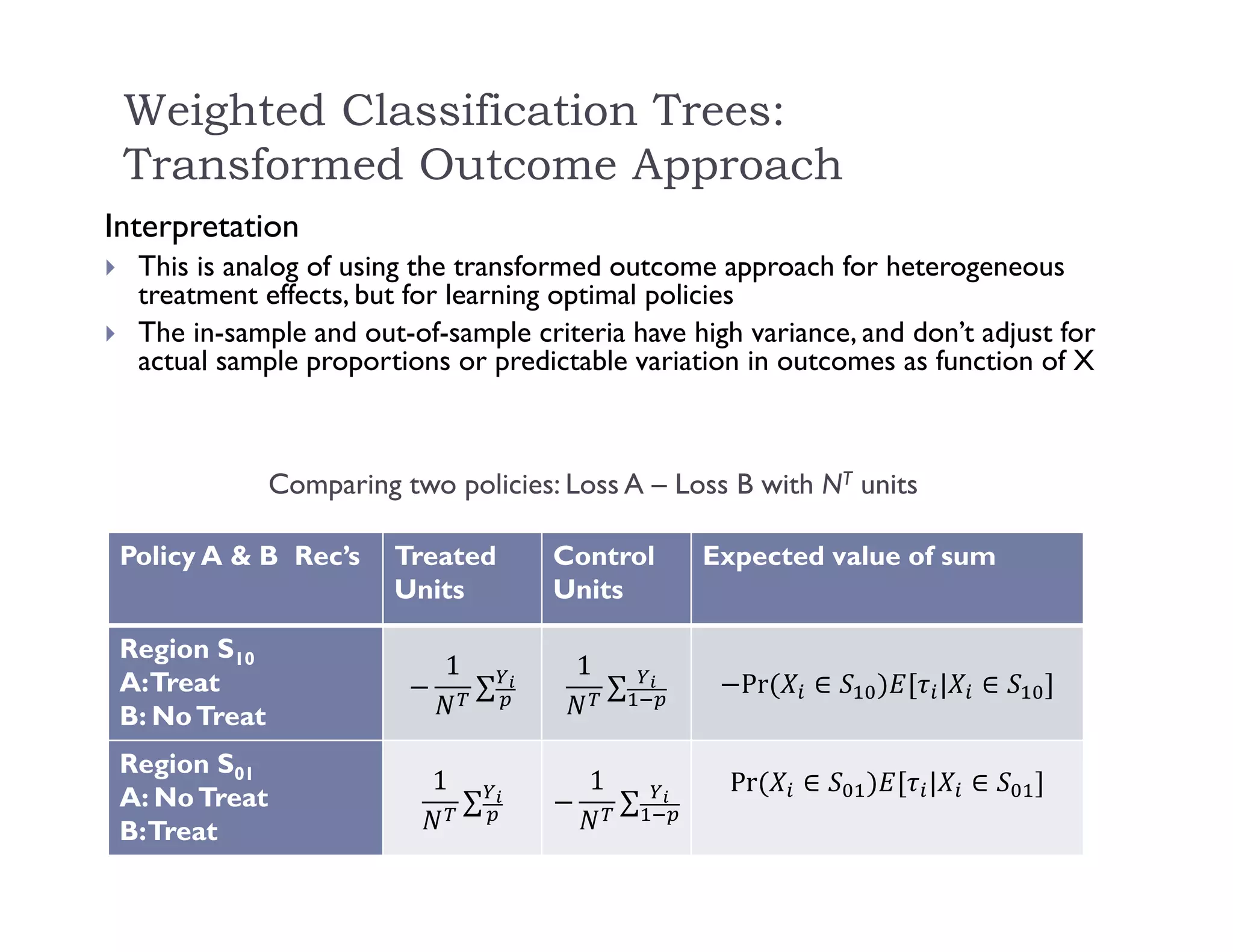
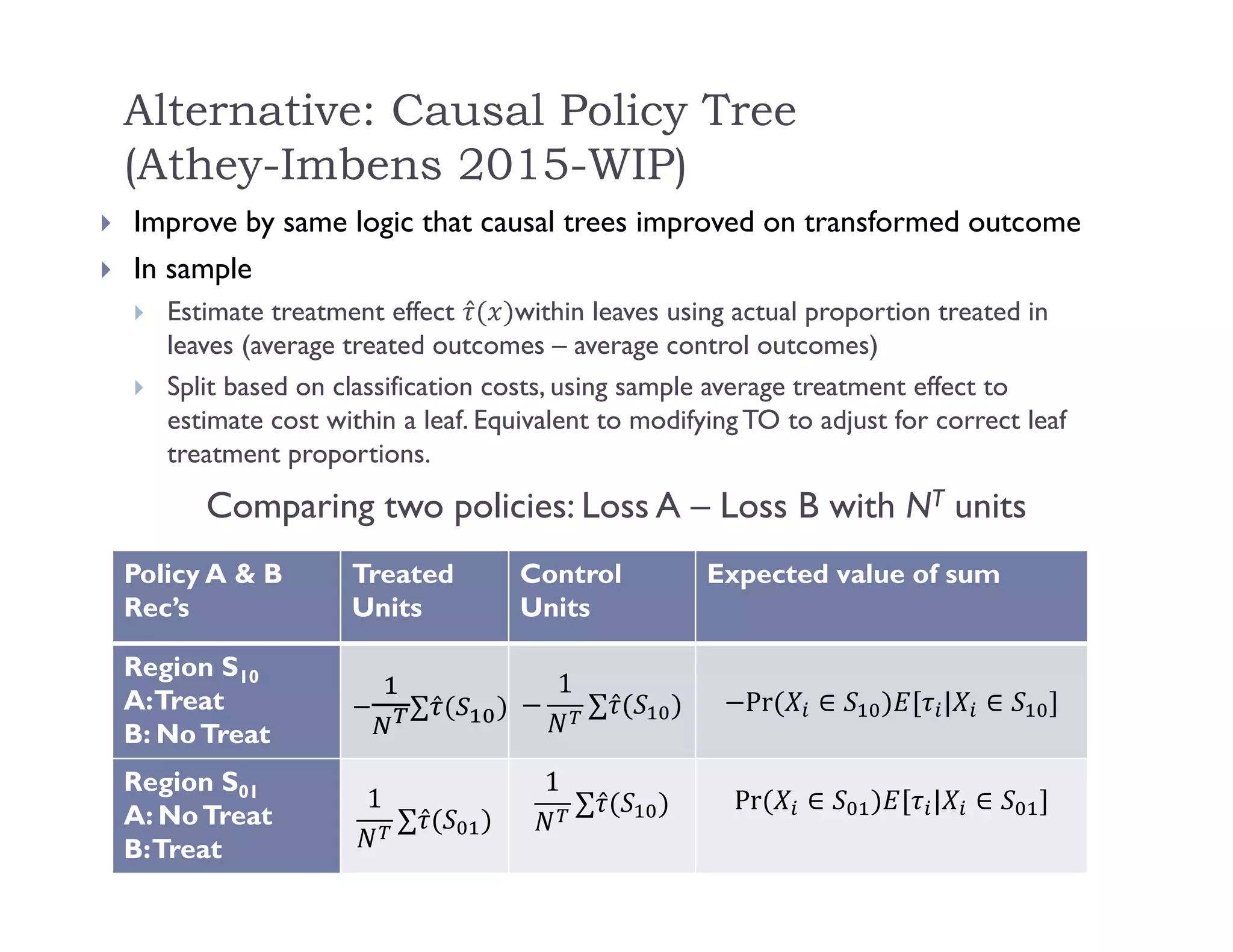
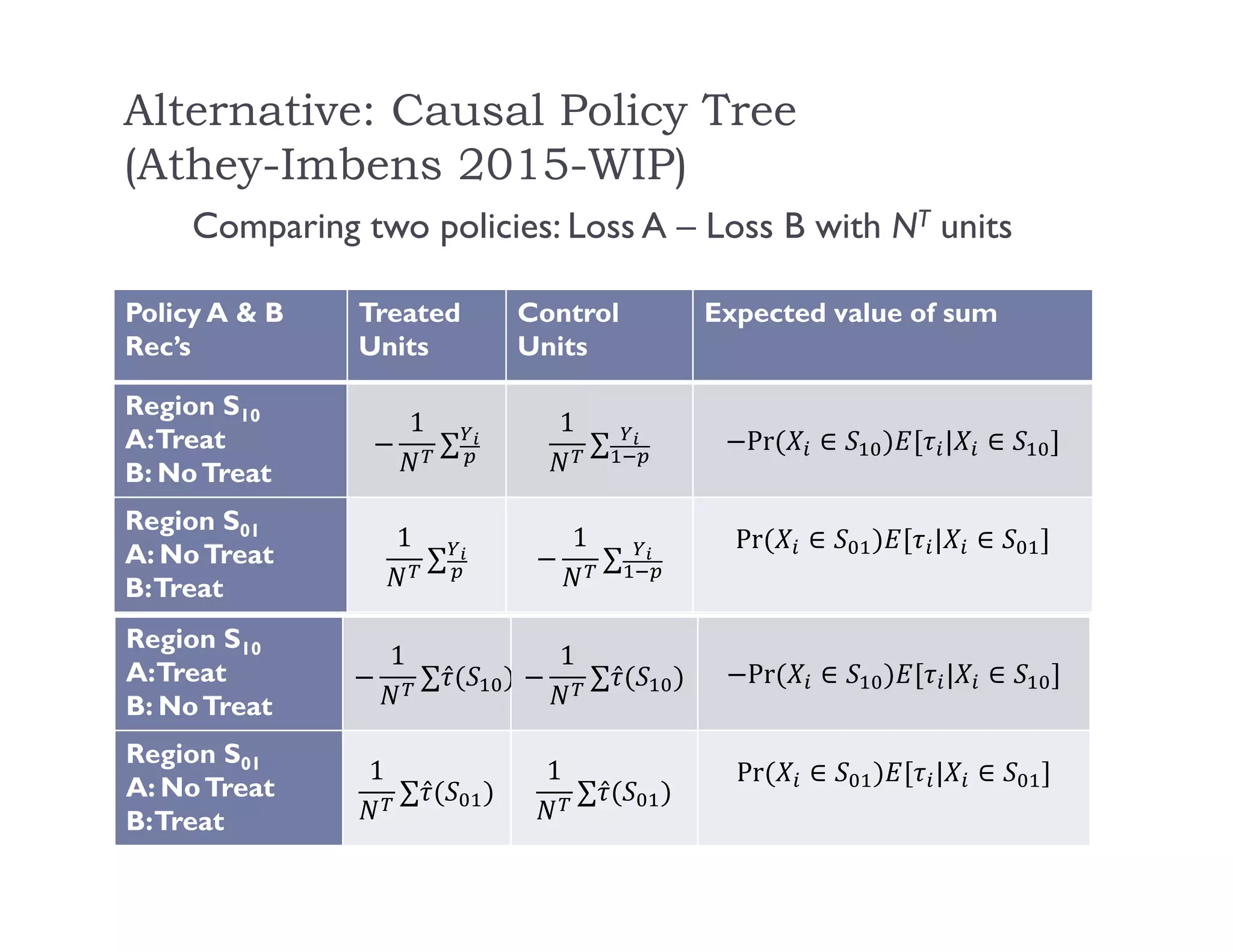
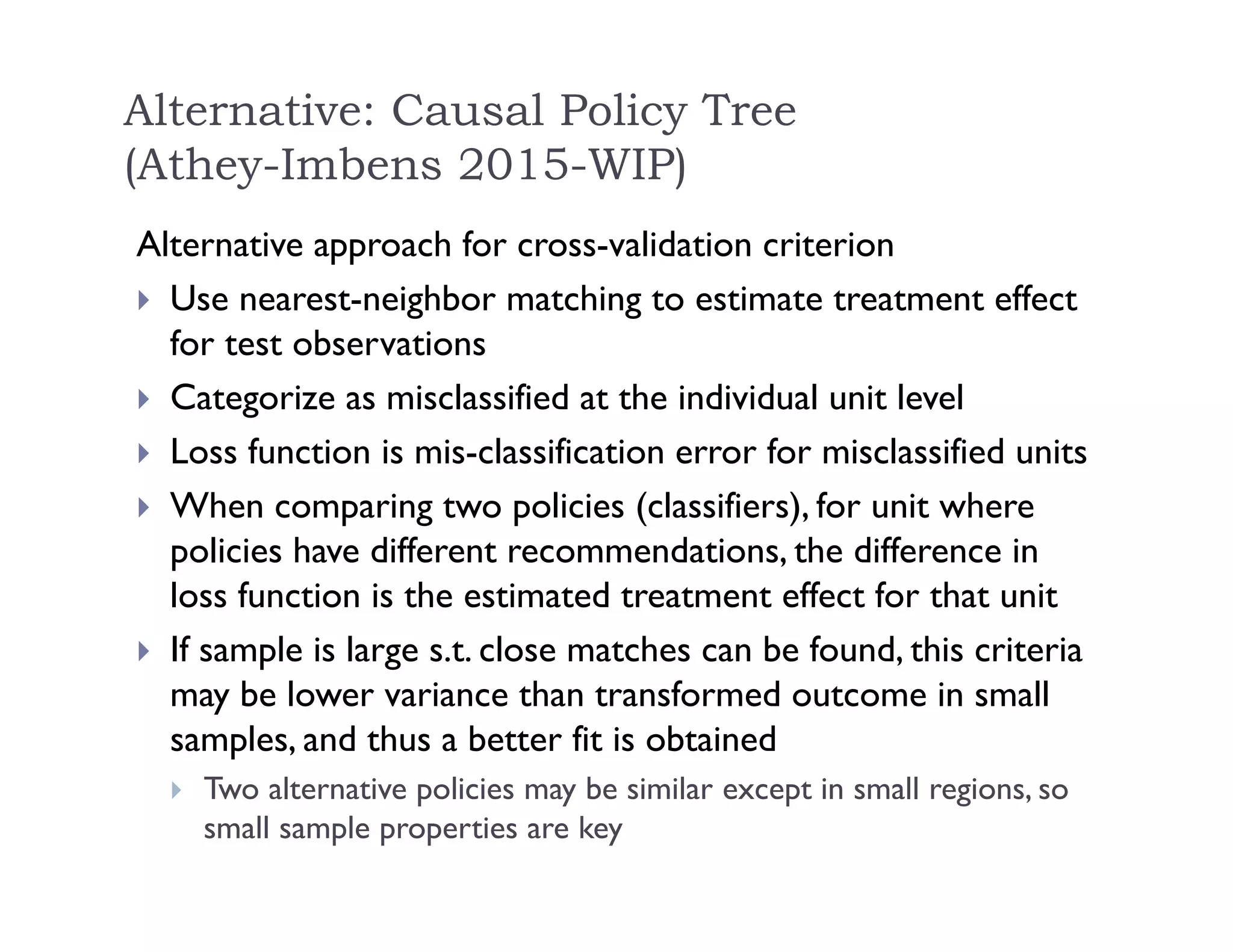
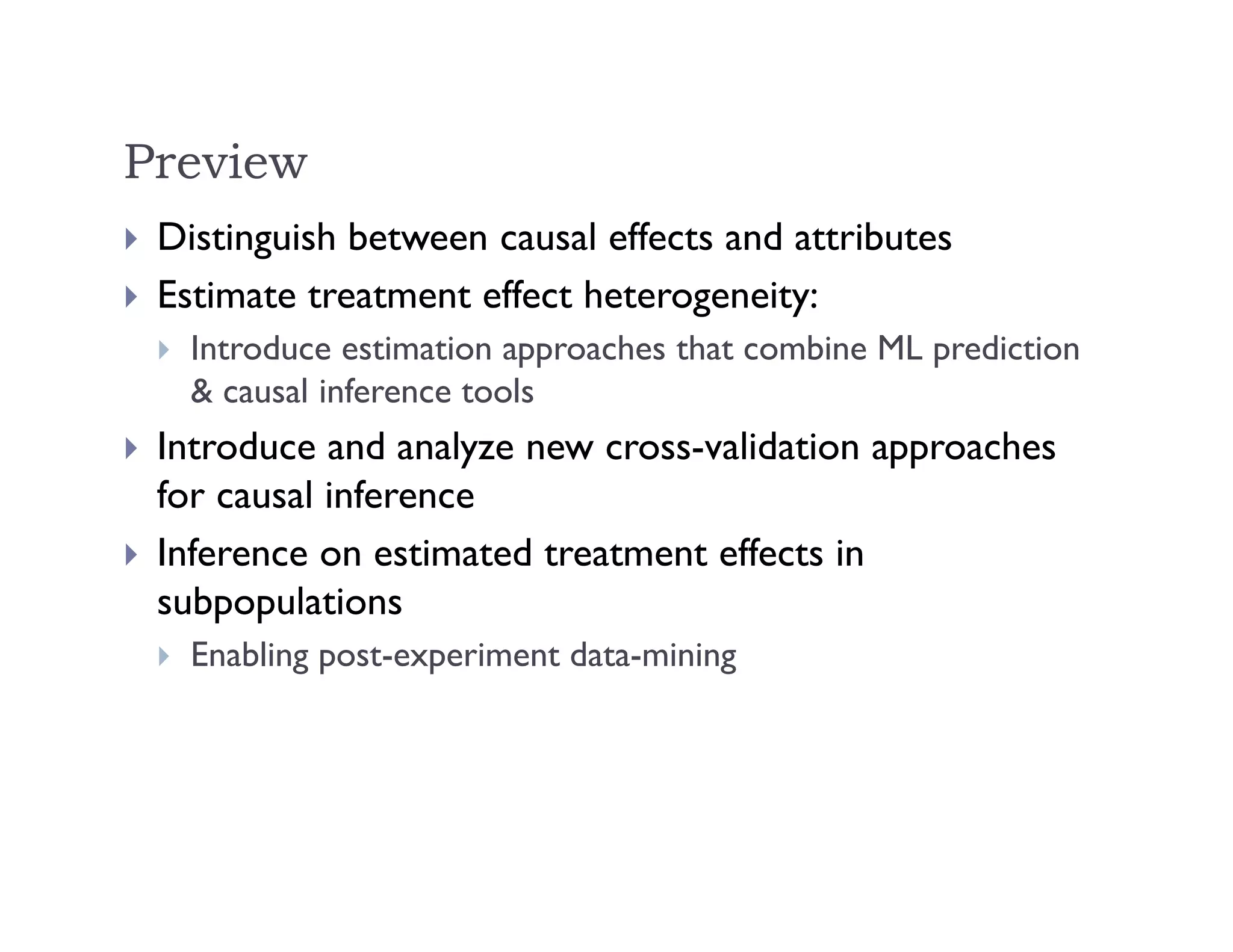
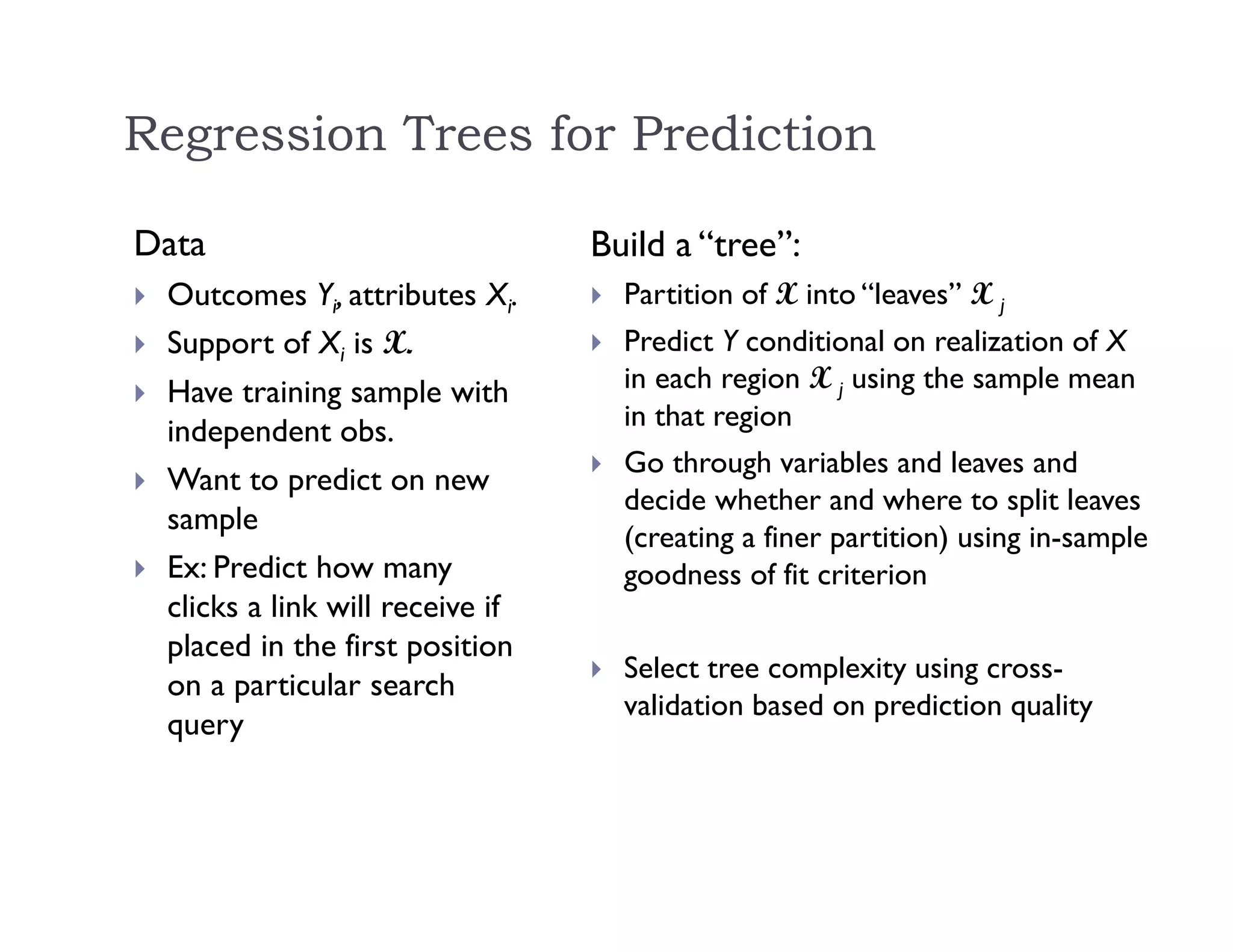
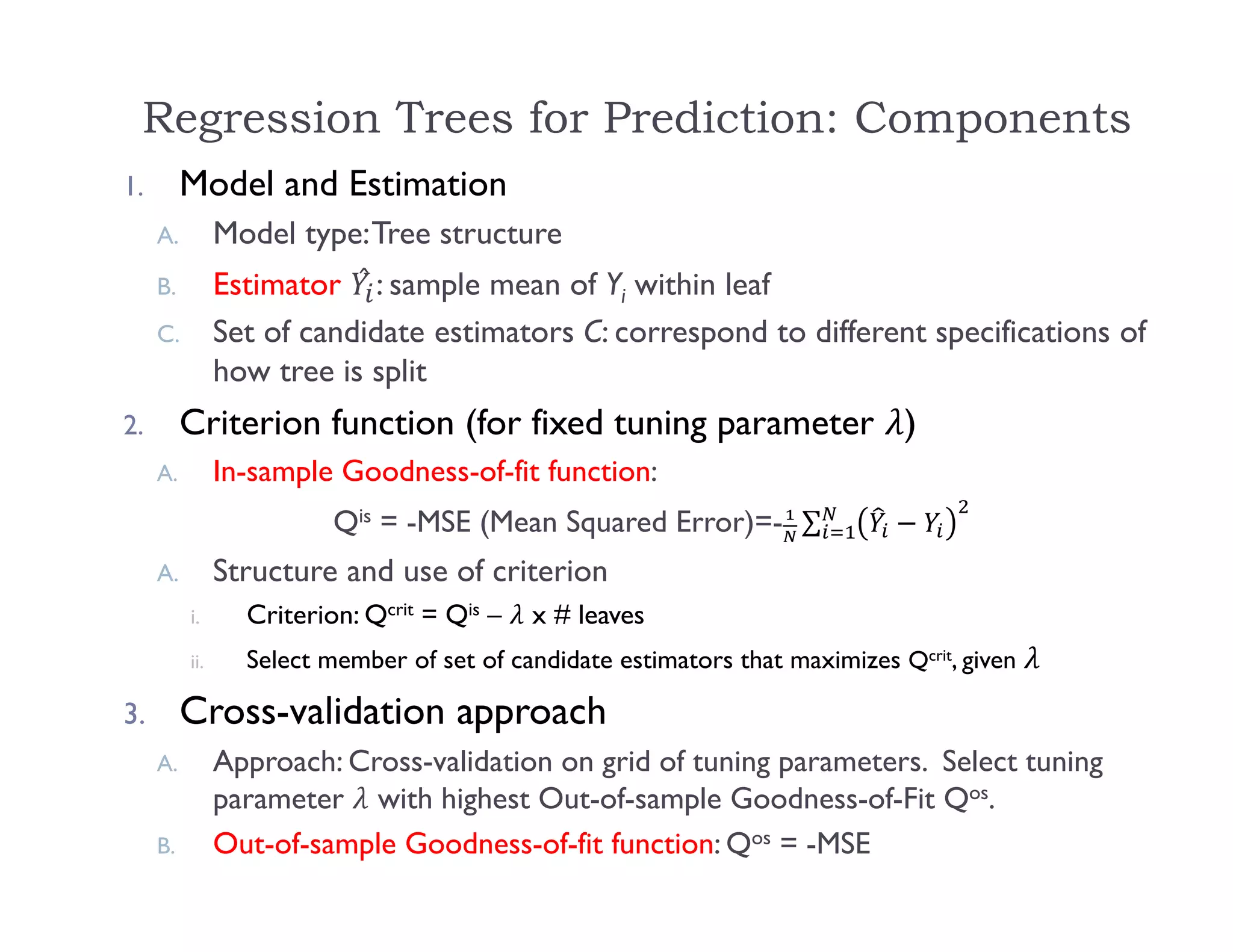
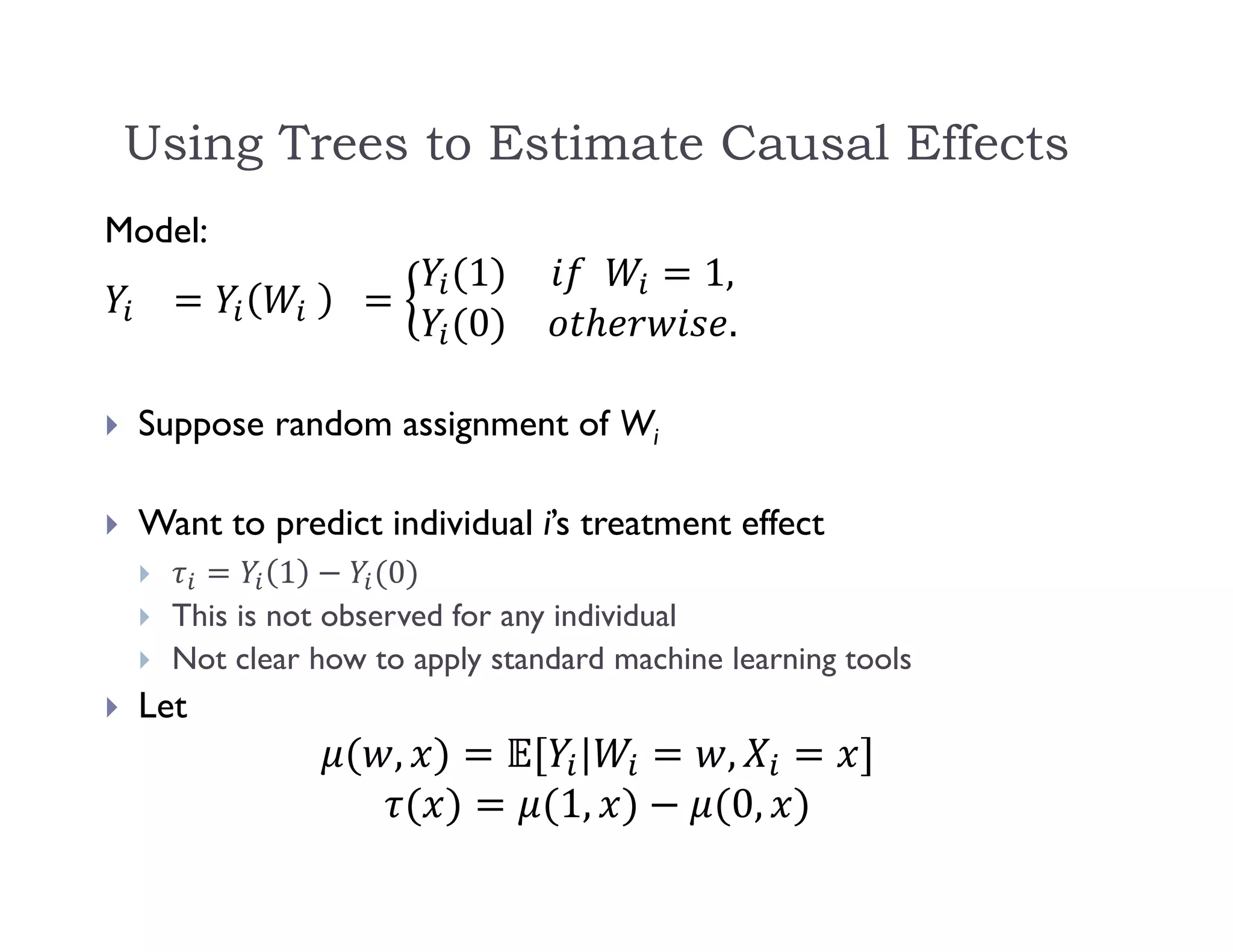
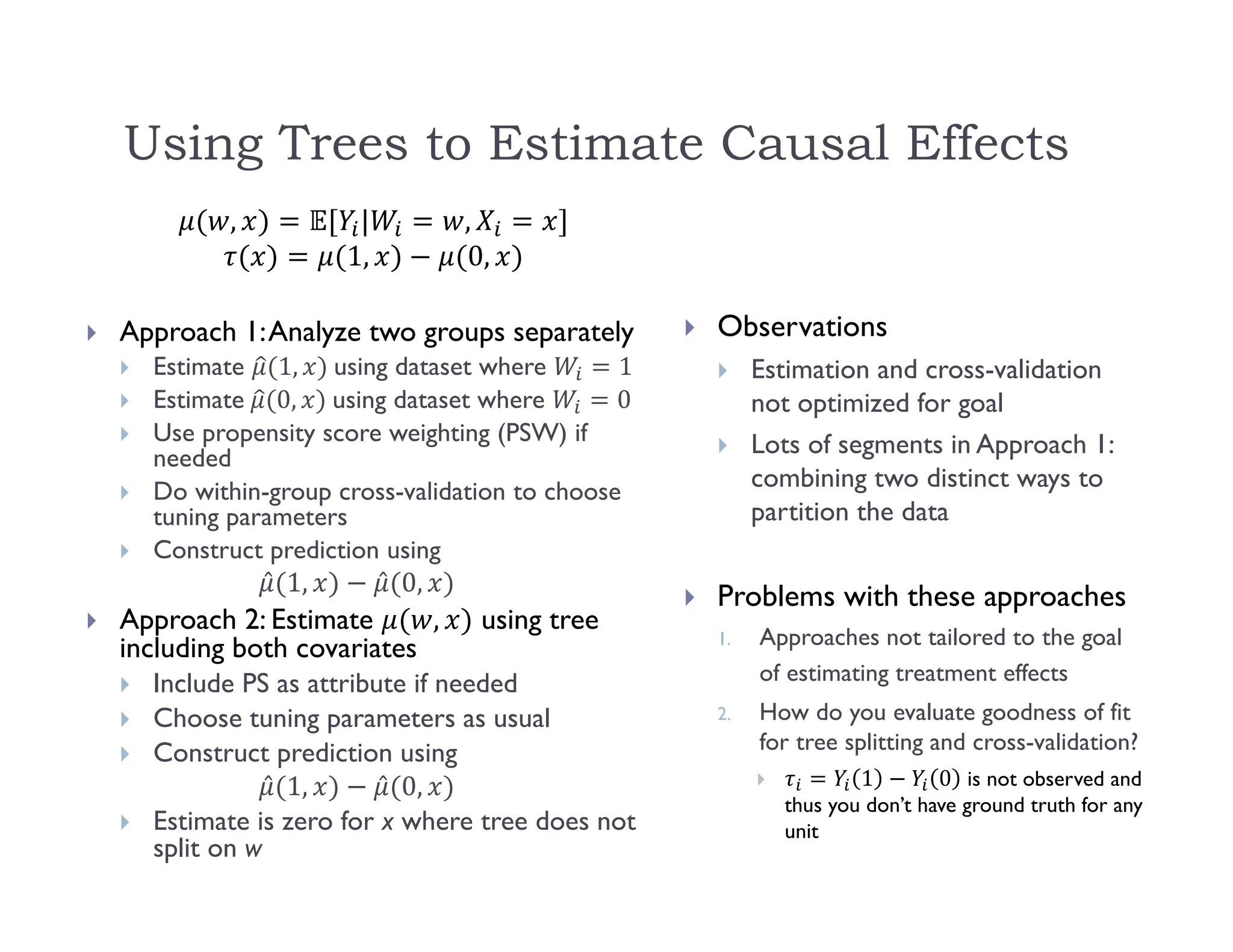
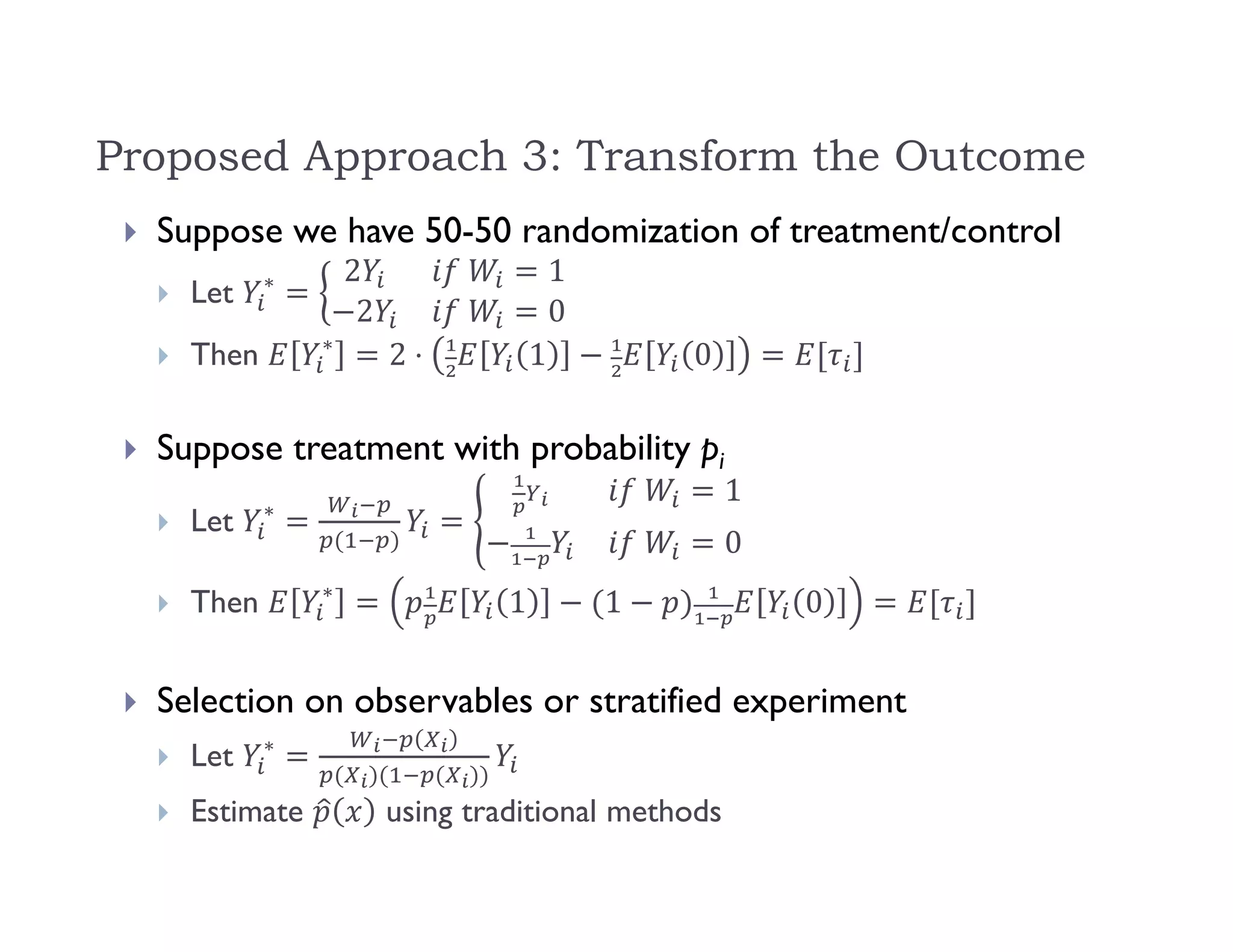
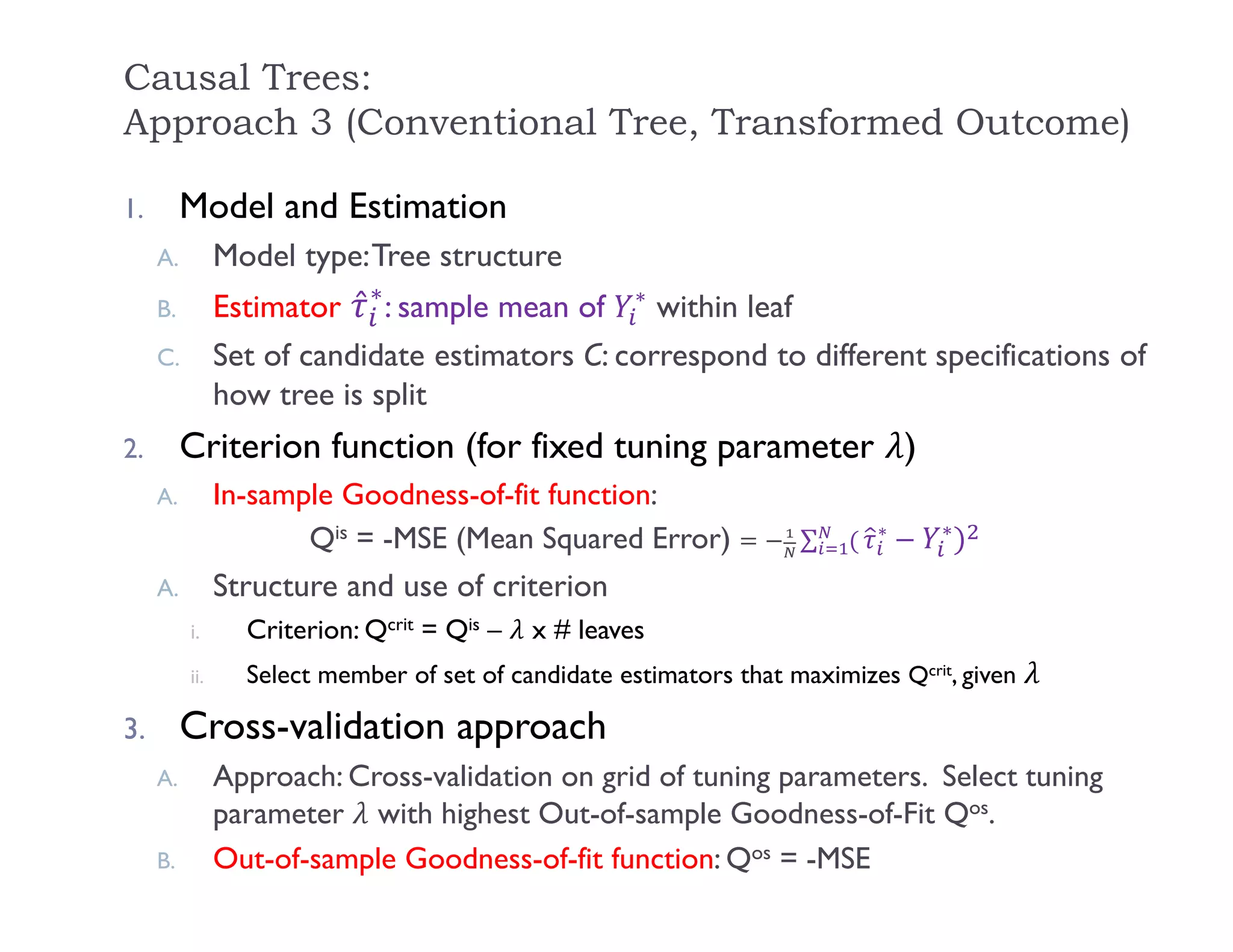
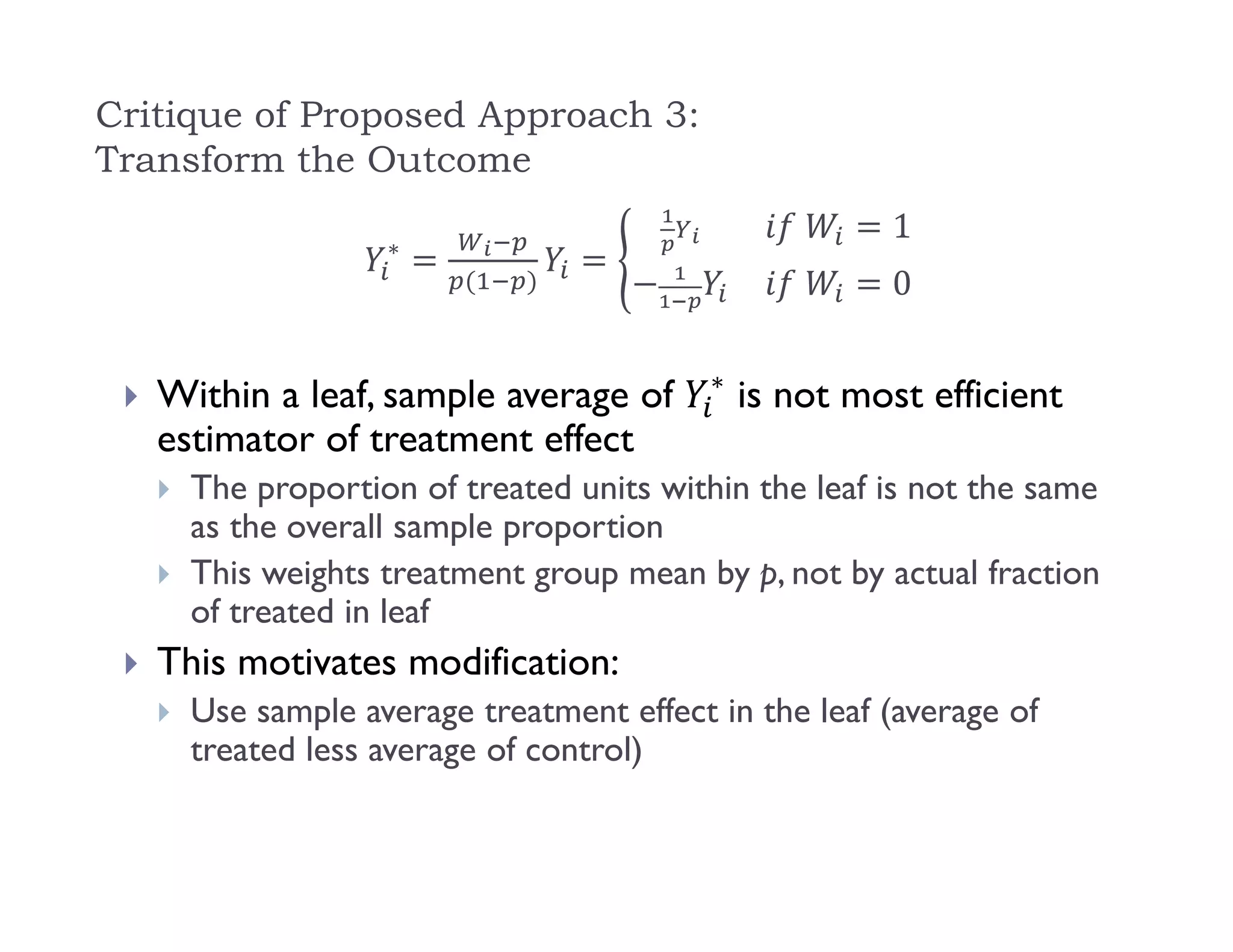
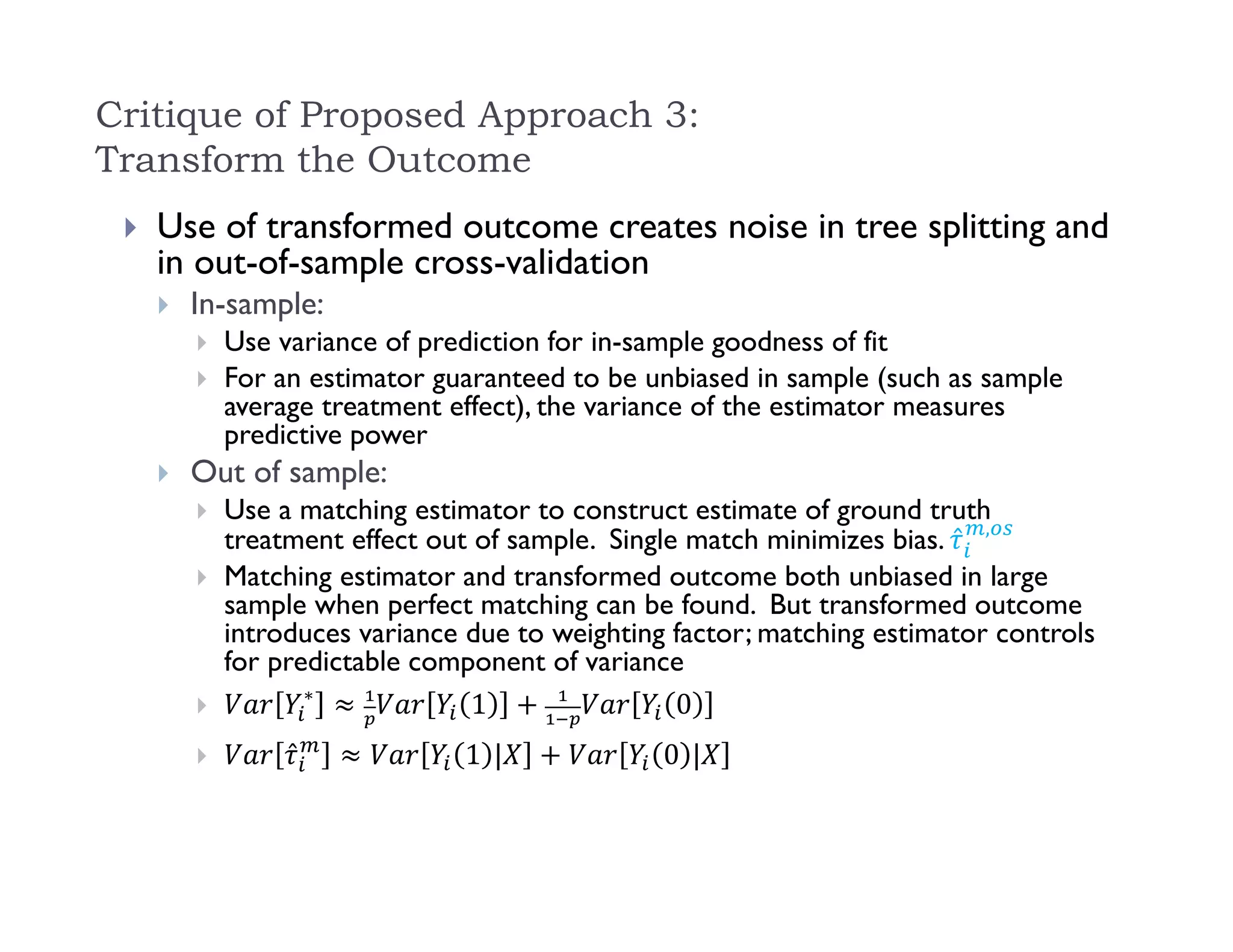
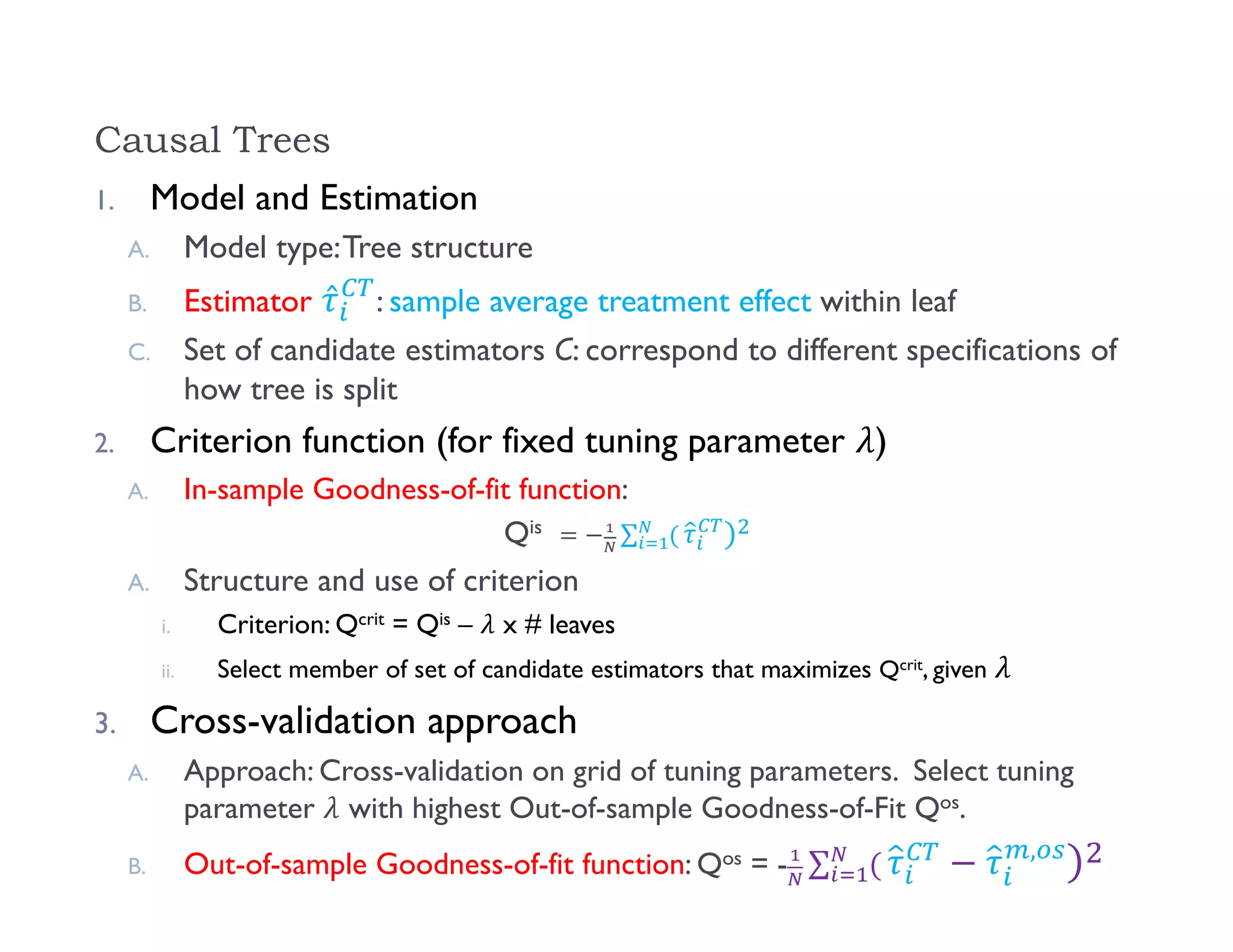
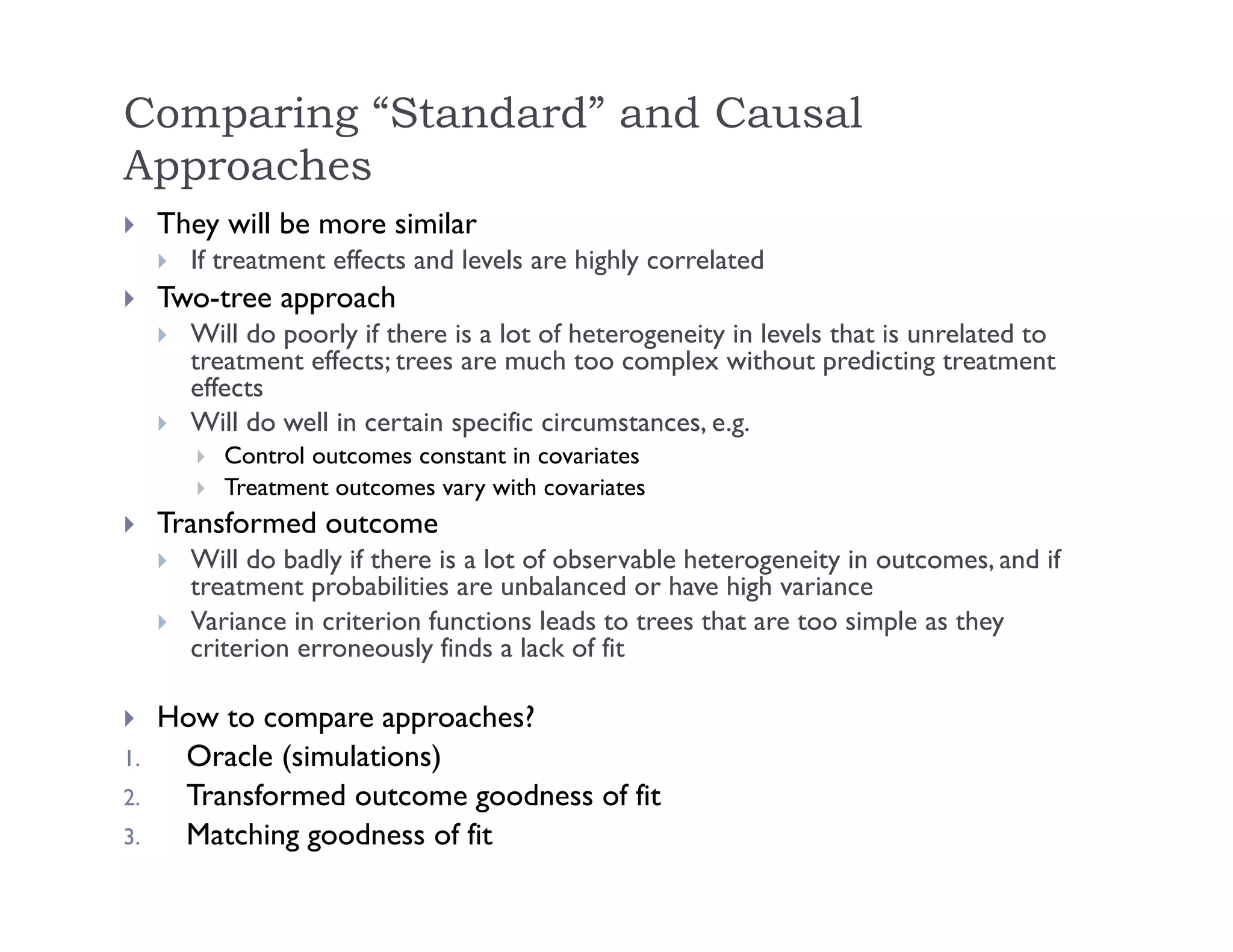
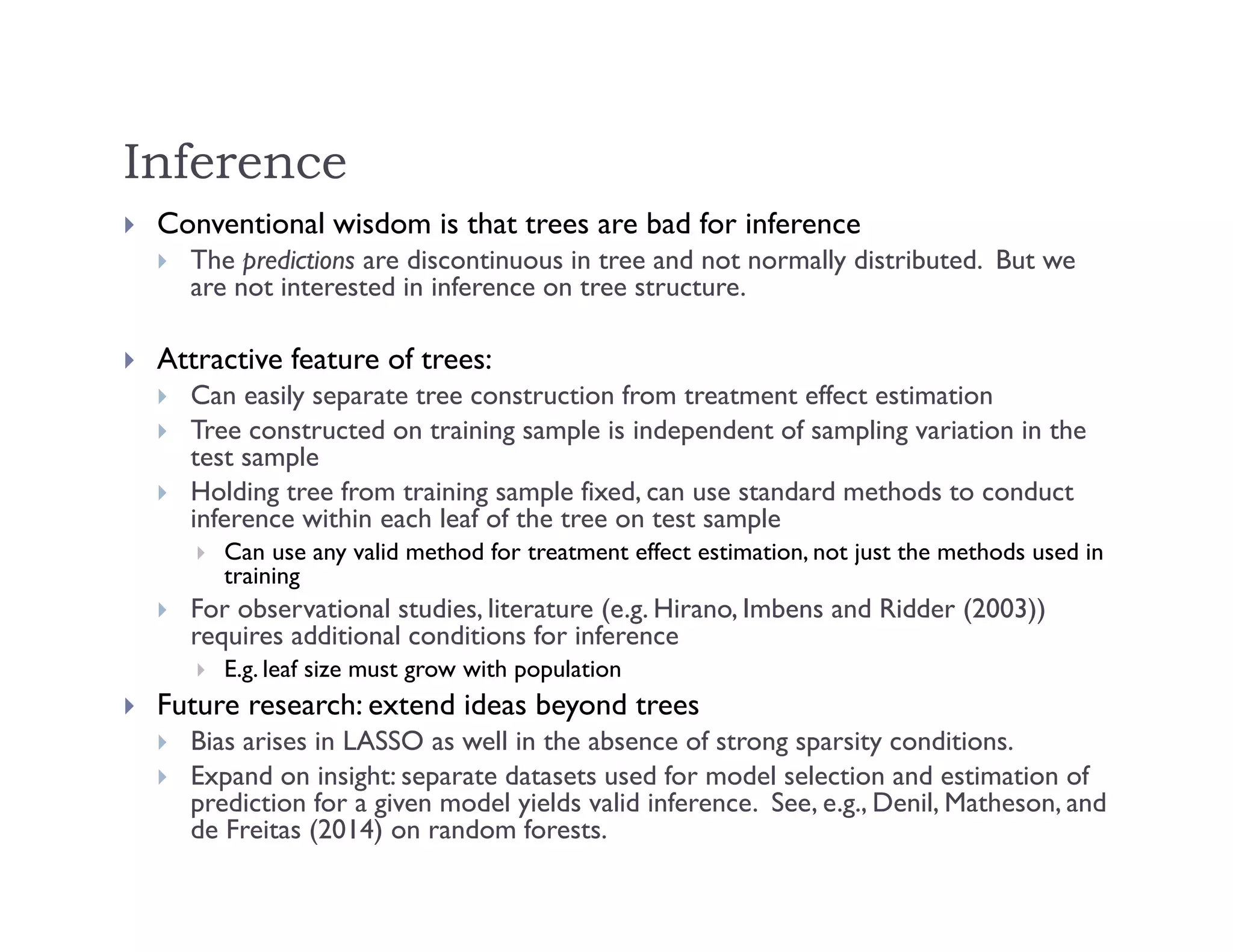
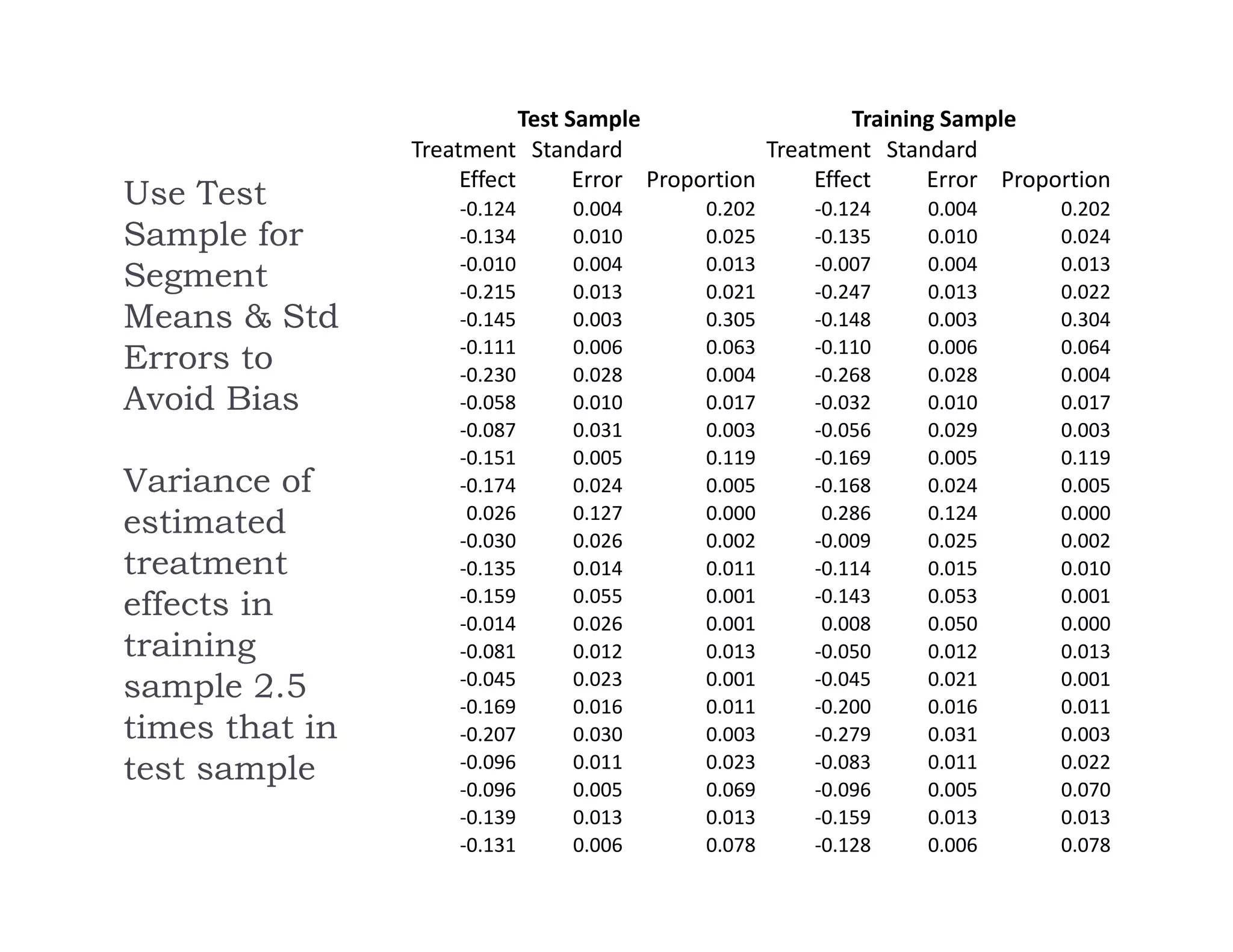
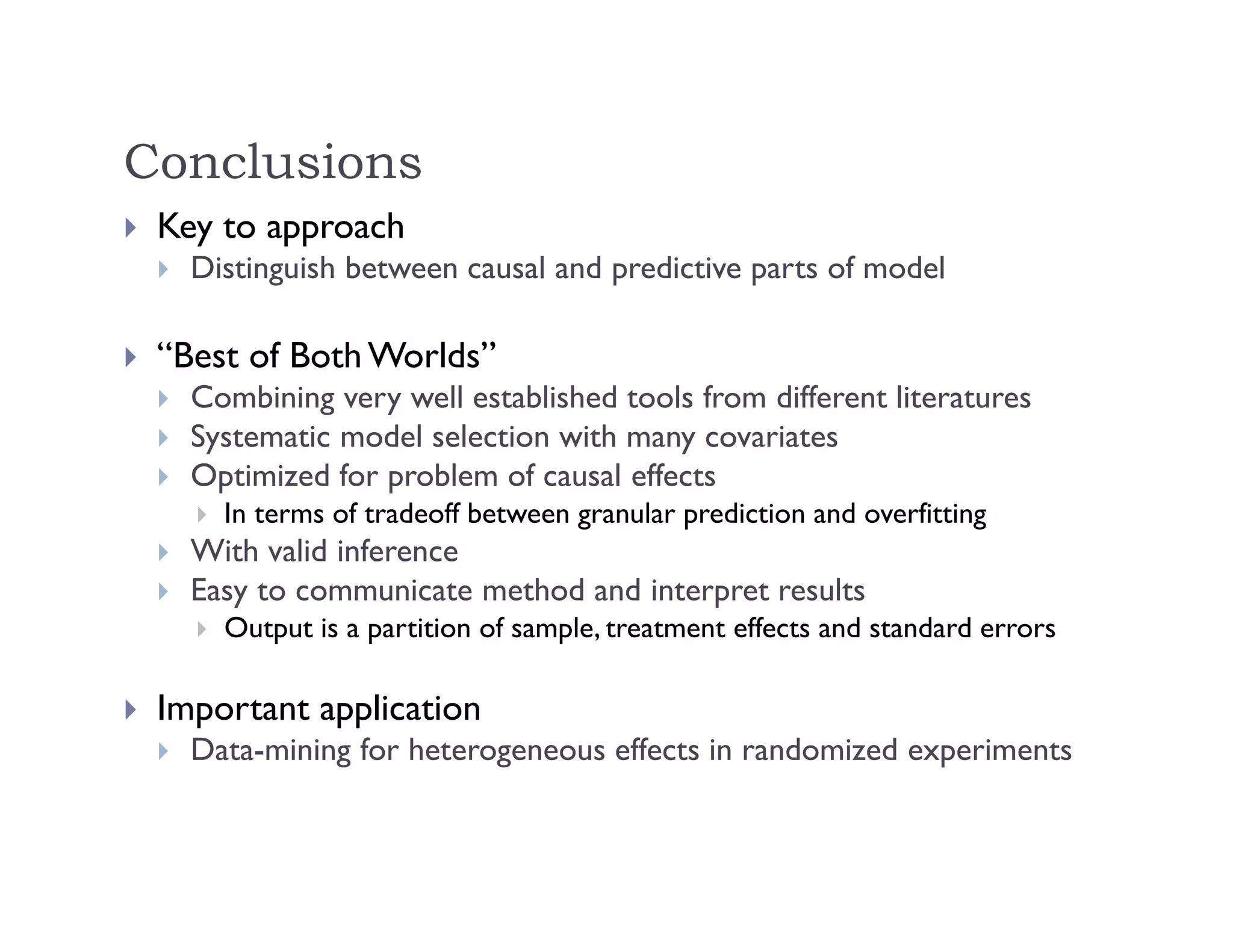
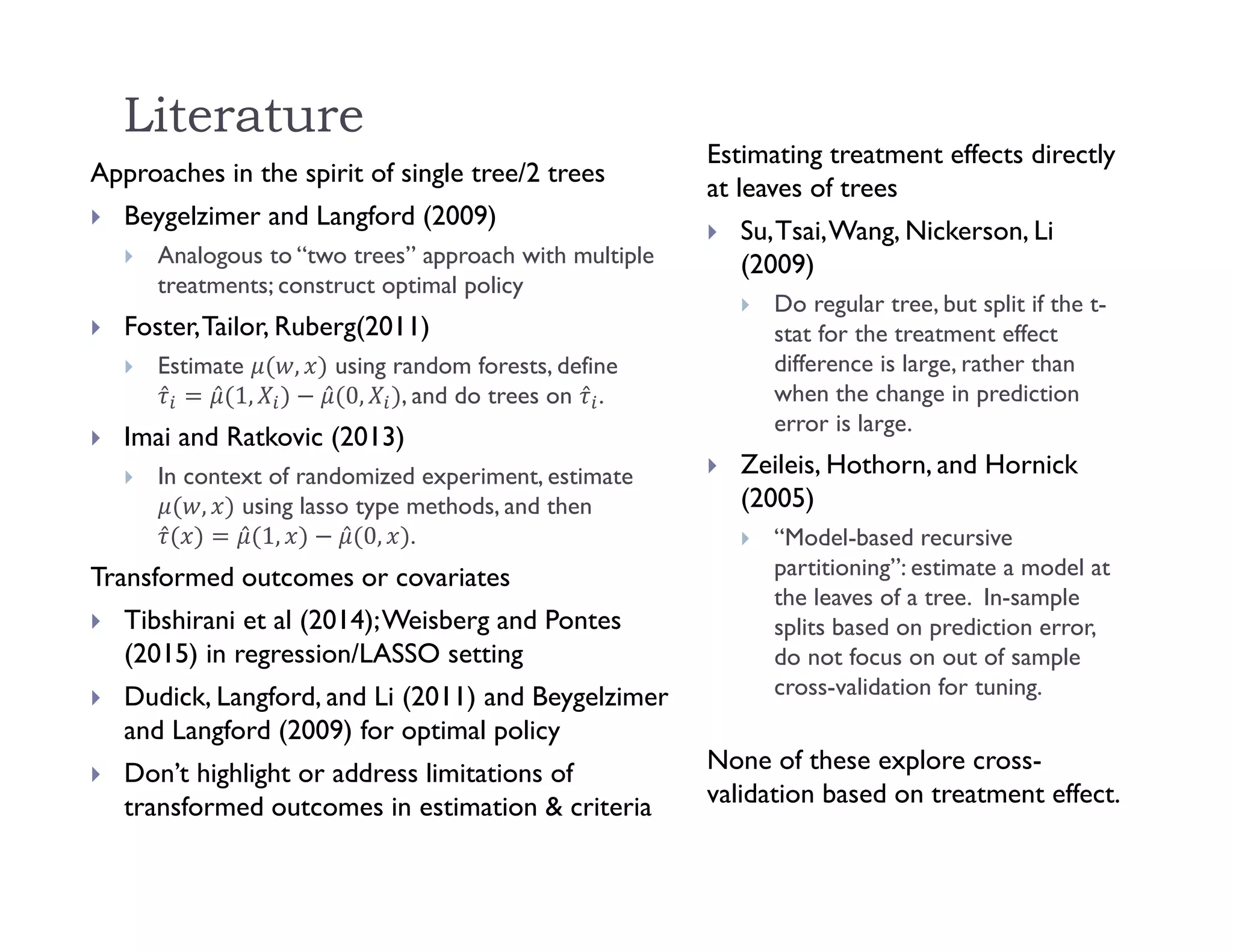
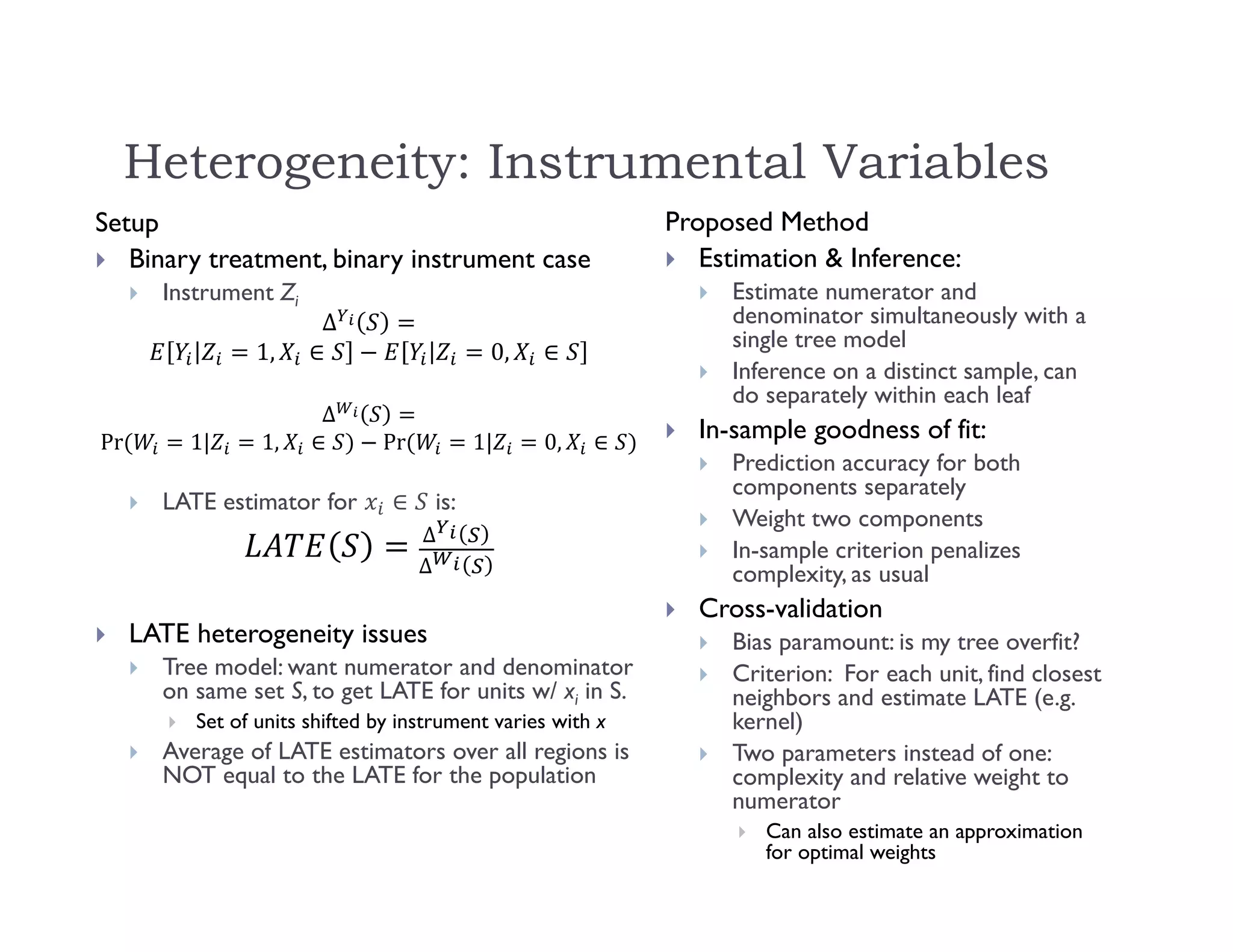
The document discusses using machine learning methods to estimate heterogeneous causal effects. It proposes an approach of using regression trees on a transformed outcome variable to estimate individual treatment effects. However, this approach is critiqued as it can introduce noise. An improved approach is presented that uses the sample average treatment effect within each leaf as the estimator, and uses the variance of predictions for model fitting criteria and a matching estimator for out-of-sample evaluation. The approach separates the tasks of model selection and treatment effect estimation to enable valid statistical inference on estimated effects in subgroups.



![Model
Outcome Yi incorporates both
costs and benefits
If cost is known, e.g. a mailing,
define outcome to include cost
Treatment Wi is multi-valued
Attributes Xi observed
Maintain selection on
observables assumption:
|
Propensity score:
Pr |
Optimal policy:
(x) = argmaxwE[Yi(w)|Xi=x]
Examples/interpretation
Marketing/web site design
Outcome is voting, purchase, a
click, etc.
Treatment is the offer
Past user behavior used to
define attributes
Selection on observables
justified by past
experimentation (or real-time
experimentation)
Personalized medicine
Treatment plan as a function of
individual characteristics](https://image.slidesharecdn.com/nbercausalpredictionv111lecture2-150818164001-lva1-app6892/75/Nbe-rcausalpredictionv111-lecture2-33-2048.jpg)
![Learning Policy Functions
ML Literature:
Contextual bandits (e.g., John
Langford), associative
reinforcement learning, associative
bandits, learning with partial
feedback, bandits with side
information, partial label problem
Cost-sensitive classification
Classifiers (e.g. logit, CART, SVM)
= discrete choice models
Weight observations by
observation-specific weight
Objective function: minimize
classification error
The policy problem
Minimize regret from suboptimal
policy (“policy regret”)
∗
For 2-choice case:
Procedure with transformed outcome:
Train classifier as if obs. treatment is optimal:
(features, choice, weight)= (Xi, Wi, ).
Estimated classifier is a possible policy
Result:
The loss from the cost-weighted classifier
(misclassification error minimization)
is the same in expectation
as the policy regret
Intuition
The expected value of the weights conditional
on xi,wi is E[Yi(wi)|Xi=xi]
Implication
Use off-the-shelf classifier to learn optimal
policies, e.g. logit, CART, SVM
Literature considers extensions to multi-
valued treatments (tree of binary classifiers)](https://image.slidesharecdn.com/nbercausalpredictionv111lecture2-150818164001-lva1-app6892/75/Nbe-rcausalpredictionv111-lecture2-34-2048.jpg)