Border towns and
spaces of (in)visibility
SIHMA
Scalabrini Institute for
Human Mobility in Africa
Study of young people on the move in the
border towns of Chipata and Katete, Zambia
Researchers and authors
Dr Glynis Clacherty, Dr Rebecca Walker and James Clacherty
Edited by Filippo Ferraro and Dr Rachel Chinyakata
2
Researchers and authors
Dr Glynis Clacherty, Dr Rebecca Walker and James Clacherty
Editing
Filippo Ferraro, SIHMA Executive Director
Dr Rachel Chinyakata, SIHMA Head of research
This report is based on a study undertaken by the Scalabrini Institute for Human Mobility in
Africa (SIHMA) in 2023.
SCALABRINI INSTITUTE FOR HUMAN MOBILITY IN AFRICA
47 Commercial Street, 8001
Cape Town Tel +27 21 4614741
Email admin@sihma.org.za
Website www.sihma.org.za
© Copyright 2024 Scalabrini Institute for Human Mobility in Africa (SIHMA).
All rights reserved, including rights to reproduce this report or portion thereof in whatever
format without prior permission in writing from SIHMA
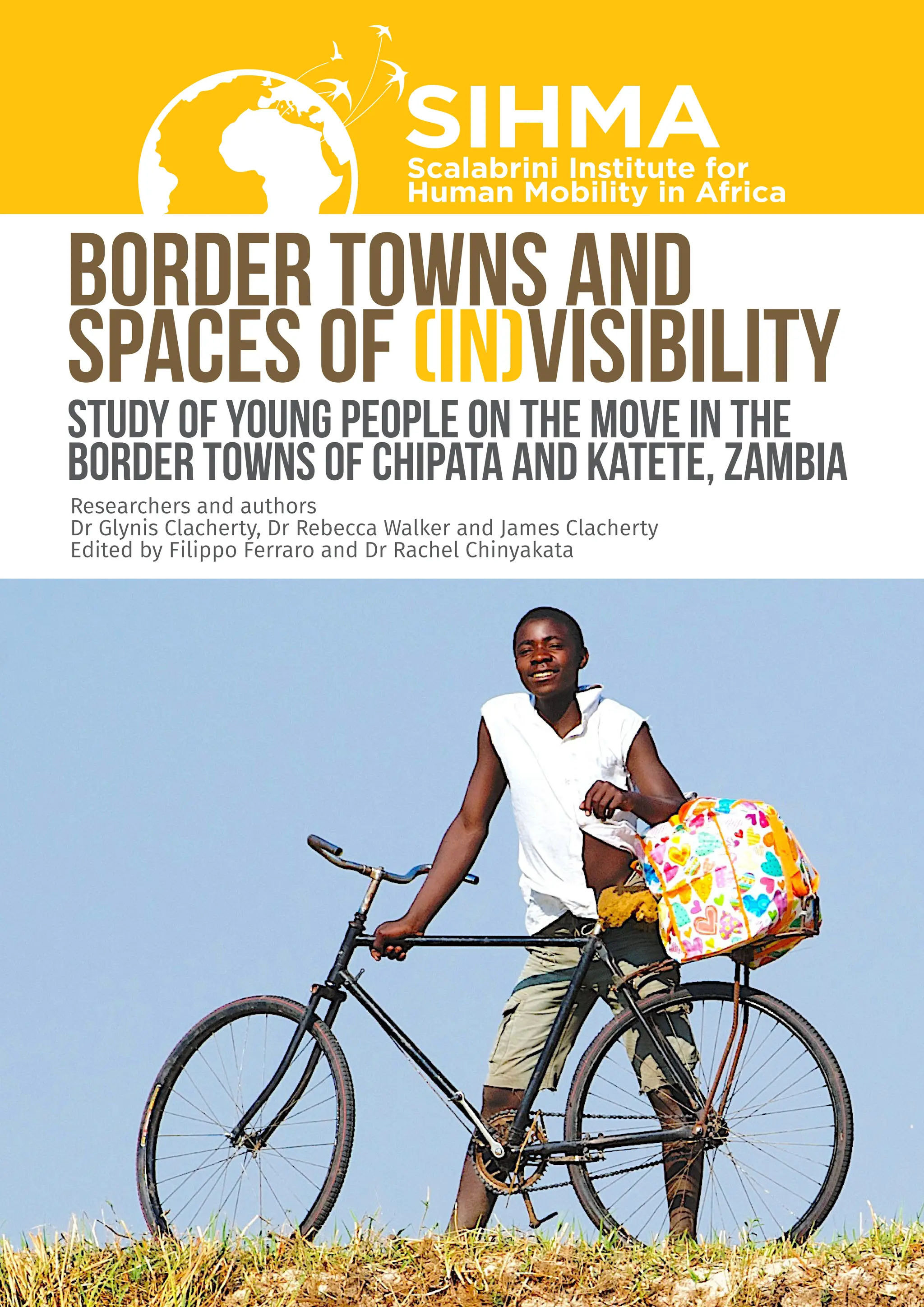
Photo on cover: Patrick Dugan, 2012.
3
AUTHORS
Dr Glynis Clacherty has worked in the field of
migration for many years as a research consultant. Her
work has focussed on East and Southern Africa where she
has worked with children in refugee camps, urban settings
and border towns. She has worked for organisations
such as Save the Children, UNICEF, CARE International,
PLAN International, Terre des Hommes and UNHCR. She
specialises in ethical research methodology with vulnerable
children and young people and has published widely in this
field. She is presently a Research Associate at the African
Centre for Migration and Society at the University of the
Witwatersrand, Johannesburg, South Africa.
Dr Rebecca Walker is an independant research
consultent and a Research Associate with the African
Centre for Migration & Society (ACMS), The University of
the Witwatersrand, Johannesburg. With a background in
Social Anthropology Rebecca's research focuses on issues
within the fields of migration, gender and health. Since
2014 Rebecca has conducted research with displaced
communities in South Africa and Southern Africa with an
interest in asylum seekers, refugees and children on the
move. Rebecca has published widely across academic
and non-academics spaces and consults for a number of
local and International organisations including Save the
Children, IOM, Lawyers for Human Rights and Sonke Gender
Justice.
James Clacherty is a qualitative researcher with a
background in social anthropology and urban geography.
James completed an MA in urban studies in 2019 and has
since been working in the international development
sector, first with Save the Children Switzerland and then
as a freelance research consultant. James specialises
in participatory research across a number of sectors,
including migration, children’s rights, homelessness, and
public health among others. James has worked with a range
of NGOs, development organisations, and government
agencies across Southern and East Africa.
4
Executive summary
This report explores the significance of border towns and spaces for strengthening responses
to young people on the move. In particular it explores the linkages of young people to local
service centres with the aim of further developing service, protection, and support strategies
for migrant children in border areas across the region. The report is based on a small-scale
fieldwork study in the border towns of Chipata and Katete in Zambia conducted in July 2023.
Border towns and spaces provide a rich source of information about issues related to the
informal or irregular movement of young people across borders, including smuggling and
trafficking. They can help build a picture of the nature and scope of the type of movement
young migrants undertake and also the forms of protection available to them. Border towns
and spaces also provide a lens through which we can better understand the vulnerabilities of
young people on the move and, critically, the strategies they use to navigate challenges and
access support.
The findings in this report highlight some of the key factors shaping the experiences
and vulnerabilities of young people on the move – particularly their proximity to border spaces
and how this affects the risks that they face. The report describes strategies that young people
on the move employ to remain below the radar of visibility to state and non-state actors due to
fear of arrest, detention, and deportation while also trying to keep themselves safe and access
support in border towns. These strategies of (in)visibility provide a way to protect themselves
yet at the same time also heighten some of the risks young people face as their vulnerabilities
are not always recognised by those who could offer support.
In this report we show that the realities and challenges of life and migration in this
region and in Zambia need to be better understood for support to be strengthened and tuned
to meet the specific needs of young people on the move. This includes understanding the
role of state and non-state stakeholders, the impact of laws and policies and, critically, the
experiences of the young people themselves. We provide recommendations for immediate
action, recommendations for programming to support young people on the move in the two
towns that would reduce risk for young people in this area, and recommendations for longer
term policy advocacy.
5
Table of Contents
Executive summary							4
Acronyms								8
Glossary: Terminology and Definitions of key concepts				 9
1. Introduction							10
2. Methodology							12
2.1 Desk and policy review					 12
2.2 Interviews with stakeholders					12
2.3 Participatory FGDs with youth on the move			 13
		2.3.1 Participants					13
		2.3.2 Research activities				13
		2.3.3 Ethics						15
3. Background and Context						15
3.1 Zambia as a transit and destination country			 15
3.2 Zambia’s migration and child protection legislative approach		 16
3.3 Engagement with cross-border coordination and mechanisms		 17
3.4. Two border towns: Chipata and Katete				 17
4. Findings							19
4.1 Overarching themes and sub-themes				 19
		4.1.1 Space						19
		4.1.2 Invisibility					19
4.2 Two border worlds						20
		4.2.1 Proximal migrants					21
		4.2.2 Distal Migrants					23
4.3 Migration flows navigating migration opportunities and vulnerabilities 24
		4.3.1 Reasons for leaving				25
		4.3.2 Crossing the border				25
		4.3.3 Moving in groups					26
4.4 Employment						27
		4.4.1 Informal work					27
		4.4.2 Boys and employment				28
		4.4.3 Girls and employment				28
		4.4.4 Sex work and exploitation				30
4.5 Protection strategies					31
		 4.5.1 Avoiding detection from authorities – staying invisible 31
		4.5.2 Peer support networks				33
		 4.5.3 Compound living and invisibility			 34
		 4.5.4 (In)visibility and accessing services			 36
4.6. Limitations of legislation and the state				 36
		 4.6.1 Absence of child-centred policy and practices for young 			
		people on the move					37
6
		 4.6.2 Alternatives to documentation needed			 39
4.7 Service Provision and Rights					40
		4.7.1 Existing service provision				40
		 4.7.2 Limitations to service provision			 41
5. Conclusion and steps forward						43
5.1 Thinking forward: strengthening responses			 43
		 5.1.1 Places of safety in Katete				 43
		 5.1.2 Safe employment options in border towns		 44
		 5.1.3 Develop responses based on unique needs of different groups 			
		 of migrants based on (in)visibility and proximity to the border 45
5.2 Policy advocacy						45
		 5.2.1. Alternative options for ensuring documentation		 45
		 5.2.2 Initiatives to address the gaps between policy and practice. 45
Appendix A: Literature Review						46
1. Context of children crossing borders in Zambia			 46
		1.1 Data availability				46
		1.2 Migration Routes				47
		 1.3 National policies, laws, and agreements governing 			
			migration and children			48
2. Existing responses						53
		 2.1 Local and international partnerships and mechanisms 53
		 2.2 Detention and deportation of child migrants		 55
		2.3 Child labour				56
		2.4 Access to services				57
Appendix B: Policy review table						58
Appendix C: Research Tool 1 (Participatory FGD)				 59
Appendix D: Research Tool 2:KI interview Guide				 63
References								64
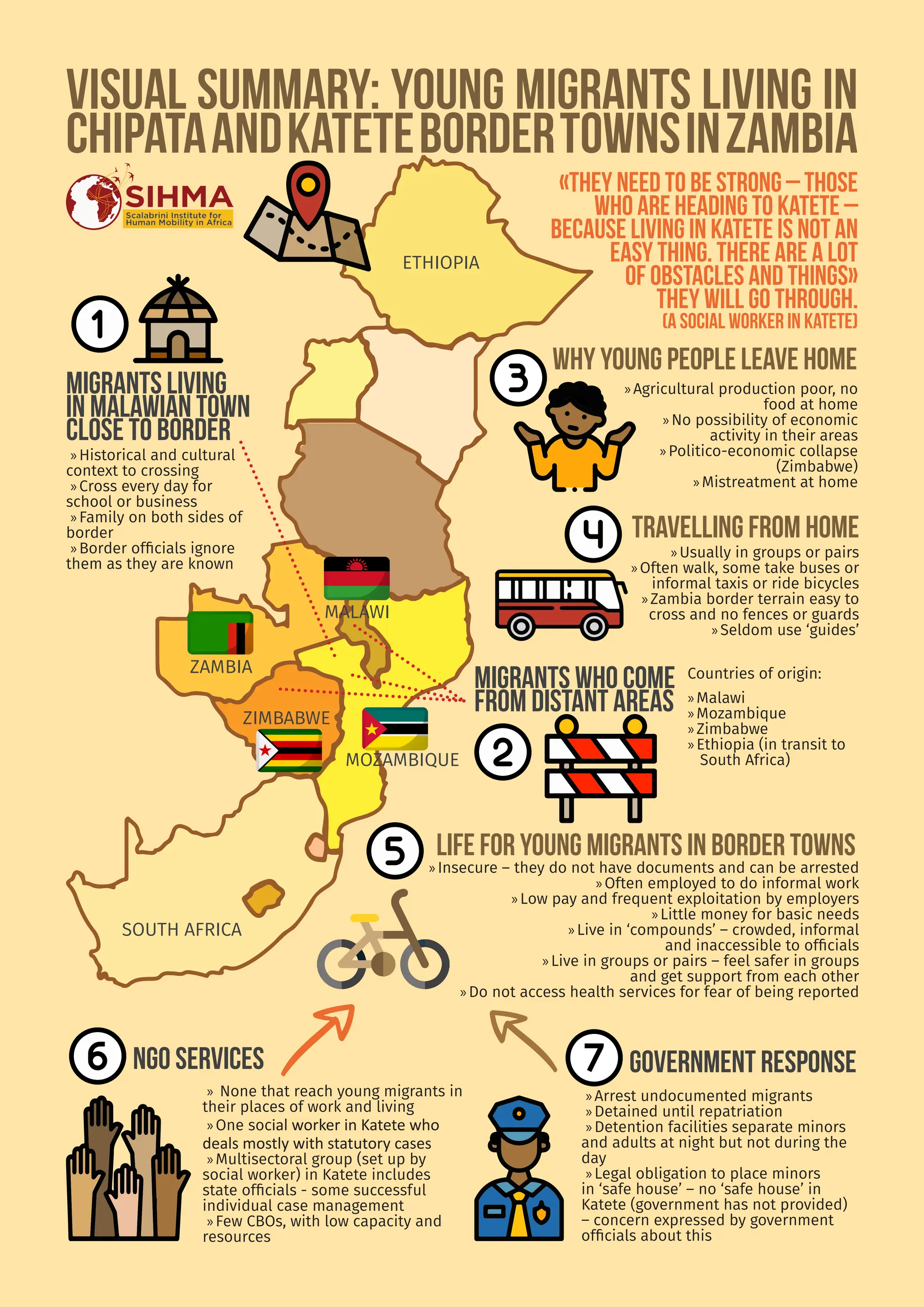
Visual summary							68
Acknowledgment							69
7
List of Figures
Figure 1. A map of the ‘places I go to’ drawn in a small book			 14
Figure 2: Map of Zambia						18
Figure 3: Two border worlds. Green shows where proximal migrants live.			
Routes show origins of distal migrants					 20
Figure 4: A map showing how the young person’s life takes place on both 			
sides of the border. The border is shown as a bridge				 23
Figure 5: Map shows where distal migrants come from				 24
Figure 6: An informal market in Chipata. Some young people on the move 			
(men and women) work for an employer to sell in these markets			 29
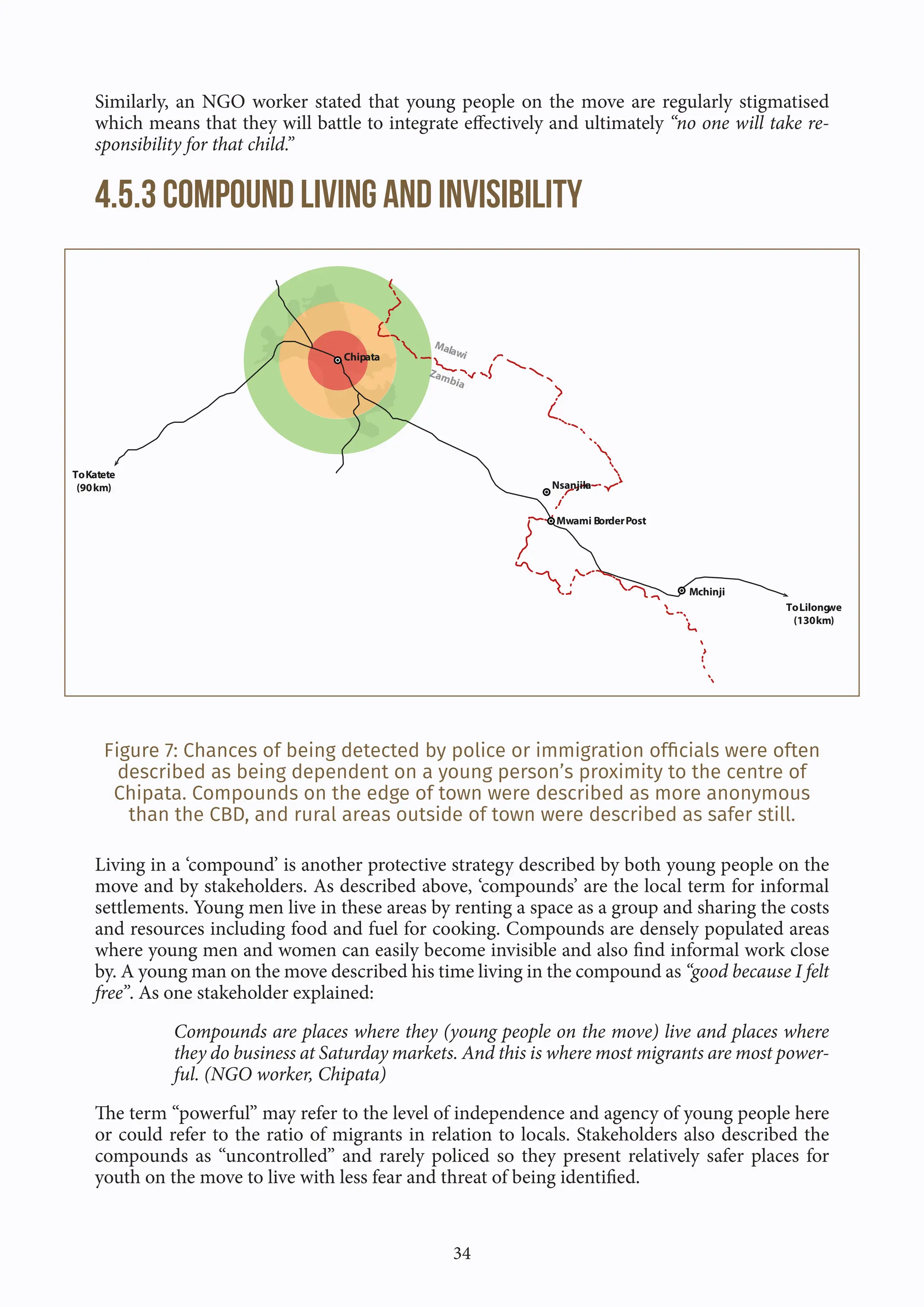
Figure 7: Chances of being detected by police or immigration officials were often		
described as being dependent on a young person’s proximity to the centre of Chipata. 		
Compounds on the edge of town were described as more anonymous than the CBD, 		
and rural areas outside of town were described as safer still			 34
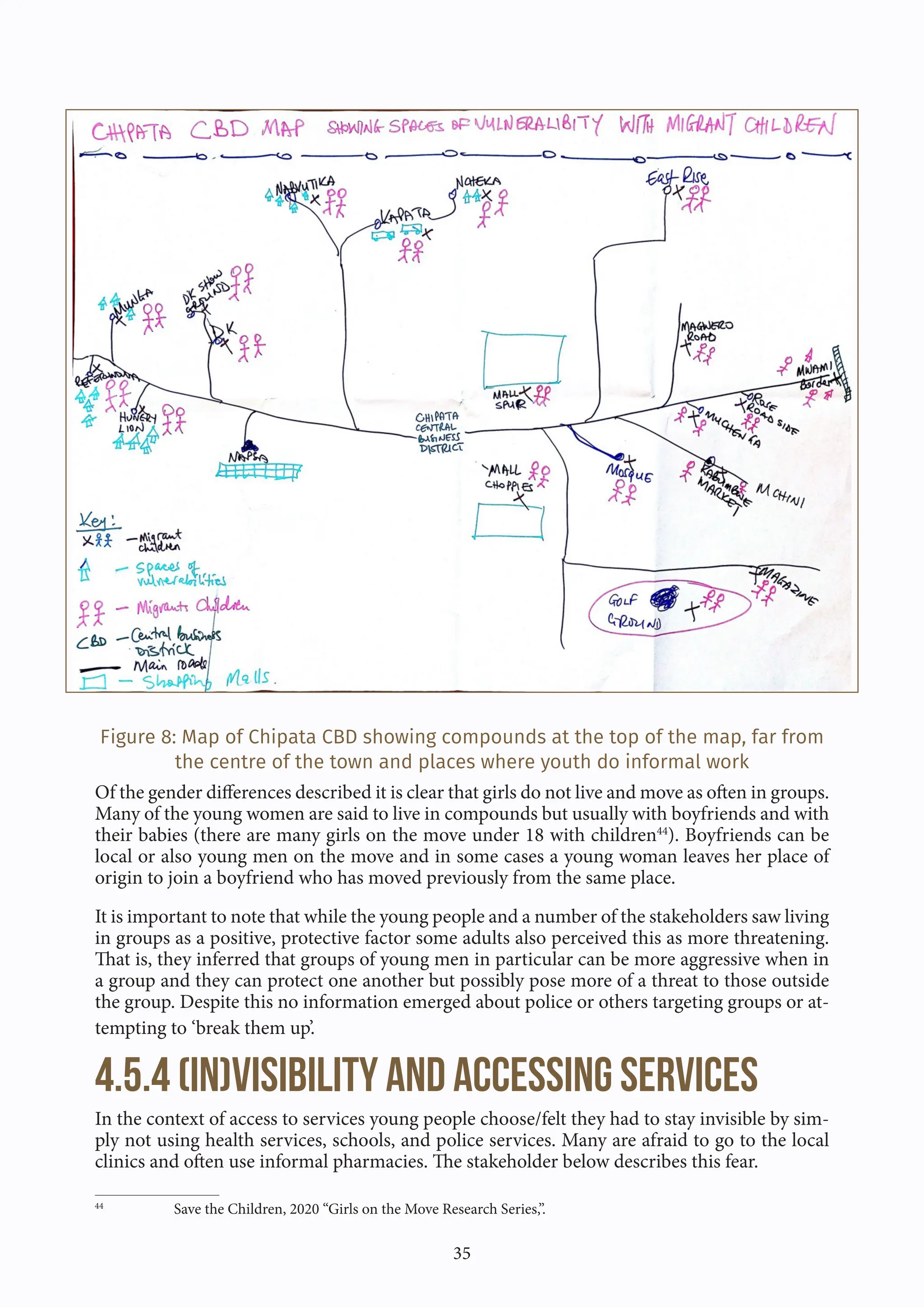
Figure 8: Map of Chipata CBD showing compounds at the top of the map, far from the		
centre of the town and places where youth do informal work			 35
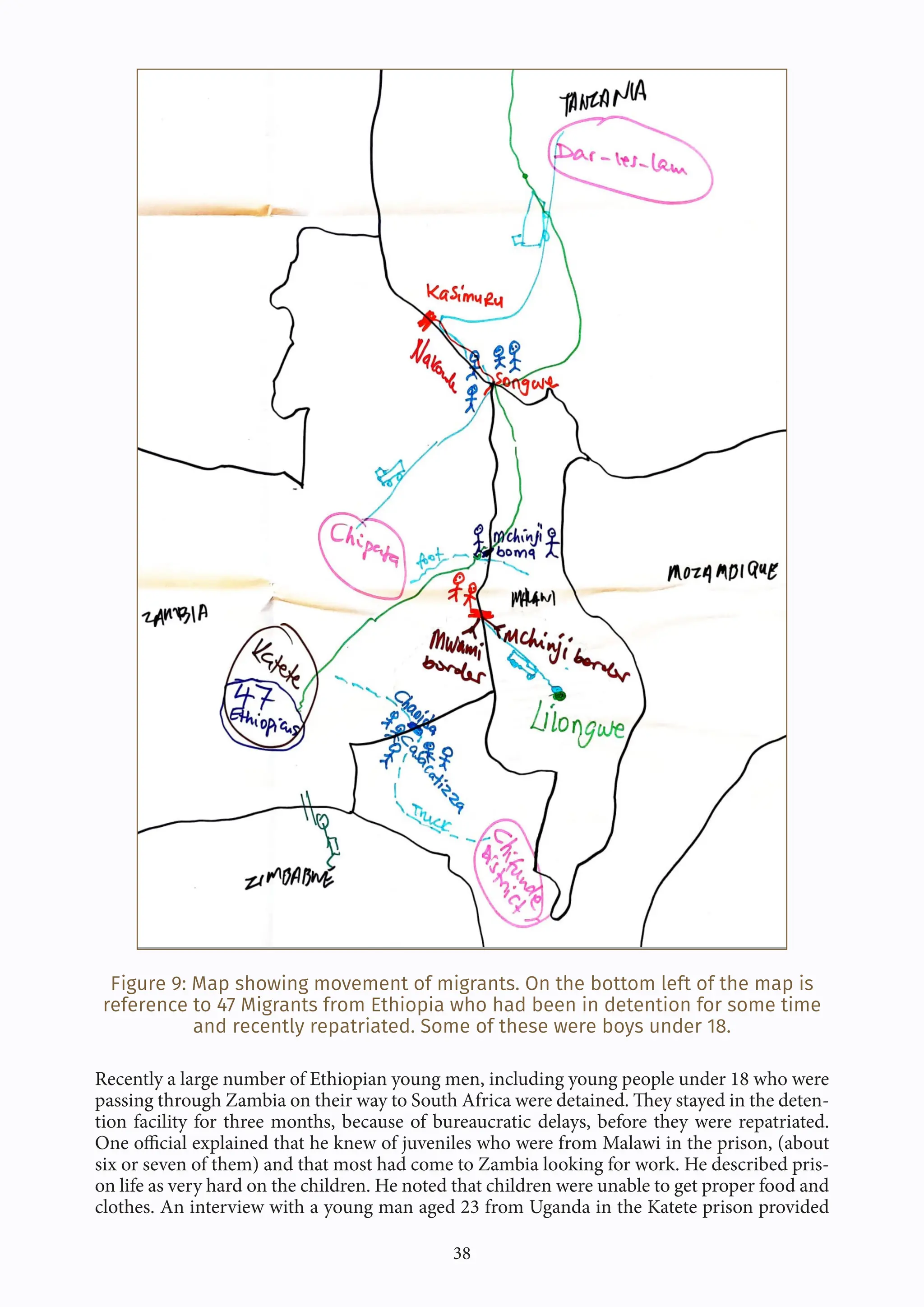
Figure 9: Map showing movement of migrants. On the bottom left of the map is reference
to Migrants from Ethiopia who had been in detention for some time and recently
repatriated. Some of these were boys under 18				 38
Table 1: Mobility and child aware policy review				 49
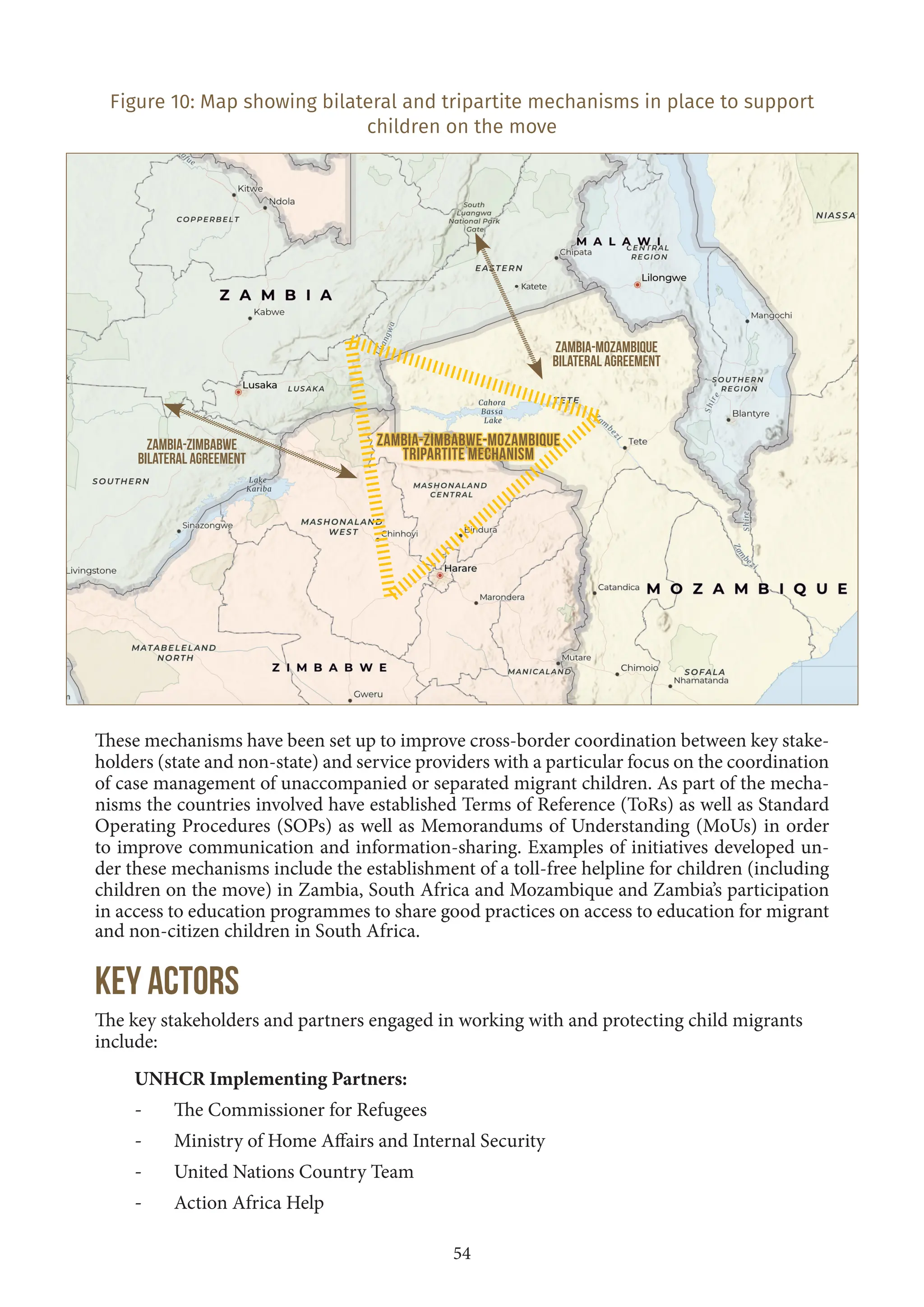
Figure 10: Map showing bilateral and tripartite mechanisms in place to support 				
children on the move							54
8
Acronyms
ACRWC African Charter on the Rights and Welfare of the Child
AU African Union
BIA Best Interest Assessment
BID Best Interest Determination
CoM Children on the Move
CRC Children’s Rights Charter
CSO Civil Society Organization
CYCC Children and Youth Care Centres
DBE Department of Basic Education
DHA Department of Home Affairs
DSD Department of Social Development
DRC Democratic Republic of Congo
DSW Department of Social Welfare
FGD Focus Group Discussion
FTR Family Tracing and Reunification
IDP Internally Displaced Person
IOM International Organisation for Migration
ISS International Social Services
KI(s) Key Informant(s)
MIDSA Migration Dialogue for Southern Africa
MOU Memorandum of Understanding
NGO Non-Governmental Organization
NTT National Task Force
SADC Southern Africa Development Community
SOPs Standard Operating Procedures
UNHCR United Nations High Commissioner for Refugees
UNICEF United Nations Children’s Fund
USMC Unaccompanied and Separated Migrant Children
9
Glossary: Terminology
and Definitions of key concepts
Adult: An adult is an individual who is over the age of 18 years.
Child: A child is defined in international law (the Convention on the Rights of the Child) as
anyone under the age of 18 years.1
Children on the move: Children on the Move are defined as ‘Children moving for a variety
of reasons, voluntarily or involuntarily, within or between countries, with or without their
parents or other primary caregivers, and whose movement, while it may open up opportuni-
ties, might also place them at risk (or at an increased risk) of economic or sexual exploitation,
abuse, neglect and violence’.2
A distinction should also be made between the various children
on the move, based on the reasons motivating such movement. The four categories include:
Internally displaced persons; asylum seekers and refugees; migrants (i.e., for economic reasons
or due to climate change, both internally and across borders); and trafficked persons. In this
report we have used the term ‘youth on the move’ as most of the young migrants living in the
border area are over the age of 14 though there was reference to migrants as young as 10.
Unaccompanied migrant children (UMC): An unaccompanied migrant child is a child who
‘has either crossed a border alone or has subsequently found him or herself living in a foreign
country without an adult care-giver (not being cared for by an adult who by law, or custom,
has a responsibility to do so)’3
Separated children: UNCRC’s Committee on the Rights of the child’s General Comment Nr
6 (2005) defines this group of children as children who have been separated from both parents
or from their previous legal or customary primary caregiver, but not necessarily from other
relatives. These may therefore include children accompanied by other adult family members.4
Migrant/refugee children: A refugee child is a child that has a refugee claim due to having left
their country of origin to escape war, conflict or persecution and therefore may be eligible for
refugee status and may qualify for protection. In addition, the principle of family unity is rec-
ognised in the UN Refugee Convention and in many domestic refugee laws. As such, a refugee
child can also be a child of a parent or guardian who has a refugee claim. If a child has left for
other reasons, for example to attend school or to find work they are seen as a migrant and not
necessarily eligible for protection under the Refugees Act.
Trafficked children: The Palermo Protocol defines trafficking in children as the recruitment,
transportation, transfer, harbouring, or receipt of a child for the purpose of exploitation, even
if this does not involve any fraudulent means such as violence, deception, or coercion.5
A child
is defined as any person under 18 years of age.
Smuggled children: Child smuggling is defined as ‘the illegal transportation of children for
profit’ as set out in the Protocol against the Smuggling of Migrants by Land, Sea, and Air
(Migrant Smuggling Protocol), supplementing the United Nations Convention against Trans-
national Organised Crime.6
1
UNHCR, 1990 “The United Nations Convention on the Rights of the Child.”
2
UNICEF et al.,2019 “Guidance to Respect Children’s rights in Return Policies and Practices. Focus on the
EU Legal Framework.”
3
Hillier, 2007 “Children on the Move.”
4
General Comment Number 6 (2005) Treatment of unaccompanied and separated children outside their
country of origin. Par 8:
5
OHCHR, 2000 “Protocol to Prevent, Suppress and Punish Trafficking in Persons.”
6
UN, 2000 “Protocol Against the Smuggling of Migrants by Land, Sea and Air, Supplementing the United
Nations Convention Against Transnational Organised Crime.”
10
1. Introduction
Southern Africa is a highly mobile region with significant historical and contemporary
migration within countries and across borders.7
Research shows that, like adults, children
migrate for many different reasons and that mobility is seen as the key to access opportunities,
livelihoods, education, and security.8
However, increasingly restrictive migration laws and the
securitisation of borders across the region has created greater risk for young people on the
move who choose to remain invisible to avoid coming into conflict with the law.9
Attempts to
stay hidden from border officials and other figures of authority pushes young people to avoid
historically familiar (and safer) routes and border-crossing strategies. To remain invisible
young people, use unknown routes of travel, risky ways of crossing borders and, unsafe
strategies to remain hidden after arrival. Though these strategies show considerable agency
they also increase young people’s vulnerability to violence and exploitation.10
A growing body of research suggests that there is increasing awareness of the irregular move-
ment of children across borders and improved support through engagement and cross-border
mechanisms established by state and non-state actors.11
There has been a particular focus on
children who are vulnerable to human trafficking and the development of policies and prac-
tices to increase awareness and improve responses. However, at the same time there remains a
lack of information regarding the challenges and complexities of irregular movement (some of
which is connected to trafficking and some which is not trafficking) and the support available
to or strategies employed by young people to navigate these challenges.12
Furthermore, despite interventions to secure borders and prevent movement it is evident that
children will keep on moving and needing support to avoid risks, including trafficking.13
There
is a need, therefore, for a more in-depth understanding of the support and protection needs
of young people on the move, particularly those who either pass through or remain for some
time in border towns and other border spaces as they move. Young people living in or moving
through border towns and border areas are some of the most vulnerable young people on the
move because of the danger inherent in crossing borders, the chaotic activity of a border town,
and their proximity to officials whose mandate is to return them to their countries of origin.
Research in border towns and spaces can provide rich information about issues related to the
informal movement of young people across borders, including smuggling and trafficking.
Research on young people on the move has focused on urban areas in Southern Africa,14
but
there is limited work on border towns and border spaces in the region. This is partly because
7
Blaser Mapitsa and Landau, 2019 “Measuring Municipal Capacity to Respond to Mobility”; Amit, 2015
“From Protection to Exclusion: Asylum Seekers and Immigration Detention in Democratic South Africa.”
8
Save the Children, 2017 “Study on Unaccompanied Migrant Children in Mozambique, South Africa, Zambia
and Zimbabwe”; Save the Children, 2022 “Documenting the Impact of Cross-Border Case Management for Children on
the Move in Southern Africa,”
9
Walker and Clacherty, 2023 “Hair Salons as ‘Private-Public Spaces’: Exploring the Experiences of Young
Migrant Women in an Urban Township in South Africa”; Save the Children, 2022 “Documenting the Impact of Cross-
Border Case Management for Children on the Move in Southern Africa,”
10
Denov and Bryan, 2012 “Tactical Manoeuvring and Calculated Risks”; O’Higgins, 2012 “Vulnerability and
Agency.”
11
Save the Children, 2022 “Documenting the Impact of Cross-Border Case Management for Children on the
Move in Southern Africa”; Misago and Landau, 2018 “Free and Safe Movement in Southern Africa Research to Promote
People’s Safe and Unencumbered Movement across International Borders.”
12
Crepeau. 2013 “The Rights of All Children in the Context of International Migration.”
13
Denov and Bryan, 2012 “Tactical Manoeuvring and Calculated Risks”; O’Higgins, 2012 “Vulnerability and
Agency.”
14
Tschudin, 2014 “Literature Review”; Walker and Clacherty, “Hair Salons as ‘Private-Public Spaces’: Exploring
the Experiences of Young Migrant Women in an Urban Township in South Africa.”
11
many assume that migrants use border towns as a temporary stop or transit space on their way
to bigger urban areas where economic activity would provide access to employment. The lim-
ited research that has been done with young people in border areas15
suggests that many young
people stay in these towns and spaces, sometimes because they do not have the means to move
on, but often because the economic activity characteristic of border areas provides informal
work and the ‘coming and going’ that characterises such towns makes it easier for these young
people to remain invisible.
This report seeks to redress this gap in information and understanding about the experiences
of young people in border towns in Southern Africa with the aim of supporting and strength-
ening service provision for young migrants. In particular it seeks to explore the linkages of
young people to local service centres with the aim of further developing service, protection,
and support strategies for migrant children in border areas across the region.
The research consisted of a small-scale fieldwork study in the border towns of Chipata and
Katete, Zambia conducted in July 2023. The study is located within a larger SIHMA project to
understand the lived reality of young people living in border towns in Southern Africa. It is
our hope that the preliminary findings and insights from this small study can contribute to the
broader discourse on irregular movement of children across borders and be used as an impe-
tus for more in-depth and widespread research that will strengthen responses to the realities
of young people living in border areas.
15
Mahati, 2012 “Children Learning Life Skills through Work: Evidence from the Lives of Unaccompanied
Migrant Children in a South African Border Town”; Walker, Mahati, and Magaya, 2020 “Child Trafficking in South
Africa: Exploring the Myths and Realities”; Save the Children, 2017 “Strengthening Child Protection Systems for
Unaccompanied Migrant Children in Mozambique.”
12
2. Methodology
Based on previous research and preliminary findings about the significance of these two bor-
der towns, we decided to use a methodology that could help us uncover some of the complexi-
ties of the lived experiences of young people on the move in Chipata and Katete. We chose a
research method based primarily on a ‘light’ or ‘rapid’ ethnographic approach.16
Overall, three
key methods were used:
1. Desktop review of relevant literature pertaining to children on the move in Southern
Africa and specifically Zambia. This also included a mapping of the legal and policy land-
scape in Zambia in relation to migration and children’s rights.
2. Semi-structured key informant interviews (KIIs) and participatory focus group discus-
sions (FGDs) with staff at service centres and officials working with or in contact with
migrant youth.
3. Participatory FGDs with young people on the move.
2.1 Desk and policy review
A review of the literature and policy was conducted to identify key trends and issues impacting
child migrants in Southern Africa with a specific focus on Zambia. It soon became clear that
children and youth in border towns generally and the border area we were interested in were
largely invisible in the literature. Given the limited literature available the review focused on
the context of children crossing borders in Zambia more widely. Overall, 20 academic articles
and grey literature documents were reviewed and of these only two made specific reference
to child migrants in the two towns that are major transit points for children moving through
Zambia and their surroundings. The review identified the key actors involved in engaging
with child migrants as well as some of the key issues faced by child migrants such as deten-
tion and deportation, child labour, and access to services. A policy review is included as part
of the review. Aspects of the review are integrated into the body of this report to contextualise
our empirical findings and support the analysis and recommendations. The full literature and
policy review is included in Appendix A.
2.2 Interviews with stakeholders
The table below outlines the number of interviews conducted and the stakeholder roles.
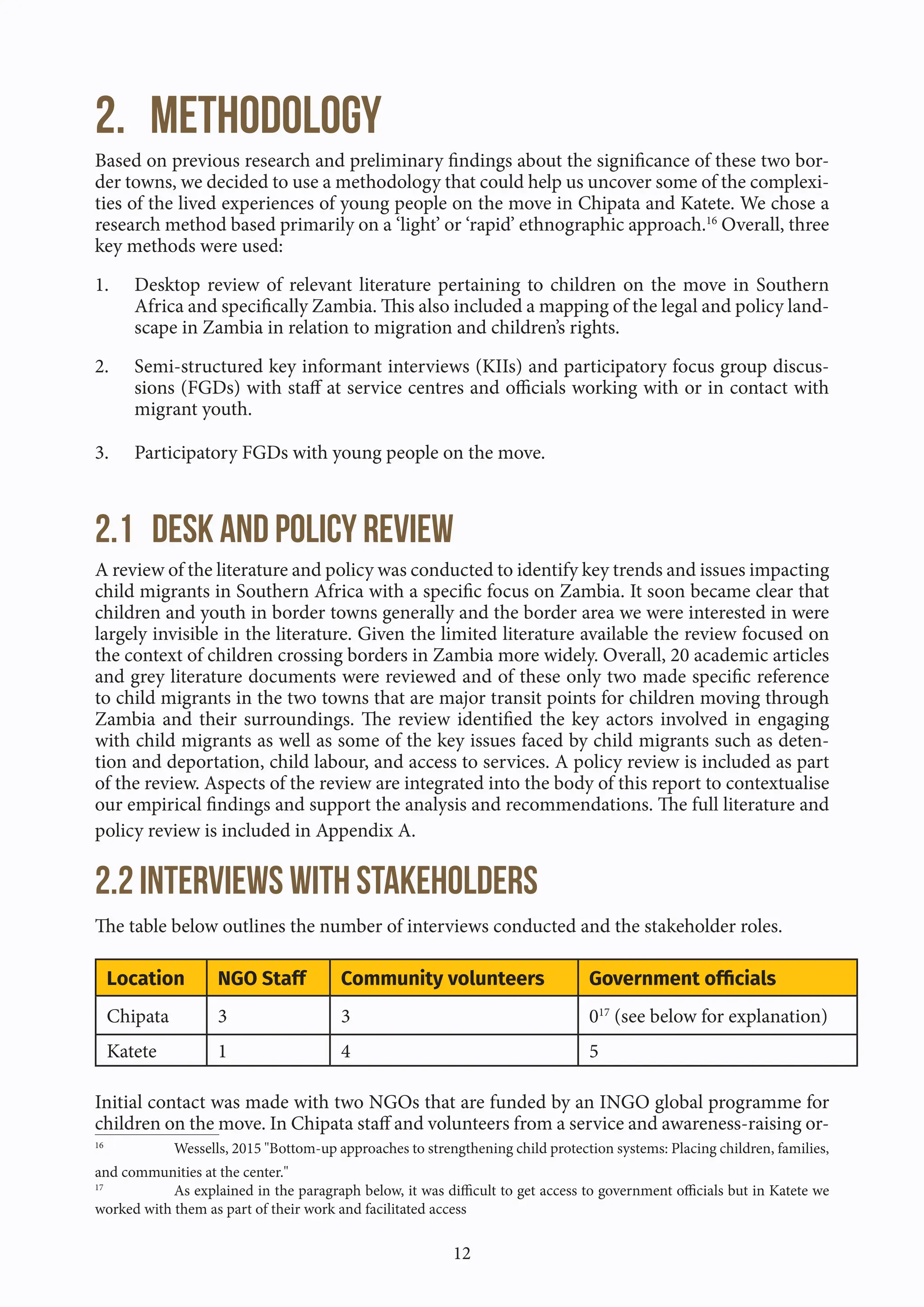
Location NGO Staff Community volunteers Government officials
Chipata 3 3 017
(see below for explanation)
Katete 1 4 5
Initial contact was made with two NGOs that are funded by an INGO global programme for
children on the move. In Chipata staff and volunteers from a service and awareness-raising or-
16
Wessells, 2015 "Bottom-up approaches to strengthening child protection systems: Placing children, families,
and communities at the center."
17
As explained in the paragraph below, it was difficult to get access to government officials but in Katete we
worked with them as part of their work and facilitated access
13
ganisation were interviewed. Access to officials was difficult in Chipata as the NGO we worked
with had little contact with them. In Katete, however, the NGO we worked through managed
an intersectoral network of officials who came into contact with children and youth on the
move so worked regularly with all relevant officials. This made it easy to facilitate access, hence
the number of government officials listed in the table above for Katete. The network gave us
almost unique contact with officials that are often difficult to interview, for example the head
of correctional services in the area, who facilitated a prison visit to interview two young men
aged 22 and 1818
in custody. To protect identities all quotes are anonymous.
2.3 Participatory FGDs with youth on the move
2.3.1 Participants
The table below outlines the details about the youth participants.
Location Number Gender Ages Proximal19
Distal20
Chipata 16 7 F 9 M 14-17
7 F
9 M
2
Katete 10
2 F
8 M
15-18 (inc. a
22-year-old)
3 7
19 of the young people were from Malawi, 6 from Mozambique and one from Uganda. The
small number of distal migrants we were able to engage with is a limitation of this research.
There were two reasons for this issue: the fact that the young people were largely ‘invisible’ (see
4.1.2) and because we were careful not to expose them as ‘different’ by engaging them in public
(see 2.3.3). With more time we may have found a space where they congregated and felt safe
to talk as we have done in previous work.21
Additionally, the NGOs we worked through in the
two towns, did not engage with young people on the move directly. Despite of the fact that the
NGOs had ‘children on the move’ programmes – young people on the move largely remained
‘invisible’ to them too (4.5.4). This reinforces a key recommendation of this study that there is
a need for a researcher who can spend an extended period of time understanding the spatial
dynamics of invisibility, finding out where young people would feel safe to meet and talk and
the time to build relationships and develop trust.
2.3.2 Research activities
We chose to use maps as the main form of participatory activity. This was because we were
interested in the country of origin of the young people, how they had crossed the border and
where and how they now lived in the two towns. Maps seemed to provide the best means of
18
Though older than the focus population of the research they could give information of their lives before
they turned 18 and those, they had come into contact with who were under 18. Their knowledge of young people
who were kept in detention because of the lack of a place of safety or safe house (described later in the report) was
invaluable.
19
Term is described in 4.2.1.
20
Term is described in 4.2.2.
21
Walker and Clacherty, 2023 “Hair Salons as ‘Private-Public Spaces’ Exploring the Experiences of Young
Migrant Women in an Urban Township in South Africa”;
14
gatheringthisinformation.Drawingfrompreviouswork22
wewereawarethatmovementacross
borders, places of work and living are chosen strategically by young people and therefore, as we
go on to discuss later in this report, the choice of spaces in moving and surviving can be seen as
one of the main structuring factors behind the lived experiences of young people on the move.
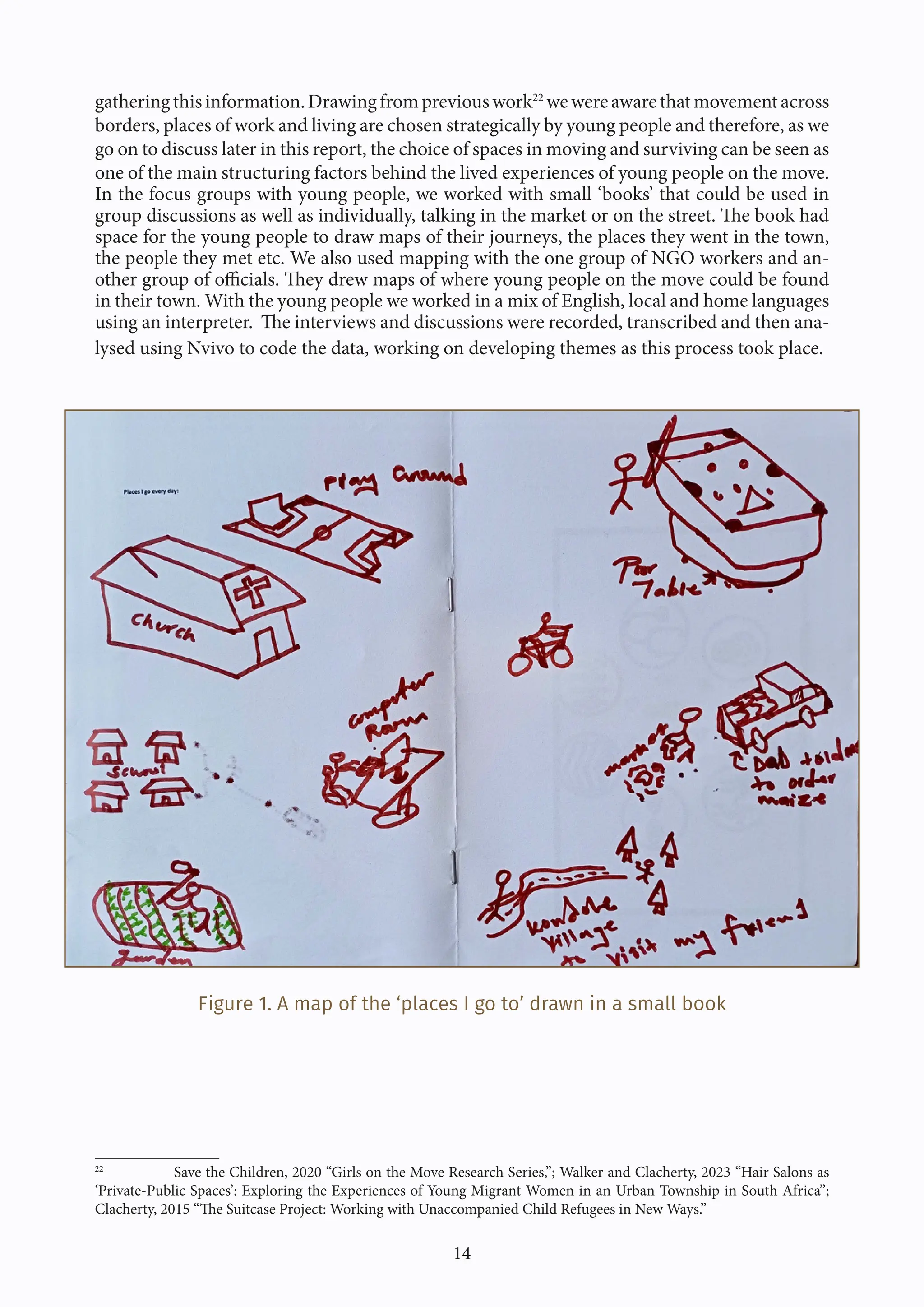
In the focus groups with young people, we worked with small ‘books’ that could be used in
group discussions as well as individually, talking in the market or on the street. The book had
space for the young people to draw maps of their journeys, the places they went in the town,
the people they met etc. We also used mapping with the one group of NGO workers and an-
other group of officials. They drew maps of where young people on the move could be found
in their town. With the young people we worked in a mix of English, local and home languages
using an interpreter. The interviews and discussions were recorded, transcribed and then ana-
lysed using Nvivo to code the data, working on developing themes as this process took place.
Figure 1. A map of the ‘places I go to’ drawn in a small book
22
Save the Children, 2020 “Girls on the Move Research Series,”; Walker and Clacherty, 2023 “Hair Salons as
‘Private-Public Spaces’: Exploring the Experiences of Young Migrant Women in an Urban Township in South Africa”;
Clacherty, 2015 “The Suitcase Project: Working with Unaccompanied Child Refugees in New Ways.”
15
2.3.3 Ethics
The study protocol was submitted to the University of the Witwatersrand Human Research
Ethics Committee and approved (Protocol number: H22/07/02). It was then submitted to the
ERES-Converge Ethics which is an internationally certified agency in Zambia. The study was
approved (2023-May-030).
The researchers also applied the widely accepted principles outlined in the UNICEF review
on ethical research with children and all have completed courses in ethical research with
children23. We were particularly sensitive to the need to protect young people on the move
who worked to stay ‘below the radar’ because of the risk of being identified as undocumented
migrants by immigration officials. Often the local researcher/interpreter recognised young
people on the move but chose not to approach them in a public space for this reason. If we did
ask to talk to them, we chose to hold short discussions in public spaces such as markets and
streets and only once we had ascertained their willingness and consent to engage.
3. Background and Context
3.1 Zambia as a transit and destination country
Zambia is a land land-locked country which borders Mozambique, Malawi, Zimbabwe, Dem-
ocratic Republic of Congo, Angola, Tanzania, Namibia and Botswana. With all these interna-
tional borders, Zambia has become a common transit, and destination country for migration.
Regular and irregular migration across borders into Zambia for trade and employment pur-
poses is frequent. There is limited data available on child migrants in Zambia. According to a
report by the IOM (2019)24
, no routine data is collected on unaccompanied and separated mi-
grant children in Zambia. Despite this it is evident that a significant number of children cross
into Zambia. Many young people transit through from countries in the north and east on their
way to South Africa such as young men from Ethiopia and Somalia making their way to South
Africa. Other young people, most often from Malawi and Mozambique choose to migrate to
Zambia itself for work and a few for education. Many are attracted by work on farms as it is
easy to avoid detection if working on large farms. The informal economy built around trad-
ing and markets is also stronger economically than in Mozambique, Zimbabwe and Malawi.
Young people often use border towns as a stopping off point to make enough money to find
work in the Zambian capital, Lusaka. Some remain in ‘limbo’ in the border towns – with ambi-
tions to move but faced with challenges that may prevent them from doing. Though many are
aiming for Lusaka they know that living in large cities such as Lusaka is more difficult young
migrants as they are not so easily able to avoid immigration officials so many choose to live in
smaller towns. Border towns with their ‘coming and going’ and often chaotic environment are,
therefore, seen as ‘safer’ spaces where it is easy to remain invisible. In spite of their presence
in border spaces, as discussed in the introduction the nature of the lives of young people in
border spaces is largely unknown.
This study focuses on two border towns in the Eastern Province of Zambia, Chipata and Ka-
tete because their nature as a hub for migration into Zambia make them a particularly useful
space for understanding the protection needs and survival strategies of young people living
on borders.
23
CP MERG, 2012 “Ethical principles, dilemmas and risks in collecting data on violence against children.”
24
IOM, 2019 “Migration Governance Overview - The Republic of Zambia.”
16
3.2 Zambia’s migration and child protection
legislative approach
Generally, Zambia has a robust legislative framework in terms of general child protection, but
not in migration, there is also no overlap between the two frameworks. The child protection
legislation includes provision for children on the move but migration policies have very little
focus on young people on the move.
In terms of child protection, the recently enacted Children's Code Act (2022)25
significantly
addresses the needs of children on the move. It affirms a child’s right to a name and an identity
(no matter their country of origin). It also creates an obligation on the state to offer assistance
to children who have been denied this right including through the children’s court. The act also
requires the provision of “places of safety”26
and a policy of non-detention of children under
18. Despite the framework of comprehensive legislation providing for the protection of chil-
dren’s rights and protection, overall, like many other countries in the region there is a lack of
comprehensive legislation that meets the needs of children on the move. The Immigration and
Deportation Act, 2010 for example, makes no provision for migrant children and where there
is child-related legislation it focuses primarily on children who migrate as victims of traffick-
ing. Although The Guidelines on Protection Assistance for Vulnerable Migrants27
makes a dis-
tinction between victims of trafficking and other categories of children on the move in its defi-
nition of ‘migrants of concern', which includes rejected asylum seekers, victims of trafficking
(including ‘presumed’ trafficked persons and ‘potential’ trafficked persons), unaccompanied
and separated children, stranded irregular migrants, stateless migrants, and other vulnerable
migrants in need of protection assistance overall. The broader spectrum of irregular migration
experiences are not catered for. More detail about protective legislation and policy is provided
in the Literature Review (Appendix A).
Our discussions with stakeholders also revealed that the application of laws and policies on
the ground is also limited. The provisions in the Children’s Code Act for example is limited
by the lack of resources to improve infrastructure and trained staff such as social workers. An
example of this is that Katete town has no “place of safety” and in spite of repeated requests to
government by MGOs and government officials there has been no funding set aside for this
urgent requirement. This issue is discussed in more detail later in the report.
When looking at work by young people on the move labour legislation is important. Zam-
bia has ratified both the ILO Convention (clause 138) on Minimum Age of Employment and
Elimination of the Worst Forms of Child Labour (clause 182)28
. Nationally, the Employment
Code Act No. 3 of 2019, Part V has created a strong legislative framework for stopping haz-
ardous working conditions for children and “prohibited the employment of young persons in
undertakings associated with child labour”29
This legislation is silent on young people on the
move, however. District child labour officers are in place to enforce the legislation but their
presence is patchy and their job description does not refer to monitoring the particular vulner-
ability of young people on the move to exploitative labour.
25
The Government of Zambia, 2022 “The Children’s Code Act, 12 of 2022.”
26
Zambia’s Children Code Act of 2022 defines a "place of safety" as a child care facility, a house or other suitable
place, the occupier of which is willing to accept the temporary care of a child.
27
Government of Zambia, 2014 “National Referral Mechanism (NRM) for the Protection of Vulnerable
Migrants in Zambia.”
28
Government of Zambia, 2020 “The National Action Plan for the Elimination of Worst Forms of Child
Labour 2020 - 2025."
29
The Government of the Republic of Zambia, 2019 “The Employment Code Act No. 3 of 2019.”
17
3.3 Engagement with cross-border coordination and
mechanisms
In terms of the coordination of the protection of children on the move with other countries
in the SADC region, Zambia is engaged in a number of cross-border agreements.30
These are
part of a larger regional approach to strengthen coordination and communication between
stakeholders and ensure consistent access to care, protection, and services for children on the
move. Zambia has developed bilateral agreements with Zimbabwe and with Mozambique and
a tripartite agreement with Zimbabwe and Mozambique. It also has Standard Operating pro-
cedures (SOPs) in place with South Africa and Mozambique. The SOPs outline clear guidelines
for family tracing, family assessment, best interest determination (including child participa-
tion), alternative care placement, follow-up, and case closure.31
Cross-border mechanisms have also led to increased communication and meetings between
various stakeholders to address specific communication and exchange needs. In Zambia this
has been seen in terms of a border-post reference group through which immigration, police,
local CSOs and social workers meet regularly to discuss issues relevant to the specific border
where frontline officials are working.
3.4. Two border towns: Chipata and Katete
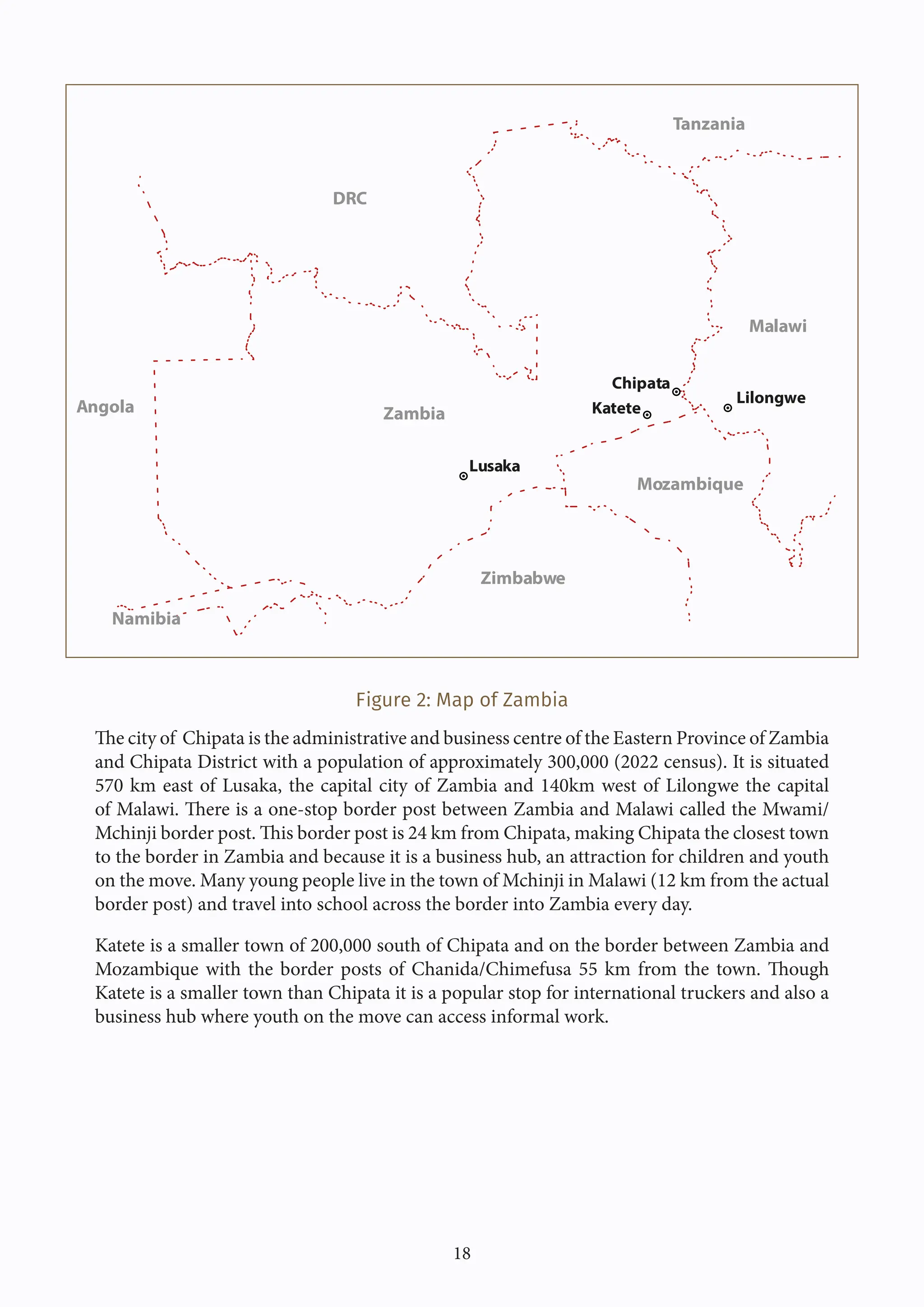
The map on the next page shows the position of the two towns as a central focus for a number
of Southern African countries as well as their proximity to border posts.
30
Bertrand and Castrataro, 2019 “Cross-Border Protection of Children on the Move in East and Southern
Africa.”
31
Save the Children, 2022 “Documenting the Impact of Cross-Border Case Management for Children on the
Move in Southern Africa,” “Documenting the Impact of Cross-Border Case Management for Children on the Move in
Southern Africa,”
18
Figure 2: Map of Zambia
The city of Chipata is the administrative and business centre of the Eastern Province of Zambia
and Chipata District with a population of approximately 300,000 (2022 census). It is situated
570 km east of Lusaka, the capital city of Zambia and 140km west of Lilongwe the capital
of Malawi. There is a one-stop border post between Zambia and Malawi called the Mwami/
Mchinji border post. This border post is 24 km from Chipata, making Chipata the closest town
to the border in Zambia and because it is a business hub, an attraction for children and youth
on the move. Many young people live in the town of Mchinji in Malawi (12 km from the actual
border post) and travel into school across the border into Zambia every day.
Katete is a smaller town of 200,000 south of Chipata and on the border between Zambia and
Mozambique with the border posts of Chanida/Chimefusa 55 km from the town. Though
Katete is a smaller town than Chipata it is a popular stop for international truckers and also a
business hub where youth on the move can access informal work.
Lusaka
Chipata
Katete
Lilongwe
Zambia
DRC
Tanzania
Malawi
Zimbabwe
Mozambique
Namibia
Angola
19
4. Findings
The findings are presented below within the themes that emerged from the data. Quotes from
young people or stakeholders are used to illustrate or substantiate the findings. The person
speaking is identified with an anonymous label after each quote. Young people are identified
by their country of origin.
Given the importance of ‘space’ as an emergent theme (see below) the report uses a number of
maps to contextualise the findings.
4.1 Overarching themes and sub-themes
There are two interlinked and overarching themes that emerged from the stories we were told
by young people on the move and the stakeholders that work with them. These were ‘space’
and ‘invisibility’. They are described in some detail below but also integrated into the findings
throughout the report.
4.1.1 Space
First, the stories that the young people and other stakeholders told us were highly spatialised.
Where young people live relative to the border significantly changes their experience of being
on the move. The young people we spoke to explain, understand, and respond to their lived
experiences in terms of space: safe spaces, unsafe spaces, spaces to inhabit, spaces to avoid,
spaces to generate income, spaces to seek protection, and spaces to hide from risks. Their
ability to negotiate the spaces they occupied shows the sophisticated strategies employed by
young people on the move. Similarly, officials and NGO service staff (stakeholders) framed
their discussions in relation to different ‘border regions’ and the ways these spaces influenced
the experience of young people.
In addition, our data collection approach made use of a number of participatory mapping
exercises. As a result, data is located in space (no doubt this choice of methodology shaped the
data we were able to gather). We wanted to foreground this presentation of the experiences of
young people on the move by presenting our findings and discussions in the same modality as
the young people themselves presented them to us. Therefore, we have structured this report
around a series of maps (both participant-generated and formal) that represent the towns of
Chipata, Katete, and the areas that surround them.
4.1.2 Invisibility
Second, a key element that structures how young people on the move make use of space
is whether or not they feel comfortable being visible as foreigners – to local Zambians, to
government officials, or to the staff of NGOs or other service providers. Invisibility, as we go
on to show, is one of the main strategies for survival and protection used by young people
on the move. This invisibility in terms of remaining under the radar and not being noticed
by authorities, particularly police and immigration officials, is critical to their survival and
yet simultaneously renders them more vulnerable and exposed to increased risks such as
exploitation and violence.
In section 4.4.1 we show how invisibility is a key strategy for protection in accessing
employment, forming relationships and living arrangements, and avoiding risks of arrest and
deportation. However, these invisibility strategies also work against young people on the move
20
in terms of limiting their access to support services. The overarching theme of (in)visibility
therefore not only frames our key findings but also directs us to the recommended actions to
address the gaps and challenges young people face in accessing services.
Within the two overarching themes we identified six sub-themes which describe the challeng-
es, opportunities and strategies of young people on the move in the border towns of Chipata
and Katete. The findings section that follows is structured around the following sub-themes:
· Two border worlds
· Migration flows: navigating migration opportunities and vulnerabilities
· Employment
· Protection strategies
· Limitation of legislation and the state
· Service Provision and Rights
4.2 Two border worlds
This sub-theme highlights how important it is to do local research before any programme im-
plementation in a specific border area. Borders and border towns are complex environments
with little homogeneity in young people’s reasons for being there and how young people use
their agency to navigate the particular space and context they arrive in. An example of this
is our growing understanding as we conducted the research that in both towns there are two
distinct groups of young people on the move with very different lived experience.
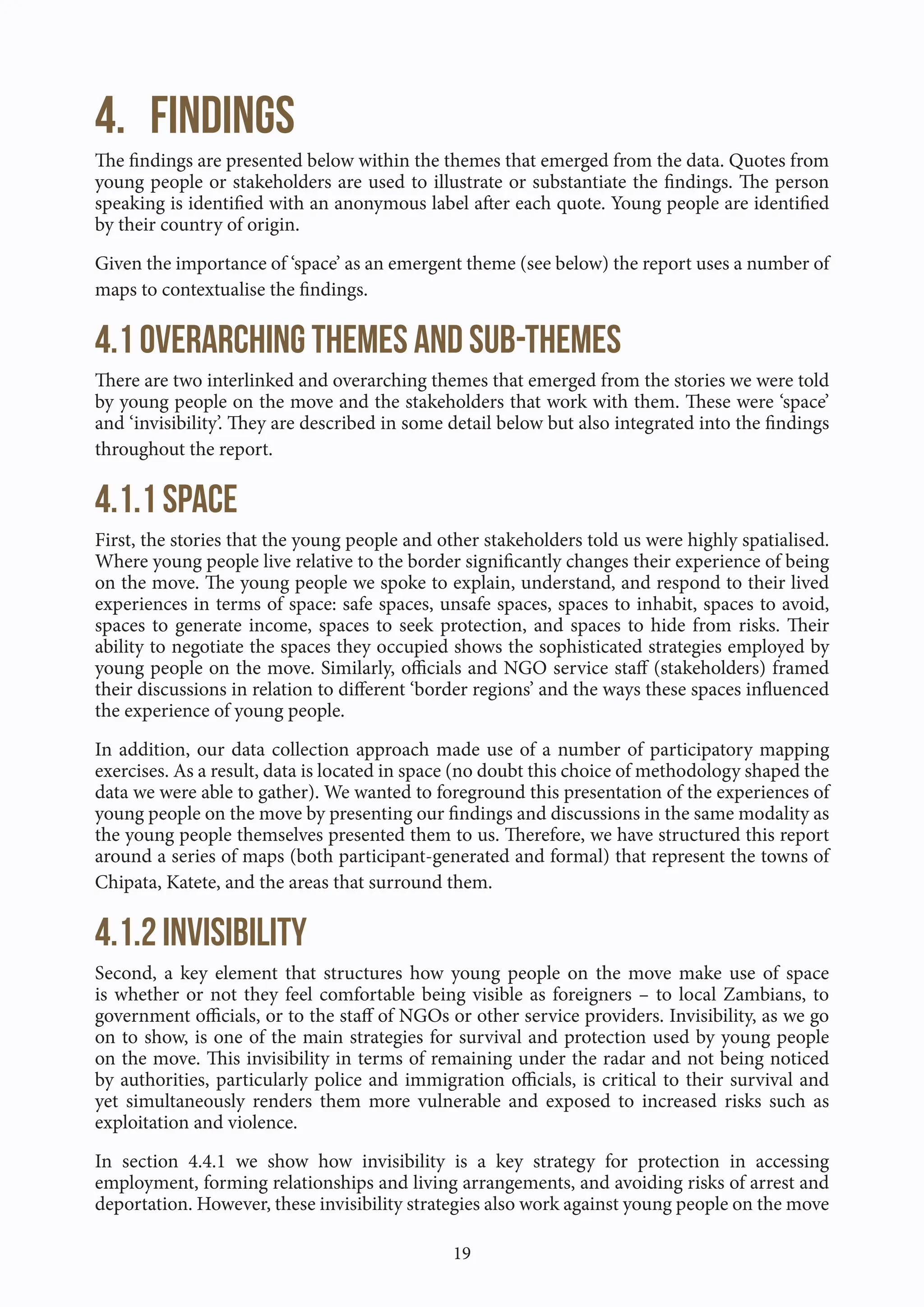
Figure 3: Two border worlds. Green shows where proximal migrants live. Routes
show origins of distal migrants.
Mozambique
Zambia
Mozambique
Zambia
Z
a
m
b
i
a
M
a
l
a
w
i
M
o
z
a
m
b
i
q
u
e
M
a
l
a
w
i
Katete
Chanida BorderPost
Chipata
Mwami BorderPost
Mchinji
ToLilongwe
(130km)
ToTete
(273km)
ToLusaka
(483km)
21
4.2.1 Proximal migrants
One group mostly live near or in Mchinji town in Malawi which is 12km from the Mwami/
Mchinji border. We have called these young people ‘proximal’ migrants as they live close to
the border and cross it almost every day into Chipata town and the surrounding areas. We met
with this group of young people at a school, set up to cater for children crossing the border, half
way between Chipata and the border post in Zambia.
In the research groups these young people began by discussing their history of movement.
Their maps of ‘journeys I have made’ made it clear that before coming to Mchinji most had
moved many times with their families, back and forth between Zambia and Malawi and within
both countries in search of employment opportunities. In this way migration is a characteristic
and common experience in their lives. This is shown in the following quote:
I was born in Zambia and then went to Malawi after I was born. I went to stay in
Lilongwe, then at Kasungu (in Malawi) then we came to Mchinji. (YPoM, Malawi)
The young people also described the reasons why their families had finally settled in Mchinji
including for business, education and more space for houses.
The houses in Malawi are cheaper (than in Zambia). There is also space around
Mchinji for farming. Where we we re in Livingstone and Lusaka there was no business.
My parents (moved) and provided everything (for me) to get education in Zambia.
(YPoM, Malawi)
The young people and their families saw the access to what they referred to as “better edu-
cation” in Zambia as another reason for living close to the border. Most lived with one or
both parents in Mchinji. All of them had support from their families to attend the school and
seemed to have their basic needs met. They did, though, describe other children and young
people in Mchinji and its surrounds who did not attend school. It was clear that these children
and young people were vulnerable. They did not attend school because their parents did not
have money, they worked for their parents in the fields and in their small businesses. The
young people in the school also noted that some of the young women who can’t afford to go
to school or whose families struggle to meet their needs “just choose to get married”. This was
a finding also supported by interviews with service providers who commented that early mar-
riage is often a survival strategy for families living on the margins.
The children who attended the school all moved across the border frequently. When they used
the border crossing to get to school, they had no problems with immigration officials, “we just
cross the border as pedestrians and no one stops us”. They explained that border officials knew
they were going to school “because of our uniforms”. The young people did describe that if they
were taking goods across the border to sell for their parents, rather than going to school, it was
less easy to cross as the immigration officials stopped them and asked for a ‘border pass’32
. For
this reason, if they were crossing to sell, they chose to use an informal crossing point over a
small river near the family fields instead of crossing at the border. Therefore, even these proxi-
mal migrants had strategies that allowed them to stay invisible.
(It is easy to cross the border to school) but for going for business they want a border
pass. We cross here, (she refers to the river on her map). (YPoM, Malawi)
32
A ‘border pass’ is valid for three days and designed to allow people to do business on either side of the
border.
22
One of the stakeholders described the border as “just a road” that cuts through communities
whose lives are already intertwined, for example, aunts or grandparents often lived in Zambia
Another stakeholder described the strong intersections of language and culture which facili-
tated movement across the border.
Also, cultural practices play a major role in the movement of people in the border area.
For instance, in the Eastern Province where there has been a lot of migration, we have
two major tribes … and during the annual traditional ceremony, a lot of Ngonis from
Malawi, from Mozambique, they come to Zambia because their biggest chief is in Zam-
bia. (NGO worker, Chipata)
As the quote below illustrates immigration officials do not get involved because of the normal-
ity of this movement.
A person can walk. I mean, there is nothing that stops people from walking … you cross
the border several times, so you see people walk from Malawi, people from Zambia, so
it’s very porous ... the border is just a road. So, people from Malawi, they just cross into
Zambia and they are not actually detained. So, they migrate here. When people are
moving it is very easy because they have already interacted with others and they have
established the travel routes. And no one issues a passport, they just cross without any
border checking. (NGO worker, Chipata)
The young people also described going to health clinics in both Malawi and Zambia,
Researcher: Is one clinic easier than another?
Young person: Malawi because it is close to where we live.
Researcher: Could you come to the Zambian clinic, is it possible?
Young person: Yes!! At the Zambian clinic we are given service, we are taken as one.
(YPoM, Malawi)
23
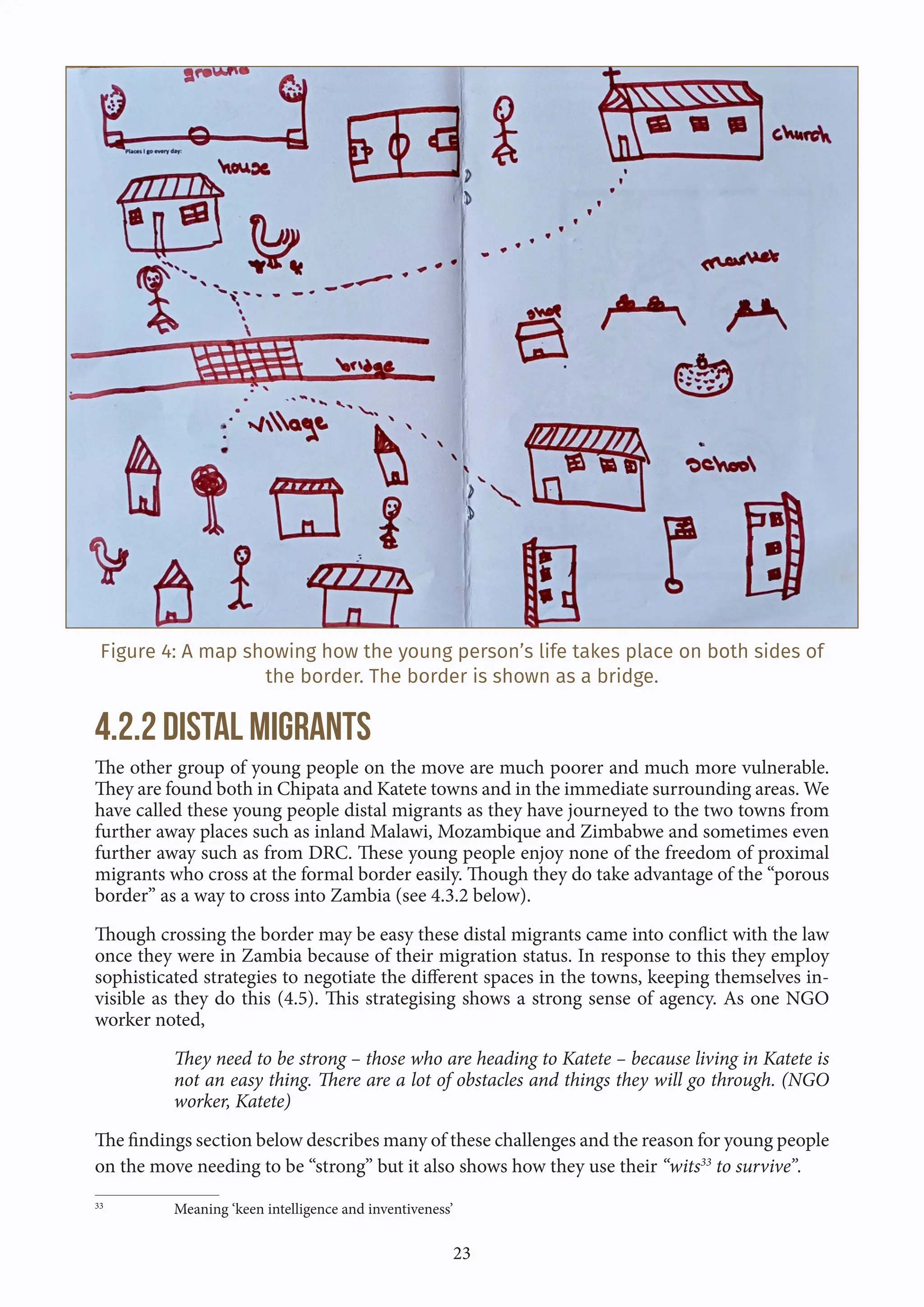
Figure 4: A map showing how the young person’s life takes place on both sides of
the border. The border is shown as a bridge.
4.2.2 Distal Migrants
The other group of young people on the move are much poorer and much more vulnerable.
They are found both in Chipata and Katete towns and in the immediate surrounding areas. We
have called these young people distal migrants as they have journeyed to the two towns from
further away places such as inland Malawi, Mozambique and Zimbabwe and sometimes even
further away such as from DRC. These young people enjoy none of the freedom of proximal
migrants who cross at the formal border easily. Though they do take advantage of the “porous
border” as a way to cross into Zambia (see 4.3.2 below).
Though crossing the border may be easy these distal migrants came into conflict with the law
once they were in Zambia because of their migration status. In response to this they employ
sophisticated strategies to negotiate the different spaces in the towns, keeping themselves in-
visible as they do this (4.5). This strategising shows a strong sense of agency. As one NGO
worker noted,
They need to be strong – those who are heading to Katete – because living in Katete is
not an easy thing. There are a lot of obstacles and things they will go through. (NGO
worker, Katete)
The findings section below describes many of these challenges and the reason for young people
on the move needing to be “strong” but it also shows how they use their “wits33
to survive”.
33
Meaning ‘keen intelligence and inventiveness’
24
4.3 Migration flows navigating migration opportunities
and vulnerabilities
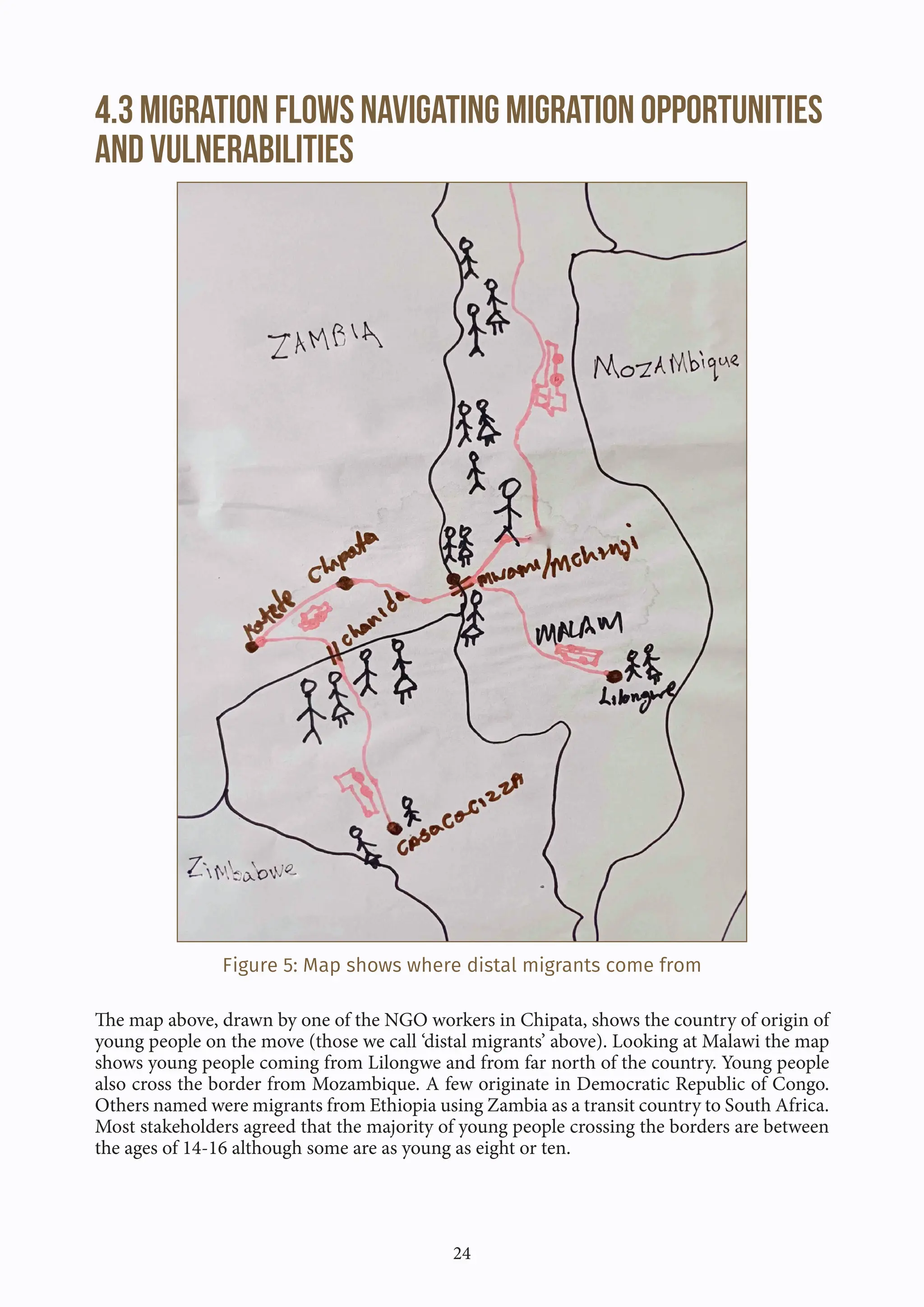
Figure 5: Map shows where distal migrants come from
The map above, drawn by one of the NGO workers in Chipata, shows the country of origin of
young people on the move (those we call ‘distal migrants’ above). Looking at Malawi the map
shows young people coming from Lilongwe and from far north of the country. Young people
also cross the border from Mozambique. A few originate in Democratic Republic of Congo.
Others named were migrants from Ethiopia using Zambia as a transit country to South Africa.
Most stakeholders agreed that the majority of young people crossing the borders are between
the ages of 14-16 although some are as young as eight or ten.
25
4.3.1 Reasons for leaving
Various reasons were given for why young people from distant areas migrate across Zambia’s
borders and into the border towns. One of the main reasons was to find employment. One
young man from Mozambique (who had entered the country at 17 but was now 18) described
how he had come to Zambia to get money to continue school. The second quote is from a
young man who travelled from Malawi to find work.
A friend told me there was a job in Katete working on a farm and so I and my friend
travelled from Mozambique. My plan was to come to Zambia to work on the farms and
go back and continue school. I came with my friend (YPoM, Mozambique)
From Lilongwe we came straight to Katete because there was no work in Malawi.
(YPoM from Malawi)
Some young people are sent by their parents to try and make money “because they know that
there is business in the border areas” (YPoM from northern Malawi). Sometimes the parents rely
on ‘syndicates” who organise the journey and help young people to get across the border. One
stakeholder explained how this is a carefully orchestrated process.
Sometimes they (the parents) even pay huge sums of money to the border police for
them to migrate and also organise their stay in that country of receiving from the send-
ing country. (Official, Katete)
The two young women we interviewed explained that they left home due to the death of par-
ents and mistreatment by aunts or stepmothers as illustrated in the quote below from a young
woman of 16.
I was staying in Malawi there and then my mother passed away. Then my father …
also passed away. Then I was staying with my aunt. She was telling me to go and sell
different things like maybe fritters (small doughnuts). When I got back, I was not even
finding food at home. I was beaten, mistreated. So, it's how I decided on my own. I ran
away. I came here (Chipata). (YPoM, Malawi)
There were also stories of how young people had been persuaded to move by peers. The story
of one young woman of 17 from inland Malawi was told by a service provider. They described
how the young woman was persuaded by a Malawian friend living in Katete to come to Zam-
bia because she could find work there. After some time, the friend disappeared and without
support the young woman began to engage in sex work to survive.
When her friend left, she had no support so she resorted to prostitution. It was six
months she was here. (NGO social worker, Katete)
The young woman was identified by immigration officials and, with the help of the NGO, was
subsequently repatriated to her home in Malawi by the Department of Immigration.
4.3.2 Crossing the border
Crossing the border in the Eastern District of Zambia is much easier than in other border ar-
eas of Southern Africa as there is no control along the border, no fence, no patrolling soldiers.
There also seems to be no need for the smugglers or ‘guides’ (except for those from Ethiopia)
used by migrants to walk across borders in other areas of Southern Africa. This is largely
related to terrain, for example, crossing from Zimbabwe to South Africa requires negotiating
26
the Limpopo River and from Mozambique into South Africa crossing the mountains. In the
Eastern District of Zambia young people from Mozambique, Malawi and Zimbabwe can just
walk into Zambia at a place away from the border post such as the river the other young people
described below.
No, we do not know about smugglers. We just walk and cross from Mozambique into
Malawi, we know the directions. (YPoM from Mozambique)
There is no need for smugglers. The area close to the border post is easy to just cross.
(Official, Katete)
Using a bicycle ‘taxi’ was another strategy described,
As you are almost nearing the border, you find people with bicycles, even the other side
(Malawi). Those bicycles transport people. So, children would just get on the bicycle as
if they (live nearby) and are going within (to Zambia). Meanwhile they are actually
crossing the border. So even the cyclists are also facilitating the modes of the children to
move from one country to another. Because in most cases, the immigration department
don't care about the cyclists, they know these are the people who cross regularly from
nearby (proximal migrants). (NGO worker, Chipata)
4.3.3 Moving in groups
One characteristic of the journey and border crossing is that young people on the move (par-
ticularly boys) travel in groups as the stakeholder below explains:
They don’t move with families they just move in a group. Even those from Ethiopia,
those from (inland) Malawi, a lot of them just move with a group of children and any
age from nine to maybe 16 or 21. (Official, Katete)
While we discuss how young people on the move use groups in a complex, strategic way to
stay invisible once they arrive in the two towns in section 4.5.2 here we describe how they
migrate into Zambia in a group. One group of migrants that always travel in large groups is
those from Ethiopia. Stakeholders described how groups as large as 50 were often intercepted
at the border. All use Zambia as a transit country to reach South Africa. Their movement is
organised by ‘smugglers’ and they usually travel hidden in trucks or containers. The stake-
holders displayed concern about the groups of Ethiopians who came through Zambia as the
conditions they travelled in were dangerous and they were often exploited by those they had
paid to transport them.
Like those that were recaptured the other time from Ethiopia, it was discovered that
they were in a container. And this trafficking34
, the way it was happening it was ar-
ranged that when they reach at a certain point, another person picks them up to take
them to another destination point. Unfortunately, or fortunately enough, there was
miscommunication between the traffickers and this trafficker, who reached the point
34
Based on the description here it is not clear that form of movement this would be categorised as human
trafficking. Legally, child trafficking is defined by two key elements - the action (recruitment, buying and selling) and
that this is for the purpose of exploitation. (OHCHR, 2000 “Protocol to Prevent, Suppress and Punish Trafficking in
Persons.”) Given that these young men had chosen to migrate and were not brought to another country for the purpose
of exploitation this is more likely an act of smuggling. While smuggling and trafficking often overlap and a smuggled
child could become a victim of trafficking it is also important to recognise that the definition of trafficking is very often
misunderstood and the word is used to describe many forms of informal movement. Walker, Mahati, and Magaya, 2020
“Child Trafficking in South Africa: Exploring the Myths and Realities.”
27
where the friend did not come in time decided to abandon the migrants, just to leave
them there in the bush. Local people reported that they were there and they were cap-
tured by police and immigration, they were afraid – they didn't know what will hap-
pen. (Official, Katete)
But for those who are coming from Ethiopia, if you have an interaction with them, defi-
nitely they will tell you that ‘when I was moving, we moved in a container, in situations
which are not very pleasant’. I even found that sometimes (when we found them) I was
talking to the child. They are even traumatised sometimes. They will not even want to
talk to you, not until you build that relationship with them. That's when they open up.
(NGO Social worker, Katete)
One immigration official reported that recently 42 young men had been arrested at the border
travelling in a truck. They were aged from “13 to men”. (see 4.7.1 for more information about
this group).
4.4 Employment
4.4.1 Informal work
Most stakeholders interviewed emphasised the importance of employment for young people,
both as a reason for migrating and also as a survival strategy while on the move and once in
the border towns. Employment opportunities are the key factor that impacts how and why
young people move between spaces within Zambia. Speaking about Chipata an NGO worker
explained that often young people arrive with the plan to move on elsewhere, but that this
onward movement depends on the opportunities available to them.
From Chipata they may then go to Katete a week before or a week after. (Their move-
ment) depends on the opportunities that they find and their integration with others …
some stay. (in Chipata). (NGO worker, Chipata)
See Figure 7, pag. 34
The types of employment young people on the move access are almost exclusively informal.
This work is easier to access than formal employment as the young people do not have docu-
ments. Informal work also allows invisibility as it is transitory and mobile allowing them to
stay under the radar of immigration officials. This kind of unpredictable work means that
although it may be easier to access it is also precarious. Without a formal agreement such as
a contract informal workers face exploitation, cannot access sick pay or other benefits and
have no form of reprise if they are not paid – which is often the case. Informal work therefore,
ultimately entrenches the poverty that young people on the move experience. As one NGO
stakeholder and a young person noted,
They can work or beg today and be given something but tomorrow they may not get
anything. (NGO worker, Chipata)
It's not good work but it's the only means of survival that we have. (YPoM, Mozam-
bique)
Clear gender differences were also identified in terms of the experiences of boys and girls on
the move in the border towns of Chipata and Katete and these are shaped particularly by types
of employment.
28
4.4.2 Boys and employment
Boys are said to work on farms and as part-time labourers on building sites. They also clean
cars, sell in markets or on the street and work as porters carrying goods for shoppers to the taxi
or bus rank. Girls meanwhile are said to help with selling or trading or domestic work. One
NGO worker described the differences in terms of responsibilities.
If a migrant girl is 14 or 15 years and good at plaiting hair, she will be used for doing
that and if the child is a boy and good at riding the bicycle or motorbike, he will be used
to do that … that is the only difference. (NGO worker, Chipata)
Boys were also spoken about in terms of frequent movement from place to place, within the
towns, between them and to outlying areas where they worked on farms. Although we did not
talk to young people on the move working on farms during this study, stakeholders explained
that many cross the border from Mozambique, Malawi, and Zimbabwe to work on local farms
and that this movement is frequent, routine and historical. This finding is supported by re-
search in other areas35
and presents an important issue for further research, particularly the
need to find out how to support such young people who, as we discuss later can face high levels
of exploitation.
4.4.3 Girls and employment
Young women on the move described how they also did mostly informal work.
Selling fritters (a fried dough cake), clothes and vegetables along the road and house
maids. (YPoM, Malawi)
The practice of bringing a young woman from within the extended family (e.g., a niece) to
work in the home was another practice young women described.
My aunt sent for me to look after the children. From Malawi. My parents agreed as
there was no food at home. I did not finish school. (YPoM, Malawi)
These young women were not identified by NGO workers or officials as ‘on the move’ but were
perceived as part of the family. They were, however, often exploited.
I was to work for my mother’s aunt as a ‘house maid’ in the house. I worked all the
time, no break. I was not allowed out (of the house and yard). I wanted to go home.
(YPoM, Malawi)
Other young women who arrived with friends chose to work as “house maids” because this job
allowed for invisibility. One government official explained this in more detail.
[Their origin is] unknown because many have been integrated into local households
and are part of the family – you can't say this child is from Mozambique or this one is
Zambian – they become the same. (Official, Katete)
The discussion about boys and girls above highlights how the need to ‘stay invisible’ strongly
influences the choices young people make about employment. This is only one of the strategies
which young people on the move use to remain hidden while trying to earn money (see 4.4.1).
These strategies are strong evidence of agency among young people and their “constructive
approaches to the management of risk”.36
35
Walker, Mahati, and Magaya, 2020 “Child Trafficking in South Africa: Exploring the Myths and Realities.”
36
Boyden, 2003 “Children under Fire: Challenging Assumptions about Children’s Resilience.”
29
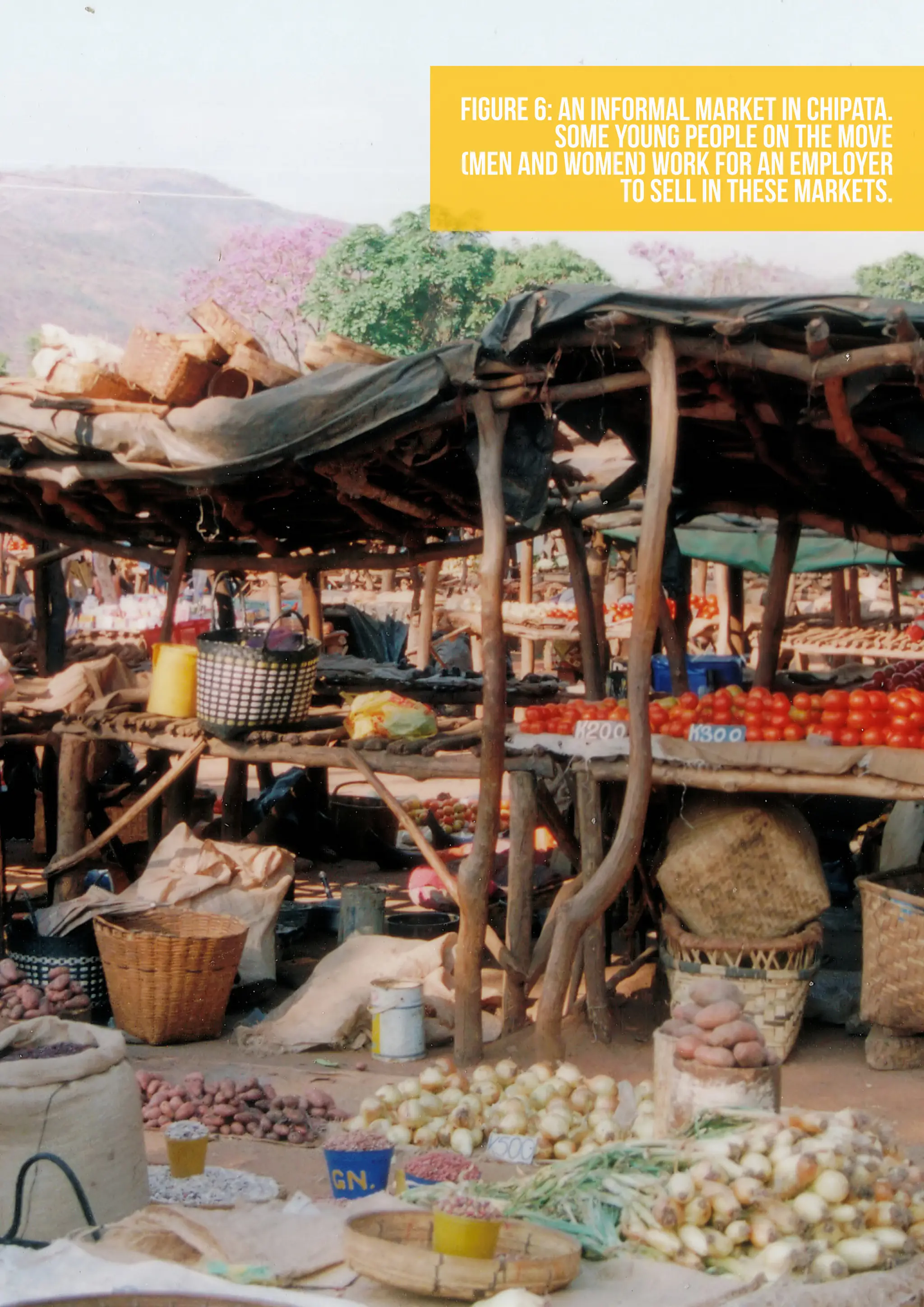
Figure 6: An informal market in Chipata.
Some young people on the move
(men and women) work for an employer
to sell in these markets.
30
However, not all risks can be mitigated and as a number of stakeholders described young
people can be tricked and exploited within informal work. For example, employers will agree
to pay the young person at the end of the month and then when they reach month-end they
will refuse to pay up as the employer knows the young person cannot go to the police because
they are undocumented. Similarly, some young women are said to be “called to work as ‘house
maids’” by relatives and yet after working for a period of time are not paid. Because they are
afraid of being deported, they may never report this.
Some are brought in for cheap labour, maybe cattle herding, maybe working as a maid
… they (are) not paid, they have waited and they (employers) fail to pay them. That's
when they need to come to report to us (but they do not). (Official, Katete)
4.4.4 Sex work and exploitation
In interviews and FGDs with stakeholders when asked about employment for young women
they immediately spoke about young women selling sex for income, only mentioning other
forms of employment such as selling goods and domestic work once prompted. Many of these
stakeholders also talked about ‘selling sex’, ‘trafficking’, and sexual relationships interchange-
ably. While it is important to be clear on the distinctions between these descriptions, the fact
that they are used together is also important as it reflects how girls on the move are viewed
primarily through their relationships and vulnerabilities and with a measure of ‘victim blam-
ing’. One example is an NGO worker who described the risks of sexual abuse for young women
stating that many migrate “when they reach the age of puberty and have a desire for better things”
and that this can often end up in exploitative relationships for girls. Some of the NGO workers
spoke about girls on the move encouraging each other to enter the sex trade in order to make
money. They said this starts during migration and particularly when encountering truck driv-
ers. An NGO worker referred to the route through the Chanida border post from Mozambique
to Katete where truckers will stop and buy sex.
They always park here in Katete so then you find that the migrants will come and they
(the young women) already have a target – they will find the truckers. (NGO worker,
Katete)
One NGO worker said that the young women enter Zambia looking to make money through
informal work and then through peer-pressure and encouragement “this is how they learn to
stay in Zambia.” Another explained that the biggest reason why young women end up in en-
gaging in sex for money was because they could not find other work. One story for example
involved a young woman aged 18 from Malawi who was promised work as a domestic worker
by a family member but when she arrived the work was not there. She ran away and ended up
living alone. She had turned to engaging in sex for money to survive.
There was some discussion about young women who were engaging selling sex in their coun-
tries of origin “moving to Zambia for sex work” to escape stigmatisation in their own countries.
Even though sex work is illegal in Zambia the young women can remain relatively anonymous
in border areas and so avoid the levels of discrimination they might face otherwise.
They fear the shame of the people that know them in their country. So, they would
rather go to another country where they are not known and where they will not be
judged. They will just do whatever they are doing the way they understand it, freely.
(NGO worker, Chipata)
It is also important to note here that although stakeholders referred to young women as in-
volved in “sex work” – a sex worker by definition is an adult – over the age of 18 and based on a
31
consensual transaction for the exchange of money.37
Therefore throughout this report we refer
to young women under 18 as young people who ‘engage in sex for money’ rather than as ‘sex
workers’. Given that the age of the young women we focus on in this study are mostly above the
age of consent (16) but below age of 18 it is clear that this presents a ‘grey zone’ in which both
exploitation and agency must be considered.38
The term ‘engaging in sex for money’ allows
recognition of this complexity. However, in the interviews it is evident that this distinction is
not made although it is made clear that the girls discussed are older adolescent girls (15 years
upwards) rather than younger girls. For younger girls any discussion of sex should be based on
sexual exploitation and rape.39
4.5 Protection strategies
The third theme that emerged from the research highlights the agency of young people by
looking at the strategies they use to navigate and limit the risks to themselves and others.
This theme emphasises their strengths and sense of agency, “how they actively and creatively
engage with their situation and adopt constructive approaches to the management of risk (and
even) staying alive.”40
4.5.1 Avoiding detection from
authorities – staying invisible
The findings show that the ways in which young people on the move cross borders and whether
they stay in border spaces or move further inland is shaped significantly by the risks they face,
particularly in terms of police and immigration officials. Stakeholders noted for example that
in the border areas young people tend to be in early adolescence whereas the older adolescents
move further inland and plan to migrate to other countries beyond Zambia. They explained
this primarily in terms of the actions of immigration officials:
The immigration departments tend to ignore them (younger migrants) so they will not
ask for their documents. So, it is easier for them to actually cross the border. The im-
migration officers will not be looking at them because they are children but they don’t
want the older ones, like 17/18 as they are already considered adults – so they actually
have to run away to stay far from the border. (NGO worker, Chipata)
An NGO worker also noted that a number of young people chose to work on tobacco farms
because they are a safe distance from the immigration department and “so they feel they are
hiding in there”. This was confirmed by a young man from Mozambique who called a job on
a farm “safe”. Often the young people would live in the farmer’s household which also made
them more ‘invisible”.
A friend told me there was a safe job in Katete working on a farm. So, I travelled with
him and we moved from Mozambique to the farm. We lived with the owner of the
37
UNAIDS, 2012 “UNAIDS Guidance Note on HIV and Sex Work.”
38
Walker and Oliveira, 2008 “Contested Spaces: Exploring the Intersections of Migration, Sex Work and
Trafficking in South Africa.”; Gould, C. and Fick, N. 2008. Selling Sex in Cape Town: Human trafficking in a South African
Context.
39
This is part of a much larger and complex discussion around sex work, sexual exploitation, and trafficking
which we will not focus on here other than to recognise that young people under the age of 18 cannot legally sell sex while
at the same time an older adolescent of 17 or 18 is capable of making decisions and showing agency in ways that a younger
girl cannot (Gould and Fick, 2008 "Selling Sex in Cape Town: Human trafficking in a South African Context").
40
Boyden, 2003 “Children under Fire: Challenging Assumptions about Children’s Resilience.” Children, Youth
and Environments 13, no. 1 (2003): 1–29.
32
farm. (YPoM, Mozambique)
The search for informal work can also lead to relationships forming between local adults and
migrant youth, creating invisibility as they become “part of the family”. In some cases, this is
based purely on a business relationship i.e., a Zambian adult will have a product such as tyres
or baskets to sell and they will employ a young person on the move to go out and sell for them.
This is advantageous for both because the adult is able to sell their product and does not have
to do the work of moving around and hustling to sell while the young person can either make
money or is given a place to stay and a level of support and protection. For the adult this out-
sourcing of labour also allows them to increase their income as they can get away with paying
less to a young person who is a migrant than a local person.
In some cases, however, this relationship goes further and is based on building familial ties
and integration for the young migrants into a Zambian family. One stakeholder referred to
this scenario as the creation of “second parents” for the young people on the move. The quote
below explains this situation in more detail:
A migrant child may have a talent, whether he plays football or she is good at doing
some hair for the ladies - and maybe she’s just eight years, ten years, twelve years, just
like that. So, the local (adult) would be able to take care of them because of the skill –
and so their association (relationship) will grow stronger because the adult knows they
can benefit from the skill … but it goes even further to protect the child and they can
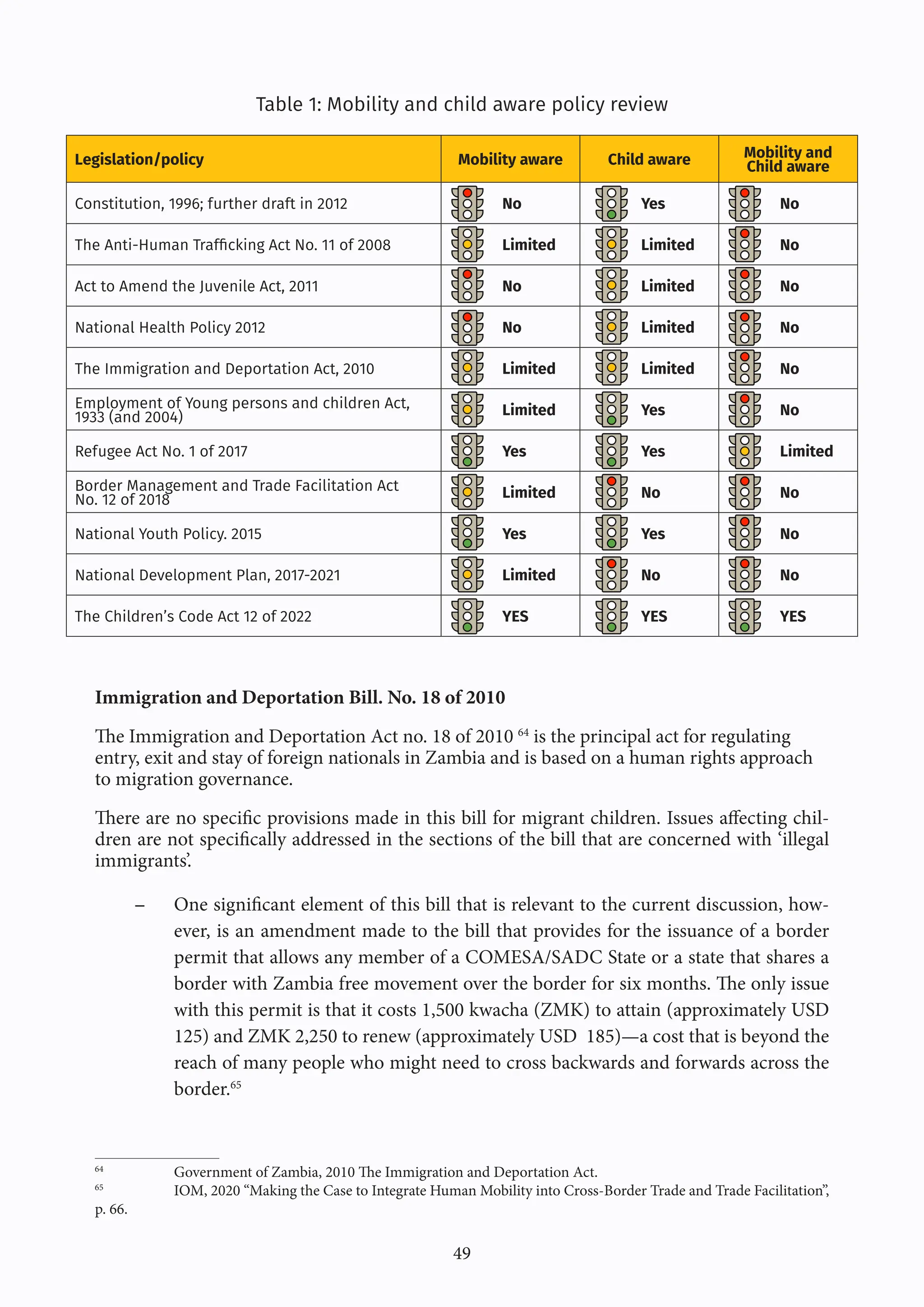
even process the documentation so that she becomes a citizen and even be incorporated
into their family. (Official, Katete)
This quote shows how complex this practice is, it refers to some families being committed
enough to the young people to arrange documentation but at same time the stakeholder says
that “adult benefits from the skill”. The quote below adds another dimension of indebtedness
created by this relationship.
When they (young people) are given the responsibility of selling they feel that it’s a
payback kind of gesture. (Official, Katete)
Another example of ‘support’ from adults was what NGO workers described as “Queen Moth-
ers”. These women provide accommodation and work for older women who are sex workers
but more often to underage girls (often from Malawi) engaged in selling sex for money.
It is the Queen Mother who is going to give them a place to stay and set the rules, say
what they are supposed to do and how they are going to play the game…so they (the
young women) have got somebody. (NGO worker, Chipata)
In this quote the Queen Mothers are assumed to provide a level of protection for the young
women although how this is experienced by the young women themselves was not discussed
in the interviews or shared by any of the young people on the move themselves.41
More research on this practice and the previous one described where young people become
“part of the family” is important as such adults can become important protectors and support-
ers for young people on the move. An example of this is the Terre des Hommes42
project in
Burkina Faso. In West Africa there is a tradition of young women moving from a rural area to
a city where parents set up a situation where they are greeted by women called Landladies who
41
The role of “queen mothers” appears to be similar to that of brothel owners – individuals who provide
accommodation and space to work as well as a level of protection from the risks that sex work can involve such as violence
from clients and exploitation. However, as with Queen Mothers this role is not clear cut and more would need to be
known about the nature relationship in order to understand it better.
42
Terre des hommes, 2014 “The Added Value of Protective Accompaniment.”
33
provide accommodation and through relationships with local residents find domestic work for
these young women. This can be an exploitative situation but the project builds relationship
with such people, helps them understand children’s rights and essentially co-opts them as pro-
tectors of and advocates for young people on the move. A similar project is run by a Scalabrini
support project for young people on the move in Ressano Garcia on the border with South
Africa. This project is described in the Girls on the Move study, Southern Africa,43
.
To return to the topic of ‘invisibility’ immigration officials and state social workers described
this strategy as concerning. If immigration officials arrest young people for example, they refer
them to a state social worker who will try and respond in the ‘best interest of the child’. How-
ever, often the young person, quite understandably, does not want to go back to their coun-
tries and despite a careful process of reunification planning, will hide key information about
themselves which will hinder and sometimes prevent this process. As a result, for some young
people on the move the strategy to remain invisible to immigration officials and other state and
non-state actors can increase the risks they face.
4.5.2 Peer support networks
The most common protection strategy, which is applied as young people journey as well as
once they arrive in either of the two towns, is to support each other. Young people and the
NGOs who observe them describe how they travel from their places of origin in groups and
very often stay in these groups once they are living and working in town. Those who ask or
are asked to join their group are most often from the same place of origin. Young people on
the move seldom move through the border town alone as they know that to move in a group
reduces some of the risks they face as the following quote suggests: “They move together as a
group. They don’t move alone. The group makes them to blend in.”
‘Blending in’ is important as they want to avoid being noticed as non-locals by immigration
officials and the police. Another group related strategy is for the young people on the move,
especially young men, to make friends with local youth who are working and living in the
same areas. Having locals in the group is seen as an important strategy as the locals can speak
for the group when approached by police, for example in the local dialect, and provide layer
of protection.
The children will mostly interact with the ordinary people because they feel they are
a source of protection. So, you find that in most cases, they will mingle with the other
people and interact with them … there is a health facility, which is a public clinic where
there is a youth friendly service. Normally they (the young people on the move) would
actually come through their (local) friends. So, they are able to come to the facility, to
the youth friendly service where the children meet. And then through that, they actu-
ally access even the health services, if possible, in case they feel sick. So that is how they
actually protect themselves. So even if the health facility staff say no, these kids know
they can be a part of this. (NGO worker, Chipata)
However, the young people also acknowledged that this strategy did not always work. Some
of the young people pointed out that the police and immigration officials can often recognise
them as migrants particularly when they speak in their home languages. Youth from Mozam-
bique are especially vulnerable to being identified by immigration officials by language as even
if they speak Chichewa instead of Portuguese they can be identified by their accent.
They knew I was from Mozambique by my accent, when they arrested me. (18-year-old
YPoM in Katete prison)
43
Save the Children, 2020 “Girls on the Move Research Series,”
34
Similarly, an NGO worker stated that young people on the move are regularly stigmatised
which means that they will battle to integrate effectively and ultimately “no one will take re-
sponsibility for that child.”
4.5.3 Compound living and invisibility
Figure 7: Chances of being detected by police or immigration officials were often
described as being dependent on a young person’s proximity to the centre of
Chipata. Compounds on the edge of town were described as more anonymous
than the CBD, and rural areas outside of town were described as safer still.
Living in a ‘compound’ is another protective strategy described by both young people on the
move and by stakeholders. As described above, ‘compounds’ are the local term for informal
settlements. Young men live in these areas by renting a space as a group and sharing the costs
and resources including food and fuel for cooking. Compounds are densely populated areas
where young men and women can easily become invisible and also find informal work close
by. A young man on the move described his time living in the compound as “good because I felt
free”. As one stakeholder explained:
Compounds are places where they (young people on the move) live and places where
they do business at Saturday markets. And this is where most migrants are most power-
ful. (NGO worker, Chipata)
The term “powerful” may refer to the level of independence and agency of young people here
or could refer to the ratio of migrants in relation to locals. Stakeholders also described the
compounds as “uncontrolled” and rarely policed so they present relatively safer places for
youth on the move to live with less fear and threat of being identified.
Chipata
Nsanjik
a
Mwami BorderPost
Zambia
Mchinji
Malawi
ToKatete
(90km)
ToLilong
we
(130km)
35
Figure 8: Map of Chipata CBD showing compounds at the top of the map, far from
the centre of the town and places where youth do informal work
Of the gender differences described it is clear that girls do not live and move as often in groups.
Many of the young women are said to live in compounds but usually with boyfriends and with
their babies (there are many girls on the move under 18 with children44
). Boyfriends can be
local or also young men on the move and in some cases a young woman leaves her place of
origin to join a boyfriend who has moved previously from the same place.
It is important to note that while the young people and a number of the stakeholders saw living
in groups as a positive, protective factor some adults also perceived this as more threatening.
That is, they inferred that groups of young men in particular can be more aggressive when in
a group and they can protect one another but possibly pose more of a threat to those outside
the group. Despite this no information emerged about police or others targeting groups or at-
tempting to ‘break them up’.
4.5.4 (In)visibility and accessing services
In the context of access to services young people choose/felt they had to stay invisible by sim-
ply not using health services, schools, and police services. Many are afraid to go to the local
clinics and often use informal pharmacies. The stakeholder below describes this fear.
44
Save the Children, 2020 “Girls on the Move Research Series,”.
36
Let’s say the boy contracted an STI, but then he's a Malawian. So, he was actually
fearing to go and access health services from the health facilities … They are not able
to access services because they fear that if they went to the facility, they'll be identified
because of their language as Malawians and then the immigration will arrest them.
Some others die of diseases like malaria. (NGO worker, Chipata)
Young people on the move also worry that trying to register at school in case they are identi-
fied as migrants and reported to immigration officials. This fear also means that young people
on the move have little access to protection and recourse – they feel they cannot report crimes
committed against them such as inter-personal violence, Gender Based Violence (GBV) and
exploitation such as non-payment by employers (see 4.5.1).
Then also on GBV they are even scared to go to the police themselves. They think ‘may-
be when I go that side (the police station), they are going to arrest us or maybe they're
going to deport us. (NGO worker, Chipata)
From the perspective of service-providers these strategies of invisibility pose challenges in
terms of providing care and support. NGO service organisation staff described how this strat-
egy of ‘invisibility’ made it very difficult for them to even identify and support young people
on the move. Yet for the young people themselves, this invisibility is how they survive in such
precarious spaces.
In Chipata one service organisation, a local NGO, had a small project with young community
volunteers who were well informed about young people on the move and had made efforts to
better understand their realities and the risks they face. The volunteers explained how they had
made contact and won the trust of the young people, mostly through a strategy of “walking
the streets”. This meant moving around in the same, less visible spaces that the young people
also move and working out where they may feel safer and where they might be able to engage
them.45
An NGO in Katete meanwhile described how they worked to sensitise local communi-
ties through awareness sessions so that children and youth on the move could approach these
communities for help and know that the communities and/or organisation would not pass
them on to the immigration officials.
In spite of these activities described in the focus groups and interviews it was clear that young
people on the move were largely ‘invisible’ to local NGOs. Apart from the very limited infor-
mal contact made by the local NGO in Chipata there was no programme working directly with
young people on the move in either town.
4.6. Limitations of legislation and the state
Before discussing limiting factors in legislation, it is useful to acknowledge that stakeholders,
including officials, understood that the young people came to find employment in Zambia and
that this was often an ‘only’ way of solving the problem of deep poverty and unemployment in
their countries of origin. Yet, within this context the major limitation of policy was that it did
not allow young people to migrate frequently and access employment and education without
any enforcement of requirements for documentation.
The second limitation expressed, was that, although the legislation to protect young people on
45
A similar approach is described by two of the researchers (G. Clacherty and Walker) in their research with
young women in a township on the periphery of Johannesburg. Finding ‘safe’ spaces to talk to young migrant women
and building a level of trust was done by identifying the spaces where young women socialise and work, which in this case
was hair salons. Walker and Clacherty, 2023 “Hair Salons as ‘Private-Public Spaces’: Exploring the Experiences of Young
Migrant Women in an Urban Township in South Africa.”
37
the move is (partly) in place the resources to implement it at local level are limited.
4.6.1 Absence of child-centred policy and practices for
young people on the move
In terms of the most commonly mentioned limitation of freedom of movement, stakeholders
identified the harmful state practice of detaining young people because they do not have the
correct documentation. Stakeholders spoke about young people being identified and arrested
as they crossed the border, working on farms or in the town. These arrests were carried out by
police and immigration officials. The quote below from one young man (who was 17 when he
arrived in Zambia but was 18 at the time, we interviewed him) describes how this plays out
in practice.
I was at the farm five months. Then one day we were working on the farm and the
Zambian immigration officials do inspections (and they) caught me. My friend es-
caped. They noticed that I was foreign because of my accent. The immigration patrols
the farms. I was charged for not having documents. I met about seven of the Malawian
children who are in the prison. My full charge was for two years for not having docu-
ments. (YPoM, Mozambique)
In Chipata young people who were under 18 were taken to a “place of safety” or “safe house”
(applying the Children’s Code Act requirement for under-age migrants) and then repatriated
by immigration officials.
In Katete, though, stakeholders spoke about the lack of appropriate safe-holding facilities for
young people. They discussed how this lack of “a safe house” to keep young people prior to
repatriation meant that they were housed in the prison. Though the young people under 18
were housed in a separate room during the night during the day they were with adult prison-
ers. Officials described how they knew this practice was wrong (and violates international
laws) but they were struggling to implement the Children’s Code Act which required that
young people must be sent to specific safe facilities because these facilities do not yet exist. As
one official explains
We think that the Children’s Code Act went beyond what we are able to provide and we
are struggling to live up to the law …. we are talking of how a child appearing in court
should be referred to a particular facility … and we are talking about facilities we don’t
even have. (Official, Katete)
38
Figure 9: Map showing movement of migrants. On the bottom left of the map is
reference to 47 Migrants from Ethiopia who had been in detention for some time
and recently repatriated. Some of these were boys under 18.
Recently a large number of Ethiopian young men, including young people under 18 who were
passing through Zambia on their way to South Africa were detained. They stayed in the deten-
tion facility for three months, because of bureaucratic delays, before they were repatriated.
One official explained that he knew of juveniles who were from Malawi in the prison, (about
six or seven of them) and that most had come to Zambia looking for work. He described pris-
on life as very hard on the children. He noted that children were unable to get proper food and
clothes. An interview with a young man aged 23 from Uganda in the Katete prison provided
39
some idea of the conditions for young people.
Prison for me is torture and yeah, I have met juveniles who were from Malawi in the
prison, about six or seven of them. Most of them were here in Zambia looking for
work. Prison life is very hard on the children, mental torture. They aren’t able to get
proper food and clothes. They sleep in a separate room, but during the day they mix
with all the adults. This is torture for them. (YPoM imprisoned in Katete for being in
Zambia undocumented).
NGO workers and officials in Katete were deeply concerned about the fact that young people
in the town had to be kept in the prison. An immigration official and an NGO social worker
made the point that they try to repatriate children as quickly as possible (within 48 hours is
what they aim for) because they want to get them out of the detention facility.
So, the alternative is to repatriate them back as soon as possible because right now
in our district we don’t have a safe holding facility, the only thing we have is a
prison which is not safe for these young migrants…so when we come across them,
we try by all means to facilitate the process of repatriation - we take them back.
(NGO worker, Katete)
The social worker quoted above made the point that the experience of living in the prison was
traumatic for young people and creates a lack of trust between the young people and the social
workers making it even less likely that they will provide information that could in the long run
be in their interest and help repatriation.
Another legislative challenge is posed by the Immigration and Deportation Act46
as it does not
specify how to deal with young people on the move and therefore can be interpreted as apply-
ing to young people and adults, including detention and deportation. Stakeholders noted that
the Act needs to align with the Children’s Code Act in order to ensure that young people on
the move are protected. The need is expressed in the quote below.
It highlights the need for interdepartmental connectivity, realistic policies aligned with
infrastructure capabilities, and a regional approach to enhance child protection meas-
ures. (Official, Katete)
4.6.2 Alternatives to documentation needed
Stakeholders recognised the challenges that young people on the move face when coming into
contact with the law and its enforcers in Zambia’s border towns and spoke about the need for
alternative immigration practices for young people crossing the border. Many claimed that
this could work if there is better understanding of the realities of the young people on the
move such as the fact that young people often do not carry passports or other documents and
do not have the money to access what they need to formally cross the border. Therefore, some
stakeholders suggested not requiring a passport from young people and instead just register-
ing them to know who has entered the country as the following quotes illustrate:
When I look at the border situation and the children that are crossing, we probably
need to put up a mechanism where they can say, okay they are children so they don’t
need a passport, but they still need to register. (Official Katete)
46
Government of Zambia, 2010 The Immigration and Deportation Act.
40
Yes, we can identify them, but we should put up the mechanism of saying through the
border that if they pass, they do not need documents because they cannot manage to
get it. Like in Zambia where its 300 and 200 (Zambian Kwacha, about USD14) to get
a passport and the children cannot manage that. (Official, Katete)
The lack of specific permit for children on the move in Zambia or across the region means
that practitioners have to find alternative ways of documenting children which, can often pose
a lengthy and expensive process. Facing a similar issue in South Africa practitioners have fo-
cused their advocacy on calling for a special dispensation visa for children that can respond to
the specific realities and challenges that children on the move face.47
4.7 Service Provision and Rights
There were clear limitations to service provision for young people on the move and violation
of their rights. Stakeholders did provide some services, but these included very minimal direct
contact with young people on the move, especially in Katete.
4.7.1 Existing service provision
There is some service provision for young people on the move in the research area. One of
the NGOs was involved in the IOM-Save the Children ‘HIV Knows No Borders’ project that
aims to ensure access to sexual and reproductive health rights for migrants. The NGO workers
observed that the strengthening of healthcare access and provision in clinics as well as capac-
ity building of healthcare workers and interacting with traditional leaders is an important
intervention.
If somebody is from Malawi and is going back to Malawi, we will give them that re-
ferral form to continue getting medicines in Malawi especially if they are living with
HIV. If medication finishes here, he shouldn't go back to Malawi to get medication,
similarly from Mozambique. So, we have improved our referral mechanisms. (NGO
worker, Chipata)
The project also employed ‘change agents’ who are volunteers working with young people.
Interviews and FGDs suggested that the NGO was doing important work but that the project
did not interact with the most vulnerable young people on the move. They did point out that
the project had begun to include volunteers from neighbouring countries.
Change agents are Zambians, they are from other countries. Also, change agents are
being recruited from those other countries and they all integrate. For instance, change
agents in Malawi have been given best practice training by change agents from Zambia
– this is helped by the border interaction. (NGO worker, Chipata)
In Katete an intersectoral network involving an NGO social worker, state social services, the
immigration officials (including the local head of immigration), Ministry of Health, police and
officials from correctional services was working successfully. The interaction had expedited
follow up on cases of GBV, counselling, labour law infringement, family tracing and repatria-
tion and access to health services and medication for young people on the move.
In addition, a cross-border mechanism had been set up between officials from Malawi, Mo-
47
Save the Children, 2022 “Documenting the Impact of Cross-Border Case Management for Children on the
Move in Southern Africa,”
41
zambique and Zambia. This expedited cross border referral in cases of family tracing, repatria-
tion and reunification. There had also been agreements on protocols for age determination
amongst the three countries.48
4.7.2 Limitations to service provision
While service providers recognise the challenges young people on the move face and they have
some understanding of how they could be supported, they described the limitations of what
they can do. One of the limitations was funding. They explained that donors and international
organisations have particular limits on their funding that do not include the interventions that
young people on the move really need, for example the creation of a place of safety in Katete.
NGO staff describe how, if provided with funding that would allow them to work indepen-
dently, they would work on their dream intervention of building a receiving bay for young
people on the move at the borders. This receiving bay as described by the service providers
would provide all the assistance that young migrants might need based on the experience and
learning of the organisations. In particular, it would strengthen processes to ensure continuity
of care and facilitate access to services including education, health, and documentation as the
following quote describes:
The money that we’re using now is restricted funding, particularly to what a donor
wants. If we received unrestricted funding, (our project) would have already exploded.
(…) We want to ensure that we establish a receiving bay, where we can be receiving
them (young people on the move). And then when we receive them, before they can be
integrated elsewhere, we just better understand them. What are their needs, how (do)
they feel to be in that country, what do they want to explore? (NGO, Chipata)
A service provider also spoke about the importance of looking beyond the basic access to
health services (which make up the majority of services provided at present) and explore op-
tions based on the skills young migrants bring when they cross into Zambia and what employ-
ment they may be able to engage in. This was described as follows:
You could also go to look at their skills … some of them have that capacity, they’re able
to do some mechanical job, they’re able to do the agriculture, brick work. So actually, it
will be good to link them to the institutions. So, then it will actually be good for us also
to have the stakeholder meetings to actually look at who takes part in what and how
can we actually work with that. (NGO worker, Chipata)
Reference was also made here to working closely with the government to ensure that in focus-
ing on skills and employment for young people that there is space for the young people to do
this legally.
In the discussions and interviews it was clear that some NGO workers and officials understand
that shaping responses to the complex realities of young people and they wished to respond
to these.
What seems most evident is that the invisibility of young people, especially distal migrants,
limit their engagement with service providers. Young people are mostly invisible to service
providers and moreover, stay hidden for fear of being arrested and detained/deported. A first
response, therefore, needs to find and communicate with them, through identifying the spaces
they feel safe in, speaking the same language and building trust over time by ‘being present’ in
48
Save the Children, 2022 “Documenting the Impact of Cross-Border Case Management for Children on the
Move in Southern Africa”
42
the young peoples’ spaces to slowly overcome their fear of exposure.
It is also clear that there is a need for NGOs to implement a “child-focused response” in every
department and space. It is important that this response works within an awareness of the
structure and flows of migration (including the frequency and normalisation of daily migra-
tion) in these areas. This is important because, as we have shown, there are differences between
proximal and distal migrants in terms of the vulnerabilities they experience and challenges
they face.
The themes discussed above paint a picture of how the vulnerability of young people on the
move is affected by the spaces they occupy in the area surrounding the border and in the two
towns. The most vulnerable seem to be the young people in the towns though there are clear
vulnerabilities among young people living in Mchinji in Malawi too. For the young people who
have come from far and now live largely invisible lives in the two towns there are some issues
that need immediate action. Not least the building of a safe house in order to halt the detention
of young people in an adult prison in Katete. The ideas below provide some actions for moving
forward, these include potential programmatic responses as well as advocacy actions.
43
5. Conclusion and steps forward
In this final section, we summarise the findings of our study and identify five key recommen-
dations from the interviews and FGD data. We suggest that these recommendations provide
a starting point for new discussions and for further research rather than being taken as direc-
tions for what service providers need to do. The findings show very clearly that both young
people on the move and those working to support them have an acute awareness of the risks
and vulnerabilities faced when crossing borders and living in border spaces. These vulnerabili-
ties heighten with the levels of visibility and invisibility that young people need to negotiate in
order to try and protect themselves.
It is clear from the desk and policy review and the ethnographic study that the border regimes
developed to manage and control migration and more specifically restrict border crossings in
Zambia and across the region significantly impact migration routes and strategies for young
people. They can constrain movement, encourage alternative ways of moving and sometimes
raise the stakes and risk that young people on the move face.
It is evident that, though stakeholders had an understanding of the challenges faced by young
people on the move, there is a space for awareness raising amongst them. An example of this
is that adult respondents used the word “children” frequently without qualifying the heteroge-
neity of young people and the vastly different experiences shaped by age, gender, nationality,
spaces of residence, support networks, resources etc. The need to move away from the very
common idea that children are “innocent” and lacking in agency which is documented in
a large body of research49
needs to be challenged as it was a dominant perspective amongst
stakeholders. The challenge here is that this belief limits responses to young people on the
move and does not necessarily reflect their diverse and complex realities. Previous research has
shown for example, that some young people do know about the need for documents, and can
carefully plan and strategise to cross borders yet at the same time can also be vulnerable and
need support and protection.50
Therefore, where there is emphasis on alternative responses
these must also work with these different realities and experiences of different children and,
as this report shows, in border towns and spaces these are particularly important. With this
in mind we suggest the following issues should be used for thinking forward in strengthening
responses to young people in border spaces.
5.1 Thinking forward: strengthening responses
Practical programming response
5.1.1 Places of safety in Katete
Based on the urgent need for a place of safety for young people on the move in Katete we
recommend that an immediate action should be for local organisations to develop a plan to
address this need. The Scalabrini Centre could work with local organisations including the
network of service providers in Katete and the NGO in Chipata to advocate for this with the
relevant government departments. There is already a safe space in Chipata. Engagement with
the organisation running this space could be a good starting point.
49
e.g., Boyden, 2003 “Children under Fire: Challenging Assumptions about Children’s Resilience.”
50
Save the Children, 2022 “Documenting the Impact of Cross-Border Case Management for Children on the
Move in Southern Africa,”; Walker and Clacherty, 2023 "Hair Salons as ‘Private-Public Spaces’: Exploring the Experiences
of Young Migrant Women in an Urban Township in South Africa."
44
5.1.2 Safe employment options in border towns
Children on the move and service providers both recognise the lack of safe employment options
for young people at the borders. The work that is currently available is unregulated and leads to
exploitation of young people. Young people on the move are over-worked and underpaid and,
in some cases, not paid at all. The suggestion therefore is to create training and employment
options that are viable and safe, in line with the reality that young people will want and need to
work and still need protection when doing so. We recommend that more research is conducted
to better understand the spaces of work and young people’s experiences and from there a plan
be developed between the young people, service providers, and employers to create better and
safer employment options.
This plan should also include finding out more about the vocational training run at the Ressano
Garcia border in Mozambique and using this as a model to emulate and possibly partner with.
A short description of the Support Centre is given below.
Irmãs Missionárias de São Carlos Borromeo,
Scalabrinianas Support Centre for Migrant
Children in Ressano Garcia on the Mozambique-
South Africa border
The Support Centre in Ressano Garcia has been running since 2015 under the
Scalabrini sisters. A careful learning phase took place before the establishment of
the centre. This involved listening to young people and understanding the chal-
lenges they faced and how they identified their needs. The project has over the
years developed a deep understanding of the official context of the border and
built relationships with officials. The work includes the following:
A safe house for particularly vulnerable girls which is also used in cases of repa-
triation from South Africa
A vocational training centre for both young men and women on the move
Regular support groups for young people on the move
The setting up of groups of employers of young men and women to raise aware-
ness of child rights and good labour practices. These groups then become sup-
porters and protectors of young people on the move in the wider community.
Local advocacy with officials around particular cases.
45
5.1.3 Develop responses based on unique needs of
different groups of migrants based on (in)visibility
and proximity to the border
Recognising the differences between young people who are close to the borders and cross
frequently and those who come from further afield and face greater challenges and vulner-
abilities is key.
• For proximal migrants
There is a need for programmes that can support children who frequently cross the borders
and who seem to face heightened vulnerabilities, for example those on the Malawian side of
the border. Currently there is a lack of research into the nature and scope of these vulnerabili-
ties and therefore the recommendation is to build from this study to develop more in-depth
and focused research at certain borders and with certain groups.
• For distal migrants
For migrants who travel further and cross other borders we recommend that a resource centre
is developed where youth can access services in one place and seek advice and assistance espe-
cially with issues such as documentation. This could also be a place to rest and have fun. This
was a suggestion made by one of the NGOs in Chipata and it is recognised that to do so would
require trusted community facilitators to find and draw youth in (based on their level of invis-
ibility). Again, we suggest that the example of the centre at Ressano Garcia is used as a model
and guide. This would also require funding from a larger, perhaps international organisation
such as Save the Children.
5.2 Policy advocacy
5.2.1. Alternative options for ensuring documentation
Given the challenges currently faced by young people on the move in terms of accessing docu-
mentation and based on the suggestions of various officials and service providers we recom-
mend that alternative options for ensuring documentation are explored. These options need to
be aligned with the policy approaches of other SADC member states and should be supported
and strengthened by the cross-border coordination committees.
5.2.2 Initiatives to address the gaps between policy and
practice
More attention should be placed on the evident gaps between what is provided for in policy
and what is available on the ground when it comes to facilities including safe shelters and re-
sources for young people on the move. Based on Zambia’s strong legislative approach to young
people it is important that more attention is placed on the extent to which this is upheld in
practice and further that there is more in-depth research into the impact of policy and practice
limitations on young people on the move.
46
Appendix A: Literature Review
Understanding the lived reality of ‘children on the
move’ in the eastern border area of Zambia to develop
recommendations for support programmes for
vulnerable children in border-zones
This literature review provides an overview of the migration context in Zambia with a focus
on children crossing borders. Given the limited literature available on the migration situation
in the Chipata-Nyimba border area shared by Zambia, Malawi and Mozambique (the specific
focus of our study) the review focusses on the context of children crossing borders in Zambia
more widely. It provides an overview of the relevant policies and legislation, and identifies the
key actors involved in engaging with child migrants as well as some of the key issues faced by
child migrants such as detention and deportation, child labour, and access to services.
Of the 20 academic articles and grey literature documents reviewed only two made specific
reference to child migrants in Chipata or Katete—two major transit points for children mov-
ing through Zambia—and their surrounds.
1. Context of children crossing borders
in Zambia
1.1 Data availability
As a land-locked country with eight international borders, Zambia is considered a source,
transit and destination country for migration. There is a lot of regular and irregular migration
across borders into Zambia for trade and employment purposes. Zambia also receives a high
number of asylum seekers and refugees from surrounding countries facing political instability,
conflict and poverty including the Democratic Republic of Congo (DRC), Rwanda, Burundi
and Angola. Although Zambian law is based on restricting refugees to settlements or camps
(rather than allowing free movement) the historic and frequent movement of people between
Zambia and neighbouring countries also means that there is a level of ‘de facto integration’ in
border towns and urban areas.
Based on UNHCR’s most recent operational update of data on ‘people of concern’ (POC) in
Zambia51
the country hosts 105,868 POC of which 47% are children (those below the age of
18). Of the total number of people of concern 76,093 are refugees, 4,874 are asylum-seekers,
and 24,901 are defined as ‘others of concern’. The majority of the new arrivals in February 2022
were from the DRC (79%), Burundi (11%), and Somalia (8%).
There is limited data available for child migrants in particular as, according to a report by the
IOM (2019), no routine data is collected on unaccompanied and separated migrant children.
What data does exist is collected as part of household surveys and censuses, which only count
dependents that are members of households. The data gathered by government authorities
51
UNHCR, 2022 “Zambia Operational Update.”
47
and partners providing protection assistance to migrant children indicate that neighbouring
countries such as the DRC as well as the Horn of Africa—especially Ethiopia—are the country
of origin for the majority of unaccompanied and separated children in Zambia.52
1.2 Migration Routes
As far as migration routes are concerned data collected by the IOM in 2013 showed that the
intended final destination of most vulnerable children in Zambia—especially those from the
DRC—was Zambia itself (51.3%) as it is perceived as a safe haven and has porous borders with
neighbouring countries. Zambia is also a country of destination and transit for children from
East Africa and the Horn of Africa although a 2022 report by Save the Children reports that
there is a shift away from Zambia being a transit country towards being a destination country53
.
UNICEF reports that “traditional entry points have been through the borders with DRC in the
north and Tanzania in the north-east. However, new entry points in the east, where Zambia
borders Malawi and Mozambique were found in 2020”54
. The report suggests that these new
entry points can be attributed to increased monitoring at traditional entry points as a result
of the COVID-19 pandemic and more restrictive entry measures imposed on non-Zambians.
As this eastern route has grown in popularity, the IOM has reported a general decrease in
the age of migrants: “where previously the lowest age range was about 15–17 years; last year’s
[2020] reports have indicated that child migrants between ages 12–14 years move inde-
pendently, without a parent or guardian, and in the company of other older migrants who
are not related to them, with most of these migrants, including the child migrants, not being
in possession of any legal identity documents”.55
There is also evidence that there is frequent
movement by migrants looking for work, particularly seasonal work.56
In addition to flows of migrants into Zambia from neighbouring countries, there is also sig-
nificant movement of migrants between cities, refugee settlements and border areas. Officially
Zambia has an encampment policy that makes it an offence for any refugee to reside outside
of a refugee settlement. According to the UNHCR (2020) when Zambia repealed the Refugee
Control Act of 1970 and enacted the Refugees Act of 2017 (discussed below) the new act re-
tained restrictive provisions concerning the encampment policy, freedom of movement, the
right to work, and the requirement to submit an asylum application within 7 days of entry
into the country. Research into movements of refugees living in urban areas of Zambia57
has
shown that enforcing this encampment policy has, however, been a challenge for the Zambian
government.
Frischkorn58
reports that “the recycling of refugees from the settlements and border areas was
common” and suggests three reasons for this. The first is that Zambia’s existing national borders
were initially drawn through existing communities and cultural groups where flows between
what we now know as Angola, Mozambique, Malawi and Zambia were common. This free-
dom of movement persists today despite attempts to strengthen border security and is often
supported by Zambians who aid migrants in avoiding detection by government agencies. The
second reason is that refugee settlements represent significant limitations on refugee’s freedom
52
IOM, 2019 “Migration Governance Overview - The Republic of Zambia.”
53
Save the Children, 2022 “Documenting the Impact of Cross-Border Case Management for Children on the
Move in Southern Africa,”
54
UNICEF, 2021 “The 2021 Situation Analysis of the Status and Well-Being of Children in Zambia.”
55
Ibid.
56
Save the Children, 2022 “Documenting the Impact of Cross-Border Case Management for Children on the
Move in Southern Africa.”
57
Frischkorn, 2015 “Political Economy of Control: Urban Refugees and the Regulation of Space in Lusaka,
Zambia”
58
Ibid.
48
of movement and their access to economic and social opportunities. Despite the settlement’s
relatively good welfare conditions, therefore, migrants will often return to border areas, where
they can usually evade detection by government agencies fairly effectively, in pursuit of eco-
nomic opportunities. The third reason Frischkorn outlines is that “even if refugees were sent to
refugee camps or deported to a border town, those with resources could easily make their way
back to Lusaka”. Despite the potential for conflict with the law that might arise from leaving
refugee settlements or reception centres, the advantage that free mobility represents appears to
be worth the risk for many migrants.
1.3 National policies, laws, and agreements governing
migration and children
Zambia is a key member of the Southern African Development Community (SADC) and has a
diverse and long-standing record of migration governance with a number of recent significant
shifts in policy.59
As signatory to the 1951 Refugee Convention, Zambia did not adopt a num-
ber of its refugee-rights provisions into law including elements of the refugee definition. Un-
der Zambia’s dualist system international law provisions can only be enforced when formally
incorporated into national/domestic law. A shift in approach however, is evident in a number
of new laws and policies including the Seventh National Development Plan (7NDP)60
which
mainstreams migration into its targets and specifically sets out the right to health care for all
including migrants. Zambia’s Vision 2030, also prioritises health, and is committed to the at-
tainment of ‘equitable access to quality health care by all 2030’ in which a number of specific
provisions for the health and wellbeing of children are included.61
Zambia was the first country in Southern Africa to voluntarily sign up to the Comprehensive
Refugee Response Framework (CRRF) – a centrepiece of the UNs current reform plans for the
refugee system and the operational pillar of the new UN Global Compact on Refugees. Like
other member states in the SADC region Zambia has also demonstrated their commitment to
the United Nations (UN) Convention against Transnational and Organised Crime and its sup-
plementary protocols, The Protocol to Prevent, Suppress and Punish Trafficking in Persons62
and The Protocol Against the Smuggling of Migrants by Land, Sea and Air63
through legislative
and policy measures. The enactment of national legislation has been justified as a necessary
response to the crime of human trafficking (including child trafficking) and associated human
rights violations, which is said to be widespread and increasing across the region.
A number of key forms of legislation relating to migration and to children. In the table below
we assess each of these laws and policies in terms of how mobility aware, child aware and mo-
bility and child aware they are. This provides a broad idea of the policy landscape in Zambia as
it relates to the rights, support and protection of migrant children. This is followed by a brief
overview of some these policies looking at elements that are specific to child migration.
59
IOM, 2019 “Migration Governance Overview - The Republic of Zambia.”
60
Ministry of National Development Planning; Republic of Zambia, 2017 “7NDP Implementation Plan 2017–
2021,”
61
The Republic of Zambia, 2006 “Republic of Zambia Vision 2030.”
62
OHCHR, 2000 “Protocol to Prevent, Suppress and Punish Trafficking in Persons.”
63
UN, 2000 “Protocol Against the Smuggling of Migrants by Land, Sea and Air, Supplimenting the United
Nations Convention Against Transnational Organised Crime.”
49
Table 1: Mobility and child aware policy review
Immigration and Deportation Bill. No. 18 of 2010
The Immigration and Deportation Act no. 18 of 2010 64
is the principal act for regulating
entry, exit and stay of foreign nationals in Zambia and is based on a human rights approach
to migration governance.
There are no specific provisions made in this bill for migrant children. Issues affecting chil-
dren are not specifically addressed in the sections of the bill that are concerned with ‘illegal
immigrants’.
- One significant element of this bill that is relevant to the current discussion, how-
ever, is an amendment made to the bill that provides for the issuance of a border
permit that allows any member of a COMESA/SADC State or a state that shares a
border with Zambia free movement over the border for six months. The only issue
with this permit is that it costs 1,500 kwacha (ZMK) to attain (approximately USD
125) and ZMK 2,250 to renew (approximately USD 185)—a cost that is beyond the
reach of many people who might need to cross backwards and forwards across the
border.65
64
Government of Zambia, 2010 The Immigration and Deportation Act.
65
IOM, 2020 “Making the Case to Integrate Human Mobility into Cross-Border Trade and Trade Facilitation”,
p. 66.
Legislation/policy Mobility aware Child aware Mobility and
Child aware
Constitution, 1996; further draft in 2012 No Yes No
The Anti-Human Trafficking Act No. 11 of 2008 Limited Limited No
Act to Amend the Juvenile Act, 2011 No Limited No
National Health Policy 2012 No Limited No
The Immigration and Deportation Act, 2010 Limited Limited No
Employment of Young persons and children Act,
1933 (and 2004) Limited Yes No
Refugee Act No. 1 of 2017 Yes Yes Limited
Border Management and Trade Facilitation Act
No. 12 of 2018 Limited No No
National Youth Policy. 2015 Yes Yes No
National Development Plan, 2017-2021 Limited No No
The Children’s Code Act 12 of 2022 YES YES YES
50
The National Health Policy 2012
The National Health Policy (NHP) provides to “ensure equitable access to healthcare for all the
people of Zambia, regardless of their geographical location, gender, age, race, social, economic,
cultural or political status.” The policy acknowledges key risks to health including HIV/AIDS
and recognises key drivers66
as “mobility and labour migration, vulnerability and marginalised
groups and vertical mother to child transmission.” There is also recognition of the significant
adverse impact of poverty, communicable diseases and poor environmental sanitation on the
poor, “especially children”.67
There is no specific mention of migration and migrant children
however.
Refugee Act No. 1 of 2017
The Refugee Act No.1 of 2017, replaces The Refugee Control Act and provides for the recogni-
tion, protection and control of refugees alongside the need to make provisions for the rights
and responsibilities of refugees in Zambia68
The Act also domesticates the UN Convention
relating to the status of Refugees 1951 and its Protocol of 1967, as well as the Organisation
of African Unity (OAU) Convention Governing the Specific Aspects of Refugee Problems in
Africa, 1969. The Refugee Act, alongside a public commitment by the President to relax re-
strictions on the freedom of movement of refugees in the two main refugee settlements signals
a recent shift in Zambia’s approach to migration.
- The commissioner for refugees is identified as the national body that is responsible
for protecting and assisting child asylum seekers and refugees.
- Part IV, section 53 of the act protects the right of children who are refugees or asylum
seekers to protection and assistance, family tracing and reunification, and “where
the parents of the child or other members of the child’s family cannot be found, the
child shall be accorded the same protection as any other child permanently or tem-
porarily deprived of the child’s family”69
.
Border Management and Trade Facilitation Act No. 12 of 2018
No provisions are made in this bill for migrant children who may be crossing Zambia’s bor-
ders or recognition of the fact that children are sometimes involved in cross-border trade or
labour migration.
One important consideration raised in a report by the IOM regarding the Border Man-
agement Act is that immigration legislation tends to focus on border control rather than
facilitating cross-border trade and migration. The report suggests that “Zambia’s Border
Management and Trade Facilitation Act represents an important milestone relating to trade
facilitation. Nevertheless, the act contains no reference to mobility of persons related to trade
or human rights principles”70
The Anti-Human Trafficking Act No. 11 of 2008
Zambia was among the first countries in the SADC to adopt an extensive domestic legislation
66
Government of Zambia, National Health Policy of 2012
67
The Government of Zambia, 2022 “The Children’s Code Act, 12 of 2022.”
68
The Government of Zambia, 2017 “The Refugees Act No. 1 of 2017.”
69
The Government of Zambia, 2017 “The Refugees Act No. 1 of 2017.”
70
IOM, 2020 “Making the Case to Integrate Human Mobility into Cross-Border Trade and Trade Facilitation.”
P 12
51
on human trafficking: The Zambian Anti Human Trafficking Act71
is closely modelled upon
the Palermo Protocol. It goes beyond the Protocol’s distinct focus on border controls and also
includes comprehensive standards for victim protection and care that can be categorised in the
domain of human rights.
This Act stipulates that the best interests of the child shall remain paramount in any assis-
tance offered to a child victim of trafficking and makes provision for:
- The care and protection of children who are trafficked into Zambia. This includes
a prohibition on the summary deportation of victims of trafficking, and assisting a
child to apply for asylum if they do not have the proper documentation.
- Children who are involved in trafficking to be referred to a social worker or autho-
rised care institution while they remain in Zambia.
- Determining the best interests of a child before repatriating them to their country of
origin or any other country.
- The authorisation of any non-Zambian victim of trafficking to stay in Zambia for the
duration of their court order.
- The care of child victims of trafficking at a dedicated centre. The centre is responsi-
ble for providing for the needs of the child, protecting their safety, providing coun-
selling and rehabilitation, and providing education. This applies to unaccompanied
and separated children as well as children who were trafficked with a guardian.
National Youth Policy. 2015
This policy has no substantive recommendations for supporting migrant youth aside from
limited references to the need to protect the rights of migrant youth and the need to include
migrant youth in civil society and youth governance actions. Young refugees are not men-
tioned in the policy at all.
The Children’s Code Act, 12 of 2022
This act solidifies various rights and protections for children, and officially establishes pro-
cedures for the regulation of foster care, adoption, and child care facilities. It is aligned with
international child rights standards and will enable the protection of vulnerable children, espe-
cially those without adequate parental care, children living in the street, refugee children and
children on the move. The law will also protect children who have experienced violence, abuse
and neglect and will ensure their access to justice.
- Under the Act child marriages (under 18) and practices are banned. The Act also
introduces child safeguarding procedures for all services and organizations work-
ing with children. Through this, children will have avenues in place to report cases
of violence, be it physical, sexual or emotional abuse. The Children’s Act will also
provide the legal basis for the implementation of regulated community responses to
juvenile offending that is focused on child reintegration and preventing the repeti-
tion of offences.
- The Act recognises the specific protection needs of migrant children. For example,
Article 16 provides, “A child on the move is entitled to appropriate protection and
71
The Government of Zambia, 2008 "The anti-human trafficking act of 2008".
52
humanitarian assistance in accordance with the Anti-Human Trafficking Act, 2008,
the Refugees Act, 2017 and any other relevant written law. Article 167 recognises
that unaccompanied children on the move or refugee children are in need of care
of protection.72
National Referral Mechanism (NRM) for the Protection of Vulnerable Migrants in Zam-
bia.
This document provides a simple overview of the NRM for the Protection of Vulnerable Mi-
grants in Zambia and specifically identifies unaccompanied and separated children as one of
six groups of vulnerable migrants. It also identifies the Department of Social Welfare as the
body responsible for both the status determination of these children and for referral for ser-
vice provision. Children could also fall under all of the remaining five categories of vulnerable
migrants identified in the NRM, but no specific provision for these children is made in this
document.
Guidelines for best interest determination for vulnerable child migrants in Zambia. 2018
A full overview of these guidelines is beyond the scope of this review. This document has
significant relevance for the support of migrant children in Zambia and has as its main ob-
jectives to (a) formalize the process of determining children’s best interests, and (b) increase
the consistency and quality of services that significantly impact the lives of migrant children
in Zambia.
Guidelines: Protection Assistance for Vulnerable Migrants
Unaccompanied and separated children are identified in this document as migrants of con-
cern whose needs the guidelines intend to address.
The guidelines identify:
- The short, medium and long-term needs of unaccompanied and separated children
and child victims of trafficking. These include access to healthcare, education, family
tracing and reunification, national registration, birth registration where necessary,
and asylum procedures.
- The need for access to emergency healthcare for vulnerable migrants, and especially
children.
- A need for information to be presented to children in a child-friendly manner.
- Procedures to follow for the assistance of unaccompanied and separated children
that include requirements for specially trained authorities, conducting interviews
in an age-appropriate manner, and for a social worker or child psychologist to be
present whenever possible.
- The procedures to follow in the case of a child victim of trafficking. These include the
need to regularise the immigration status of any non-Zambian child at the earliest
possible time.
The guidelines stipulate that:
- The detention of children be used only as a last resort and only for the shortest pos-
72
The Government of Zambia, 2022 “The Children’s Code Act, 12 of 2022.”
53
sible period of time.
- The child’s best interests should be the primary consideration in all actions concern-
ing the child
Unaccompanied and separated children will be referred to the Department of Social Welfare.
Overall, it is evident that Zambia has a fairly comprehensive legislative framework and a num-
ber of policies that address migration and children. However, there is little in the earlier poli-
cies that engages with the needs of migrant children specifically. A shift can be seen in terms of
migration governance and in relation to Zambia’s commitment to International Policies with
the Children’s Code Act (2022) demonstrating particular awareness of the protection risks and
needs of migrant children.
2. Existing responses
2.1 Local and international partnerships
and mechanisms
As with the data on child migrants in Zambia, there is limited information available on re-
sponses and interventions to support child migrants in the eastern border area of Zambia.
Forbes73
reports on a number of good practices in relation to child migrants in Zambia such as,
Child-specific screening systems including child-friendly interview spaces in border
areas and accompanying training of government officials; case management systems
run by civil society organisations and case resolution for unaccompanied children
through assisted voluntary return and reintegration to their country of nationality
and a variety of alternative care arrangements ranging from shelters and open recep-
tion centres to foster care and guardianship arrangements.
In 2021 UNICEF also reported on the launch of the EU Global Promotion of Best Practices for
Children in Migration programme to strengthen child protection systems and provide alter-
natives to immigration detention. This programme is being implemented by the Government
of Zambia, the European Union, UNICEF and UNHCR. The Minister of Home Affairs, Mr
Stephen Kampyongo, was also quoted saying the Government of Zambia is responding to the
challenges faced by migrant children by setting up shelters for vulnerable persons including
unaccompanied and separated children in Chipata, Sesheke, Chongwe and Mansa.74
Zambia is also part of two bilateral and one tripartite cross-border coordination mechanisms
for the protection of children on the move led by Save the Children’s East and Southern Africa
regional programme Unit and regional Save the Children country offices. These include: A
bilateral agreement with Zimbabwe and a bilateral agreement with Mozambique as well as a
tripartite mechanism between Zambia, Mozambique and Zimbabwe.75
These are shown on the
map below.
73
Forbes, 2022 “An Intersectional Approach to Alternative Care Models: A Case Study of Asylum-Seeking
Children at the Makeni Transit Centre in Zambia.”p 201
74
Forbes, 2022 “An Intersectional Approach to Alternative Care Models: A Case Study of Asylum-Seeking
Children at the Makeni Transit Centre in Zambia.”p 201
75
UNICEF & UNHCR, 2021 “Child Protection Blueprint A Fair Deal for Refugee Children UNHCR UNICEF
2021.”
54
Figure 10: Map showing bilateral and tripartite mechanisms in place to support
children on the move
These mechanisms have been set up to improve cross-border coordination between key stake-
holders (state and non-state) and service providers with a particular focus on the coordination
of case management of unaccompanied or separated migrant children. As part of the mecha-
nisms the countries involved have established Terms of Reference (ToRs) as well as Standard
Operating Procedures (SOPs) as well as Memorandums of Understanding (MoUs) in order
to improve communication and information-sharing. Examples of initiatives developed un-
der these mechanisms include the establishment of a toll-free helpline for children (including
children on the move) in Zambia, South Africa and Mozambique and Zambia’s participation
in access to education programmes to share good practices on access to education for migrant
and non-citizen children in South Africa.
Key actors
The key stakeholders and partners engaged in working with and protecting child migrants
include:
UNHCR Implementing Partners:
- The Commissioner for Refugees
- Ministry of Home Affairs and Internal Security
- United Nations Country Team
- Action Africa Help
Zambia-Zimbabwe
bilateral agreemenT
Zambia-MOZAMBIQUE
bilateral agreemenT
Zambia-ZIMBABWE-MOZAMBIQUE
TRIPARTITE MECHANISM
• Katete
55
- Plan International
- Caritas Czech Republic
- CARE International
- World Vision Zambia
- Cavendish University
National Key Players
- The Commissioner for Refugees
- Department of Immigration
- Department of Social Welfare
- Ministry of Health
- Ministry of Education
- Ministry of Labour and Social Security
- Zambia Police Service
2.2 Detention and deportation of child migrants
With regards to the detention of migrants crossing into Zambia the situation appears to be
improving steadily. Zambia still practices immigration detention and has entered a reserva-
tion to Article 26 (freedom of movement) of the 1951 Convention Relating to the Status of
Refugees.76
As a result, migrants who cross into Zambia at points of entry without an official
reception centre are detained until their asylum applications are processed or pending depor-
tation. Research from 2015 suggests that immigration detention practices were so widespread
that the Department of Immigration represented “the most prominent security concern for
refugees” with 40% of refugees having spent time in prison and an even larger proportion with
immediate family members who had been imprisoned.77
More recently, through its detention
monitoring programme, the UNHCR facilitated the release of 7 people of concern who had
been imprisoned for immigration related offences.78
Despite the legal structures in place, pressure from international organisations has led to some
positive steps away from widespread detention of migrants. For example, a range of alterna-
tives to detention are stipulated in the Immigration and Deportation act of 2010 such as asy-
lum seekers permits and report orders. There is also a 30-day limit on immigration detention,
or a 90-day limit prior to deportation stipulated in the Act.79
The UNHCR reports that in prac-
tice, however, these alternatives to detention are seldom used and there is need for continued
lobbying of the government.80
With regards to children UNICEF reports that “the current Zambian juvenile justice system
is harmful to juveniles who come into conflict with the law”. The report specifically identifies
children in migration flows as being at risk of imprisonment unless they are identified and
76
Save the Children, 2022 “Documenting the Impact of Cross-Border Case Management for Children on the
Move in Southern Africa.”
77
Frischkorn, 2015 “Political Economy of Control.”
78
UNHCR, 2022 “Zambia Operational Update.”
79
Forbes, 2022 “An Intersectional Approach to Alternative Care Models: A Case Study of Asylum-Seeking
Children at the Makeni Transit Centre in Zambia.”
80
UNHCR, 2020 “UNHCR Global Strategy Beyond Detention.”
56
assessed as needing protection. The juvenile detention system is reported as being overly pu-
nitive with “prolonged child detention, over prosecution of minor offences, lack of alternative
sentencing and community-based rehabilitation services”. 81
In 2018 a UNICEF-supported
nationwide child detention monitoring mission was carried out that identified 1 000 chil-
dren, including migrant and circumstantial children, in detention. Migrant children identified
through detention monitoring programmes report that they have been held for prolonged
periods of time, in conditions that are harmful to their health, and exposed to violence.82
Forbes83
reports that despite the harmful nature of the existing system, the Government of
Zambia has been working towards ending the detention of asylum-seeking children and im-
proving protection services. One example of this work is the adoption of a non-detention pol-
icy for children and single mothers with children. To facilitate this the Government of Zambia
and its partners have established shelters for migrants, refugees, and asylum seekers, with spe-
cific arrangements for unaccompanied and separated children. Forbes reports that “between
2014 and 2017 the number of places available for UASC in alternative care arrangements in-
creased from 2 to 13. The number of [alternatives to detention] places available for families
with children increased from 2 to 13 during the same period and then decreased again to 12
by 2019”84
Following this trend, the number of children detained for immigration offences has
decreased from 49 in 2013, to 18 in 2015, to 0 in 2017, 2018, and 2019 (Forbes, 2022). These
figures are drawn from the UNHCR report on the Global Strategy beyond Detention UNHCR,
“UNHCR Global Strategy Beyond Detention.”.
However, recent reports also suggest that with the impact of the COVID-19 pandemic an
increase in irregular movement across Zambia’s borders and SADC more broadly led to an
increase in the numbers of children needing shelter. A Save the Children report subsequently
found that “children have been ‘kept’ or detained by correctional services” due to a lack of safe
houses85
. At the time of the pandemic Family Tracing and Reunification (FTR) was also not
functioning fully and so children were reported to have been left in limbo and without a sense
of what would happen.86
2.3 Child labour
Of the limited literature available on labour practices among child migrants in Zambia the pri-
mary focus is on child trafficking. There is very little in-depth data on children participating in
the informal and/or formal economy such as what work children are doing, where they work,
and how they are treated in these jobs.
The literature on child trafficking reports that in 2019 the Ministry of Labour and Social
Security investigated 38 potential forced child-labour cases.87
, and that 80% of the 166 child
81
UNICEF, 2021 “The 2021 Situation Analysis of the Status and Well-Being of Children in Zambia.” P 17
82
UNICEF, 2021 “The 2021 Situation Analysis of the Status and Well-Being of Children in Zambia.”
83
Forbes, 2022 “An Intersectional Approach to Alternative Care Models: A Case Study of Asylum-Seeking
Children at the Makeni Transit Centre in Zambia.”
84
Forbes, 2022 “An Intersectional Approach to Alternative Care Models: A Case Study of Asylum-Seeking
Children at the Makeni Transit Centre in Zambia.”. P198
85
UNHCR, 2020 “UNHCR Global Strategy Beyond Detention.”
86
Save the Children, 2022 “Documenting the Impact of Cross-Border Case Management for Children on the
Move in Southern Africa.” P 27
87
Save the Children, 2022 “Documenting the Impact of Cross-Border Case Management for Children on the
Move in Southern Africa”, p. 57.
57
victims of trafficking assisted by the Department of Social Welfare from 2013 to 2017 were
children. It also shows that children were primarily trafficked for sexual exploitation or other
forms of exploitative labour such as domestic servitude.88
However, it is also important to note that data on trafficking and exploitative practices is often
difficult to ascertain and therefore figures available are unlikely to represent a complete pic-
ture.89
Furthermore, with children who are of a decision-making age and have migrated inde-
pendently it is often difficult to draw lines between work they chose to do (even if the options
are constrained) and work into which they have been forced. This is particularly the case where
the voices of children are absent from research and so their levels of agency and freedom to
make choices are not understood or recognised.90
A report by Fox (2008) was the only piece of research that engaged directly and in-depth with
migrant child labour in Zambia.91
Fox found that the working conditions of migrant labourers
were often considered exploitative and that exploitation of migrant labourers was particular-
ly apparent among young domestic workers and child cattle herders. Chipata was found to
have the highest number of labour complaints in the agriculture sector with 14% of the total
complaints lodged with the Ministry of Labour and Social Security and the Human Rights
Commission (HRC) nationwide. Fox cites the example of children in Chipata, Katete, and
Petauke working as cattle herders for four years before being paid with a single cow. Fox also
quotes a labour officer from Chipata who reports that “most of the complaints were lodged by
the Malawian migrant labourers against the local tobacco farmers in the district. Nearly all the
cases reported related to employers who had refused to pay the agreed wages after the harvest
and sale of the produce”.92
These tobacco farms are thought to be a large employer of child
migrants, however, the exact numbers of children involved are difficult to monitor due to the
nature of farm employment. Adults are formally employed on farms but then those who are
parents will often bring their children to work with them to reduce the workload in this very
labour-intensive industry.
2.4 Access to services
There is very little literature, either academic literature or grey literature, available on services
available to migrants in Zambia. From what is available it is evident that the UNHCR has four
outreach centres in Kanyama, George, Chipata and Chawama. There are three refugee settle-
ments: Meheba, Mayukwayukwa, and Mantapala where refugees and asylum seekers awaiting
status determination can receive healthcare, education, and food. There are also six shelters for
unaccompanied and separated children that provide food, accommodation, counselling, and
case management services.93
A Save the Children impact assessment of cross-border coordination mechanisms and case
management found that Zambia has effectively addressed some of the basic needs of children
on the move through ensuring access to schooling and the distribution of ‘social cash transfer
funds’ for ‘vulnerable families.’ It reported that in June 2019 the Social Welfare office reported
supporting 2,924 individuals with the aim to promote ‘family unification and cohesion’ and
reduce irregular migration. In addition, Zambia reports offering ‘direct assistance’ in terms of
88
The Vatican, 2021 “Migration Profile: Zambia.”
89
IOM, 2019 “Migration Governance Overview - The Republic of Zambia.”
90
Walker, Mahati, and Magaya, 2020 “Child Trafficking in South Africa: Exploring the Myths and Realities.”
91
Bolgrien, Levison, and Vavrus, 2021 “Generational Power in Research with Children”; Clacherty, 2021
“Artbooks as Witness of Everyday Resistance”; Mahati and Palmary, 2017 “Independent Migrant Children, Humanitarian
92
Fox, 2008 “Investigating Forced Labour and Trafficking: Do They Exist in Zambia?”
93
Ibid.
58
temporary shelter, food, sanitary facilities and counselling’ at the border areas.94
Zambia is also a part of cross-border initiatives to ensure access to health for migrants. How-
ever, beyond this general information it is unclear what services are available to child migrants,
particularly in the eastern border area.
Appendix B: Policy review table (ZAMBIA)
94
Forbes, 2022 “An Intersectional Approach to Alternative Care Models: A Case Study of Asylum-Seeking
Children at the Makeni Transit Centre in Zambia.”
Name of Document Addresses child protection
Addresses migration (vulnerabilities
and risks around migration)
The Children’s Code Act, 2022 (Act
No. 12 of 2022).
Adresses but limited Adresses but limited
Immigration and Deportation Act,
2010
Does not address Adresses but limited
National policy on human traf-
ficking and smuggling of migrants:
implementation plan
Does not address
Address
comprehensively
National Migration Policy Does not address Adresses but limited
Anti-Human Trafficking Act, 2008 Adresses but limited Adresses but limited
Refugees Act, 2017 Address comprehensively Adresses but limited
The National Action Plan for the
Elimination of Worst Forms of
Child Labour 2020 - 2025
Adresses but limited Does not address
Guidelines for best interests’
determination for vulnerable child
migrants in Zambia
Adresses but limited Adresses but limited
Guidelines: Protection Assistance
for Vulnerable Migrants
Adresses but limited Adresses but limited
Constitution of Zambia Address comprehensively Does not address
59
Appendix C: Research Tool 1 (Participatory FGD)
Participatory focus group with youth on the move in Chipata and Katate area,
Zambia
Focus of the research
The focus of the participatory groups will be:
· The lived reality of young people on the move in the two border towns of Chipata
and Katete and surrounding areas
· The dynamics of migration i.e.
o where they come from originally,
o why they chose to leave
o how they came to be in the border towns
o how long they have been there
o if they plan to stay and why
o if they will move and why and where to
· Endogenous and existing protective mechanisms as well as the strategies young
people use to keep themselves safe in the two towns and on the farms
o peer support
o adults that help them (formally and informally)
o individual internal strategies they apply to cope with their situation
· Protection issues they face
· Socio-economic issues they face
· Services they access and don’t access and why
· What they think would help them
Other topics such as politico/legal context, services that are available etc. will be covered in
interviews with stakeholders.
Outline of the participatory focus groups
The activities will all be done in a small A5 booklet so that the research can be done informally
in pairs or in a group. The activities will be written up on each page and the books printed.
60
Activity Probing questions Materials
Fun game to help the young
people feel relaxed and begin
to get to know you.
Or a ‘chat’ if working with
2 or 3.
A ball
Section 1: My journey
A pre-drawn simple map
showing Zambia and the sur-
rounding countries.
“Please show us your journey
(can be to another country/
returning or both) on this
drawing of the countries
around Zambia”
Tell us about your journey.
- where did you plan to go?
- draw a picture of the way you travelled – in
transport or walking – draw this on the map
- did you want to come to Chipata/Katete?
Why did you stay?
- why did you leave home? (Question asked
later as it may be difficult emotionally)
- did anyone help you on your journey? Who
and how?
- did anyone make your journey more dif-
ficult?
- do you plan to go on to somewhere else?
Can you show me on the map?
Booklet for each
participant – map
on double page.
Pens
Section 2: My life now
Their own drawing/ map of
life in the border town
“Draw a map of all the places
you go to in a week here in
Chipata/ Katete.”
Use the map to explore the
topics below.
Tell us about all the places you have drawn.
Booklet – blank
double page
Work
“Show us where you are work-
ing, draw the work you do
on your map” (if not drawn
already).
Tell us about work.
- Is it good work? Why? Why not?
- How did you get this work/ decide to do
this work? Did anyone help you/ advise you
to get this work?
- How much money do you make?
- What do you do with the money?
Sleep
“Draw a picture on the map
with a crayon of where you
sleep at night.”
Tell us about where you stay.
- Is it a good place to sleep why?
- Why do you sleep here?
- Does anyone else sleep here with you and
if so, who?
- Where would you rather be?
61
Other activities
“Draw the things you do
besides working.”
Tell us about any other things you do with
your time
- where you get food
- play sport
- chat with friends
- earn some money
Section 3: People in my life here
All the people in their lives
“I have some small figures
here. I want you to place them
on your map at the places you
meet them, think of young
people and older people, all
the people you meet.”
Use the figures on the maps
to explore their relationships
with the different people
listed below:
Friends/ peers
Adults
Service providers
Officials
- Which of these people are friends?
- Why are they friends?
Probe with these questions:
Friends your own age:
- What do you do together?
- What support do they give you?
Adult/grown up friends: (may need to define
who you mean for them)
- What do you do together?
- What support do they give you?
People who are not friends:
- Why are they not friends?
Service providers
How did you meet this person?
Have they done anything for you? What?
What would you like them to do for you?
Officials
What about border guards, police, people in
charge/tell you what to do?
Many small paper
cut-outs of people
place a small piece
of press-stik on the
back so they can
be moved but don’t
fall off as you talk
Section 4: How I feel here
Feelings about lives.
Bring out the larger ‘feeling
drawings’ and explain each
one in turn using body lan-
guage and voice.
“I have some small figures
here. I want you to place a few
of them on your map to show
me what feeling you have in
different places.”
“Take one of the drawings and
then tell us where you feel like
this, show us on your map.”
Tell us about where you have placed the differ-
ent feelings.
- Why do you feel these feelings in these
places?
Explore especially the feelings they have
at the service organisations (Childline and
Happy Healthy and Strong) if they put these
on their map. If they didn’t and you know
they have contact with these organisations
ask these questions:
-Tell me about (name of organisation or
their staff).
- what do you do with/ at (Childline and
Happy Healthy and Safe)?
- Are they helpful/ useful to you? How?
- What would you wish they could do?
A6 laminated feel-
ing drawings – see
Appendix 2
You need a few of
each feeling.
62
Section 5: Service access
Access to protection (based
on Save the Children indica-
tor framework95
).
In the book you will see a
drawing. Each picture is
linked to a question. Show
me with a tick if you have
received any of these things.
Note: Explain each drawing
as you read the questions
- Have I been able to get the documents
I need?
- Have I been listened to and shared my
problems/worries?
- Have I been able to get help if I am sick
or hungry or need support?
- Am I in a place I feel safe and with the
people I want to be with?
- Am I able to go to school/have something
to do each day?
- Has someone checked in on me/followed
up?
- Do I have the support I need for my plans
for the future?
This drawing in
booklet.
Individual strengths.
“Draw a picture of yourself in
the booklet and tell us about
your strengths, the ways you
are inside and out that help
you to survive and live your
life. You can use words or
small pictures on your picture
of yourself to show these
things.”
Tell me about what you have drawn.
Note: don’t ask probing questions here – but
‘celebrate’ the answers e.g. “oh so you have
dreams for your future. I can see that you are
strong in your mind and you work hard too”.
End with a happy game.
Example of Booklet – A4 folded = A5 size
My story
Age and gender – no name
Cover
My journey
Pre-drawn map of countries around Zambia
Places I go everyday – space to draw their own map
A drawing of me
95
The indicator framework was developed by Rebecca and Scalabrini staff as part of the Save the Child
Cross border coordination mechanisms impact study – it worked well with children in border areas such as Musina and
Ressano Garcia.
63
Appendix D: Research Tool 2:			
KI interview Guide
Zambia: Officials involved with children on the move
Could you tell me a little about your role at work?
Probe the following:
a. Background and current roles at work
b. Other responsibilities and positions
c. Length of time in this position, and other experiences
regionally working with CotM
Can you tell me about your understanding and experiences of working with Children on
the Move?
Probe the following:
a. Experiences/understanding of CotM –reasons for moving, what challenges they face and
what interventions/practices are in place
b. Do you think it is different for officials working at borders and in border towns than for
officials working in urban areas inland?
c. What relevant laws, policies, tools and guidelines guide your work?
d. What are the key challenges and sticking points when assisting CotM?
Any key challenges/changes in broader context that impact CotM
Probe the following:
a. Restrictive migration policies and changes in laws/policies
b. Laws and policies shaping practices with children.
c. Implementation gaps between laws and policies, and application on the ground.
d. Access to documentation and immigration status.
e. Thinking about going forward- what changes would you like to see in cross-border coordi-
nation mechanisms and practices?
f. How can practices be changed/strengthened?
g. What would this look like in terms of impact on children?
64
References
Amit, Roni. “From Protection to Exclusion: Asylum Seekers and Immigration Deten-
tion in Democratic South Africa.” In Immigration Detention: The Migration of a Policy and Its
Human Impact, edited by A Nethery and S.J Silverman. Routledge, 2015.
Bertrand, Sara Lim, and Kristen Castrataro. “Cross-Border Protection of Children on
the Move in East and Southern Africa: A Quick Reference Guide for Bilateral Coordination.”
Save the Children Sweden and Save the Children International, 2019. https://resourcecentre.
savethechildren.net/node/15970/pdf/cross_border_protection_guide_esaro_rpu.pdf.
Blaser Mapitsa, Caitlin, and Loren Landau. “Measuring Municipal Capacity to Re-
spond to Mobility.” SAGE Open 9, no. 1 (January 1, 2019): 2158244019829565. https://doi.
org/10.1177/2158244019829565.
Bolgrien, Anna, Deborah Levison, and Frances Vavrus. “Generational Power in Re-
search with Children: Reflections on Risk and ‘Voice.’” In Children and Youth as Subjects, Ob-
jects, Agents : Innovative Approaches to Research Across Space and Time, edited by Deborah
Levison, Mary Jo Maynes, and Frances Vavrus, 227–43. Cham: Springer International Publish-
ing, 2021. https://doi.org/10.1007/978-3-030-63632-6_14.
Boyden, Jo. “Children under Fire: Challenging Assumptions about Children’s Resil-
ience.” Children, Youth and Environments 13, no. 1 (2003): 1–29.
Clacherty, Glynis. “Artbooks as Witness of Everyday Resistance: Using Art with Dis-
placed Children Living in Johannesburg, South Africa.” Global Studies of Childhood 11, no. 1
(March 1, 2021): 7–20. https://doi.org/10.1177/2043610621995820.
———. “The Suitcase Project: Working with Unaccompanied Child Refugees in New
Ways.” In Healing and Change in the City of Gold: Case Studies of Coping and Support in Jo-
hannesburg, edited by Ingrid Palmary, Brandon Hamber, and Lorena Núñez, 13–30. Cham:
Springer International Publishing, 2015. https://doi.org/10.1007/978-3-319-08768-9_2.
Crepeau, Francois. “The Rights of All Chilren in the Context of International Migra-
tion.” In Children on the Move, 1–4. IOM, 2013. https://doi.org/10.18356/71cba847-en.
Denov, Myriam, and Catherine Bryan. “Tactical Maneuvering and Calculated Risks:
Independent Child Migrants and the Complex Terrain of Flight.” New Directions for Child and
Adolescent Development 2012, no. 136 (June 2012): 13–27. https://doi.org/10.1002/cad.20008.
Forbes, Emily. “An Intersectional Approach to Alternative Care Models: A Case Study
of Asylum-Seeking Children at the Makeni Transit Centre in Zambia,” 2022.
Fox, Carron. “Investigating Forced Labour and Trafficking: Do They Exist in Zam-
bia?” Geneva, Switzerland: ILO, 2008. https://www.ilo.org/wcmsp5/groups/public/---ed_
norm/---declaration/documents/publication/wcms_098473.pdf.
Frischkorn, Rebecca. “Political Economy of Control: Urban Refugees and the Regu-
lation of Space in Lusaka, Zambia.” Economic Anthropology 2, no. 1 (January 2015): 205–23.
https://doi.org/10.1002/sea2.12025.
Gould, Chandre, and Nicole Fick. Selling Sex in Cape Town Sex Work and Human Traf-
ficking in a South African City. SWEAT, 2008. https://www.abebooks.com/9781920114312/
65
Selling-Sex-Cape-Town-Work-1920114319/plp.
Government of Zambia. “National Referral Mechanism (NRM) for the Protection of
Vulnerable Migrants in Zambia,” n.d.
———. The anti-human trafficking act, Pub. L. No. 11 (2008). http://ilo.org/dyn/nat-
lex/docs/MONOGRAPH/79940/86184/F202769530/ZMB79940.pdf.
———. THE IMMIGRATION AND DEPORTATION ACT, Pub. L. No. 18 (2010).
https://www.ilo.org/wcmsp5/groups/public/---ed_protect/---protrav/---ilo_aids/documents/
legaldocument/wcms_186144.pdf.
———. “The National Action Plan for the Elimination of Worst Forms of Child Labour
2020 - 2025.” Accessed July 3, 2023. https://www.ilo.org/wcmsp5/groups/public/---africa/---
ro-abidjan/---ilo-lusaka/documents/publication/wcms_818216.pdf.
Hillier, Lucy. “Children on the Move: Protecting Unaccompanied Migrant Children in
South Africa and the Region.” Resource Centre, 2007. https://resourcecentre.savethechildren.
net/node/2665/pdf/2665.pdf.
IOM. “Making the Case to Integrate Human Mobility into Cross-Border Trade and
TradeFacilitation,”2020.https://publications.iom.int/system/files/pdf/making-the-case-to-in-
tegrate-human-mobility.pdf.
———. “Migration Governance Overview - The Republic of Zambia,” 2019. https://
www.migrationdataportal.org/sites/g/files/tmzbdl251/files/2019-12/Migration%20Gover-
nance%20Overview%20-%20The%20Republic%20of%20Zambia.pdf.
Mahati, Stanford. “Children Learning Life Skills through Work: Evidence from the
Lives of Unaccompanied Migrant Chidlren in a South African Border Town.” In African Chil-
dren at Work: Working and Learning in Growing Up for Life. LIT Verlag Münster, 2012.
Mahati, Stanford, and Ingrid Palmary. “Independent Migrant Children, Humanitarian
Work and Statecraft: Mapping the Connections in South Africa.” In Different Childhoods: Non/
Normative Development and Transgressive Trajectories, edited by L O’Dell, C Brownlow, and H
Bertilsdotter-Rosqvist. New York: Routledge, 2017.
Ministry of National Development Planning; Republic of Zambia. “7NDP Implemen-
tation Plan 2017–2021,” 2018. https://zambia.unfpa.org/sites/default/files/pub-pdf/Final%20
7NDP%20Implementation%20Plan%20-%209%20April_2018.pdf.
Misago, Jean Pierre, and Loren Landau. “Free and Safe Movement in Southern Africa
Research to Promote People’s Safe and Unencumbered Movement across International Bor-
ders.” Research report. Johannebsurg: ACMS, 2018.
OHCHR. “Protocol to Prevent, Suppress and Punish Trafficking in Persons,” 2000.
https://www.ohchr.org/en/professionalinterest/pages/protocoltraffickinginpersons.aspx.
O’Higgins, Aoife. “Vulnerability and Agency: Beyond an Irreconcilable Dichotomy for
Social Service Providers Working with Young Refugees in the UK.” New Directions for Child
and Adolescent Development 2012, no. 136 (2012): 79–91. https://doi.org/10.1002/cad.20012.
Save the Children. “Documenting the Impact of Cross-Border Case Management for
Children on the Move in Southern Africa,” 2022.
66
———. “Girls on the Move Research Series.” Save the Children International., 2020.
https://resourcecentre.savethechildren.net/node/18292/pdf/girls_on_the_move_southern_
africa_final.pdf.
———. “Girls on the Move Research Series.” Save the Children International., 2020.
https://resourcecentre.savethechildren.net/node/18292/pdf/girls_on_the_move_southern_
africa_final.pdf.
———. “Strengthening Child Protection Systems for Unaccompanied Migrant Chil-
dren in Mozambique: A Case Study of the Border Town of Ressano Garcia.” Resource Centre,
2017. https://resourcecentre.savethechildren.net/node/13917/pdf/iwp_2013_mozambique.
pdf.
———. “Study On Unaccompanied Migrant Children In Mozambique, South Africa,
Zambia And Zimbabwe,” 2017.
Terre des hommes. “The Added Value of Protective Accompaniment,” 2014.
The Government of the Republic of Zambia. “The Employment Code Act No. 3 of
2019,” 2019. https://www.parliament.gov.zm/sites/default/files/documents/acts/The%20Em-
ployment%20Code%20Act%20No.%203%20of%202019.pdf.
The Government of Zambia. “The Children’s Code Act, 12 of 2022,” 2022.
———. “The Refugees Act No. 1 of 2017.Pdf,” 2016. https://www.parliament.gov.zm/
sites/default/files/documents/acts/The%20Refugees%20Act%20No.%201%20of%202017.pdf.
———. “Zambia National Health Policy,” 2012.
The Republic of Zambia. “Republic of Zambia Vision 2030,” 2006. https://zambiaem-
bassy.org/sites/default/files/documents/Vision_2030.pdf.
The Vatican. “Migration Profile: Zambia.” The Vatican, 2021. https://migrants-refugees.
va/wp-content/uploads/2021/06/2021-CP-Zambia.pdf.
Tschudin, Alain. “Literature Review: Jozi Lights - Children on the Move.” Save the
Children International., 2014. https://resourcecentre.savethechildren.net/node/9104/pdf/sci-
jozilightslitreview2014tschudin.pdf.
UN. “Protocol Against The Smuggling of Migrants by Land, Sea and Air, Suppliment-
ing the United Nations Convention Against Transnational Organised Crime,” 2000. https://
www.unodc.org/documents/middleeastandnorthafrica/smuggling-migrants/SoM_Protocol_
English.pdf.
UNAIDS. “UNAIDS Guidance Note on HIV and Sex Work (Updated April 2012),”
2021. https://www.unaids.org/en/resources/documents/2012/20120402_UNAIDS-guidance-
note-HIV-sex-work.
UNHCR. “Global Strategy Beyond Detention: Final Progress Report 2014 - 2019,”
2020. https://www.unhcr.org/protection/detention/5fa26ed64/unhcr-global-strategy-be-
yond-detention-final-progress-report-2014-2019.html.
———. “The United Nations Convention on the Rights of the Child,” 1989. https://
downloads.unicef.org.uk/wp-content/uploads/2010/05/UNCRC_united_nations_con-
vention_on_the_rights_of_the_child.pdf?_ga=2.110043020.86309793.1524477481-
67
1140048376.1524477481.
———. “Zambia Operational Update,” 2022.
UNICEF. “The 2021 Situation Analysis of the Status and Well-Being of Children in
Zambia,” 2021. https://www.unicef.org/zambia/media/2591/file/Zambia-situation-analy-
sis-2021-revised.pdf.
UNICEF & UNHCR. “Child Protection Blueprint A Fair Deal for Refugee Children
UNHCR UNICEF 2021,” 2021.
UNICEF, OHCHR, IOM, Save the Children, PICUM, ECRE, and Child Circle. “Guid-
ance to Respect Children’srights in Return Policies and Practices.Focus on the EU Legal
Framework,” 2019. https://picum.org/wp-content/uploads/2019/09/2019_Guidance_chil-
drens_rights_in_return_policies.pdf.
Walker, Rebecca, and Glynis Clacherty. “Hair Salons as ‘Private-Public Spaces’: Explor-
ing the Experiences of Young Migrant Women in an Urban Township in South Africa.” In
Refugee Youth. Migration, Justice and Urban Space. Bristol University Press, 2023.
Walker, Rebecca, Stanford Mahati, and Isabel Magaya. “Child Trafficking in South Af-
rica: Exploring the Myths and Realities.” The Centre for Child Law: University of Pretoria,
2020. http://centreforchildlaw.co.za/wp-content/uploads/2020/08/WEB-CFCL-Child_Traf-
ficking-Report.pdf.
Walker, Rebecca, and Elsa Oliveira. “Contested Spaces: Exploring the Intersections of
Migration, Sex Work and Trafficking in South Africa.” Graduate Journal of Social Science 11,
no. 2 (December 2015): 129–53.
68
VISUAL SUMMARY: Young migrants living in
ChipataandKatetebordertownsinZambia
»Historical and cultural
context to crossing
»Cross every day for
school or business
»Family on both sides of
border
»Border officials ignore
them as they are known
«They need to be strong – those
who are heading to Katete –
because living in Katete is not an
easy thing. There are a lot
of obstacles and things»
they will go through.
(A SOCIAL WORKER IN KATETE)
Migrants living
in Malawian town
close to border
Migrants who come
from distant areas
Countries of origin:
»Malawi
»Mozambique
»Zimbabwe
»Ethiopia (in transit to
South Africa)
»Agricultural production poor, no
food at home
»No possibility of economic
activity in their areas
»Politico-economic collapse
(Zimbabwe)
»Mistreatment at home
Travelling from home
»Usually in groups or pairs
»Often walk, some take buses or
informal taxis or ride bicycles
»Zambia border terrain easy to
cross and no fences or guards
»Seldom use ‘guides’
»Insecure – they do not have documents and can be arrested
»Often employed to do informal work
»Low pay and frequent exploitation by employers
»Little money for basic needs
»Live in ‘compounds’ – crowded, informal
and inaccessible to officials
»Live in groups or pairs – feel safer in groups
and get support from each other
»Do not access health services for fear of being reported
» None that reach young migrants in
their places of work and living
»One social worker in Katete who
deals mostly with statutory cases
»Multisectoral group (set up by
social worker) in Katete includes
state officials - some successful
individual case management
»Few CBOs, with low capacity and
resources
Government response
»Arrest undocumented migrants
»Detained until repatriation
»Detention facilities separate minors
and adults at night but not during the
day
»Legal obligation to place minors
in ‘safe house’ – no ‘safe house’ in
Katete (government has not provided)
– concern expressed by government
officials about this
Life for young migrants in border towns
Why young people leave home
NGO serviceS
ZAMBIA
ZIMBABWE
MOZAMBIQUE
MALAWI
SOUTH AFRICA
ETHIOPIA
69
ACKNOWLEDGEMENT
As Scalabrini Institute for Human Mobility in Africa, we would like to express our deepest appreciation
to all the individuals and organisations who contributed to the publication of this study.
We would like to acknowledge the Raskob Foundation (United States) for funding this research within the
SIHMA Project to combat human trafficking and exploitation of vulnerable children in Southern Africa.
Our appreciation also goes to young people in Chipata and Katete who participated in the process by
sharing their experiences.
We would also like to extend our gratitude to the research team (Glynis Clacherty, Rebecca Walker, and
James Clacherty), for their invaluable contributions and collaborative spirit throughout the process. Our
collective efforts and synergistic teamwork have significantly enhanced the quality and depth of this study.
Our sincere gratitude also goes to the organisations that assisted the research team with organising and
implementing the fieldwork, these include, the Childline in Katete and Happy, Healthy and Safe in
Chipata.
Photos and images
James Clacherty (fieldwork)
Photo pag. 29 Hans Hillewaert, Chipata Market (Creative commons license)
Icons by
SIHMA graphics
Icon.verse and Dreamstale from www.freepik.com
Elite Art, Sergey_Alx, Kiranshastry and Mayor Icons from www.flaticon.com
70
NETWORK OF SCALABRINI
STUDY CENTRES
CEMLA, Buenos Aires
CMS, New York
CIEMI, Paris
CSER, Rome
CEM, Sao Paolo SMC, Manila
Centro de Estudios Migra-
torios Latinoamericanos,
established in 1985 in
Buenos Aires (Argentina)
www.cemla.com
Center for Migration Studies
of New York, established in
1969 in New York (USA)
www.cmsny.org
Centro Studi Emigrazione
Roma, established in 1964
in Rome (Italy)
www.cser.it
Centro de Estudios Migra-
torios, established in 1985
in Sao Paulo (Brazil)
www.missaonspaz.org
Centre d’Information et d'
Études sur les Migrations
Internationales, established
in 1971 in Paris (France)
www.ciemi.org
Scalabrini Migration Center,
established in 1987 in Manila
(Philippines)
www.smc.org.ph
The Scalabrini International Migration Network
(SIMN) is an umbrella organization established in
2007 by the Congregation of the Missionaries of
Saint Charles, Scalabrinians. SIMN encompasses
more than 250 grassroots Scalabrini entities that
serve and advocate for the dignity and rights of
migrants, refugees, internally displaced people,
and seafarers around the world. SIMN fulfils its
mission through an extensive network of think
tanks, social service centres, shelters, senior
centres, orphanages, medical clinics, kindergar-
tens, schools, employment centres, and cultural
centres. SIMN works closely with other entities
at the local, national, and international levels,
promoting comprehensive service programs and
advocating for the dignity and rights of migrants
and their families.
CEMLA, Buenos Aires
CIEMI, Paris
SMC, Manila
CSER, Rome
CEM, Sao Paolo
CMS, New York
SIHMA Cape Town
Scalabrini Institute for
Human Mobility in Africa (2014)
The Federation of Scalabrini Centers for Migra-
tion Studies unites seven centres across the
world, each devoted to research and advocacy
on migration. Located in New York, Paris, Rome,
Basel, São Paulo, Buenos Aires, and Manila,
these centres monitor the development of in-
ternational migration. All of them are organized
with similar departments, including a program
dedicated to research, another dedicated to
specialized publications—including periodicals,
monographs and academic papers—as well as
programmes dedicated to documentation, con-
ferences, and other educational activities.
71
Scalabrini Institute for
Human Mobility in Africa (SIHMA)
The Scalabrini Institute for Human Mobility in Africa (SIHMA)
was established in Cape Town, South Africa, in 2014.
Our Vision is an Africa where the human rights of people on the move are ensured and their dignity is
promoted.
Our Mission is to conduct and disseminate research that contributes to the understanding of human
mobility and informs policies that ensure the rights and dignity of migrants, asylum seekers and refugees
in Africa.
We disseminate th efindings of our research through our Journal AHMR (African Human Mobility
Review), social media and our website www.sihma.org.za.
WHAT THEY SAY ABOUT US
In recent years the focus of the traumas around the refugee and migrant experiences has been large-
ly seen through its impacts on and narratives emerging from Europe and North America.
Sadly the clamor on those continents has rendered the vast movement of people in Africa almost
invisible and silent.
It is estimated that at least 26% of all people on the move internationally, move in and through the
vast expanses of the African continent. Some set the figure much higher. Whatever the percentages,
each statistic represents a person with individual hopes and dreams, in addition to their anxieties
and fears, legacies of danger and vulnerability.
As with every vulnerable group, any desire to accompany such people, to give substance to their
dreams and sustain their hope demands a thorough understanding of their realities.
SIHMA stands amongst the few institutions in Africa that seeks to understand the multiple dynamics
that contribute to such accompaniment, speaks into those diverse situations, and honour the values
embedded in the noble protocols and policies which govern this universe.
SIHMA is committed to providing a thorough intellectual grounding, through sound analysis and the
development of a rights-based praxis and pointed advocacy for displaced persons.
Without such research and without developing life-giving synergies, the entire accompaniment pro-
cess would be faulty and soulless.
Thus, SIHMA provides a vital service to understanding the realities of the vulnerable people on the
move and developing paths beyond the pathologies that often ensnare them. This is an exceptionally
valuable service.
SIHMA also brings to the table a powerful wisdom drawn from the deep wells of its faith foundation.
In a moment of history so distorted by cheap populism and sound bites, faith provides another way
of seeing issues, another means of enriching the mind, and of expanding the heart so that we, who
are honored to be part of SIHMA’s ministry, can give public significance to our privat beliefs.
I think of SIHMA as a laboratory for new and creative ways of crafting life-giving environments, a plat-
form for multidisciplinary conversations in this contested domain and an energy for doing advocacy
that allows the continent, in the poignant words of the Nobel laureate Chief Albert Luthuli, ‘to be a
home for all.’
SIHMA is already a microcosm of this shared home and a place where study is at the service of
growth into a fuller humanity.
When I think of SIHMA and the populations it serves, I often think of Shakespeares’ words that ‘we
know what we are but we know not what we may be.’
SIHMA dreams and works strenuously to accompany people into being the best person they can be.
Peter John Pearson, CPLO Director
PEOPLE BEHIND THE FIGURES

Border towns and spaces of (in)visibility.pdf

  • 1.
    Border towns and spacesof (in)visibility SIHMA Scalabrini Institute for Human Mobility in Africa Study of young people on the move in the border towns of Chipata and Katete, Zambia Researchers and authors Dr Glynis Clacherty, Dr Rebecca Walker and James Clacherty Edited by Filippo Ferraro and Dr Rachel Chinyakata
  • 2.
    2 Researchers and authors DrGlynis Clacherty, Dr Rebecca Walker and James Clacherty Editing Filippo Ferraro, SIHMA Executive Director Dr Rachel Chinyakata, SIHMA Head of research This report is based on a study undertaken by the Scalabrini Institute for Human Mobility in Africa (SIHMA) in 2023. SCALABRINI INSTITUTE FOR HUMAN MOBILITY IN AFRICA 47 Commercial Street, 8001 Cape Town Tel +27 21 4614741 Email admin@sihma.org.za Website www.sihma.org.za © Copyright 2024 Scalabrini Institute for Human Mobility in Africa (SIHMA). All rights reserved, including rights to reproduce this report or portion thereof in whatever format without prior permission in writing from SIHMA Photo on cover: Patrick Dugan, 2012.
  • 3.
    3 AUTHORS Dr Glynis Clachertyhas worked in the field of migration for many years as a research consultant. Her work has focussed on East and Southern Africa where she has worked with children in refugee camps, urban settings and border towns. She has worked for organisations such as Save the Children, UNICEF, CARE International, PLAN International, Terre des Hommes and UNHCR. She specialises in ethical research methodology with vulnerable children and young people and has published widely in this field. She is presently a Research Associate at the African Centre for Migration and Society at the University of the Witwatersrand, Johannesburg, South Africa. Dr Rebecca Walker is an independant research consultent and a Research Associate with the African Centre for Migration & Society (ACMS), The University of the Witwatersrand, Johannesburg. With a background in Social Anthropology Rebecca's research focuses on issues within the fields of migration, gender and health. Since 2014 Rebecca has conducted research with displaced communities in South Africa and Southern Africa with an interest in asylum seekers, refugees and children on the move. Rebecca has published widely across academic and non-academics spaces and consults for a number of local and International organisations including Save the Children, IOM, Lawyers for Human Rights and Sonke Gender Justice. James Clacherty is a qualitative researcher with a background in social anthropology and urban geography. James completed an MA in urban studies in 2019 and has since been working in the international development sector, first with Save the Children Switzerland and then as a freelance research consultant. James specialises in participatory research across a number of sectors, including migration, children’s rights, homelessness, and public health among others. James has worked with a range of NGOs, development organisations, and government agencies across Southern and East Africa.
  • 4.
    4 Executive summary This reportexplores the significance of border towns and spaces for strengthening responses to young people on the move. In particular it explores the linkages of young people to local service centres with the aim of further developing service, protection, and support strategies for migrant children in border areas across the region. The report is based on a small-scale fieldwork study in the border towns of Chipata and Katete in Zambia conducted in July 2023. Border towns and spaces provide a rich source of information about issues related to the informal or irregular movement of young people across borders, including smuggling and trafficking. They can help build a picture of the nature and scope of the type of movement young migrants undertake and also the forms of protection available to them. Border towns and spaces also provide a lens through which we can better understand the vulnerabilities of young people on the move and, critically, the strategies they use to navigate challenges and access support. The findings in this report highlight some of the key factors shaping the experiences and vulnerabilities of young people on the move – particularly their proximity to border spaces and how this affects the risks that they face. The report describes strategies that young people on the move employ to remain below the radar of visibility to state and non-state actors due to fear of arrest, detention, and deportation while also trying to keep themselves safe and access support in border towns. These strategies of (in)visibility provide a way to protect themselves yet at the same time also heighten some of the risks young people face as their vulnerabilities are not always recognised by those who could offer support. In this report we show that the realities and challenges of life and migration in this region and in Zambia need to be better understood for support to be strengthened and tuned to meet the specific needs of young people on the move. This includes understanding the role of state and non-state stakeholders, the impact of laws and policies and, critically, the experiences of the young people themselves. We provide recommendations for immediate action, recommendations for programming to support young people on the move in the two towns that would reduce risk for young people in this area, and recommendations for longer term policy advocacy.
  • 5.
    5 Table of Contents Executivesummary 4 Acronyms 8 Glossary: Terminology and Definitions of key concepts 9 1. Introduction 10 2. Methodology 12 2.1 Desk and policy review 12 2.2 Interviews with stakeholders 12 2.3 Participatory FGDs with youth on the move 13 2.3.1 Participants 13 2.3.2 Research activities 13 2.3.3 Ethics 15 3. Background and Context 15 3.1 Zambia as a transit and destination country 15 3.2 Zambia’s migration and child protection legislative approach 16 3.3 Engagement with cross-border coordination and mechanisms 17 3.4. Two border towns: Chipata and Katete 17 4. Findings 19 4.1 Overarching themes and sub-themes 19 4.1.1 Space 19 4.1.2 Invisibility 19 4.2 Two border worlds 20 4.2.1 Proximal migrants 21 4.2.2 Distal Migrants 23 4.3 Migration flows navigating migration opportunities and vulnerabilities 24 4.3.1 Reasons for leaving 25 4.3.2 Crossing the border 25 4.3.3 Moving in groups 26 4.4 Employment 27 4.4.1 Informal work 27 4.4.2 Boys and employment 28 4.4.3 Girls and employment 28 4.4.4 Sex work and exploitation 30 4.5 Protection strategies 31 4.5.1 Avoiding detection from authorities – staying invisible 31 4.5.2 Peer support networks 33 4.5.3 Compound living and invisibility 34 4.5.4 (In)visibility and accessing services 36 4.6. Limitations of legislation and the state 36 4.6.1 Absence of child-centred policy and practices for young people on the move 37
  • 6.
    6 4.6.2 Alternativesto documentation needed 39 4.7 Service Provision and Rights 40 4.7.1 Existing service provision 40 4.7.2 Limitations to service provision 41 5. Conclusion and steps forward 43 5.1 Thinking forward: strengthening responses 43 5.1.1 Places of safety in Katete 43 5.1.2 Safe employment options in border towns 44 5.1.3 Develop responses based on unique needs of different groups of migrants based on (in)visibility and proximity to the border 45 5.2 Policy advocacy 45 5.2.1. Alternative options for ensuring documentation 45 5.2.2 Initiatives to address the gaps between policy and practice. 45 Appendix A: Literature Review 46 1. Context of children crossing borders in Zambia 46 1.1 Data availability 46 1.2 Migration Routes 47 1.3 National policies, laws, and agreements governing migration and children 48 2. Existing responses 53 2.1 Local and international partnerships and mechanisms 53 2.2 Detention and deportation of child migrants 55 2.3 Child labour 56 2.4 Access to services 57 Appendix B: Policy review table 58 Appendix C: Research Tool 1 (Participatory FGD) 59 Appendix D: Research Tool 2:KI interview Guide 63 References 64 Visual summary 68 Acknowledgment 69
  • 7.
    7 List of Figures Figure1. A map of the ‘places I go to’ drawn in a small book 14 Figure 2: Map of Zambia 18 Figure 3: Two border worlds. Green shows where proximal migrants live. Routes show origins of distal migrants 20 Figure 4: A map showing how the young person’s life takes place on both sides of the border. The border is shown as a bridge 23 Figure 5: Map shows where distal migrants come from 24 Figure 6: An informal market in Chipata. Some young people on the move (men and women) work for an employer to sell in these markets 29 Figure 7: Chances of being detected by police or immigration officials were often described as being dependent on a young person’s proximity to the centre of Chipata. Compounds on the edge of town were described as more anonymous than the CBD, and rural areas outside of town were described as safer still 34 Figure 8: Map of Chipata CBD showing compounds at the top of the map, far from the centre of the town and places where youth do informal work 35 Figure 9: Map showing movement of migrants. On the bottom left of the map is reference to Migrants from Ethiopia who had been in detention for some time and recently repatriated. Some of these were boys under 18 38 Table 1: Mobility and child aware policy review 49 Figure 10: Map showing bilateral and tripartite mechanisms in place to support children on the move 54
  • 8.
    8 Acronyms ACRWC African Charteron the Rights and Welfare of the Child AU African Union BIA Best Interest Assessment BID Best Interest Determination CoM Children on the Move CRC Children’s Rights Charter CSO Civil Society Organization CYCC Children and Youth Care Centres DBE Department of Basic Education DHA Department of Home Affairs DSD Department of Social Development DRC Democratic Republic of Congo DSW Department of Social Welfare FGD Focus Group Discussion FTR Family Tracing and Reunification IDP Internally Displaced Person IOM International Organisation for Migration ISS International Social Services KI(s) Key Informant(s) MIDSA Migration Dialogue for Southern Africa MOU Memorandum of Understanding NGO Non-Governmental Organization NTT National Task Force SADC Southern Africa Development Community SOPs Standard Operating Procedures UNHCR United Nations High Commissioner for Refugees UNICEF United Nations Children’s Fund USMC Unaccompanied and Separated Migrant Children
  • 9.
    9 Glossary: Terminology and Definitionsof key concepts Adult: An adult is an individual who is over the age of 18 years. Child: A child is defined in international law (the Convention on the Rights of the Child) as anyone under the age of 18 years.1 Children on the move: Children on the Move are defined as ‘Children moving for a variety of reasons, voluntarily or involuntarily, within or between countries, with or without their parents or other primary caregivers, and whose movement, while it may open up opportuni- ties, might also place them at risk (or at an increased risk) of economic or sexual exploitation, abuse, neglect and violence’.2 A distinction should also be made between the various children on the move, based on the reasons motivating such movement. The four categories include: Internally displaced persons; asylum seekers and refugees; migrants (i.e., for economic reasons or due to climate change, both internally and across borders); and trafficked persons. In this report we have used the term ‘youth on the move’ as most of the young migrants living in the border area are over the age of 14 though there was reference to migrants as young as 10. Unaccompanied migrant children (UMC): An unaccompanied migrant child is a child who ‘has either crossed a border alone or has subsequently found him or herself living in a foreign country without an adult care-giver (not being cared for by an adult who by law, or custom, has a responsibility to do so)’3 Separated children: UNCRC’s Committee on the Rights of the child’s General Comment Nr 6 (2005) defines this group of children as children who have been separated from both parents or from their previous legal or customary primary caregiver, but not necessarily from other relatives. These may therefore include children accompanied by other adult family members.4 Migrant/refugee children: A refugee child is a child that has a refugee claim due to having left their country of origin to escape war, conflict or persecution and therefore may be eligible for refugee status and may qualify for protection. In addition, the principle of family unity is rec- ognised in the UN Refugee Convention and in many domestic refugee laws. As such, a refugee child can also be a child of a parent or guardian who has a refugee claim. If a child has left for other reasons, for example to attend school or to find work they are seen as a migrant and not necessarily eligible for protection under the Refugees Act. Trafficked children: The Palermo Protocol defines trafficking in children as the recruitment, transportation, transfer, harbouring, or receipt of a child for the purpose of exploitation, even if this does not involve any fraudulent means such as violence, deception, or coercion.5 A child is defined as any person under 18 years of age. Smuggled children: Child smuggling is defined as ‘the illegal transportation of children for profit’ as set out in the Protocol against the Smuggling of Migrants by Land, Sea, and Air (Migrant Smuggling Protocol), supplementing the United Nations Convention against Trans- national Organised Crime.6 1 UNHCR, 1990 “The United Nations Convention on the Rights of the Child.” 2 UNICEF et al.,2019 “Guidance to Respect Children’s rights in Return Policies and Practices. Focus on the EU Legal Framework.” 3 Hillier, 2007 “Children on the Move.” 4 General Comment Number 6 (2005) Treatment of unaccompanied and separated children outside their country of origin. Par 8: 5 OHCHR, 2000 “Protocol to Prevent, Suppress and Punish Trafficking in Persons.” 6 UN, 2000 “Protocol Against the Smuggling of Migrants by Land, Sea and Air, Supplementing the United Nations Convention Against Transnational Organised Crime.”
  • 10.
    10 1. Introduction Southern Africais a highly mobile region with significant historical and contemporary migration within countries and across borders.7 Research shows that, like adults, children migrate for many different reasons and that mobility is seen as the key to access opportunities, livelihoods, education, and security.8 However, increasingly restrictive migration laws and the securitisation of borders across the region has created greater risk for young people on the move who choose to remain invisible to avoid coming into conflict with the law.9 Attempts to stay hidden from border officials and other figures of authority pushes young people to avoid historically familiar (and safer) routes and border-crossing strategies. To remain invisible young people, use unknown routes of travel, risky ways of crossing borders and, unsafe strategies to remain hidden after arrival. Though these strategies show considerable agency they also increase young people’s vulnerability to violence and exploitation.10 A growing body of research suggests that there is increasing awareness of the irregular move- ment of children across borders and improved support through engagement and cross-border mechanisms established by state and non-state actors.11 There has been a particular focus on children who are vulnerable to human trafficking and the development of policies and prac- tices to increase awareness and improve responses. However, at the same time there remains a lack of information regarding the challenges and complexities of irregular movement (some of which is connected to trafficking and some which is not trafficking) and the support available to or strategies employed by young people to navigate these challenges.12 Furthermore, despite interventions to secure borders and prevent movement it is evident that children will keep on moving and needing support to avoid risks, including trafficking.13 There is a need, therefore, for a more in-depth understanding of the support and protection needs of young people on the move, particularly those who either pass through or remain for some time in border towns and other border spaces as they move. Young people living in or moving through border towns and border areas are some of the most vulnerable young people on the move because of the danger inherent in crossing borders, the chaotic activity of a border town, and their proximity to officials whose mandate is to return them to their countries of origin. Research in border towns and spaces can provide rich information about issues related to the informal movement of young people across borders, including smuggling and trafficking. Research on young people on the move has focused on urban areas in Southern Africa,14 but there is limited work on border towns and border spaces in the region. This is partly because 7 Blaser Mapitsa and Landau, 2019 “Measuring Municipal Capacity to Respond to Mobility”; Amit, 2015 “From Protection to Exclusion: Asylum Seekers and Immigration Detention in Democratic South Africa.” 8 Save the Children, 2017 “Study on Unaccompanied Migrant Children in Mozambique, South Africa, Zambia and Zimbabwe”; Save the Children, 2022 “Documenting the Impact of Cross-Border Case Management for Children on the Move in Southern Africa,” 9 Walker and Clacherty, 2023 “Hair Salons as ‘Private-Public Spaces’: Exploring the Experiences of Young Migrant Women in an Urban Township in South Africa”; Save the Children, 2022 “Documenting the Impact of Cross- Border Case Management for Children on the Move in Southern Africa,” 10 Denov and Bryan, 2012 “Tactical Manoeuvring and Calculated Risks”; O’Higgins, 2012 “Vulnerability and Agency.” 11 Save the Children, 2022 “Documenting the Impact of Cross-Border Case Management for Children on the Move in Southern Africa”; Misago and Landau, 2018 “Free and Safe Movement in Southern Africa Research to Promote People’s Safe and Unencumbered Movement across International Borders.” 12 Crepeau. 2013 “The Rights of All Children in the Context of International Migration.” 13 Denov and Bryan, 2012 “Tactical Manoeuvring and Calculated Risks”; O’Higgins, 2012 “Vulnerability and Agency.” 14 Tschudin, 2014 “Literature Review”; Walker and Clacherty, “Hair Salons as ‘Private-Public Spaces’: Exploring the Experiences of Young Migrant Women in an Urban Township in South Africa.”
  • 11.
    11 many assume thatmigrants use border towns as a temporary stop or transit space on their way to bigger urban areas where economic activity would provide access to employment. The lim- ited research that has been done with young people in border areas15 suggests that many young people stay in these towns and spaces, sometimes because they do not have the means to move on, but often because the economic activity characteristic of border areas provides informal work and the ‘coming and going’ that characterises such towns makes it easier for these young people to remain invisible. This report seeks to redress this gap in information and understanding about the experiences of young people in border towns in Southern Africa with the aim of supporting and strength- ening service provision for young migrants. In particular it seeks to explore the linkages of young people to local service centres with the aim of further developing service, protection, and support strategies for migrant children in border areas across the region. The research consisted of a small-scale fieldwork study in the border towns of Chipata and Katete, Zambia conducted in July 2023. The study is located within a larger SIHMA project to understand the lived reality of young people living in border towns in Southern Africa. It is our hope that the preliminary findings and insights from this small study can contribute to the broader discourse on irregular movement of children across borders and be used as an impe- tus for more in-depth and widespread research that will strengthen responses to the realities of young people living in border areas. 15 Mahati, 2012 “Children Learning Life Skills through Work: Evidence from the Lives of Unaccompanied Migrant Children in a South African Border Town”; Walker, Mahati, and Magaya, 2020 “Child Trafficking in South Africa: Exploring the Myths and Realities”; Save the Children, 2017 “Strengthening Child Protection Systems for Unaccompanied Migrant Children in Mozambique.”
  • 12.
    12 2. Methodology Based onprevious research and preliminary findings about the significance of these two bor- der towns, we decided to use a methodology that could help us uncover some of the complexi- ties of the lived experiences of young people on the move in Chipata and Katete. We chose a research method based primarily on a ‘light’ or ‘rapid’ ethnographic approach.16 Overall, three key methods were used: 1. Desktop review of relevant literature pertaining to children on the move in Southern Africa and specifically Zambia. This also included a mapping of the legal and policy land- scape in Zambia in relation to migration and children’s rights. 2. Semi-structured key informant interviews (KIIs) and participatory focus group discus- sions (FGDs) with staff at service centres and officials working with or in contact with migrant youth. 3. Participatory FGDs with young people on the move. 2.1 Desk and policy review A review of the literature and policy was conducted to identify key trends and issues impacting child migrants in Southern Africa with a specific focus on Zambia. It soon became clear that children and youth in border towns generally and the border area we were interested in were largely invisible in the literature. Given the limited literature available the review focused on the context of children crossing borders in Zambia more widely. Overall, 20 academic articles and grey literature documents were reviewed and of these only two made specific reference to child migrants in the two towns that are major transit points for children moving through Zambia and their surroundings. The review identified the key actors involved in engaging with child migrants as well as some of the key issues faced by child migrants such as deten- tion and deportation, child labour, and access to services. A policy review is included as part of the review. Aspects of the review are integrated into the body of this report to contextualise our empirical findings and support the analysis and recommendations. The full literature and policy review is included in Appendix A. 2.2 Interviews with stakeholders The table below outlines the number of interviews conducted and the stakeholder roles. Location NGO Staff Community volunteers Government officials Chipata 3 3 017 (see below for explanation) Katete 1 4 5 Initial contact was made with two NGOs that are funded by an INGO global programme for children on the move. In Chipata staff and volunteers from a service and awareness-raising or- 16 Wessells, 2015 "Bottom-up approaches to strengthening child protection systems: Placing children, families, and communities at the center." 17 As explained in the paragraph below, it was difficult to get access to government officials but in Katete we worked with them as part of their work and facilitated access
  • 13.
    13 ganisation were interviewed.Access to officials was difficult in Chipata as the NGO we worked with had little contact with them. In Katete, however, the NGO we worked through managed an intersectoral network of officials who came into contact with children and youth on the move so worked regularly with all relevant officials. This made it easy to facilitate access, hence the number of government officials listed in the table above for Katete. The network gave us almost unique contact with officials that are often difficult to interview, for example the head of correctional services in the area, who facilitated a prison visit to interview two young men aged 22 and 1818 in custody. To protect identities all quotes are anonymous. 2.3 Participatory FGDs with youth on the move 2.3.1 Participants The table below outlines the details about the youth participants. Location Number Gender Ages Proximal19 Distal20 Chipata 16 7 F 9 M 14-17 7 F 9 M 2 Katete 10 2 F 8 M 15-18 (inc. a 22-year-old) 3 7 19 of the young people were from Malawi, 6 from Mozambique and one from Uganda. The small number of distal migrants we were able to engage with is a limitation of this research. There were two reasons for this issue: the fact that the young people were largely ‘invisible’ (see 4.1.2) and because we were careful not to expose them as ‘different’ by engaging them in public (see 2.3.3). With more time we may have found a space where they congregated and felt safe to talk as we have done in previous work.21 Additionally, the NGOs we worked through in the two towns, did not engage with young people on the move directly. Despite of the fact that the NGOs had ‘children on the move’ programmes – young people on the move largely remained ‘invisible’ to them too (4.5.4). This reinforces a key recommendation of this study that there is a need for a researcher who can spend an extended period of time understanding the spatial dynamics of invisibility, finding out where young people would feel safe to meet and talk and the time to build relationships and develop trust. 2.3.2 Research activities We chose to use maps as the main form of participatory activity. This was because we were interested in the country of origin of the young people, how they had crossed the border and where and how they now lived in the two towns. Maps seemed to provide the best means of 18 Though older than the focus population of the research they could give information of their lives before they turned 18 and those, they had come into contact with who were under 18. Their knowledge of young people who were kept in detention because of the lack of a place of safety or safe house (described later in the report) was invaluable. 19 Term is described in 4.2.1. 20 Term is described in 4.2.2. 21 Walker and Clacherty, 2023 “Hair Salons as ‘Private-Public Spaces’ Exploring the Experiences of Young Migrant Women in an Urban Township in South Africa”;
  • 14.
    14 gatheringthisinformation.Drawingfrompreviouswork22 wewereawarethatmovementacross borders, places ofwork and living are chosen strategically by young people and therefore, as we go on to discuss later in this report, the choice of spaces in moving and surviving can be seen as one of the main structuring factors behind the lived experiences of young people on the move. In the focus groups with young people, we worked with small ‘books’ that could be used in group discussions as well as individually, talking in the market or on the street. The book had space for the young people to draw maps of their journeys, the places they went in the town, the people they met etc. We also used mapping with the one group of NGO workers and an- other group of officials. They drew maps of where young people on the move could be found in their town. With the young people we worked in a mix of English, local and home languages using an interpreter. The interviews and discussions were recorded, transcribed and then ana- lysed using Nvivo to code the data, working on developing themes as this process took place. Figure 1. A map of the ‘places I go to’ drawn in a small book 22 Save the Children, 2020 “Girls on the Move Research Series,”; Walker and Clacherty, 2023 “Hair Salons as ‘Private-Public Spaces’: Exploring the Experiences of Young Migrant Women in an Urban Township in South Africa”; Clacherty, 2015 “The Suitcase Project: Working with Unaccompanied Child Refugees in New Ways.”
  • 15.
    15 2.3.3 Ethics The studyprotocol was submitted to the University of the Witwatersrand Human Research Ethics Committee and approved (Protocol number: H22/07/02). It was then submitted to the ERES-Converge Ethics which is an internationally certified agency in Zambia. The study was approved (2023-May-030). The researchers also applied the widely accepted principles outlined in the UNICEF review on ethical research with children and all have completed courses in ethical research with children23. We were particularly sensitive to the need to protect young people on the move who worked to stay ‘below the radar’ because of the risk of being identified as undocumented migrants by immigration officials. Often the local researcher/interpreter recognised young people on the move but chose not to approach them in a public space for this reason. If we did ask to talk to them, we chose to hold short discussions in public spaces such as markets and streets and only once we had ascertained their willingness and consent to engage. 3. Background and Context 3.1 Zambia as a transit and destination country Zambia is a land land-locked country which borders Mozambique, Malawi, Zimbabwe, Dem- ocratic Republic of Congo, Angola, Tanzania, Namibia and Botswana. With all these interna- tional borders, Zambia has become a common transit, and destination country for migration. Regular and irregular migration across borders into Zambia for trade and employment pur- poses is frequent. There is limited data available on child migrants in Zambia. According to a report by the IOM (2019)24 , no routine data is collected on unaccompanied and separated mi- grant children in Zambia. Despite this it is evident that a significant number of children cross into Zambia. Many young people transit through from countries in the north and east on their way to South Africa such as young men from Ethiopia and Somalia making their way to South Africa. Other young people, most often from Malawi and Mozambique choose to migrate to Zambia itself for work and a few for education. Many are attracted by work on farms as it is easy to avoid detection if working on large farms. The informal economy built around trad- ing and markets is also stronger economically than in Mozambique, Zimbabwe and Malawi. Young people often use border towns as a stopping off point to make enough money to find work in the Zambian capital, Lusaka. Some remain in ‘limbo’ in the border towns – with ambi- tions to move but faced with challenges that may prevent them from doing. Though many are aiming for Lusaka they know that living in large cities such as Lusaka is more difficult young migrants as they are not so easily able to avoid immigration officials so many choose to live in smaller towns. Border towns with their ‘coming and going’ and often chaotic environment are, therefore, seen as ‘safer’ spaces where it is easy to remain invisible. In spite of their presence in border spaces, as discussed in the introduction the nature of the lives of young people in border spaces is largely unknown. This study focuses on two border towns in the Eastern Province of Zambia, Chipata and Ka- tete because their nature as a hub for migration into Zambia make them a particularly useful space for understanding the protection needs and survival strategies of young people living on borders. 23 CP MERG, 2012 “Ethical principles, dilemmas and risks in collecting data on violence against children.” 24 IOM, 2019 “Migration Governance Overview - The Republic of Zambia.”
  • 16.
    16 3.2 Zambia’s migrationand child protection legislative approach Generally, Zambia has a robust legislative framework in terms of general child protection, but not in migration, there is also no overlap between the two frameworks. The child protection legislation includes provision for children on the move but migration policies have very little focus on young people on the move. In terms of child protection, the recently enacted Children's Code Act (2022)25 significantly addresses the needs of children on the move. It affirms a child’s right to a name and an identity (no matter their country of origin). It also creates an obligation on the state to offer assistance to children who have been denied this right including through the children’s court. The act also requires the provision of “places of safety”26 and a policy of non-detention of children under 18. Despite the framework of comprehensive legislation providing for the protection of chil- dren’s rights and protection, overall, like many other countries in the region there is a lack of comprehensive legislation that meets the needs of children on the move. The Immigration and Deportation Act, 2010 for example, makes no provision for migrant children and where there is child-related legislation it focuses primarily on children who migrate as victims of traffick- ing. Although The Guidelines on Protection Assistance for Vulnerable Migrants27 makes a dis- tinction between victims of trafficking and other categories of children on the move in its defi- nition of ‘migrants of concern', which includes rejected asylum seekers, victims of trafficking (including ‘presumed’ trafficked persons and ‘potential’ trafficked persons), unaccompanied and separated children, stranded irregular migrants, stateless migrants, and other vulnerable migrants in need of protection assistance overall. The broader spectrum of irregular migration experiences are not catered for. More detail about protective legislation and policy is provided in the Literature Review (Appendix A). Our discussions with stakeholders also revealed that the application of laws and policies on the ground is also limited. The provisions in the Children’s Code Act for example is limited by the lack of resources to improve infrastructure and trained staff such as social workers. An example of this is that Katete town has no “place of safety” and in spite of repeated requests to government by MGOs and government officials there has been no funding set aside for this urgent requirement. This issue is discussed in more detail later in the report. When looking at work by young people on the move labour legislation is important. Zam- bia has ratified both the ILO Convention (clause 138) on Minimum Age of Employment and Elimination of the Worst Forms of Child Labour (clause 182)28 . Nationally, the Employment Code Act No. 3 of 2019, Part V has created a strong legislative framework for stopping haz- ardous working conditions for children and “prohibited the employment of young persons in undertakings associated with child labour”29 This legislation is silent on young people on the move, however. District child labour officers are in place to enforce the legislation but their presence is patchy and their job description does not refer to monitoring the particular vulner- ability of young people on the move to exploitative labour. 25 The Government of Zambia, 2022 “The Children’s Code Act, 12 of 2022.” 26 Zambia’s Children Code Act of 2022 defines a "place of safety" as a child care facility, a house or other suitable place, the occupier of which is willing to accept the temporary care of a child. 27 Government of Zambia, 2014 “National Referral Mechanism (NRM) for the Protection of Vulnerable Migrants in Zambia.” 28 Government of Zambia, 2020 “The National Action Plan for the Elimination of Worst Forms of Child Labour 2020 - 2025." 29 The Government of the Republic of Zambia, 2019 “The Employment Code Act No. 3 of 2019.”
  • 17.
    17 3.3 Engagement withcross-border coordination and mechanisms In terms of the coordination of the protection of children on the move with other countries in the SADC region, Zambia is engaged in a number of cross-border agreements.30 These are part of a larger regional approach to strengthen coordination and communication between stakeholders and ensure consistent access to care, protection, and services for children on the move. Zambia has developed bilateral agreements with Zimbabwe and with Mozambique and a tripartite agreement with Zimbabwe and Mozambique. It also has Standard Operating pro- cedures (SOPs) in place with South Africa and Mozambique. The SOPs outline clear guidelines for family tracing, family assessment, best interest determination (including child participa- tion), alternative care placement, follow-up, and case closure.31 Cross-border mechanisms have also led to increased communication and meetings between various stakeholders to address specific communication and exchange needs. In Zambia this has been seen in terms of a border-post reference group through which immigration, police, local CSOs and social workers meet regularly to discuss issues relevant to the specific border where frontline officials are working. 3.4. Two border towns: Chipata and Katete The map on the next page shows the position of the two towns as a central focus for a number of Southern African countries as well as their proximity to border posts. 30 Bertrand and Castrataro, 2019 “Cross-Border Protection of Children on the Move in East and Southern Africa.” 31 Save the Children, 2022 “Documenting the Impact of Cross-Border Case Management for Children on the Move in Southern Africa,” “Documenting the Impact of Cross-Border Case Management for Children on the Move in Southern Africa,”
  • 18.
    18 Figure 2: Mapof Zambia The city of Chipata is the administrative and business centre of the Eastern Province of Zambia and Chipata District with a population of approximately 300,000 (2022 census). It is situated 570 km east of Lusaka, the capital city of Zambia and 140km west of Lilongwe the capital of Malawi. There is a one-stop border post between Zambia and Malawi called the Mwami/ Mchinji border post. This border post is 24 km from Chipata, making Chipata the closest town to the border in Zambia and because it is a business hub, an attraction for children and youth on the move. Many young people live in the town of Mchinji in Malawi (12 km from the actual border post) and travel into school across the border into Zambia every day. Katete is a smaller town of 200,000 south of Chipata and on the border between Zambia and Mozambique with the border posts of Chanida/Chimefusa 55 km from the town. Though Katete is a smaller town than Chipata it is a popular stop for international truckers and also a business hub where youth on the move can access informal work. Lusaka Chipata Katete Lilongwe Zambia DRC Tanzania Malawi Zimbabwe Mozambique Namibia Angola
  • 19.
    19 4. Findings The findingsare presented below within the themes that emerged from the data. Quotes from young people or stakeholders are used to illustrate or substantiate the findings. The person speaking is identified with an anonymous label after each quote. Young people are identified by their country of origin. Given the importance of ‘space’ as an emergent theme (see below) the report uses a number of maps to contextualise the findings. 4.1 Overarching themes and sub-themes There are two interlinked and overarching themes that emerged from the stories we were told by young people on the move and the stakeholders that work with them. These were ‘space’ and ‘invisibility’. They are described in some detail below but also integrated into the findings throughout the report. 4.1.1 Space First, the stories that the young people and other stakeholders told us were highly spatialised. Where young people live relative to the border significantly changes their experience of being on the move. The young people we spoke to explain, understand, and respond to their lived experiences in terms of space: safe spaces, unsafe spaces, spaces to inhabit, spaces to avoid, spaces to generate income, spaces to seek protection, and spaces to hide from risks. Their ability to negotiate the spaces they occupied shows the sophisticated strategies employed by young people on the move. Similarly, officials and NGO service staff (stakeholders) framed their discussions in relation to different ‘border regions’ and the ways these spaces influenced the experience of young people. In addition, our data collection approach made use of a number of participatory mapping exercises. As a result, data is located in space (no doubt this choice of methodology shaped the data we were able to gather). We wanted to foreground this presentation of the experiences of young people on the move by presenting our findings and discussions in the same modality as the young people themselves presented them to us. Therefore, we have structured this report around a series of maps (both participant-generated and formal) that represent the towns of Chipata, Katete, and the areas that surround them. 4.1.2 Invisibility Second, a key element that structures how young people on the move make use of space is whether or not they feel comfortable being visible as foreigners – to local Zambians, to government officials, or to the staff of NGOs or other service providers. Invisibility, as we go on to show, is one of the main strategies for survival and protection used by young people on the move. This invisibility in terms of remaining under the radar and not being noticed by authorities, particularly police and immigration officials, is critical to their survival and yet simultaneously renders them more vulnerable and exposed to increased risks such as exploitation and violence. In section 4.4.1 we show how invisibility is a key strategy for protection in accessing employment, forming relationships and living arrangements, and avoiding risks of arrest and deportation. However, these invisibility strategies also work against young people on the move
  • 20.
    20 in terms oflimiting their access to support services. The overarching theme of (in)visibility therefore not only frames our key findings but also directs us to the recommended actions to address the gaps and challenges young people face in accessing services. Within the two overarching themes we identified six sub-themes which describe the challeng- es, opportunities and strategies of young people on the move in the border towns of Chipata and Katete. The findings section that follows is structured around the following sub-themes: · Two border worlds · Migration flows: navigating migration opportunities and vulnerabilities · Employment · Protection strategies · Limitation of legislation and the state · Service Provision and Rights 4.2 Two border worlds This sub-theme highlights how important it is to do local research before any programme im- plementation in a specific border area. Borders and border towns are complex environments with little homogeneity in young people’s reasons for being there and how young people use their agency to navigate the particular space and context they arrive in. An example of this is our growing understanding as we conducted the research that in both towns there are two distinct groups of young people on the move with very different lived experience. Figure 3: Two border worlds. Green shows where proximal migrants live. Routes show origins of distal migrants. Mozambique Zambia Mozambique Zambia Z a m b i a M a l a w i M o z a m b i q u e M a l a w i Katete Chanida BorderPost Chipata Mwami BorderPost Mchinji ToLilongwe (130km) ToTete (273km) ToLusaka (483km)
  • 21.
    21 4.2.1 Proximal migrants Onegroup mostly live near or in Mchinji town in Malawi which is 12km from the Mwami/ Mchinji border. We have called these young people ‘proximal’ migrants as they live close to the border and cross it almost every day into Chipata town and the surrounding areas. We met with this group of young people at a school, set up to cater for children crossing the border, half way between Chipata and the border post in Zambia. In the research groups these young people began by discussing their history of movement. Their maps of ‘journeys I have made’ made it clear that before coming to Mchinji most had moved many times with their families, back and forth between Zambia and Malawi and within both countries in search of employment opportunities. In this way migration is a characteristic and common experience in their lives. This is shown in the following quote: I was born in Zambia and then went to Malawi after I was born. I went to stay in Lilongwe, then at Kasungu (in Malawi) then we came to Mchinji. (YPoM, Malawi) The young people also described the reasons why their families had finally settled in Mchinji including for business, education and more space for houses. The houses in Malawi are cheaper (than in Zambia). There is also space around Mchinji for farming. Where we we re in Livingstone and Lusaka there was no business. My parents (moved) and provided everything (for me) to get education in Zambia. (YPoM, Malawi) The young people and their families saw the access to what they referred to as “better edu- cation” in Zambia as another reason for living close to the border. Most lived with one or both parents in Mchinji. All of them had support from their families to attend the school and seemed to have their basic needs met. They did, though, describe other children and young people in Mchinji and its surrounds who did not attend school. It was clear that these children and young people were vulnerable. They did not attend school because their parents did not have money, they worked for their parents in the fields and in their small businesses. The young people in the school also noted that some of the young women who can’t afford to go to school or whose families struggle to meet their needs “just choose to get married”. This was a finding also supported by interviews with service providers who commented that early mar- riage is often a survival strategy for families living on the margins. The children who attended the school all moved across the border frequently. When they used the border crossing to get to school, they had no problems with immigration officials, “we just cross the border as pedestrians and no one stops us”. They explained that border officials knew they were going to school “because of our uniforms”. The young people did describe that if they were taking goods across the border to sell for their parents, rather than going to school, it was less easy to cross as the immigration officials stopped them and asked for a ‘border pass’32 . For this reason, if they were crossing to sell, they chose to use an informal crossing point over a small river near the family fields instead of crossing at the border. Therefore, even these proxi- mal migrants had strategies that allowed them to stay invisible. (It is easy to cross the border to school) but for going for business they want a border pass. We cross here, (she refers to the river on her map). (YPoM, Malawi) 32 A ‘border pass’ is valid for three days and designed to allow people to do business on either side of the border.
  • 22.
    22 One of thestakeholders described the border as “just a road” that cuts through communities whose lives are already intertwined, for example, aunts or grandparents often lived in Zambia Another stakeholder described the strong intersections of language and culture which facili- tated movement across the border. Also, cultural practices play a major role in the movement of people in the border area. For instance, in the Eastern Province where there has been a lot of migration, we have two major tribes … and during the annual traditional ceremony, a lot of Ngonis from Malawi, from Mozambique, they come to Zambia because their biggest chief is in Zam- bia. (NGO worker, Chipata) As the quote below illustrates immigration officials do not get involved because of the normal- ity of this movement. A person can walk. I mean, there is nothing that stops people from walking … you cross the border several times, so you see people walk from Malawi, people from Zambia, so it’s very porous ... the border is just a road. So, people from Malawi, they just cross into Zambia and they are not actually detained. So, they migrate here. When people are moving it is very easy because they have already interacted with others and they have established the travel routes. And no one issues a passport, they just cross without any border checking. (NGO worker, Chipata) The young people also described going to health clinics in both Malawi and Zambia, Researcher: Is one clinic easier than another? Young person: Malawi because it is close to where we live. Researcher: Could you come to the Zambian clinic, is it possible? Young person: Yes!! At the Zambian clinic we are given service, we are taken as one. (YPoM, Malawi)
  • 23.
    23 Figure 4: Amap showing how the young person’s life takes place on both sides of the border. The border is shown as a bridge. 4.2.2 Distal Migrants The other group of young people on the move are much poorer and much more vulnerable. They are found both in Chipata and Katete towns and in the immediate surrounding areas. We have called these young people distal migrants as they have journeyed to the two towns from further away places such as inland Malawi, Mozambique and Zimbabwe and sometimes even further away such as from DRC. These young people enjoy none of the freedom of proximal migrants who cross at the formal border easily. Though they do take advantage of the “porous border” as a way to cross into Zambia (see 4.3.2 below). Though crossing the border may be easy these distal migrants came into conflict with the law once they were in Zambia because of their migration status. In response to this they employ sophisticated strategies to negotiate the different spaces in the towns, keeping themselves in- visible as they do this (4.5). This strategising shows a strong sense of agency. As one NGO worker noted, They need to be strong – those who are heading to Katete – because living in Katete is not an easy thing. There are a lot of obstacles and things they will go through. (NGO worker, Katete) The findings section below describes many of these challenges and the reason for young people on the move needing to be “strong” but it also shows how they use their “wits33 to survive”. 33 Meaning ‘keen intelligence and inventiveness’
  • 24.
    24 4.3 Migration flowsnavigating migration opportunities and vulnerabilities Figure 5: Map shows where distal migrants come from The map above, drawn by one of the NGO workers in Chipata, shows the country of origin of young people on the move (those we call ‘distal migrants’ above). Looking at Malawi the map shows young people coming from Lilongwe and from far north of the country. Young people also cross the border from Mozambique. A few originate in Democratic Republic of Congo. Others named were migrants from Ethiopia using Zambia as a transit country to South Africa. Most stakeholders agreed that the majority of young people crossing the borders are between the ages of 14-16 although some are as young as eight or ten.
  • 25.
    25 4.3.1 Reasons forleaving Various reasons were given for why young people from distant areas migrate across Zambia’s borders and into the border towns. One of the main reasons was to find employment. One young man from Mozambique (who had entered the country at 17 but was now 18) described how he had come to Zambia to get money to continue school. The second quote is from a young man who travelled from Malawi to find work. A friend told me there was a job in Katete working on a farm and so I and my friend travelled from Mozambique. My plan was to come to Zambia to work on the farms and go back and continue school. I came with my friend (YPoM, Mozambique) From Lilongwe we came straight to Katete because there was no work in Malawi. (YPoM from Malawi) Some young people are sent by their parents to try and make money “because they know that there is business in the border areas” (YPoM from northern Malawi). Sometimes the parents rely on ‘syndicates” who organise the journey and help young people to get across the border. One stakeholder explained how this is a carefully orchestrated process. Sometimes they (the parents) even pay huge sums of money to the border police for them to migrate and also organise their stay in that country of receiving from the send- ing country. (Official, Katete) The two young women we interviewed explained that they left home due to the death of par- ents and mistreatment by aunts or stepmothers as illustrated in the quote below from a young woman of 16. I was staying in Malawi there and then my mother passed away. Then my father … also passed away. Then I was staying with my aunt. She was telling me to go and sell different things like maybe fritters (small doughnuts). When I got back, I was not even finding food at home. I was beaten, mistreated. So, it's how I decided on my own. I ran away. I came here (Chipata). (YPoM, Malawi) There were also stories of how young people had been persuaded to move by peers. The story of one young woman of 17 from inland Malawi was told by a service provider. They described how the young woman was persuaded by a Malawian friend living in Katete to come to Zam- bia because she could find work there. After some time, the friend disappeared and without support the young woman began to engage in sex work to survive. When her friend left, she had no support so she resorted to prostitution. It was six months she was here. (NGO social worker, Katete) The young woman was identified by immigration officials and, with the help of the NGO, was subsequently repatriated to her home in Malawi by the Department of Immigration. 4.3.2 Crossing the border Crossing the border in the Eastern District of Zambia is much easier than in other border ar- eas of Southern Africa as there is no control along the border, no fence, no patrolling soldiers. There also seems to be no need for the smugglers or ‘guides’ (except for those from Ethiopia) used by migrants to walk across borders in other areas of Southern Africa. This is largely related to terrain, for example, crossing from Zimbabwe to South Africa requires negotiating
  • 26.
    26 the Limpopo Riverand from Mozambique into South Africa crossing the mountains. In the Eastern District of Zambia young people from Mozambique, Malawi and Zimbabwe can just walk into Zambia at a place away from the border post such as the river the other young people described below. No, we do not know about smugglers. We just walk and cross from Mozambique into Malawi, we know the directions. (YPoM from Mozambique) There is no need for smugglers. The area close to the border post is easy to just cross. (Official, Katete) Using a bicycle ‘taxi’ was another strategy described, As you are almost nearing the border, you find people with bicycles, even the other side (Malawi). Those bicycles transport people. So, children would just get on the bicycle as if they (live nearby) and are going within (to Zambia). Meanwhile they are actually crossing the border. So even the cyclists are also facilitating the modes of the children to move from one country to another. Because in most cases, the immigration department don't care about the cyclists, they know these are the people who cross regularly from nearby (proximal migrants). (NGO worker, Chipata) 4.3.3 Moving in groups One characteristic of the journey and border crossing is that young people on the move (par- ticularly boys) travel in groups as the stakeholder below explains: They don’t move with families they just move in a group. Even those from Ethiopia, those from (inland) Malawi, a lot of them just move with a group of children and any age from nine to maybe 16 or 21. (Official, Katete) While we discuss how young people on the move use groups in a complex, strategic way to stay invisible once they arrive in the two towns in section 4.5.2 here we describe how they migrate into Zambia in a group. One group of migrants that always travel in large groups is those from Ethiopia. Stakeholders described how groups as large as 50 were often intercepted at the border. All use Zambia as a transit country to reach South Africa. Their movement is organised by ‘smugglers’ and they usually travel hidden in trucks or containers. The stake- holders displayed concern about the groups of Ethiopians who came through Zambia as the conditions they travelled in were dangerous and they were often exploited by those they had paid to transport them. Like those that were recaptured the other time from Ethiopia, it was discovered that they were in a container. And this trafficking34 , the way it was happening it was ar- ranged that when they reach at a certain point, another person picks them up to take them to another destination point. Unfortunately, or fortunately enough, there was miscommunication between the traffickers and this trafficker, who reached the point 34 Based on the description here it is not clear that form of movement this would be categorised as human trafficking. Legally, child trafficking is defined by two key elements - the action (recruitment, buying and selling) and that this is for the purpose of exploitation. (OHCHR, 2000 “Protocol to Prevent, Suppress and Punish Trafficking in Persons.”) Given that these young men had chosen to migrate and were not brought to another country for the purpose of exploitation this is more likely an act of smuggling. While smuggling and trafficking often overlap and a smuggled child could become a victim of trafficking it is also important to recognise that the definition of trafficking is very often misunderstood and the word is used to describe many forms of informal movement. Walker, Mahati, and Magaya, 2020 “Child Trafficking in South Africa: Exploring the Myths and Realities.”
  • 27.
    27 where the frienddid not come in time decided to abandon the migrants, just to leave them there in the bush. Local people reported that they were there and they were cap- tured by police and immigration, they were afraid – they didn't know what will hap- pen. (Official, Katete) But for those who are coming from Ethiopia, if you have an interaction with them, defi- nitely they will tell you that ‘when I was moving, we moved in a container, in situations which are not very pleasant’. I even found that sometimes (when we found them) I was talking to the child. They are even traumatised sometimes. They will not even want to talk to you, not until you build that relationship with them. That's when they open up. (NGO Social worker, Katete) One immigration official reported that recently 42 young men had been arrested at the border travelling in a truck. They were aged from “13 to men”. (see 4.7.1 for more information about this group). 4.4 Employment 4.4.1 Informal work Most stakeholders interviewed emphasised the importance of employment for young people, both as a reason for migrating and also as a survival strategy while on the move and once in the border towns. Employment opportunities are the key factor that impacts how and why young people move between spaces within Zambia. Speaking about Chipata an NGO worker explained that often young people arrive with the plan to move on elsewhere, but that this onward movement depends on the opportunities available to them. From Chipata they may then go to Katete a week before or a week after. (Their move- ment) depends on the opportunities that they find and their integration with others … some stay. (in Chipata). (NGO worker, Chipata) See Figure 7, pag. 34 The types of employment young people on the move access are almost exclusively informal. This work is easier to access than formal employment as the young people do not have docu- ments. Informal work also allows invisibility as it is transitory and mobile allowing them to stay under the radar of immigration officials. This kind of unpredictable work means that although it may be easier to access it is also precarious. Without a formal agreement such as a contract informal workers face exploitation, cannot access sick pay or other benefits and have no form of reprise if they are not paid – which is often the case. Informal work therefore, ultimately entrenches the poverty that young people on the move experience. As one NGO stakeholder and a young person noted, They can work or beg today and be given something but tomorrow they may not get anything. (NGO worker, Chipata) It's not good work but it's the only means of survival that we have. (YPoM, Mozam- bique) Clear gender differences were also identified in terms of the experiences of boys and girls on the move in the border towns of Chipata and Katete and these are shaped particularly by types of employment.
  • 28.
    28 4.4.2 Boys andemployment Boys are said to work on farms and as part-time labourers on building sites. They also clean cars, sell in markets or on the street and work as porters carrying goods for shoppers to the taxi or bus rank. Girls meanwhile are said to help with selling or trading or domestic work. One NGO worker described the differences in terms of responsibilities. If a migrant girl is 14 or 15 years and good at plaiting hair, she will be used for doing that and if the child is a boy and good at riding the bicycle or motorbike, he will be used to do that … that is the only difference. (NGO worker, Chipata) Boys were also spoken about in terms of frequent movement from place to place, within the towns, between them and to outlying areas where they worked on farms. Although we did not talk to young people on the move working on farms during this study, stakeholders explained that many cross the border from Mozambique, Malawi, and Zimbabwe to work on local farms and that this movement is frequent, routine and historical. This finding is supported by re- search in other areas35 and presents an important issue for further research, particularly the need to find out how to support such young people who, as we discuss later can face high levels of exploitation. 4.4.3 Girls and employment Young women on the move described how they also did mostly informal work. Selling fritters (a fried dough cake), clothes and vegetables along the road and house maids. (YPoM, Malawi) The practice of bringing a young woman from within the extended family (e.g., a niece) to work in the home was another practice young women described. My aunt sent for me to look after the children. From Malawi. My parents agreed as there was no food at home. I did not finish school. (YPoM, Malawi) These young women were not identified by NGO workers or officials as ‘on the move’ but were perceived as part of the family. They were, however, often exploited. I was to work for my mother’s aunt as a ‘house maid’ in the house. I worked all the time, no break. I was not allowed out (of the house and yard). I wanted to go home. (YPoM, Malawi) Other young women who arrived with friends chose to work as “house maids” because this job allowed for invisibility. One government official explained this in more detail. [Their origin is] unknown because many have been integrated into local households and are part of the family – you can't say this child is from Mozambique or this one is Zambian – they become the same. (Official, Katete) The discussion about boys and girls above highlights how the need to ‘stay invisible’ strongly influences the choices young people make about employment. This is only one of the strategies which young people on the move use to remain hidden while trying to earn money (see 4.4.1). These strategies are strong evidence of agency among young people and their “constructive approaches to the management of risk”.36 35 Walker, Mahati, and Magaya, 2020 “Child Trafficking in South Africa: Exploring the Myths and Realities.” 36 Boyden, 2003 “Children under Fire: Challenging Assumptions about Children’s Resilience.”
  • 29.
    29 Figure 6: Aninformal market in Chipata. Some young people on the move (men and women) work for an employer to sell in these markets.
  • 30.
    30 However, not allrisks can be mitigated and as a number of stakeholders described young people can be tricked and exploited within informal work. For example, employers will agree to pay the young person at the end of the month and then when they reach month-end they will refuse to pay up as the employer knows the young person cannot go to the police because they are undocumented. Similarly, some young women are said to be “called to work as ‘house maids’” by relatives and yet after working for a period of time are not paid. Because they are afraid of being deported, they may never report this. Some are brought in for cheap labour, maybe cattle herding, maybe working as a maid … they (are) not paid, they have waited and they (employers) fail to pay them. That's when they need to come to report to us (but they do not). (Official, Katete) 4.4.4 Sex work and exploitation In interviews and FGDs with stakeholders when asked about employment for young women they immediately spoke about young women selling sex for income, only mentioning other forms of employment such as selling goods and domestic work once prompted. Many of these stakeholders also talked about ‘selling sex’, ‘trafficking’, and sexual relationships interchange- ably. While it is important to be clear on the distinctions between these descriptions, the fact that they are used together is also important as it reflects how girls on the move are viewed primarily through their relationships and vulnerabilities and with a measure of ‘victim blam- ing’. One example is an NGO worker who described the risks of sexual abuse for young women stating that many migrate “when they reach the age of puberty and have a desire for better things” and that this can often end up in exploitative relationships for girls. Some of the NGO workers spoke about girls on the move encouraging each other to enter the sex trade in order to make money. They said this starts during migration and particularly when encountering truck driv- ers. An NGO worker referred to the route through the Chanida border post from Mozambique to Katete where truckers will stop and buy sex. They always park here in Katete so then you find that the migrants will come and they (the young women) already have a target – they will find the truckers. (NGO worker, Katete) One NGO worker said that the young women enter Zambia looking to make money through informal work and then through peer-pressure and encouragement “this is how they learn to stay in Zambia.” Another explained that the biggest reason why young women end up in en- gaging in sex for money was because they could not find other work. One story for example involved a young woman aged 18 from Malawi who was promised work as a domestic worker by a family member but when she arrived the work was not there. She ran away and ended up living alone. She had turned to engaging in sex for money to survive. There was some discussion about young women who were engaging selling sex in their coun- tries of origin “moving to Zambia for sex work” to escape stigmatisation in their own countries. Even though sex work is illegal in Zambia the young women can remain relatively anonymous in border areas and so avoid the levels of discrimination they might face otherwise. They fear the shame of the people that know them in their country. So, they would rather go to another country where they are not known and where they will not be judged. They will just do whatever they are doing the way they understand it, freely. (NGO worker, Chipata) It is also important to note here that although stakeholders referred to young women as in- volved in “sex work” – a sex worker by definition is an adult – over the age of 18 and based on a
  • 31.
    31 consensual transaction forthe exchange of money.37 Therefore throughout this report we refer to young women under 18 as young people who ‘engage in sex for money’ rather than as ‘sex workers’. Given that the age of the young women we focus on in this study are mostly above the age of consent (16) but below age of 18 it is clear that this presents a ‘grey zone’ in which both exploitation and agency must be considered.38 The term ‘engaging in sex for money’ allows recognition of this complexity. However, in the interviews it is evident that this distinction is not made although it is made clear that the girls discussed are older adolescent girls (15 years upwards) rather than younger girls. For younger girls any discussion of sex should be based on sexual exploitation and rape.39 4.5 Protection strategies The third theme that emerged from the research highlights the agency of young people by looking at the strategies they use to navigate and limit the risks to themselves and others. This theme emphasises their strengths and sense of agency, “how they actively and creatively engage with their situation and adopt constructive approaches to the management of risk (and even) staying alive.”40 4.5.1 Avoiding detection from authorities – staying invisible The findings show that the ways in which young people on the move cross borders and whether they stay in border spaces or move further inland is shaped significantly by the risks they face, particularly in terms of police and immigration officials. Stakeholders noted for example that in the border areas young people tend to be in early adolescence whereas the older adolescents move further inland and plan to migrate to other countries beyond Zambia. They explained this primarily in terms of the actions of immigration officials: The immigration departments tend to ignore them (younger migrants) so they will not ask for their documents. So, it is easier for them to actually cross the border. The im- migration officers will not be looking at them because they are children but they don’t want the older ones, like 17/18 as they are already considered adults – so they actually have to run away to stay far from the border. (NGO worker, Chipata) An NGO worker also noted that a number of young people chose to work on tobacco farms because they are a safe distance from the immigration department and “so they feel they are hiding in there”. This was confirmed by a young man from Mozambique who called a job on a farm “safe”. Often the young people would live in the farmer’s household which also made them more ‘invisible”. A friend told me there was a safe job in Katete working on a farm. So, I travelled with him and we moved from Mozambique to the farm. We lived with the owner of the 37 UNAIDS, 2012 “UNAIDS Guidance Note on HIV and Sex Work.” 38 Walker and Oliveira, 2008 “Contested Spaces: Exploring the Intersections of Migration, Sex Work and Trafficking in South Africa.”; Gould, C. and Fick, N. 2008. Selling Sex in Cape Town: Human trafficking in a South African Context. 39 This is part of a much larger and complex discussion around sex work, sexual exploitation, and trafficking which we will not focus on here other than to recognise that young people under the age of 18 cannot legally sell sex while at the same time an older adolescent of 17 or 18 is capable of making decisions and showing agency in ways that a younger girl cannot (Gould and Fick, 2008 "Selling Sex in Cape Town: Human trafficking in a South African Context"). 40 Boyden, 2003 “Children under Fire: Challenging Assumptions about Children’s Resilience.” Children, Youth and Environments 13, no. 1 (2003): 1–29.
  • 32.
    32 farm. (YPoM, Mozambique) Thesearch for informal work can also lead to relationships forming between local adults and migrant youth, creating invisibility as they become “part of the family”. In some cases, this is based purely on a business relationship i.e., a Zambian adult will have a product such as tyres or baskets to sell and they will employ a young person on the move to go out and sell for them. This is advantageous for both because the adult is able to sell their product and does not have to do the work of moving around and hustling to sell while the young person can either make money or is given a place to stay and a level of support and protection. For the adult this out- sourcing of labour also allows them to increase their income as they can get away with paying less to a young person who is a migrant than a local person. In some cases, however, this relationship goes further and is based on building familial ties and integration for the young migrants into a Zambian family. One stakeholder referred to this scenario as the creation of “second parents” for the young people on the move. The quote below explains this situation in more detail: A migrant child may have a talent, whether he plays football or she is good at doing some hair for the ladies - and maybe she’s just eight years, ten years, twelve years, just like that. So, the local (adult) would be able to take care of them because of the skill – and so their association (relationship) will grow stronger because the adult knows they can benefit from the skill … but it goes even further to protect the child and they can even process the documentation so that she becomes a citizen and even be incorporated into their family. (Official, Katete) This quote shows how complex this practice is, it refers to some families being committed enough to the young people to arrange documentation but at same time the stakeholder says that “adult benefits from the skill”. The quote below adds another dimension of indebtedness created by this relationship. When they (young people) are given the responsibility of selling they feel that it’s a payback kind of gesture. (Official, Katete) Another example of ‘support’ from adults was what NGO workers described as “Queen Moth- ers”. These women provide accommodation and work for older women who are sex workers but more often to underage girls (often from Malawi) engaged in selling sex for money. It is the Queen Mother who is going to give them a place to stay and set the rules, say what they are supposed to do and how they are going to play the game…so they (the young women) have got somebody. (NGO worker, Chipata) In this quote the Queen Mothers are assumed to provide a level of protection for the young women although how this is experienced by the young women themselves was not discussed in the interviews or shared by any of the young people on the move themselves.41 More research on this practice and the previous one described where young people become “part of the family” is important as such adults can become important protectors and support- ers for young people on the move. An example of this is the Terre des Hommes42 project in Burkina Faso. In West Africa there is a tradition of young women moving from a rural area to a city where parents set up a situation where they are greeted by women called Landladies who 41 The role of “queen mothers” appears to be similar to that of brothel owners – individuals who provide accommodation and space to work as well as a level of protection from the risks that sex work can involve such as violence from clients and exploitation. However, as with Queen Mothers this role is not clear cut and more would need to be known about the nature relationship in order to understand it better. 42 Terre des hommes, 2014 “The Added Value of Protective Accompaniment.”
  • 33.
    33 provide accommodation andthrough relationships with local residents find domestic work for these young women. This can be an exploitative situation but the project builds relationship with such people, helps them understand children’s rights and essentially co-opts them as pro- tectors of and advocates for young people on the move. A similar project is run by a Scalabrini support project for young people on the move in Ressano Garcia on the border with South Africa. This project is described in the Girls on the Move study, Southern Africa,43 . To return to the topic of ‘invisibility’ immigration officials and state social workers described this strategy as concerning. If immigration officials arrest young people for example, they refer them to a state social worker who will try and respond in the ‘best interest of the child’. How- ever, often the young person, quite understandably, does not want to go back to their coun- tries and despite a careful process of reunification planning, will hide key information about themselves which will hinder and sometimes prevent this process. As a result, for some young people on the move the strategy to remain invisible to immigration officials and other state and non-state actors can increase the risks they face. 4.5.2 Peer support networks The most common protection strategy, which is applied as young people journey as well as once they arrive in either of the two towns, is to support each other. Young people and the NGOs who observe them describe how they travel from their places of origin in groups and very often stay in these groups once they are living and working in town. Those who ask or are asked to join their group are most often from the same place of origin. Young people on the move seldom move through the border town alone as they know that to move in a group reduces some of the risks they face as the following quote suggests: “They move together as a group. They don’t move alone. The group makes them to blend in.” ‘Blending in’ is important as they want to avoid being noticed as non-locals by immigration officials and the police. Another group related strategy is for the young people on the move, especially young men, to make friends with local youth who are working and living in the same areas. Having locals in the group is seen as an important strategy as the locals can speak for the group when approached by police, for example in the local dialect, and provide layer of protection. The children will mostly interact with the ordinary people because they feel they are a source of protection. So, you find that in most cases, they will mingle with the other people and interact with them … there is a health facility, which is a public clinic where there is a youth friendly service. Normally they (the young people on the move) would actually come through their (local) friends. So, they are able to come to the facility, to the youth friendly service where the children meet. And then through that, they actu- ally access even the health services, if possible, in case they feel sick. So that is how they actually protect themselves. So even if the health facility staff say no, these kids know they can be a part of this. (NGO worker, Chipata) However, the young people also acknowledged that this strategy did not always work. Some of the young people pointed out that the police and immigration officials can often recognise them as migrants particularly when they speak in their home languages. Youth from Mozam- bique are especially vulnerable to being identified by immigration officials by language as even if they speak Chichewa instead of Portuguese they can be identified by their accent. They knew I was from Mozambique by my accent, when they arrested me. (18-year-old YPoM in Katete prison) 43 Save the Children, 2020 “Girls on the Move Research Series,”
  • 34.
    34 Similarly, an NGOworker stated that young people on the move are regularly stigmatised which means that they will battle to integrate effectively and ultimately “no one will take re- sponsibility for that child.” 4.5.3 Compound living and invisibility Figure 7: Chances of being detected by police or immigration officials were often described as being dependent on a young person’s proximity to the centre of Chipata. Compounds on the edge of town were described as more anonymous than the CBD, and rural areas outside of town were described as safer still. Living in a ‘compound’ is another protective strategy described by both young people on the move and by stakeholders. As described above, ‘compounds’ are the local term for informal settlements. Young men live in these areas by renting a space as a group and sharing the costs and resources including food and fuel for cooking. Compounds are densely populated areas where young men and women can easily become invisible and also find informal work close by. A young man on the move described his time living in the compound as “good because I felt free”. As one stakeholder explained: Compounds are places where they (young people on the move) live and places where they do business at Saturday markets. And this is where most migrants are most power- ful. (NGO worker, Chipata) The term “powerful” may refer to the level of independence and agency of young people here or could refer to the ratio of migrants in relation to locals. Stakeholders also described the compounds as “uncontrolled” and rarely policed so they present relatively safer places for youth on the move to live with less fear and threat of being identified. Chipata Nsanjik a Mwami BorderPost Zambia Mchinji Malawi ToKatete (90km) ToLilong we (130km)
  • 35.
    35 Figure 8: Mapof Chipata CBD showing compounds at the top of the map, far from the centre of the town and places where youth do informal work Of the gender differences described it is clear that girls do not live and move as often in groups. Many of the young women are said to live in compounds but usually with boyfriends and with their babies (there are many girls on the move under 18 with children44 ). Boyfriends can be local or also young men on the move and in some cases a young woman leaves her place of origin to join a boyfriend who has moved previously from the same place. It is important to note that while the young people and a number of the stakeholders saw living in groups as a positive, protective factor some adults also perceived this as more threatening. That is, they inferred that groups of young men in particular can be more aggressive when in a group and they can protect one another but possibly pose more of a threat to those outside the group. Despite this no information emerged about police or others targeting groups or at- tempting to ‘break them up’. 4.5.4 (In)visibility and accessing services In the context of access to services young people choose/felt they had to stay invisible by sim- ply not using health services, schools, and police services. Many are afraid to go to the local clinics and often use informal pharmacies. The stakeholder below describes this fear. 44 Save the Children, 2020 “Girls on the Move Research Series,”.
  • 36.
    36 Let’s say theboy contracted an STI, but then he's a Malawian. So, he was actually fearing to go and access health services from the health facilities … They are not able to access services because they fear that if they went to the facility, they'll be identified because of their language as Malawians and then the immigration will arrest them. Some others die of diseases like malaria. (NGO worker, Chipata) Young people on the move also worry that trying to register at school in case they are identi- fied as migrants and reported to immigration officials. This fear also means that young people on the move have little access to protection and recourse – they feel they cannot report crimes committed against them such as inter-personal violence, Gender Based Violence (GBV) and exploitation such as non-payment by employers (see 4.5.1). Then also on GBV they are even scared to go to the police themselves. They think ‘may- be when I go that side (the police station), they are going to arrest us or maybe they're going to deport us. (NGO worker, Chipata) From the perspective of service-providers these strategies of invisibility pose challenges in terms of providing care and support. NGO service organisation staff described how this strat- egy of ‘invisibility’ made it very difficult for them to even identify and support young people on the move. Yet for the young people themselves, this invisibility is how they survive in such precarious spaces. In Chipata one service organisation, a local NGO, had a small project with young community volunteers who were well informed about young people on the move and had made efforts to better understand their realities and the risks they face. The volunteers explained how they had made contact and won the trust of the young people, mostly through a strategy of “walking the streets”. This meant moving around in the same, less visible spaces that the young people also move and working out where they may feel safer and where they might be able to engage them.45 An NGO in Katete meanwhile described how they worked to sensitise local communi- ties through awareness sessions so that children and youth on the move could approach these communities for help and know that the communities and/or organisation would not pass them on to the immigration officials. In spite of these activities described in the focus groups and interviews it was clear that young people on the move were largely ‘invisible’ to local NGOs. Apart from the very limited infor- mal contact made by the local NGO in Chipata there was no programme working directly with young people on the move in either town. 4.6. Limitations of legislation and the state Before discussing limiting factors in legislation, it is useful to acknowledge that stakeholders, including officials, understood that the young people came to find employment in Zambia and that this was often an ‘only’ way of solving the problem of deep poverty and unemployment in their countries of origin. Yet, within this context the major limitation of policy was that it did not allow young people to migrate frequently and access employment and education without any enforcement of requirements for documentation. The second limitation expressed, was that, although the legislation to protect young people on 45 A similar approach is described by two of the researchers (G. Clacherty and Walker) in their research with young women in a township on the periphery of Johannesburg. Finding ‘safe’ spaces to talk to young migrant women and building a level of trust was done by identifying the spaces where young women socialise and work, which in this case was hair salons. Walker and Clacherty, 2023 “Hair Salons as ‘Private-Public Spaces’: Exploring the Experiences of Young Migrant Women in an Urban Township in South Africa.”
  • 37.
    37 the move is(partly) in place the resources to implement it at local level are limited. 4.6.1 Absence of child-centred policy and practices for young people on the move In terms of the most commonly mentioned limitation of freedom of movement, stakeholders identified the harmful state practice of detaining young people because they do not have the correct documentation. Stakeholders spoke about young people being identified and arrested as they crossed the border, working on farms or in the town. These arrests were carried out by police and immigration officials. The quote below from one young man (who was 17 when he arrived in Zambia but was 18 at the time, we interviewed him) describes how this plays out in practice. I was at the farm five months. Then one day we were working on the farm and the Zambian immigration officials do inspections (and they) caught me. My friend es- caped. They noticed that I was foreign because of my accent. The immigration patrols the farms. I was charged for not having documents. I met about seven of the Malawian children who are in the prison. My full charge was for two years for not having docu- ments. (YPoM, Mozambique) In Chipata young people who were under 18 were taken to a “place of safety” or “safe house” (applying the Children’s Code Act requirement for under-age migrants) and then repatriated by immigration officials. In Katete, though, stakeholders spoke about the lack of appropriate safe-holding facilities for young people. They discussed how this lack of “a safe house” to keep young people prior to repatriation meant that they were housed in the prison. Though the young people under 18 were housed in a separate room during the night during the day they were with adult prison- ers. Officials described how they knew this practice was wrong (and violates international laws) but they were struggling to implement the Children’s Code Act which required that young people must be sent to specific safe facilities because these facilities do not yet exist. As one official explains We think that the Children’s Code Act went beyond what we are able to provide and we are struggling to live up to the law …. we are talking of how a child appearing in court should be referred to a particular facility … and we are talking about facilities we don’t even have. (Official, Katete)
  • 38.
    38 Figure 9: Mapshowing movement of migrants. On the bottom left of the map is reference to 47 Migrants from Ethiopia who had been in detention for some time and recently repatriated. Some of these were boys under 18. Recently a large number of Ethiopian young men, including young people under 18 who were passing through Zambia on their way to South Africa were detained. They stayed in the deten- tion facility for three months, because of bureaucratic delays, before they were repatriated. One official explained that he knew of juveniles who were from Malawi in the prison, (about six or seven of them) and that most had come to Zambia looking for work. He described pris- on life as very hard on the children. He noted that children were unable to get proper food and clothes. An interview with a young man aged 23 from Uganda in the Katete prison provided
  • 39.
    39 some idea ofthe conditions for young people. Prison for me is torture and yeah, I have met juveniles who were from Malawi in the prison, about six or seven of them. Most of them were here in Zambia looking for work. Prison life is very hard on the children, mental torture. They aren’t able to get proper food and clothes. They sleep in a separate room, but during the day they mix with all the adults. This is torture for them. (YPoM imprisoned in Katete for being in Zambia undocumented). NGO workers and officials in Katete were deeply concerned about the fact that young people in the town had to be kept in the prison. An immigration official and an NGO social worker made the point that they try to repatriate children as quickly as possible (within 48 hours is what they aim for) because they want to get them out of the detention facility. So, the alternative is to repatriate them back as soon as possible because right now in our district we don’t have a safe holding facility, the only thing we have is a prison which is not safe for these young migrants…so when we come across them, we try by all means to facilitate the process of repatriation - we take them back. (NGO worker, Katete) The social worker quoted above made the point that the experience of living in the prison was traumatic for young people and creates a lack of trust between the young people and the social workers making it even less likely that they will provide information that could in the long run be in their interest and help repatriation. Another legislative challenge is posed by the Immigration and Deportation Act46 as it does not specify how to deal with young people on the move and therefore can be interpreted as apply- ing to young people and adults, including detention and deportation. Stakeholders noted that the Act needs to align with the Children’s Code Act in order to ensure that young people on the move are protected. The need is expressed in the quote below. It highlights the need for interdepartmental connectivity, realistic policies aligned with infrastructure capabilities, and a regional approach to enhance child protection meas- ures. (Official, Katete) 4.6.2 Alternatives to documentation needed Stakeholders recognised the challenges that young people on the move face when coming into contact with the law and its enforcers in Zambia’s border towns and spoke about the need for alternative immigration practices for young people crossing the border. Many claimed that this could work if there is better understanding of the realities of the young people on the move such as the fact that young people often do not carry passports or other documents and do not have the money to access what they need to formally cross the border. Therefore, some stakeholders suggested not requiring a passport from young people and instead just register- ing them to know who has entered the country as the following quotes illustrate: When I look at the border situation and the children that are crossing, we probably need to put up a mechanism where they can say, okay they are children so they don’t need a passport, but they still need to register. (Official Katete) 46 Government of Zambia, 2010 The Immigration and Deportation Act.
  • 40.
    40 Yes, we canidentify them, but we should put up the mechanism of saying through the border that if they pass, they do not need documents because they cannot manage to get it. Like in Zambia where its 300 and 200 (Zambian Kwacha, about USD14) to get a passport and the children cannot manage that. (Official, Katete) The lack of specific permit for children on the move in Zambia or across the region means that practitioners have to find alternative ways of documenting children which, can often pose a lengthy and expensive process. Facing a similar issue in South Africa practitioners have fo- cused their advocacy on calling for a special dispensation visa for children that can respond to the specific realities and challenges that children on the move face.47 4.7 Service Provision and Rights There were clear limitations to service provision for young people on the move and violation of their rights. Stakeholders did provide some services, but these included very minimal direct contact with young people on the move, especially in Katete. 4.7.1 Existing service provision There is some service provision for young people on the move in the research area. One of the NGOs was involved in the IOM-Save the Children ‘HIV Knows No Borders’ project that aims to ensure access to sexual and reproductive health rights for migrants. The NGO workers observed that the strengthening of healthcare access and provision in clinics as well as capac- ity building of healthcare workers and interacting with traditional leaders is an important intervention. If somebody is from Malawi and is going back to Malawi, we will give them that re- ferral form to continue getting medicines in Malawi especially if they are living with HIV. If medication finishes here, he shouldn't go back to Malawi to get medication, similarly from Mozambique. So, we have improved our referral mechanisms. (NGO worker, Chipata) The project also employed ‘change agents’ who are volunteers working with young people. Interviews and FGDs suggested that the NGO was doing important work but that the project did not interact with the most vulnerable young people on the move. They did point out that the project had begun to include volunteers from neighbouring countries. Change agents are Zambians, they are from other countries. Also, change agents are being recruited from those other countries and they all integrate. For instance, change agents in Malawi have been given best practice training by change agents from Zambia – this is helped by the border interaction. (NGO worker, Chipata) In Katete an intersectoral network involving an NGO social worker, state social services, the immigration officials (including the local head of immigration), Ministry of Health, police and officials from correctional services was working successfully. The interaction had expedited follow up on cases of GBV, counselling, labour law infringement, family tracing and repatria- tion and access to health services and medication for young people on the move. In addition, a cross-border mechanism had been set up between officials from Malawi, Mo- 47 Save the Children, 2022 “Documenting the Impact of Cross-Border Case Management for Children on the Move in Southern Africa,”
  • 41.
    41 zambique and Zambia.This expedited cross border referral in cases of family tracing, repatria- tion and reunification. There had also been agreements on protocols for age determination amongst the three countries.48 4.7.2 Limitations to service provision While service providers recognise the challenges young people on the move face and they have some understanding of how they could be supported, they described the limitations of what they can do. One of the limitations was funding. They explained that donors and international organisations have particular limits on their funding that do not include the interventions that young people on the move really need, for example the creation of a place of safety in Katete. NGO staff describe how, if provided with funding that would allow them to work indepen- dently, they would work on their dream intervention of building a receiving bay for young people on the move at the borders. This receiving bay as described by the service providers would provide all the assistance that young migrants might need based on the experience and learning of the organisations. In particular, it would strengthen processes to ensure continuity of care and facilitate access to services including education, health, and documentation as the following quote describes: The money that we’re using now is restricted funding, particularly to what a donor wants. If we received unrestricted funding, (our project) would have already exploded. (…) We want to ensure that we establish a receiving bay, where we can be receiving them (young people on the move). And then when we receive them, before they can be integrated elsewhere, we just better understand them. What are their needs, how (do) they feel to be in that country, what do they want to explore? (NGO, Chipata) A service provider also spoke about the importance of looking beyond the basic access to health services (which make up the majority of services provided at present) and explore op- tions based on the skills young migrants bring when they cross into Zambia and what employ- ment they may be able to engage in. This was described as follows: You could also go to look at their skills … some of them have that capacity, they’re able to do some mechanical job, they’re able to do the agriculture, brick work. So actually, it will be good to link them to the institutions. So, then it will actually be good for us also to have the stakeholder meetings to actually look at who takes part in what and how can we actually work with that. (NGO worker, Chipata) Reference was also made here to working closely with the government to ensure that in focus- ing on skills and employment for young people that there is space for the young people to do this legally. In the discussions and interviews it was clear that some NGO workers and officials understand that shaping responses to the complex realities of young people and they wished to respond to these. What seems most evident is that the invisibility of young people, especially distal migrants, limit their engagement with service providers. Young people are mostly invisible to service providers and moreover, stay hidden for fear of being arrested and detained/deported. A first response, therefore, needs to find and communicate with them, through identifying the spaces they feel safe in, speaking the same language and building trust over time by ‘being present’ in 48 Save the Children, 2022 “Documenting the Impact of Cross-Border Case Management for Children on the Move in Southern Africa”
  • 42.
    42 the young peoples’spaces to slowly overcome their fear of exposure. It is also clear that there is a need for NGOs to implement a “child-focused response” in every department and space. It is important that this response works within an awareness of the structure and flows of migration (including the frequency and normalisation of daily migra- tion) in these areas. This is important because, as we have shown, there are differences between proximal and distal migrants in terms of the vulnerabilities they experience and challenges they face. The themes discussed above paint a picture of how the vulnerability of young people on the move is affected by the spaces they occupy in the area surrounding the border and in the two towns. The most vulnerable seem to be the young people in the towns though there are clear vulnerabilities among young people living in Mchinji in Malawi too. For the young people who have come from far and now live largely invisible lives in the two towns there are some issues that need immediate action. Not least the building of a safe house in order to halt the detention of young people in an adult prison in Katete. The ideas below provide some actions for moving forward, these include potential programmatic responses as well as advocacy actions.
  • 43.
    43 5. Conclusion andsteps forward In this final section, we summarise the findings of our study and identify five key recommen- dations from the interviews and FGD data. We suggest that these recommendations provide a starting point for new discussions and for further research rather than being taken as direc- tions for what service providers need to do. The findings show very clearly that both young people on the move and those working to support them have an acute awareness of the risks and vulnerabilities faced when crossing borders and living in border spaces. These vulnerabili- ties heighten with the levels of visibility and invisibility that young people need to negotiate in order to try and protect themselves. It is clear from the desk and policy review and the ethnographic study that the border regimes developed to manage and control migration and more specifically restrict border crossings in Zambia and across the region significantly impact migration routes and strategies for young people. They can constrain movement, encourage alternative ways of moving and sometimes raise the stakes and risk that young people on the move face. It is evident that, though stakeholders had an understanding of the challenges faced by young people on the move, there is a space for awareness raising amongst them. An example of this is that adult respondents used the word “children” frequently without qualifying the heteroge- neity of young people and the vastly different experiences shaped by age, gender, nationality, spaces of residence, support networks, resources etc. The need to move away from the very common idea that children are “innocent” and lacking in agency which is documented in a large body of research49 needs to be challenged as it was a dominant perspective amongst stakeholders. The challenge here is that this belief limits responses to young people on the move and does not necessarily reflect their diverse and complex realities. Previous research has shown for example, that some young people do know about the need for documents, and can carefully plan and strategise to cross borders yet at the same time can also be vulnerable and need support and protection.50 Therefore, where there is emphasis on alternative responses these must also work with these different realities and experiences of different children and, as this report shows, in border towns and spaces these are particularly important. With this in mind we suggest the following issues should be used for thinking forward in strengthening responses to young people in border spaces. 5.1 Thinking forward: strengthening responses Practical programming response 5.1.1 Places of safety in Katete Based on the urgent need for a place of safety for young people on the move in Katete we recommend that an immediate action should be for local organisations to develop a plan to address this need. The Scalabrini Centre could work with local organisations including the network of service providers in Katete and the NGO in Chipata to advocate for this with the relevant government departments. There is already a safe space in Chipata. Engagement with the organisation running this space could be a good starting point. 49 e.g., Boyden, 2003 “Children under Fire: Challenging Assumptions about Children’s Resilience.” 50 Save the Children, 2022 “Documenting the Impact of Cross-Border Case Management for Children on the Move in Southern Africa,”; Walker and Clacherty, 2023 "Hair Salons as ‘Private-Public Spaces’: Exploring the Experiences of Young Migrant Women in an Urban Township in South Africa."
  • 44.
    44 5.1.2 Safe employmentoptions in border towns Children on the move and service providers both recognise the lack of safe employment options for young people at the borders. The work that is currently available is unregulated and leads to exploitation of young people. Young people on the move are over-worked and underpaid and, in some cases, not paid at all. The suggestion therefore is to create training and employment options that are viable and safe, in line with the reality that young people will want and need to work and still need protection when doing so. We recommend that more research is conducted to better understand the spaces of work and young people’s experiences and from there a plan be developed between the young people, service providers, and employers to create better and safer employment options. This plan should also include finding out more about the vocational training run at the Ressano Garcia border in Mozambique and using this as a model to emulate and possibly partner with. A short description of the Support Centre is given below. Irmãs Missionárias de São Carlos Borromeo, Scalabrinianas Support Centre for Migrant Children in Ressano Garcia on the Mozambique- South Africa border The Support Centre in Ressano Garcia has been running since 2015 under the Scalabrini sisters. A careful learning phase took place before the establishment of the centre. This involved listening to young people and understanding the chal- lenges they faced and how they identified their needs. The project has over the years developed a deep understanding of the official context of the border and built relationships with officials. The work includes the following: A safe house for particularly vulnerable girls which is also used in cases of repa- triation from South Africa A vocational training centre for both young men and women on the move Regular support groups for young people on the move The setting up of groups of employers of young men and women to raise aware- ness of child rights and good labour practices. These groups then become sup- porters and protectors of young people on the move in the wider community. Local advocacy with officials around particular cases.
  • 45.
    45 5.1.3 Develop responsesbased on unique needs of different groups of migrants based on (in)visibility and proximity to the border Recognising the differences between young people who are close to the borders and cross frequently and those who come from further afield and face greater challenges and vulner- abilities is key. • For proximal migrants There is a need for programmes that can support children who frequently cross the borders and who seem to face heightened vulnerabilities, for example those on the Malawian side of the border. Currently there is a lack of research into the nature and scope of these vulnerabili- ties and therefore the recommendation is to build from this study to develop more in-depth and focused research at certain borders and with certain groups. • For distal migrants For migrants who travel further and cross other borders we recommend that a resource centre is developed where youth can access services in one place and seek advice and assistance espe- cially with issues such as documentation. This could also be a place to rest and have fun. This was a suggestion made by one of the NGOs in Chipata and it is recognised that to do so would require trusted community facilitators to find and draw youth in (based on their level of invis- ibility). Again, we suggest that the example of the centre at Ressano Garcia is used as a model and guide. This would also require funding from a larger, perhaps international organisation such as Save the Children. 5.2 Policy advocacy 5.2.1. Alternative options for ensuring documentation Given the challenges currently faced by young people on the move in terms of accessing docu- mentation and based on the suggestions of various officials and service providers we recom- mend that alternative options for ensuring documentation are explored. These options need to be aligned with the policy approaches of other SADC member states and should be supported and strengthened by the cross-border coordination committees. 5.2.2 Initiatives to address the gaps between policy and practice More attention should be placed on the evident gaps between what is provided for in policy and what is available on the ground when it comes to facilities including safe shelters and re- sources for young people on the move. Based on Zambia’s strong legislative approach to young people it is important that more attention is placed on the extent to which this is upheld in practice and further that there is more in-depth research into the impact of policy and practice limitations on young people on the move.
  • 46.
    46 Appendix A: LiteratureReview Understanding the lived reality of ‘children on the move’ in the eastern border area of Zambia to develop recommendations for support programmes for vulnerable children in border-zones This literature review provides an overview of the migration context in Zambia with a focus on children crossing borders. Given the limited literature available on the migration situation in the Chipata-Nyimba border area shared by Zambia, Malawi and Mozambique (the specific focus of our study) the review focusses on the context of children crossing borders in Zambia more widely. It provides an overview of the relevant policies and legislation, and identifies the key actors involved in engaging with child migrants as well as some of the key issues faced by child migrants such as detention and deportation, child labour, and access to services. Of the 20 academic articles and grey literature documents reviewed only two made specific reference to child migrants in Chipata or Katete—two major transit points for children mov- ing through Zambia—and their surrounds. 1. Context of children crossing borders in Zambia 1.1 Data availability As a land-locked country with eight international borders, Zambia is considered a source, transit and destination country for migration. There is a lot of regular and irregular migration across borders into Zambia for trade and employment purposes. Zambia also receives a high number of asylum seekers and refugees from surrounding countries facing political instability, conflict and poverty including the Democratic Republic of Congo (DRC), Rwanda, Burundi and Angola. Although Zambian law is based on restricting refugees to settlements or camps (rather than allowing free movement) the historic and frequent movement of people between Zambia and neighbouring countries also means that there is a level of ‘de facto integration’ in border towns and urban areas. Based on UNHCR’s most recent operational update of data on ‘people of concern’ (POC) in Zambia51 the country hosts 105,868 POC of which 47% are children (those below the age of 18). Of the total number of people of concern 76,093 are refugees, 4,874 are asylum-seekers, and 24,901 are defined as ‘others of concern’. The majority of the new arrivals in February 2022 were from the DRC (79%), Burundi (11%), and Somalia (8%). There is limited data available for child migrants in particular as, according to a report by the IOM (2019), no routine data is collected on unaccompanied and separated migrant children. What data does exist is collected as part of household surveys and censuses, which only count dependents that are members of households. The data gathered by government authorities 51 UNHCR, 2022 “Zambia Operational Update.”
  • 47.
    47 and partners providingprotection assistance to migrant children indicate that neighbouring countries such as the DRC as well as the Horn of Africa—especially Ethiopia—are the country of origin for the majority of unaccompanied and separated children in Zambia.52 1.2 Migration Routes As far as migration routes are concerned data collected by the IOM in 2013 showed that the intended final destination of most vulnerable children in Zambia—especially those from the DRC—was Zambia itself (51.3%) as it is perceived as a safe haven and has porous borders with neighbouring countries. Zambia is also a country of destination and transit for children from East Africa and the Horn of Africa although a 2022 report by Save the Children reports that there is a shift away from Zambia being a transit country towards being a destination country53 . UNICEF reports that “traditional entry points have been through the borders with DRC in the north and Tanzania in the north-east. However, new entry points in the east, where Zambia borders Malawi and Mozambique were found in 2020”54 . The report suggests that these new entry points can be attributed to increased monitoring at traditional entry points as a result of the COVID-19 pandemic and more restrictive entry measures imposed on non-Zambians. As this eastern route has grown in popularity, the IOM has reported a general decrease in the age of migrants: “where previously the lowest age range was about 15–17 years; last year’s [2020] reports have indicated that child migrants between ages 12–14 years move inde- pendently, without a parent or guardian, and in the company of other older migrants who are not related to them, with most of these migrants, including the child migrants, not being in possession of any legal identity documents”.55 There is also evidence that there is frequent movement by migrants looking for work, particularly seasonal work.56 In addition to flows of migrants into Zambia from neighbouring countries, there is also sig- nificant movement of migrants between cities, refugee settlements and border areas. Officially Zambia has an encampment policy that makes it an offence for any refugee to reside outside of a refugee settlement. According to the UNHCR (2020) when Zambia repealed the Refugee Control Act of 1970 and enacted the Refugees Act of 2017 (discussed below) the new act re- tained restrictive provisions concerning the encampment policy, freedom of movement, the right to work, and the requirement to submit an asylum application within 7 days of entry into the country. Research into movements of refugees living in urban areas of Zambia57 has shown that enforcing this encampment policy has, however, been a challenge for the Zambian government. Frischkorn58 reports that “the recycling of refugees from the settlements and border areas was common” and suggests three reasons for this. The first is that Zambia’s existing national borders were initially drawn through existing communities and cultural groups where flows between what we now know as Angola, Mozambique, Malawi and Zambia were common. This free- dom of movement persists today despite attempts to strengthen border security and is often supported by Zambians who aid migrants in avoiding detection by government agencies. The second reason is that refugee settlements represent significant limitations on refugee’s freedom 52 IOM, 2019 “Migration Governance Overview - The Republic of Zambia.” 53 Save the Children, 2022 “Documenting the Impact of Cross-Border Case Management for Children on the Move in Southern Africa,” 54 UNICEF, 2021 “The 2021 Situation Analysis of the Status and Well-Being of Children in Zambia.” 55 Ibid. 56 Save the Children, 2022 “Documenting the Impact of Cross-Border Case Management for Children on the Move in Southern Africa.” 57 Frischkorn, 2015 “Political Economy of Control: Urban Refugees and the Regulation of Space in Lusaka, Zambia” 58 Ibid.
  • 48.
    48 of movement andtheir access to economic and social opportunities. Despite the settlement’s relatively good welfare conditions, therefore, migrants will often return to border areas, where they can usually evade detection by government agencies fairly effectively, in pursuit of eco- nomic opportunities. The third reason Frischkorn outlines is that “even if refugees were sent to refugee camps or deported to a border town, those with resources could easily make their way back to Lusaka”. Despite the potential for conflict with the law that might arise from leaving refugee settlements or reception centres, the advantage that free mobility represents appears to be worth the risk for many migrants. 1.3 National policies, laws, and agreements governing migration and children Zambia is a key member of the Southern African Development Community (SADC) and has a diverse and long-standing record of migration governance with a number of recent significant shifts in policy.59 As signatory to the 1951 Refugee Convention, Zambia did not adopt a num- ber of its refugee-rights provisions into law including elements of the refugee definition. Un- der Zambia’s dualist system international law provisions can only be enforced when formally incorporated into national/domestic law. A shift in approach however, is evident in a number of new laws and policies including the Seventh National Development Plan (7NDP)60 which mainstreams migration into its targets and specifically sets out the right to health care for all including migrants. Zambia’s Vision 2030, also prioritises health, and is committed to the at- tainment of ‘equitable access to quality health care by all 2030’ in which a number of specific provisions for the health and wellbeing of children are included.61 Zambia was the first country in Southern Africa to voluntarily sign up to the Comprehensive Refugee Response Framework (CRRF) – a centrepiece of the UNs current reform plans for the refugee system and the operational pillar of the new UN Global Compact on Refugees. Like other member states in the SADC region Zambia has also demonstrated their commitment to the United Nations (UN) Convention against Transnational and Organised Crime and its sup- plementary protocols, The Protocol to Prevent, Suppress and Punish Trafficking in Persons62 and The Protocol Against the Smuggling of Migrants by Land, Sea and Air63 through legislative and policy measures. The enactment of national legislation has been justified as a necessary response to the crime of human trafficking (including child trafficking) and associated human rights violations, which is said to be widespread and increasing across the region. A number of key forms of legislation relating to migration and to children. In the table below we assess each of these laws and policies in terms of how mobility aware, child aware and mo- bility and child aware they are. This provides a broad idea of the policy landscape in Zambia as it relates to the rights, support and protection of migrant children. This is followed by a brief overview of some these policies looking at elements that are specific to child migration. 59 IOM, 2019 “Migration Governance Overview - The Republic of Zambia.” 60 Ministry of National Development Planning; Republic of Zambia, 2017 “7NDP Implementation Plan 2017– 2021,” 61 The Republic of Zambia, 2006 “Republic of Zambia Vision 2030.” 62 OHCHR, 2000 “Protocol to Prevent, Suppress and Punish Trafficking in Persons.” 63 UN, 2000 “Protocol Against the Smuggling of Migrants by Land, Sea and Air, Supplimenting the United Nations Convention Against Transnational Organised Crime.”
  • 49.
    49 Table 1: Mobilityand child aware policy review Immigration and Deportation Bill. No. 18 of 2010 The Immigration and Deportation Act no. 18 of 2010 64 is the principal act for regulating entry, exit and stay of foreign nationals in Zambia and is based on a human rights approach to migration governance. There are no specific provisions made in this bill for migrant children. Issues affecting chil- dren are not specifically addressed in the sections of the bill that are concerned with ‘illegal immigrants’. - One significant element of this bill that is relevant to the current discussion, how- ever, is an amendment made to the bill that provides for the issuance of a border permit that allows any member of a COMESA/SADC State or a state that shares a border with Zambia free movement over the border for six months. The only issue with this permit is that it costs 1,500 kwacha (ZMK) to attain (approximately USD 125) and ZMK 2,250 to renew (approximately USD 185)—a cost that is beyond the reach of many people who might need to cross backwards and forwards across the border.65 64 Government of Zambia, 2010 The Immigration and Deportation Act. 65 IOM, 2020 “Making the Case to Integrate Human Mobility into Cross-Border Trade and Trade Facilitation”, p. 66. Legislation/policy Mobility aware Child aware Mobility and Child aware Constitution, 1996; further draft in 2012 No Yes No The Anti-Human Trafficking Act No. 11 of 2008 Limited Limited No Act to Amend the Juvenile Act, 2011 No Limited No National Health Policy 2012 No Limited No The Immigration and Deportation Act, 2010 Limited Limited No Employment of Young persons and children Act, 1933 (and 2004) Limited Yes No Refugee Act No. 1 of 2017 Yes Yes Limited Border Management and Trade Facilitation Act No. 12 of 2018 Limited No No National Youth Policy. 2015 Yes Yes No National Development Plan, 2017-2021 Limited No No The Children’s Code Act 12 of 2022 YES YES YES
  • 50.
    50 The National HealthPolicy 2012 The National Health Policy (NHP) provides to “ensure equitable access to healthcare for all the people of Zambia, regardless of their geographical location, gender, age, race, social, economic, cultural or political status.” The policy acknowledges key risks to health including HIV/AIDS and recognises key drivers66 as “mobility and labour migration, vulnerability and marginalised groups and vertical mother to child transmission.” There is also recognition of the significant adverse impact of poverty, communicable diseases and poor environmental sanitation on the poor, “especially children”.67 There is no specific mention of migration and migrant children however. Refugee Act No. 1 of 2017 The Refugee Act No.1 of 2017, replaces The Refugee Control Act and provides for the recogni- tion, protection and control of refugees alongside the need to make provisions for the rights and responsibilities of refugees in Zambia68 The Act also domesticates the UN Convention relating to the status of Refugees 1951 and its Protocol of 1967, as well as the Organisation of African Unity (OAU) Convention Governing the Specific Aspects of Refugee Problems in Africa, 1969. The Refugee Act, alongside a public commitment by the President to relax re- strictions on the freedom of movement of refugees in the two main refugee settlements signals a recent shift in Zambia’s approach to migration. - The commissioner for refugees is identified as the national body that is responsible for protecting and assisting child asylum seekers and refugees. - Part IV, section 53 of the act protects the right of children who are refugees or asylum seekers to protection and assistance, family tracing and reunification, and “where the parents of the child or other members of the child’s family cannot be found, the child shall be accorded the same protection as any other child permanently or tem- porarily deprived of the child’s family”69 . Border Management and Trade Facilitation Act No. 12 of 2018 No provisions are made in this bill for migrant children who may be crossing Zambia’s bor- ders or recognition of the fact that children are sometimes involved in cross-border trade or labour migration. One important consideration raised in a report by the IOM regarding the Border Man- agement Act is that immigration legislation tends to focus on border control rather than facilitating cross-border trade and migration. The report suggests that “Zambia’s Border Management and Trade Facilitation Act represents an important milestone relating to trade facilitation. Nevertheless, the act contains no reference to mobility of persons related to trade or human rights principles”70 The Anti-Human Trafficking Act No. 11 of 2008 Zambia was among the first countries in the SADC to adopt an extensive domestic legislation 66 Government of Zambia, National Health Policy of 2012 67 The Government of Zambia, 2022 “The Children’s Code Act, 12 of 2022.” 68 The Government of Zambia, 2017 “The Refugees Act No. 1 of 2017.” 69 The Government of Zambia, 2017 “The Refugees Act No. 1 of 2017.” 70 IOM, 2020 “Making the Case to Integrate Human Mobility into Cross-Border Trade and Trade Facilitation.” P 12
  • 51.
    51 on human trafficking:The Zambian Anti Human Trafficking Act71 is closely modelled upon the Palermo Protocol. It goes beyond the Protocol’s distinct focus on border controls and also includes comprehensive standards for victim protection and care that can be categorised in the domain of human rights. This Act stipulates that the best interests of the child shall remain paramount in any assis- tance offered to a child victim of trafficking and makes provision for: - The care and protection of children who are trafficked into Zambia. This includes a prohibition on the summary deportation of victims of trafficking, and assisting a child to apply for asylum if they do not have the proper documentation. - Children who are involved in trafficking to be referred to a social worker or autho- rised care institution while they remain in Zambia. - Determining the best interests of a child before repatriating them to their country of origin or any other country. - The authorisation of any non-Zambian victim of trafficking to stay in Zambia for the duration of their court order. - The care of child victims of trafficking at a dedicated centre. The centre is responsi- ble for providing for the needs of the child, protecting their safety, providing coun- selling and rehabilitation, and providing education. This applies to unaccompanied and separated children as well as children who were trafficked with a guardian. National Youth Policy. 2015 This policy has no substantive recommendations for supporting migrant youth aside from limited references to the need to protect the rights of migrant youth and the need to include migrant youth in civil society and youth governance actions. Young refugees are not men- tioned in the policy at all. The Children’s Code Act, 12 of 2022 This act solidifies various rights and protections for children, and officially establishes pro- cedures for the regulation of foster care, adoption, and child care facilities. It is aligned with international child rights standards and will enable the protection of vulnerable children, espe- cially those without adequate parental care, children living in the street, refugee children and children on the move. The law will also protect children who have experienced violence, abuse and neglect and will ensure their access to justice. - Under the Act child marriages (under 18) and practices are banned. The Act also introduces child safeguarding procedures for all services and organizations work- ing with children. Through this, children will have avenues in place to report cases of violence, be it physical, sexual or emotional abuse. The Children’s Act will also provide the legal basis for the implementation of regulated community responses to juvenile offending that is focused on child reintegration and preventing the repeti- tion of offences. - The Act recognises the specific protection needs of migrant children. For example, Article 16 provides, “A child on the move is entitled to appropriate protection and 71 The Government of Zambia, 2008 "The anti-human trafficking act of 2008".
  • 52.
    52 humanitarian assistance inaccordance with the Anti-Human Trafficking Act, 2008, the Refugees Act, 2017 and any other relevant written law. Article 167 recognises that unaccompanied children on the move or refugee children are in need of care of protection.72 National Referral Mechanism (NRM) for the Protection of Vulnerable Migrants in Zam- bia. This document provides a simple overview of the NRM for the Protection of Vulnerable Mi- grants in Zambia and specifically identifies unaccompanied and separated children as one of six groups of vulnerable migrants. It also identifies the Department of Social Welfare as the body responsible for both the status determination of these children and for referral for ser- vice provision. Children could also fall under all of the remaining five categories of vulnerable migrants identified in the NRM, but no specific provision for these children is made in this document. Guidelines for best interest determination for vulnerable child migrants in Zambia. 2018 A full overview of these guidelines is beyond the scope of this review. This document has significant relevance for the support of migrant children in Zambia and has as its main ob- jectives to (a) formalize the process of determining children’s best interests, and (b) increase the consistency and quality of services that significantly impact the lives of migrant children in Zambia. Guidelines: Protection Assistance for Vulnerable Migrants Unaccompanied and separated children are identified in this document as migrants of con- cern whose needs the guidelines intend to address. The guidelines identify: - The short, medium and long-term needs of unaccompanied and separated children and child victims of trafficking. These include access to healthcare, education, family tracing and reunification, national registration, birth registration where necessary, and asylum procedures. - The need for access to emergency healthcare for vulnerable migrants, and especially children. - A need for information to be presented to children in a child-friendly manner. - Procedures to follow for the assistance of unaccompanied and separated children that include requirements for specially trained authorities, conducting interviews in an age-appropriate manner, and for a social worker or child psychologist to be present whenever possible. - The procedures to follow in the case of a child victim of trafficking. These include the need to regularise the immigration status of any non-Zambian child at the earliest possible time. The guidelines stipulate that: - The detention of children be used only as a last resort and only for the shortest pos- 72 The Government of Zambia, 2022 “The Children’s Code Act, 12 of 2022.”
  • 53.
    53 sible period oftime. - The child’s best interests should be the primary consideration in all actions concern- ing the child Unaccompanied and separated children will be referred to the Department of Social Welfare. Overall, it is evident that Zambia has a fairly comprehensive legislative framework and a num- ber of policies that address migration and children. However, there is little in the earlier poli- cies that engages with the needs of migrant children specifically. A shift can be seen in terms of migration governance and in relation to Zambia’s commitment to International Policies with the Children’s Code Act (2022) demonstrating particular awareness of the protection risks and needs of migrant children. 2. Existing responses 2.1 Local and international partnerships and mechanisms As with the data on child migrants in Zambia, there is limited information available on re- sponses and interventions to support child migrants in the eastern border area of Zambia. Forbes73 reports on a number of good practices in relation to child migrants in Zambia such as, Child-specific screening systems including child-friendly interview spaces in border areas and accompanying training of government officials; case management systems run by civil society organisations and case resolution for unaccompanied children through assisted voluntary return and reintegration to their country of nationality and a variety of alternative care arrangements ranging from shelters and open recep- tion centres to foster care and guardianship arrangements. In 2021 UNICEF also reported on the launch of the EU Global Promotion of Best Practices for Children in Migration programme to strengthen child protection systems and provide alter- natives to immigration detention. This programme is being implemented by the Government of Zambia, the European Union, UNICEF and UNHCR. The Minister of Home Affairs, Mr Stephen Kampyongo, was also quoted saying the Government of Zambia is responding to the challenges faced by migrant children by setting up shelters for vulnerable persons including unaccompanied and separated children in Chipata, Sesheke, Chongwe and Mansa.74 Zambia is also part of two bilateral and one tripartite cross-border coordination mechanisms for the protection of children on the move led by Save the Children’s East and Southern Africa regional programme Unit and regional Save the Children country offices. These include: A bilateral agreement with Zimbabwe and a bilateral agreement with Mozambique as well as a tripartite mechanism between Zambia, Mozambique and Zimbabwe.75 These are shown on the map below. 73 Forbes, 2022 “An Intersectional Approach to Alternative Care Models: A Case Study of Asylum-Seeking Children at the Makeni Transit Centre in Zambia.”p 201 74 Forbes, 2022 “An Intersectional Approach to Alternative Care Models: A Case Study of Asylum-Seeking Children at the Makeni Transit Centre in Zambia.”p 201 75 UNICEF & UNHCR, 2021 “Child Protection Blueprint A Fair Deal for Refugee Children UNHCR UNICEF 2021.”
  • 54.
    54 Figure 10: Mapshowing bilateral and tripartite mechanisms in place to support children on the move These mechanisms have been set up to improve cross-border coordination between key stake- holders (state and non-state) and service providers with a particular focus on the coordination of case management of unaccompanied or separated migrant children. As part of the mecha- nisms the countries involved have established Terms of Reference (ToRs) as well as Standard Operating Procedures (SOPs) as well as Memorandums of Understanding (MoUs) in order to improve communication and information-sharing. Examples of initiatives developed un- der these mechanisms include the establishment of a toll-free helpline for children (including children on the move) in Zambia, South Africa and Mozambique and Zambia’s participation in access to education programmes to share good practices on access to education for migrant and non-citizen children in South Africa. Key actors The key stakeholders and partners engaged in working with and protecting child migrants include: UNHCR Implementing Partners: - The Commissioner for Refugees - Ministry of Home Affairs and Internal Security - United Nations Country Team - Action Africa Help Zambia-Zimbabwe bilateral agreemenT Zambia-MOZAMBIQUE bilateral agreemenT Zambia-ZIMBABWE-MOZAMBIQUE TRIPARTITE MECHANISM • Katete
  • 55.
    55 - Plan International -Caritas Czech Republic - CARE International - World Vision Zambia - Cavendish University National Key Players - The Commissioner for Refugees - Department of Immigration - Department of Social Welfare - Ministry of Health - Ministry of Education - Ministry of Labour and Social Security - Zambia Police Service 2.2 Detention and deportation of child migrants With regards to the detention of migrants crossing into Zambia the situation appears to be improving steadily. Zambia still practices immigration detention and has entered a reserva- tion to Article 26 (freedom of movement) of the 1951 Convention Relating to the Status of Refugees.76 As a result, migrants who cross into Zambia at points of entry without an official reception centre are detained until their asylum applications are processed or pending depor- tation. Research from 2015 suggests that immigration detention practices were so widespread that the Department of Immigration represented “the most prominent security concern for refugees” with 40% of refugees having spent time in prison and an even larger proportion with immediate family members who had been imprisoned.77 More recently, through its detention monitoring programme, the UNHCR facilitated the release of 7 people of concern who had been imprisoned for immigration related offences.78 Despite the legal structures in place, pressure from international organisations has led to some positive steps away from widespread detention of migrants. For example, a range of alterna- tives to detention are stipulated in the Immigration and Deportation act of 2010 such as asy- lum seekers permits and report orders. There is also a 30-day limit on immigration detention, or a 90-day limit prior to deportation stipulated in the Act.79 The UNHCR reports that in prac- tice, however, these alternatives to detention are seldom used and there is need for continued lobbying of the government.80 With regards to children UNICEF reports that “the current Zambian juvenile justice system is harmful to juveniles who come into conflict with the law”. The report specifically identifies children in migration flows as being at risk of imprisonment unless they are identified and 76 Save the Children, 2022 “Documenting the Impact of Cross-Border Case Management for Children on the Move in Southern Africa.” 77 Frischkorn, 2015 “Political Economy of Control.” 78 UNHCR, 2022 “Zambia Operational Update.” 79 Forbes, 2022 “An Intersectional Approach to Alternative Care Models: A Case Study of Asylum-Seeking Children at the Makeni Transit Centre in Zambia.” 80 UNHCR, 2020 “UNHCR Global Strategy Beyond Detention.”
  • 56.
    56 assessed as needingprotection. The juvenile detention system is reported as being overly pu- nitive with “prolonged child detention, over prosecution of minor offences, lack of alternative sentencing and community-based rehabilitation services”. 81 In 2018 a UNICEF-supported nationwide child detention monitoring mission was carried out that identified 1 000 chil- dren, including migrant and circumstantial children, in detention. Migrant children identified through detention monitoring programmes report that they have been held for prolonged periods of time, in conditions that are harmful to their health, and exposed to violence.82 Forbes83 reports that despite the harmful nature of the existing system, the Government of Zambia has been working towards ending the detention of asylum-seeking children and im- proving protection services. One example of this work is the adoption of a non-detention pol- icy for children and single mothers with children. To facilitate this the Government of Zambia and its partners have established shelters for migrants, refugees, and asylum seekers, with spe- cific arrangements for unaccompanied and separated children. Forbes reports that “between 2014 and 2017 the number of places available for UASC in alternative care arrangements in- creased from 2 to 13. The number of [alternatives to detention] places available for families with children increased from 2 to 13 during the same period and then decreased again to 12 by 2019”84 Following this trend, the number of children detained for immigration offences has decreased from 49 in 2013, to 18 in 2015, to 0 in 2017, 2018, and 2019 (Forbes, 2022). These figures are drawn from the UNHCR report on the Global Strategy beyond Detention UNHCR, “UNHCR Global Strategy Beyond Detention.”. However, recent reports also suggest that with the impact of the COVID-19 pandemic an increase in irregular movement across Zambia’s borders and SADC more broadly led to an increase in the numbers of children needing shelter. A Save the Children report subsequently found that “children have been ‘kept’ or detained by correctional services” due to a lack of safe houses85 . At the time of the pandemic Family Tracing and Reunification (FTR) was also not functioning fully and so children were reported to have been left in limbo and without a sense of what would happen.86 2.3 Child labour Of the limited literature available on labour practices among child migrants in Zambia the pri- mary focus is on child trafficking. There is very little in-depth data on children participating in the informal and/or formal economy such as what work children are doing, where they work, and how they are treated in these jobs. The literature on child trafficking reports that in 2019 the Ministry of Labour and Social Security investigated 38 potential forced child-labour cases.87 , and that 80% of the 166 child 81 UNICEF, 2021 “The 2021 Situation Analysis of the Status and Well-Being of Children in Zambia.” P 17 82 UNICEF, 2021 “The 2021 Situation Analysis of the Status and Well-Being of Children in Zambia.” 83 Forbes, 2022 “An Intersectional Approach to Alternative Care Models: A Case Study of Asylum-Seeking Children at the Makeni Transit Centre in Zambia.” 84 Forbes, 2022 “An Intersectional Approach to Alternative Care Models: A Case Study of Asylum-Seeking Children at the Makeni Transit Centre in Zambia.”. P198 85 UNHCR, 2020 “UNHCR Global Strategy Beyond Detention.” 86 Save the Children, 2022 “Documenting the Impact of Cross-Border Case Management for Children on the Move in Southern Africa.” P 27 87 Save the Children, 2022 “Documenting the Impact of Cross-Border Case Management for Children on the Move in Southern Africa”, p. 57.
  • 57.
    57 victims of traffickingassisted by the Department of Social Welfare from 2013 to 2017 were children. It also shows that children were primarily trafficked for sexual exploitation or other forms of exploitative labour such as domestic servitude.88 However, it is also important to note that data on trafficking and exploitative practices is often difficult to ascertain and therefore figures available are unlikely to represent a complete pic- ture.89 Furthermore, with children who are of a decision-making age and have migrated inde- pendently it is often difficult to draw lines between work they chose to do (even if the options are constrained) and work into which they have been forced. This is particularly the case where the voices of children are absent from research and so their levels of agency and freedom to make choices are not understood or recognised.90 A report by Fox (2008) was the only piece of research that engaged directly and in-depth with migrant child labour in Zambia.91 Fox found that the working conditions of migrant labourers were often considered exploitative and that exploitation of migrant labourers was particular- ly apparent among young domestic workers and child cattle herders. Chipata was found to have the highest number of labour complaints in the agriculture sector with 14% of the total complaints lodged with the Ministry of Labour and Social Security and the Human Rights Commission (HRC) nationwide. Fox cites the example of children in Chipata, Katete, and Petauke working as cattle herders for four years before being paid with a single cow. Fox also quotes a labour officer from Chipata who reports that “most of the complaints were lodged by the Malawian migrant labourers against the local tobacco farmers in the district. Nearly all the cases reported related to employers who had refused to pay the agreed wages after the harvest and sale of the produce”.92 These tobacco farms are thought to be a large employer of child migrants, however, the exact numbers of children involved are difficult to monitor due to the nature of farm employment. Adults are formally employed on farms but then those who are parents will often bring their children to work with them to reduce the workload in this very labour-intensive industry. 2.4 Access to services There is very little literature, either academic literature or grey literature, available on services available to migrants in Zambia. From what is available it is evident that the UNHCR has four outreach centres in Kanyama, George, Chipata and Chawama. There are three refugee settle- ments: Meheba, Mayukwayukwa, and Mantapala where refugees and asylum seekers awaiting status determination can receive healthcare, education, and food. There are also six shelters for unaccompanied and separated children that provide food, accommodation, counselling, and case management services.93 A Save the Children impact assessment of cross-border coordination mechanisms and case management found that Zambia has effectively addressed some of the basic needs of children on the move through ensuring access to schooling and the distribution of ‘social cash transfer funds’ for ‘vulnerable families.’ It reported that in June 2019 the Social Welfare office reported supporting 2,924 individuals with the aim to promote ‘family unification and cohesion’ and reduce irregular migration. In addition, Zambia reports offering ‘direct assistance’ in terms of 88 The Vatican, 2021 “Migration Profile: Zambia.” 89 IOM, 2019 “Migration Governance Overview - The Republic of Zambia.” 90 Walker, Mahati, and Magaya, 2020 “Child Trafficking in South Africa: Exploring the Myths and Realities.” 91 Bolgrien, Levison, and Vavrus, 2021 “Generational Power in Research with Children”; Clacherty, 2021 “Artbooks as Witness of Everyday Resistance”; Mahati and Palmary, 2017 “Independent Migrant Children, Humanitarian 92 Fox, 2008 “Investigating Forced Labour and Trafficking: Do They Exist in Zambia?” 93 Ibid.
  • 58.
    58 temporary shelter, food,sanitary facilities and counselling’ at the border areas.94 Zambia is also a part of cross-border initiatives to ensure access to health for migrants. How- ever, beyond this general information it is unclear what services are available to child migrants, particularly in the eastern border area. Appendix B: Policy review table (ZAMBIA) 94 Forbes, 2022 “An Intersectional Approach to Alternative Care Models: A Case Study of Asylum-Seeking Children at the Makeni Transit Centre in Zambia.” Name of Document Addresses child protection Addresses migration (vulnerabilities and risks around migration) The Children’s Code Act, 2022 (Act No. 12 of 2022). Adresses but limited Adresses but limited Immigration and Deportation Act, 2010 Does not address Adresses but limited National policy on human traf- ficking and smuggling of migrants: implementation plan Does not address Address comprehensively National Migration Policy Does not address Adresses but limited Anti-Human Trafficking Act, 2008 Adresses but limited Adresses but limited Refugees Act, 2017 Address comprehensively Adresses but limited The National Action Plan for the Elimination of Worst Forms of Child Labour 2020 - 2025 Adresses but limited Does not address Guidelines for best interests’ determination for vulnerable child migrants in Zambia Adresses but limited Adresses but limited Guidelines: Protection Assistance for Vulnerable Migrants Adresses but limited Adresses but limited Constitution of Zambia Address comprehensively Does not address
  • 59.
    59 Appendix C: ResearchTool 1 (Participatory FGD) Participatory focus group with youth on the move in Chipata and Katate area, Zambia Focus of the research The focus of the participatory groups will be: · The lived reality of young people on the move in the two border towns of Chipata and Katete and surrounding areas · The dynamics of migration i.e. o where they come from originally, o why they chose to leave o how they came to be in the border towns o how long they have been there o if they plan to stay and why o if they will move and why and where to · Endogenous and existing protective mechanisms as well as the strategies young people use to keep themselves safe in the two towns and on the farms o peer support o adults that help them (formally and informally) o individual internal strategies they apply to cope with their situation · Protection issues they face · Socio-economic issues they face · Services they access and don’t access and why · What they think would help them Other topics such as politico/legal context, services that are available etc. will be covered in interviews with stakeholders. Outline of the participatory focus groups The activities will all be done in a small A5 booklet so that the research can be done informally in pairs or in a group. The activities will be written up on each page and the books printed.
  • 60.
    60 Activity Probing questionsMaterials Fun game to help the young people feel relaxed and begin to get to know you. Or a ‘chat’ if working with 2 or 3. A ball Section 1: My journey A pre-drawn simple map showing Zambia and the sur- rounding countries. “Please show us your journey (can be to another country/ returning or both) on this drawing of the countries around Zambia” Tell us about your journey. - where did you plan to go? - draw a picture of the way you travelled – in transport or walking – draw this on the map - did you want to come to Chipata/Katete? Why did you stay? - why did you leave home? (Question asked later as it may be difficult emotionally) - did anyone help you on your journey? Who and how? - did anyone make your journey more dif- ficult? - do you plan to go on to somewhere else? Can you show me on the map? Booklet for each participant – map on double page. Pens Section 2: My life now Their own drawing/ map of life in the border town “Draw a map of all the places you go to in a week here in Chipata/ Katete.” Use the map to explore the topics below. Tell us about all the places you have drawn. Booklet – blank double page Work “Show us where you are work- ing, draw the work you do on your map” (if not drawn already). Tell us about work. - Is it good work? Why? Why not? - How did you get this work/ decide to do this work? Did anyone help you/ advise you to get this work? - How much money do you make? - What do you do with the money? Sleep “Draw a picture on the map with a crayon of where you sleep at night.” Tell us about where you stay. - Is it a good place to sleep why? - Why do you sleep here? - Does anyone else sleep here with you and if so, who? - Where would you rather be?
  • 61.
    61 Other activities “Draw thethings you do besides working.” Tell us about any other things you do with your time - where you get food - play sport - chat with friends - earn some money Section 3: People in my life here All the people in their lives “I have some small figures here. I want you to place them on your map at the places you meet them, think of young people and older people, all the people you meet.” Use the figures on the maps to explore their relationships with the different people listed below: Friends/ peers Adults Service providers Officials - Which of these people are friends? - Why are they friends? Probe with these questions: Friends your own age: - What do you do together? - What support do they give you? Adult/grown up friends: (may need to define who you mean for them) - What do you do together? - What support do they give you? People who are not friends: - Why are they not friends? Service providers How did you meet this person? Have they done anything for you? What? What would you like them to do for you? Officials What about border guards, police, people in charge/tell you what to do? Many small paper cut-outs of people place a small piece of press-stik on the back so they can be moved but don’t fall off as you talk Section 4: How I feel here Feelings about lives. Bring out the larger ‘feeling drawings’ and explain each one in turn using body lan- guage and voice. “I have some small figures here. I want you to place a few of them on your map to show me what feeling you have in different places.” “Take one of the drawings and then tell us where you feel like this, show us on your map.” Tell us about where you have placed the differ- ent feelings. - Why do you feel these feelings in these places? Explore especially the feelings they have at the service organisations (Childline and Happy Healthy and Strong) if they put these on their map. If they didn’t and you know they have contact with these organisations ask these questions: -Tell me about (name of organisation or their staff). - what do you do with/ at (Childline and Happy Healthy and Safe)? - Are they helpful/ useful to you? How? - What would you wish they could do? A6 laminated feel- ing drawings – see Appendix 2 You need a few of each feeling.
  • 62.
    62 Section 5: Serviceaccess Access to protection (based on Save the Children indica- tor framework95 ). In the book you will see a drawing. Each picture is linked to a question. Show me with a tick if you have received any of these things. Note: Explain each drawing as you read the questions - Have I been able to get the documents I need? - Have I been listened to and shared my problems/worries? - Have I been able to get help if I am sick or hungry or need support? - Am I in a place I feel safe and with the people I want to be with? - Am I able to go to school/have something to do each day? - Has someone checked in on me/followed up? - Do I have the support I need for my plans for the future? This drawing in booklet. Individual strengths. “Draw a picture of yourself in the booklet and tell us about your strengths, the ways you are inside and out that help you to survive and live your life. You can use words or small pictures on your picture of yourself to show these things.” Tell me about what you have drawn. Note: don’t ask probing questions here – but ‘celebrate’ the answers e.g. “oh so you have dreams for your future. I can see that you are strong in your mind and you work hard too”. End with a happy game. Example of Booklet – A4 folded = A5 size My story Age and gender – no name Cover My journey Pre-drawn map of countries around Zambia Places I go everyday – space to draw their own map A drawing of me 95 The indicator framework was developed by Rebecca and Scalabrini staff as part of the Save the Child Cross border coordination mechanisms impact study – it worked well with children in border areas such as Musina and Ressano Garcia.
  • 63.
    63 Appendix D: ResearchTool 2: KI interview Guide Zambia: Officials involved with children on the move Could you tell me a little about your role at work? Probe the following: a. Background and current roles at work b. Other responsibilities and positions c. Length of time in this position, and other experiences regionally working with CotM Can you tell me about your understanding and experiences of working with Children on the Move? Probe the following: a. Experiences/understanding of CotM –reasons for moving, what challenges they face and what interventions/practices are in place b. Do you think it is different for officials working at borders and in border towns than for officials working in urban areas inland? c. What relevant laws, policies, tools and guidelines guide your work? d. What are the key challenges and sticking points when assisting CotM? Any key challenges/changes in broader context that impact CotM Probe the following: a. Restrictive migration policies and changes in laws/policies b. Laws and policies shaping practices with children. c. Implementation gaps between laws and policies, and application on the ground. d. Access to documentation and immigration status. e. Thinking about going forward- what changes would you like to see in cross-border coordi- nation mechanisms and practices? f. How can practices be changed/strengthened? g. What would this look like in terms of impact on children?
  • 64.
    64 References Amit, Roni. “FromProtection to Exclusion: Asylum Seekers and Immigration Deten- tion in Democratic South Africa.” In Immigration Detention: The Migration of a Policy and Its Human Impact, edited by A Nethery and S.J Silverman. Routledge, 2015. Bertrand, Sara Lim, and Kristen Castrataro. “Cross-Border Protection of Children on the Move in East and Southern Africa: A Quick Reference Guide for Bilateral Coordination.” Save the Children Sweden and Save the Children International, 2019. https://resourcecentre. savethechildren.net/node/15970/pdf/cross_border_protection_guide_esaro_rpu.pdf. Blaser Mapitsa, Caitlin, and Loren Landau. “Measuring Municipal Capacity to Re- spond to Mobility.” SAGE Open 9, no. 1 (January 1, 2019): 2158244019829565. https://doi. org/10.1177/2158244019829565. Bolgrien, Anna, Deborah Levison, and Frances Vavrus. “Generational Power in Re- search with Children: Reflections on Risk and ‘Voice.’” In Children and Youth as Subjects, Ob- jects, Agents : Innovative Approaches to Research Across Space and Time, edited by Deborah Levison, Mary Jo Maynes, and Frances Vavrus, 227–43. Cham: Springer International Publish- ing, 2021. https://doi.org/10.1007/978-3-030-63632-6_14. Boyden, Jo. “Children under Fire: Challenging Assumptions about Children’s Resil- ience.” Children, Youth and Environments 13, no. 1 (2003): 1–29. Clacherty, Glynis. “Artbooks as Witness of Everyday Resistance: Using Art with Dis- placed Children Living in Johannesburg, South Africa.” Global Studies of Childhood 11, no. 1 (March 1, 2021): 7–20. https://doi.org/10.1177/2043610621995820. ———. “The Suitcase Project: Working with Unaccompanied Child Refugees in New Ways.” In Healing and Change in the City of Gold: Case Studies of Coping and Support in Jo- hannesburg, edited by Ingrid Palmary, Brandon Hamber, and Lorena Núñez, 13–30. Cham: Springer International Publishing, 2015. https://doi.org/10.1007/978-3-319-08768-9_2. Crepeau, Francois. “The Rights of All Chilren in the Context of International Migra- tion.” In Children on the Move, 1–4. IOM, 2013. https://doi.org/10.18356/71cba847-en. Denov, Myriam, and Catherine Bryan. “Tactical Maneuvering and Calculated Risks: Independent Child Migrants and the Complex Terrain of Flight.” New Directions for Child and Adolescent Development 2012, no. 136 (June 2012): 13–27. https://doi.org/10.1002/cad.20008. Forbes, Emily. “An Intersectional Approach to Alternative Care Models: A Case Study of Asylum-Seeking Children at the Makeni Transit Centre in Zambia,” 2022. Fox, Carron. “Investigating Forced Labour and Trafficking: Do They Exist in Zam- bia?” Geneva, Switzerland: ILO, 2008. https://www.ilo.org/wcmsp5/groups/public/---ed_ norm/---declaration/documents/publication/wcms_098473.pdf. Frischkorn, Rebecca. “Political Economy of Control: Urban Refugees and the Regu- lation of Space in Lusaka, Zambia.” Economic Anthropology 2, no. 1 (January 2015): 205–23. https://doi.org/10.1002/sea2.12025. Gould, Chandre, and Nicole Fick. Selling Sex in Cape Town Sex Work and Human Traf- ficking in a South African City. SWEAT, 2008. https://www.abebooks.com/9781920114312/
  • 65.
    65 Selling-Sex-Cape-Town-Work-1920114319/plp. Government of Zambia.“National Referral Mechanism (NRM) for the Protection of Vulnerable Migrants in Zambia,” n.d. ———. The anti-human trafficking act, Pub. L. No. 11 (2008). http://ilo.org/dyn/nat- lex/docs/MONOGRAPH/79940/86184/F202769530/ZMB79940.pdf. ———. THE IMMIGRATION AND DEPORTATION ACT, Pub. L. No. 18 (2010). https://www.ilo.org/wcmsp5/groups/public/---ed_protect/---protrav/---ilo_aids/documents/ legaldocument/wcms_186144.pdf. ———. “The National Action Plan for the Elimination of Worst Forms of Child Labour 2020 - 2025.” Accessed July 3, 2023. https://www.ilo.org/wcmsp5/groups/public/---africa/--- ro-abidjan/---ilo-lusaka/documents/publication/wcms_818216.pdf. Hillier, Lucy. “Children on the Move: Protecting Unaccompanied Migrant Children in South Africa and the Region.” Resource Centre, 2007. https://resourcecentre.savethechildren. net/node/2665/pdf/2665.pdf. IOM. “Making the Case to Integrate Human Mobility into Cross-Border Trade and TradeFacilitation,”2020.https://publications.iom.int/system/files/pdf/making-the-case-to-in- tegrate-human-mobility.pdf. ———. “Migration Governance Overview - The Republic of Zambia,” 2019. https:// www.migrationdataportal.org/sites/g/files/tmzbdl251/files/2019-12/Migration%20Gover- nance%20Overview%20-%20The%20Republic%20of%20Zambia.pdf. Mahati, Stanford. “Children Learning Life Skills through Work: Evidence from the Lives of Unaccompanied Migrant Chidlren in a South African Border Town.” In African Chil- dren at Work: Working and Learning in Growing Up for Life. LIT Verlag Münster, 2012. Mahati, Stanford, and Ingrid Palmary. “Independent Migrant Children, Humanitarian Work and Statecraft: Mapping the Connections in South Africa.” In Different Childhoods: Non/ Normative Development and Transgressive Trajectories, edited by L O’Dell, C Brownlow, and H Bertilsdotter-Rosqvist. New York: Routledge, 2017. Ministry of National Development Planning; Republic of Zambia. “7NDP Implemen- tation Plan 2017–2021,” 2018. https://zambia.unfpa.org/sites/default/files/pub-pdf/Final%20 7NDP%20Implementation%20Plan%20-%209%20April_2018.pdf. Misago, Jean Pierre, and Loren Landau. “Free and Safe Movement in Southern Africa Research to Promote People’s Safe and Unencumbered Movement across International Bor- ders.” Research report. Johannebsurg: ACMS, 2018. OHCHR. “Protocol to Prevent, Suppress and Punish Trafficking in Persons,” 2000. https://www.ohchr.org/en/professionalinterest/pages/protocoltraffickinginpersons.aspx. O’Higgins, Aoife. “Vulnerability and Agency: Beyond an Irreconcilable Dichotomy for Social Service Providers Working with Young Refugees in the UK.” New Directions for Child and Adolescent Development 2012, no. 136 (2012): 79–91. https://doi.org/10.1002/cad.20012. Save the Children. “Documenting the Impact of Cross-Border Case Management for Children on the Move in Southern Africa,” 2022.
  • 66.
    66 ———. “Girls onthe Move Research Series.” Save the Children International., 2020. https://resourcecentre.savethechildren.net/node/18292/pdf/girls_on_the_move_southern_ africa_final.pdf. ———. “Girls on the Move Research Series.” Save the Children International., 2020. https://resourcecentre.savethechildren.net/node/18292/pdf/girls_on_the_move_southern_ africa_final.pdf. ———. “Strengthening Child Protection Systems for Unaccompanied Migrant Chil- dren in Mozambique: A Case Study of the Border Town of Ressano Garcia.” Resource Centre, 2017. https://resourcecentre.savethechildren.net/node/13917/pdf/iwp_2013_mozambique. pdf. ———. “Study On Unaccompanied Migrant Children In Mozambique, South Africa, Zambia And Zimbabwe,” 2017. Terre des hommes. “The Added Value of Protective Accompaniment,” 2014. The Government of the Republic of Zambia. “The Employment Code Act No. 3 of 2019,” 2019. https://www.parliament.gov.zm/sites/default/files/documents/acts/The%20Em- ployment%20Code%20Act%20No.%203%20of%202019.pdf. The Government of Zambia. “The Children’s Code Act, 12 of 2022,” 2022. ———. “The Refugees Act No. 1 of 2017.Pdf,” 2016. https://www.parliament.gov.zm/ sites/default/files/documents/acts/The%20Refugees%20Act%20No.%201%20of%202017.pdf. ———. “Zambia National Health Policy,” 2012. The Republic of Zambia. “Republic of Zambia Vision 2030,” 2006. https://zambiaem- bassy.org/sites/default/files/documents/Vision_2030.pdf. The Vatican. “Migration Profile: Zambia.” The Vatican, 2021. https://migrants-refugees. va/wp-content/uploads/2021/06/2021-CP-Zambia.pdf. Tschudin, Alain. “Literature Review: Jozi Lights - Children on the Move.” Save the Children International., 2014. https://resourcecentre.savethechildren.net/node/9104/pdf/sci- jozilightslitreview2014tschudin.pdf. UN. “Protocol Against The Smuggling of Migrants by Land, Sea and Air, Suppliment- ing the United Nations Convention Against Transnational Organised Crime,” 2000. https:// www.unodc.org/documents/middleeastandnorthafrica/smuggling-migrants/SoM_Protocol_ English.pdf. UNAIDS. “UNAIDS Guidance Note on HIV and Sex Work (Updated April 2012),” 2021. https://www.unaids.org/en/resources/documents/2012/20120402_UNAIDS-guidance- note-HIV-sex-work. UNHCR. “Global Strategy Beyond Detention: Final Progress Report 2014 - 2019,” 2020. https://www.unhcr.org/protection/detention/5fa26ed64/unhcr-global-strategy-be- yond-detention-final-progress-report-2014-2019.html. ———. “The United Nations Convention on the Rights of the Child,” 1989. https:// downloads.unicef.org.uk/wp-content/uploads/2010/05/UNCRC_united_nations_con- vention_on_the_rights_of_the_child.pdf?_ga=2.110043020.86309793.1524477481-
  • 67.
    67 1140048376.1524477481. ———. “Zambia OperationalUpdate,” 2022. UNICEF. “The 2021 Situation Analysis of the Status and Well-Being of Children in Zambia,” 2021. https://www.unicef.org/zambia/media/2591/file/Zambia-situation-analy- sis-2021-revised.pdf. UNICEF & UNHCR. “Child Protection Blueprint A Fair Deal for Refugee Children UNHCR UNICEF 2021,” 2021. UNICEF, OHCHR, IOM, Save the Children, PICUM, ECRE, and Child Circle. “Guid- ance to Respect Children’srights in Return Policies and Practices.Focus on the EU Legal Framework,” 2019. https://picum.org/wp-content/uploads/2019/09/2019_Guidance_chil- drens_rights_in_return_policies.pdf. Walker, Rebecca, and Glynis Clacherty. “Hair Salons as ‘Private-Public Spaces’: Explor- ing the Experiences of Young Migrant Women in an Urban Township in South Africa.” In Refugee Youth. Migration, Justice and Urban Space. Bristol University Press, 2023. Walker, Rebecca, Stanford Mahati, and Isabel Magaya. “Child Trafficking in South Af- rica: Exploring the Myths and Realities.” The Centre for Child Law: University of Pretoria, 2020. http://centreforchildlaw.co.za/wp-content/uploads/2020/08/WEB-CFCL-Child_Traf- ficking-Report.pdf. Walker, Rebecca, and Elsa Oliveira. “Contested Spaces: Exploring the Intersections of Migration, Sex Work and Trafficking in South Africa.” Graduate Journal of Social Science 11, no. 2 (December 2015): 129–53.
  • 68.
    68 VISUAL SUMMARY: Youngmigrants living in ChipataandKatetebordertownsinZambia »Historical and cultural context to crossing »Cross every day for school or business »Family on both sides of border »Border officials ignore them as they are known «They need to be strong – those who are heading to Katete – because living in Katete is not an easy thing. There are a lot of obstacles and things» they will go through. (A SOCIAL WORKER IN KATETE) Migrants living in Malawian town close to border Migrants who come from distant areas Countries of origin: »Malawi »Mozambique »Zimbabwe »Ethiopia (in transit to South Africa) »Agricultural production poor, no food at home »No possibility of economic activity in their areas »Politico-economic collapse (Zimbabwe) »Mistreatment at home Travelling from home »Usually in groups or pairs »Often walk, some take buses or informal taxis or ride bicycles »Zambia border terrain easy to cross and no fences or guards »Seldom use ‘guides’ »Insecure – they do not have documents and can be arrested »Often employed to do informal work »Low pay and frequent exploitation by employers »Little money for basic needs »Live in ‘compounds’ – crowded, informal and inaccessible to officials »Live in groups or pairs – feel safer in groups and get support from each other »Do not access health services for fear of being reported » None that reach young migrants in their places of work and living »One social worker in Katete who deals mostly with statutory cases »Multisectoral group (set up by social worker) in Katete includes state officials - some successful individual case management »Few CBOs, with low capacity and resources Government response »Arrest undocumented migrants »Detained until repatriation »Detention facilities separate minors and adults at night but not during the day »Legal obligation to place minors in ‘safe house’ – no ‘safe house’ in Katete (government has not provided) – concern expressed by government officials about this Life for young migrants in border towns Why young people leave home NGO serviceS ZAMBIA ZIMBABWE MOZAMBIQUE MALAWI SOUTH AFRICA ETHIOPIA
  • 69.
    69 ACKNOWLEDGEMENT As Scalabrini Institutefor Human Mobility in Africa, we would like to express our deepest appreciation to all the individuals and organisations who contributed to the publication of this study. We would like to acknowledge the Raskob Foundation (United States) for funding this research within the SIHMA Project to combat human trafficking and exploitation of vulnerable children in Southern Africa. Our appreciation also goes to young people in Chipata and Katete who participated in the process by sharing their experiences. We would also like to extend our gratitude to the research team (Glynis Clacherty, Rebecca Walker, and James Clacherty), for their invaluable contributions and collaborative spirit throughout the process. Our collective efforts and synergistic teamwork have significantly enhanced the quality and depth of this study. Our sincere gratitude also goes to the organisations that assisted the research team with organising and implementing the fieldwork, these include, the Childline in Katete and Happy, Healthy and Safe in Chipata. Photos and images James Clacherty (fieldwork) Photo pag. 29 Hans Hillewaert, Chipata Market (Creative commons license) Icons by SIHMA graphics Icon.verse and Dreamstale from www.freepik.com Elite Art, Sergey_Alx, Kiranshastry and Mayor Icons from www.flaticon.com
  • 70.
    70 NETWORK OF SCALABRINI STUDYCENTRES CEMLA, Buenos Aires CMS, New York CIEMI, Paris CSER, Rome CEM, Sao Paolo SMC, Manila Centro de Estudios Migra- torios Latinoamericanos, established in 1985 in Buenos Aires (Argentina) www.cemla.com Center for Migration Studies of New York, established in 1969 in New York (USA) www.cmsny.org Centro Studi Emigrazione Roma, established in 1964 in Rome (Italy) www.cser.it Centro de Estudios Migra- torios, established in 1985 in Sao Paulo (Brazil) www.missaonspaz.org Centre d’Information et d' Études sur les Migrations Internationales, established in 1971 in Paris (France) www.ciemi.org Scalabrini Migration Center, established in 1987 in Manila (Philippines) www.smc.org.ph The Scalabrini International Migration Network (SIMN) is an umbrella organization established in 2007 by the Congregation of the Missionaries of Saint Charles, Scalabrinians. SIMN encompasses more than 250 grassroots Scalabrini entities that serve and advocate for the dignity and rights of migrants, refugees, internally displaced people, and seafarers around the world. SIMN fulfils its mission through an extensive network of think tanks, social service centres, shelters, senior centres, orphanages, medical clinics, kindergar- tens, schools, employment centres, and cultural centres. SIMN works closely with other entities at the local, national, and international levels, promoting comprehensive service programs and advocating for the dignity and rights of migrants and their families. CEMLA, Buenos Aires CIEMI, Paris SMC, Manila CSER, Rome CEM, Sao Paolo CMS, New York SIHMA Cape Town Scalabrini Institute for Human Mobility in Africa (2014) The Federation of Scalabrini Centers for Migra- tion Studies unites seven centres across the world, each devoted to research and advocacy on migration. Located in New York, Paris, Rome, Basel, São Paulo, Buenos Aires, and Manila, these centres monitor the development of in- ternational migration. All of them are organized with similar departments, including a program dedicated to research, another dedicated to specialized publications—including periodicals, monographs and academic papers—as well as programmes dedicated to documentation, con- ferences, and other educational activities.
  • 71.
    71 Scalabrini Institute for HumanMobility in Africa (SIHMA) The Scalabrini Institute for Human Mobility in Africa (SIHMA) was established in Cape Town, South Africa, in 2014. Our Vision is an Africa where the human rights of people on the move are ensured and their dignity is promoted. Our Mission is to conduct and disseminate research that contributes to the understanding of human mobility and informs policies that ensure the rights and dignity of migrants, asylum seekers and refugees in Africa. We disseminate th efindings of our research through our Journal AHMR (African Human Mobility Review), social media and our website www.sihma.org.za. WHAT THEY SAY ABOUT US In recent years the focus of the traumas around the refugee and migrant experiences has been large- ly seen through its impacts on and narratives emerging from Europe and North America. Sadly the clamor on those continents has rendered the vast movement of people in Africa almost invisible and silent. It is estimated that at least 26% of all people on the move internationally, move in and through the vast expanses of the African continent. Some set the figure much higher. Whatever the percentages, each statistic represents a person with individual hopes and dreams, in addition to their anxieties and fears, legacies of danger and vulnerability. As with every vulnerable group, any desire to accompany such people, to give substance to their dreams and sustain their hope demands a thorough understanding of their realities. SIHMA stands amongst the few institutions in Africa that seeks to understand the multiple dynamics that contribute to such accompaniment, speaks into those diverse situations, and honour the values embedded in the noble protocols and policies which govern this universe. SIHMA is committed to providing a thorough intellectual grounding, through sound analysis and the development of a rights-based praxis and pointed advocacy for displaced persons. Without such research and without developing life-giving synergies, the entire accompaniment pro- cess would be faulty and soulless. Thus, SIHMA provides a vital service to understanding the realities of the vulnerable people on the move and developing paths beyond the pathologies that often ensnare them. This is an exceptionally valuable service. SIHMA also brings to the table a powerful wisdom drawn from the deep wells of its faith foundation. In a moment of history so distorted by cheap populism and sound bites, faith provides another way of seeing issues, another means of enriching the mind, and of expanding the heart so that we, who are honored to be part of SIHMA’s ministry, can give public significance to our privat beliefs. I think of SIHMA as a laboratory for new and creative ways of crafting life-giving environments, a plat- form for multidisciplinary conversations in this contested domain and an energy for doing advocacy that allows the continent, in the poignant words of the Nobel laureate Chief Albert Luthuli, ‘to be a home for all.’ SIHMA is already a microcosm of this shared home and a place where study is at the service of growth into a fuller humanity. When I think of SIHMA and the populations it serves, I often think of Shakespeares’ words that ‘we know what we are but we know not what we may be.’ SIHMA dreams and works strenuously to accompany people into being the best person they can be. Peter John Pearson, CPLO Director
  • 72.