DRUG INDUCED TOXICITY
NAVANEETH A
MSc Environmental Technology
CUSAT
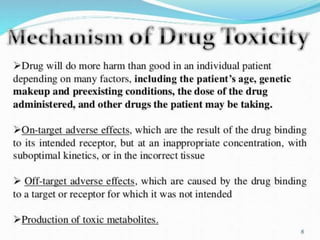
 Physicians prescribe drugs to prevent or treat disease. Those
same drugs can be toxic to certain patients, this toxicity is due
to the pharmacologic effect that are not necessary for the
achievement of desired action of drug
 It must be recognized that no drug is entirely specific. All
drugs have both primary intended effects and secondary
unintended effects, the latter known as side effects
 Adverse effects can range in severity from nuisance to life
threatening. Drug toxicology focuses on the harmful effects of
drugs in the animal and human body
INTRODUCTION
HARMFUL IMMUNE RESPONSES
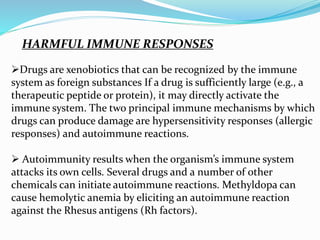
Drugs are xenobiotics that can be recognized by the immune
system as foreign substances If a drug is sufficiently large (e.g., a
therapeutic peptide or protein), it may directly activate the
immune system. The two principal immune mechanisms by which
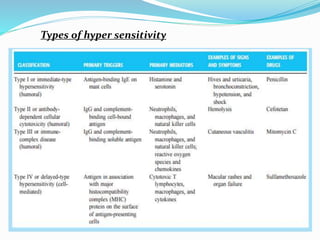
drugs can produce damage are hypersensitivity responses (allergic
responses) and autoimmune reactions.
 Autoimmunity results when the organism’s immune system
attacks its own cells. Several drugs and a number of other
chemicals can initiate autoimmune reactions. Methyldopa can
cause hemolytic anemia by eliciting an autoimmune reaction
against the Rhesus antigens (Rh factors).
Types of hyper sensitivity
DRUG-DRUG INTERACTIONS
 As the population has aged and increasing numbers of
patients have been prescribed multiple medications, the
potential for drug-drug interactions has grown. Numerous
adverse interactions have been identified, and the
mechanisms often involve pharmacokinetic or
pharmacodynamic effects. Drug-herb interactions are also an
important subset of drug-drug interactions.
References
 https://www.slideshare.net/rview-of-drug-toxicity
 https://en.wikipedia.org/wiki/Combined_drug_intoxication
 https://www.ncbi.nlm.nih.gov/pubmed/20978361
Loomis’s Essentials of Toxicology
drug induced toxicity

drug induced toxicity

  • 1.
    DRUG INDUCED TOXICITY NAVANEETHA MSc Environmental Technology CUSAT
  • 2.
     Physicians prescribedrugs to prevent or treat disease. Those same drugs can be toxic to certain patients, this toxicity is due to the pharmacologic effect that are not necessary for the achievement of desired action of drug  It must be recognized that no drug is entirely specific. All drugs have both primary intended effects and secondary unintended effects, the latter known as side effects  Adverse effects can range in severity from nuisance to life threatening. Drug toxicology focuses on the harmful effects of drugs in the animal and human body INTRODUCTION
  • 15.
    HARMFUL IMMUNE RESPONSES Drugsare xenobiotics that can be recognized by the immune system as foreign substances If a drug is sufficiently large (e.g., a therapeutic peptide or protein), it may directly activate the immune system. The two principal immune mechanisms by which drugs can produce damage are hypersensitivity responses (allergic responses) and autoimmune reactions.  Autoimmunity results when the organism’s immune system attacks its own cells. Several drugs and a number of other chemicals can initiate autoimmune reactions. Methyldopa can cause hemolytic anemia by eliciting an autoimmune reaction against the Rhesus antigens (Rh factors).
  • 16.
    Types of hypersensitivity
  • 18.
    DRUG-DRUG INTERACTIONS  Asthe population has aged and increasing numbers of patients have been prescribed multiple medications, the potential for drug-drug interactions has grown. Numerous adverse interactions have been identified, and the mechanisms often involve pharmacokinetic or pharmacodynamic effects. Drug-herb interactions are also an important subset of drug-drug interactions.
  • 28.