DRUG TOXICITY
By Imad Nmeir
Supervised by Dr. Rita Mouawad
HOLY-SPIRIT UNIVERSITY OF KASLIK
Faculty of sciences
Department of pharmacology and cosmetology
1
TABLE CONTENT
Introduction
• Toxicology and pharmacology
• Drug toxicity
• Adverse effects of drugs
Mechanism
• Introduction
• Factors affecting drug toxicity
• Classification
• On-target adverse effect
• Causes
• Miscellaneous
• Off-target adverse effect
• Reason as drug causing it
• Reason as body causing it
• Production of toxic metabolism
• Drug metabolism
Acetaminophen toxicity
• Biotransformation in normal dose levels
• Biotransformation with large doses
2
INTRODUCTION
Drug toxicity and its science3
TOXICOLOGY AND PHARMACOLOGY
ToxicologyPharmacology
Kinetic
Dynamic
Dose-
response
Receptors
Common
fields of
study
4
DRUGS
Therapeutic
• Used correctly
Toxic
• Supratherapeutic-
doses
• Genetic
predispositions
• Inappropriate use
• Non-selective
actions
5
ADVERSE EFFECTS OF DRUGS
All drugs
have
adverse
effects
Most are
undesirable
From
nuisance to
life
threatening
Subject of
focus of
drug
toxicology
Inappropriate
drug behavior
6
MECHANISM OF DRUG TOXICITY
Introduction7
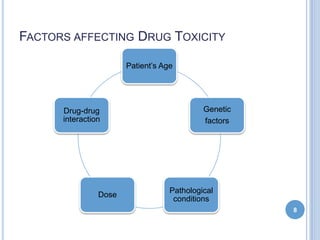
FACTORS AFFECTING DRUG TOXICITY
Patient’s Age
Genetic
factors
Pathological
conditions
Dose
Drug-drug
interaction
8
EXAMPLES
 The very young and the very old may be more
susceptible to the toxic effects of a drug because of
age-dependent differences in pharmacokinetic
profiles or in drug metabolizing enzymes.
 Liver or kidney dysfunction will affect drug
pharmacokinetics
 Genetic difference may yield difference in drug
metabolism or in receptor activity, as well
differences in activities of repair mechanism
9
CLINICAL DETERMINATION IS NOT STRAIGHT
FORWARD
 a patient treated with antibiotic may develop skin
rash, high fever, and other morbidities for several
reasons:
 Allergic reactions to antibiotics
 Recurrence of infection
10
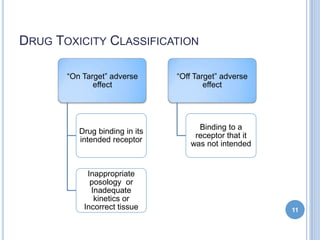
DRUG TOXICITY CLASSIFICATION
“On Target” adverse
effect
Drug binding in its
intended receptor
Inappropriate
posology or
Inadequate
kinetics or
Incorrect tissue
“Off Target” adverse
effect
Binding to a
receptor that it
was not intended
11
OTHER CLASSIFICATIONS
Harmful
immune
response
12
MECHANISM OF DRUG TOXICITY
On-Target adverse effect13
CAUSES OF ON-TARGET EFFECTS
Exaggeration in
pharmacologic action
Alteration
in the
pharmacod
ynamics
Alteration
of the
pharmaco
kinetics
Dosing
error
14
SUBCLASS AND IMPORTANT DETAILS OF ON-
TARGET EFFECTS
May expose
unknown functions
of the biological
target
Drug action on the
same receptor but on
different tissue than
the target one
15
EXAMPLE: HMG COA REDUCTASE INHIBITOR
 Used to decrease blood cholesterol levels
 Target organ: liver
 Inhibition of HMG CoA reductase
 Rate limiting step in isoprenoid synthesis
 Have muscle toxicity as side effect
 HMG CoA reductase is important for muscle protein
posttranslational modification regulation
 Lipidation through geranyl-geranylation
16
EXAMPLE: ANTIHISTAMINE DIPHENHYDRAMINE
 Used to reduce allergic reaction
 Minimize histamine release by interacting with H1
receptors.
 Pass the blood-brain barrier
 Causes drowsiness by interacting with H1 receptor
in the brain.
17
MECHANISM OF DRUG TOXICITY
Off-Target adverse effect18
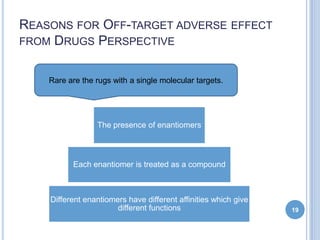
REASONS FOR OFF-TARGET ADVERSE EFFECT
FROM DRUGS PERSPECTIVE
Rare are the rugs with a single molecular targets.
The presence of enantiomers
Each enantiomer is treated as a compound
Different enantiomers have different affinities which give
different functions 19
EXAMPLE: ANTIHISTAMINE TERFENADINE
 Inhibits histamine release in the blood
 Also inhibits cardiac potassium channels
 Causes fatal cardiac arrhythmias
 Withdrawn from the market
 Now usage of fexofenadine
 Have affinity to cardiac potassium channels but to a
much lesser degree than terfenadine
20
EXAMPLE: R AND S THALIDOMIDE
 Effective sedative
 S-thalidomide is a potent teratogen
 Cause of this is: anti-angiogenic property of S-
thalidomide
21
REASONS FOR OFF-TARGET ADVERSE
EFFECTS FROM BODY PERSPECTIVE
Unintentional activation of a different receptor other than
the target one.
Usage of genetically modified
animals which lack the target
receptor.
22
EXAMPLE: BETA-BLOCKERS
 Beta1 receptors: causes increase in heart rate and
myocardium contractility
 Beta2 receptors: smooth muscle relaxation and
dilatation of these tissues
 Some Beta1 antagonist exert activity on beta 2
receptors
 May cause airway constriction with asthma patients
 Non-selective Beta blockers are not given to these
patients then
23
MECHANISM OF DRUG TOXICITY
Production of toxic metabolites24
DRUG METABOLISM
Metabolized
in the liver
Gives
active
compound
Undesired
actions
25
EXAMPLE: LOSARTAN AND EBASTIN
 Losartan is converted to the active E3174
 Ebastin is converted to carebastine
 Both are active inside the body and may cause
damage.
26
ACETAMINOPHEN
Mechanism of Acetaminophen toxicity27
WITH NORMAL DOSES
Acetaminophen
enter through the
digestive tract
Heavily
metabolized by
the liver by Liver
enzymes
P450 will
metabolize it into
intermediate “N-
acetyl-p-
benzoquinoneimine
(NAPQI)”
NAPQI is then
immediately
conjugated with
glutathione
Then it is further
conjugated with
glucuronate and
sulfate
Finally it is
excreted from the
body
28
WITH HIGH DOSE ADMINISTERED
The high levels of
acetaminophen will
saturate the
conjugation
enzymes
First the glucuronate
transferase and the
sulfate transferase
will be saturated
This will eventually
saturate the
glutathione
transferase
When that happens
high levels of
NAPQI will
accumulate inside
the cell
NAPQI will react
with other hepatic
proteins giving
other toxic
compounds
This will cause
hepatotoxicity and
will cause death
This is solved by
giving the patient
N-acetylcysteine
29

Drug toxicity

  • 1.
    DRUG TOXICITY By ImadNmeir Supervised by Dr. Rita Mouawad HOLY-SPIRIT UNIVERSITY OF KASLIK Faculty of sciences Department of pharmacology and cosmetology 1
  • 2.
    TABLE CONTENT Introduction • Toxicologyand pharmacology • Drug toxicity • Adverse effects of drugs Mechanism • Introduction • Factors affecting drug toxicity • Classification • On-target adverse effect • Causes • Miscellaneous • Off-target adverse effect • Reason as drug causing it • Reason as body causing it • Production of toxic metabolism • Drug metabolism Acetaminophen toxicity • Biotransformation in normal dose levels • Biotransformation with large doses 2
  • 3.
  • 4.
  • 5.
    DRUGS Therapeutic • Used correctly Toxic •Supratherapeutic- doses • Genetic predispositions • Inappropriate use • Non-selective actions 5
  • 6.
    ADVERSE EFFECTS OFDRUGS All drugs have adverse effects Most are undesirable From nuisance to life threatening Subject of focus of drug toxicology Inappropriate drug behavior 6
  • 7.
    MECHANISM OF DRUGTOXICITY Introduction7
  • 8.
    FACTORS AFFECTING DRUGTOXICITY Patient’s Age Genetic factors Pathological conditions Dose Drug-drug interaction 8
  • 9.
    EXAMPLES  The veryyoung and the very old may be more susceptible to the toxic effects of a drug because of age-dependent differences in pharmacokinetic profiles or in drug metabolizing enzymes.  Liver or kidney dysfunction will affect drug pharmacokinetics  Genetic difference may yield difference in drug metabolism or in receptor activity, as well differences in activities of repair mechanism 9
  • 10.
    CLINICAL DETERMINATION ISNOT STRAIGHT FORWARD  a patient treated with antibiotic may develop skin rash, high fever, and other morbidities for several reasons:  Allergic reactions to antibiotics  Recurrence of infection 10
  • 11.
    DRUG TOXICITY CLASSIFICATION “OnTarget” adverse effect Drug binding in its intended receptor Inappropriate posology or Inadequate kinetics or Incorrect tissue “Off Target” adverse effect Binding to a receptor that it was not intended 11
  • 12.
  • 13.
    MECHANISM OF DRUGTOXICITY On-Target adverse effect13
  • 14.
    CAUSES OF ON-TARGETEFFECTS Exaggeration in pharmacologic action Alteration in the pharmacod ynamics Alteration of the pharmaco kinetics Dosing error 14
  • 15.
    SUBCLASS AND IMPORTANTDETAILS OF ON- TARGET EFFECTS May expose unknown functions of the biological target Drug action on the same receptor but on different tissue than the target one 15
  • 16.
    EXAMPLE: HMG COAREDUCTASE INHIBITOR  Used to decrease blood cholesterol levels  Target organ: liver  Inhibition of HMG CoA reductase  Rate limiting step in isoprenoid synthesis  Have muscle toxicity as side effect  HMG CoA reductase is important for muscle protein posttranslational modification regulation  Lipidation through geranyl-geranylation 16
  • 17.
    EXAMPLE: ANTIHISTAMINE DIPHENHYDRAMINE Used to reduce allergic reaction  Minimize histamine release by interacting with H1 receptors.  Pass the blood-brain barrier  Causes drowsiness by interacting with H1 receptor in the brain. 17
  • 18.
    MECHANISM OF DRUGTOXICITY Off-Target adverse effect18
  • 19.
    REASONS FOR OFF-TARGETADVERSE EFFECT FROM DRUGS PERSPECTIVE Rare are the rugs with a single molecular targets. The presence of enantiomers Each enantiomer is treated as a compound Different enantiomers have different affinities which give different functions 19
  • 20.
    EXAMPLE: ANTIHISTAMINE TERFENADINE Inhibits histamine release in the blood  Also inhibits cardiac potassium channels  Causes fatal cardiac arrhythmias  Withdrawn from the market  Now usage of fexofenadine  Have affinity to cardiac potassium channels but to a much lesser degree than terfenadine 20
  • 21.
    EXAMPLE: R ANDS THALIDOMIDE  Effective sedative  S-thalidomide is a potent teratogen  Cause of this is: anti-angiogenic property of S- thalidomide 21
  • 22.
    REASONS FOR OFF-TARGETADVERSE EFFECTS FROM BODY PERSPECTIVE Unintentional activation of a different receptor other than the target one. Usage of genetically modified animals which lack the target receptor. 22
  • 23.
    EXAMPLE: BETA-BLOCKERS  Beta1receptors: causes increase in heart rate and myocardium contractility  Beta2 receptors: smooth muscle relaxation and dilatation of these tissues  Some Beta1 antagonist exert activity on beta 2 receptors  May cause airway constriction with asthma patients  Non-selective Beta blockers are not given to these patients then 23
  • 24.
    MECHANISM OF DRUGTOXICITY Production of toxic metabolites24
  • 25.
    DRUG METABOLISM Metabolized in theliver Gives active compound Undesired actions 25
  • 26.
    EXAMPLE: LOSARTAN ANDEBASTIN  Losartan is converted to the active E3174  Ebastin is converted to carebastine  Both are active inside the body and may cause damage. 26
  • 27.
  • 28.
    WITH NORMAL DOSES Acetaminophen enterthrough the digestive tract Heavily metabolized by the liver by Liver enzymes P450 will metabolize it into intermediate “N- acetyl-p- benzoquinoneimine (NAPQI)” NAPQI is then immediately conjugated with glutathione Then it is further conjugated with glucuronate and sulfate Finally it is excreted from the body 28
  • 29.
    WITH HIGH DOSEADMINISTERED The high levels of acetaminophen will saturate the conjugation enzymes First the glucuronate transferase and the sulfate transferase will be saturated This will eventually saturate the glutathione transferase When that happens high levels of NAPQI will accumulate inside the cell NAPQI will react with other hepatic proteins giving other toxic compounds This will cause hepatotoxicity and will cause death This is solved by giving the patient N-acetylcysteine 29