गर विष
Guided by: Presented by:
Dr.Adarsh.sir Vidyashri.H.Biradar
Dr.shivanand sir 3 rd BAMS
Contents:
 ➢ Introduction
 ➢ Definition
 ➢ Composition
 ➢Types
 ➢ Administration
 ➢ Routes of Administration
 ➢ Signs and Symptoms
 ➢Treatment
 ➢ Garavisha in current era
 ➢ Recent Research updates
 ➢ Discussion
 ➢ Summary
 ➢ Conclusion
 ➢ References
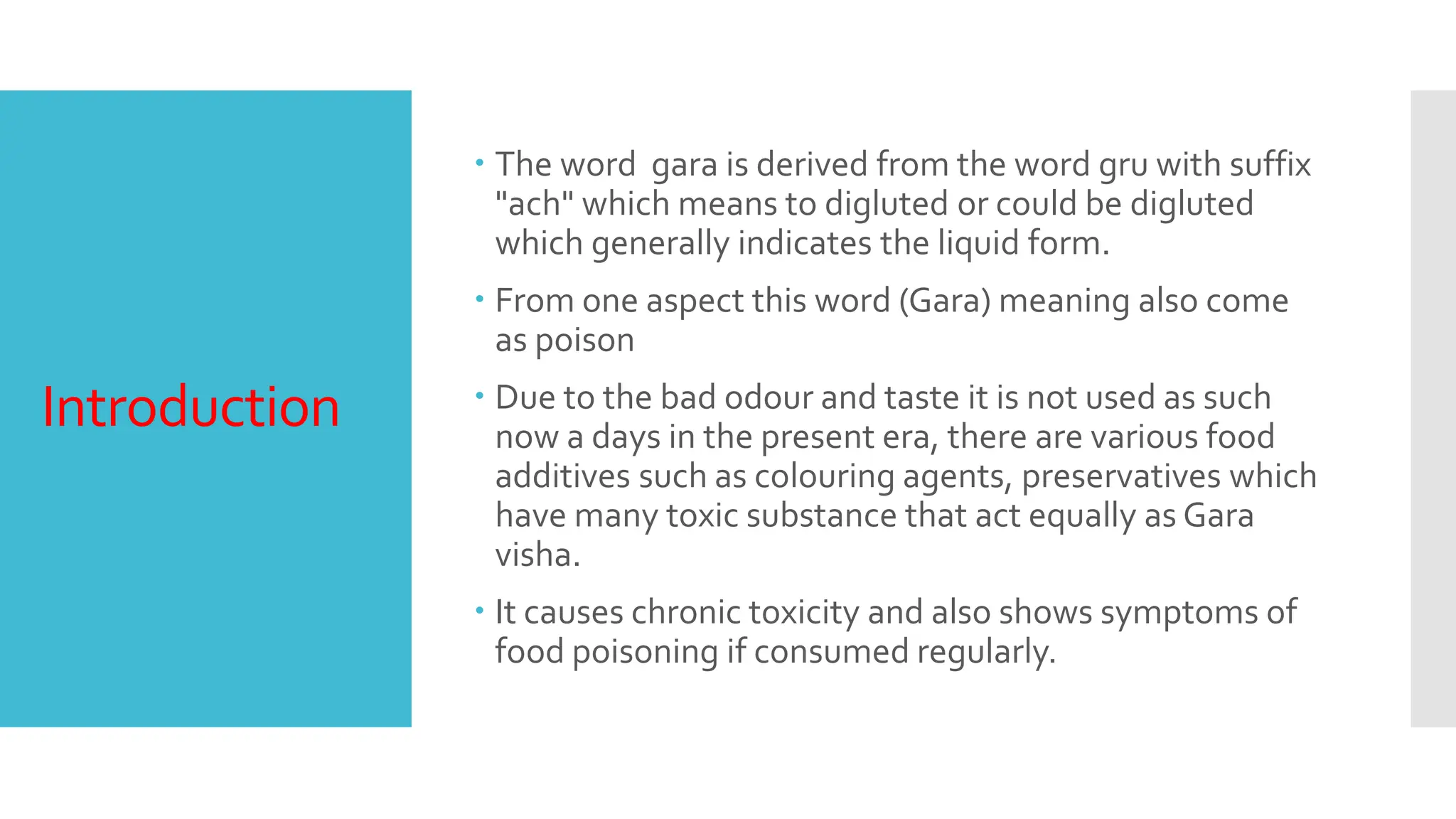
Introduction
 The word gara is derived from the word gru with suffix
"ach" which means to digluted or could be digluted
which generally indicates the liquid form.
 From one aspect this word (Gara) meaning also come
as poison
 Due to the bad odour and taste it is not used as such
now a days in the present era, there are various food
additives such as colouring agents, preservatives which
have many toxic substance that act equally as Gara
visha.
 It causes chronic toxicity and also shows symptoms of
food poisoning if consumed regularly.
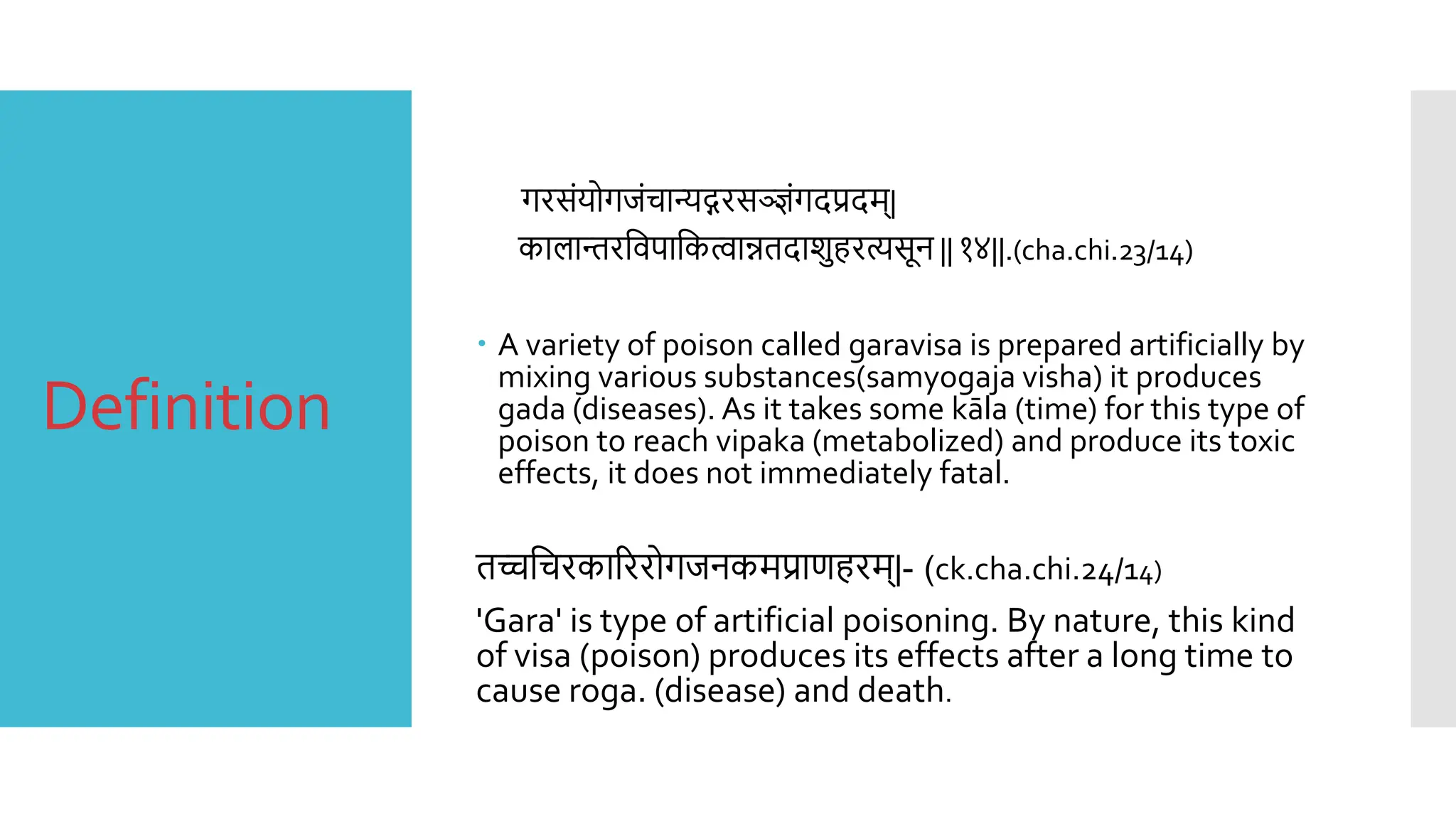
Definition
गरसंयोगजंचान्यद्गरसञ्ज्ञंगदप्रदम्|
कालान्तरविपावकत्वान्नतदाशुहरत्यसून || १४||.(cha.chi.23/14)
 A variety of poison called garavisa is prepared artificially by
mixing various substances(samyogaja visha) it produces
gada (diseases). As it takes some kāla (time) for this type of
poison to reach vipaka (metabolized) and produce its toxic
effects, it does not immediately fatal.
तच्चवचरकारररोगजनकमप्राणहरम्|- (ck.cha.chi.24/14)
'Gara' is type of artificial poisoning. By nature, this kind
of visa (poison) produces its effects after a long time to
cause roga. (disease) and death.
क
ृ विमं गरसंञं तु वियते विविधौषधैः।
हन्तन्त योगिशेनाशु वचरान्तच्चरतराच्च तत्||६||
शोफपाण्ड
ू दरोन्माददुनाामदीन् करोवत िा।।
(A.Hr.Ut 35)
 Combination of two or more than two
poisonous or non poisonous drugs and
ultimately affects the whole body by
vitiating all the dhatus in the body.
 It can go to such extent that it alleviates the
dhatus drastically which in turn could prove
to be fatal.
Composition:
नानाप्राण्यङ्गशमलविरुद्धौषवधभस्मनाम् ४९। ।
विषाणांचाल्पिीयााणांयोगोगरइवतस्मृतम् -(AH.Ut.35/49-50)
 Combination of मल (excreta) from various अङ्ग
(bodyparts) of प्राणी (living beings), विरुद्ध औषवध
(incompatible drugs), भस्म (calcined powders) and अल्प
िीया विष (poisonous substances of mild potency) is
known as garavisha
 ➢ Nanapranyangasha mala:
 Mala,mutra,shukra,sveda,artava of animals
 Apakwa mamsa
 Virrudha ahara
 Rodent excreta in – rice, wheat, jawar
विरुद्ध औषवध भस्मनम्
Hypersensitive reactions
Adverse drug reactions
 Longterm medicine : Paracetamol,
Diclofenac , contraceptives
 Hormonal pills
 Anti cancerous medications
 िीयााणां च अल्पं
 Pesticides
 Insecticiedes
 Preservatives
 Additives
 Flavouring agents
 Colouring agents
 Sweeteners
 Ajinomoto (Mono sodium glutamate)
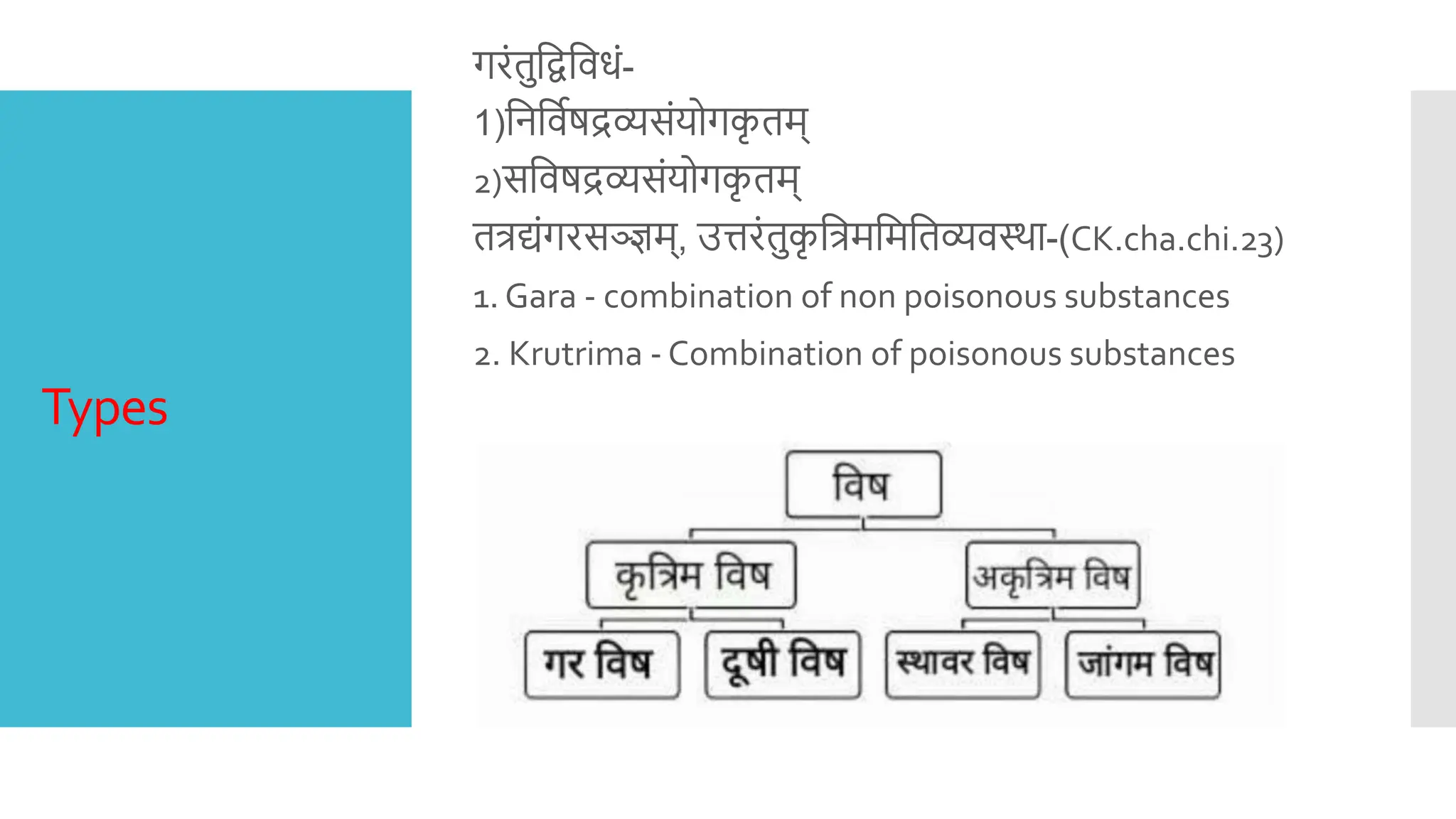
Types
गरंतुविविधं-
1)वनविाषद्रव्यसंयोगक
ृ तम्
2)सविषद्रव्यसंयोगक
ृ तम्
तिद्यंगरसञ्ज्ञम्, उत्तरंतुक
ृ विमवमवतव्यिस्था-(CK.cha.chi.23)
1. Gara - combination of non poisonous substances
2. Krutrima - Combination of poisonous substances
विष प्रयोग: (Administration):
सौभाग्याथंन्तियैःस्वेदरजोनानाड्गजान्मलान्।
शिुप्रयुक्ांश्चगरान्प्रयच्छन्त्यन्नवमवरिततान्।।
(Cha.Chi.23/233)
 Stri (women), in order to gain saubhagya
(favour from their husbands), at times,
administer their sveda (sweat), raja
(menstrual blood) and dif ferent types of mala
(waste products) of their anga (body) along
with anna (food).
 Even infiltrators playing in the hands of satru
(foes), sometimes, administer various types
of garavisa along with food preparations.
Routes of administration:
अन्नेपानेदन्तकाष्ठेतथाऽभ्यङ्ग
े ऽिलेखने |
उत्सादनेकषाये च पररषेकsनुलेपने ||२५|
स्रक्षुििेषुशय्यासुकिचाभरणेषुच |
पादकापादपीठे षुपृष्ठेषुगजिावजनाम्||२६||-(Su.ka.1/25-26)
▪ Anna – Food
▪ Pana–Drinks
▪ Dantakasta –Toothpaste
▪ Abhyanga – Massage
▪ Avalekhana –Comb
▪ Utsadana – powders
▪ Kashaya – decoctions
▪ Parisheka - bathing liquids
▪ Anulepana – Cosmetics
 Srakshu – Garlands
 Vastra - Apparels
 Sayyeshu - Bed
 Kavachabharana - ornaments, watch
 Padukapadapiteshu - foot wears
 Prusteshu Gaja vajina - back of elephants and
horses
 Nasya snuff - Drugs – Charas
 Dhooma -smoking
 Anjana - collyrium etc.
गरविषलक्षण (Signs and symptoms) :
➢ As per Acarya Caraka :
तैःस्यात्पाण्डुैःक
ृ शोल्पाविगारश्चास्योपजायते।
ममाप्रधमनाध्मानंश्वयथुंहस्तपादयोैः॥
जठरंग्रहणीदोषोयक्ष्मागुल्ैःक्षयोज्वरैः|
एिंविधस्यचान्यस्यव्याधेवलंगावनदशायेत्।।
स्वप्नेमाजाारगोमायुव्यालान्सनक
ु लान्कपीन।
प्रायैःपश्यवतनद्यादीच्छु ष्ांशसिनस्पतीन॥
कालश्चगौरमात्मानंस्वप्नेगौरश्चकालकम्।
विकणानावसक
ं िाsवप्रपश्येविहतेवद्रयैः॥(CS.Ci.23.234-
237)
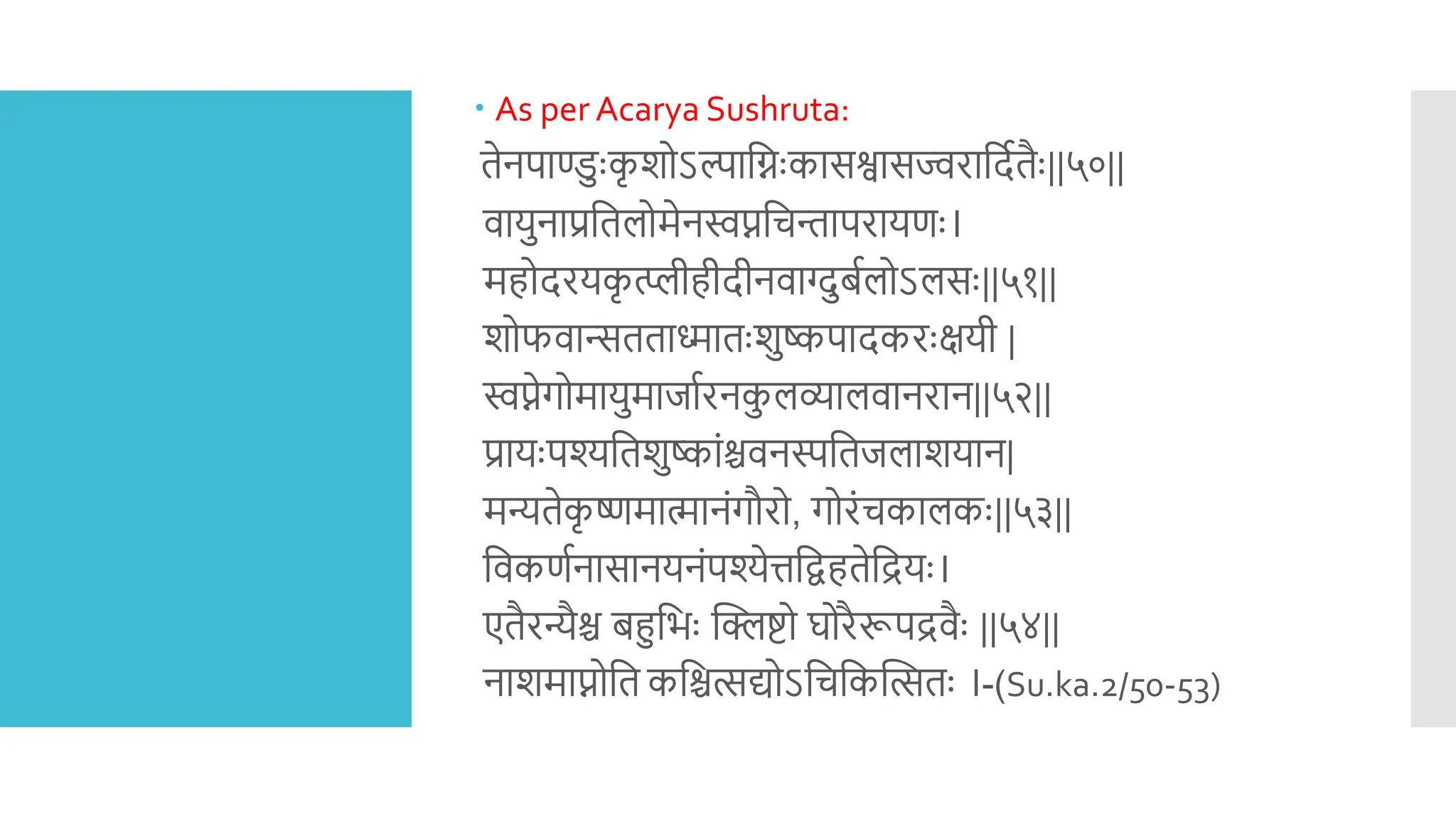
 As per Acarya Sushruta:
तेनपाण्डुैःक
ृ शोऽल्पाविैःकासश्वासज्वरावदातैः||५०||
िायुनाप्रवतलोमेनस्वप्नवचन्तापरायणैः।
महोदरयक
ृ त्प्लीहीदीनिाग्दुर्ालोऽलसैः||५१||
शोफिान्सतताध्मातैःशुष्पादकरैःक्षयी |
स्वप्नेगोमायुमाजाारनक
ु लव्यालिानरान||५२||
प्रायैःपश्यवतशुष्ांश्चिनस्पवतजलाशयान|
मन्यतेक
ृ ष्णमात्मानंगौरो, गोरंचकालकैः||५३||
विकणानासानयनंपश्येत्तविहतेवद्रयैः।
एतरन्यश्च र्हुवभैः न्तिष्टो घोररूपद्रिैः ||५४||
नाशमाप्नोवत कवश्चत्सद्योऽवचवकन्तत्सतैः ।-(Su.ka.2/50-53)
As per AcaryaVagbhata:
क
ृ विमंगरसंञंतुवियतेविविधौषधैः।
हन्तन्तयोगिशेनाशुवचरान्तच्चरतरच्चतत्।|
शोफपाण्ड
ू दरोन्माददुनाामादीन्करोवतिा। -(Ah.Ut.35/6-7)
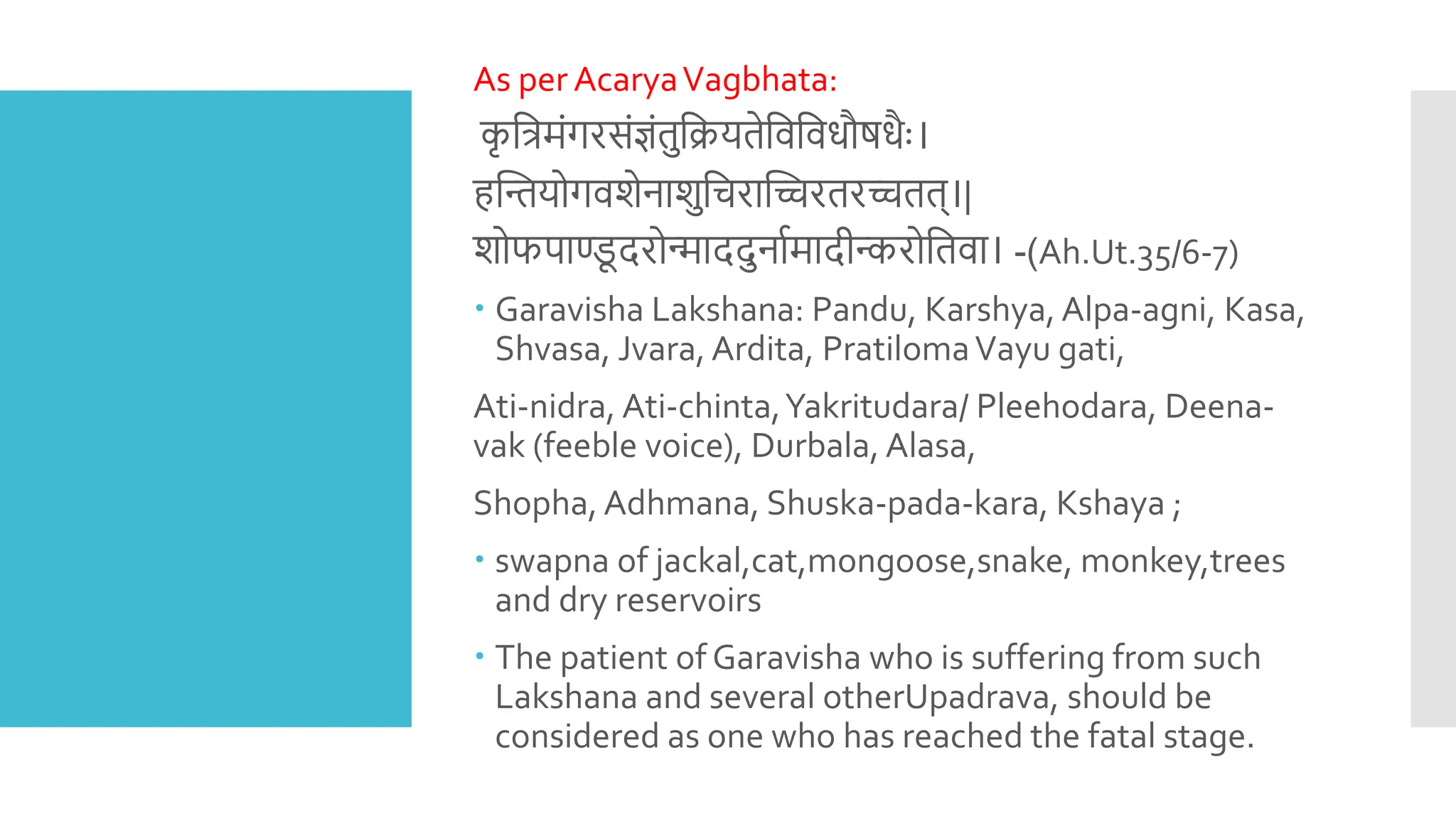
 Garavisha Lakshana: Pandu, Karshya, Alpa-agni, Kasa,
Shvasa, Jvara, Ardita, PratilomaVayu gati,
Ati-nidra, Ati-chinta,Yakritudara/ Pleehodara, Deena-
vak (feeble voice), Durbala, Alasa,
Shopha, Adhmana, Shuska-pada-kara, Kshaya ;
 swapna of jackal,cat,mongoose,snake, monkey,trees
and dry reservoirs
 The patient of Garavisha who is suffering from such
Lakshana and several otherUpadrava, should be
considered as one who has reached the fatal stage.
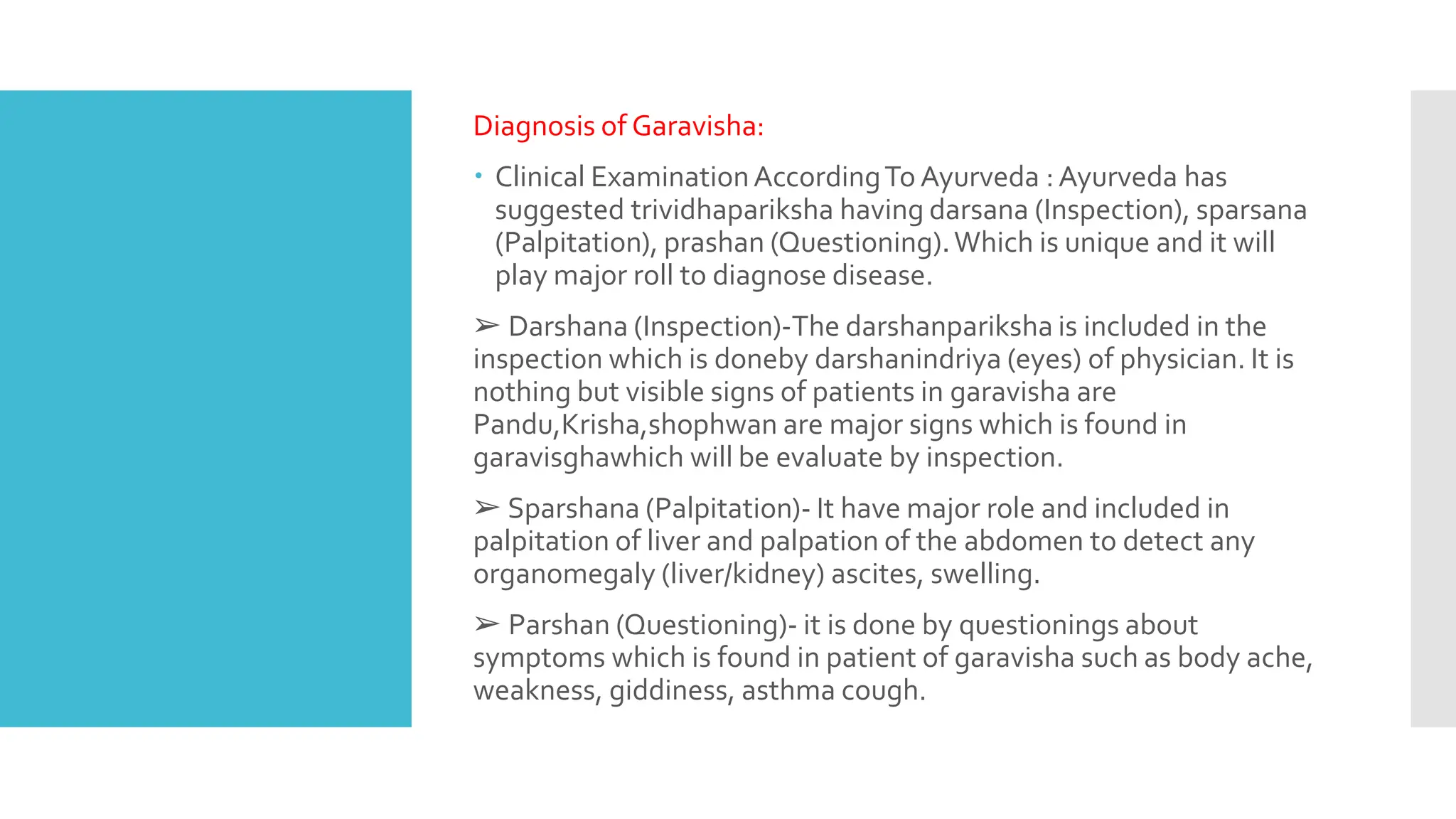
Diagnosis of Garavisha:
 Clinical ExaminationAccordingTo Ayurveda :Ayurveda has
suggested trividhapariksha having darsana (Inspection), sparsana
(Palpitation), prashan (Questioning).Which is unique and it will
play major roll to diagnose disease.
➢ Darshana (Inspection)-The darshanpariksha is included in the
inspection which is doneby darshanindriya (eyes) of physician. It is
nothing but visible signs of patients in garavisha are
Pandu,Krisha,shophwan are major signs which is found in
garavisghawhich will be evaluate by inspection.
➢ Sparshana (Palpitation)- It have major role and included in
palpitation of liver and palpation of the abdomen to detect any
organomegaly (liver/kidney) ascites, swelling.
➢ Parshan (Questioning)- it is done by questionings about
symptoms which is found in patient of garavisha such as body ache,
weakness, giddiness, asthma cough.
वचवकत्सा:
➢ As per Acharya Charaka:
▪Vamana-karma (emesis):
सूक्ष्मंताम्ररजस्तस्मसक्षौद्रंहविशोधनम।- च.वच 23.239/240)
 The patient should promptly be given vamana by the physician.
He should be given
 ताम्ररज (fine powder of copper) along with ksaudra (honey) for हृद्
विशोधन ( cleansing the heart)
▪ हेमचूणा:
शुद्धेहृदाततैःशाणंहेमचूणास्यदापयेत्||
हेमसिाविषाण्याशुगरांश्चयविवनयच्छवत।
नसज्जतेहेमपांगेविषंपद्मदलेऽम्बुित्।।(CS.Ci. 23.239-240)
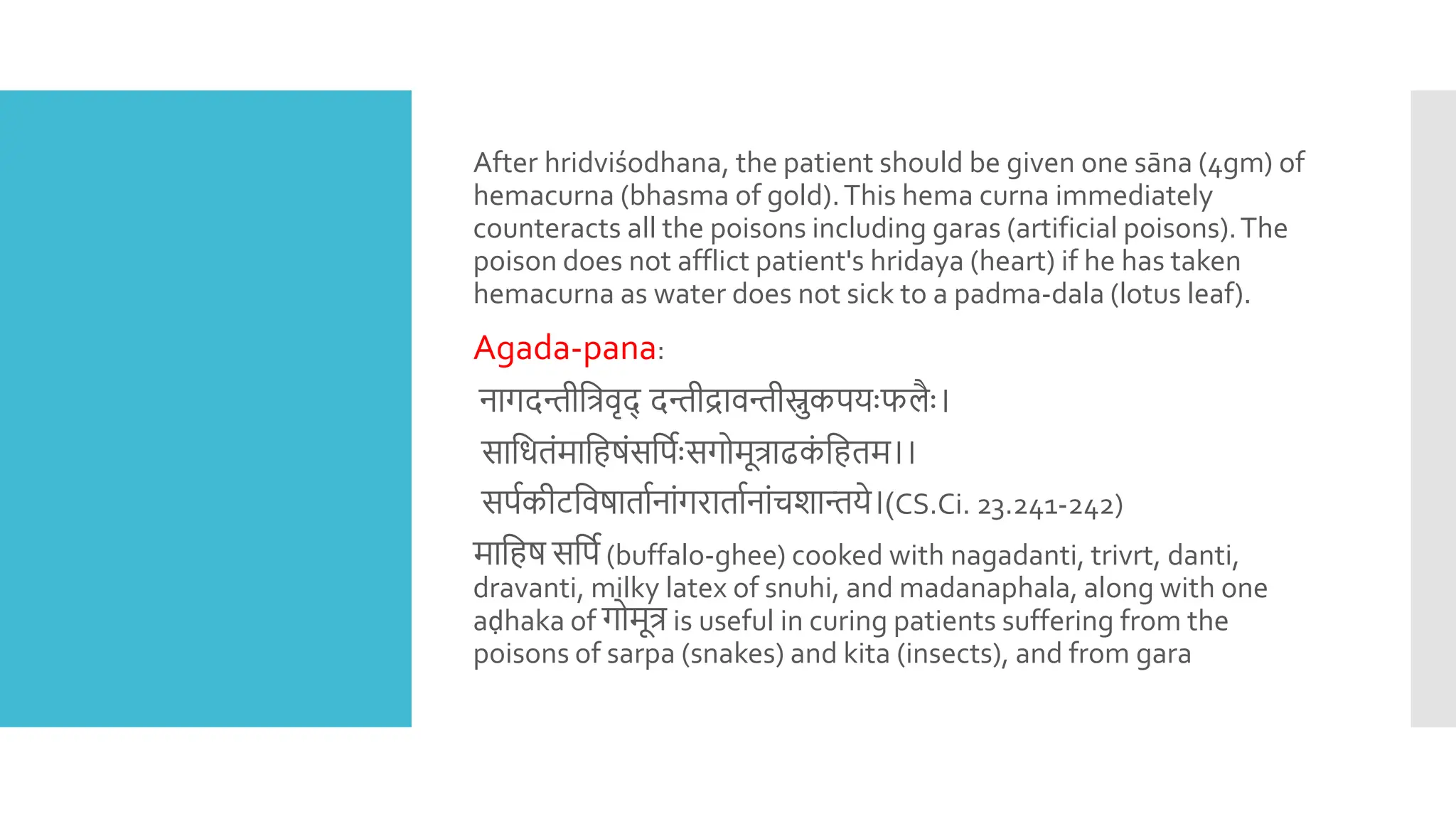
After hridviśodhana, the patient should be given one sāna (4gm) of
hemacurna (bhasma of gold).This hema curna immediately
counteracts all the poisons including garas (artificial poisons).The
poison does not afflict patient's hridaya (heart) if he has taken
hemacurna as water does not sick to a padma-dala (lotus leaf).
Agada-pana:
नागदन्तीवििृद् दन्तीद्रािन्तीस्नुकपयैःफलैः।
सावधतंमावहषंसवपाैःसगोमूिाढक
ं वहतम।।
सपाकीटविषाताानांगराताानांचशान्तये।(CS.Ci. 23.241-242)
मावहष सवपा (buffalo-ghee) cooked with nagadanti, trivrt, danti,
dravanti, milky latex of snuhi, and madanaphala, along with one
aḍhaka of गोमूि is useful in curing patients suffering from the
poisons of sarpa (snakes) and kita (insects), and from gara
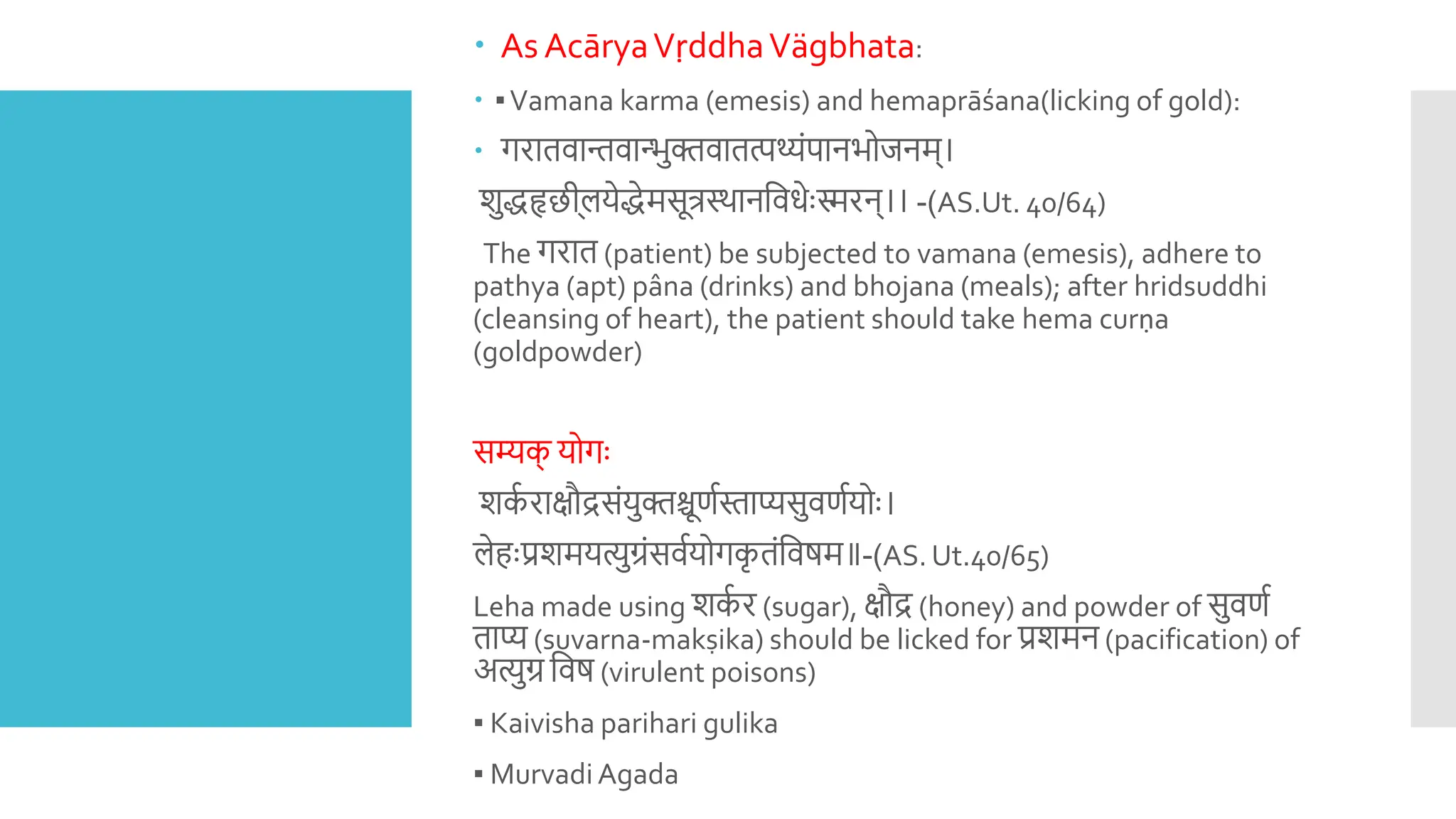
 As AcāryaVṛddhaVägbhata:
 ▪Vamana karma (emesis) and hemaprāśana(licking of gold):
 गरातिान्तिान्भुक्िातत्पथ्यंपानभोजनम्।
शुद्धहृछी्लयेद्धेमसूिस्थानविधेैःस्मरन्।। -(AS.Ut. 40/64)
The गरात (patient) be subjected to vamana (emesis), adhere to
pathya (apt) pâna (drinks) and bhojana (meals); after hridsuddhi
(cleansing of heart), the patient should take hema curṇa
(goldpowder)
सम्यक
् योगैः
शक
ा राक्षौद्रसंयुक्श्चूणास्ताप्यसुिणायोैः।
लेहैःप्रशमयत्युग्रंसिायोगक
ृ तंविषम॥-(AS.Ut.40/65)
Leha made using शक
ा र (sugar), क्षौद्र (honey) and powder of सुिणा
ताप्य (suvarna-makṣika) should be licked for प्रशमन (pacification) of
अत्युग्र विष (virulent poisons)
▪ Kaivisha parihari gulika
▪ Murvadi Agada
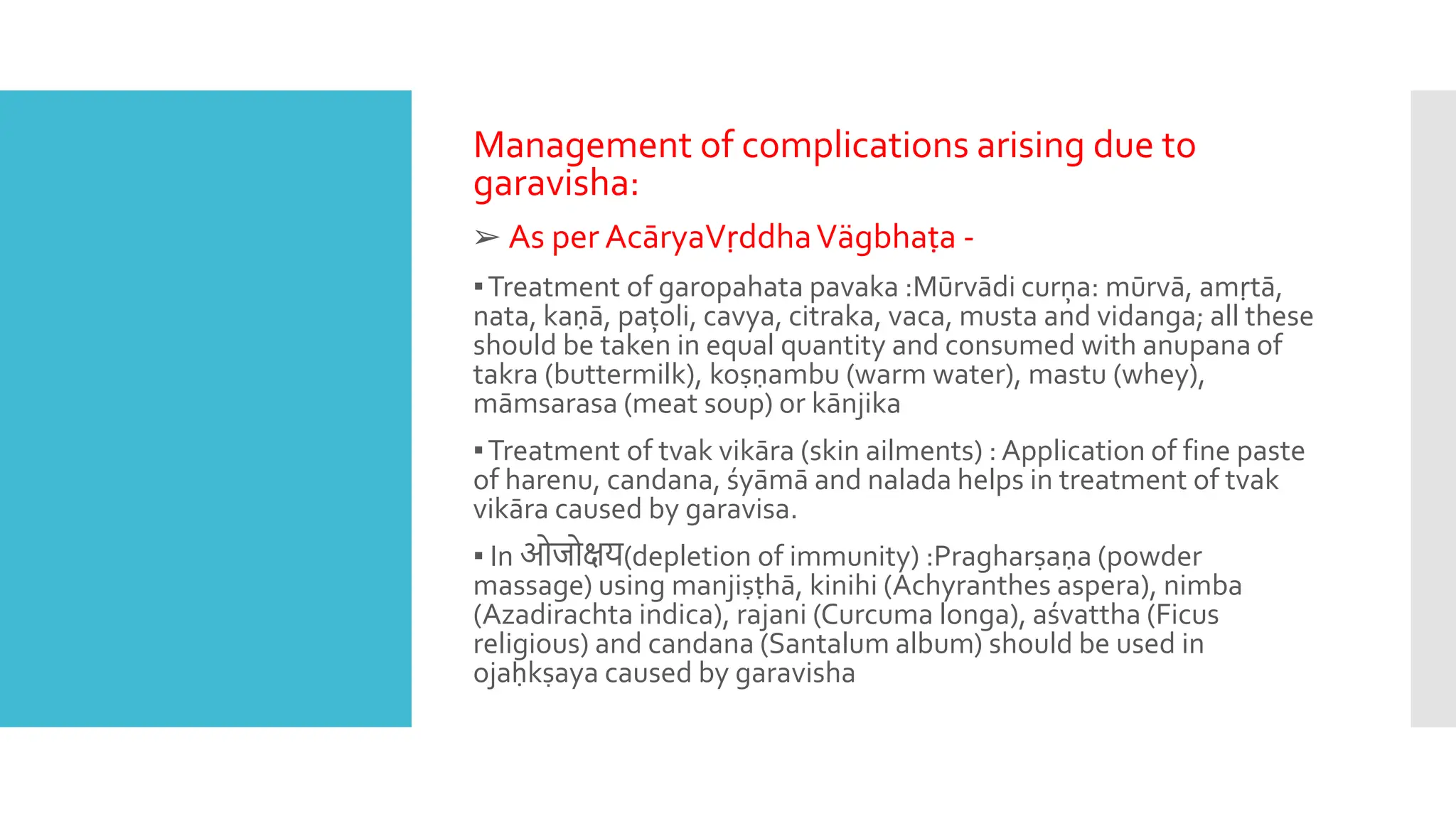
Management of complications arising due to
garavisha:
➢ As per AcāryaVṛddhaVägbhaṭa -
▪Treatment of garopahata pavaka :Mūrvādi curņa: mūrvā, amṛtā,
nata, kaṇā, pațoli, cavya, citraka, vaca, musta and vidanga; all these
should be taken in equal quantity and consumed with anupana of
takra (buttermilk), koṣṇambu (warm water), mastu (whey),
māmsarasa (meat soup) or kānjika
▪Treatment of tvak vikāra (skin ailments) : Application of fine paste
of harenu, candana, śyāmā and nalada helps in treatment of tvak
vikāra caused by garavisa.
▪ In ओजोक्षय(depletion of immunity) :Pragharṣaṇa (powder
massage) using manjiṣṭhā, kinihi (Achyranthes aspera), nimba
(Azadirachta indica), rajani (Curcuma longa), aśvattha (Ficus
religious) and candana (Santalum album) should be used in
ojaḥkṣaya caused by garavisha
Formulation:
 For kvātha (decoction):vasa (Ahata vasica)
 Nimba (Azadirachta indica)
 Patola (Trichosanthes dioica)
 For kalka (paste):Abhayā (Terminalia chebula)
 Dosage: 24 to 48 ml
 Anupana: koshna jala (warm water)
Diet apt in garavisha:
 पथ्यंपरममुविष्टंशीलनंक्षीरसवपाषोैः।(AS.Ut.40/71
 क्षीर (milk) and सवपा (ghee) are apt in conditions
caused by गरविष.
 GaraVisha (concocted poison) in Current Era:
 Viruddhahara andAhitahara.
 Fast foods and cold beverages like colas.,additives, colouring
agents ,adulterants
 Drugs like quinine, NSAIDs, steroids etc.
 Pesticides, fertilizers ,metals, minerals, pollutants Beauty
creams etc.
 Any form of incompatible drug combination or less potent
toxins that may get into our daily utensils accidently or
intentionally, will definitely harm the consumers.The food,
drinks, medicines,Washing Powder, Cosmetics, tooth paste
etc are now taken along with concocted poison.
Food Adulteration: chemicals
 Turmeric – Lead Chromate, MetanilYellow
 Chilly – Rhodamin B
 Milk – Urea, Detergent, Starch, synthetic milk.
 Oil – Argemone Oil, Liquid Paraffin
 Ghee – Animal Fat,Vegetable Oil, Starch
 Fruits -Ripening
 Rice – Plastic
Drinks:
 Now a day’s drinks or beverages are
changing its form to soft drinks, milk, milk
shakes, carbonated water etc.
 As a part of this change some or other
forms of toxins also get into our daily
drinks.
 Most of the carbonated and soft drinks
require additives and preservatives which
consist of
 chemical substances that are harmful to our
body.
 Artificial sugar like Aspartame are added to
these soft drinks which shows carcinogenic
effect.
Cosmetics:
Talc which is seen in cosmetics,
lotion, powder etc is a proven
carcinogen linked to ovarian cancer.
lmadazolidinyl is a chemical found
in hair dyes is carcinogenic.
Sodium lauryl sulfate is a compound
commonly seen in face creams for
the removal of dirt and oil from skin
is proved carcinogenic.
BHA (butylated hydroxyanisole) and
BHT ( butylated hydroxytoluene) in
lipsticks, moisturisers etc causes
liver, thyroid and kidney problems
and affects blood coagulation.
CosmeticToxicity:
▪ Lead in toothpaste - neurotoxic
▪ Butyl acetate - Nail polish
▪ Coal tar-Carcinogen
▪ Diethanolamine (DEA) - Foaming agent:Carcinogenic
▪ 1,4 dioxane - Shampoo - Carcinogenic
▪ Formaldehyde - genotoxic, cause immune system damage
▪ Fragrance - disrupt normal endocrine function,
▪ Phthalates - developmental defects and delays.
▪ Mercury - Make up
▪Toluene- hair color and nail polish - ovarian cancer, reproductive
and developmental damage.
Discussion:
 Everything is toxic but its toxicity depends upon its dose, even
water is also toxic if it is consumed in large amounts in relatively
short time. According to ayurveda ahara also acts as poison if not
taken properly. Some toxins cannot be removed from food as
these toxins are present naturally and others may be created
during processing or cooking.
 Consumption of all these toxins are hazardous for our health. By
knowing these toxins we will live a healthy life.
 Gara visha in ayurveda is an artificial poison. It is a combination of
two or more products that lead to the formation of toxins which
after intake deteriorate the health of consumer.The marvelous
drugs mentioned in ayurvedic samhitas are ancient treasure in the
management of Gara visha.
summary:
 all these following factors can be considered as garavisha
 Viruddhahara and Ahitahara.
 Fast foods and cold beverages
 Alcohol, tobacco
 Drugs like quinine, NSAIDs, steroids etc.
 pesticides, metals, minerals, pollutants etc.
 Cosmetics etc.
 Conclusion:
 Wonderful concept of garavisha explained by Ayurveda.Today man
is commonly unprotected to these artificial poisons which are
primed by the combination of poisonous and non poisonous
substances.Garavisha is often consumed unintentionally hence the
person doesn't
 feel anything proximately and even delayed onset of symptoms
makes treatment bit difficult.
 Early Diagnosis is better diagnosis so we need to aware the cause,
diagnosis, Symptoms &Treatment of garavisha
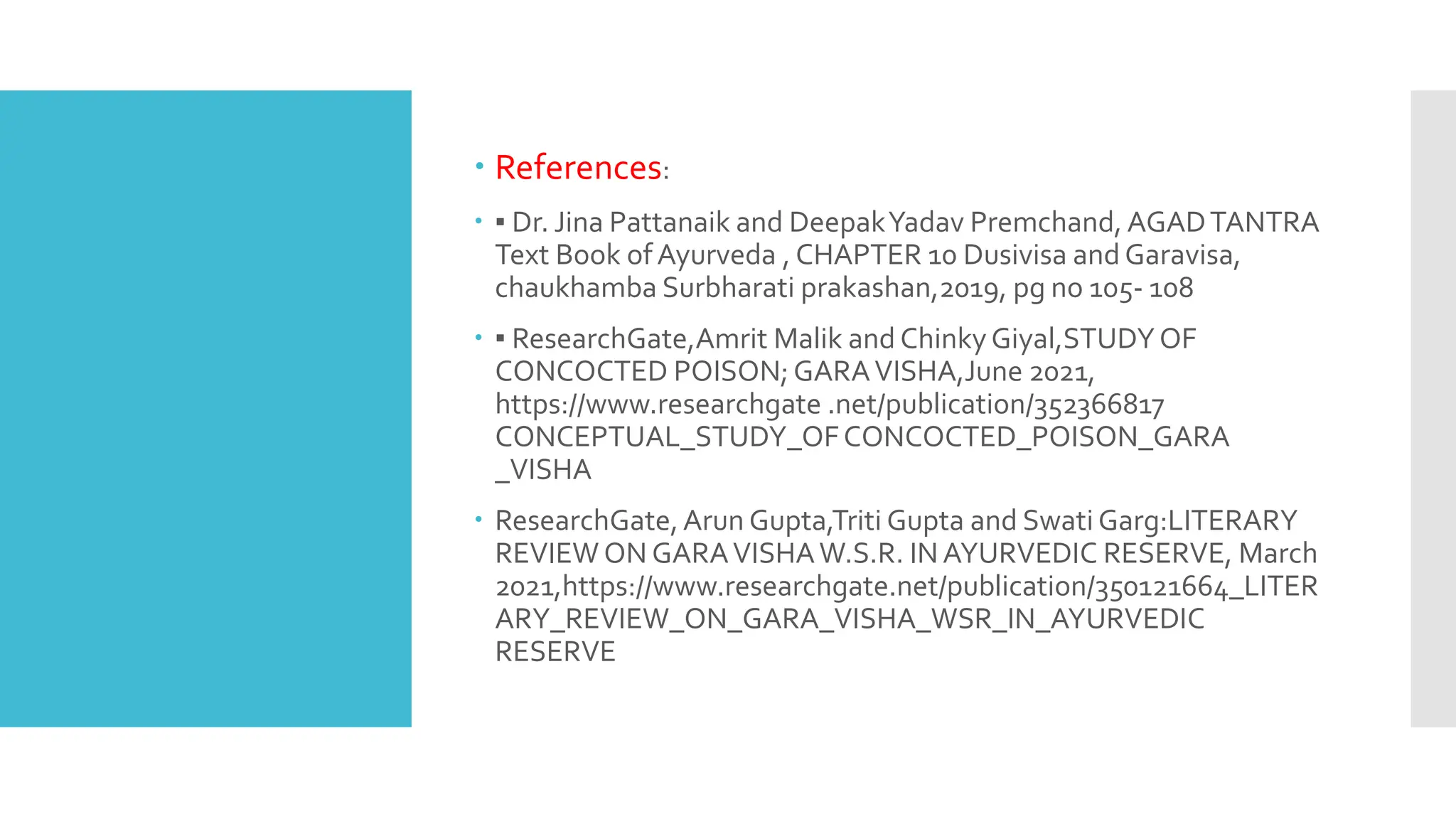
 References:
 ▪ Dr. Jina Pattanaik and DeepakYadav Premchand, AGADTANTRA
Text Book ofAyurveda , CHAPTER 10 Dusivisa and Garavisa,
chaukhamba Surbharati prakashan,2019, pg no 105- 108
 ▪ ResearchGate,Amrit Malik and ChinkyGiyal,STUDYOF
CONCOCTED POISON; GARAVISHA,June 2021,
https://www.researchgate .net/publication/352366817
CONCEPTUAL_STUDY_OFCONCOCTED_POISON_GARA
_VISHA
 ResearchGate,Arun Gupta,Triti Gupta and Swati Garg:LITERARY
REVIEW ON GARAVISHAW.S.R. INAYURVEDIC RESERVE, March
2021,https://www.researchgate.net/publication/350121664_LITER
ARY_REVIEW_ON_GARA_VISHA_WSR_IN_AYURVEDIC
RESERVE
Garavisha-Vidyashri useful class ppt in 3rd year

Garavisha-Vidyashri useful class ppt in 3rd year

  • 1.
    गर विष Guided by:Presented by: Dr.Adarsh.sir Vidyashri.H.Biradar Dr.shivanand sir 3 rd BAMS
  • 2.
    Contents:  ➢ Introduction ➢ Definition  ➢ Composition  ➢Types  ➢ Administration  ➢ Routes of Administration  ➢ Signs and Symptoms  ➢Treatment  ➢ Garavisha in current era  ➢ Recent Research updates
  • 3.
     ➢ Discussion ➢ Summary  ➢ Conclusion  ➢ References
  • 4.
    Introduction  The wordgara is derived from the word gru with suffix "ach" which means to digluted or could be digluted which generally indicates the liquid form.  From one aspect this word (Gara) meaning also come as poison  Due to the bad odour and taste it is not used as such now a days in the present era, there are various food additives such as colouring agents, preservatives which have many toxic substance that act equally as Gara visha.  It causes chronic toxicity and also shows symptoms of food poisoning if consumed regularly.
  • 5.
    Definition गरसंयोगजंचान्यद्गरसञ्ज्ञंगदप्रदम्| कालान्तरविपावकत्वान्नतदाशुहरत्यसून || १४||.(cha.chi.23/14) A variety of poison called garavisa is prepared artificially by mixing various substances(samyogaja visha) it produces gada (diseases). As it takes some kāla (time) for this type of poison to reach vipaka (metabolized) and produce its toxic effects, it does not immediately fatal. तच्चवचरकारररोगजनकमप्राणहरम्|- (ck.cha.chi.24/14) 'Gara' is type of artificial poisoning. By nature, this kind of visa (poison) produces its effects after a long time to cause roga. (disease) and death.
  • 6.
    क ृ विमं गरसंञंतु वियते विविधौषधैः। हन्तन्त योगिशेनाशु वचरान्तच्चरतराच्च तत्||६|| शोफपाण्ड ू दरोन्माददुनाामदीन् करोवत िा।। (A.Hr.Ut 35)  Combination of two or more than two poisonous or non poisonous drugs and ultimately affects the whole body by vitiating all the dhatus in the body.  It can go to such extent that it alleviates the dhatus drastically which in turn could prove to be fatal.
  • 7.
    Composition: नानाप्राण्यङ्गशमलविरुद्धौषवधभस्मनाम् ४९। । विषाणांचाल्पिीयााणांयोगोगरइवतस्मृतम्-(AH.Ut.35/49-50)  Combination of मल (excreta) from various अङ्ग (bodyparts) of प्राणी (living beings), विरुद्ध औषवध (incompatible drugs), भस्म (calcined powders) and अल्प िीया विष (poisonous substances of mild potency) is known as garavisha  ➢ Nanapranyangasha mala:  Mala,mutra,shukra,sveda,artava of animals  Apakwa mamsa  Virrudha ahara  Rodent excreta in – rice, wheat, jawar
  • 8.
    विरुद्ध औषवध भस्मनम् Hypersensitivereactions Adverse drug reactions  Longterm medicine : Paracetamol, Diclofenac , contraceptives  Hormonal pills  Anti cancerous medications
  • 9.
     िीयााणां चअल्पं  Pesticides  Insecticiedes  Preservatives  Additives  Flavouring agents  Colouring agents  Sweeteners  Ajinomoto (Mono sodium glutamate)
  • 10.
    Types गरंतुविविधं- 1)वनविाषद्रव्यसंयोगक ृ तम् 2)सविषद्रव्यसंयोगक ृ तम् तिद्यंगरसञ्ज्ञम्,उत्तरंतुक ृ विमवमवतव्यिस्था-(CK.cha.chi.23) 1. Gara - combination of non poisonous substances 2. Krutrima - Combination of poisonous substances
  • 11.
    विष प्रयोग: (Administration): सौभाग्याथंन्तियैःस्वेदरजोनानाड्गजान्मलान्। शिुप्रयुक्ांश्चगरान्प्रयच्छन्त्यन्नवमवरिततान्।। (Cha.Chi.23/233) Stri (women), in order to gain saubhagya (favour from their husbands), at times, administer their sveda (sweat), raja (menstrual blood) and dif ferent types of mala (waste products) of their anga (body) along with anna (food).  Even infiltrators playing in the hands of satru (foes), sometimes, administer various types of garavisa along with food preparations.
  • 12.
    Routes of administration: अन्नेपानेदन्तकाष्ठेतथाऽभ्यङ्ग ेऽिलेखने | उत्सादनेकषाये च पररषेकsनुलेपने ||२५| स्रक्षुििेषुशय्यासुकिचाभरणेषुच | पादकापादपीठे षुपृष्ठेषुगजिावजनाम्||२६||-(Su.ka.1/25-26) ▪ Anna – Food ▪ Pana–Drinks ▪ Dantakasta –Toothpaste ▪ Abhyanga – Massage ▪ Avalekhana –Comb ▪ Utsadana – powders ▪ Kashaya – decoctions ▪ Parisheka - bathing liquids ▪ Anulepana – Cosmetics
  • 13.
     Srakshu –Garlands  Vastra - Apparels  Sayyeshu - Bed  Kavachabharana - ornaments, watch  Padukapadapiteshu - foot wears  Prusteshu Gaja vajina - back of elephants and horses  Nasya snuff - Drugs – Charas  Dhooma -smoking  Anjana - collyrium etc.
  • 14.
    गरविषलक्षण (Signs andsymptoms) : ➢ As per Acarya Caraka : तैःस्यात्पाण्डुैःक ृ शोल्पाविगारश्चास्योपजायते। ममाप्रधमनाध्मानंश्वयथुंहस्तपादयोैः॥ जठरंग्रहणीदोषोयक्ष्मागुल्ैःक्षयोज्वरैः| एिंविधस्यचान्यस्यव्याधेवलंगावनदशायेत्।। स्वप्नेमाजाारगोमायुव्यालान्सनक ु लान्कपीन। प्रायैःपश्यवतनद्यादीच्छु ष्ांशसिनस्पतीन॥ कालश्चगौरमात्मानंस्वप्नेगौरश्चकालकम्। विकणानावसक ं िाsवप्रपश्येविहतेवद्रयैः॥(CS.Ci.23.234- 237)
  • 15.
     As perAcarya Sushruta: तेनपाण्डुैःक ृ शोऽल्पाविैःकासश्वासज्वरावदातैः||५०|| िायुनाप्रवतलोमेनस्वप्नवचन्तापरायणैः। महोदरयक ृ त्प्लीहीदीनिाग्दुर्ालोऽलसैः||५१|| शोफिान्सतताध्मातैःशुष्पादकरैःक्षयी | स्वप्नेगोमायुमाजाारनक ु लव्यालिानरान||५२|| प्रायैःपश्यवतशुष्ांश्चिनस्पवतजलाशयान| मन्यतेक ृ ष्णमात्मानंगौरो, गोरंचकालकैः||५३|| विकणानासानयनंपश्येत्तविहतेवद्रयैः। एतरन्यश्च र्हुवभैः न्तिष्टो घोररूपद्रिैः ||५४|| नाशमाप्नोवत कवश्चत्सद्योऽवचवकन्तत्सतैः ।-(Su.ka.2/50-53)
  • 16.
    As per AcaryaVagbhata: क ृविमंगरसंञंतुवियतेविविधौषधैः। हन्तन्तयोगिशेनाशुवचरान्तच्चरतरच्चतत्।| शोफपाण्ड ू दरोन्माददुनाामादीन्करोवतिा। -(Ah.Ut.35/6-7)  Garavisha Lakshana: Pandu, Karshya, Alpa-agni, Kasa, Shvasa, Jvara, Ardita, PratilomaVayu gati, Ati-nidra, Ati-chinta,Yakritudara/ Pleehodara, Deena- vak (feeble voice), Durbala, Alasa, Shopha, Adhmana, Shuska-pada-kara, Kshaya ;  swapna of jackal,cat,mongoose,snake, monkey,trees and dry reservoirs  The patient of Garavisha who is suffering from such Lakshana and several otherUpadrava, should be considered as one who has reached the fatal stage.
  • 17.
    Diagnosis of Garavisha: Clinical ExaminationAccordingTo Ayurveda :Ayurveda has suggested trividhapariksha having darsana (Inspection), sparsana (Palpitation), prashan (Questioning).Which is unique and it will play major roll to diagnose disease. ➢ Darshana (Inspection)-The darshanpariksha is included in the inspection which is doneby darshanindriya (eyes) of physician. It is nothing but visible signs of patients in garavisha are Pandu,Krisha,shophwan are major signs which is found in garavisghawhich will be evaluate by inspection. ➢ Sparshana (Palpitation)- It have major role and included in palpitation of liver and palpation of the abdomen to detect any organomegaly (liver/kidney) ascites, swelling. ➢ Parshan (Questioning)- it is done by questionings about symptoms which is found in patient of garavisha such as body ache, weakness, giddiness, asthma cough.
  • 18.
    वचवकत्सा: ➢ As perAcharya Charaka: ▪Vamana-karma (emesis): सूक्ष्मंताम्ररजस्तस्मसक्षौद्रंहविशोधनम।- च.वच 23.239/240)  The patient should promptly be given vamana by the physician. He should be given  ताम्ररज (fine powder of copper) along with ksaudra (honey) for हृद् विशोधन ( cleansing the heart) ▪ हेमचूणा: शुद्धेहृदाततैःशाणंहेमचूणास्यदापयेत्|| हेमसिाविषाण्याशुगरांश्चयविवनयच्छवत। नसज्जतेहेमपांगेविषंपद्मदलेऽम्बुित्।।(CS.Ci. 23.239-240)
  • 19.
    After hridviśodhana, thepatient should be given one sāna (4gm) of hemacurna (bhasma of gold).This hema curna immediately counteracts all the poisons including garas (artificial poisons).The poison does not afflict patient's hridaya (heart) if he has taken hemacurna as water does not sick to a padma-dala (lotus leaf). Agada-pana: नागदन्तीवििृद् दन्तीद्रािन्तीस्नुकपयैःफलैः। सावधतंमावहषंसवपाैःसगोमूिाढक ं वहतम।। सपाकीटविषाताानांगराताानांचशान्तये।(CS.Ci. 23.241-242) मावहष सवपा (buffalo-ghee) cooked with nagadanti, trivrt, danti, dravanti, milky latex of snuhi, and madanaphala, along with one aḍhaka of गोमूि is useful in curing patients suffering from the poisons of sarpa (snakes) and kita (insects), and from gara
  • 20.
     As AcāryaVṛddhaVägbhata: ▪Vamana karma (emesis) and hemaprāśana(licking of gold):  गरातिान्तिान्भुक्िातत्पथ्यंपानभोजनम्। शुद्धहृछी्लयेद्धेमसूिस्थानविधेैःस्मरन्।। -(AS.Ut. 40/64) The गरात (patient) be subjected to vamana (emesis), adhere to pathya (apt) pâna (drinks) and bhojana (meals); after hridsuddhi (cleansing of heart), the patient should take hema curṇa (goldpowder) सम्यक ् योगैः शक ा राक्षौद्रसंयुक्श्चूणास्ताप्यसुिणायोैः। लेहैःप्रशमयत्युग्रंसिायोगक ृ तंविषम॥-(AS.Ut.40/65) Leha made using शक ा र (sugar), क्षौद्र (honey) and powder of सुिणा ताप्य (suvarna-makṣika) should be licked for प्रशमन (pacification) of अत्युग्र विष (virulent poisons) ▪ Kaivisha parihari gulika ▪ Murvadi Agada
  • 21.
    Management of complicationsarising due to garavisha: ➢ As per AcāryaVṛddhaVägbhaṭa - ▪Treatment of garopahata pavaka :Mūrvādi curņa: mūrvā, amṛtā, nata, kaṇā, pațoli, cavya, citraka, vaca, musta and vidanga; all these should be taken in equal quantity and consumed with anupana of takra (buttermilk), koṣṇambu (warm water), mastu (whey), māmsarasa (meat soup) or kānjika ▪Treatment of tvak vikāra (skin ailments) : Application of fine paste of harenu, candana, śyāmā and nalada helps in treatment of tvak vikāra caused by garavisa. ▪ In ओजोक्षय(depletion of immunity) :Pragharṣaṇa (powder massage) using manjiṣṭhā, kinihi (Achyranthes aspera), nimba (Azadirachta indica), rajani (Curcuma longa), aśvattha (Ficus religious) and candana (Santalum album) should be used in ojaḥkṣaya caused by garavisha
  • 22.
    Formulation:  For kvātha(decoction):vasa (Ahata vasica)  Nimba (Azadirachta indica)  Patola (Trichosanthes dioica)  For kalka (paste):Abhayā (Terminalia chebula)  Dosage: 24 to 48 ml  Anupana: koshna jala (warm water) Diet apt in garavisha:  पथ्यंपरममुविष्टंशीलनंक्षीरसवपाषोैः।(AS.Ut.40/71  क्षीर (milk) and सवपा (ghee) are apt in conditions caused by गरविष.
  • 23.
     GaraVisha (concoctedpoison) in Current Era:  Viruddhahara andAhitahara.  Fast foods and cold beverages like colas.,additives, colouring agents ,adulterants  Drugs like quinine, NSAIDs, steroids etc.  Pesticides, fertilizers ,metals, minerals, pollutants Beauty creams etc.  Any form of incompatible drug combination or less potent toxins that may get into our daily utensils accidently or intentionally, will definitely harm the consumers.The food, drinks, medicines,Washing Powder, Cosmetics, tooth paste etc are now taken along with concocted poison.
  • 24.
    Food Adulteration: chemicals Turmeric – Lead Chromate, MetanilYellow  Chilly – Rhodamin B  Milk – Urea, Detergent, Starch, synthetic milk.  Oil – Argemone Oil, Liquid Paraffin  Ghee – Animal Fat,Vegetable Oil, Starch  Fruits -Ripening  Rice – Plastic Drinks:  Now a day’s drinks or beverages are changing its form to soft drinks, milk, milk shakes, carbonated water etc.  As a part of this change some or other forms of toxins also get into our daily drinks.  Most of the carbonated and soft drinks require additives and preservatives which consist of  chemical substances that are harmful to our body.  Artificial sugar like Aspartame are added to these soft drinks which shows carcinogenic effect.
  • 25.
    Cosmetics: Talc which isseen in cosmetics, lotion, powder etc is a proven carcinogen linked to ovarian cancer. lmadazolidinyl is a chemical found in hair dyes is carcinogenic. Sodium lauryl sulfate is a compound commonly seen in face creams for the removal of dirt and oil from skin is proved carcinogenic. BHA (butylated hydroxyanisole) and BHT ( butylated hydroxytoluene) in lipsticks, moisturisers etc causes liver, thyroid and kidney problems and affects blood coagulation.
  • 26.
    CosmeticToxicity: ▪ Lead intoothpaste - neurotoxic ▪ Butyl acetate - Nail polish ▪ Coal tar-Carcinogen ▪ Diethanolamine (DEA) - Foaming agent:Carcinogenic ▪ 1,4 dioxane - Shampoo - Carcinogenic ▪ Formaldehyde - genotoxic, cause immune system damage ▪ Fragrance - disrupt normal endocrine function, ▪ Phthalates - developmental defects and delays. ▪ Mercury - Make up ▪Toluene- hair color and nail polish - ovarian cancer, reproductive and developmental damage.
  • 27.
    Discussion:  Everything istoxic but its toxicity depends upon its dose, even water is also toxic if it is consumed in large amounts in relatively short time. According to ayurveda ahara also acts as poison if not taken properly. Some toxins cannot be removed from food as these toxins are present naturally and others may be created during processing or cooking.  Consumption of all these toxins are hazardous for our health. By knowing these toxins we will live a healthy life.  Gara visha in ayurveda is an artificial poison. It is a combination of two or more products that lead to the formation of toxins which after intake deteriorate the health of consumer.The marvelous drugs mentioned in ayurvedic samhitas are ancient treasure in the management of Gara visha.
  • 28.
    summary:  all thesefollowing factors can be considered as garavisha  Viruddhahara and Ahitahara.  Fast foods and cold beverages  Alcohol, tobacco  Drugs like quinine, NSAIDs, steroids etc.  pesticides, metals, minerals, pollutants etc.  Cosmetics etc.  Conclusion:  Wonderful concept of garavisha explained by Ayurveda.Today man is commonly unprotected to these artificial poisons which are primed by the combination of poisonous and non poisonous substances.Garavisha is often consumed unintentionally hence the person doesn't  feel anything proximately and even delayed onset of symptoms makes treatment bit difficult.  Early Diagnosis is better diagnosis so we need to aware the cause, diagnosis, Symptoms &Treatment of garavisha
  • 29.
     References:  ▪Dr. Jina Pattanaik and DeepakYadav Premchand, AGADTANTRA Text Book ofAyurveda , CHAPTER 10 Dusivisa and Garavisa, chaukhamba Surbharati prakashan,2019, pg no 105- 108  ▪ ResearchGate,Amrit Malik and ChinkyGiyal,STUDYOF CONCOCTED POISON; GARAVISHA,June 2021, https://www.researchgate .net/publication/352366817 CONCEPTUAL_STUDY_OFCONCOCTED_POISON_GARA _VISHA  ResearchGate,Arun Gupta,Triti Gupta and Swati Garg:LITERARY REVIEW ON GARAVISHAW.S.R. INAYURVEDIC RESERVE, March 2021,https://www.researchgate.net/publication/350121664_LITER ARY_REVIEW_ON_GARA_VISHA_WSR_IN_AYURVEDIC RESERVE