LOGO
NATURALISM
NATURALISM
Naturalism is a concept that firmly
believes that ultimate reality lies in
the nature of the matter.
 Matter is considered to be supreme
and mind is the functioning of the
brain that is made up of matter.
 The whole universe is governed by
laws of nature and they are
changeable.
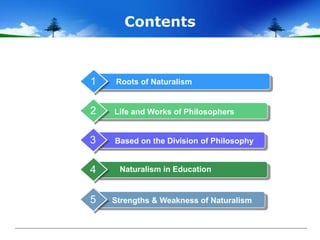
Contents
Roots of Naturalism1
Life and Works of Philosophers2
Based on the Division of Philosophy3
Strengths & Weakness of Naturalism5
Naturalism in Education4
www.themegallery.com Company Logo
1. Roots of Naturalism
The oldest philosophy
Ionian pre-Socratic philosophers
Thales in 6th century B.C .
- father of science
 These early philosophers subscribed
to principles of empirical investigation
that strikingly anticipate naturalism.
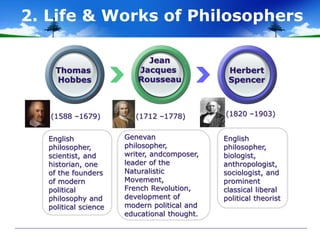
Genevan
philosopher,
writer, andcomposer,
leader of the
Naturalistic
Movement,
French Revolution,
development of
modern political and
educational thought.
English
philosopher,
scientist, and
historian, one
of the founders
of modern
political
philosophy and
political science
English
philosopher,
biologist,
anthropologist,
sociologist, and
prominent
classical liberal
political theorist
2. Life & Works of Philosophers
Thomas
Hobbes
Jean
Jacques
Rousseau
Herbert
Spencer
(1588 –1679) (1712 –1778) (1820 –1903)
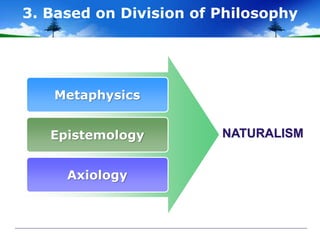
3. Based on Division of Philosophy
Metaphysics
Epistemology
Axiology
NATURALISM
Naturalism based on Metaphysics
 A worldview which holds that there is
nothing but natural elements,
principles, and relations of the kind
studied by the natural sciences
 deals with existence
 rejects the supernatural concepts and
explanations
3. Based on Division of Philosophy
Naturalism based on Epistemology
 According to naturalism, reality and
nature are identical and beyond
nature there is no reality.
 Then how this theory of reality can be
proved true?
 This leads us to the naturalist theory
of knowledge ; by perception, sensory
knowledge, observation.
3. Based on Division of Philosophy
Naturalism based on Axiology
 Life’s values  Two general principles
i. General character of values
embedded in nature
ii. The most desirable values realised
in proportion to our harmonizing life
with nature  Greatest peace
; Pleasure and Satisfaction
3. Based on Division of Philosophy
4. Naturalism in Education
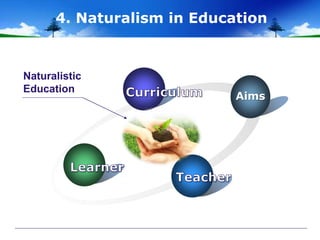
Aims
Naturalistic
Education
Learner
 Individual is to be given unrestricted
freedom and only then his harmonious
development will take place.
 The checks on the child are also to be
natural.
 The naturalists advocate discipline by
natural consequences.
 A danger that the child may harm
himself and cause worry to the parents.
4. Naturalism in Education
Teacher
 Extreme naturalists ignore teacher;
because teacher will interfere with the
development of a child.
 If the teacher is to be there, let him
design situations which help in the
inculcation of right type of habits in the
children.
 As a director of activity, the teacher
should not overdo his role or overact his
role.
4. Naturalism in Education
Curriculum
 Child centered according to the present
and future needs of the child
 Curriculum divided under two stages
i. Earlier stage : Sensory training
ii. Later stage : Subjects are include in
the curriculum through activities and
occupations like physical sciences,
language, mathematics, manual work,
trade, moral education, etc.
4. Naturalism in Education
Aims
 Rousseau says that . . .
education aims at the inner faculties,
capacities and powers of the child
aim of education is not preparation for life,
but participation in it
Each stage through which a child passes
has a specific aim of education
4. Naturalism in Education
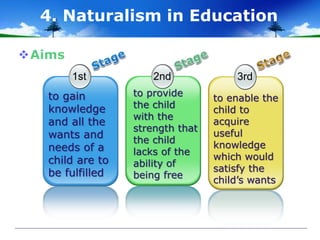
1st
to gain
knowledge
and all the
wants and
needs of a
child are to
be fulfilled
2nd
to provide
the child
with the
strength that
the child
lacks of the
ability of
being free
3rd
to enable the
child to
acquire
useful
knowledge
which would
satisfy the
child’s wants
Aims
4. Naturalism in Education
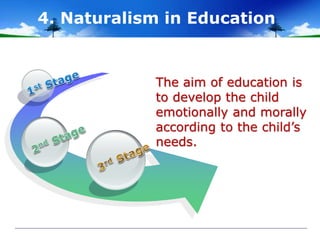
The aim of education is
to develop the child
emotionally and morally
according to the child’s
needs.
Strengths
 Clear formation of the psychological and
scientific conception of education
 Freedom for child from tyranny and
rigidity, interference and strict discipline
 Spontaneous self-activity of the child
 new psychological methods in
educations
5. Strengths and Weaknesses
Strengths
 Self-expression, follow nature, auto
education, plays way, self-discipline and
non-interference, etc.
 The great strength of Naturalism is its
simplicity. It does not complicate the
perception of existence by using
abstract concepts.
5. Strengths and Weaknesses
Weaknesses
 It is based on one- sided psychology.
Irrespective of their individual differences,
capacities and temperament
 Direct experiences cannot be provided all
the time; expensive and something
impossible
 It gives no place to the spiritual values.
5. Strengths and Weaknesses
Weaknesses
 Some of the principles envisaged by
naturalism are not possible to be
practiced in the existing situations.
 Ross rightly opines ‘it is in educational
ideals, not in methods that naturalism
fails to satisfy.’
5. Strengths and Weaknesses
LOGO

Naturalism in education

  • 1.
  • 2.
    NATURALISM Naturalism is aconcept that firmly believes that ultimate reality lies in the nature of the matter.  Matter is considered to be supreme and mind is the functioning of the brain that is made up of matter.  The whole universe is governed by laws of nature and they are changeable.
  • 3.
    Contents Roots of Naturalism1 Lifeand Works of Philosophers2 Based on the Division of Philosophy3 Strengths & Weakness of Naturalism5 Naturalism in Education4
  • 4.
    www.themegallery.com Company Logo 1.Roots of Naturalism The oldest philosophy Ionian pre-Socratic philosophers Thales in 6th century B.C . - father of science  These early philosophers subscribed to principles of empirical investigation that strikingly anticipate naturalism.
  • 5.
    Genevan philosopher, writer, andcomposer, leader ofthe Naturalistic Movement, French Revolution, development of modern political and educational thought. English philosopher, scientist, and historian, one of the founders of modern political philosophy and political science English philosopher, biologist, anthropologist, sociologist, and prominent classical liberal political theorist 2. Life & Works of Philosophers Thomas Hobbes Jean Jacques Rousseau Herbert Spencer (1588 –1679) (1712 –1778) (1820 –1903)
  • 6.
    3. Based onDivision of Philosophy Metaphysics Epistemology Axiology NATURALISM
  • 7.
    Naturalism based onMetaphysics  A worldview which holds that there is nothing but natural elements, principles, and relations of the kind studied by the natural sciences  deals with existence  rejects the supernatural concepts and explanations 3. Based on Division of Philosophy
  • 8.
    Naturalism based onEpistemology  According to naturalism, reality and nature are identical and beyond nature there is no reality.  Then how this theory of reality can be proved true?  This leads us to the naturalist theory of knowledge ; by perception, sensory knowledge, observation. 3. Based on Division of Philosophy
  • 9.
    Naturalism based onAxiology  Life’s values  Two general principles i. General character of values embedded in nature ii. The most desirable values realised in proportion to our harmonizing life with nature  Greatest peace ; Pleasure and Satisfaction 3. Based on Division of Philosophy
  • 10.
    4. Naturalism inEducation Aims Naturalistic Education
  • 11.
    Learner  Individual isto be given unrestricted freedom and only then his harmonious development will take place.  The checks on the child are also to be natural.  The naturalists advocate discipline by natural consequences.  A danger that the child may harm himself and cause worry to the parents. 4. Naturalism in Education
  • 12.
    Teacher  Extreme naturalistsignore teacher; because teacher will interfere with the development of a child.  If the teacher is to be there, let him design situations which help in the inculcation of right type of habits in the children.  As a director of activity, the teacher should not overdo his role or overact his role. 4. Naturalism in Education
  • 13.
    Curriculum  Child centeredaccording to the present and future needs of the child  Curriculum divided under two stages i. Earlier stage : Sensory training ii. Later stage : Subjects are include in the curriculum through activities and occupations like physical sciences, language, mathematics, manual work, trade, moral education, etc. 4. Naturalism in Education
  • 14.
    Aims  Rousseau saysthat . . . education aims at the inner faculties, capacities and powers of the child aim of education is not preparation for life, but participation in it Each stage through which a child passes has a specific aim of education 4. Naturalism in Education
  • 15.
    4. Naturalism inEducation 1st to gain knowledge and all the wants and needs of a child are to be fulfilled 2nd to provide the child with the strength that the child lacks of the ability of being free 3rd to enable the child to acquire useful knowledge which would satisfy the child’s wants Aims
  • 16.
    4. Naturalism inEducation The aim of education is to develop the child emotionally and morally according to the child’s needs.
  • 17.
    Strengths  Clear formationof the psychological and scientific conception of education  Freedom for child from tyranny and rigidity, interference and strict discipline  Spontaneous self-activity of the child  new psychological methods in educations 5. Strengths and Weaknesses
  • 18.
    Strengths  Self-expression, follownature, auto education, plays way, self-discipline and non-interference, etc.  The great strength of Naturalism is its simplicity. It does not complicate the perception of existence by using abstract concepts. 5. Strengths and Weaknesses
  • 19.
    Weaknesses  It isbased on one- sided psychology. Irrespective of their individual differences, capacities and temperament  Direct experiences cannot be provided all the time; expensive and something impossible  It gives no place to the spiritual values. 5. Strengths and Weaknesses
  • 20.
    Weaknesses  Some ofthe principles envisaged by naturalism are not possible to be practiced in the existing situations.  Ross rightly opines ‘it is in educational ideals, not in methods that naturalism fails to satisfy.’ 5. Strengths and Weaknesses
  • 21.