NATURALISM
MARE-AN P. JADMAN
SOUTHERN PHILIPPINES COLLEGE
JULIO PACANA ST., LICUAN CAGAYAN DE OROCITY, 9000
PHILOSOPHY OF EDUCATION
EDUC201
~MPJ~
Definition of Naturalism
Naturalism in Education
Principles underlying
Naturalistic
Education
Aims of Education in
Naturalism
Rousseau on Education
Naturalism and the
Learner
Naturalism and the
Curriculum
Methodology of
Teaching
Discipline and
Naturalism
Naturalism and the
Teacher
Merits of Naturalism
Demerits of Naturalism
Conclusion
~MPJ~
O U T L I N E
 Naturalism means belief in nature. It
advocates return to Nature.
Meaning of Naturalism
 According to W.E. Hocking, “Naturalism is a
type of metaphysics which takes Nature as
the whole of reality”.
 The philosophy of Naturalism excludes
whatever is supernatural or other worldly. Even
life is a part of the scheme of nature. This
philosophy believes that “everything comes
from nature and returns to nature.”
~MPJ~
 Naturalism appeared as a revolt against
formalism and stereotyped system of
education.
Naturalism in Education
 In the words of Adams, “Naturalism is a term
loosely applied to systems of training that are
not dependent on schools and books but on the
manipulation of the actual life of the educand.”
 According to Ross, “Education is merely the fostering
of natural development and true education takes
place when the nature, power and inclinations of the
child are allowed to develop freely with a minimum of
guidance.”
~MPJ~
Education must conform to the natural
processes of growth and mental
development.
Naturalism in Education
Aristotle, Comte, Bacon, Thomas
Hobbes, Rousseau, Comenius, Huxley,
Herbert Spencer, Tagore and T.P. Nunn
are among those who thought of
education along naturalistic
philosophy.
~MPJ~
1. Natural Setting: The essence of naturalistic
philosophy of education lies in providing
natural environment to the child. It is in this
setting that proper development of the child
can take place.
Principles underlying Naturalistic Education
2. Child-Centeredness: Naturalism gives central
position to the child. Accordingly, the teacher
should understand child psychology and guide
the educand according to his needs and
attitudes. Children should be treated as children
and not as miniature adults.
~MPJ~
3. Maximum freedom to the child: Freedom is the
watchword of naturalistic education. It is through
freedom that the child-growth takes a natural
direction. Children should have a free choice of
activities to gain first-hand experiences.
Principles underlying Naturalistic Education
4. Happiness and Healthy Mood: Happiness and
healthy mood go hand in hand. Happy
childhood is an essential factor in healthy
growth. Naturalism believes that education
should generate happiness and healthy mood
for the growing child.
~MPJ~
5. Senses – the Gateways of Knowledge:
Senses are the gateways of knowledge. For
effective learning, adequate sensory
experiences should be provided to the child.
Principles underlying Naturalistic Education
6. Instincts – the basis of education:
Naturalistic education regards instincts as the
basis of all education. The teacher should fully
exploit child’s instincts and try to modify this
behaviour. It is through education that the
child’s animal behaviour should be transformed
into human behaviour.
~MPJ~
Aims of Education in Naturalism
1. Self Expression: Self expression, not self
realization is an important aim of naturalistic
education.
2. Self-Preservation: Education should help the
child in self-preservation. It includes self health
along with healthy environment.
3. Fullest Development: Naturalism believes that
the chief aim of education is the fullest
development of the child.
4. Survival of the Individual: Naturalism believes
that the fittest alone should survive. Education
must equip the child to struggle to exist.
~MPJ~
Aims of Education in Naturalism
5. Economic Efficiency: Naturalism believes that
education should be geared to the
fulfillment of economic needs of the child.
6. Sublimation of Instincts: Education should
aim at the redirection and sublimation of
child’s instincts.
7. Maintenance of Social and Political relations:
Naturalist educators believe through
education the rate of development should
increase so that social and political justice is
maintained.
~MPJ~
Aims of Education in Naturalism
8. Adjustment with surrounding: Education should
enable an individual to live in harmony with his
surroundings. This alone will ensure his health and
happiness.
9. Autonomous development of individuality: Education
regards the autonomous development of
individuality as an important goal of education.
Rousseau and T.P. Nunn are the main exponents of
this view..
10. Enjoyment of Leisure: It occupies an important place
in the scheme of education. As such happiness of
leisure should be the lasting experience.
~MPJ~
 education aims at the inner faculties,
capacities and powers of the child.
Rousseau on Education
 aim of education is not preparation
for life, but participation in it
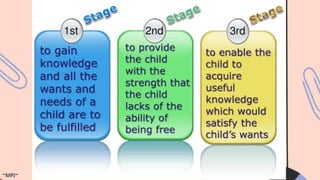
 Each stage through which a child
passes has a specific aim of
education
~MPJ~
Rousseau says that . . .
~MPJ~
1. Individual is to be given unrestricted
freedom and only then his harmonious
development will take place
Naturalism and the Learner
2. The checks on the child are also to be
natural.
3. The naturalists advocate discipline by
natural consequences.
~MPJ~
4. A danger that the child may harm himself
and cause worry to the parents.
1. Child centered according to the
present and future needs of the child
Naturalism and the Curriculum
2. Curriculum divided under two stages
i. Earlier stage : Sensory training
ii. Later stage : Subjects are include in
the curriculum through activities and
occupations like physical sciences,
language, mathematics, manual work,
trade, moral education, etc.
~MPJ~
1. Learning by doing and
interaction with Nature
2. Observation, Play-way, Dalton
Plan
3. Heuristic, Montessori,
Kindergarten methods
4. Observation of nature
encouraged
Methodology of Teaching
~MPJ~
1. Supporting positive and
progressive discipline
2. Discipline by natural
consequences
3. Maximum freedom to the
child
Discipline and Naturalism
~MPJ~
1. Extreme naturalists ignore teacher;
because teacher will interfere with the
development of a child.
Naturalism and the Teacher
2. If the teacher is to be there, let him
design situations which help in the
inculcation of right type of habits in the
children.
3. As a director of activity, the teacher
should not overdo his role or overact
his role.
~MPJ~
1. Clear formation of the psychological and
scientific conception of education
2. Freedom for child from tyranny and rigidity,
interference and strict discipline
3. Spontaneous self-activity of the child
4. New psychological methods in educations
5. Self-expression, follow nature, auto education,
play- way, self-discipline and non-
interference, etc.
6. The great strength of Naturalism is its simplicity.
It does not complicate the perception of
existence by using abstract concepts.
Merits of Naturalism
~MPJ~
1. It is based on one- sided psychology.
Irrespective of their individual differences,
capacities and temperament
2. Direct experiences cannot be provided all the
time; expensive and something impossible
3. It gives no place to the spiritual values.
4. Some of the principles envisaged by
naturalism are not possible to be practiced in
the existing situations.
5. Ross rightly opines ‘it is in educational ideals,
not in methods that naturalism fails to satisfy.’
Demerits of Naturalism
~MPJ~
Thus, Naturalism is naturo-centric.
According to this philosophy only the
material universe or nature alone is
real. All things have originated from
matter and all are ultimately to be
reduced to that. Matter is the stuff
with which the universe has been
built up.
Conclusion
~MPJ~
~MPJ~ MARE-AN P. JADMAN

Naturalism

  • 1.
    NATURALISM MARE-AN P. JADMAN SOUTHERNPHILIPPINES COLLEGE JULIO PACANA ST., LICUAN CAGAYAN DE OROCITY, 9000 PHILOSOPHY OF EDUCATION EDUC201
  • 2.
  • 3.
    Definition of Naturalism Naturalismin Education Principles underlying Naturalistic Education Aims of Education in Naturalism Rousseau on Education Naturalism and the Learner Naturalism and the Curriculum Methodology of Teaching Discipline and Naturalism Naturalism and the Teacher Merits of Naturalism Demerits of Naturalism Conclusion ~MPJ~ O U T L I N E
  • 4.
     Naturalism meansbelief in nature. It advocates return to Nature. Meaning of Naturalism  According to W.E. Hocking, “Naturalism is a type of metaphysics which takes Nature as the whole of reality”.  The philosophy of Naturalism excludes whatever is supernatural or other worldly. Even life is a part of the scheme of nature. This philosophy believes that “everything comes from nature and returns to nature.” ~MPJ~
  • 5.
     Naturalism appearedas a revolt against formalism and stereotyped system of education. Naturalism in Education  In the words of Adams, “Naturalism is a term loosely applied to systems of training that are not dependent on schools and books but on the manipulation of the actual life of the educand.”  According to Ross, “Education is merely the fostering of natural development and true education takes place when the nature, power and inclinations of the child are allowed to develop freely with a minimum of guidance.” ~MPJ~
  • 6.
    Education must conformto the natural processes of growth and mental development. Naturalism in Education Aristotle, Comte, Bacon, Thomas Hobbes, Rousseau, Comenius, Huxley, Herbert Spencer, Tagore and T.P. Nunn are among those who thought of education along naturalistic philosophy. ~MPJ~
  • 7.
    1. Natural Setting:The essence of naturalistic philosophy of education lies in providing natural environment to the child. It is in this setting that proper development of the child can take place. Principles underlying Naturalistic Education 2. Child-Centeredness: Naturalism gives central position to the child. Accordingly, the teacher should understand child psychology and guide the educand according to his needs and attitudes. Children should be treated as children and not as miniature adults. ~MPJ~
  • 8.
    3. Maximum freedomto the child: Freedom is the watchword of naturalistic education. It is through freedom that the child-growth takes a natural direction. Children should have a free choice of activities to gain first-hand experiences. Principles underlying Naturalistic Education 4. Happiness and Healthy Mood: Happiness and healthy mood go hand in hand. Happy childhood is an essential factor in healthy growth. Naturalism believes that education should generate happiness and healthy mood for the growing child. ~MPJ~
  • 9.
    5. Senses –the Gateways of Knowledge: Senses are the gateways of knowledge. For effective learning, adequate sensory experiences should be provided to the child. Principles underlying Naturalistic Education 6. Instincts – the basis of education: Naturalistic education regards instincts as the basis of all education. The teacher should fully exploit child’s instincts and try to modify this behaviour. It is through education that the child’s animal behaviour should be transformed into human behaviour. ~MPJ~
  • 10.
    Aims of Educationin Naturalism 1. Self Expression: Self expression, not self realization is an important aim of naturalistic education. 2. Self-Preservation: Education should help the child in self-preservation. It includes self health along with healthy environment. 3. Fullest Development: Naturalism believes that the chief aim of education is the fullest development of the child. 4. Survival of the Individual: Naturalism believes that the fittest alone should survive. Education must equip the child to struggle to exist. ~MPJ~
  • 11.
    Aims of Educationin Naturalism 5. Economic Efficiency: Naturalism believes that education should be geared to the fulfillment of economic needs of the child. 6. Sublimation of Instincts: Education should aim at the redirection and sublimation of child’s instincts. 7. Maintenance of Social and Political relations: Naturalist educators believe through education the rate of development should increase so that social and political justice is maintained. ~MPJ~
  • 12.
    Aims of Educationin Naturalism 8. Adjustment with surrounding: Education should enable an individual to live in harmony with his surroundings. This alone will ensure his health and happiness. 9. Autonomous development of individuality: Education regards the autonomous development of individuality as an important goal of education. Rousseau and T.P. Nunn are the main exponents of this view.. 10. Enjoyment of Leisure: It occupies an important place in the scheme of education. As such happiness of leisure should be the lasting experience. ~MPJ~
  • 13.
     education aimsat the inner faculties, capacities and powers of the child. Rousseau on Education  aim of education is not preparation for life, but participation in it  Each stage through which a child passes has a specific aim of education ~MPJ~ Rousseau says that . . .
  • 14.
  • 15.
    1. Individual isto be given unrestricted freedom and only then his harmonious development will take place Naturalism and the Learner 2. The checks on the child are also to be natural. 3. The naturalists advocate discipline by natural consequences. ~MPJ~ 4. A danger that the child may harm himself and cause worry to the parents.
  • 16.
    1. Child centeredaccording to the present and future needs of the child Naturalism and the Curriculum 2. Curriculum divided under two stages i. Earlier stage : Sensory training ii. Later stage : Subjects are include in the curriculum through activities and occupations like physical sciences, language, mathematics, manual work, trade, moral education, etc. ~MPJ~
  • 17.
    1. Learning bydoing and interaction with Nature 2. Observation, Play-way, Dalton Plan 3. Heuristic, Montessori, Kindergarten methods 4. Observation of nature encouraged Methodology of Teaching ~MPJ~
  • 18.
    1. Supporting positiveand progressive discipline 2. Discipline by natural consequences 3. Maximum freedom to the child Discipline and Naturalism ~MPJ~
  • 19.
    1. Extreme naturalistsignore teacher; because teacher will interfere with the development of a child. Naturalism and the Teacher 2. If the teacher is to be there, let him design situations which help in the inculcation of right type of habits in the children. 3. As a director of activity, the teacher should not overdo his role or overact his role. ~MPJ~
  • 20.
    1. Clear formationof the psychological and scientific conception of education 2. Freedom for child from tyranny and rigidity, interference and strict discipline 3. Spontaneous self-activity of the child 4. New psychological methods in educations 5. Self-expression, follow nature, auto education, play- way, self-discipline and non- interference, etc. 6. The great strength of Naturalism is its simplicity. It does not complicate the perception of existence by using abstract concepts. Merits of Naturalism ~MPJ~
  • 21.
    1. It isbased on one- sided psychology. Irrespective of their individual differences, capacities and temperament 2. Direct experiences cannot be provided all the time; expensive and something impossible 3. It gives no place to the spiritual values. 4. Some of the principles envisaged by naturalism are not possible to be practiced in the existing situations. 5. Ross rightly opines ‘it is in educational ideals, not in methods that naturalism fails to satisfy.’ Demerits of Naturalism ~MPJ~
  • 22.
    Thus, Naturalism isnaturo-centric. According to this philosophy only the material universe or nature alone is real. All things have originated from matter and all are ultimately to be reduced to that. Matter is the stuff with which the universe has been built up. Conclusion ~MPJ~
  • 23.