PRESENTED BY: SYAMA S
M Ed, School of Education, Pondicherry University
 Interaction
 Dimensions of interaction
 Interaction Analysis
 Theoretical assumptions of interaction analysis
 Flanders’ category systems
 Advantages of FIACS
 Limitations of FIACS
 Uses of interaction analysis in classroom
Interaction is defined as the learner’s engagement with the
course content, other learners, the instructor and the
technological medium use in the course. True
interactions with other learners, the instructor and the
technology results in a reciprocal exchange of
information. The exchange of information is intended to
enhance knowledge development in the learning
environment. Depending on the nature of the course
content, the reciprocal exchange may be absent- such as
in the case of paper printed content. The ultimate goal of
interaction is to increase understanding of the course
content or mastery of the defined goals.
(Thurmond,2003)
Teaching as an interactive process. Interaction
means participation of teacher and students in the
process of teaching. In this process, teacher
influences the students; students also interact with
the teacher. Interaction takes place among the
students themselves also. It means, in the process of
teaching, every body interacts with every other
person involved in the process.
communication
Co-ordination
Integration
 It refers to a technique consisting of objective and
systematic observation of the classroom events for
the study of the teacher’s behaviour and the process
of interaction going inside the classroom.
 It is a process of encoding and decoding the study
pattern of teaching and learning.
A typical system of interaction analysis will usually
include:
 a) A set of categories, each defined clearly.
 b) A procedure for observation and a set of ground
rules which govern the coding process.
 c) Steps for tabulating data inorder to arrange display
 d) Suggestions which can be followed in some of the
more common applications.
 In a normal classroom situation, it is verbal
communication which is predominant (Flanders,
1965)
 We can normally assume that verbal statements of a
teacher are consistent with his non verbal gestures
and, in fact, his total behaviour. This assumption was
sustained in terms of experience in Minnesota studies
(Flanders, 1966)
 The relation between students and teacher is a crucial
factor in the teaching process and must be considered
an important aspect of methodology
(Haggerty,1932)
 It has been established that social climate is related t
productivity and to the quality of inter personal
relations. It has been proved that democratic
atmosphere tends to keep work of a relatively high
level even in the absence of the teacher (Lewin and
others, 1939)
 The teacher exerts a great deal of influence on the
pupils. Pupils behaviour is affected to great extent by
this type of teacher behaviour exhibited (Anderson
and others, 1946)
 Modification of teacher classroom behaviour through
feedback is possible (Flanders, 1963), though how
much change can occur and more knowledge relating
to the permanence of these changes will require
further research (Flanders, 1963, 1966)
 Children tend to be conscious of a warm acceptance
to the teacher and to express greatest fondness for
the democratic teacher (H.V. Perkins, 1950)
 The role of classroom climate is crucial for the
learning process (Perkins, 1956)
 It is a technique of classroom interaction analysis
 It consist of ten categories
 Teacher talk, Pupil talk, Silence or Confusion are the
possible conditions of communication in the
classroom
 Teacher talk and Pupil talk involves 2 types of
behaviours responsive (indirect influence) & initiative
(direct influence)
Indirect influence: 1. Accept feelings
2.Praises or encourages
3.Accepts or uses of ideas of pupils
4.Ask questions
Direct influence: 5.Lecturing
6.Giving directions
7.Criticising or Justifying authority
a)Teacher talk
Response:
8. Pupil talk response
Initiation:
9. Pupil talk initiation
10. Silence or confusion
b) Pupil Talk
c) Silence or confusion
Observation procedure
 Observer should sit in a best position in the
classroom
 He should observe and record teacher’s behaviour
in every three seconds by using the categories
Observer should be free from personal
biases
When it is difficult to decide which
behaviour belongs to which class, then
choose the category which is numerically
away from category 5
Rule
1
Rule
2
Rule 3
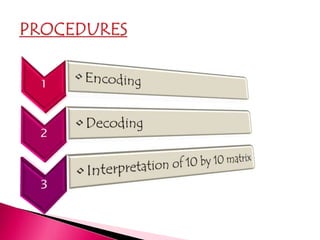
 Observation are tabulated and converted into a 10 by
10 matrix
 The matrix consists of 10 coloumns and 10 rows
making 100 cells
 Each number is entered in the form of sequence pairs
being used twice
 10 is added at the beginning and end of the series
The observed categories are;
10, 2, 2, 4, 4, 5, 6, 6, 1, 7, 8, 5,
9, 9, 10
10
2 7
2 8
4 5
4 9
5 9
6 10
6
1
1 2 3 4 5 6 7 8 9 10 Tot
al
1 1 1
2 1 1 2
3 0
4 1 1 2
5 11 1 1 4
6 1 1 2
7 1 1
8 1 1
9 1 1 2
10 1 1
Tot
al
1 2 0 2 4 2 1 1 2 1
 Teacher talk: T T = (1+2+3+4+5+6+7) / N * 100
 Indirect teacher talk: I T T = (1+2+3+4)/ N * 100
 Direct teacher talk: D T T= (5+6+7)/ N * 100
 Pupil talk: P T= (8+9)/ N * 100
 Silence/ Confusion SC = (10 )/ N * 100
 The ratio between Indirect & direct teacher talk (I/D
ratio):
ID= (1+2+3+4)/ (5+6+7) * 100
 The ratio between positive and negative
reinforcement
Positive/ negative ratio = ∑ f(1+2+3) / ∑ f(6+7)
 Pupil initiative ratio:
PIR = (9*100) / (8+9) * 100
 Teacher response ratio:
TRR = (1+2+3) / (1+2+3+6+7) * 100
 Teacher question ratio:
TQR = 4* 100 / (4+5) * 100
 Content cross cells
Content cross cells ratio
CCR= (4-4) + (5-5)+ (4-5)+ (5-4) / N * 100
 Vicious cells
Vicious cells ratio
(6-6) + (7-7) + (7-6)+ (7-7) / N * 100
 Constructive integration cells
1 2 3 4 5 6 7 8 9 10
1
2
3
4
5
6
7
8
9
10
 Steady state ratio: SSR
SSC (steady state cells) * 100
N
ssc = (1-1) (2-2) (3-3) …..(10-10)
1 2 3 4 5 6 7 8 9 10
1
2
3
4
5
6
7
8
9
10
 Helps to understand classroom interaction
 Observation after every three seconds ensured
observer records almost all the behaviour of teacher
and students
 Helps to determine the classroom climate
 Can be used as a mechanism of feedback device for
the modification of teacher behaviour
 Used as an observation technique in pre service and
in service teacher education programmes
 system is employed as a researcher tool for analysing
and studying teacher’s behaviour.
 system cannot describe classroom activity in its
totality
 More emphasis is laid on teacher behaviour as
compared to student behaviour
 Major focus of the system is on verbal behaviour
 Tabulation of data pairs into 10×10 matrix is a time
consuming process
 system is content free ie; the technique provides no
information about the quality of the content.
 To improve classroom instructions
 To develop and control the teaching behaviour
 To investigate the classroom interactions
 Mangal, s.k., Mangal, U. (2011). Essentials of
educational technology. New Delhi: PHI learning
private limited.
 Sampath, K., Paneerselvam, A., Santhanam, S.
(2007). Introduction to educational technology.
New Delhi: Sterling publishers.
 Lal, M. (2005). Essentials of educational technology.
New Delhi: Anmol publications.
Interaction analysis

Interaction analysis

  • 1.
    PRESENTED BY: SYAMAS M Ed, School of Education, Pondicherry University
  • 2.
     Interaction  Dimensionsof interaction  Interaction Analysis  Theoretical assumptions of interaction analysis  Flanders’ category systems
  • 3.
     Advantages ofFIACS  Limitations of FIACS  Uses of interaction analysis in classroom
  • 4.
    Interaction is definedas the learner’s engagement with the course content, other learners, the instructor and the technological medium use in the course. True interactions with other learners, the instructor and the technology results in a reciprocal exchange of information. The exchange of information is intended to enhance knowledge development in the learning environment. Depending on the nature of the course content, the reciprocal exchange may be absent- such as in the case of paper printed content. The ultimate goal of interaction is to increase understanding of the course content or mastery of the defined goals. (Thurmond,2003)
  • 5.
    Teaching as aninteractive process. Interaction means participation of teacher and students in the process of teaching. In this process, teacher influences the students; students also interact with the teacher. Interaction takes place among the students themselves also. It means, in the process of teaching, every body interacts with every other person involved in the process.
  • 6.
  • 7.
     It refersto a technique consisting of objective and systematic observation of the classroom events for the study of the teacher’s behaviour and the process of interaction going inside the classroom.  It is a process of encoding and decoding the study pattern of teaching and learning.
  • 8.
    A typical systemof interaction analysis will usually include:  a) A set of categories, each defined clearly.  b) A procedure for observation and a set of ground rules which govern the coding process.  c) Steps for tabulating data inorder to arrange display  d) Suggestions which can be followed in some of the more common applications.
  • 9.
     In anormal classroom situation, it is verbal communication which is predominant (Flanders, 1965)  We can normally assume that verbal statements of a teacher are consistent with his non verbal gestures and, in fact, his total behaviour. This assumption was sustained in terms of experience in Minnesota studies (Flanders, 1966)
  • 10.
     The relationbetween students and teacher is a crucial factor in the teaching process and must be considered an important aspect of methodology (Haggerty,1932)  It has been established that social climate is related t productivity and to the quality of inter personal relations. It has been proved that democratic atmosphere tends to keep work of a relatively high level even in the absence of the teacher (Lewin and others, 1939)
  • 11.
     The teacherexerts a great deal of influence on the pupils. Pupils behaviour is affected to great extent by this type of teacher behaviour exhibited (Anderson and others, 1946)  Modification of teacher classroom behaviour through feedback is possible (Flanders, 1963), though how much change can occur and more knowledge relating to the permanence of these changes will require further research (Flanders, 1963, 1966)
  • 12.
     Children tendto be conscious of a warm acceptance to the teacher and to express greatest fondness for the democratic teacher (H.V. Perkins, 1950)  The role of classroom climate is crucial for the learning process (Perkins, 1956)
  • 13.
     It isa technique of classroom interaction analysis  It consist of ten categories  Teacher talk, Pupil talk, Silence or Confusion are the possible conditions of communication in the classroom  Teacher talk and Pupil talk involves 2 types of behaviours responsive (indirect influence) & initiative (direct influence)
  • 14.
    Indirect influence: 1.Accept feelings 2.Praises or encourages 3.Accepts or uses of ideas of pupils 4.Ask questions Direct influence: 5.Lecturing 6.Giving directions 7.Criticising or Justifying authority a)Teacher talk
  • 15.
    Response: 8. Pupil talkresponse Initiation: 9. Pupil talk initiation 10. Silence or confusion b) Pupil Talk c) Silence or confusion
  • 17.
    Observation procedure  Observershould sit in a best position in the classroom  He should observe and record teacher’s behaviour in every three seconds by using the categories
  • 18.
    Observer should befree from personal biases When it is difficult to decide which behaviour belongs to which class, then choose the category which is numerically away from category 5 Rule 1 Rule 2
  • 19.
  • 20.
     Observation aretabulated and converted into a 10 by 10 matrix  The matrix consists of 10 coloumns and 10 rows making 100 cells  Each number is entered in the form of sequence pairs being used twice  10 is added at the beginning and end of the series
  • 21.
    The observed categoriesare; 10, 2, 2, 4, 4, 5, 6, 6, 1, 7, 8, 5, 9, 9, 10
  • 22.
    10 2 7 2 8 45 4 9 5 9 6 10 6 1
  • 23.
    1 2 34 5 6 7 8 9 10 Tot al 1 1 1 2 1 1 2 3 0 4 1 1 2 5 11 1 1 4 6 1 1 2 7 1 1 8 1 1 9 1 1 2 10 1 1 Tot al 1 2 0 2 4 2 1 1 2 1
  • 24.
     Teacher talk:T T = (1+2+3+4+5+6+7) / N * 100  Indirect teacher talk: I T T = (1+2+3+4)/ N * 100  Direct teacher talk: D T T= (5+6+7)/ N * 100  Pupil talk: P T= (8+9)/ N * 100  Silence/ Confusion SC = (10 )/ N * 100
  • 25.
     The ratiobetween Indirect & direct teacher talk (I/D ratio): ID= (1+2+3+4)/ (5+6+7) * 100  The ratio between positive and negative reinforcement Positive/ negative ratio = ∑ f(1+2+3) / ∑ f(6+7)  Pupil initiative ratio: PIR = (9*100) / (8+9) * 100
  • 26.
     Teacher responseratio: TRR = (1+2+3) / (1+2+3+6+7) * 100  Teacher question ratio: TQR = 4* 100 / (4+5) * 100  Content cross cells Content cross cells ratio CCR= (4-4) + (5-5)+ (4-5)+ (5-4) / N * 100
  • 27.
     Vicious cells Viciouscells ratio (6-6) + (7-7) + (7-6)+ (7-7) / N * 100  Constructive integration cells
  • 28.
    1 2 34 5 6 7 8 9 10 1 2 3 4 5 6 7 8 9 10
  • 29.
     Steady stateratio: SSR SSC (steady state cells) * 100 N ssc = (1-1) (2-2) (3-3) …..(10-10)
  • 30.
    1 2 34 5 6 7 8 9 10 1 2 3 4 5 6 7 8 9 10
  • 31.
     Helps tounderstand classroom interaction  Observation after every three seconds ensured observer records almost all the behaviour of teacher and students  Helps to determine the classroom climate  Can be used as a mechanism of feedback device for the modification of teacher behaviour
  • 32.
     Used asan observation technique in pre service and in service teacher education programmes  system is employed as a researcher tool for analysing and studying teacher’s behaviour.
  • 33.
     system cannotdescribe classroom activity in its totality  More emphasis is laid on teacher behaviour as compared to student behaviour  Major focus of the system is on verbal behaviour
  • 34.
     Tabulation ofdata pairs into 10×10 matrix is a time consuming process  system is content free ie; the technique provides no information about the quality of the content.
  • 35.
     To improveclassroom instructions  To develop and control the teaching behaviour  To investigate the classroom interactions
  • 36.
     Mangal, s.k.,Mangal, U. (2011). Essentials of educational technology. New Delhi: PHI learning private limited.  Sampath, K., Paneerselvam, A., Santhanam, S. (2007). Introduction to educational technology. New Delhi: Sterling publishers.  Lal, M. (2005). Essentials of educational technology. New Delhi: Anmol publications.