Flander’s interaction analysisSubmitted byJ. Selvabarady
Dimension of interactionAccording to Daniel G. Bobrow, there are three dimensions of interaction.1.communication2. Coordination3. Integration
Interaction Analysis:Interaction analysis is a processs of encoding and decoding the study pattern of teaching and learning.
A typical system for interaction analysis will usually include,A set of categories, each defined clearlyA procedure for observation and a set of ground rulesSteps for tabulating data in order to arrange a displaySuggestions which can be followed in some of the more common applications.
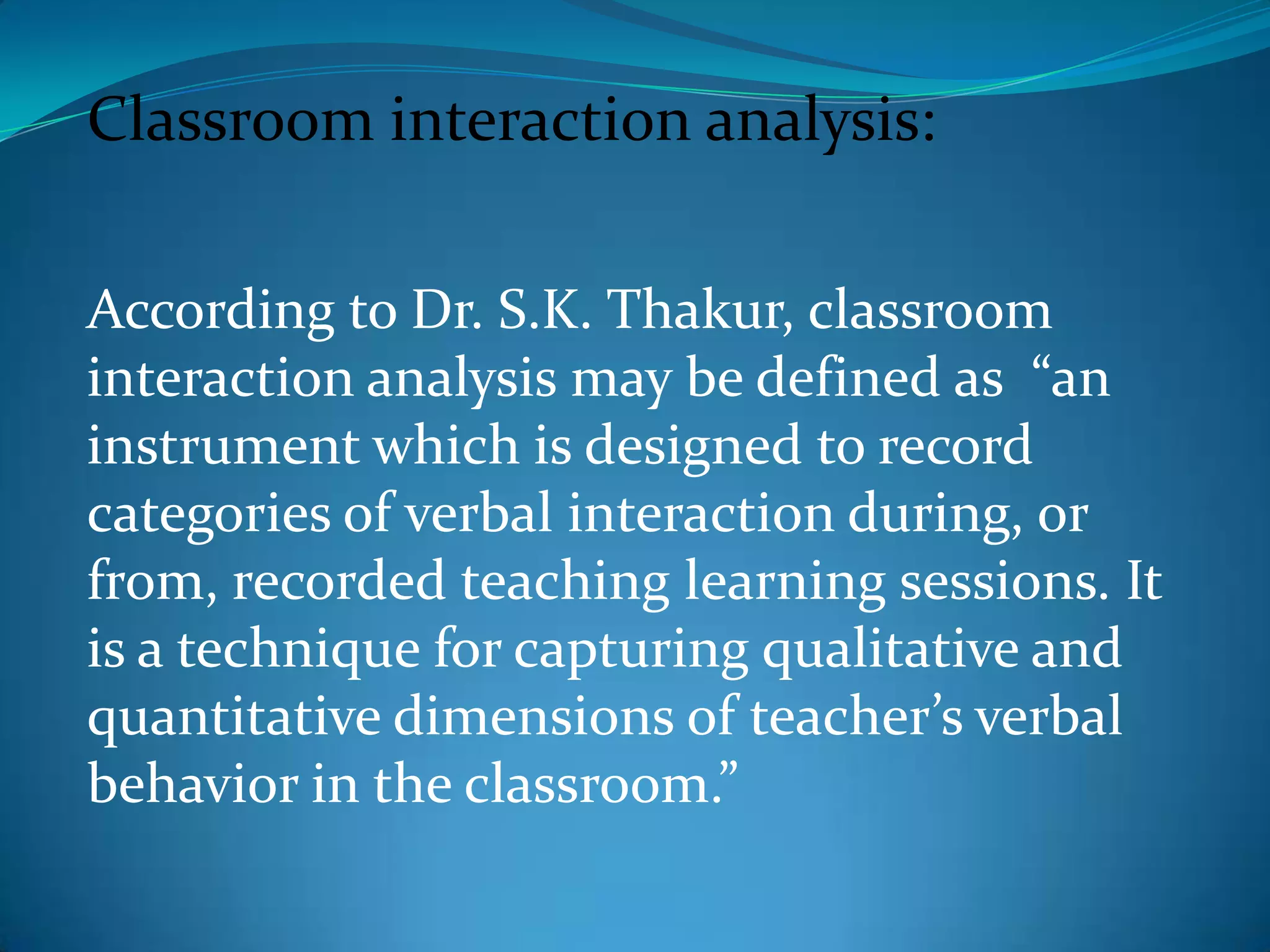
Classroom interaction analysis:According to Dr. S.K. Thakur, classroom interaction analysis may be defined as  “an instrument which is designed to record categories of verbal interaction during, or from, recorded teaching learning sessions. It is a technique for capturing qualitative and quantitative dimensions of teacher’s verbal behavior in the classroom.”
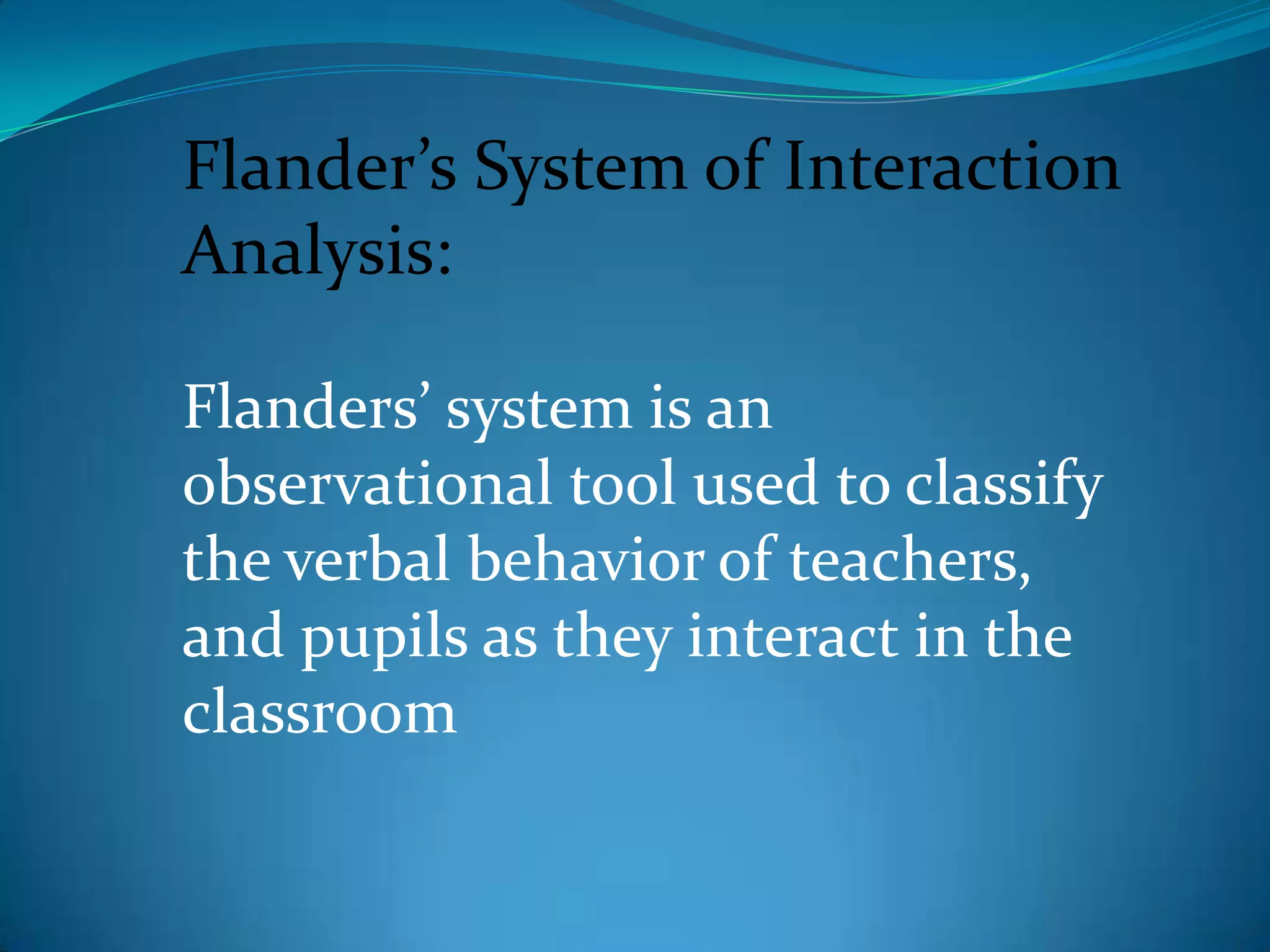
Flander’s System of Interaction Analysis:Flanders’ system is an observational tool used to classify the verbal behavior of teachers, and pupils as they interact in the classroom
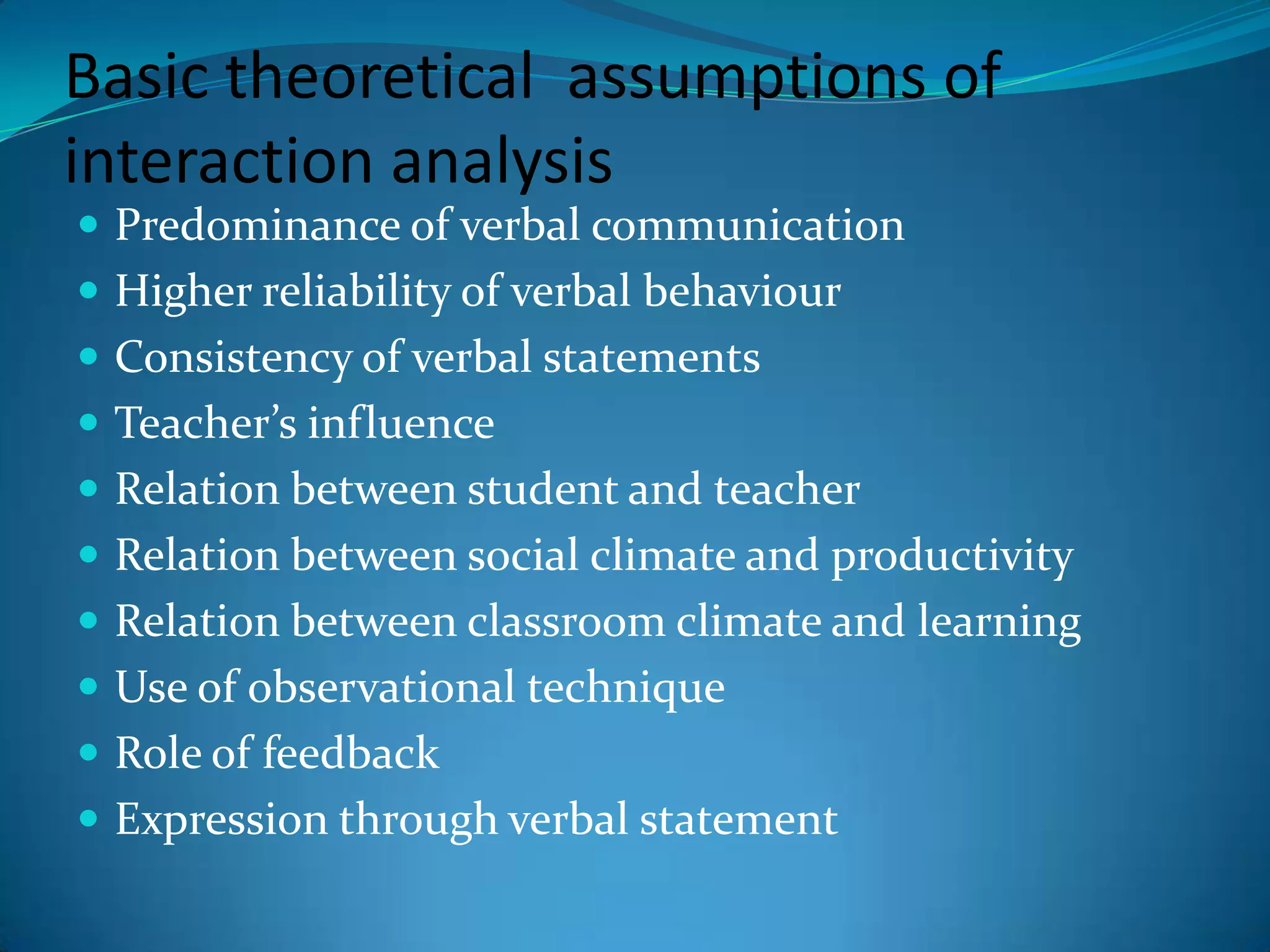
Basic theoretical  assumptions of interaction analysisPredominance of verbal communicationHigher reliability of verbal behaviourConsistency of verbal statementsTeacher’s influenceRelation between student and teacherRelation between social climate and productivityRelation between classroom climate and learningUse of observational techniqueRole of feedbackExpression through verbal statement
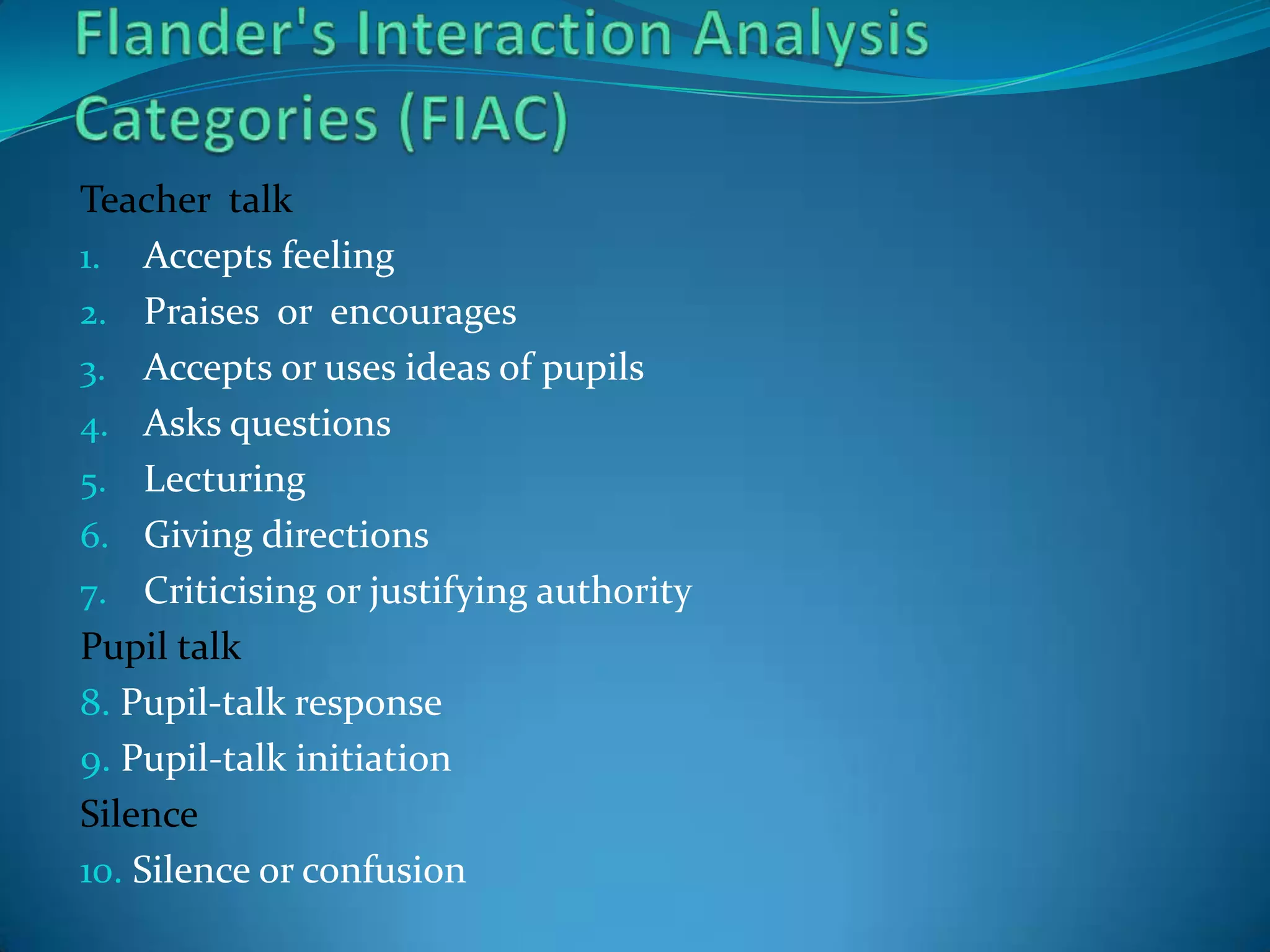
Flander's Interaction Analysis Categories (FIAC)Teacher  talkAccepts feelingPraises  or  encouragesAccepts or uses ideas of pupilsAsks questionsLecturingGiving directionsCriticising or justifying authorityPupil talk8. Pupil-talk response9. Pupil-talk initiationSilence10. Silence or confusion
Procedure of Flander’s Interaction Analysis:There are two process Encoding processDecoding processEncoding Process:Memorize the code number
Place of sitting
Recording the category numberGround rules to be observed in encoding process:Rule 1:When it is not certain in which of two or more categories a statement belongs, choose the category that is numerically farthest from the category 5. Rule2: Not to shift into opposite classificationRule3:An observer must not concern with his own biases or with the teacher’s intent.
Decoding process:Tabulating a matrix:

Flander’s interaction analysis

  • 1.
  • 2.
    Dimension of interactionAccordingto Daniel G. Bobrow, there are three dimensions of interaction.1.communication2. Coordination3. Integration
  • 3.
    Interaction Analysis:Interaction analysisis a processs of encoding and decoding the study pattern of teaching and learning.
  • 4.
    A typical systemfor interaction analysis will usually include,A set of categories, each defined clearlyA procedure for observation and a set of ground rulesSteps for tabulating data in order to arrange a displaySuggestions which can be followed in some of the more common applications.
  • 5.
    Classroom interaction analysis:Accordingto Dr. S.K. Thakur, classroom interaction analysis may be defined as “an instrument which is designed to record categories of verbal interaction during, or from, recorded teaching learning sessions. It is a technique for capturing qualitative and quantitative dimensions of teacher’s verbal behavior in the classroom.”
  • 6.
    Flander’s System ofInteraction Analysis:Flanders’ system is an observational tool used to classify the verbal behavior of teachers, and pupils as they interact in the classroom
  • 7.
    Basic theoretical assumptions of interaction analysisPredominance of verbal communicationHigher reliability of verbal behaviourConsistency of verbal statementsTeacher’s influenceRelation between student and teacherRelation between social climate and productivityRelation between classroom climate and learningUse of observational techniqueRole of feedbackExpression through verbal statement
  • 8.
    Flander's Interaction AnalysisCategories (FIAC)Teacher talkAccepts feelingPraises or encouragesAccepts or uses ideas of pupilsAsks questionsLecturingGiving directionsCriticising or justifying authorityPupil talk8. Pupil-talk response9. Pupil-talk initiationSilence10. Silence or confusion
  • 9.
    Procedure of Flander’sInteraction Analysis:There are two process Encoding processDecoding processEncoding Process:Memorize the code number
  • 10.
  • 11.
    Recording the categorynumberGround rules to be observed in encoding process:Rule 1:When it is not certain in which of two or more categories a statement belongs, choose the category that is numerically farthest from the category 5. Rule2: Not to shift into opposite classificationRule3:An observer must not concern with his own biases or with the teacher’s intent.
  • 12.
  • 13.
  • 14.
    The proportion ofteacher talk, pupil talk, and silence or confusion
  • 15.
    The ratio betweenindirect influence and direct influence
  • 16.
    The ratio betweenpositive reinforcement and negative reinforcement
  • 17.
  • 18.
  • 19.
  • 20.
    Constructive integration cellsand vicious cellsAdvantages of FIACDr. M.B. Buch says, it is “ a bold step in the right direction to improve the quality of education.”Feedback to the teacher
  • 21.
    Observation technique forclassroom behaviour
  • 22.
  • 23.
    Effective diagnostic toolto measure the social-emotional climate in the classroom