Shahid Mobeen Ali Anjum
Resource Person
AIOU Islamabad
Whatsapp:03024251700
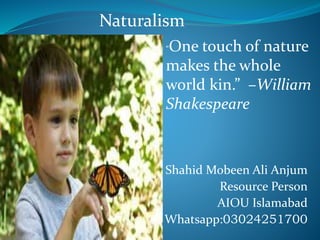
“One touch of nature
makes the whole
world kin.” –William
Shakespeare
Naturalism
Naturalism
 Naturalism is the philosophy that separates nature
from God.
 In naturalism efforts are made to develop personality
of a child in order to make him a natural man.
 According to naturalism, the personality of the child
disintegrates in the attempt for making it cultured and
civilized.
 It is like destroying the useful elements of food in the
attempt of making it delicious.
Naturalism
 Rousseau, in his book ‘Emile’, advises to
follow the nature.______According to him
 The teaching process should not be difficult , rather it
should be made easy as far as possible and children
should get opportunities for contact with nature,
experience reality directly and discover the process of
learning themselves, instead of making them
dependent on written word.
Naturalism
According to Naturalism there are two types of nature
that is
 (i) Physical Nature and
 (ii) Psychology of the Child.
They believes that when psychology of the
child corresponds with physical nature than
only learning happens.
Principles of Naturalism
 Nature is the ultimate reality. So the child should be
encouraged to learn with the nature.
 It gives full freedom to the child so that they can learn
whatever they want.
 According to this philosophy senses are the gateway of
knowledge.
 They encourages negative education and discourages
traditional teachings.
 In addition they believe in child centered education and
opposes bookish knowledge.
 They supports science education and has no faith on soul.
Aim of Education in Naturalism
 Education should aim at perfect development of
individuality.
 It serves as a mean to attain present as well as future
happiness.
 Indeed education should enable a child to adapt with
their environment.
 In particular education prepares the child for future
struggles of life.
 To enhance self expression of the child.
 It should aims at natural development of the child.
Curriculum framing principles of
Naturalism
 Principle of child centered education that means curriculum
should be framed according to the needs, interest, aptitude of
students.
 Principle of flexibility that seeks a flexible curriculum according
to the need.
 The principle of activity and play or activity based curriculum.
 Principle of life centeredness that means curriculum should
relate with the life of the people.
 The principle of scientific study.
 Principle of broad based curriculum with equal emphasis on
past, present and future.
 Moreover, gives importance to the subjects like Nature study,
Agriculture, Gardening, Art, Craft, Botany, Geology, Geography
etc.
Method of Teaching in Naturalism
 Learning by doing method in order to ensure active
involvement of students in the teaching learning process.
 Play way method.
 Learning by experience or activity method.
 Self government and self effort of students to learn by
themselves.
 Observation method where students observes their
surrounding environment, peoples, things and learn from his
observation.
 They follow different methods of teaching according to the
interests, capacities and aptitude of the child.
 OTHERS: Apart from this method naturalists adopt Dalton
Plan, Kindergarten, Excursion method, Montessori method,
Experimentation method etc
Role Of Teachers in Naturalism
 Teacher must be a friend of the child.
 Also teacher should behave sympathetically and
affectionately towards the children.
 Particularly, nature is the Supreme teacher.
 The teacher should understand about the child, his needs,
interests etc.
 Teacher is called to be a stage setter who gives the stage to
students to learn by themselves.
 Teacher should create and facilitate learning situations or
environment so that students learns themselves.
Discipline in Naturalism:
 Naturalist gives full freedom to the child to perform as
well as learn whatever he likes.
 There is full freedom, free society as well as no
punishment.
 Moreover, naturalists assumes that the child has no
knowledge of good and bad, but he suffers pain when
he makes a mistake, and pleasure when he does
something right. Thus he gets reward or punishment
for his actions.
Merits of Naturalism
 It gives the child a very important place in the educational
process. It treats a child as child, and not as a adult. The child
is good and pure at the time of birth.
 Further, it considers nature as the best teacher in whose
company the child learns better because society is full of
evils.
 Also it considers individual interests, aptitudes, inclination,
needs and capacities while structuring the curriculum.
 It prepares and encourages the child to engage in
experimentation, discoveries and inventions.
 It motivates the child to acquire more knowledge in natural
environment.
Demerits of Naturalism
 Nature centered study makes the child unsocial with no
feeling of social service.
 Naturalism ignores the spiritual world and considers the
material world only.
 Naturalism lays stress on solution for the present needs and
problems of an individual and neglects his future needs and
problems. As a result it has failed to prepare the child for
future life.
 Naturalism advocates unrestricted freedom for the child to
develop himself naturally. This is undesirable and harmful
for the child.
 It minimizes the role of the teacher in the educative process.
Therefore the teacher is merely an observer, sympathetic
guide and helps in structuring experience for the child.
unit 3 8609.pptx
unit 3 8609.pptx
unit 3 8609.pptx
unit 3 8609.pptx
unit 3 8609.pptx
unit 3 8609.pptx
unit 3 8609.pptx
unit 3 8609.pptx

unit 3 8609.pptx

  • 1.
    Shahid Mobeen AliAnjum Resource Person AIOU Islamabad Whatsapp:03024251700 “One touch of nature makes the whole world kin.” –William Shakespeare Naturalism
  • 2.
    Naturalism  Naturalism isthe philosophy that separates nature from God.  In naturalism efforts are made to develop personality of a child in order to make him a natural man.  According to naturalism, the personality of the child disintegrates in the attempt for making it cultured and civilized.  It is like destroying the useful elements of food in the attempt of making it delicious.
  • 3.
    Naturalism  Rousseau, inhis book ‘Emile’, advises to follow the nature.______According to him  The teaching process should not be difficult , rather it should be made easy as far as possible and children should get opportunities for contact with nature, experience reality directly and discover the process of learning themselves, instead of making them dependent on written word.
  • 4.
    Naturalism According to Naturalismthere are two types of nature that is  (i) Physical Nature and  (ii) Psychology of the Child. They believes that when psychology of the child corresponds with physical nature than only learning happens.
  • 5.
    Principles of Naturalism Nature is the ultimate reality. So the child should be encouraged to learn with the nature.  It gives full freedom to the child so that they can learn whatever they want.  According to this philosophy senses are the gateway of knowledge.  They encourages negative education and discourages traditional teachings.  In addition they believe in child centered education and opposes bookish knowledge.  They supports science education and has no faith on soul.
  • 6.
    Aim of Educationin Naturalism  Education should aim at perfect development of individuality.  It serves as a mean to attain present as well as future happiness.  Indeed education should enable a child to adapt with their environment.  In particular education prepares the child for future struggles of life.  To enhance self expression of the child.  It should aims at natural development of the child.
  • 7.
    Curriculum framing principlesof Naturalism  Principle of child centered education that means curriculum should be framed according to the needs, interest, aptitude of students.  Principle of flexibility that seeks a flexible curriculum according to the need.  The principle of activity and play or activity based curriculum.  Principle of life centeredness that means curriculum should relate with the life of the people.  The principle of scientific study.  Principle of broad based curriculum with equal emphasis on past, present and future.  Moreover, gives importance to the subjects like Nature study, Agriculture, Gardening, Art, Craft, Botany, Geology, Geography etc.
  • 8.
    Method of Teachingin Naturalism  Learning by doing method in order to ensure active involvement of students in the teaching learning process.  Play way method.  Learning by experience or activity method.  Self government and self effort of students to learn by themselves.  Observation method where students observes their surrounding environment, peoples, things and learn from his observation.  They follow different methods of teaching according to the interests, capacities and aptitude of the child.  OTHERS: Apart from this method naturalists adopt Dalton Plan, Kindergarten, Excursion method, Montessori method, Experimentation method etc
  • 9.
    Role Of Teachersin Naturalism  Teacher must be a friend of the child.  Also teacher should behave sympathetically and affectionately towards the children.  Particularly, nature is the Supreme teacher.  The teacher should understand about the child, his needs, interests etc.  Teacher is called to be a stage setter who gives the stage to students to learn by themselves.  Teacher should create and facilitate learning situations or environment so that students learns themselves.
  • 10.
    Discipline in Naturalism: Naturalist gives full freedom to the child to perform as well as learn whatever he likes.  There is full freedom, free society as well as no punishment.  Moreover, naturalists assumes that the child has no knowledge of good and bad, but he suffers pain when he makes a mistake, and pleasure when he does something right. Thus he gets reward or punishment for his actions.
  • 11.
    Merits of Naturalism It gives the child a very important place in the educational process. It treats a child as child, and not as a adult. The child is good and pure at the time of birth.  Further, it considers nature as the best teacher in whose company the child learns better because society is full of evils.  Also it considers individual interests, aptitudes, inclination, needs and capacities while structuring the curriculum.  It prepares and encourages the child to engage in experimentation, discoveries and inventions.  It motivates the child to acquire more knowledge in natural environment.
  • 12.
    Demerits of Naturalism Nature centered study makes the child unsocial with no feeling of social service.  Naturalism ignores the spiritual world and considers the material world only.  Naturalism lays stress on solution for the present needs and problems of an individual and neglects his future needs and problems. As a result it has failed to prepare the child for future life.  Naturalism advocates unrestricted freedom for the child to develop himself naturally. This is undesirable and harmful for the child.  It minimizes the role of the teacher in the educative process. Therefore the teacher is merely an observer, sympathetic guide and helps in structuring experience for the child.