NATURAL BAST FIBERS
Growing and processing natural renewable
BAST fibers for natural fiber composites
Second Annual
Automotive Composites Conference sponsored
by the Automotive and Composites Divisions of
the Society of Plastics Engineers
Troy, Michigan
September 12th and 13th, 2002
By Hugh S. Mckee
Flaxcraft, Inc.
Natural Bast Fibers
Bast fibers are produced from renewable
agricultural crops grown with no pesticides and
little or no herbicides.
Bast fibers have been used for thousands of years,
before petrochemical fibers were developed and
pushed them aside.
Bast fibers can reduce cost, reduce weight,
reduce manufacturing time, and improve safety
in automobiles. European automakers have
adopted them and are expected to use up to 70,000
metric tons of fiber by the year 2005.
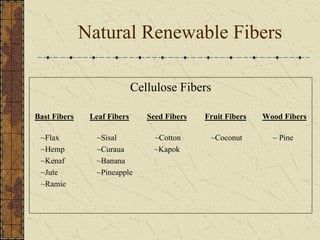
Natural Renewable Fibers
Cellulose Fibers
Bast Fibers Leaf Fibers Seed Fibers Fruit Fibers Wood Fibers
~Flax ~Sisal ~Cotton ~Coconut ~ Pine
~Hemp ~Curaua ~Kapok
~Kenaf ~Banana
~Jute ~Pineapple
~Ramie
How are Bast Fibers Different than
other Natural Fibers?
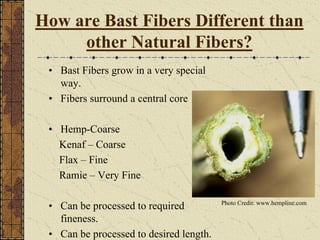
• Bast Fibers grow in a very special
way.
• Fibers surround a central core
• Hemp-Coarse
Kenaf – Coarse
Flax – Fine
Ramie – Very Fine
• Can be processed to required
fineness.
• Can be processed to desired length.
Photo Credit: www.hempline.com
Why Use Natural Bast Fibers?
Lower Cost
Long Strong Fiber
Different finenesses possible giving varying aspect ratios
Renewable
Recyclable
Bio-degradable (if used with natural resins)
Environmentally Friendly – The ‘Green’ Factor
Ag. Residues are like Recycled Plastics, while Bast fibers
are like Virgin Plastics.
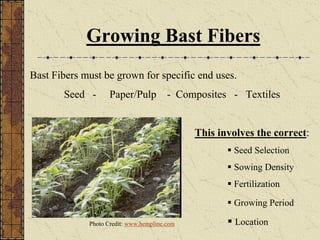
Growing Bast Fibers
Bast Fibers must be grown for specific end uses.
Seed - Paper/Pulp - Composites - Textiles
This involves the correct:
Seed Selection
Sowing Density
Fertilization
Growing Period
LocationPhoto Credit: www.hempline.com
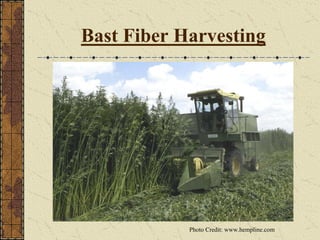
Bast Fiber Harvesting
Photo Credit: www.hempline.com
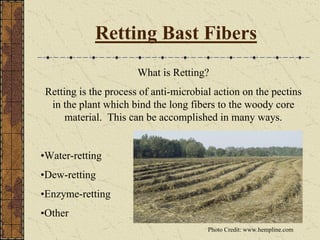
What is Retting?
Retting is the process of anti-microbial action on the pectins
in the plant which bind the long fibers to the woody core
material. This can be accomplished in many ways.
•Water-retting
•Dew-retting
•Enzyme-retting
•Other
Retting Bast Fibers
Photo Credit: www.hempline.com
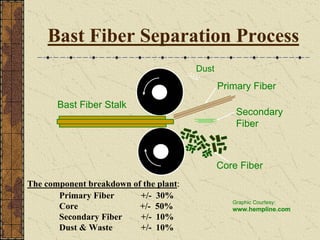
The component breakdown of the plant:
Primary Fiber +/- 30%
Core +/- 50%
Secondary Fiber +/- 10%
Dust & Waste +/- 10%
Bast Fiber Separation Process
Graphic Courtesy:
www.hempline.com
Core Fiber
Primary Fiber
Secondary
Fiber
Bast Fiber Stalk
Dust
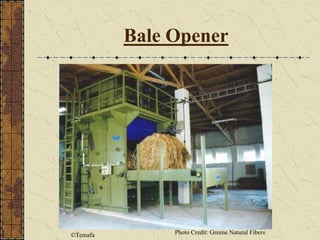
Bale Opener
Photo Credit: Greene Natural Fibers©Temafa
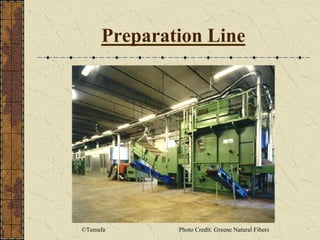
Preparation Line
Photo Credit: Greene Natural Fibers©Temafa
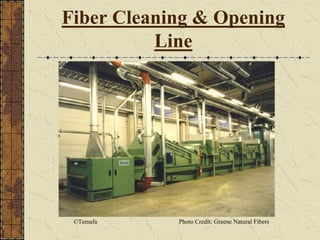
Fiber Cleaning & Opening
Line
Photo Credit: Greene Natural Fibers©Temafa
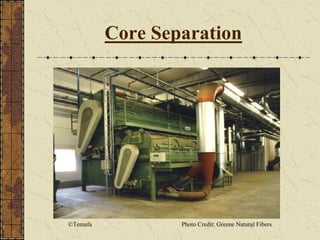
Core Separation
Photo Credit: Greene Natural Fibers©Temafa
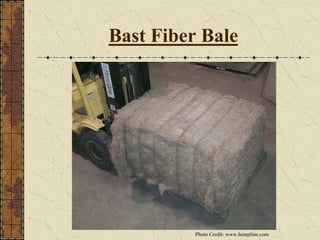
Bast Fiber Bale
Photo Credit: www.hempline.com
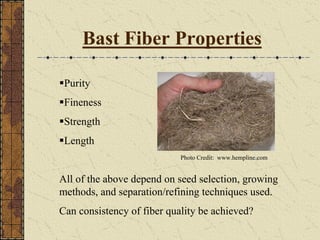
Bast Fiber Properties
Purity
Fineness
Strength
Length
All of the above depend on seed selection, growing
methods, and separation/refining techniques used.
Can consistency of fiber quality be achieved?
Photo Credit: www.hempline.com
Fiber Purity, Fiber Fineness, Fiber Length all affect
mat properties:
Weight of mat
Strength of mat
Smoothness of the molded part
Production efficiency and yield of non-woven line
Bast Fibers in Non-Wovens
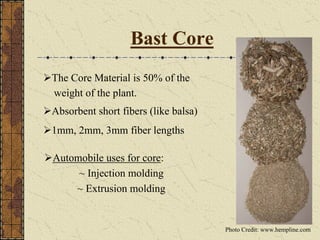
Bast Core
The Core Material is 50% of the
weight of the plant.
Absorbent short fibers (like balsa)
1mm, 2mm, 3mm fiber lengths
Automobile uses for core:
~ Injection molding
~ Extrusion molding
Photo Credit: www.hempline.com
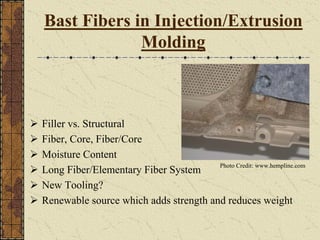
Bast Fibers in Injection/Extrusion
Molding
Filler vs. Structural
Fiber, Core, Fiber/Core
Moisture Content
Long Fiber/Elementary Fiber System
New Tooling?
Renewable source which adds strength and reduces weight
Photo Credit: www.hempline.com
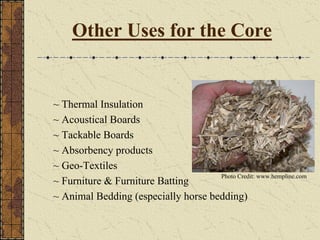
~ Thermal Insulation
~ Acoustical Boards
~ Tackable Boards
~ Absorbency products
~ Geo-Textiles
~ Furniture & Furniture Batting
~ Animal Bedding (especially horse bedding)
Other Uses for the Core
Photo Credit: www.hempline.com
Fiber/Core Treatments
Fire Retardant
Anti-Mildew
Hygroscopic
Fiber modification to increase bonding
Lower weight parts due to lower density – up to 30% lower.
Favorable mechanical and acoustical properties
Reduced molding time
Lower wear on tools
One-step manufacturing possible
Occupational health benefits compared to glass fibers
Positive effects on agriculture
Recyclable – EU End-of-Life Vehicle Directive 2000/53
Lower cost material
Nova Institute, Germany March 2000
Advantages of Using Bast Fibers
in Automobiles
Imported vs. Domestic Bast Fibers
Current Fiber Supply
Flax, Hemp Kenaf and Ramie can all be grown
and processed in North America
High freight cost and exchange rate risk of
imported fiber
Domestic growing/processing needs influx of
investment capital
New Kenaf processing plant in North Carolina
Pricing of Bast Fibers
40 to 50% less than petrochemical fibers
60 to 70% less than fiberglass
The fiber price, which is 30% of the plant,
depends on how core and core/fiber markets are
developed.
New innovative processing technologies could
reduce prices eventually.
Volume usage will help reduce prices.
Bast Fibers - Conclusions
• America must take a leadership position in expanding the
use of sustainable resources.
• Bast fibers can reduce cost, reduce weight, reduce
manufacturing time, and improve safety in automobiles.
• Bast fibers can be grown and processed in North America
to quality and consistency standards demanded by the auto
industry.
• To insure an adequate supply of domestic bast fibers, the
auto industry must understand that investment capital is
needed in order to expand the growing and processing of
bast fibers. With auto industry support, the investment
dollars will be available.
Acknowledgements
Nova Institute, Germany
Michigan State University
Hempline, Inc. – Ontario, Canada
Greene Natural Fibers – Snow Hill, NC
Biobased Manufacturers Association (BMA)
AgroTech Communications, Inc. – Memphis, TN
Thank you
Hugh S. McKee
Flaxcraft, Inc.
210 Knickerbocker Road
Cresskill, NJ 07626
Tel: (201) 569-3438
Fax: (201) 569-6780
E-mail: hmckee@flaxcraft.com

Bast fiber

  • 1.
    NATURAL BAST FIBERS Growingand processing natural renewable BAST fibers for natural fiber composites Second Annual Automotive Composites Conference sponsored by the Automotive and Composites Divisions of the Society of Plastics Engineers Troy, Michigan September 12th and 13th, 2002 By Hugh S. Mckee Flaxcraft, Inc.
  • 2.
    Natural Bast Fibers Bastfibers are produced from renewable agricultural crops grown with no pesticides and little or no herbicides. Bast fibers have been used for thousands of years, before petrochemical fibers were developed and pushed them aside. Bast fibers can reduce cost, reduce weight, reduce manufacturing time, and improve safety in automobiles. European automakers have adopted them and are expected to use up to 70,000 metric tons of fiber by the year 2005.
  • 3.
    Natural Renewable Fibers CelluloseFibers Bast Fibers Leaf Fibers Seed Fibers Fruit Fibers Wood Fibers ~Flax ~Sisal ~Cotton ~Coconut ~ Pine ~Hemp ~Curaua ~Kapok ~Kenaf ~Banana ~Jute ~Pineapple ~Ramie
  • 4.
    How are BastFibers Different than other Natural Fibers? • Bast Fibers grow in a very special way. • Fibers surround a central core • Hemp-Coarse Kenaf – Coarse Flax – Fine Ramie – Very Fine • Can be processed to required fineness. • Can be processed to desired length. Photo Credit: www.hempline.com
  • 5.
    Why Use NaturalBast Fibers? Lower Cost Long Strong Fiber Different finenesses possible giving varying aspect ratios Renewable Recyclable Bio-degradable (if used with natural resins) Environmentally Friendly – The ‘Green’ Factor Ag. Residues are like Recycled Plastics, while Bast fibers are like Virgin Plastics.
  • 6.
    Growing Bast Fibers BastFibers must be grown for specific end uses. Seed - Paper/Pulp - Composites - Textiles This involves the correct: Seed Selection Sowing Density Fertilization Growing Period LocationPhoto Credit: www.hempline.com
  • 7.
    Bast Fiber Harvesting PhotoCredit: www.hempline.com
  • 8.
    What is Retting? Rettingis the process of anti-microbial action on the pectins in the plant which bind the long fibers to the woody core material. This can be accomplished in many ways. •Water-retting •Dew-retting •Enzyme-retting •Other Retting Bast Fibers Photo Credit: www.hempline.com
  • 9.
    The component breakdownof the plant: Primary Fiber +/- 30% Core +/- 50% Secondary Fiber +/- 10% Dust & Waste +/- 10% Bast Fiber Separation Process Graphic Courtesy: www.hempline.com Core Fiber Primary Fiber Secondary Fiber Bast Fiber Stalk Dust
  • 10.
    Bale Opener Photo Credit:Greene Natural Fibers©Temafa
  • 11.
    Preparation Line Photo Credit:Greene Natural Fibers©Temafa
  • 12.
    Fiber Cleaning &Opening Line Photo Credit: Greene Natural Fibers©Temafa
  • 13.
    Core Separation Photo Credit:Greene Natural Fibers©Temafa
  • 14.
    Bast Fiber Bale PhotoCredit: www.hempline.com
  • 15.
    Bast Fiber Properties Purity Fineness Strength Length Allof the above depend on seed selection, growing methods, and separation/refining techniques used. Can consistency of fiber quality be achieved? Photo Credit: www.hempline.com
  • 16.
    Fiber Purity, FiberFineness, Fiber Length all affect mat properties: Weight of mat Strength of mat Smoothness of the molded part Production efficiency and yield of non-woven line Bast Fibers in Non-Wovens
  • 17.
    Bast Core The CoreMaterial is 50% of the weight of the plant. Absorbent short fibers (like balsa) 1mm, 2mm, 3mm fiber lengths Automobile uses for core: ~ Injection molding ~ Extrusion molding Photo Credit: www.hempline.com
  • 18.
    Bast Fibers inInjection/Extrusion Molding Filler vs. Structural Fiber, Core, Fiber/Core Moisture Content Long Fiber/Elementary Fiber System New Tooling? Renewable source which adds strength and reduces weight Photo Credit: www.hempline.com
  • 19.
    ~ Thermal Insulation ~Acoustical Boards ~ Tackable Boards ~ Absorbency products ~ Geo-Textiles ~ Furniture & Furniture Batting ~ Animal Bedding (especially horse bedding) Other Uses for the Core Photo Credit: www.hempline.com
  • 20.
  • 21.
    Lower weight partsdue to lower density – up to 30% lower. Favorable mechanical and acoustical properties Reduced molding time Lower wear on tools One-step manufacturing possible Occupational health benefits compared to glass fibers Positive effects on agriculture Recyclable – EU End-of-Life Vehicle Directive 2000/53 Lower cost material Nova Institute, Germany March 2000 Advantages of Using Bast Fibers in Automobiles
  • 22.
    Imported vs. DomesticBast Fibers Current Fiber Supply Flax, Hemp Kenaf and Ramie can all be grown and processed in North America High freight cost and exchange rate risk of imported fiber Domestic growing/processing needs influx of investment capital New Kenaf processing plant in North Carolina
  • 23.
    Pricing of BastFibers 40 to 50% less than petrochemical fibers 60 to 70% less than fiberglass The fiber price, which is 30% of the plant, depends on how core and core/fiber markets are developed. New innovative processing technologies could reduce prices eventually. Volume usage will help reduce prices.
  • 24.
    Bast Fibers -Conclusions • America must take a leadership position in expanding the use of sustainable resources. • Bast fibers can reduce cost, reduce weight, reduce manufacturing time, and improve safety in automobiles. • Bast fibers can be grown and processed in North America to quality and consistency standards demanded by the auto industry. • To insure an adequate supply of domestic bast fibers, the auto industry must understand that investment capital is needed in order to expand the growing and processing of bast fibers. With auto industry support, the investment dollars will be available.
  • 25.
    Acknowledgements Nova Institute, Germany MichiganState University Hempline, Inc. – Ontario, Canada Greene Natural Fibers – Snow Hill, NC Biobased Manufacturers Association (BMA) AgroTech Communications, Inc. – Memphis, TN
  • 26.
    Thank you Hugh S.McKee Flaxcraft, Inc. 210 Knickerbocker Road Cresskill, NJ 07626 Tel: (201) 569-3438 Fax: (201) 569-6780 E-mail: hmckee@flaxcraft.com