Natural Disaster..
• A natural disaster is an event with a natural, as
opposed to human, cause that results in large-scale
loss of life or damage to property. It could be related
to weather, geology, biology or even factors outside
the Earth. Examples are earthquakes, hurricanes,
droughts and flooding. Disease epidemics are
sometimes considered natural disasters, but may be
put into a different category. In some cases, natural
and human factors may combine to produce a
disaster.
Who is effected?
• Natural disasters can effect everyone,
everywhere. Even if it didn’t happen in our
state or area, the cost effects the nation as a
whole.
• Some Natural Disasters in India--
Uttarakhand Disaster(2013)
• The incessant rain that hit Uttarakhand from June 14 triggered
flash floods and landslides, leading to thousands of deaths,
while thousands more are missing. Over 1,00,000 people have
been evacuated so far from the affected areas. According to
Uttrakhand government, more than 5,700 were dead,
including 934 local residents.
Environmental Issues
• Unprecedented destruction by the rainfall witnessed in
Uttarakhand state was attributed, by environmentalists, to
unscientific developmental activities undertaken in recent
decades contributing to high level of loss of property and
lives. Roads constructed in haphazard style, new resorts and
hotels built on fragile river banks and more than 70
hydroelectric projects in the watersheds of the state led to a
"disaster waiting to happen" as termed by certain
environmentalists
Mumbai Disaster(2005)
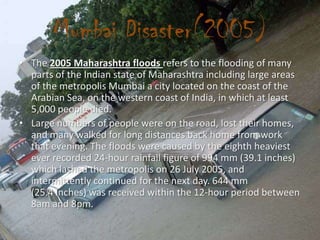
• The 2005 Maharashtra floods refers to the flooding of many
parts of the Indian state of Maharashtra including large areas
of the metropolis Mumbai a city located on the coast of the
Arabian Sea, on the western coast of India, in which at least
5,000 people died.
• Large numbers of people were on the road, lost their homes,
and many walked for long distances back home from work
that evening. The floods were caused by the eighth heaviest
ever recorded 24-hour rainfall figure of 994 mm (39.1 inches)
which lashed the metropolis on 26 July 2005, and
intermittently continued for the next day. 644 mm
(25.4 inches) was received within the 12-hour period between
8am and 8pm.
Northern Bihar Disaster(2008)
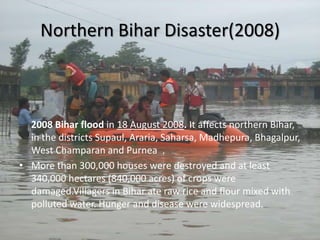
2008 Bihar flood in 18 August 2008. It affects northern Bihar,
in the districts Supaul, Araria, Saharsa, Madhepura, Bhagalpur,
West Champaran and Purnea .
• More than 300,000 houses were destroyed and at least
340,000 hectares (840,000 acres) of crops were
damaged.Villagers in Bihar ate raw rice and flour mixed with
polluted water. Hunger and disease were widespread.
How to Prevent
• Natural disaster are something that can not be stopped, or prevented, but
we can do some thing's before and after disasters to help reduce the
amount of trauma caused by these disasters.
Ways to Help:
• Donate to organizations that deal with natural disaster relief
• Volunteer with these organizations
• Help rebuild cities
Environmental Impacts of Natural Disasters
By,
lakshya karan
B.sc B.Ed

Natural disaster

  • 2.
    Natural Disaster.. • Anatural disaster is an event with a natural, as opposed to human, cause that results in large-scale loss of life or damage to property. It could be related to weather, geology, biology or even factors outside the Earth. Examples are earthquakes, hurricanes, droughts and flooding. Disease epidemics are sometimes considered natural disasters, but may be put into a different category. In some cases, natural and human factors may combine to produce a disaster.
  • 3.
    Who is effected? •Natural disasters can effect everyone, everywhere. Even if it didn’t happen in our state or area, the cost effects the nation as a whole.
  • 4.
    • Some NaturalDisasters in India--
  • 5.
    Uttarakhand Disaster(2013) • Theincessant rain that hit Uttarakhand from June 14 triggered flash floods and landslides, leading to thousands of deaths, while thousands more are missing. Over 1,00,000 people have been evacuated so far from the affected areas. According to Uttrakhand government, more than 5,700 were dead, including 934 local residents.
  • 6.
    Environmental Issues • Unprecedenteddestruction by the rainfall witnessed in Uttarakhand state was attributed, by environmentalists, to unscientific developmental activities undertaken in recent decades contributing to high level of loss of property and lives. Roads constructed in haphazard style, new resorts and hotels built on fragile river banks and more than 70 hydroelectric projects in the watersheds of the state led to a "disaster waiting to happen" as termed by certain environmentalists
  • 7.
    Mumbai Disaster(2005) • The2005 Maharashtra floods refers to the flooding of many parts of the Indian state of Maharashtra including large areas of the metropolis Mumbai a city located on the coast of the Arabian Sea, on the western coast of India, in which at least 5,000 people died. • Large numbers of people were on the road, lost their homes, and many walked for long distances back home from work that evening. The floods were caused by the eighth heaviest ever recorded 24-hour rainfall figure of 994 mm (39.1 inches) which lashed the metropolis on 26 July 2005, and intermittently continued for the next day. 644 mm (25.4 inches) was received within the 12-hour period between 8am and 8pm.
  • 8.
    Northern Bihar Disaster(2008) 2008Bihar flood in 18 August 2008. It affects northern Bihar, in the districts Supaul, Araria, Saharsa, Madhepura, Bhagalpur, West Champaran and Purnea . • More than 300,000 houses were destroyed and at least 340,000 hectares (840,000 acres) of crops were damaged.Villagers in Bihar ate raw rice and flour mixed with polluted water. Hunger and disease were widespread.
  • 10.
    How to Prevent •Natural disaster are something that can not be stopped, or prevented, but we can do some thing's before and after disasters to help reduce the amount of trauma caused by these disasters. Ways to Help: • Donate to organizations that deal with natural disaster relief • Volunteer with these organizations • Help rebuild cities
  • 11.
    Environmental Impacts ofNatural Disasters
  • 12.