Profesora        Estudiante
Aparicio Nahír   Pérez Yicel
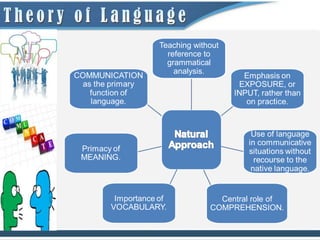
Teaching without
  reference to
  grammatical
    analysis.


               Central role of
             COMPREHENSION.
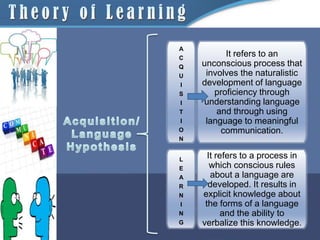
A
C
          It refers to an
Q   unconscious process that
U    involves the naturalistic
I   development of language
S      proficiency through
I   understanding language
T       and through using
I    language to meaningful
O        communication.
N


L
      It refers to a process in
E      which conscious rules
A      about a language are
R     developed. It results in
N   explicit knowledge about
I    the forms of a language
N         and the ability to
G   verbalize this knowledge.
The learning system performs the role of the
'monitor' or the 'editor'. Conscious learning can
function only as monitor or editor that checks and
repairs the output of the acquired system.

              Three conditions limit the
            successful use of the monitor


                     Focus on         Knowledge
     Time
                       form            of rules
it is based on research findings, which
suggested that the acquisition of grammatical
structures follows a 'natural order' which is
predictable. Some grammatical structures are
acquired before others for instance, the present
tense is acquired before the past tense.
The                                The learner improves
relationship    The hypothesis relates     when he/she receives
                to acquisition and not          second language
    between     to learning.              'input' that is one step
    what the                              beyond his/her current
   learner is                                  stage of linguistic
                                    Four main        competence.
 exposed to                           issues
         of a
                The ability to speak
   language     fluently cannot be                 People acquire
  (the input)   taught directly;                language best by
                rather, it “emerges”      being exposed to input
         and    after s/he has built up     that is slightly above
   language     linguistic competence        their current level of
                by understanding                     competence.
acquisition.    input.
Krashen considers the learner’s emotional state or
attitudes as an adjustable filter that passes, impedes or
blocks the input necessary to acquisition. A low affective
filter is desirable, since it impedes or block less of this
necessary input. There are three kinds of affective or
altitudinal variables. and.


                      Motivation
                      Self-confidence
                      Anxiety
The Natural Approach is for beginners and is
designed to help them become intermediates.


It has the expectation that students will be able
 to function adequately in the target language.
They should be able to make the meaning clear
 but not necessary be accurate in all details of
                   grammar.

It is important to communicate to learners what
   they can expect of a course as well as what
             they should not expect.
Comprehensible input is presented in the target
language, using:

 •   TPR (James Asher)
 •   Mimes, gestures, use of context.
 •   Group work activities.
 •   Whatever minimizes learner’s anxiety and
     maximizes learner self-confidence.
The language acquirer is seen as a processor of
             comprehensible input. Learners’ roles are seen to
             change according to their stage of linguistic
             development.


                                                                                     Speech-emergent phase
                                          Early-production stage
Pre-production stage


                       students                                    students                                  students
                       participate in                              respond to                                involve
                       the language                                familiar                                  themselves in
                       activity without                            questions, fixe                           role-play and
                       having to                                   d                                         games, and
                       respond in the                              conversation.                             participate in
                       target                                                                                group
                       language.                                                                             problem-
                                                                                                             solving.
• The teacher is primary source of
  comprehensible input in the target
  language
• The teacher creates a classroom
  atmosphere that is interesting,
  friendly and in which there is a
  low affective filter for learning.
• The teacher chooses a rich mix of
  classroom activities.
• The teacher is responsible for
  collecting materials and designing
  their use.
Natural aproach

Natural aproach

  • 1.
    Profesora Estudiante Aparicio Nahír Pérez Yicel
  • 3.
    Teaching without reference to grammatical analysis. Central role of COMPREHENSION.
  • 4.
    A C It refers to an Q unconscious process that U involves the naturalistic I development of language S proficiency through I understanding language T and through using I language to meaningful O communication. N L It refers to a process in E which conscious rules A about a language are R developed. It results in N explicit knowledge about I the forms of a language N and the ability to G verbalize this knowledge.
  • 5.
    The learning systemperforms the role of the 'monitor' or the 'editor'. Conscious learning can function only as monitor or editor that checks and repairs the output of the acquired system. Three conditions limit the successful use of the monitor Focus on Knowledge Time form of rules
  • 6.
    it is basedon research findings, which suggested that the acquisition of grammatical structures follows a 'natural order' which is predictable. Some grammatical structures are acquired before others for instance, the present tense is acquired before the past tense.
  • 7.
    The The learner improves relationship The hypothesis relates when he/she receives to acquisition and not second language between to learning. 'input' that is one step what the beyond his/her current learner is stage of linguistic Four main competence. exposed to issues of a The ability to speak language fluently cannot be People acquire (the input) taught directly; language best by rather, it “emerges” being exposed to input and after s/he has built up that is slightly above language linguistic competence their current level of by understanding competence. acquisition. input.
  • 8.
    Krashen considers thelearner’s emotional state or attitudes as an adjustable filter that passes, impedes or blocks the input necessary to acquisition. A low affective filter is desirable, since it impedes or block less of this necessary input. There are three kinds of affective or altitudinal variables. and. Motivation Self-confidence Anxiety
  • 9.
    The Natural Approachis for beginners and is designed to help them become intermediates. It has the expectation that students will be able to function adequately in the target language. They should be able to make the meaning clear but not necessary be accurate in all details of grammar. It is important to communicate to learners what they can expect of a course as well as what they should not expect.
  • 10.
    Comprehensible input ispresented in the target language, using: • TPR (James Asher) • Mimes, gestures, use of context. • Group work activities. • Whatever minimizes learner’s anxiety and maximizes learner self-confidence.
  • 11.
    The language acquireris seen as a processor of comprehensible input. Learners’ roles are seen to change according to their stage of linguistic development. Speech-emergent phase Early-production stage Pre-production stage students students students participate in respond to involve the language familiar themselves in activity without questions, fixe role-play and having to d games, and respond in the conversation. participate in target group language. problem- solving.
  • 12.
    • The teacheris primary source of comprehensible input in the target language • The teacher creates a classroom atmosphere that is interesting, friendly and in which there is a low affective filter for learning. • The teacher chooses a rich mix of classroom activities. • The teacher is responsible for collecting materials and designing their use.