Theoretical Framework


Chapter I    L2 acquisition theory


Chapter II Basic Interpersonal Skills ( BICS)


Capter III   Cognitive Academic Language Proficiency ( CALP)
What is Language Development?
Speak and listen to
communicate.
 Language develops through
conversations.
Learners need to be exposure to
language in a rich environment
How does Language Develop?


Language develops through meaningful conversations: talking
about books, daily events, places they’ve visited. These
activities help increase vocabulary and increases the ability to
understand stories and how things function
Stage 1: Pre-Production
Silent Period

   Students comprehend
    simple language but
    cannot produce language
    yet.
    –   Minimal comprehension
    –   No verbal production
Stage 2: Early Production
                       Students comprehend
                        more complex language
                        and can make one or two
                        word responses.
                        –   Limited comprehension
                        –   One/two word responses
Stage 3: Speech Emergence
   Students can speak in
    phrases and sentences.
    –   Increased comprehension
    –   Some basic errors in speech
    –   Reading limited to what is
        understood orally
    –   Writing limited to brief
        responses
Stage 4: Intermediate Fluency
                      Students can combine phrases
                       and sentences into longer
                       passages of language, oral and
                       written
                       –   Good comprehension
                       –   Use of complex sentences
                       –   Some errors in written language
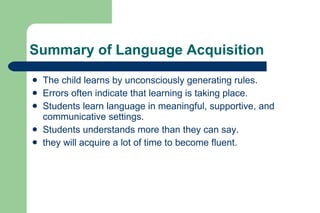
Summary of Language Acquisition
   The child learns by unconsciously generating rules.
   Errors often indicate that learning is taking place.
   Students learn language in meaningful, supportive, and
    communicative settings.
   Students understands more than they can say.
   they will acquire a lot of time to become fluent.
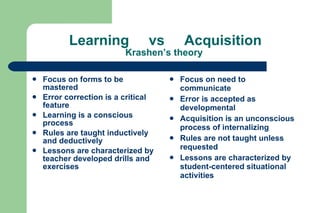
Learning             vs        Acquisition
                          Krashen’s theory

   Focus on forms to be                Focus on need to
    mastered                             communicate
   Error correction is a critical      Error is accepted as
    feature                              developmental
   Learning is a conscious             Acquisition is an unconscious
    process
                                         process of internalizing
   Rules are taught inductively
    and deductively                     Rules are not taught unless
   Lessons are characterized by         requested
    teacher developed drills and        Lessons are characterized by
    exercises                            student-centered situational
                                         activities
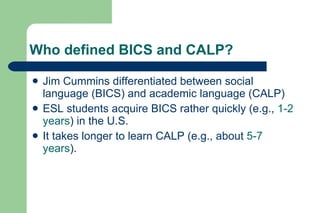
Who defined BICS and CALP?

   Jim Cummins differentiated between social
    language (BICS) and academic language (CALP)
   ESL students acquire BICS rather quickly (e.g., 1-2
    years) in the U.S.
   It takes longer to learn CALP (e.g., about 5-7
    years).
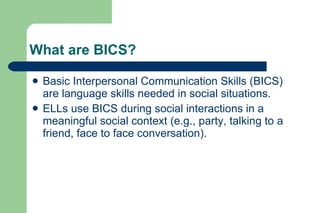
What are BICS?

   Basic Interpersonal Communication Skills (BICS)
    are language skills needed in social situations.
   ELLs use BICS during social interactions in a
    meaningful social context (e.g., party, talking to a
    friend, face to face conversation).
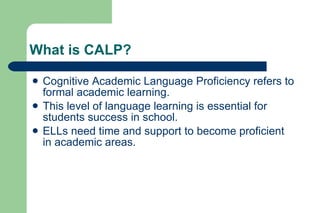
What is CALP?

   Cognitive Academic Language Proficiency refers to
    formal academic learning.
   This level of language learning is essential for
    students success in school.
   ELLs need time and support to become proficient
    in academic areas.
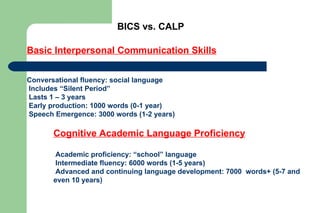
BICS vs. CALP

Basic Interpersonal Communication Skills


Conversational fluency: social language
Includes “Silent Period”
Lasts 1 – 3 years
Early production: 1000 words (0-1 year)
Speech Emergence: 3000 words (1-2 years)
        (first 2 years)
       Cognitive Academic Language Proficiency

        Academic proficiency: “school” language
        Intermediate fluency: 6000 words (1-5 years)
        Advanced and continuing language development: 7000 words+ (5-7 and
       even 10 years)
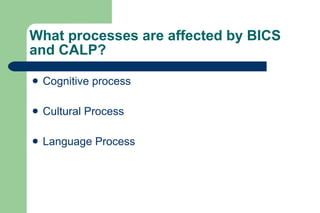
What processes are affected by BICS
and CALP?

   Cognitive process

   Cultural Process

   Language Process
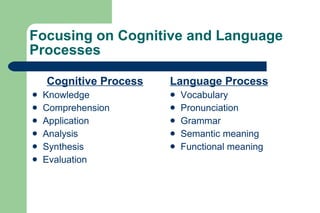
Focusing on Cognitive and Language
Processes

    Cognitive Process   Language Process
   Knowledge              Vocabulary
   Comprehension          Pronunciation
   Application            Grammar
   Analysis               Semantic meaning
   Synthesis              Functional meaning
   Evaluation
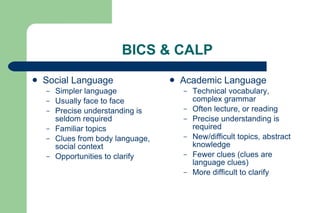
BICS & CALP
   Social Language                    Academic Language
    –   Simpler language                –   Technical vocabulary,
    –   Usually face to face                complex grammar
    –   Precise understanding is        –   Often lecture, or reading
        seldom required                 –   Precise understanding is
    –   Familiar topics                     required
    –   Clues from body language,       –   New/difficult topics, abstract
        social context                      knowledge
    –   Opportunities to clarify        –   Fewer clues (clues are
                                            language clues)
                                        –   More difficult to clarify
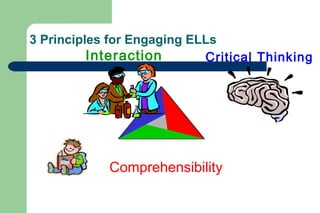
3 Principles for Engaging ELLs
          Interaction       Critical Thinking


            Comprehensibility
Principle #1: Social Interaction

   Take time to summarize learning frequently during
    instruction.

   Give students an opportunity to talk about content
    with a partner, during instruction.
Principle #2: Comprehensibility

   Use diagrams and picture cues to reinforce the
    concepts and processes of a content area.

   Provide hands-on learning opportunities.
Principle #3: Critical Thinking

   Explicitly model the thinking processes of a content
    area during instruction.

   Ask frequent questions to check for understanding
    during instruction.
Inquiry

   My concern is that my students need to
    improve communicative oral skills in English.
    How can I implement some strategies to help
    them to communicate in the second language
    at school?

Theoretical Presentation

  • 1.
    Theoretical Framework Chapter I L2 acquisition theory Chapter II Basic Interpersonal Skills ( BICS) Capter III Cognitive Academic Language Proficiency ( CALP)
  • 2.
    What is LanguageDevelopment? Speak and listen to communicate.  Language develops through conversations. Learners need to be exposure to language in a rich environment
  • 3.
    How does LanguageDevelop? Language develops through meaningful conversations: talking about books, daily events, places they’ve visited. These activities help increase vocabulary and increases the ability to understand stories and how things function
  • 4.
    Stage 1: Pre-Production SilentPeriod  Students comprehend simple language but cannot produce language yet. – Minimal comprehension – No verbal production
  • 5.
    Stage 2: EarlyProduction  Students comprehend more complex language and can make one or two word responses. – Limited comprehension – One/two word responses
  • 6.
    Stage 3: SpeechEmergence  Students can speak in phrases and sentences. – Increased comprehension – Some basic errors in speech – Reading limited to what is understood orally – Writing limited to brief responses
  • 7.
    Stage 4: IntermediateFluency  Students can combine phrases and sentences into longer passages of language, oral and written – Good comprehension – Use of complex sentences – Some errors in written language
  • 8.
    Summary of LanguageAcquisition  The child learns by unconsciously generating rules.  Errors often indicate that learning is taking place.  Students learn language in meaningful, supportive, and communicative settings.  Students understands more than they can say.  they will acquire a lot of time to become fluent.
  • 9.
    Learning vs Acquisition Krashen’s theory  Focus on forms to be  Focus on need to mastered communicate  Error correction is a critical  Error is accepted as feature developmental  Learning is a conscious  Acquisition is an unconscious process process of internalizing  Rules are taught inductively and deductively  Rules are not taught unless  Lessons are characterized by requested teacher developed drills and  Lessons are characterized by exercises student-centered situational activities
  • 10.
    Who defined BICSand CALP?  Jim Cummins differentiated between social language (BICS) and academic language (CALP)  ESL students acquire BICS rather quickly (e.g., 1-2 years) in the U.S.  It takes longer to learn CALP (e.g., about 5-7 years).
  • 11.
    What are BICS?  Basic Interpersonal Communication Skills (BICS) are language skills needed in social situations.  ELLs use BICS during social interactions in a meaningful social context (e.g., party, talking to a friend, face to face conversation).
  • 12.
    What is CALP?  Cognitive Academic Language Proficiency refers to formal academic learning.  This level of language learning is essential for students success in school.  ELLs need time and support to become proficient in academic areas.
  • 13.
    BICS vs. CALP BasicInterpersonal Communication Skills Conversational fluency: social language Includes “Silent Period” Lasts 1 – 3 years Early production: 1000 words (0-1 year) Speech Emergence: 3000 words (1-2 years) (first 2 years) Cognitive Academic Language Proficiency Academic proficiency: “school” language Intermediate fluency: 6000 words (1-5 years) Advanced and continuing language development: 7000 words+ (5-7 and even 10 years)
  • 14.
    What processes areaffected by BICS and CALP?  Cognitive process  Cultural Process  Language Process
  • 15.
    Focusing on Cognitiveand Language Processes Cognitive Process Language Process  Knowledge  Vocabulary  Comprehension  Pronunciation  Application  Grammar  Analysis  Semantic meaning  Synthesis  Functional meaning  Evaluation
  • 16.
    BICS & CALP  Social Language  Academic Language – Simpler language – Technical vocabulary, – Usually face to face complex grammar – Precise understanding is – Often lecture, or reading seldom required – Precise understanding is – Familiar topics required – Clues from body language, – New/difficult topics, abstract social context knowledge – Opportunities to clarify – Fewer clues (clues are language clues) – More difficult to clarify
  • 17.
    3 Principles forEngaging ELLs Interaction Critical Thinking Comprehensibility
  • 18.
    Principle #1: SocialInteraction  Take time to summarize learning frequently during instruction.  Give students an opportunity to talk about content with a partner, during instruction.
  • 19.
    Principle #2: Comprehensibility  Use diagrams and picture cues to reinforce the concepts and processes of a content area.  Provide hands-on learning opportunities.
  • 20.
    Principle #3: CriticalThinking  Explicitly model the thinking processes of a content area during instruction.  Ask frequent questions to check for understanding during instruction.
  • 21.
    Inquiry  My concern is that my students need to improve communicative oral skills in English. How can I implement some strategies to help them to communicate in the second language at school?