
 Input processing (IP) is concerned with these
situations, the reason being that acquisition is,
to a certain degree, a by-product of
comprehension (see, e.g., Truscott & Sharwood
Smith, 2004).
 Although comprehension cannot guarantee
acquisition, acquisition cannot happen if
comprehension does not occur. Why? Because
a good deal of acquisition is dependent upon
learners making appropriate form–meaning
connections during the act of comprehension.
 IP is concerned with three fundamental
questions that involve the assumption that an
integral part of language acquisition is making
form–meaning connections during
comprehension:
1. Under what conditions do learners make initial
form–meaning connections?
2. Why, at a given moment in time, do they make
some and not other form– meaning
connections?
3. What internal psycholinguistic strategies do
learners use in comprehending sentences and
how might this affect acquisition?
 These claims are codified in the following IP principle :
1. The Primacy of Content Words Principle. Learners process
content words in the input before anything else.
2.The Lexical Preference Principle. Learners will process lexical
items for meaning before grammatical forms when both encode
the same semantic (“real world” information.
3. (Revised) Lexical Preference Principle. If grammatical forms
express a meaning that can also be encoded lexically (i.e., that
grammatical marker is redundant), then learners will not initially
process those grammatical forms until they have lexical forms to
which they can match them.
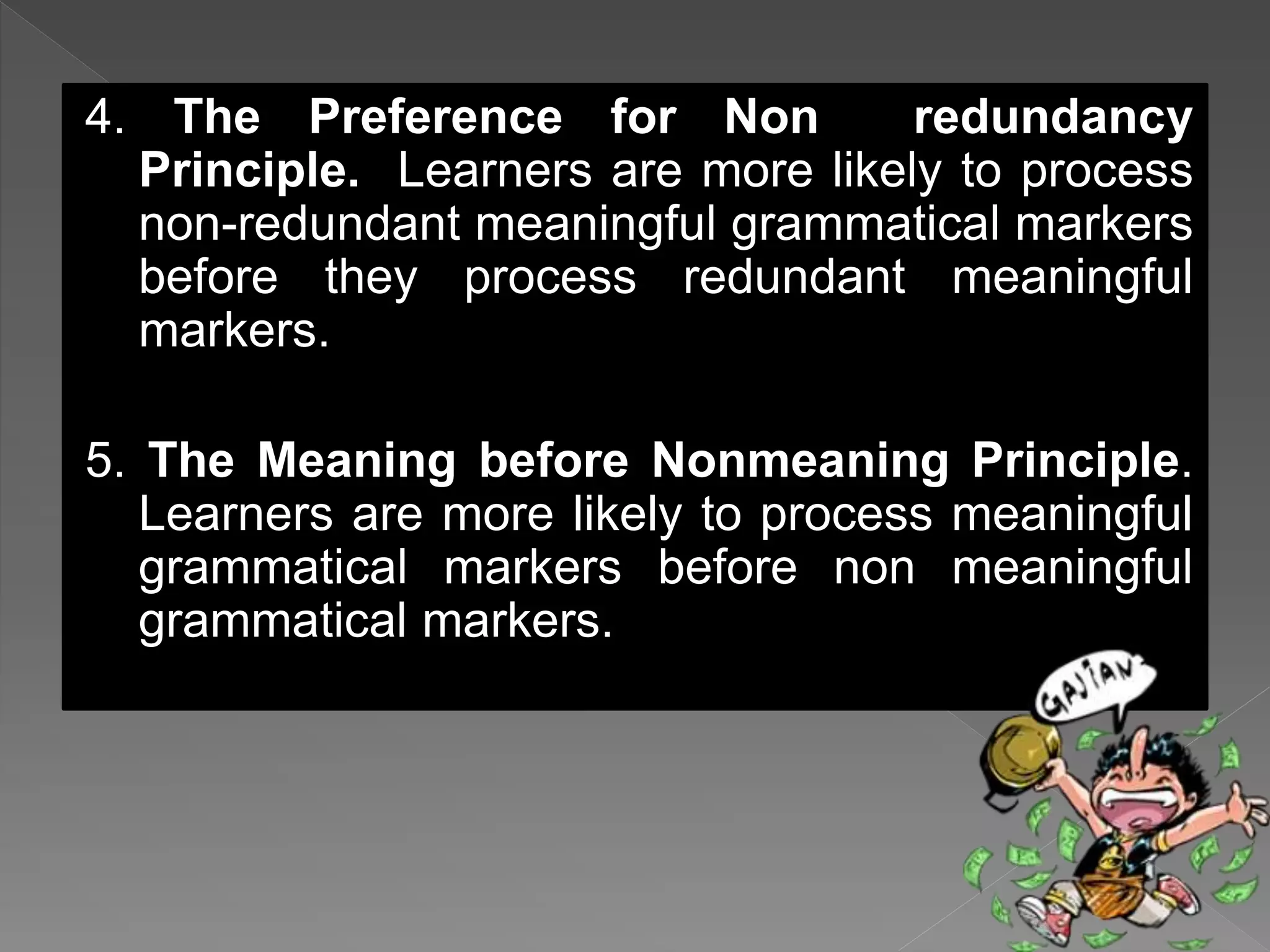
4. The Preference for Non redundancy
Principle. Learners are more likely to process
non-redundant meaningful grammatical markers
before they process redundant meaningful
markers.
5. The Meaning before Nonmeaning Principle.
Learners are more likely to process meaningful
grammatical markers before non meaningful
grammatical markers.
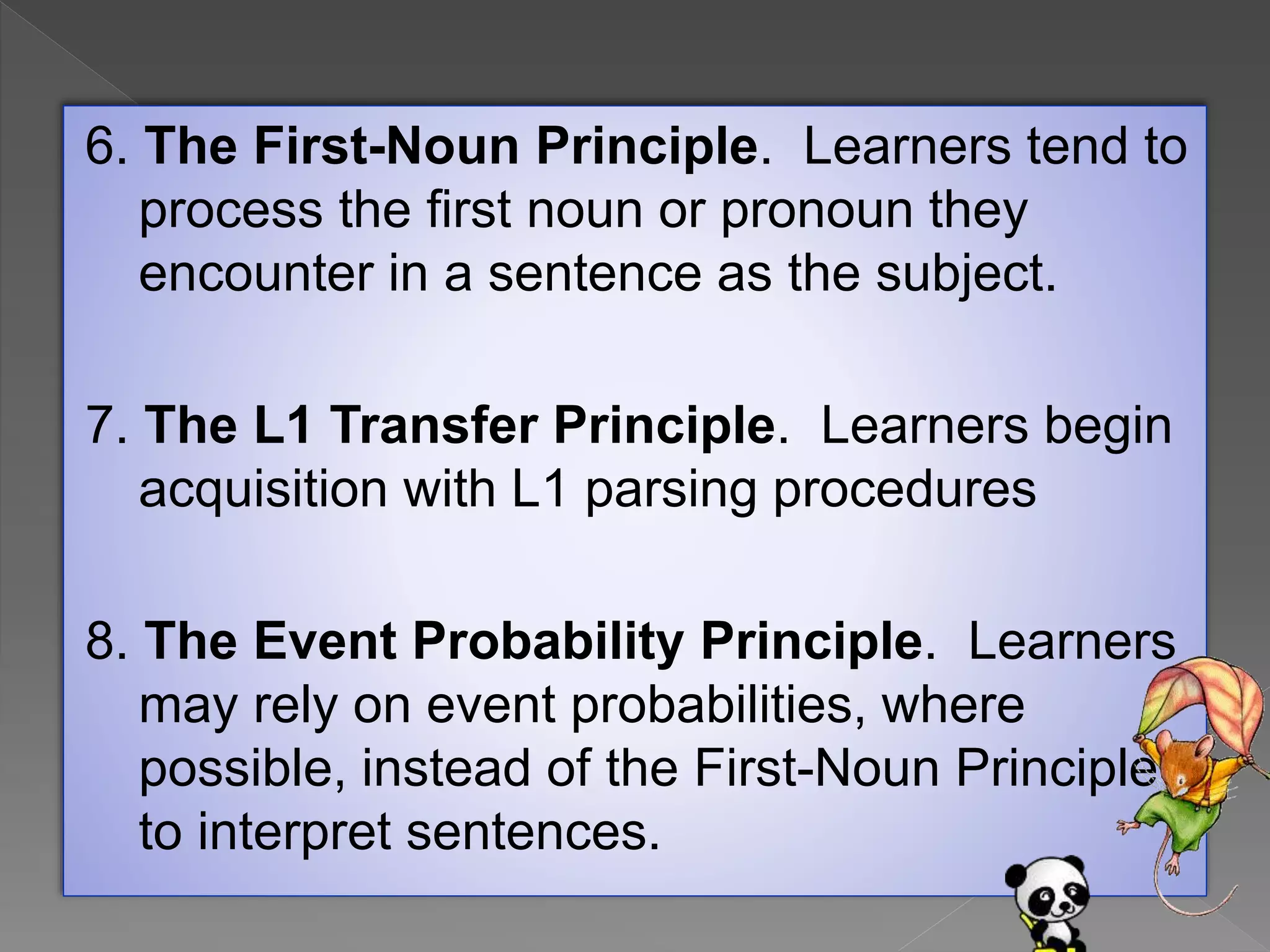
6. The First-Noun Principle. Learners tend to
process the first noun or pronoun they
encounter in a sentence as the subject.
7. The L1 Transfer Principle. Learners begin
acquisition with L1 parsing procedures
8. The Event Probability Principle. Learners
may rely on event probabilities, where
possible, instead of the First-Noun Principle
to interpret sentences.
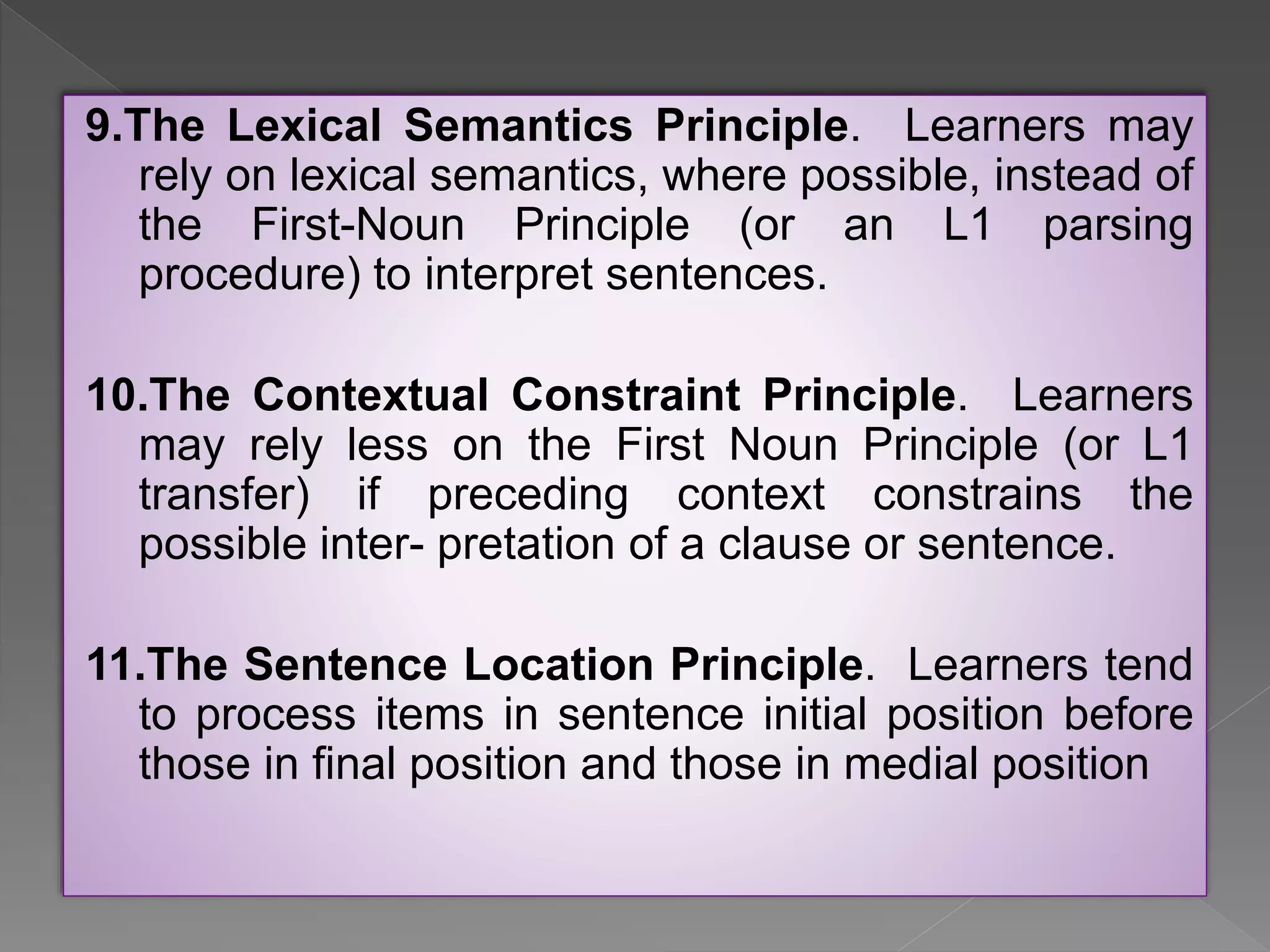
9.The Lexical Semantics Principle. Learners may
rely on lexical semantics, where possible, instead of
the First-Noun Principle (or an L1 parsing
procedure) to interpret sentences.
10.The Contextual Constraint Principle. Learners
may rely less on the First Noun Principle (or L1
transfer) if preceding context constrains the
possible inter- pretation of a clause or sentence.
11.The Sentence Location Principle. Learners tend
to process items in sentence initial position before
those in final position and those in medial position
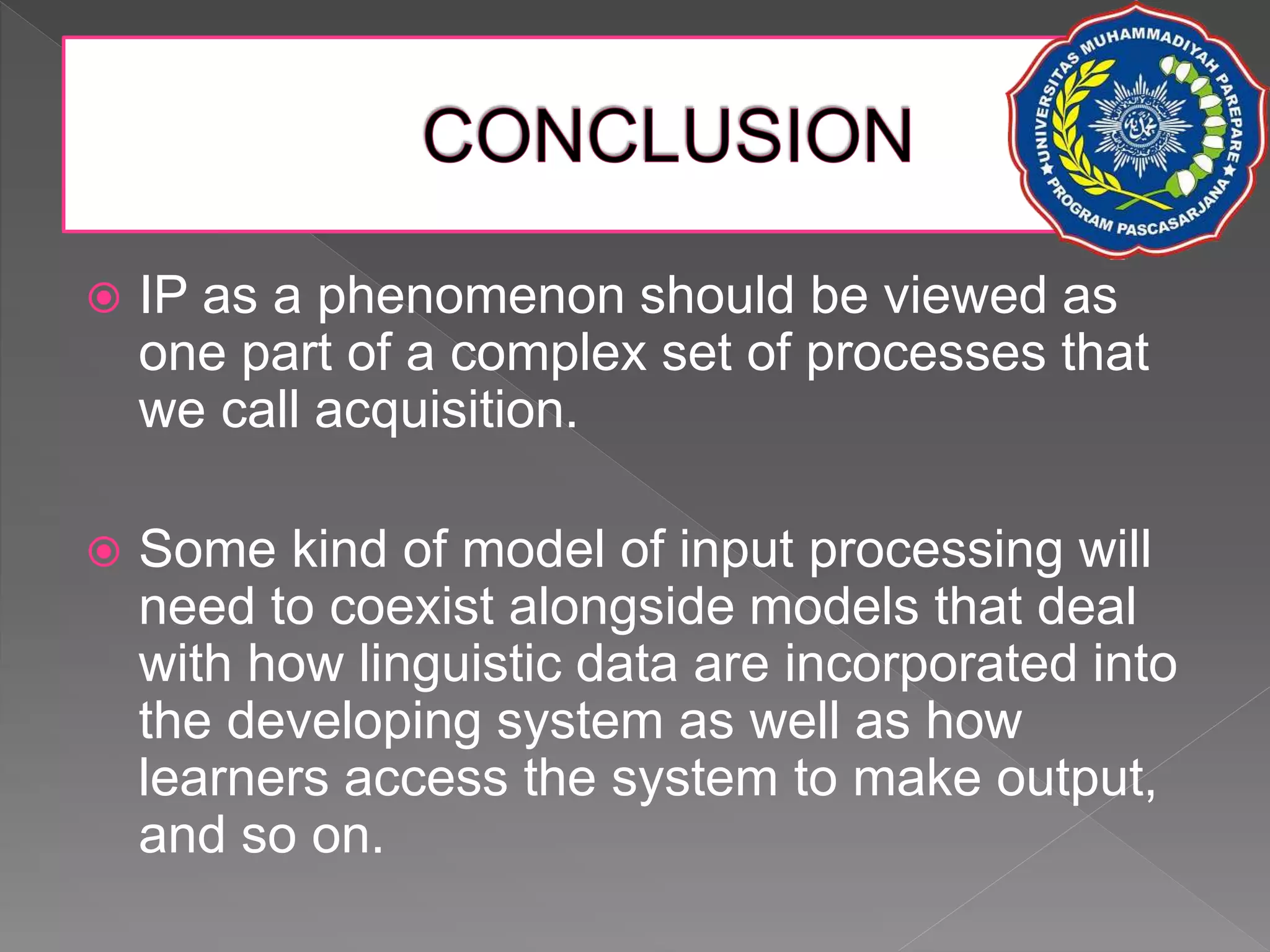
 IP as a phenomenon should be viewed as
one part of a complex set of processes that
we call acquisition.
 Some kind of model of input processing will
need to coexist alongside models that deal
with how linguistic data are incorporated into
the developing system as well as how
learners access the system to make output,
and so on.
Input processing in adult sla

Input processing in adult sla

  • 2.
     Input processing(IP) is concerned with these situations, the reason being that acquisition is, to a certain degree, a by-product of comprehension (see, e.g., Truscott & Sharwood Smith, 2004).  Although comprehension cannot guarantee acquisition, acquisition cannot happen if comprehension does not occur. Why? Because a good deal of acquisition is dependent upon learners making appropriate form–meaning connections during the act of comprehension.
  • 3.
     IP isconcerned with three fundamental questions that involve the assumption that an integral part of language acquisition is making form–meaning connections during comprehension: 1. Under what conditions do learners make initial form–meaning connections? 2. Why, at a given moment in time, do they make some and not other form– meaning connections? 3. What internal psycholinguistic strategies do learners use in comprehending sentences and how might this affect acquisition?
  • 4.
     These claimsare codified in the following IP principle : 1. The Primacy of Content Words Principle. Learners process content words in the input before anything else. 2.The Lexical Preference Principle. Learners will process lexical items for meaning before grammatical forms when both encode the same semantic (“real world” information. 3. (Revised) Lexical Preference Principle. If grammatical forms express a meaning that can also be encoded lexically (i.e., that grammatical marker is redundant), then learners will not initially process those grammatical forms until they have lexical forms to which they can match them.
  • 5.
    4. The Preferencefor Non redundancy Principle. Learners are more likely to process non-redundant meaningful grammatical markers before they process redundant meaningful markers. 5. The Meaning before Nonmeaning Principle. Learners are more likely to process meaningful grammatical markers before non meaningful grammatical markers.
  • 6.
    6. The First-NounPrinciple. Learners tend to process the first noun or pronoun they encounter in a sentence as the subject. 7. The L1 Transfer Principle. Learners begin acquisition with L1 parsing procedures 8. The Event Probability Principle. Learners may rely on event probabilities, where possible, instead of the First-Noun Principle to interpret sentences.
  • 7.
    9.The Lexical SemanticsPrinciple. Learners may rely on lexical semantics, where possible, instead of the First-Noun Principle (or an L1 parsing procedure) to interpret sentences. 10.The Contextual Constraint Principle. Learners may rely less on the First Noun Principle (or L1 transfer) if preceding context constrains the possible inter- pretation of a clause or sentence. 11.The Sentence Location Principle. Learners tend to process items in sentence initial position before those in final position and those in medial position
  • 8.
     IP asa phenomenon should be viewed as one part of a complex set of processes that we call acquisition.  Some kind of model of input processing will need to coexist alongside models that deal with how linguistic data are incorporated into the developing system as well as how learners access the system to make output, and so on.