Language Acquisition
         vs.
 Learning a Language

       Magda Enriquez-Beitler
       One Click! Your Solution
Communication is a pre-requisite for learning
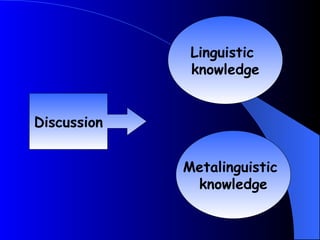
Linguistic
              knowledge


Discussion


             Metalinguistic
              knowledge
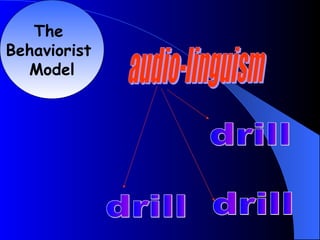
The
Behaviorist
  Model
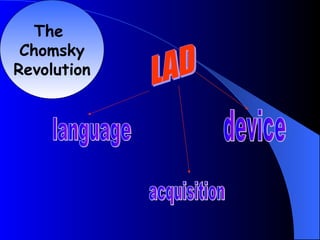
The
 Chomsky
Revolution
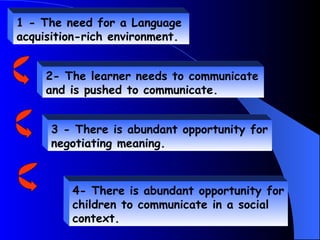
Several implications for instruction
1 - The need for a Language
acquisition-rich environment.


     2- The learner needs to communicate
     and is pushed to communicate.


      3 - There is abundant opportunity for
      negotiating meaning.


         4- There is abundant opportunity for
         children to communicate in a social
         context.
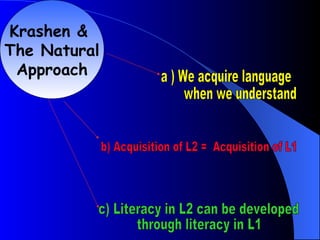
Krashen &
The Natural
 Approach
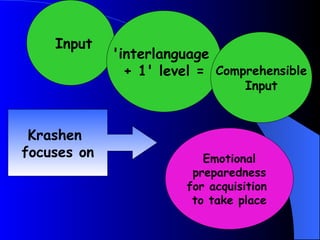
Input
             'interlanguage
               + 1' level = Comprehensible
                                  Input


 Krashen
focuses on                 Emotional
                         preparedness
                        for acquisition
                         to take place
THE NATURAL APPROACH

         5 Hypothesis
1
       Acquisition-Learning Hypothesis

    "There are two independent ways of
    developing ability in second languages.
    'Acquisition' is a subconscious process
    identical in all important ways to the
    process children utilize in acquiring their
    first language, ... [and] ‘learning’... [which
    is] a conscious process that results in
    'knowing about' [the rules of] language"
    (Krashen 1985:1).
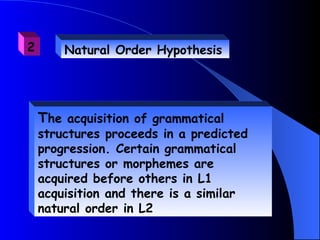
2       Natural Order Hypothesis


    The acquisition of grammatical
    structures proceeds in a predicted
    progression. Certain grammatical
    structures or morphemes are
    acquired before others in L1
    acquisition and there is a similar
    natural order in L2
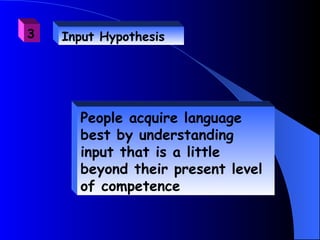
3   Input Hypothesis


      People acquire language
      best by understanding
      input that is a little
      beyond their present level
      of competence
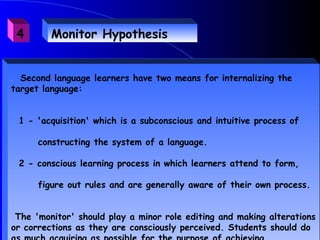
4      Monitor Hypothesis


. Second language learners have two means for internalizing the
target language:


    1 - 'acquisition' which is a subconscious and intuitive process of

        constructing the system of a language.

    2 - conscious learning process in which learners attend to form,

        figure out rules and are generally aware of their own process.


 The 'monitor' should play a minor role editing and making alterations
or corrections as they are consciously perceived. Students should do
5      Affective Filter Hypothesis


    The learner's emotional state is like an
    adjustable filter which freely passes or
    hinders input necessary to acquisition.
    The filter is 'affective' because the
    factors which regulate its strength are
    self-confidence, motivation and anxiety
    state
Characteristics of an Effective Program
Supportive
whole-school
contexts
               High expectations for
               language minority students


                        Frequent
                        student
                        interaction
Teachers with
high commitment


             Intensive staff
             development programs


                  Expert instructional
                  leaders and teachers
Emphasis on
functional communication


     Organization
     of the instruction
Principals supportive
of their instructional
staff and of teacher
autonomy
Involvement
of majority
and minority
 parents
The ESL Classroom
Teachers use English as the medium for
providing content area instruction,


Teachers adapt their language to the
proficiency level of the students.


     There are abundant opportunities for

      teachers and students to negotiate
     meaning.
Teachers use gestures and visual
aids to help students understand.


   Instruction focuses on content
   rather than language.
Principles operating
                in an ESL classroom
Focus is on meaning rather than
on form. There is no overt error
correction. Linguistic modifications,
such as simplified or caretaker
speech and controlled vocabulary
and sentence length are used.
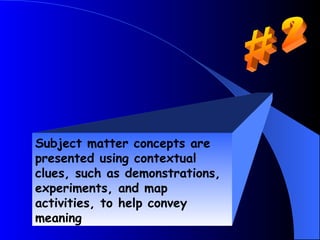
Subject matter concepts are
presented using contextual
clues, such as demonstrations,
experiments, and map
activities, to help convey
meaning
Conversational interaction
is interesting and relevant
to the students
Components of an ESL Lesson
Students are allowed a
pre-speech stage or silent
period and do not have to
speak until they are ready   (
Krashen and Terrell 1983,
Krashen 1984, 1985).
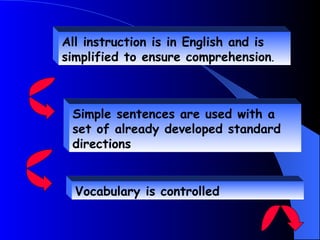
All instruction is in English and is
simplified to ensure comprehension.


 Simple sentences are used with a
 set of already developed standard
 directions


  Vocabulary is controlled
The teacher should speak at his/her
normal rate of speech, the pauses
between sentence boundaries (i.e.,
where there would be a comma,
period, or question mark if speech
were written down) can be
lengthened slightly. .


  Emphasis is on the development of
  reading, writing, and thinking skills.
Acquisition vs learning.

Acquisition vs learning.

  • 1.
    Language Acquisition vs. Learning a Language Magda Enriquez-Beitler One Click! Your Solution
  • 2.
    Communication is apre-requisite for learning
  • 4.
    Linguistic knowledge Discussion Metalinguistic knowledge
  • 5.
  • 6.
  • 7.
  • 8.
    1 - Theneed for a Language acquisition-rich environment. 2- The learner needs to communicate and is pushed to communicate. 3 - There is abundant opportunity for negotiating meaning. 4- There is abundant opportunity for children to communicate in a social context.
  • 9.
  • 10.
    Input 'interlanguage + 1' level = Comprehensible Input Krashen focuses on Emotional preparedness for acquisition to take place
  • 11.
  • 12.
    1 Acquisition-Learning Hypothesis "There are two independent ways of developing ability in second languages. 'Acquisition' is a subconscious process identical in all important ways to the process children utilize in acquiring their first language, ... [and] ‘learning’... [which is] a conscious process that results in 'knowing about' [the rules of] language" (Krashen 1985:1).
  • 13.
    2 Natural Order Hypothesis The acquisition of grammatical structures proceeds in a predicted progression. Certain grammatical structures or morphemes are acquired before others in L1 acquisition and there is a similar natural order in L2
  • 14.
    3 Input Hypothesis People acquire language best by understanding input that is a little beyond their present level of competence
  • 15.
    4 Monitor Hypothesis . Second language learners have two means for internalizing the target language: 1 - 'acquisition' which is a subconscious and intuitive process of constructing the system of a language. 2 - conscious learning process in which learners attend to form, figure out rules and are generally aware of their own process. The 'monitor' should play a minor role editing and making alterations or corrections as they are consciously perceived. Students should do
  • 16.
    5 Affective Filter Hypothesis The learner's emotional state is like an adjustable filter which freely passes or hinders input necessary to acquisition. The filter is 'affective' because the factors which regulate its strength are self-confidence, motivation and anxiety state
  • 17.
    Characteristics of anEffective Program
  • 18.
    Supportive whole-school contexts High expectations for language minority students Frequent student interaction
  • 19.
    Teachers with high commitment Intensive staff development programs Expert instructional leaders and teachers
  • 20.
    Emphasis on functional communication Organization of the instruction
  • 21.
    Principals supportive of theirinstructional staff and of teacher autonomy
  • 22.
  • 23.
  • 24.
    Teachers use Englishas the medium for providing content area instruction, Teachers adapt their language to the proficiency level of the students. There are abundant opportunities for teachers and students to negotiate meaning.
  • 25.
    Teachers use gesturesand visual aids to help students understand. Instruction focuses on content rather than language.
  • 26.
    Principles operating in an ESL classroom
  • 27.
    Focus is onmeaning rather than on form. There is no overt error correction. Linguistic modifications, such as simplified or caretaker speech and controlled vocabulary and sentence length are used.
  • 28.
    Subject matter conceptsare presented using contextual clues, such as demonstrations, experiments, and map activities, to help convey meaning
  • 29.
    Conversational interaction is interestingand relevant to the students
  • 30.
    Components of anESL Lesson
  • 31.
    Students are alloweda pre-speech stage or silent period and do not have to speak until they are ready ( Krashen and Terrell 1983, Krashen 1984, 1985).
  • 32.
    All instruction isin English and is simplified to ensure comprehension. Simple sentences are used with a set of already developed standard directions Vocabulary is controlled
  • 33.
    The teacher shouldspeak at his/her normal rate of speech, the pauses between sentence boundaries (i.e., where there would be a comma, period, or question mark if speech were written down) can be lengthened slightly. . Emphasis is on the development of reading, writing, and thinking skills.

Editor's Notes

  • #5 The pragmatic use of language - linguistic knowledge - and how language is used and regulated - metalinguistic knowledge - are the basis for children's transition to literacy. How humans acquire linguistic and metalinguistic knowledge has been the on going discussion among linguists, socio-linguist, educators, psycholinguistics and educational psychologists. 
  • #13 Krashen, in his theory of second language acquisition (SLA), suggested that adults* have two different ways of developing competence in second languages: Acquisition and learning. "There are two independent ways of developing ability in second languages. 'Acquisition' is a subconscious process identical in all important ways to the process children utilize in acquiring their first language, ... [and] ‘learning’... [which is] a conscious process that results in 'knowing about' [the rules of] language" (Krashen 1985:1).