Reproductive and Child
Health
BY
KRITI SINGH
JUNIOR RESIDENT
DEPARTMENT OF COMMUNITY MEDICINE
GSVM MEDICAL COLLEGE
Background
 The RCH Programme was launched in India on 15th October,1997.
 It was based on RCH approach
- People have the ability to reproduce and regulate their fertility
- Women are able to go through pregnancy and child birth safely,
- The outcome of pregnancies is successful in terms of maternal and
infant survival and well being,
-Couples are able to have sexual relations free of fear of pregnancy
and contracting diseases.
 Target free approach
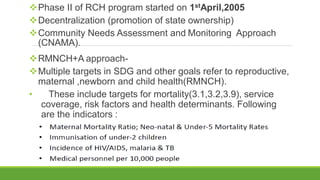
Phase II of RCH program started on 1stApril,2005
Decentralization (promotion of state ownership)
Community Needs Assessment and Monitoring Approach
(CNAMA).
RMNCH+A approach-
Multiple targets in SDG and other goals refer to reproductive,
maternal ,newborn and child health(RMNCH).
• These include targets for mortality(3.1,3.2,3.9), service
coverage, risk factors and health determinants. Following
are the indicators :
MILESTONES OF RCH
•1952 -Launch of National Family Planning Programme
•1966 -Launch of All India Hospital Post Partum Programme for hospital based maternity care
•1971 -MTP Act
•1976 -Formulation of First National Population Policy
•1977 -Renamed to National Family Welfare Programme
•1992 -Launch of Child Survival and Safe Motherhood(CSSM) Programme
•1996 -Adoption of Target Free Approach and renamed to Community Needs Assessment
Approach(CNAA)
•1997 -Launch of Community Needs Assessment and Monitoring Approach(CNAMA) under RCH
Programme
•1997 -RCH Programme Phase‐1 (15.10. 1997)
•2005 -RCH Programme Phase‐2 (01‐04‐2005)
RCH Phase‐I
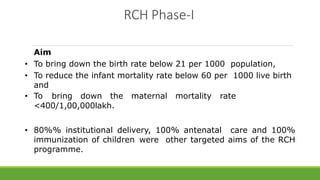
Aim
• To bring down the birth rate below 21 per 1000 population,
• To reduce the infant mortality rate below 60 per 1000 live birth
and
• To bring down the maternal mortality rate
<400/1,00,000lakh.
• 80%% institutional delivery, 100% antenatal care and 100%
immunization of children were other targeted aims of the RCH
programme.
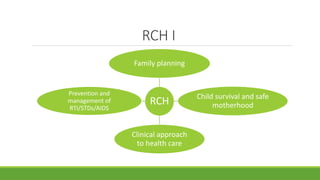
RCH I
RCH
Family planning
Child survival and safe
motherhood
Clinical approach
to health care
Prevention and
management of
RTI/STDs/AIDS
RCH Phase‐II
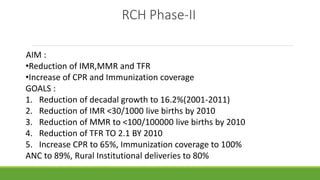
AIM :
•Reduction of IMR,MMR and TFR
•Increase of CPR and Immunization coverage
GOALS :
1. Reduction of decadal growth to 16.2%(2001-2011)
2. Reduction of IMR <30/1000 live births by 2010
3. Reduction of MMR to <100/100000 live births by 2010
4. Reduction of TFR TO 2.1 BY 2010
5. Increase CPR to 65%, Immunization coverage to 100%
ANC to 89%, Rural Institutional deliveries to 80%
Indicator Tenth Plan
Goals (2002‐
2007)
RCH II Goals
(2005‐2010)
National
Population
Policy 2000
(by 2010)
Millennium
Development
Goals (By
2015)
Sustainable
Development
Goals( By
Targets under
NHP 2017)
Population
Growth
16.2% (2001‐
2011)
16.2%
(2001‐2011)
‐ ‐ -
Infant Mortality
Rate
45/1000 35/1000 30/1000 ‐ 28 by 2019
Under 5 Mortality
Rate
‐ ‐ ‐ Reduce by
2/3rds
23 by 2025
Maternal
Mortality Ratio
200/100,000 150/100,000 100/100,000 Reduce by
3/4th
100 by2020
TotalFertility
Rate
2.3 2.2 2.1 ‐ 2.2 in 2016
Contraceptive
Prevalence Rate
65% 65% Meet 100%
needs
‐ 54%
OBJECTIVES OF RCH PHASE‐II
1. Reduction of Maternal Morbidity and Mortality
2. Reduction of Infant Morbidity and Mortality
3. Reduction of Under 5 Morbidity and Mortality
4. Promotion of Adolescent Health
5. Control of Reproductive Tract Infections and Sexually
Transmitted Infections.
Components
Essential obstetrical care
Emergency obstetrical care
Strengthening referral system Strengthening
project management
Strengthening infrastructure
Capacity building
Improving referral system
Essential obstetric care
• This is the minimum obstetric care that must be made
available to all pregnant women
 Registration of pregnancy in the first 12-16 weeks of pregnancy
 Atleast 3 prenatal checkups by ANM or health facility
 Assistance during delivery( Skilled Birth Attendant)
 At least 3 postnatal checkups
Emergency obstetric care
• Operationalisation of FRUs to provide:
– 24 hours delivery services
– Emergency obstetric care
– New born care and emergency care of the sick child
– Full range of family planning services
– Safe abortion services
– Treatment of RTI and STI
– Blood storage facility
– Essential laboratory services
– Referral ( transport ) services
New initiatives
• Training of PHC doctors in life saving anesthetic skills for emergency obstetric
care a FRUs
• Setting up of blood storage centers at FRUs
• Janani Suraksha Yojana (JSY)
• Vandemataram scheme
• Safe abortion services
• Integrated Management of Neonatal & Childhood illnesses
(IMNCI).
24 hrs. Functioning of PHCs
• Availability of Services such as
 24 Hrs. Delivery services
 New Born care
 Family Planning, Counselling and services
 Availability of RTI, STI services
 Safe abortion services (MVA etc.)
Training in Obstetric Management
•Training of MBBS doctors in obstetric management and skills
including C.S. in RCH‐II
•Training to be conducted in collaboration with FOGSI
•Duration of training to be 16 weeks
•Expert Group is considering other details
Janani Surkasha Yojna
•To promote Institutional Deliveries
– To reduce Maternal Mortality Ratio and Infant Mortality Rate
•A safe motherhood intervention, replacing the “National
Maternity Benefit Scheme”, under NRHM
•100 % centrally sponsored
•Integrates cash assistance with delivery & post‐ delivery care.
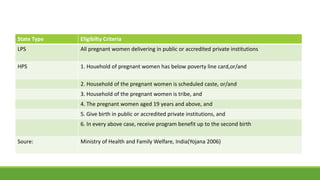
State Type Eligibilty Criteria
LPS All pregnant women delivering in public or accredited private institutions
HPS 1. Houehold of pregnant women has below poverty line card,or/and
2. Household of the pregnant women is scheduled caste, or/and
3. Household of the pregnant women is tribe, and
4. The pregnant women aged 19 years and above, and
5. Give birth in public or accredited private institutions, and
6. In every above case, receive program benefit up to the second birth
Soure: Ministry of Health and Family Welfare, India(Yojana 2006)
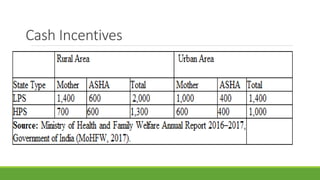
Cash Incentives
Vandematram Scheme
• To promote public private partnership
• Launched in 9th February with involvement of Indian medical
ssociation, federation of obstetrics and gynaecology society.
• Voluntary enrolment of doctors, nursing home; maternity home
• Antenatal and Postnatal Checkup
• Distribution of Iron and Folic Acid Tablets Immunization.
• Referal Case require special case
Referral Transport
Key issues:
–RCH I funds poorly Utilized,
–Community participation lacking
Under Consideration:
–Place funds with AWW /ANM, JSY
–Develop community mechanisms
–Provide out source ambulances at PHCs, CHCs, and FRUs
Role of ASHA
• ASHA must primarily be a women resident of the village-
married/widowed/divorced preferably in age group of 25-45 years.
• She receives performance based incentives for promoting universal
immunization, referral and escort services for Reproductive and Child Health
(RCH) and other heath programs.
• She act as a depot holder for essential provisions being made available to all
habitants like Oral Rehydration Therapy(ORS), Iron Folic Acid Tabs
(IFA),Chloroquine, Disposable Delivery Kits( DDK), Oral Pills and Condoms
etc.
• Adolescents Health Counsellor.
• One ASHA for every 2500 population.
• Janani‐Shishu Suraksha Karyakram (JSSK)
• Village Health & Nutrition Day (VHND- to be organized once
every month: preferably on Wednesdays and for those villages
that have been left out , on any other day in same month at
AWC in the village)
• Maternal Child Tracking System (MCTS)
• Maternal Death Review (MDR)
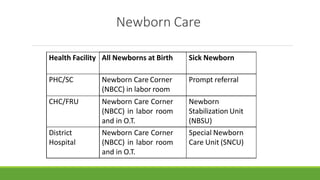
Newborn Care
Health Facility All Newborns at Birth Sick Newborn
PHC/SC Newborn Care Corner
(NBCC) in labor room
Prompt referral
CHC/FRU Newborn Care Corner
(NBCC) in labor room
and in O.T.
Newborn
Stabilization Unit
(NBSU)
District
Hospital
Newborn Care Corner
(NBCC) in labor room
and in O.T.
Special Newborn
Care Unit (SNCU)
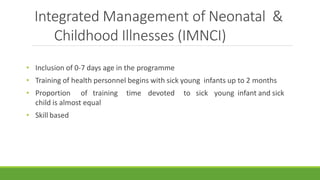
Integrated Management of Neonatal &
Childhood Illnesses (IMNCI)
• Inclusion of 0‐7 days age in the programme
• Training of health personnel begins with sick young infants up to 2 months
• Proportion of training time devoted to sick young infant and sick
child is almost equal
• Skill based
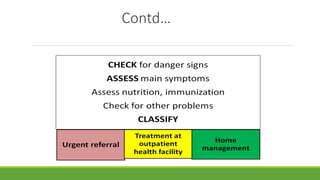
Contd…
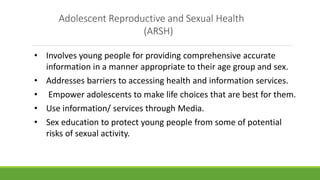
Adolescent Reproductive and Sexual Health
(ARSH)
• Involves young people for providing comprehensive accurate
information in a manner appropriate to their age group and sex.
• Addresses barriers to accessing health and information services.
• Empower adolescents to make life choices that are best for them.
• Use information/ services through Media.
• Sex education to protect young people from some of potential
risks of sexual activity.
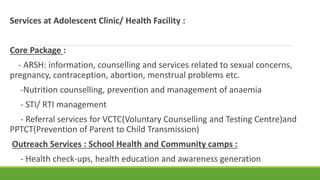
Services at Adolescent Clinic/ Health Facility :
Core Package :
- ARSH: information, counselling and services related to sexual concerns,
pregnancy, contraception, abortion, menstrual problems etc.
-Nutrition counselling, prevention and management of anaemia
- STI/ RTI management
- Referral services for VCTC(Voluntary Counselling and Testing Centre)and
PPTCT(Prevention of Parent to Child Transmission)
Outreach Services : School Health and Community camps :
- Health check-ups, health education and awareness generation
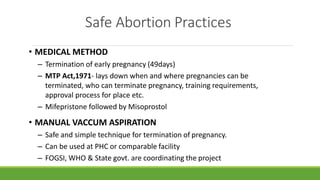
Safe Abortion Practices
• MEDICAL METHOD
– Termination of early pregnancy (49days)
– MTP Act,1971- lays down when and where pregnancies can be
terminated, who can terminate pregnancy, training requirements,
approval process for place etc.
– Mifepristone followed by Misoprostol
• MANUAL VACCUM ASPIRATION
– Safe and simple technique for termination of pregnancy.
– Can be used at PHC or comparable facility
– FOGSI, WHO & State govt. are coordinating the project
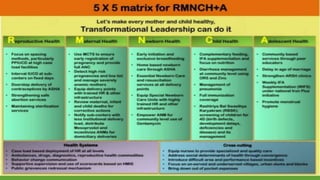
Reproductive Maternal, Newborn, Child Plus
Adolescent Health(RMNCH+A)
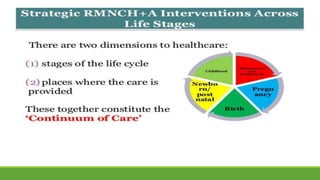
Continnum of Care approach:
1. All stages of life- life cycle approach
2. All places of Health care delivery
• Inclusion od ADOLESCENCE
• Linking of Maternal and Child Health to Reproductive
Health and Other Components( family planning,
adolescent health, HIV, gender and PC& PNDT )
• Linking of Community and Facility- Based Care
Health Outcome Goals established in the 12th
Five Year Plan
• Reduction of :
Infant Mortality Rate (IMR) to 25 per 1,000
live births by 2017
Maternal Mortality Ratio (MMR) to 100 per
100,000 live births by 2017
Total Fertility Rate(TFR) to 2.1 by 2017
Rch ppt
Rch ppt

Rch ppt

  • 1.
    Reproductive and Child Health BY KRITISINGH JUNIOR RESIDENT DEPARTMENT OF COMMUNITY MEDICINE GSVM MEDICAL COLLEGE
  • 2.
    Background  The RCHProgramme was launched in India on 15th October,1997.  It was based on RCH approach - People have the ability to reproduce and regulate their fertility - Women are able to go through pregnancy and child birth safely, - The outcome of pregnancies is successful in terms of maternal and infant survival and well being, -Couples are able to have sexual relations free of fear of pregnancy and contracting diseases.  Target free approach
  • 3.
    Phase II ofRCH program started on 1stApril,2005 Decentralization (promotion of state ownership) Community Needs Assessment and Monitoring Approach (CNAMA). RMNCH+A approach- Multiple targets in SDG and other goals refer to reproductive, maternal ,newborn and child health(RMNCH). • These include targets for mortality(3.1,3.2,3.9), service coverage, risk factors and health determinants. Following are the indicators :
  • 4.
    MILESTONES OF RCH •1952-Launch of National Family Planning Programme •1966 -Launch of All India Hospital Post Partum Programme for hospital based maternity care •1971 -MTP Act •1976 -Formulation of First National Population Policy •1977 -Renamed to National Family Welfare Programme •1992 -Launch of Child Survival and Safe Motherhood(CSSM) Programme •1996 -Adoption of Target Free Approach and renamed to Community Needs Assessment Approach(CNAA) •1997 -Launch of Community Needs Assessment and Monitoring Approach(CNAMA) under RCH Programme •1997 -RCH Programme Phase‐1 (15.10. 1997) •2005 -RCH Programme Phase‐2 (01‐04‐2005)
  • 6.
    RCH Phase‐I Aim • Tobring down the birth rate below 21 per 1000 population, • To reduce the infant mortality rate below 60 per 1000 live birth and • To bring down the maternal mortality rate <400/1,00,000lakh. • 80%% institutional delivery, 100% antenatal care and 100% immunization of children were other targeted aims of the RCH programme.
  • 7.
    RCH I RCH Family planning Childsurvival and safe motherhood Clinical approach to health care Prevention and management of RTI/STDs/AIDS
  • 8.
    RCH Phase‐II AIM : •Reductionof IMR,MMR and TFR •Increase of CPR and Immunization coverage GOALS : 1. Reduction of decadal growth to 16.2%(2001-2011) 2. Reduction of IMR <30/1000 live births by 2010 3. Reduction of MMR to <100/100000 live births by 2010 4. Reduction of TFR TO 2.1 BY 2010 5. Increase CPR to 65%, Immunization coverage to 100% ANC to 89%, Rural Institutional deliveries to 80%
  • 9.
    Indicator Tenth Plan Goals(2002‐ 2007) RCH II Goals (2005‐2010) National Population Policy 2000 (by 2010) Millennium Development Goals (By 2015) Sustainable Development Goals( By Targets under NHP 2017) Population Growth 16.2% (2001‐ 2011) 16.2% (2001‐2011) ‐ ‐ - Infant Mortality Rate 45/1000 35/1000 30/1000 ‐ 28 by 2019 Under 5 Mortality Rate ‐ ‐ ‐ Reduce by 2/3rds 23 by 2025 Maternal Mortality Ratio 200/100,000 150/100,000 100/100,000 Reduce by 3/4th 100 by2020 TotalFertility Rate 2.3 2.2 2.1 ‐ 2.2 in 2016 Contraceptive Prevalence Rate 65% 65% Meet 100% needs ‐ 54%
  • 10.
    OBJECTIVES OF RCHPHASE‐II 1. Reduction of Maternal Morbidity and Mortality 2. Reduction of Infant Morbidity and Mortality 3. Reduction of Under 5 Morbidity and Mortality 4. Promotion of Adolescent Health 5. Control of Reproductive Tract Infections and Sexually Transmitted Infections.
  • 11.
    Components Essential obstetrical care Emergencyobstetrical care Strengthening referral system Strengthening project management Strengthening infrastructure Capacity building Improving referral system
  • 12.
    Essential obstetric care •This is the minimum obstetric care that must be made available to all pregnant women  Registration of pregnancy in the first 12-16 weeks of pregnancy  Atleast 3 prenatal checkups by ANM or health facility  Assistance during delivery( Skilled Birth Attendant)  At least 3 postnatal checkups
  • 13.
    Emergency obstetric care •Operationalisation of FRUs to provide: – 24 hours delivery services – Emergency obstetric care – New born care and emergency care of the sick child – Full range of family planning services – Safe abortion services – Treatment of RTI and STI – Blood storage facility – Essential laboratory services – Referral ( transport ) services
  • 14.
    New initiatives • Trainingof PHC doctors in life saving anesthetic skills for emergency obstetric care a FRUs • Setting up of blood storage centers at FRUs • Janani Suraksha Yojana (JSY) • Vandemataram scheme • Safe abortion services • Integrated Management of Neonatal & Childhood illnesses (IMNCI).
  • 15.
    24 hrs. Functioningof PHCs • Availability of Services such as  24 Hrs. Delivery services  New Born care  Family Planning, Counselling and services  Availability of RTI, STI services  Safe abortion services (MVA etc.)
  • 16.
    Training in ObstetricManagement •Training of MBBS doctors in obstetric management and skills including C.S. in RCH‐II •Training to be conducted in collaboration with FOGSI •Duration of training to be 16 weeks •Expert Group is considering other details
  • 17.
    Janani Surkasha Yojna •Topromote Institutional Deliveries – To reduce Maternal Mortality Ratio and Infant Mortality Rate •A safe motherhood intervention, replacing the “National Maternity Benefit Scheme”, under NRHM •100 % centrally sponsored •Integrates cash assistance with delivery & post‐ delivery care.
  • 18.
    State Type EligibiltyCriteria LPS All pregnant women delivering in public or accredited private institutions HPS 1. Houehold of pregnant women has below poverty line card,or/and 2. Household of the pregnant women is scheduled caste, or/and 3. Household of the pregnant women is tribe, and 4. The pregnant women aged 19 years and above, and 5. Give birth in public or accredited private institutions, and 6. In every above case, receive program benefit up to the second birth Soure: Ministry of Health and Family Welfare, India(Yojana 2006)
  • 19.
  • 20.
    Vandematram Scheme • Topromote public private partnership • Launched in 9th February with involvement of Indian medical ssociation, federation of obstetrics and gynaecology society. • Voluntary enrolment of doctors, nursing home; maternity home • Antenatal and Postnatal Checkup • Distribution of Iron and Folic Acid Tablets Immunization. • Referal Case require special case
  • 21.
    Referral Transport Key issues: –RCHI funds poorly Utilized, –Community participation lacking Under Consideration: –Place funds with AWW /ANM, JSY –Develop community mechanisms –Provide out source ambulances at PHCs, CHCs, and FRUs
  • 22.
    Role of ASHA •ASHA must primarily be a women resident of the village- married/widowed/divorced preferably in age group of 25-45 years. • She receives performance based incentives for promoting universal immunization, referral and escort services for Reproductive and Child Health (RCH) and other heath programs. • She act as a depot holder for essential provisions being made available to all habitants like Oral Rehydration Therapy(ORS), Iron Folic Acid Tabs (IFA),Chloroquine, Disposable Delivery Kits( DDK), Oral Pills and Condoms etc. • Adolescents Health Counsellor. • One ASHA for every 2500 population.
  • 23.
    • Janani‐Shishu SurakshaKaryakram (JSSK) • Village Health & Nutrition Day (VHND- to be organized once every month: preferably on Wednesdays and for those villages that have been left out , on any other day in same month at AWC in the village) • Maternal Child Tracking System (MCTS) • Maternal Death Review (MDR)
  • 24.
    Newborn Care Health FacilityAll Newborns at Birth Sick Newborn PHC/SC Newborn Care Corner (NBCC) in labor room Prompt referral CHC/FRU Newborn Care Corner (NBCC) in labor room and in O.T. Newborn Stabilization Unit (NBSU) District Hospital Newborn Care Corner (NBCC) in labor room and in O.T. Special Newborn Care Unit (SNCU)
  • 25.
    Integrated Management ofNeonatal & Childhood Illnesses (IMNCI) • Inclusion of 0‐7 days age in the programme • Training of health personnel begins with sick young infants up to 2 months • Proportion of training time devoted to sick young infant and sick child is almost equal • Skill based
  • 26.
  • 27.
    Adolescent Reproductive andSexual Health (ARSH) • Involves young people for providing comprehensive accurate information in a manner appropriate to their age group and sex. • Addresses barriers to accessing health and information services. • Empower adolescents to make life choices that are best for them. • Use information/ services through Media. • Sex education to protect young people from some of potential risks of sexual activity.
  • 28.
    Services at AdolescentClinic/ Health Facility : Core Package : - ARSH: information, counselling and services related to sexual concerns, pregnancy, contraception, abortion, menstrual problems etc. -Nutrition counselling, prevention and management of anaemia - STI/ RTI management - Referral services for VCTC(Voluntary Counselling and Testing Centre)and PPTCT(Prevention of Parent to Child Transmission) Outreach Services : School Health and Community camps : - Health check-ups, health education and awareness generation
  • 29.
    Safe Abortion Practices •MEDICAL METHOD – Termination of early pregnancy (49days) – MTP Act,1971- lays down when and where pregnancies can be terminated, who can terminate pregnancy, training requirements, approval process for place etc. – Mifepristone followed by Misoprostol • MANUAL VACCUM ASPIRATION – Safe and simple technique for termination of pregnancy. – Can be used at PHC or comparable facility – FOGSI, WHO & State govt. are coordinating the project
  • 30.
    Reproductive Maternal, Newborn,Child Plus Adolescent Health(RMNCH+A) Continnum of Care approach: 1. All stages of life- life cycle approach 2. All places of Health care delivery • Inclusion od ADOLESCENCE • Linking of Maternal and Child Health to Reproductive Health and Other Components( family planning, adolescent health, HIV, gender and PC& PNDT ) • Linking of Community and Facility- Based Care
  • 32.
    Health Outcome Goalsestablished in the 12th Five Year Plan • Reduction of : Infant Mortality Rate (IMR) to 25 per 1,000 live births by 2017 Maternal Mortality Ratio (MMR) to 100 per 100,000 live births by 2017 Total Fertility Rate(TFR) to 2.1 by 2017

Editor's Notes