REPRODUCTION AND CHILD HEALTH
PROGRAMME
REPRODUCTIVE AND
CHILD HEALTH
PROGRAMME- 2
Introduction :
The reproductive and Child Health Programme
was formally launched by government of India on 15th
October 1997. as per Recommendation of international
conference on population and development held in cario
in 1994.
INTRODUCTION
Definition
RCH as “A state of complete, physical, mental, and social
well being and merely the absence of disease of infirmity
in all matters relating to reproductive system and its
function and process.”
Definition
“A state in which people have the ability to the reproduce and regulate their
fertility are able to go through pregnancy and child birth, the outcome of
pregnancy is successful in terms of maternal and Infant survival and well-
being, and couples are able to have sexual relation free of the fear of
pregnancy and of contracting disease”
Definition
Objectives
 To permit the health of the mothers and children
to ensure safe Motherhood and child survival.
 The intermediate objective is to reduce IMR &
MMR.
 The ultimate objective is population stabilization,
through responsible care
Objectives
 Prevention and management of unwanted
pregnancy.
 Maternal care( safe motherhood)
 Child survival
 Prevention and management of RTIS/ STD
 Prevention of HIV/AIDS.
1. Objectives
Components of RCH
Following services are included in the
reproductive health area as proposed by
Government of India.
 Family planning
 Child survival and safe Motherhood programme
 Prevention/ management of RTI/STD and AIDS.
 Client approach to health care.
Components of RCH
Other activities
 Providing counseling, information and
communication services on health, sexuality and
gender difference.
 Referral services for all above intervention.
 Growth monitoring, nutrition education,
reproductive Health Services for adolescents etc.
Other activities
RCH Package for various services:
1. For Maternal Services ( Safe Motherhood): The
servicer components are obstetric care, infection
control and nutrition promotion.
2. For Child Services (Child Survival) :- The essential
care of the newborn, including care of the at risk
newborn by prompt referral services.
 Infection control measure
 Nutritional promotion
RCH Package for various services:
3. Reproductive health :-
 Fertility control
 MTP services( for prevention and management
of unwanted pregnancies)
 Adolescent
 HIV/AIDS
RCH PHASE - I
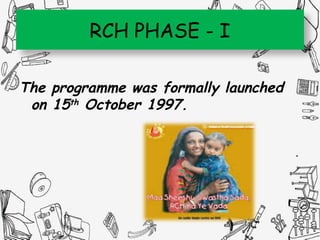
The programme was formally launched
on 15th October 1997.
RCH -2 :-
RCH-2 was started from 1st April 2005 to
2009. RCH-2 vision articulates, “improving
access, use and quality of RCS services, especially
for the poor and underserved.
AIM of RCH 2 :-
 To reduce infant mortality rate
 To reduce maternal mortality rate
 To reduce total fertility rate
 To increase couple protection rate
 Immunization coverage specially in rural
areas.
AIM??
OBJECTIVES OF RCH-2 :-
 To improve the management performance.
 To develop human resources intensively
 To expand RCH services to tribal areas also.
 To monitor and evaluate the services.
 To improve the quality, coverage and
effectiveness of the existing Family Welfare
services and essential RCH services with a special
focus on the above mentioned EAG states.
STRATEGIES
The major strategies to improve maternal health are
1) Essential obstetric care
a. Institutional delivery
b. Skilled attendance at delivery
c. Policy decisions
2) Emergency obstetric care
a. operationalizing first referral units
b. operationalizing PHCs and CHCs for round clock delivery
services
3) Strengthening referral system
1) Essential obstetric care
• A) INSTITUTIONAL DELIVERY:
to promote institutional delivery 50% of PHC and CHC
would be made operational as 24 hours delivery centre.
• B) SKILLED ATTENDANCE AT DELIVERY:
for MOs/ ANMs/LHVs – guidelines for conducting normal
delivery and management of obstetric complications.
• C) POLICY DECISIONS:
ANMs/LHVs/SNs – Permitted to use drugs in specific
emergency situations to reduce maternal mortality.
2) Emergency obstetric care (EmOC)
The minimum services provided by a fully functional FRUs
1. 24 hrs delivery services including normal and
assisted deliveries
2. EmOC including surgical interventions like
caesarean section.
3. New-born care
4. Emergency care of sick children.
5. Full range of family planning services including
laproscopic services.
Continued…
6.Safe abortion services
7.Treatment of RTIs/STIs.
8.Blood storage facility
9.Essential lab services
10.Referral (transport ) services.
B. Emergency obstetric care:- This consists of
operational zing the first referral unit to be fully
functional round the clock(24 hours)
First referral unit(FRU):- It is an upgraded PHC/ CHC into a 30
bedded Hospital, having a well furnished and equipped operation
theatre With a newborn care corner ,a Labor room, blood bank
and laboratory to provide the services of obstetric emergencies
such as cesarean section and adequate supply of drugs to the
patients, care of seek children, family welfare services.
Newer Schemes
Janani Suraksha Yojana scheme
Prasoothi araiker
Training of traditional birth attendants.
Training of Mos in the skill of obstetric
management.
3) Strengthening referral system
• Funds were given to panchayat for providing
assistance to poor people in case of obstetric
emergencies.
• Involvement of local self-help groups, NGOs and
women groups.
NEW INTIATIVES
1. Training of MBBS doctors in life saving anesthetic
skills for emergency obstetric care.
Govt .of India is also introducing training of MBBS
doctors of obstetric management skills, prepared
training plan for 16 weeks in all obstetric management
skills,inculding caesarean section operation.
2.Setting up of blood storage centres at FRUs
according to government of India guidelines
3.JANANI SURAKSHA YOJANA
• The national maternity benefit scheme has been modified
into a (JSY) JANANI SURAKSHA YOJANA.
• It was launched on 12th April 2005.
• It is a 100% centrally sponsored scheme
• Under national rural health mission ,it integrates the cash
assistance with institutional care during antenatal, delivery
and immediate post-partum care
• ASHA would work as a link worker
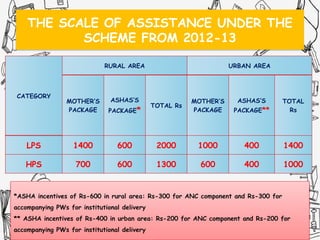
THE SCALE OF ASSISTANCE UNDER THE
SCHEME FROM 2012-13
CATEGORY
RURAL AREA URBAN AREA
MOTHER’S
PACKAGE
ASHAS’S
PACKAGE*
TOTAL Rs
MOTHER’S
PACKAGE
ASHAS’S
PACKAGE**
TOTAL
Rs
LPS 1400 600 2000 1000 400 1400
HPS 700 600 1300 600 400 1000
*ASHA incentives of Rs-600 in rural area: Rs-300 for ANC component and Rs-300 for
accompanying PWs for institutional delivery
** ASHA incentives of Rs-400 in urban area: Rs-200 for ANC component and Rs-200 for
accompanying PWs for institutional delivery
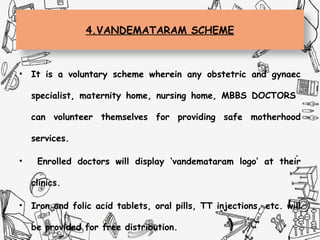
4.VANDEMATARAM SCHEME
• It is a voluntary scheme wherein any obstetric and gynaec
specialist, maternity home, nursing home, MBBS DOCTORS
can volunteer themselves for providing safe motherhood
services.
• Enrolled doctors will display ‘vandemataram logo’ at their
clinics.
• Iron and folic acid tablets, oral pills, TT injections, etc. will
be provided for free distribution.
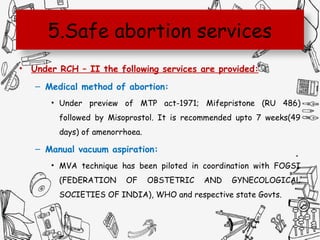
5.Safe abortion services
• Under RCH – II the following services are provided:
– Medical method of abortion:
• Under preview of MTP act-1971; Mifepristone (RU 486)
followed by Misoprostol. It is recommended upto 7 weeks(49
days) of amenorrhoea.
– Manual vacuum aspiration:
• MVA technique has been piloted in coordination with FOGSI
(FEDERATION OF OBSTETRIC AND GYNECOLOGICAL
SOCIETIES OF INDIA), WHO and respective state Govts.
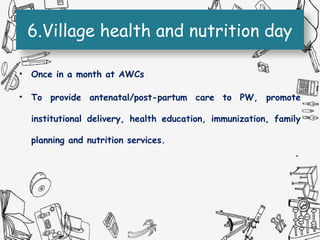
6.Village health and nutrition day
• Once in a month at AWCs
• To provide antenatal/post-partum care to PW, promote
institutional delivery, health education, immunization, family
planning and nutrition services.
7.Maternal death review
• Both facility and community maternal death review
• To improve the quality of obstetric care and
reduce the maternal morbidity and mortality.
8.JANANI-SHISHU SURAKSHA KARYAKRAM (JSSK)
• Launched on 1st
June 2011
• To make available better health facilities for women and child.
• The facilities to pregnant women:
– all PW delivering in PH institutions to have absolutely free and no expense
including C-Section.
– The entitlements include free drugs & consumables, free diet upto 3 days
during normal delivery and upto 7 days for C-section, free diagnostics and free
blood, free transport from home to institution & between facilities an case of
referral.
– Similar entitlements for all sick newborns.
– The scheme has now been extended to cover the complications during ANC, PNC
& sick newborn.
CHILD HEALTH COMPONENTS
Strategy
• The strategy for child health care, aims to reduce
under-five child mortality through improved child
care practices and child nutrition.
1.Nutritional rehabilitation
centres( NRCs)
• Medical and nutritional care to severe acute malnutrition children
under 5 years of age.
• The services provided:
1. 24 hrs care and monitoring of the child
2. Treatment of medical complications
3. Therapeutic feeding
4. Sensory stimulation and emotional care
5. Counselling on appropriate feed, care and hygiene
6. Demonstration and practice by doing of energy dense food
7. Social assessment of family
8. Follow-up of the children discharged from the facility.
2.IMNCI (INTEGRATED MANAGEMENT OF NEONATAL
AND CHILDHOOD ILLNESS)
• IMNCI is one of the main intervention under RCH-II.
• The objective is to implement IMNCI package at the level of
household, and through ANMs at sub-centre level; through
MOs, nurses and LHVs at PHC level.
Pre-service IMNCI
• IMNCI is being included in the curriculum of medical
colleges. This will help in providing trained IMNCI
manpower in public and private sector.
Facility based IMNCI (F-IMNCI)
• Integration of facility based care package with
IMNCI package, to empower the health personnel
with the skill to manage newborn and childhood illness
at community level as well as the health facility.
3. HOME BASED NEWBORN CARE (HBNC)
• Aimed at improving newborn survival
• Strategy is to universal access to home based
newborn care
• The providers of service include AWWs, ANM,
ASHA and the MO.
• However ASHA is the main person involved in
home based newborn care.
4. NAVJAT SHISHU SURAKSHA KARYAKRAM
(NSSK)
• Is a programme aimed to train health
personnel in basic newborn care and
resuscitation.
• Launched to address care at birth issue i.e
prevention of hypothermia, prevention of
infection, early initiation of breat-feeding and
basic newborn resuscitation.
5. RASHTRIYA BAL SWASTHYA KARYAKRAM
(RBSK)
• Launched in February 2013.
• Provision for child health screening and early
intervention services through early detection
and management of 4 Ds prevalent in children.
• 4 Ds:
1. Defects at birth
2. Deficiency conditions
3. Diseases in children
4. Developmental delays including disabilities
rchprogramme 2 elaborated version for nursing

rchprogramme 2 elaborated version for nursing

  • 1.
    REPRODUCTION AND CHILDHEALTH PROGRAMME REPRODUCTIVE AND CHILD HEALTH PROGRAMME- 2
  • 2.
    Introduction : The reproductiveand Child Health Programme was formally launched by government of India on 15th October 1997. as per Recommendation of international conference on population and development held in cario in 1994. INTRODUCTION
  • 3.
    Definition RCH as “Astate of complete, physical, mental, and social well being and merely the absence of disease of infirmity in all matters relating to reproductive system and its function and process.” Definition
  • 4.
    “A state inwhich people have the ability to the reproduce and regulate their fertility are able to go through pregnancy and child birth, the outcome of pregnancy is successful in terms of maternal and Infant survival and well- being, and couples are able to have sexual relation free of the fear of pregnancy and of contracting disease” Definition
  • 5.
    Objectives  To permitthe health of the mothers and children to ensure safe Motherhood and child survival.  The intermediate objective is to reduce IMR & MMR.  The ultimate objective is population stabilization, through responsible care Objectives
  • 6.
     Prevention andmanagement of unwanted pregnancy.  Maternal care( safe motherhood)  Child survival  Prevention and management of RTIS/ STD  Prevention of HIV/AIDS. 1. Objectives
  • 7.
    Components of RCH Followingservices are included in the reproductive health area as proposed by Government of India.  Family planning  Child survival and safe Motherhood programme  Prevention/ management of RTI/STD and AIDS.  Client approach to health care. Components of RCH
  • 8.
    Other activities  Providingcounseling, information and communication services on health, sexuality and gender difference.  Referral services for all above intervention.  Growth monitoring, nutrition education, reproductive Health Services for adolescents etc. Other activities
  • 9.
    RCH Package forvarious services: 1. For Maternal Services ( Safe Motherhood): The servicer components are obstetric care, infection control and nutrition promotion. 2. For Child Services (Child Survival) :- The essential care of the newborn, including care of the at risk newborn by prompt referral services.  Infection control measure  Nutritional promotion RCH Package for various services:
  • 10.
    3. Reproductive health:-  Fertility control  MTP services( for prevention and management of unwanted pregnancies)  Adolescent  HIV/AIDS
  • 11.
    RCH PHASE -I The programme was formally launched on 15th October 1997.
  • 12.
    RCH -2 :- RCH-2was started from 1st April 2005 to 2009. RCH-2 vision articulates, “improving access, use and quality of RCS services, especially for the poor and underserved.
  • 13.
    AIM of RCH2 :-  To reduce infant mortality rate  To reduce maternal mortality rate  To reduce total fertility rate  To increase couple protection rate  Immunization coverage specially in rural areas. AIM??
  • 14.
    OBJECTIVES OF RCH-2:-  To improve the management performance.  To develop human resources intensively  To expand RCH services to tribal areas also.  To monitor and evaluate the services.  To improve the quality, coverage and effectiveness of the existing Family Welfare services and essential RCH services with a special focus on the above mentioned EAG states.
  • 15.
    STRATEGIES The major strategiesto improve maternal health are 1) Essential obstetric care a. Institutional delivery b. Skilled attendance at delivery c. Policy decisions 2) Emergency obstetric care a. operationalizing first referral units b. operationalizing PHCs and CHCs for round clock delivery services 3) Strengthening referral system
  • 16.
    1) Essential obstetriccare • A) INSTITUTIONAL DELIVERY: to promote institutional delivery 50% of PHC and CHC would be made operational as 24 hours delivery centre. • B) SKILLED ATTENDANCE AT DELIVERY: for MOs/ ANMs/LHVs – guidelines for conducting normal delivery and management of obstetric complications. • C) POLICY DECISIONS: ANMs/LHVs/SNs – Permitted to use drugs in specific emergency situations to reduce maternal mortality.
  • 17.
    2) Emergency obstetriccare (EmOC) The minimum services provided by a fully functional FRUs 1. 24 hrs delivery services including normal and assisted deliveries 2. EmOC including surgical interventions like caesarean section. 3. New-born care 4. Emergency care of sick children. 5. Full range of family planning services including laproscopic services.
  • 18.
    Continued… 6.Safe abortion services 7.Treatmentof RTIs/STIs. 8.Blood storage facility 9.Essential lab services 10.Referral (transport ) services.
  • 19.
    B. Emergency obstetriccare:- This consists of operational zing the first referral unit to be fully functional round the clock(24 hours)
  • 20.
    First referral unit(FRU):-It is an upgraded PHC/ CHC into a 30 bedded Hospital, having a well furnished and equipped operation theatre With a newborn care corner ,a Labor room, blood bank and laboratory to provide the services of obstetric emergencies such as cesarean section and adequate supply of drugs to the patients, care of seek children, family welfare services.
  • 21.
    Newer Schemes Janani SurakshaYojana scheme Prasoothi araiker Training of traditional birth attendants. Training of Mos in the skill of obstetric management.
  • 22.
    3) Strengthening referralsystem • Funds were given to panchayat for providing assistance to poor people in case of obstetric emergencies. • Involvement of local self-help groups, NGOs and women groups.
  • 23.
    NEW INTIATIVES 1. Trainingof MBBS doctors in life saving anesthetic skills for emergency obstetric care. Govt .of India is also introducing training of MBBS doctors of obstetric management skills, prepared training plan for 16 weeks in all obstetric management skills,inculding caesarean section operation. 2.Setting up of blood storage centres at FRUs according to government of India guidelines
  • 24.
    3.JANANI SURAKSHA YOJANA •The national maternity benefit scheme has been modified into a (JSY) JANANI SURAKSHA YOJANA. • It was launched on 12th April 2005. • It is a 100% centrally sponsored scheme • Under national rural health mission ,it integrates the cash assistance with institutional care during antenatal, delivery and immediate post-partum care • ASHA would work as a link worker
  • 25.
    THE SCALE OFASSISTANCE UNDER THE SCHEME FROM 2012-13 CATEGORY RURAL AREA URBAN AREA MOTHER’S PACKAGE ASHAS’S PACKAGE* TOTAL Rs MOTHER’S PACKAGE ASHAS’S PACKAGE** TOTAL Rs LPS 1400 600 2000 1000 400 1400 HPS 700 600 1300 600 400 1000 *ASHA incentives of Rs-600 in rural area: Rs-300 for ANC component and Rs-300 for accompanying PWs for institutional delivery ** ASHA incentives of Rs-400 in urban area: Rs-200 for ANC component and Rs-200 for accompanying PWs for institutional delivery
  • 26.
    4.VANDEMATARAM SCHEME • Itis a voluntary scheme wherein any obstetric and gynaec specialist, maternity home, nursing home, MBBS DOCTORS can volunteer themselves for providing safe motherhood services. • Enrolled doctors will display ‘vandemataram logo’ at their clinics. • Iron and folic acid tablets, oral pills, TT injections, etc. will be provided for free distribution.
  • 27.
    5.Safe abortion services •Under RCH – II the following services are provided: – Medical method of abortion: • Under preview of MTP act-1971; Mifepristone (RU 486) followed by Misoprostol. It is recommended upto 7 weeks(49 days) of amenorrhoea. – Manual vacuum aspiration: • MVA technique has been piloted in coordination with FOGSI (FEDERATION OF OBSTETRIC AND GYNECOLOGICAL SOCIETIES OF INDIA), WHO and respective state Govts.
  • 28.
    6.Village health andnutrition day • Once in a month at AWCs • To provide antenatal/post-partum care to PW, promote institutional delivery, health education, immunization, family planning and nutrition services.
  • 29.
    7.Maternal death review •Both facility and community maternal death review • To improve the quality of obstetric care and reduce the maternal morbidity and mortality.
  • 30.
    8.JANANI-SHISHU SURAKSHA KARYAKRAM(JSSK) • Launched on 1st June 2011 • To make available better health facilities for women and child. • The facilities to pregnant women: – all PW delivering in PH institutions to have absolutely free and no expense including C-Section. – The entitlements include free drugs & consumables, free diet upto 3 days during normal delivery and upto 7 days for C-section, free diagnostics and free blood, free transport from home to institution & between facilities an case of referral. – Similar entitlements for all sick newborns. – The scheme has now been extended to cover the complications during ANC, PNC & sick newborn.
  • 31.
  • 32.
    Strategy • The strategyfor child health care, aims to reduce under-five child mortality through improved child care practices and child nutrition.
  • 33.
    1.Nutritional rehabilitation centres( NRCs) •Medical and nutritional care to severe acute malnutrition children under 5 years of age. • The services provided: 1. 24 hrs care and monitoring of the child 2. Treatment of medical complications 3. Therapeutic feeding 4. Sensory stimulation and emotional care 5. Counselling on appropriate feed, care and hygiene 6. Demonstration and practice by doing of energy dense food 7. Social assessment of family 8. Follow-up of the children discharged from the facility.
  • 34.
    2.IMNCI (INTEGRATED MANAGEMENTOF NEONATAL AND CHILDHOOD ILLNESS) • IMNCI is one of the main intervention under RCH-II. • The objective is to implement IMNCI package at the level of household, and through ANMs at sub-centre level; through MOs, nurses and LHVs at PHC level.
  • 35.
    Pre-service IMNCI • IMNCIis being included in the curriculum of medical colleges. This will help in providing trained IMNCI manpower in public and private sector.
  • 36.
    Facility based IMNCI(F-IMNCI) • Integration of facility based care package with IMNCI package, to empower the health personnel with the skill to manage newborn and childhood illness at community level as well as the health facility.
  • 37.
    3. HOME BASEDNEWBORN CARE (HBNC) • Aimed at improving newborn survival • Strategy is to universal access to home based newborn care • The providers of service include AWWs, ANM, ASHA and the MO. • However ASHA is the main person involved in home based newborn care.
  • 38.
    4. NAVJAT SHISHUSURAKSHA KARYAKRAM (NSSK) • Is a programme aimed to train health personnel in basic newborn care and resuscitation. • Launched to address care at birth issue i.e prevention of hypothermia, prevention of infection, early initiation of breat-feeding and basic newborn resuscitation.
  • 39.
    5. RASHTRIYA BALSWASTHYA KARYAKRAM (RBSK) • Launched in February 2013. • Provision for child health screening and early intervention services through early detection and management of 4 Ds prevalent in children. • 4 Ds: 1. Defects at birth 2. Deficiency conditions 3. Diseases in children 4. Developmental delays including disabilities