Criteria 3
Course Outcomes and
Program Outcomes
(100 Marks)
Dr. M. G. Maniyar
Associate Prof., HOD &
Head R & D
COP, Pandharpur
1
Frame a CO for theory and practical
3.1.1. Course Outcomes (05 Marks)
• Number of Outcomes for a Course is expected to be
around 6.
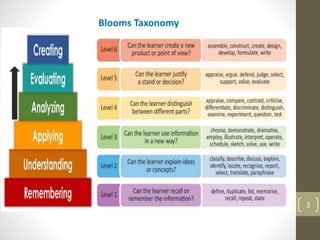
• Follow Blooms Taxanomy
2
Blooms Taxonomy
3
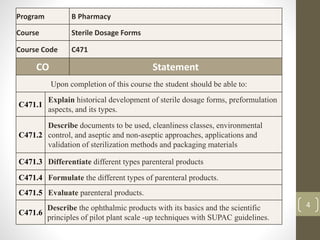
Program B Pharmacy
Course Sterile Dosage Forms
Course Code C471
CO Statement
Upon completion of this course the student should be able to:
C471.1
Explain historical development of sterile dosage forms, preformulation
aspects, and its types.
C471.2
Describe documents to be used, cleanliness classes, environmental
control, and aseptic and non-aseptic approaches, applications and
validation of sterilization methods and packaging materials
C471.3 Differentiate different types parenteral products
C471.4 Formulate the different types of parenteral products.
C471.5 Evaluate parenteral products.
C471.6
Describe the ophthalmic products with its basics and the scientific
principles of pilot plant scale -up techniques with SUPAC guidelines.
4
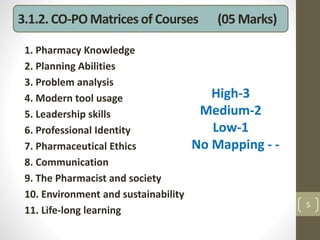
3.1.2. CO-PO Matrices of Courses (05 Marks)
1. Pharmacy Knowledge
2. Planning Abilities
3. Problem analysis
4. Modern tool usage
5. Leadership skills
6. Professional Identity
7. Pharmaceutical Ethics
8. Communication
9. The Pharmacist and society
10. Environment and sustainability
11. Life-long learning
High-3
Medium-2
Low-1
No Mapping - -
5
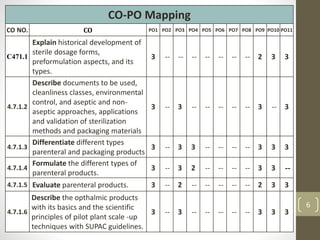
CO-PO Mapping
CO NO. CO PO1 PO2 PO3 PO4 PO5 PO6 PO7 PO8 PO9 PO10 PO11
C471.1
Explain historical development of
sterile dosage forms,
preformulation aspects, and its
types.
3 -- -- -- -- -- -- -- 2 3 3
4.7.1.2
Describe documents to be used,
cleanliness classes, environmental
control, and aseptic and non-
aseptic approaches, applications
and validation of sterilization
methods and packaging materials
3 -- 3 -- -- -- -- -- 3 -- 3
4.7.1.3
Differentiate different types
parenteral and packaging products
3 -- 3 3 -- -- -- -- 3 3 3
4.7.1.4
Formulate the different types of
parenteral products.
3 -- 3 2 -- -- -- -- 3 3 --
4.7.1.5 Evaluate parenteral products. 3 -- 2 -- -- -- -- -- 2 3 3
4.7.1.6
Describe the opthalmic products
with its basics and the scientific
principles of pilot plant scale -up
techniques with SUPAC guidelines.
3 -- 3 -- -- -- -- -- 3 3 3
6
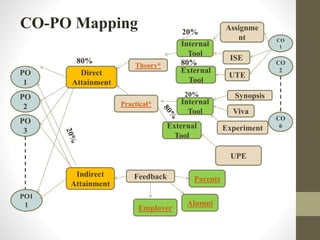
20%
ISE
Experiment
20%
80%Theory*
Practical*
PO
1
PO
2
PO
3
PO1
1
Direct
Attainment
Indirect
Attainment
80%
Internal
Tool
External
Tool
UTE
Assignme
nt CO
1
CO
2
CO
6
Internal
Tool
External
Tool
Synopsis
Viva
UPE
Feedback Parents
Alumni
Employer
CO-PO Mapping
CO-PO Mapping Correlation
CO
B
L
1 2 3 4 5 6 7 8 9
1
0
1
1
Correlation basis explanation
Elaborate
applications
and validation
of
sterilization
methods,
different
parenteral
packaging
materials and
FFS.
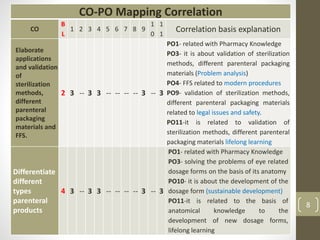
2 3 -- 3 3 -- -- -- -- 3 -- 3
PO1- related with Pharmacy Knowledge
PO3- it is about validation of sterilization
methods, different parenteral packaging
materials (Problem analysis)
PO4- FFS related to modern procedures
PO9- validation of sterilization methods,
different parenteral packaging materials
related to legal issues and safety.
PO11-it is related to validation of
sterilization methods, different parenteral
packaging materials lifelong learning
Differentiate
different
types
parenteral
products
4 3 -- 3 3 -- -- -- -- 3 -- 3
PO1- related with Pharmacy Knowledge
PO3- solving the problems of eye related
dosage forms on the basis of its anatomy
PO10- it is about the development of the
dosage form (sustainable development)
PO11-it is related to the basis of
anatomical knowledge to the
development of new dosage forms,
lifelong learning
8
3.1.3.Course-POmatrixof courses for all
four yearsof study (10)
Course
Name
PO
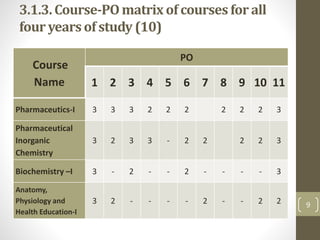
1 2 3 4 5 6 7 8 9 10 11
Pharmaceutics-I 3 3 3 2 2 2 2 2 2 3
Pharmaceutical
Inorganic
Chemistry
3 2 3 3 - 2 2 2 2 3
Biochemistry –I 3 - 2 - - 2 - - - - 3
Anatomy,
Physiology and
Health Education-I
3 2 - - - - 2 - - 2 2 9
CO
No.
Course outcomes
Bloom’s
level
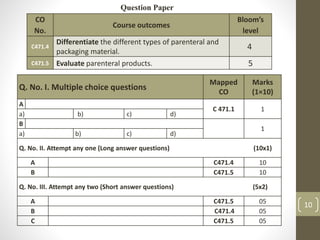
C471.4
Differentiate the different types of parenteral and
packaging material.
4
C471.5 Evaluate parenteral products. 5
Question Paper
Q. No. I. Multiple choice questions
Mapped
CO
Marks
(1×10)
A
C 471.1 1
a) b) c) d)
B
C471.5 1
a) b) c) d)
Q. No. II. Attempt any one (Long answer questions) (10x1)
A C471.4 10
B C471.5 10
Q. No. III. Attempt any two (Short answer questions) (5x2)
A C471.5 05
B C471.4 05
C C471.5 05
10
Excel-sheets
11
• STDF Th 2017-18.xlsx
Excel sheets:
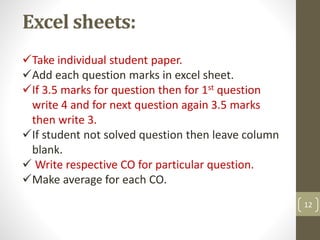
Take individual student paper.
Add each question marks in excel sheet.
If 3.5 marks for question then for 1st question
write 4 and for next question again 3.5 marks
then write 3.
If student not solved question then leave column
blank.
 Write respective CO for particular question.
Make average for each CO.
12
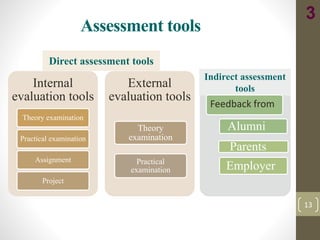
Assessment tools
13
Internal
evaluation tools
Theory examination
Practical examination
Assignment
Project
External
evaluation tools
Theory
examination
Practical
examination
Alumni
Parents
Employer
Indirect assessment
tools
Direct assessment tools
3
Feedback from
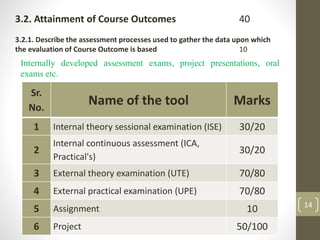
3.2. Attainment of Course Outcomes 40
3.2.1. Describe the assessment processes used to gather the data upon which
the evaluation of Course Outcome is based 10
14
Internally developed assessment exams, project presentations, oral
exams etc.
Sr.
No.
Name of the tool Marks
1 Internal theory sessional examination (ISE) 30/20
2
Internal continuous assessment (ICA,
Practical's)
30/20
3 External theory examination (UTE) 70/80
4 External practical examination (UPE) 70/80
5 Assignment 10
6 Project 50/100
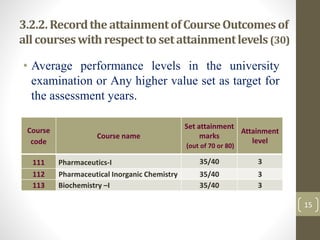
3.2.2.Recordthe attainmentofCourseOutcomesof
allcourseswithrespectto setattainmentlevels(30)
• Average performance levels in the university
examination or Any higher value set as target for
the assessment years.
15
Course
code
Course name
Set attainment
marks
(out of 70 or 80)
Attainment
level
111 Pharmaceutics-I 35/40 3
112 Pharmaceutical Inorganic Chemistry 35/40 3
113 Biochemistry –I 35/40 3
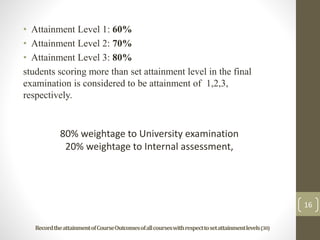
• Attainment Level 1: 60%
• Attainment Level 2: 70%
• Attainment Level 3: 80%
students scoring more than set attainment level in the final
examination is considered to be attainment of 1,2,3,
respectively.
16
RecordtheattainmentofCourseOutcomesofallcourseswithrespecttosetattainmentlevels(30)
80% weightage to University examination
20% weightage to Internal assessment,
17
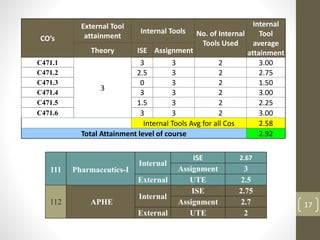
111 Pharmaceutics-I
Internal
ISE 2.67
Assignment 3
External UTE 2.5
112 APHE
Internal
ISE 2.75
Assignment 2.7
External UTE 2
CO’s
External Tool
attainment
Internal Tools No. of Internal
Tools Used
Internal
Tool
average
attainmentTheory ISE Assignment
C471.1
3
3 3 2 3.00
C471.2 2.5 3 2 2.75
C471.3 0 3 2 1.50
C471.4 3 3 2 3.00
C471.5 1.5 3 2 2.25
C471.6 3 3 2 3.00
Internal Tools Avg for all Cos 2.58
Total Attainment level of course 2.92
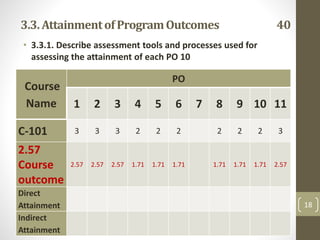
3.3.AttainmentofProgramOutcomes 40
• 3.3.1. Describe assessment tools and processes used for
assessing the attainment of each PO 10
18
Course
Name
PO
1 2 3 4 5 6 7 8 9 10 11
C-101 3 3 3 2 2 2 2 2 2 3
2.57
Course
outcome
2.57 2.57 2.57 1.71 1.71 1.71 1.71 1.71 1.71 2.57
Direct
Attainment
Indirect
Attainment
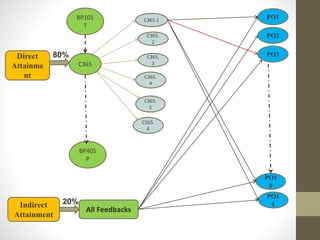
PO1
PO2
PO3
PO1
0
PO1
1
C365.1
C365.
2
C365.
3
C365.
4
C365.
5
C365.
6
C365
BP101
T
BP405
P
Direct
Attainme
nt
Indirect
Attainment
80%
20%
All Feedbacks
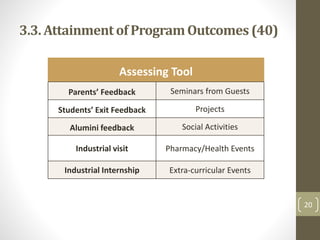
3.3.Attainmentof ProgramOutcomes(40)
20
Assessing Tool
Parents’ Feedback Seminars from Guests
Students’ Exit Feedback Projects
Alumini feedback Social Activities
Industrial visit Pharmacy/Health Events
Industrial Internship Extra-curricular Events
21
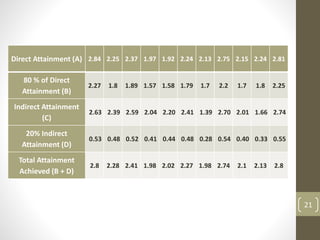
Direct Attainment (A) 2.84 2.25 2.37 1.97 1.92 2.24 2.13 2.75 2.15 2.24 2.81
80 % of Direct
Attainment (B)
2.27 1.8 1.89 1.57 1.58 1.79 1.7 2.2 1.7 1.8 2.25
Indirect Attainment
(C)
2.63 2.39 2.59 2.04 2.20 2.41 1.39 2.70 2.01 1.66 2.74
20% Indirect
Attainment (D)
0.53 0.48 0.52 0.41 0.44 0.48 0.28 0.54 0.40 0.33 0.55
Total Attainment
Achieved (B + D)
2.8 2.28 2.41 1.98 2.02 2.27 1.98 2.74 2.1 2.13 2.8
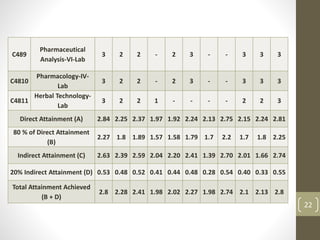
C489
Pharmaceutical
Analysis-VI-Lab
3 2 2 - 2 3 - - 3 3 3
C4810
Pharmacology-IV-
Lab
3 2 2 - 2 3 - - 3 3 3
C4811
Herbal Technology-
Lab
3 2 2 1 - - - - 2 2 3
Direct Attainment (A) 2.84 2.25 2.37 1.97 1.92 2.24 2.13 2.75 2.15 2.24 2.81
80 % of Direct Attainment
(B)
2.27 1.8 1.89 1.57 1.58 1.79 1.7 2.2 1.7 1.8 2.25
Indirect Attainment (C) 2.63 2.39 2.59 2.04 2.20 2.41 1.39 2.70 2.01 1.66 2.74
20% Indirect Attainment (D) 0.53 0.48 0.52 0.41 0.44 0.48 0.28 0.54 0.40 0.33 0.55
Total Attainment Achieved
(B + D)
2.8 2.28 2.41 1.98 2.02 2.27 1.98 2.74 2.1 2.13 2.8
22
23

Cr 3: Course Outcomes and Program Outcomes

  • 1.
    Criteria 3 Course Outcomesand Program Outcomes (100 Marks) Dr. M. G. Maniyar Associate Prof., HOD & Head R & D COP, Pandharpur 1
  • 2.
    Frame a COfor theory and practical 3.1.1. Course Outcomes (05 Marks) • Number of Outcomes for a Course is expected to be around 6. • Follow Blooms Taxanomy 2
  • 3.
  • 4.
    Program B Pharmacy CourseSterile Dosage Forms Course Code C471 CO Statement Upon completion of this course the student should be able to: C471.1 Explain historical development of sterile dosage forms, preformulation aspects, and its types. C471.2 Describe documents to be used, cleanliness classes, environmental control, and aseptic and non-aseptic approaches, applications and validation of sterilization methods and packaging materials C471.3 Differentiate different types parenteral products C471.4 Formulate the different types of parenteral products. C471.5 Evaluate parenteral products. C471.6 Describe the ophthalmic products with its basics and the scientific principles of pilot plant scale -up techniques with SUPAC guidelines. 4
  • 5.
    3.1.2. CO-PO Matricesof Courses (05 Marks) 1. Pharmacy Knowledge 2. Planning Abilities 3. Problem analysis 4. Modern tool usage 5. Leadership skills 6. Professional Identity 7. Pharmaceutical Ethics 8. Communication 9. The Pharmacist and society 10. Environment and sustainability 11. Life-long learning High-3 Medium-2 Low-1 No Mapping - - 5
  • 6.
    CO-PO Mapping CO NO.CO PO1 PO2 PO3 PO4 PO5 PO6 PO7 PO8 PO9 PO10 PO11 C471.1 Explain historical development of sterile dosage forms, preformulation aspects, and its types. 3 -- -- -- -- -- -- -- 2 3 3 4.7.1.2 Describe documents to be used, cleanliness classes, environmental control, and aseptic and non- aseptic approaches, applications and validation of sterilization methods and packaging materials 3 -- 3 -- -- -- -- -- 3 -- 3 4.7.1.3 Differentiate different types parenteral and packaging products 3 -- 3 3 -- -- -- -- 3 3 3 4.7.1.4 Formulate the different types of parenteral products. 3 -- 3 2 -- -- -- -- 3 3 -- 4.7.1.5 Evaluate parenteral products. 3 -- 2 -- -- -- -- -- 2 3 3 4.7.1.6 Describe the opthalmic products with its basics and the scientific principles of pilot plant scale -up techniques with SUPAC guidelines. 3 -- 3 -- -- -- -- -- 3 3 3 6
  • 7.
  • 8.
    CO-PO Mapping Correlation CO B L 12 3 4 5 6 7 8 9 1 0 1 1 Correlation basis explanation Elaborate applications and validation of sterilization methods, different parenteral packaging materials and FFS. 2 3 -- 3 3 -- -- -- -- 3 -- 3 PO1- related with Pharmacy Knowledge PO3- it is about validation of sterilization methods, different parenteral packaging materials (Problem analysis) PO4- FFS related to modern procedures PO9- validation of sterilization methods, different parenteral packaging materials related to legal issues and safety. PO11-it is related to validation of sterilization methods, different parenteral packaging materials lifelong learning Differentiate different types parenteral products 4 3 -- 3 3 -- -- -- -- 3 -- 3 PO1- related with Pharmacy Knowledge PO3- solving the problems of eye related dosage forms on the basis of its anatomy PO10- it is about the development of the dosage form (sustainable development) PO11-it is related to the basis of anatomical knowledge to the development of new dosage forms, lifelong learning 8
  • 9.
    3.1.3.Course-POmatrixof courses forall four yearsof study (10) Course Name PO 1 2 3 4 5 6 7 8 9 10 11 Pharmaceutics-I 3 3 3 2 2 2 2 2 2 3 Pharmaceutical Inorganic Chemistry 3 2 3 3 - 2 2 2 2 3 Biochemistry –I 3 - 2 - - 2 - - - - 3 Anatomy, Physiology and Health Education-I 3 2 - - - - 2 - - 2 2 9
  • 10.
    CO No. Course outcomes Bloom’s level C471.4 Differentiate thedifferent types of parenteral and packaging material. 4 C471.5 Evaluate parenteral products. 5 Question Paper Q. No. I. Multiple choice questions Mapped CO Marks (1×10) A C 471.1 1 a) b) c) d) B C471.5 1 a) b) c) d) Q. No. II. Attempt any one (Long answer questions) (10x1) A C471.4 10 B C471.5 10 Q. No. III. Attempt any two (Short answer questions) (5x2) A C471.5 05 B C471.4 05 C C471.5 05 10
  • 11.
  • 12.
    Excel sheets: Take individualstudent paper. Add each question marks in excel sheet. If 3.5 marks for question then for 1st question write 4 and for next question again 3.5 marks then write 3. If student not solved question then leave column blank.  Write respective CO for particular question. Make average for each CO. 12
  • 13.
    Assessment tools 13 Internal evaluation tools Theoryexamination Practical examination Assignment Project External evaluation tools Theory examination Practical examination Alumni Parents Employer Indirect assessment tools Direct assessment tools 3 Feedback from
  • 14.
    3.2. Attainment ofCourse Outcomes 40 3.2.1. Describe the assessment processes used to gather the data upon which the evaluation of Course Outcome is based 10 14 Internally developed assessment exams, project presentations, oral exams etc. Sr. No. Name of the tool Marks 1 Internal theory sessional examination (ISE) 30/20 2 Internal continuous assessment (ICA, Practical's) 30/20 3 External theory examination (UTE) 70/80 4 External practical examination (UPE) 70/80 5 Assignment 10 6 Project 50/100
  • 15.
    3.2.2.Recordthe attainmentofCourseOutcomesof allcourseswithrespectto setattainmentlevels(30) •Average performance levels in the university examination or Any higher value set as target for the assessment years. 15 Course code Course name Set attainment marks (out of 70 or 80) Attainment level 111 Pharmaceutics-I 35/40 3 112 Pharmaceutical Inorganic Chemistry 35/40 3 113 Biochemistry –I 35/40 3
  • 16.
    • Attainment Level1: 60% • Attainment Level 2: 70% • Attainment Level 3: 80% students scoring more than set attainment level in the final examination is considered to be attainment of 1,2,3, respectively. 16 RecordtheattainmentofCourseOutcomesofallcourseswithrespecttosetattainmentlevels(30) 80% weightage to University examination 20% weightage to Internal assessment,
  • 17.
    17 111 Pharmaceutics-I Internal ISE 2.67 Assignment3 External UTE 2.5 112 APHE Internal ISE 2.75 Assignment 2.7 External UTE 2 CO’s External Tool attainment Internal Tools No. of Internal Tools Used Internal Tool average attainmentTheory ISE Assignment C471.1 3 3 3 2 3.00 C471.2 2.5 3 2 2.75 C471.3 0 3 2 1.50 C471.4 3 3 2 3.00 C471.5 1.5 3 2 2.25 C471.6 3 3 2 3.00 Internal Tools Avg for all Cos 2.58 Total Attainment level of course 2.92
  • 18.
    3.3.AttainmentofProgramOutcomes 40 • 3.3.1.Describe assessment tools and processes used for assessing the attainment of each PO 10 18 Course Name PO 1 2 3 4 5 6 7 8 9 10 11 C-101 3 3 3 2 2 2 2 2 2 3 2.57 Course outcome 2.57 2.57 2.57 1.71 1.71 1.71 1.71 1.71 1.71 2.57 Direct Attainment Indirect Attainment
  • 19.
  • 20.
    3.3.Attainmentof ProgramOutcomes(40) 20 Assessing Tool Parents’Feedback Seminars from Guests Students’ Exit Feedback Projects Alumini feedback Social Activities Industrial visit Pharmacy/Health Events Industrial Internship Extra-curricular Events
  • 21.
    21 Direct Attainment (A)2.84 2.25 2.37 1.97 1.92 2.24 2.13 2.75 2.15 2.24 2.81 80 % of Direct Attainment (B) 2.27 1.8 1.89 1.57 1.58 1.79 1.7 2.2 1.7 1.8 2.25 Indirect Attainment (C) 2.63 2.39 2.59 2.04 2.20 2.41 1.39 2.70 2.01 1.66 2.74 20% Indirect Attainment (D) 0.53 0.48 0.52 0.41 0.44 0.48 0.28 0.54 0.40 0.33 0.55 Total Attainment Achieved (B + D) 2.8 2.28 2.41 1.98 2.02 2.27 1.98 2.74 2.1 2.13 2.8
  • 22.
    C489 Pharmaceutical Analysis-VI-Lab 3 2 2- 2 3 - - 3 3 3 C4810 Pharmacology-IV- Lab 3 2 2 - 2 3 - - 3 3 3 C4811 Herbal Technology- Lab 3 2 2 1 - - - - 2 2 3 Direct Attainment (A) 2.84 2.25 2.37 1.97 1.92 2.24 2.13 2.75 2.15 2.24 2.81 80 % of Direct Attainment (B) 2.27 1.8 1.89 1.57 1.58 1.79 1.7 2.2 1.7 1.8 2.25 Indirect Attainment (C) 2.63 2.39 2.59 2.04 2.20 2.41 1.39 2.70 2.01 1.66 2.74 20% Indirect Attainment (D) 0.53 0.48 0.52 0.41 0.44 0.48 0.28 0.54 0.40 0.33 0.55 Total Attainment Achieved (B + D) 2.8 2.28 2.41 1.98 2.02 2.27 1.98 2.74 2.1 2.13 2.8 22
  • 23.