Approaches of Nanoelectronics
Presented by
Aravinth
II-MSc Nanoscience and Technology
Alagappa University, Karaikudi
Nanoelectronics
• Nanoelectronics refer to the use of nanotechnology in electronic
components
• Make use of scientific methods at atomic scale for developing the
Nanomachines
• Main target is reduce the size, risk factor and surface area of the
materials and molecules
Moore predicted that this trend would continue for
the foreseeable future.
Moore’s Law
Semiconductor Road Map
• The International Road Map Technology of
Semiconductors (IRTS) is an assessment of the
semiconductor industry’s technology requirement.
• IRTS is advance performance of integrated circuits
and remove roadblocks to the continuation of Moore’s
Law.
The “Top-Down” Approach
• A Top-Down approach is
essentially the breaking down of
a system to gain insight into its
compositional sub-systems.
• Each sub-systems is then refined
in yet greater detail, sometimes
in many additional sub-system
levels, until the entire
specification is reduced to base
elements.
• The invention of transistor in
1947. The first transistor was a
bipolar device consisting of two
sharp metal wires.
size year
100µm 1960
1µm 1980
130nm 2001
90nm 2003
60nm 2005
45nm 2007
32nm 2010
16nm 2017
10nm 2018
7nm 2019
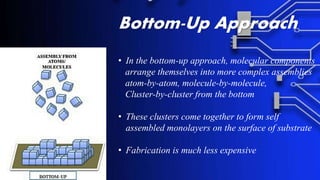
• In the bottom-up approach, molecular components
arrange themselves into more complex assemblies
atom-by-atom, molecule-by-molecule,
Cluster-by-cluster from the bottom
• These clusters come together to form self
assembled monolayers on the surface of substrate
• Fabrication is much less expensive
Bottom-Up Approach
Nanolithography
Nanolithography is used during the fabrication of leading –edge semiconductor
integrated circuits (nanocircuitry) or nanoelectromechanical system (NEMS)
Nanolithography is that branch of Nanotechnology, which deals with the study
And applications of fabrication of nanoscale structures like semiconductor circuits.
There are many types of lithography;
• Optical Lithography
• X-ray Lithography
• Magneto Lithography
• Extreme Ultraviolet Lithography
• Immersion Lithography
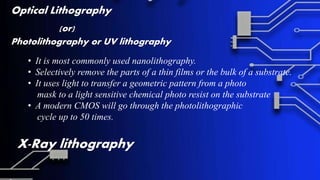
Optical Lithography
(or)
Photolithography or UV lithography
• It is most commonly used nanolithography.
• Selectively remove the parts of a thin films or the bulk of a substrate.
• It uses light to transfer a geometric pattern from a photo
mask to a light sensitive chemical photo resist on the substrate
• A modern CMOS will go through the photolithographic
cycle up to 50 times.
X-Ray lithography
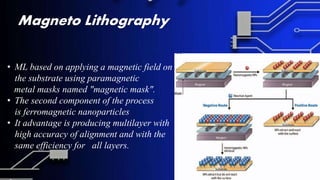
Magneto Lithography
• ML based on applying a magnetic field on
the substrate using paramagnetic
metal masks named "magnetic mask".
• The second component of the process
is ferromagnetic nanoparticles
• It advantage is producing multilayer with
high accuracy of alignment and with the
same efficiency for all layers.
Extreme ultraviolet lithography
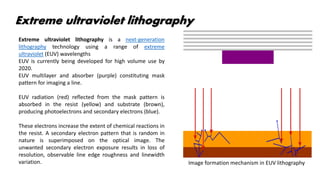
Extreme ultraviolet lithography is a next-generation
lithography technology using a range of extreme
ultraviolet (EUV) wavelengths
EUV is currently being developed for high volume use by
2020.
EUV multilayer and absorber (purple) constituting mask
pattern for imaging a line.
EUV radiation (red) reflected from the mask pattern is
absorbed in the resist (yellow) and substrate (brown),
producing photoelectrons and secondary electrons (blue).
These electrons increase the extent of chemical reactions in
the resist. A secondary electron pattern that is random in
nature is superimposed on the optical image. The
unwanted secondary electron exposure results in loss of
resolution, observable line edge roughness and linewidth
variation. Image formation mechanism in EUV lithography
Immersion lithography
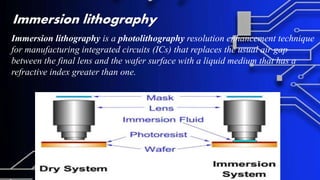
Immersion lithography is a photolithography resolution enhancement technique
for manufacturing integrated circuits (ICs) that replaces the usual air gap
between the final lens and the wafer surface with a liquid medium that has a
refractive index greater than one.
Innovative nanoelectronic devices:
There are numerous devolvement in the field of nanoelectronics, just to list few:
Carbon nanotube devices (CNT devices)
The first application of CNT’s are wiring of microelectronic circuits and its
uses as field emitters for high resolution flat banal displays and other
is carbon nanotube transistors.
Nanowires:
Semiconductor nanowires are used in electronic devices including field emitting transistors,
sensors, detectors and light emitting diodes.
Advantages of nanoelectronics:
• Compact
• Less energy consumption
• More efficient
• Enhanced device, better security and many more
Application of Nanoelectronics:
• Wearable, flexible electronics
• Optoelectronics
• Bioelectronics
• Energy storage devices
• Nano structured sensors
Reference:
wikipedia.org/
newatlas.com
nanowerk.com
academia.edu
nano.gov
spiedigitallibrary.org
Approaches of nanoelectronics

Approaches of nanoelectronics

  • 1.
    Approaches of Nanoelectronics Presentedby Aravinth II-MSc Nanoscience and Technology Alagappa University, Karaikudi
  • 2.
    Nanoelectronics • Nanoelectronics referto the use of nanotechnology in electronic components • Make use of scientific methods at atomic scale for developing the Nanomachines • Main target is reduce the size, risk factor and surface area of the materials and molecules
  • 3.
    Moore predicted thatthis trend would continue for the foreseeable future. Moore’s Law
  • 5.
    Semiconductor Road Map •The International Road Map Technology of Semiconductors (IRTS) is an assessment of the semiconductor industry’s technology requirement. • IRTS is advance performance of integrated circuits and remove roadblocks to the continuation of Moore’s Law.
  • 6.
    The “Top-Down” Approach •A Top-Down approach is essentially the breaking down of a system to gain insight into its compositional sub-systems. • Each sub-systems is then refined in yet greater detail, sometimes in many additional sub-system levels, until the entire specification is reduced to base elements. • The invention of transistor in 1947. The first transistor was a bipolar device consisting of two sharp metal wires. size year 100µm 1960 1µm 1980 130nm 2001 90nm 2003 60nm 2005 45nm 2007 32nm 2010 16nm 2017 10nm 2018 7nm 2019
  • 7.
    • In thebottom-up approach, molecular components arrange themselves into more complex assemblies atom-by-atom, molecule-by-molecule, Cluster-by-cluster from the bottom • These clusters come together to form self assembled monolayers on the surface of substrate • Fabrication is much less expensive Bottom-Up Approach
  • 8.
    Nanolithography Nanolithography is usedduring the fabrication of leading –edge semiconductor integrated circuits (nanocircuitry) or nanoelectromechanical system (NEMS) Nanolithography is that branch of Nanotechnology, which deals with the study And applications of fabrication of nanoscale structures like semiconductor circuits. There are many types of lithography; • Optical Lithography • X-ray Lithography • Magneto Lithography • Extreme Ultraviolet Lithography • Immersion Lithography
  • 9.
    Optical Lithography (or) Photolithography orUV lithography • It is most commonly used nanolithography. • Selectively remove the parts of a thin films or the bulk of a substrate. • It uses light to transfer a geometric pattern from a photo mask to a light sensitive chemical photo resist on the substrate • A modern CMOS will go through the photolithographic cycle up to 50 times. X-Ray lithography
  • 10.
    Magneto Lithography • MLbased on applying a magnetic field on the substrate using paramagnetic metal masks named "magnetic mask". • The second component of the process is ferromagnetic nanoparticles • It advantage is producing multilayer with high accuracy of alignment and with the same efficiency for all layers.
  • 11.
    Extreme ultraviolet lithography Extremeultraviolet lithography is a next-generation lithography technology using a range of extreme ultraviolet (EUV) wavelengths EUV is currently being developed for high volume use by 2020. EUV multilayer and absorber (purple) constituting mask pattern for imaging a line. EUV radiation (red) reflected from the mask pattern is absorbed in the resist (yellow) and substrate (brown), producing photoelectrons and secondary electrons (blue). These electrons increase the extent of chemical reactions in the resist. A secondary electron pattern that is random in nature is superimposed on the optical image. The unwanted secondary electron exposure results in loss of resolution, observable line edge roughness and linewidth variation. Image formation mechanism in EUV lithography
  • 12.
    Immersion lithography Immersion lithographyis a photolithography resolution enhancement technique for manufacturing integrated circuits (ICs) that replaces the usual air gap between the final lens and the wafer surface with a liquid medium that has a refractive index greater than one.
  • 13.
    Innovative nanoelectronic devices: Thereare numerous devolvement in the field of nanoelectronics, just to list few: Carbon nanotube devices (CNT devices) The first application of CNT’s are wiring of microelectronic circuits and its uses as field emitters for high resolution flat banal displays and other is carbon nanotube transistors. Nanowires: Semiconductor nanowires are used in electronic devices including field emitting transistors, sensors, detectors and light emitting diodes. Advantages of nanoelectronics: • Compact • Less energy consumption • More efficient • Enhanced device, better security and many more Application of Nanoelectronics: • Wearable, flexible electronics • Optoelectronics • Bioelectronics • Energy storage devices • Nano structured sensors
  • 14.