 Water has always played a prominent role
in human civilization.
 An adequate supply of
safe drinking water is one of the major
prerequisites for a healthy life, but waterborne
diseases is still a major cause of death in many
parts of the world .
 For better water treatment
processes NANOTECHNOLOGY is preferred.
 Many Different types of nanomaterial’s are
used in Water Treatment process.
 Nanotechnology holds Great promise in
desalination, purification and water treatment.
 Nano is the Greek word for dwarf
 Nanotechnology deals with the objects on
the order of a nanometers(10-9m)
 Nanotechnology is science, engineering,
and technology conducted at the
nanoscale, which is about 1 to 100
nanometers
 . One nanometer is a billionth of a meter, or
10-9 of a meter
The key features that make nanoparticles
attractive for water treatment……….
 More surface area and small volume
 The higher the SA:V, the stronger, more
stable and durable
 Materials may change optical, electrical,
physical, chemical, or biological properties
at the nanoscale level
 Makes biological and chemical reactions
easier
 Can attach various reactor groups to
increase the chemical affinity to words the
target
 Boiling water:
› Time consuming
› Fails to remove the heavy metal
 Ordinary activated carbon filters:
› Not able to remove micro organisms
› Chemical pollutants and heavy metals
 UV filters:
› Application of uv lightning require longer radiation
time
› Reverse osmosis process
› It may remove the useful nutrients from the water
 REVERSE OSMOSIS:
› removes the useful minerals
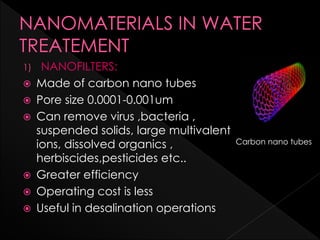
1) NANOFILTERS:
 Made of carbon nano tubes
 Pore size 0.0001-0.001um
 Can remove virus ,bacteria ,
suspended solids, large multivalent
ions, dissolved organics ,
herbiscides,pesticides etc..
 Greater efficiency
 Operating cost is less
 Useful in desalination operations
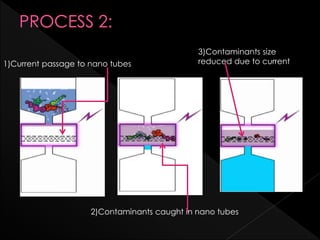
Carbon nano tubes
PURE WATER
NANO FILTER
WASTE WATER
CONTAMINANTS
1)Current passage to nano tubes
2)Contaminants caught in nano tubes
3)Contaminants size
reduced due to current
2)NANOSORBENTS:
 Used majorly in water remediation. For
removing inorganic and organic
pollutants, from contaminated water.
 Nanoparticles used as sorbents.
 Nanoparticles can be functionalized with
various chemical groups to increase their
affinity towards target compounds.
 Nanocrystalline zeolites can remediate
water containing cationic species such
as ammonium and heavy metals. As well
chemicals like 137Cs and 90Sr. [5].
 Magnetic nanoparticles bind with
contaminants , such as oil and arsenic
and removed using a magnet.
 Magnetic nanoparticles have large
surface areas relative to their volume
and can easily bind with chemicals.
 In water treatment applications, they
can be used to bind with contaminants
— such as arsenic or oil — and then be
removed using a magnet.
 Nanoparticles serve as catalysts.
 A nanocatalyst is a substance or materials with the
catalytic properties that has at least one nanoscale
dimension either externally or in terms of internal
structures.
 Used for Chemically degrade pollutants, heavy metals.
 some of the nanocatalysts are…
› Titanium dioxide
› Palladium
› silica
 Methods of waste water treatment using
nanocatalyst:
 There are various methods for wastewater treatment using
nanocatalyst. one of the eco-friendly and less expensive
method are:
•Nanotechnology can also detect water-borne
Contaminants like heavy metals.
•A new type of nanomaterial called nanostructured silica has been found to
detect heavy metals
•It has large surface area and regular pores, has the capability of being able
to extract heavy
metals from wastewaters.
•Electrodes are separated with a small atomic gap so a few ions can be
detect.
 Potential health and environmental risks.
 reactivity of nanomaterials in case they
are released into the environment and
come into contact with leaving
organisms.
 Carbon nanotubes can cause lung
damage
 Integration of nanomaterials into existing
water purification systems.
 Availability and cost.
 Already showing promising results.
 Once certain impending hurdles are
overcome, will solve the global water
shortages
 Proper studies are to be carried out to
assess any harmful effects on
environment and living beings.

Nano water technology

  • 2.
     Water hasalways played a prominent role in human civilization.  An adequate supply of safe drinking water is one of the major prerequisites for a healthy life, but waterborne diseases is still a major cause of death in many parts of the world .  For better water treatment processes NANOTECHNOLOGY is preferred.  Many Different types of nanomaterial’s are used in Water Treatment process.  Nanotechnology holds Great promise in desalination, purification and water treatment.
  • 3.
     Nano isthe Greek word for dwarf  Nanotechnology deals with the objects on the order of a nanometers(10-9m)  Nanotechnology is science, engineering, and technology conducted at the nanoscale, which is about 1 to 100 nanometers  . One nanometer is a billionth of a meter, or 10-9 of a meter
  • 4.
    The key featuresthat make nanoparticles attractive for water treatment……….  More surface area and small volume  The higher the SA:V, the stronger, more stable and durable  Materials may change optical, electrical, physical, chemical, or biological properties at the nanoscale level  Makes biological and chemical reactions easier  Can attach various reactor groups to increase the chemical affinity to words the target
  • 5.
     Boiling water: ›Time consuming › Fails to remove the heavy metal  Ordinary activated carbon filters: › Not able to remove micro organisms › Chemical pollutants and heavy metals  UV filters: › Application of uv lightning require longer radiation time › Reverse osmosis process › It may remove the useful nutrients from the water  REVERSE OSMOSIS: › removes the useful minerals
  • 6.
    1) NANOFILTERS:  Madeof carbon nano tubes  Pore size 0.0001-0.001um  Can remove virus ,bacteria , suspended solids, large multivalent ions, dissolved organics , herbiscides,pesticides etc..  Greater efficiency  Operating cost is less  Useful in desalination operations Carbon nano tubes
  • 7.
    PURE WATER NANO FILTER WASTEWATER CONTAMINANTS
  • 8.
    1)Current passage tonano tubes 2)Contaminants caught in nano tubes 3)Contaminants size reduced due to current
  • 9.
    2)NANOSORBENTS:  Used majorlyin water remediation. For removing inorganic and organic pollutants, from contaminated water.  Nanoparticles used as sorbents.  Nanoparticles can be functionalized with various chemical groups to increase their affinity towards target compounds.  Nanocrystalline zeolites can remediate water containing cationic species such as ammonium and heavy metals. As well chemicals like 137Cs and 90Sr. [5].  Magnetic nanoparticles bind with contaminants , such as oil and arsenic and removed using a magnet.
  • 10.
     Magnetic nanoparticleshave large surface areas relative to their volume and can easily bind with chemicals.  In water treatment applications, they can be used to bind with contaminants — such as arsenic or oil — and then be removed using a magnet.
  • 11.
     Nanoparticles serveas catalysts.  A nanocatalyst is a substance or materials with the catalytic properties that has at least one nanoscale dimension either externally or in terms of internal structures.  Used for Chemically degrade pollutants, heavy metals.  some of the nanocatalysts are… › Titanium dioxide › Palladium › silica  Methods of waste water treatment using nanocatalyst:  There are various methods for wastewater treatment using nanocatalyst. one of the eco-friendly and less expensive method are:
  • 12.
    •Nanotechnology can alsodetect water-borne Contaminants like heavy metals. •A new type of nanomaterial called nanostructured silica has been found to detect heavy metals •It has large surface area and regular pores, has the capability of being able to extract heavy metals from wastewaters. •Electrodes are separated with a small atomic gap so a few ions can be detect.
  • 13.
     Potential healthand environmental risks.  reactivity of nanomaterials in case they are released into the environment and come into contact with leaving organisms.  Carbon nanotubes can cause lung damage  Integration of nanomaterials into existing water purification systems.  Availability and cost.
  • 14.
     Already showingpromising results.  Once certain impending hurdles are overcome, will solve the global water shortages  Proper studies are to be carried out to assess any harmful effects on environment and living beings.