SUBMITTED BY:
STUDYMAFIA.ORG
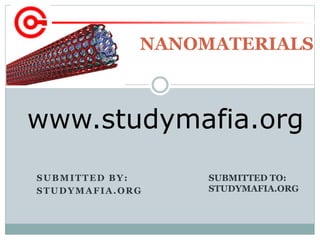
NANOMATERIALS
SUBMITTED TO:
STUDYMAFIA.ORG
www.studymafia.org
Table Of Content
 What are Nanomaterials?
 Properties of Nanomaterials?
 Nanomaterial shapes
 Why nanomaterials ?
 Approaches
 Applications of nanomaterials
 Advantages of Nanomaterials
 Disadvantages of Nanomaterials
 Conclusion
What is nanomaterial
 Nanomaterials are commonly defined as materials
with an average grain size less than 100
nanometers
 Nanomaterials have extremely small size which
having at least one dimension 100 nm
 One billion nanometers equals one meter
Properties of Nanomaterials?
Physical properties
 Size, shape, specific surface area, aspect ratio
 Agglomeration/aggregation state
 Size distribution
 Surface morphology/topography
 Structure, including crystallinity and defect structure
 Solubility
Properties of Nanomaterials?....
Chemical properties
 Structural formula/molecular structure
 Composition of nanomaterial (including degree of
purity, known impurities or additives)
 Phase identity
 Surface chemistry (composition, charge, tension,
reactive sites, physical structure, photocatalytic
properties, zeta potential)
 Hydrophilicity/lipophilicity
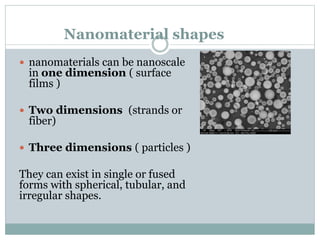
Nanomaterial shapes
 nanomaterials can be nanoscale
in one dimension ( surface
films )
 Two dimensions (strands or
fiber)
 Three dimensions ( particles )
They can exist in single or fused
forms with spherical, tubular, and
irregular shapes.
Why nanomaterials ?
 Nanotechnology exploits benefits of ultra small size,
enabling the use of particles to deliver a range of
important benefits
 Small particles are ‘invisible’ :
 Transparent Coatings/Films are attainable
 Small particles are very weight efficient:
 Surfaces can be modified with minimal material
 the behavior of nanomaterials may depend more on
surface area than particle composition itself.
 Relative-surface area is one of the principal factors
that enhance its reactivity, strength and electrical
properties.
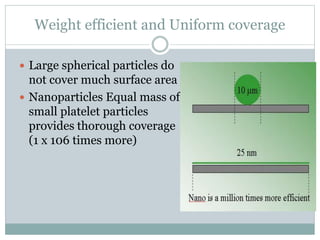
Weight efficient and Uniform coverage
 Large spherical particles do
not cover much surface area
 Nanoparticles Equal mass of
small platelet particles
provides thorough coverage
(1 x 10⁶ times more)
 by patterning matter on the nano scale, it is
possible to vary fundamental properties of materials
without changing the chemical composition
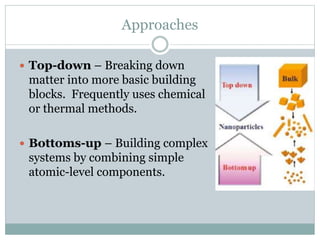
Approaches
 Top-down – Breaking down
matter into more basic building
blocks. Frequently uses chemical
or thermal methods.
 Bottoms-up – Building complex
systems by combining simple
atomic-level components.
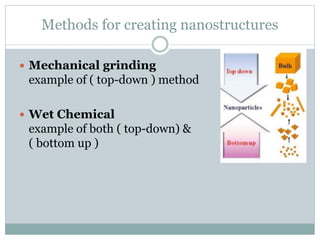
Methods for creating nanostructures
 Mechanical grinding
example of ( top-down ) method
 Wet Chemical
example of both ( top-down) &
( bottom up )
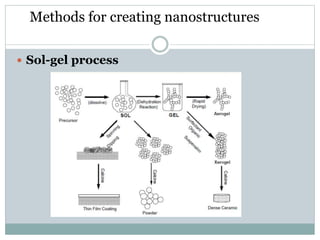
 Sol-gel process
Methods for creating nanostructures
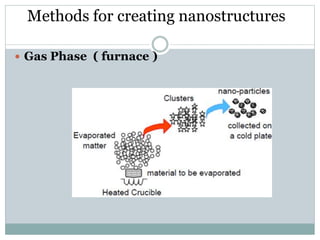
 Gas Phase ( furnace )
Methods for creating nanostructures
Different types of Nanomaterial
 Nanopowder
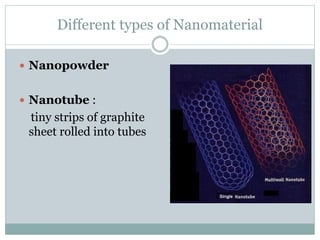
 Nanotube :
tiny strips of graphite
sheet rolled into tubes
Why are nanomaterials important
 These materials have created a high interest in
recent years by their high mechanical, electrical,
optical and magnetic properties.
Applications of nanomaterials
 Light source - QD lasers, QC (Quantum Cascade)
lasers
 Light detector – QDIP (Quantum Dot Infrared
Photo-detector)
 Electromagnetic induced transparency (EIT) – to
obtain transparent highly dispersive materials
 Ballistic electron devices
 Tunneling electron devices
 Single electron devices
Advantages of Nanomaterials
 The properties of nanomaterials, particularly their size, offer various
different advantages compared to the bulk-form of the materials, and
their versatility in terms of the ability to tailor them for specific
requirements accentuates their usefulness. An additional advantage is
their high porosity, which again increases demand for their use in a
multitude of industries.
 In the energy sector, the use of nanomaterials is advantageous in that
they can make the existing methods of generating energy - such as
solar panels - more efficient and cost-effective, as well as opening
up new ways in which to both harness and store energy.
 Nanomaterials are also set to introduce a number of advantages in the
electronics and computing industry. Their use will permit an increase
in the accuracy of the construction of electronic circuits on
an atomic level, assisting in the development of numerous electronic
products.
Disadvantages of Nanomaterials
 Due to the relative novelty of the widespread use of nanomaterials,
there is not a large amount of information on the health and
safety aspects of exposure to the materials.
 Currently, one of the main disadvantages associated with
nanomaterials is considered to be inhalation exposure. This concern
arises from animal studies, the results of which suggested that
nanomaterials such as carbon nanotubes and nanofibers may cause
detrimental pulmonary effects, such as pulmonary fibrosis. Further
possible health risks are ingestion exposure and dust explosion
hazards.
 Additionally, there are still knowledge gaps regarding nanomaterials,
meaning the manufacturing process can often be complex and
difficult. The overall process is also expensive, requiring optimum
results - especially regarding their use in consumer goods - in order to
avoid financial losses.
Conclusion
 Cylinders always align along diagonal of texture, even with small wave
amplitude
 For hydrophilic walls, small wall spacing with small wave amplitude
only distorts structure
 For hydrophilic walls, large wall spacing with small wave amplitude
promotes (1 0 0) orientation
 For hydrophilic walls, planar defects may be more likely if wall spacing
> space needed for # of layers
 systems with hydrophobic walls may avoid planar defects, because
 the deposition of a monolayer of surfactant on the wall.
 The chain softness mitigates the pattern
References
 Wikipedia
 Google
 Studymafia
 pptplanet
Thank you

Nanomaterials

  • 1.
  • 2.
    Table Of Content What are Nanomaterials?  Properties of Nanomaterials?  Nanomaterial shapes  Why nanomaterials ?  Approaches  Applications of nanomaterials  Advantages of Nanomaterials  Disadvantages of Nanomaterials  Conclusion
  • 3.
    What is nanomaterial Nanomaterials are commonly defined as materials with an average grain size less than 100 nanometers  Nanomaterials have extremely small size which having at least one dimension 100 nm  One billion nanometers equals one meter
  • 4.
    Properties of Nanomaterials? Physicalproperties  Size, shape, specific surface area, aspect ratio  Agglomeration/aggregation state  Size distribution  Surface morphology/topography  Structure, including crystallinity and defect structure  Solubility
  • 5.
    Properties of Nanomaterials?.... Chemicalproperties  Structural formula/molecular structure  Composition of nanomaterial (including degree of purity, known impurities or additives)  Phase identity  Surface chemistry (composition, charge, tension, reactive sites, physical structure, photocatalytic properties, zeta potential)  Hydrophilicity/lipophilicity
  • 6.
    Nanomaterial shapes  nanomaterialscan be nanoscale in one dimension ( surface films )  Two dimensions (strands or fiber)  Three dimensions ( particles ) They can exist in single or fused forms with spherical, tubular, and irregular shapes.
  • 7.
    Why nanomaterials ? Nanotechnology exploits benefits of ultra small size, enabling the use of particles to deliver a range of important benefits  Small particles are ‘invisible’ :  Transparent Coatings/Films are attainable  Small particles are very weight efficient:  Surfaces can be modified with minimal material
  • 8.
     the behaviorof nanomaterials may depend more on surface area than particle composition itself.  Relative-surface area is one of the principal factors that enhance its reactivity, strength and electrical properties.
  • 9.
    Weight efficient andUniform coverage  Large spherical particles do not cover much surface area  Nanoparticles Equal mass of small platelet particles provides thorough coverage (1 x 10⁶ times more)
  • 10.
     by patterningmatter on the nano scale, it is possible to vary fundamental properties of materials without changing the chemical composition
  • 11.
    Approaches  Top-down –Breaking down matter into more basic building blocks. Frequently uses chemical or thermal methods.  Bottoms-up – Building complex systems by combining simple atomic-level components.
  • 12.
    Methods for creatingnanostructures  Mechanical grinding example of ( top-down ) method  Wet Chemical example of both ( top-down) & ( bottom up )
  • 13.
     Sol-gel process Methodsfor creating nanostructures
  • 14.
     Gas Phase( furnace ) Methods for creating nanostructures
  • 15.
    Different types ofNanomaterial  Nanopowder  Nanotube : tiny strips of graphite sheet rolled into tubes
  • 16.
    Why are nanomaterialsimportant  These materials have created a high interest in recent years by their high mechanical, electrical, optical and magnetic properties.
  • 17.
    Applications of nanomaterials Light source - QD lasers, QC (Quantum Cascade) lasers  Light detector – QDIP (Quantum Dot Infrared Photo-detector)  Electromagnetic induced transparency (EIT) – to obtain transparent highly dispersive materials  Ballistic electron devices  Tunneling electron devices  Single electron devices
  • 18.
    Advantages of Nanomaterials The properties of nanomaterials, particularly their size, offer various different advantages compared to the bulk-form of the materials, and their versatility in terms of the ability to tailor them for specific requirements accentuates their usefulness. An additional advantage is their high porosity, which again increases demand for their use in a multitude of industries.  In the energy sector, the use of nanomaterials is advantageous in that they can make the existing methods of generating energy - such as solar panels - more efficient and cost-effective, as well as opening up new ways in which to both harness and store energy.  Nanomaterials are also set to introduce a number of advantages in the electronics and computing industry. Their use will permit an increase in the accuracy of the construction of electronic circuits on an atomic level, assisting in the development of numerous electronic products.
  • 19.
    Disadvantages of Nanomaterials Due to the relative novelty of the widespread use of nanomaterials, there is not a large amount of information on the health and safety aspects of exposure to the materials.  Currently, one of the main disadvantages associated with nanomaterials is considered to be inhalation exposure. This concern arises from animal studies, the results of which suggested that nanomaterials such as carbon nanotubes and nanofibers may cause detrimental pulmonary effects, such as pulmonary fibrosis. Further possible health risks are ingestion exposure and dust explosion hazards.  Additionally, there are still knowledge gaps regarding nanomaterials, meaning the manufacturing process can often be complex and difficult. The overall process is also expensive, requiring optimum results - especially regarding their use in consumer goods - in order to avoid financial losses.
  • 20.
    Conclusion  Cylinders alwaysalign along diagonal of texture, even with small wave amplitude  For hydrophilic walls, small wall spacing with small wave amplitude only distorts structure  For hydrophilic walls, large wall spacing with small wave amplitude promotes (1 0 0) orientation  For hydrophilic walls, planar defects may be more likely if wall spacing > space needed for # of layers  systems with hydrophobic walls may avoid planar defects, because  the deposition of a monolayer of surfactant on the wall.  The chain softness mitigates the pattern
  • 21.
  • 22.