Nanostructure
synthesis and Surface
modification
Presentation outline
Nanostructure
Nanostructure synthesis
Surface modification
What is Nano and Nano particle?
Nano- (symbol n) is a unit prefix meaning "one billionth".
One nanometer is equivalent to a billionth of a meter.
A nanoparticle is a microscopic particle with at least one dimension less
than 100 nm.
Nanoparticles are of great scientific interest as they are effectively a bridge
between bulk materials and atomic or molecular structures.
Nanoparticles exhibit a number of special properties relative to bulk
material.
For example, the bending of bulk copper (wire, ribbon, etc.) occurs with
movement of copper atoms/clusters at about the 50 nm scale.
Copper nanoparticles smaller than 50 nm are considered super hard materials
that do not exhibit the same malleability and ductility as bulk copper.
Nano particles have a relative larger surface area when compared to the same
volume of the material.
Its means that when given volume is divided into smaller pieces, the surface area
increases. Therefore as particle size decreases, a greater portion of the atoms are
found at the surface compared to those inside and nanomaterials have a much
greater surface area per unit volume compared with the larger particles.
For example, a particle of size 30 nm has 5% of its atoms its surface.
At 10 nm 20% of its atoms on its surface
But at the size of 3 nm, 50% of its atoms on its surface.
 A bulk material should have constant physical properties regardless
of its size, but at the nano-scale this is often not the case.
Size-dependent properties are observed such as quantum confinement in
semiconductor particles, surface plasmon resonance in some metal particles
and superparamagnetism in magnetic materials.
Size dependent properties of nanoparticles are:
1. Chemical properties ---- reactivity, catalysis
2. Thermal properties --- melting point
3. Mechanical properties --- adhesive force, capillary forces
4. Optical properties --- scattering of light
5. Electrical properties --- tunneling current
6. Magnetic properties --- super magnetic effect
New properties enable new applications and
it opens a whole new area for researchers… … …
…
Nano structure
 A nanostructure is a structure of intermediate size between
microscopic and molecular structures.
Nanostructures refer to materials or structures that have at least one
dimension between 1 and 100 nm.
Nanostructures based on naturally and artificially organic materials,
such as nanoparticles, nanomicelles etc.
Classification of nanostructure
According to the dimensionality of nanostructure, nanostructural
material (NSM) are of following type.
0d NSM
1d NSM
2d NSM
3d NSM
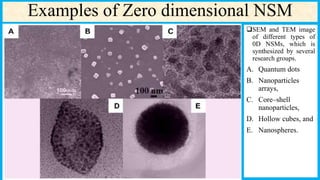
SEM and TEM image
of different types of
0D NSMs, which is
synthesized by several
research groups.
A. Quantum dots
B. Nanoparticles
arrays,
C. Core–shell
nanoparticles,
D. Hollow cubes, and
E. Nanospheres.
Examples of Zero dimensional NSM
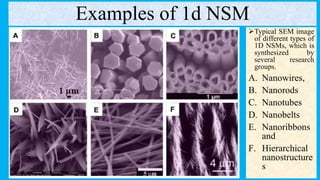
Examples of 1d NSM
Typical SEM image
of different types of
1D NSMs, which is
synthesized by
several research
groups.
A. Nanowires,
B. Nanorods
C. Nanotubes
D. Nanobelts
E. Nanoribbons
and
F. Hierarchical
nanostructure
s
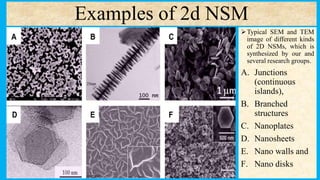
Examples of 2d NSM
Typical SEM and TEM
image of different kinds
of 2D NSMs, which is
synthesized by our and
several research groups.
A. Junctions
(continuous
islands),
B. Branched
structures
C. Nanoplates
D. Nanosheets
E. Nano walls and
F. Nano disks
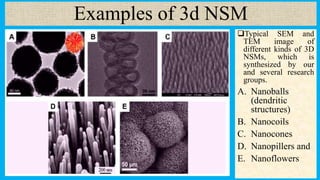
Examples of 3d NSM
Typical SEM and
TEM image of
different kinds of 3D
NSMs, which is
synthesized by our
and several research
groups.
A. Nanoballs
(dendritic
structures)
B. Nanocoils
C. Nanocones
D. Nanopillers and
E. Nanoflowers
Nano structure Synthesis
There are various methods of synthesis of NSM. Methods are given
below:
Physical methods
1. Evaporation technique
2. Sputtering technique
3. Lithography process
4. Hot and cold plasma
5. Spray pyrolysis
6. Inert gas phase condensation
technique
7. Pulsed laser ablation
Chemical methods
1. Lyotropic liquid crystal templates
2. Electroless decomposition
3. Hydrothermal and solvothermal
techniques
4. Sol-gel techniques
5. Chemical vapour decomposition
6. Laser pyrolysis
7. Laser chemical vapor decomposition
technique
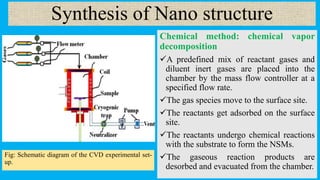
Synthesis of Nano structure
Chemical method: chemical vapor
decomposition
A predefined mix of reactant gases and
diluent inert gases are placed into the
chamber by the mass flow controller at a
specified flow rate.
The gas species move to the surface site.
The reactants get adsorbed on the surface
site.
The reactants undergo chemical reactions
with the substrate to form the NSMs.
The gaseous reaction products are
desorbed and evacuated from the chamber.
Fig: Schematic diagram of the CVD experimental set-
up.
Surface modification
Surface modification is the process of modifying the surface of a
material by physical and chemical method.
It is usually made to solid materials, but it is possible to find examples of the
modification to the surface of specific liquids.
Properties, which can be improved or changed:
Surface charge
Reactivity
Corrosion protection
Roughness
Hydrophilicity
Surface energy
Surface modification technique
Thermal spraying
Physical Vapor Deposition (PVD)
Chemical vapor deposition (CVD)
CVD is classified by operating conditions:
1. Atmospheric pressure CVD
2. Low-pressure CVD
3. Ultrahigh vacuum CVD
Thermal spraying
• Fig. 1 shows that the
chemical energy of
combustion of the fuel
gas in oxygen is used to
generate a hot flame.
• Feedstock material in
the form of a wire or
powder is melted or
softened by flame or
electricity and propelled
onto the work piece to
form a coating.
Fig. 1: Schematic diagram of Thermal Spray
References
Jitendra N. Tiwari, Rajanish N. Tiwari, Kwang S. Kim, 2011, “Zero-dimensional,
one-dimensional, two-dimensional and three-dimensional nanostructured
materials for advanced electrochemical energy devices”, Elsevier, volume
57,Pages 724-803 (https://doi.org/10.1016/j.pmatsci.2011.08.003)
Vineet Shibe,Vikas Chawla,2014,“A Review of Surface Modification Techniques
in Enhancing the Erosion Resistance of Engineering Components”,
https://www.researchgate.net/publication/319207272
BASF( https://www.basf.com/global/en/who-we-are/sustainability/responsible-
partnering/nanotechnology/what-is-nano.html )
Science daily ( https://www.sciencedaily.com/terms/nanoparticle.htm )
ScienceDirect ( https://www.sciencedirect.com/topics/materials-
science/nanostructure )
Nanostructure and surface modification

Nanostructure and surface modification

  • 1.
  • 2.
  • 3.
    What is Nanoand Nano particle? Nano- (symbol n) is a unit prefix meaning "one billionth". One nanometer is equivalent to a billionth of a meter. A nanoparticle is a microscopic particle with at least one dimension less than 100 nm. Nanoparticles are of great scientific interest as they are effectively a bridge between bulk materials and atomic or molecular structures. Nanoparticles exhibit a number of special properties relative to bulk material. For example, the bending of bulk copper (wire, ribbon, etc.) occurs with movement of copper atoms/clusters at about the 50 nm scale. Copper nanoparticles smaller than 50 nm are considered super hard materials that do not exhibit the same malleability and ductility as bulk copper.
  • 4.
    Nano particles havea relative larger surface area when compared to the same volume of the material. Its means that when given volume is divided into smaller pieces, the surface area increases. Therefore as particle size decreases, a greater portion of the atoms are found at the surface compared to those inside and nanomaterials have a much greater surface area per unit volume compared with the larger particles. For example, a particle of size 30 nm has 5% of its atoms its surface. At 10 nm 20% of its atoms on its surface But at the size of 3 nm, 50% of its atoms on its surface.  A bulk material should have constant physical properties regardless of its size, but at the nano-scale this is often not the case. Size-dependent properties are observed such as quantum confinement in semiconductor particles, surface plasmon resonance in some metal particles and superparamagnetism in magnetic materials.
  • 5.
    Size dependent propertiesof nanoparticles are: 1. Chemical properties ---- reactivity, catalysis 2. Thermal properties --- melting point 3. Mechanical properties --- adhesive force, capillary forces 4. Optical properties --- scattering of light 5. Electrical properties --- tunneling current 6. Magnetic properties --- super magnetic effect New properties enable new applications and it opens a whole new area for researchers… … … …
  • 6.
    Nano structure  Ananostructure is a structure of intermediate size between microscopic and molecular structures. Nanostructures refer to materials or structures that have at least one dimension between 1 and 100 nm. Nanostructures based on naturally and artificially organic materials, such as nanoparticles, nanomicelles etc. Classification of nanostructure According to the dimensionality of nanostructure, nanostructural material (NSM) are of following type. 0d NSM 1d NSM 2d NSM 3d NSM
  • 7.
    SEM and TEMimage of different types of 0D NSMs, which is synthesized by several research groups. A. Quantum dots B. Nanoparticles arrays, C. Core–shell nanoparticles, D. Hollow cubes, and E. Nanospheres. Examples of Zero dimensional NSM
  • 8.
    Examples of 1dNSM Typical SEM image of different types of 1D NSMs, which is synthesized by several research groups. A. Nanowires, B. Nanorods C. Nanotubes D. Nanobelts E. Nanoribbons and F. Hierarchical nanostructure s
  • 9.
    Examples of 2dNSM Typical SEM and TEM image of different kinds of 2D NSMs, which is synthesized by our and several research groups. A. Junctions (continuous islands), B. Branched structures C. Nanoplates D. Nanosheets E. Nano walls and F. Nano disks
  • 10.
    Examples of 3dNSM Typical SEM and TEM image of different kinds of 3D NSMs, which is synthesized by our and several research groups. A. Nanoballs (dendritic structures) B. Nanocoils C. Nanocones D. Nanopillers and E. Nanoflowers
  • 11.
    Nano structure Synthesis Thereare various methods of synthesis of NSM. Methods are given below: Physical methods 1. Evaporation technique 2. Sputtering technique 3. Lithography process 4. Hot and cold plasma 5. Spray pyrolysis 6. Inert gas phase condensation technique 7. Pulsed laser ablation Chemical methods 1. Lyotropic liquid crystal templates 2. Electroless decomposition 3. Hydrothermal and solvothermal techniques 4. Sol-gel techniques 5. Chemical vapour decomposition 6. Laser pyrolysis 7. Laser chemical vapor decomposition technique
  • 12.
    Synthesis of Nanostructure Chemical method: chemical vapor decomposition A predefined mix of reactant gases and diluent inert gases are placed into the chamber by the mass flow controller at a specified flow rate. The gas species move to the surface site. The reactants get adsorbed on the surface site. The reactants undergo chemical reactions with the substrate to form the NSMs. The gaseous reaction products are desorbed and evacuated from the chamber. Fig: Schematic diagram of the CVD experimental set- up.
  • 13.
    Surface modification Surface modificationis the process of modifying the surface of a material by physical and chemical method. It is usually made to solid materials, but it is possible to find examples of the modification to the surface of specific liquids. Properties, which can be improved or changed: Surface charge Reactivity Corrosion protection Roughness Hydrophilicity Surface energy
  • 14.
    Surface modification technique Thermalspraying Physical Vapor Deposition (PVD) Chemical vapor deposition (CVD) CVD is classified by operating conditions: 1. Atmospheric pressure CVD 2. Low-pressure CVD 3. Ultrahigh vacuum CVD
  • 15.
    Thermal spraying • Fig.1 shows that the chemical energy of combustion of the fuel gas in oxygen is used to generate a hot flame. • Feedstock material in the form of a wire or powder is melted or softened by flame or electricity and propelled onto the work piece to form a coating. Fig. 1: Schematic diagram of Thermal Spray
  • 16.
    References Jitendra N. Tiwari,Rajanish N. Tiwari, Kwang S. Kim, 2011, “Zero-dimensional, one-dimensional, two-dimensional and three-dimensional nanostructured materials for advanced electrochemical energy devices”, Elsevier, volume 57,Pages 724-803 (https://doi.org/10.1016/j.pmatsci.2011.08.003) Vineet Shibe,Vikas Chawla,2014,“A Review of Surface Modification Techniques in Enhancing the Erosion Resistance of Engineering Components”, https://www.researchgate.net/publication/319207272 BASF( https://www.basf.com/global/en/who-we-are/sustainability/responsible- partnering/nanotechnology/what-is-nano.html ) Science daily ( https://www.sciencedaily.com/terms/nanoparticle.htm ) ScienceDirect ( https://www.sciencedirect.com/topics/materials- science/nanostructure )