Pyroelectric Nanogenerators
Ansar Abbas
Student ID: MPHF17BM05
M.Sc Physics (Sem-IV)
Department of Physics UOS Sub Campus Bhakkar
Pyroelectric
• Pyro electricity can be described as the ability of certain materials to
generate a temporary voltage when they are heated or cooled.
• The change in temperature modifies the positions of the atoms
slightly within the crystal structure, such that the polarization of the
material changes.
Pyroelectric detector
• A Pyroelectric detector is an infrared sensitive optoelectronic
component which are specifically used for detecting electromagnetic
radiation in a wavelength range from (2 to 14) µm.
• A receiver chip of a pyroelectric infrared detector manufactured by
InfraTec consists of single-crystalline lithium tantalate.
Pyroelectric crystals
• Pyroelectric crystals are crystals that generate electricity when
heated. It is similar to piezoelectricity.
• Pyroelectricity is a phenomenon of certain crystals, displaying
temporary voltage followed by external current, when subjected to a
temperature gradient[1].
Pyroelectric effect
• Pyroelectric effect: ability of certain materials to generate a
temporary voltage when they are heated or cooled.
Pyroelectric Nanogenerator
• A nanogenerator is an energy harvesting device converting the
external thermal energy into an electrical energy by using nano-
structured pyroelectric materials.
Mechanism
• Primary pyroelectric effect (Ferroelectric materials (PZT, BTO))
• Secondary pyroelectric effect (Wurtzite-type materials (ZnO, CdS))
Primary pyroelectric effect
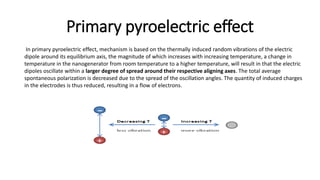
In primary pyroelectric effect, mechanism is based on the thermally induced random vibrations of the electric
dipole around its equilibrium axis, the magnitude of which increases with increasing temperature, a change in
temperature in the nanogenerator from room temperature to a higher temperature, will result in that the electric
dipoles oscillate within a larger degree of spread around their respective aligning axes. The total average
spontaneous polarization is decreased due to the spread of the oscillation angles. The quantity of induced charges
in the electrodes is thus reduced, resulting in a flow of electrons.
Secondary pyroelectric effect
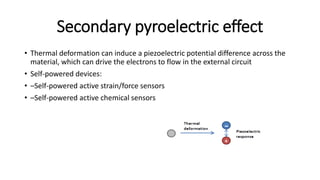
• Thermal deformation can induce a piezoelectric potential difference across the
material, which can drive the electrons to flow in the external circuit
• Self-powered devices:
• –Self-powered active strain/force sensors
• –Self-powered active chemical sensors
Applications of Pyroelectric Nanogenerators
• Applications of Pyroelectric Nanogenerators
• Time-dependent temperature fluctuation
• Self-powered thermal sensor
• Thermal imaging
•Thank You

Pyroelectric nanogenerators

  • 1.
    Pyroelectric Nanogenerators Ansar Abbas StudentID: MPHF17BM05 M.Sc Physics (Sem-IV) Department of Physics UOS Sub Campus Bhakkar
  • 2.
    Pyroelectric • Pyro electricitycan be described as the ability of certain materials to generate a temporary voltage when they are heated or cooled. • The change in temperature modifies the positions of the atoms slightly within the crystal structure, such that the polarization of the material changes.
  • 3.
    Pyroelectric detector • APyroelectric detector is an infrared sensitive optoelectronic component which are specifically used for detecting electromagnetic radiation in a wavelength range from (2 to 14) µm. • A receiver chip of a pyroelectric infrared detector manufactured by InfraTec consists of single-crystalline lithium tantalate.
  • 4.
    Pyroelectric crystals • Pyroelectriccrystals are crystals that generate electricity when heated. It is similar to piezoelectricity. • Pyroelectricity is a phenomenon of certain crystals, displaying temporary voltage followed by external current, when subjected to a temperature gradient[1].
  • 5.
    Pyroelectric effect • Pyroelectriceffect: ability of certain materials to generate a temporary voltage when they are heated or cooled.
  • 6.
    Pyroelectric Nanogenerator • Ananogenerator is an energy harvesting device converting the external thermal energy into an electrical energy by using nano- structured pyroelectric materials.
  • 7.
    Mechanism • Primary pyroelectriceffect (Ferroelectric materials (PZT, BTO)) • Secondary pyroelectric effect (Wurtzite-type materials (ZnO, CdS))
  • 8.
    Primary pyroelectric effect Inprimary pyroelectric effect, mechanism is based on the thermally induced random vibrations of the electric dipole around its equilibrium axis, the magnitude of which increases with increasing temperature, a change in temperature in the nanogenerator from room temperature to a higher temperature, will result in that the electric dipoles oscillate within a larger degree of spread around their respective aligning axes. The total average spontaneous polarization is decreased due to the spread of the oscillation angles. The quantity of induced charges in the electrodes is thus reduced, resulting in a flow of electrons.
  • 9.
    Secondary pyroelectric effect •Thermal deformation can induce a piezoelectric potential difference across the material, which can drive the electrons to flow in the external circuit • Self-powered devices: • –Self-powered active strain/force sensors • –Self-powered active chemical sensors
  • 10.
    Applications of PyroelectricNanogenerators • Applications of Pyroelectric Nanogenerators • Time-dependent temperature fluctuation • Self-powered thermal sensor • Thermal imaging
  • 11.