
Nano technology based bio
degradable plastics
By: Prasad Reddy,M.N
M-Tech(FST)
2015694708
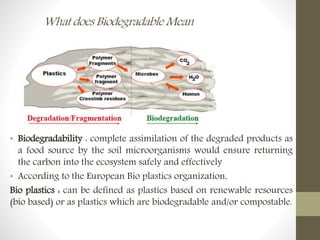
What does Biodegradable Mean
• Biodegradability : complete assimilation of the degraded products as
a food source by the soil microorganisms would ensure returning
the carbon into the ecosystem safely and effectively
• According to the European Bio plastics organization,
Bio plastics : can be defined as plastics based on renewable resources
(bio based) or as plastics which are biodegradable and/or compostable.
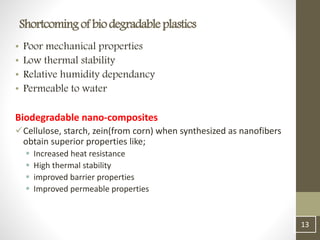
• Poor mechanical properties
• Low thermal stability
• Relative humidity dependancy
• Permeable to water
Biodegradable nano-composites
Cellulose, starch, zein(from corn) when synthesized as nanofibers
obtain superior properties like;
 Increased heat resistance
 High thermal stability
 improved barrier properties
 Improved permeable properties
13
Shortcomingof biodegradable plastics
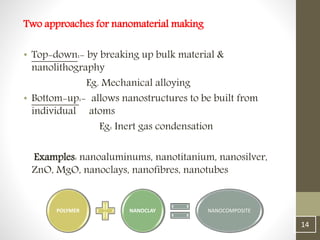
Two approaches for nanomaterial making
• Top-down:- by breaking up bulk material &
nanolithography
Eg. Mechanical alloying
• Bottom-up:- allows nanostructures to be built from
individual atoms
Eg: Inert gas condensation
Examples: nanoaluminums, nanotitanium, nanosilver,
ZnO, MgO, nanoclays, nanofibres, nanotubes
14
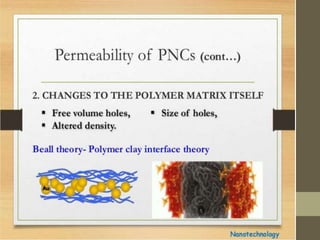
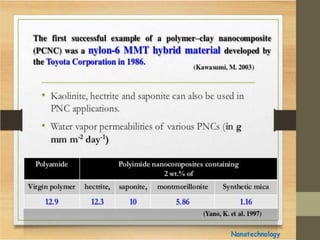
POLYMER NANOCLAY NANOCOMPOSITE
NanocompositePreparation
• For nanocomposite preparation, (OMLS)Organically Modified
Layered Silicates (powder form) and PLA (pellets form) were first
dry-mixed by shaking them in a bag.
• The mixture was then melt-extruded by using a twin screw
extruder operated at 210℃ (screw speed = 100 rpm, feed
rate=120 gm /min) to yield nanocomposite strands.
• The strands were pelletized and dried under vacuum at 60 ℃ for
48 h to remove water.
• The dried nanocomposite pellets were then converted into sheets
with a thickness of 0.7–2 mm by pressing with 1.5 MPa at 190 ℃
for 3 min.
• The molded sheets were then quickly quenched between glass
plates and then annealed at 110 ℃ for 1.5 h to crystallize
isothermally before being subjected to wide-angle X-ray
diffraction, transmission electron microscopy, and dynamic
mechanical properties measurements.
Incorporationofpolymatrixin tonanoparticles
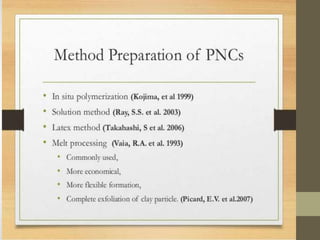
• In situ polymerization : dissolution of the nanoparticles
in the monomer solution before polymerization,
• solvent intercalation :use of a solvent to enhance the
affinity between the nanoparticles and the matrix
• melt intercalation : addition of the nanoparticles during
extrusion
Source: Chivrac et al., 2009; Shen, Simon, & Cheng,2002).
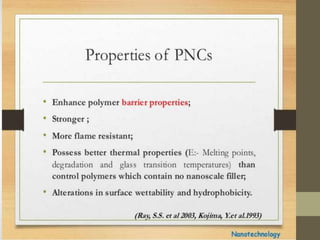
 Basically montmorillonites (MMT) has been used.
• Polylactic acid + MMT = increased thermal resistance
• Polyvinylchloride + MMT = improved optical resistance
• Polyethylene + MMT/SiO2 = improved durability
• Polyamide+multi wall carbon nanotubes = significant flame
resistance
17
Nanocomposites
Others
•Nanofibres: barrier and mechanical properties, it also
displayed high transparency properties
•Silica nanoparticles: improve mechanical or barrier properties
of composites
•Starch nanocrystals: mechanical properties
•Titanium dioxide nanoparticulate: block UV light and provide
a longer shelf-life for food
18
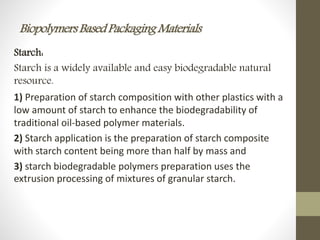
BiopolymersBasedPackagingMaterials
Starch:
Starch is a widely available and easy biodegradable natural
resource.
1) Preparation of starch composition with other plastics with a
low amount of starch to enhance the biodegradability of
traditional oil-based polymer materials.
2) Starch application is the preparation of starch composite
with starch content being more than half by mass and
3) starch biodegradable polymers preparation uses the
extrusion processing of mixtures of granular starch.
Cellulose
• Cellulose is the most widely spread natural polymer and is
derived by a delignification from wood pulp or cotton linters.
• It is a biodegradable polysaccharide which can be dissolved in
a mixture of sodium hydroxide and carbon disulphide to obtain
cellulose xanthate and then recast into an acid solution
(sulfuric acid) to make a cellophane film.
• Alternatively, cellulose derivatives can be produced by
derivatization of cellulose from the solvated state, via
esterification or etherification of, hydroxyl groups.
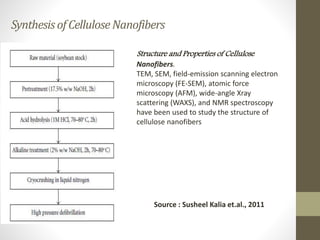
Synthesis of CelluloseNanofibers
Structure and Properties of Cellulose
Nanofibers.
TEM, SEM, field-emission scanning electron
microscopy (FE-SEM), atomic force
microscopy (AFM), wide-angle Xray
scattering (WAXS), and NMR spectroscopy
have been used to study the structure of
cellulose nanofibers
Source : Susheel Kalia et.al., 2011
PHA
• The polyhydroxyalkanoates (PHA) family are biodegradable
thermoplastic polymers, produced by a wide range of
microorganisms.
• The polymer is produced in the microbial cells through a
fermentation process and then harvested by using solvents
such as chloroform, methylene chloride or propylene chloride.
• More than 100 PHA composites are known, of which
polyhydroxybutyrate (PHB) is the most common.
• The PHAs have potential as a substitute for many conventional
polymers, since they possess similar chemical and physical
properties
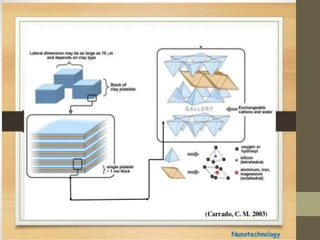
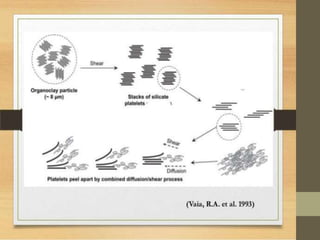
Clay delamination/dispersion
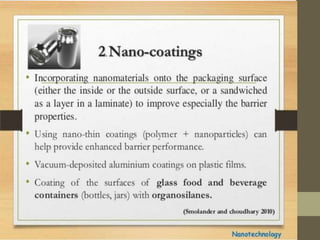
Surface coatings
 Nano silver
 Zinc oxide
 Titanium dioxide
 Magnesium oxide
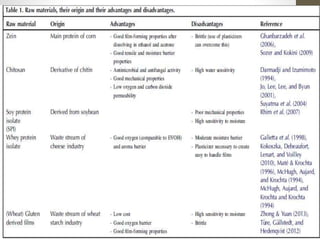
Limitations of bio plastics
• higher price level compared to conventional plastics,
• Brittleness(due to high glass transition and melting
temperatures)
• Thermal instability, low melt strength, difficult heat
sealability,
• high water vapor(hydrophilic nature of starch and cellulose,)
and oxygen permeability restrict the use of PLA films for
many food packaging applications
To over come these problems
• To achieve this modifications, a good interaction between
the polymer matrix (continuous phase) and the nanofiller
(discontinuous phase) is desired (Lagaron & Lopez-Rubio,
2011).
• Coatings : cellulose film with PHB resulted in lower WVP
values, higher elastic modulus and tensile strength for
films containing 10% or more PHB and better strain at
break for films containing 15% or more PHB (Cyras et al.,
2009).
• A nitrocellulose or PVdC coating on cellophane improved
both O2 and H2O barrier properties (Shen et al., 2009).
• In general, Popa and Belc (2007) stated that chitosan
may be used as a biobased coating on polymers with
poor gas barrier properties.
• coating of PLA with PLA-Si/SiOx, PCL-Si/SiOx
(polycaprolactone) or PEO-Si/SiOx (polyethylene oxide)
enhanced the barrier (oxygen and water vapor)
properties,
Reference
• Nanotechnology for bioplastics opportunities, challenges and
strategies, (2011) Trends in Food Science & Technology 22 611-617.
• Nanocomposites for food packaging applications 2009, Henriette
M.C. de Azeredo, Food Research International 42 1240–1253.
• Biodegradable Polylactide and Its Nanocomposites: Opening a New
Dimension for Plastics and Composites (2003) Suprakas Sinha
Ray,*Masami Okamoto, research gate, DOI:
10.1002/marc.200300008
• Recent trends of Biodegradable polymer: Biodegradable films for
Food Packaging and application of Nanotechnology in
Biodegradable Food Packaging , (2014) Malathi A. N. Current
Trends in Technology and Science ISSN : 2279-0535. Volume : 3,
Issue : 2
• Cellulose-Based Bio- and Nanocomposites (2011), Susheel Kalia
et.al., International Journal of Polymer Science , Article ID 837875,
35 pages, doi:10.1155/2011/837875,Hindawi Publishing
Corporation.
Thank you!!
Our technological powers increase, but the side
effects and potential hazards also escalate.
Alvin Toffler

Nano technology based bio degradable plastics

  • 1.
    Nano technology basedbio degradable plastics By: Prasad Reddy,M.N M-Tech(FST) 2015694708
  • 12.
    What does BiodegradableMean • Biodegradability : complete assimilation of the degraded products as a food source by the soil microorganisms would ensure returning the carbon into the ecosystem safely and effectively • According to the European Bio plastics organization, Bio plastics : can be defined as plastics based on renewable resources (bio based) or as plastics which are biodegradable and/or compostable.
  • 13.
    • Poor mechanicalproperties • Low thermal stability • Relative humidity dependancy • Permeable to water Biodegradable nano-composites Cellulose, starch, zein(from corn) when synthesized as nanofibers obtain superior properties like;  Increased heat resistance  High thermal stability  improved barrier properties  Improved permeable properties 13 Shortcomingof biodegradable plastics
  • 14.
    Two approaches fornanomaterial making • Top-down:- by breaking up bulk material & nanolithography Eg. Mechanical alloying • Bottom-up:- allows nanostructures to be built from individual atoms Eg: Inert gas condensation Examples: nanoaluminums, nanotitanium, nanosilver, ZnO, MgO, nanoclays, nanofibres, nanotubes 14 POLYMER NANOCLAY NANOCOMPOSITE
  • 15.
    NanocompositePreparation • For nanocompositepreparation, (OMLS)Organically Modified Layered Silicates (powder form) and PLA (pellets form) were first dry-mixed by shaking them in a bag. • The mixture was then melt-extruded by using a twin screw extruder operated at 210℃ (screw speed = 100 rpm, feed rate=120 gm /min) to yield nanocomposite strands. • The strands were pelletized and dried under vacuum at 60 ℃ for 48 h to remove water. • The dried nanocomposite pellets were then converted into sheets with a thickness of 0.7–2 mm by pressing with 1.5 MPa at 190 ℃ for 3 min. • The molded sheets were then quickly quenched between glass plates and then annealed at 110 ℃ for 1.5 h to crystallize isothermally before being subjected to wide-angle X-ray diffraction, transmission electron microscopy, and dynamic mechanical properties measurements.
  • 16.
    Incorporationofpolymatrixin tonanoparticles • Insitu polymerization : dissolution of the nanoparticles in the monomer solution before polymerization, • solvent intercalation :use of a solvent to enhance the affinity between the nanoparticles and the matrix • melt intercalation : addition of the nanoparticles during extrusion Source: Chivrac et al., 2009; Shen, Simon, & Cheng,2002).
  • 17.
     Basically montmorillonites(MMT) has been used. • Polylactic acid + MMT = increased thermal resistance • Polyvinylchloride + MMT = improved optical resistance • Polyethylene + MMT/SiO2 = improved durability • Polyamide+multi wall carbon nanotubes = significant flame resistance 17 Nanocomposites
  • 18.
    Others •Nanofibres: barrier andmechanical properties, it also displayed high transparency properties •Silica nanoparticles: improve mechanical or barrier properties of composites •Starch nanocrystals: mechanical properties •Titanium dioxide nanoparticulate: block UV light and provide a longer shelf-life for food 18
  • 20.
    BiopolymersBasedPackagingMaterials Starch: Starch is awidely available and easy biodegradable natural resource. 1) Preparation of starch composition with other plastics with a low amount of starch to enhance the biodegradability of traditional oil-based polymer materials. 2) Starch application is the preparation of starch composite with starch content being more than half by mass and 3) starch biodegradable polymers preparation uses the extrusion processing of mixtures of granular starch.
  • 21.
    Cellulose • Cellulose isthe most widely spread natural polymer and is derived by a delignification from wood pulp or cotton linters. • It is a biodegradable polysaccharide which can be dissolved in a mixture of sodium hydroxide and carbon disulphide to obtain cellulose xanthate and then recast into an acid solution (sulfuric acid) to make a cellophane film. • Alternatively, cellulose derivatives can be produced by derivatization of cellulose from the solvated state, via esterification or etherification of, hydroxyl groups.
  • 22.
    Synthesis of CelluloseNanofibers Structureand Properties of Cellulose Nanofibers. TEM, SEM, field-emission scanning electron microscopy (FE-SEM), atomic force microscopy (AFM), wide-angle Xray scattering (WAXS), and NMR spectroscopy have been used to study the structure of cellulose nanofibers Source : Susheel Kalia et.al., 2011
  • 23.
    PHA • The polyhydroxyalkanoates(PHA) family are biodegradable thermoplastic polymers, produced by a wide range of microorganisms. • The polymer is produced in the microbial cells through a fermentation process and then harvested by using solvents such as chloroform, methylene chloride or propylene chloride. • More than 100 PHA composites are known, of which polyhydroxybutyrate (PHB) is the most common. • The PHAs have potential as a substitute for many conventional polymers, since they possess similar chemical and physical properties
  • 33.
    Clay delamination/dispersion Surface coatings Nano silver  Zinc oxide  Titanium dioxide  Magnesium oxide
  • 36.
    Limitations of bioplastics • higher price level compared to conventional plastics, • Brittleness(due to high glass transition and melting temperatures) • Thermal instability, low melt strength, difficult heat sealability, • high water vapor(hydrophilic nature of starch and cellulose,) and oxygen permeability restrict the use of PLA films for many food packaging applications
  • 37.
    To over comethese problems • To achieve this modifications, a good interaction between the polymer matrix (continuous phase) and the nanofiller (discontinuous phase) is desired (Lagaron & Lopez-Rubio, 2011). • Coatings : cellulose film with PHB resulted in lower WVP values, higher elastic modulus and tensile strength for films containing 10% or more PHB and better strain at break for films containing 15% or more PHB (Cyras et al., 2009). • A nitrocellulose or PVdC coating on cellophane improved both O2 and H2O barrier properties (Shen et al., 2009).
  • 38.
    • In general,Popa and Belc (2007) stated that chitosan may be used as a biobased coating on polymers with poor gas barrier properties. • coating of PLA with PLA-Si/SiOx, PCL-Si/SiOx (polycaprolactone) or PEO-Si/SiOx (polyethylene oxide) enhanced the barrier (oxygen and water vapor) properties,
  • 40.
    Reference • Nanotechnology forbioplastics opportunities, challenges and strategies, (2011) Trends in Food Science & Technology 22 611-617. • Nanocomposites for food packaging applications 2009, Henriette M.C. de Azeredo, Food Research International 42 1240–1253. • Biodegradable Polylactide and Its Nanocomposites: Opening a New Dimension for Plastics and Composites (2003) Suprakas Sinha Ray,*Masami Okamoto, research gate, DOI: 10.1002/marc.200300008 • Recent trends of Biodegradable polymer: Biodegradable films for Food Packaging and application of Nanotechnology in Biodegradable Food Packaging , (2014) Malathi A. N. Current Trends in Technology and Science ISSN : 2279-0535. Volume : 3, Issue : 2 • Cellulose-Based Bio- and Nanocomposites (2011), Susheel Kalia et.al., International Journal of Polymer Science , Article ID 837875, 35 pages, doi:10.1155/2011/837875,Hindawi Publishing Corporation.
  • 41.
    Thank you!! Our technologicalpowers increase, but the side effects and potential hazards also escalate. Alvin Toffler