MONETARY
POLICY
INTRODUCTION
 BARTER SYSTEM
 DIFFUCLITIES
Double coincidence of wants

Measure of value
DEFINITION OF MONEY
DEF: anything that is generally acceptable as
a means of exchange and that at the same time

acts as a measure and as a store of valueCrowther
Money is that which money does-Walker
FUNCTIONS OF MONEY
Medium of exchange
Measure of value
Store of value
Standard of differed payments
IMPORTANCE OF MONEY
Fundamental discovery
Capitalist economy
Socialist economy
planning
MONEY SUPPLY
 M1= currency with the public +DD (narrow money)
 M2=M1+post office deposits
 M3=M1+time deposits with the banks (broad money)

 M4 =M3+total post office deposits
RESERVE MONEY
 Reserve money: government money, RR is the cash held by the
pubic and the banks
 It is composed of
 C+OD+CR
C=currency with the public in circulation
OD=other deposits of public with the RBI
CR=cash reserve of banks

M=RM
FIAT MONEY
 CURRENCY NOTES IN CIRCULATION ARE NORMALLY
REFERRED TO AS FIAT MONEY

 THE NOTES ISSUED BY THE RBI ARE USUALLY
REFERED AS BANK MONEY OR PROMISSORY NOTES
MONETARY POLICY
 BASIC GOALS : full employment ,price stablity,rapid
economic growth ,balance of payments equilibrium and
economic justice.

 “monetary policy is policy that employs the central bank „s
control over the supply and cost of money as an instruments for
achieving the objectives of economic policy”
INSTRUMENTS OF
MONETARY POLICY
QUANTITATIVE CREDIT CONTROL
MEASURES

SELECTIVE CREDIT CONTROL
MEASURES
QUANTITATIVE CREDIT
CONTROL


Bank rate

 Variation of cash reserve ratios
 Open market operations
1.the possession by the central bank of adequate volume of securities
2.The presence of well developed bill market
3.Stability of CRR
SELECTIVE CRDIT
CONTROL
 Fixing minimum margin of lending
 Ceiling on the amount of credit for expansion
 Different rate of interest will be charged to encourage

certain sectors
 The central bank will persuade the commercial banks to
follow certain policies through moral suasion
MONETARY
TRANSMISSION
The transmission mechanism tells that
monetary policy affects income through

the interest rate and investment
DDDDDDD
ARGUMENTS
Interest rate is inversely related with
consumption

Income may change by altering net private
wealth
Liquidity trap
DEAR MONEY
When there is inflation in a
country ,the central bank tries to
control it by dear
money……….interest rates are high
CHEAP MONEY
CHEAP MONEY loans are available at low
rates of interest rate it is fallowed during

?
VALUE OF MONEY
 PURCHASING POWER OF MONEY
 PRICE LEVEL

A general rise in the price level indicates a fall in the value of
money
A general fall in prices indicates

?
THE QUANTITY THEORY
OF MONEY OR THE
EQUATION OF EXCHANGE
 Irving Fisher
 “prices always change in exact proportion to change in the
quantity money .if the amount of money doubled ,prices

double.if the amount of money is halved,prices fall to half their
original level”
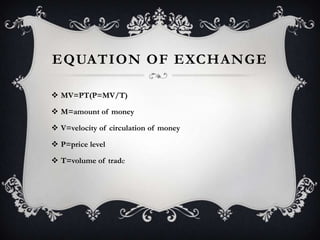
EQUATION OF EXCHANGE
 MV=PT(P=MV/T)
 M=amount of money
 V=velocity of circulation of money

 P=price level
 T=volume of trade
 Now a days, a large proprtion of money consists of ?
So the equation of exchange has been modified as
 PT=MV+M‟V‟
 M‟= ?
 V‟=?
INFLATION
 Inflation is a state in which the value of money i.e price are
rising –crowther
 There is inflation even without rise in the price level this is

known as Repressed inflation
 A situation marked by rising prices and stagnation in
demand is known as Stagflation
TYPES OF INFLATION
 Demand pull inflation
 Creeping or persistent inflation -1945-prices and wages push each other
 Runway or galloping or hyper inflation
 Cost push inflation
 Bottleneck inflation
 Profit –push inflation
 Inflationary spiral
MEASURES TO CHECK
INFLATION
 Incresed taxation
 Reducing government exp. ?
 Restriction on imports

 Rationong
 Price control
 Wage freeze
DEFLATION
 Crowther- state in which the value of money is
rising i.e prices are falling
 Bad trade and unemployment

 Losses for producers and businessmen
 Fall in investment
 Wage cut
EFFECTS OF CHANGES IN
PRICES
inflation
production

stimulate

deflation
Discourage

Distribution
Business class
Fixed income groups
Wage earners and salaried
investors
Rentiers

gain
Hit hard
Lose their jobs
Gain but gilt edged lose
lose

Hit hard
not much effect
gain
lose
gain
Inflation is unjust and deflation is inexpedient

Any questions

?
THANK YOU

HAVE A NICE AND FRUITFULL HOLIDAYS
 YOURS
S.MADAN KUMAR
M.A.,M.A.,B.Ed.,M.Phil.,M.B.A

Monetary policy

  • 1.
  • 2.
    INTRODUCTION  BARTER SYSTEM DIFFUCLITIES Double coincidence of wants Measure of value
  • 3.
    DEFINITION OF MONEY DEF:anything that is generally acceptable as a means of exchange and that at the same time acts as a measure and as a store of valueCrowther Money is that which money does-Walker
  • 4.
    FUNCTIONS OF MONEY Mediumof exchange Measure of value Store of value Standard of differed payments
  • 5.
    IMPORTANCE OF MONEY Fundamentaldiscovery Capitalist economy Socialist economy planning
  • 6.
    MONEY SUPPLY  M1=currency with the public +DD (narrow money)  M2=M1+post office deposits  M3=M1+time deposits with the banks (broad money)  M4 =M3+total post office deposits
  • 7.
    RESERVE MONEY  Reservemoney: government money, RR is the cash held by the pubic and the banks  It is composed of  C+OD+CR C=currency with the public in circulation OD=other deposits of public with the RBI CR=cash reserve of banks M=RM
  • 8.
    FIAT MONEY  CURRENCYNOTES IN CIRCULATION ARE NORMALLY REFERRED TO AS FIAT MONEY  THE NOTES ISSUED BY THE RBI ARE USUALLY REFERED AS BANK MONEY OR PROMISSORY NOTES
  • 9.
    MONETARY POLICY  BASICGOALS : full employment ,price stablity,rapid economic growth ,balance of payments equilibrium and economic justice.  “monetary policy is policy that employs the central bank „s control over the supply and cost of money as an instruments for achieving the objectives of economic policy”
  • 10.
    INSTRUMENTS OF MONETARY POLICY QUANTITATIVECREDIT CONTROL MEASURES SELECTIVE CREDIT CONTROL MEASURES
  • 11.
    QUANTITATIVE CREDIT CONTROL  Bank rate Variation of cash reserve ratios  Open market operations 1.the possession by the central bank of adequate volume of securities 2.The presence of well developed bill market 3.Stability of CRR
  • 12.
    SELECTIVE CRDIT CONTROL  Fixingminimum margin of lending  Ceiling on the amount of credit for expansion  Different rate of interest will be charged to encourage certain sectors  The central bank will persuade the commercial banks to follow certain policies through moral suasion
  • 13.
    MONETARY TRANSMISSION The transmission mechanismtells that monetary policy affects income through the interest rate and investment
  • 14.
  • 15.
    ARGUMENTS Interest rate isinversely related with consumption Income may change by altering net private wealth Liquidity trap
  • 16.
    DEAR MONEY When thereis inflation in a country ,the central bank tries to control it by dear money……….interest rates are high
  • 17.
    CHEAP MONEY CHEAP MONEYloans are available at low rates of interest rate it is fallowed during ?
  • 18.
    VALUE OF MONEY PURCHASING POWER OF MONEY  PRICE LEVEL A general rise in the price level indicates a fall in the value of money A general fall in prices indicates ?
  • 19.
    THE QUANTITY THEORY OFMONEY OR THE EQUATION OF EXCHANGE  Irving Fisher  “prices always change in exact proportion to change in the quantity money .if the amount of money doubled ,prices double.if the amount of money is halved,prices fall to half their original level”
  • 20.
    EQUATION OF EXCHANGE MV=PT(P=MV/T)  M=amount of money  V=velocity of circulation of money  P=price level  T=volume of trade
  • 21.
     Now adays, a large proprtion of money consists of ? So the equation of exchange has been modified as  PT=MV+M‟V‟  M‟= ?  V‟=?
  • 22.
    INFLATION  Inflation isa state in which the value of money i.e price are rising –crowther  There is inflation even without rise in the price level this is known as Repressed inflation  A situation marked by rising prices and stagnation in demand is known as Stagflation
  • 23.
    TYPES OF INFLATION Demand pull inflation  Creeping or persistent inflation -1945-prices and wages push each other  Runway or galloping or hyper inflation  Cost push inflation  Bottleneck inflation  Profit –push inflation  Inflationary spiral
  • 24.
    MEASURES TO CHECK INFLATION Incresed taxation  Reducing government exp. ?  Restriction on imports  Rationong  Price control  Wage freeze
  • 25.
    DEFLATION  Crowther- statein which the value of money is rising i.e prices are falling  Bad trade and unemployment  Losses for producers and businessmen  Fall in investment  Wage cut
  • 26.
    EFFECTS OF CHANGESIN PRICES inflation production stimulate deflation Discourage Distribution Business class Fixed income groups Wage earners and salaried investors Rentiers gain Hit hard Lose their jobs Gain but gilt edged lose lose Hit hard not much effect gain lose gain
  • 27.
    Inflation is unjustand deflation is inexpedient Any questions ?
  • 28.
    THANK YOU HAVE ANICE AND FRUITFULL HOLIDAYS
  • 29.