Introduction
In economics, natural resource scarcity is a relative concept. It
implies that a natural resource is scarce when its quantity is less
than other inputs to the production process. The main objective of
natural resource economics is to better understand the role of
natural resources in the economy in order to develop
more sustainable methods of measuring and mitigating those
resources to ensure their availability to future generations.
Types of Scarcity
Absolute or Physical resource scarcity
It may occur if any economic activity or a whole system of
economic activities depends upon an essential natural
resource which has a finite limit on its physical availability.
Example: Uranium
Types of Scarcity
Relative natural-resource scarcity
Economics is a science which studies human behavior as a
relation between ends and scarce means which have
alternative use. Thus there always exits the solution of
relative scarcity as the resources are limited with respect to
human demand and human wants are unlimited in relation to
resources.
Example: coal
Malthusian & Ricardian Scarcity Recognition
Theory of Natural-resource scarcity
The theories of natural-resource scarcity have been traditionally classified
as either “pessimistic Malthusian” model that suggests a long-term
absolute natural-resource scarcity constraint or “optimistic Ricardian”
model that do not assume any absolute limits but only admit that
resources decline in quality and are therefore relatively scarce.
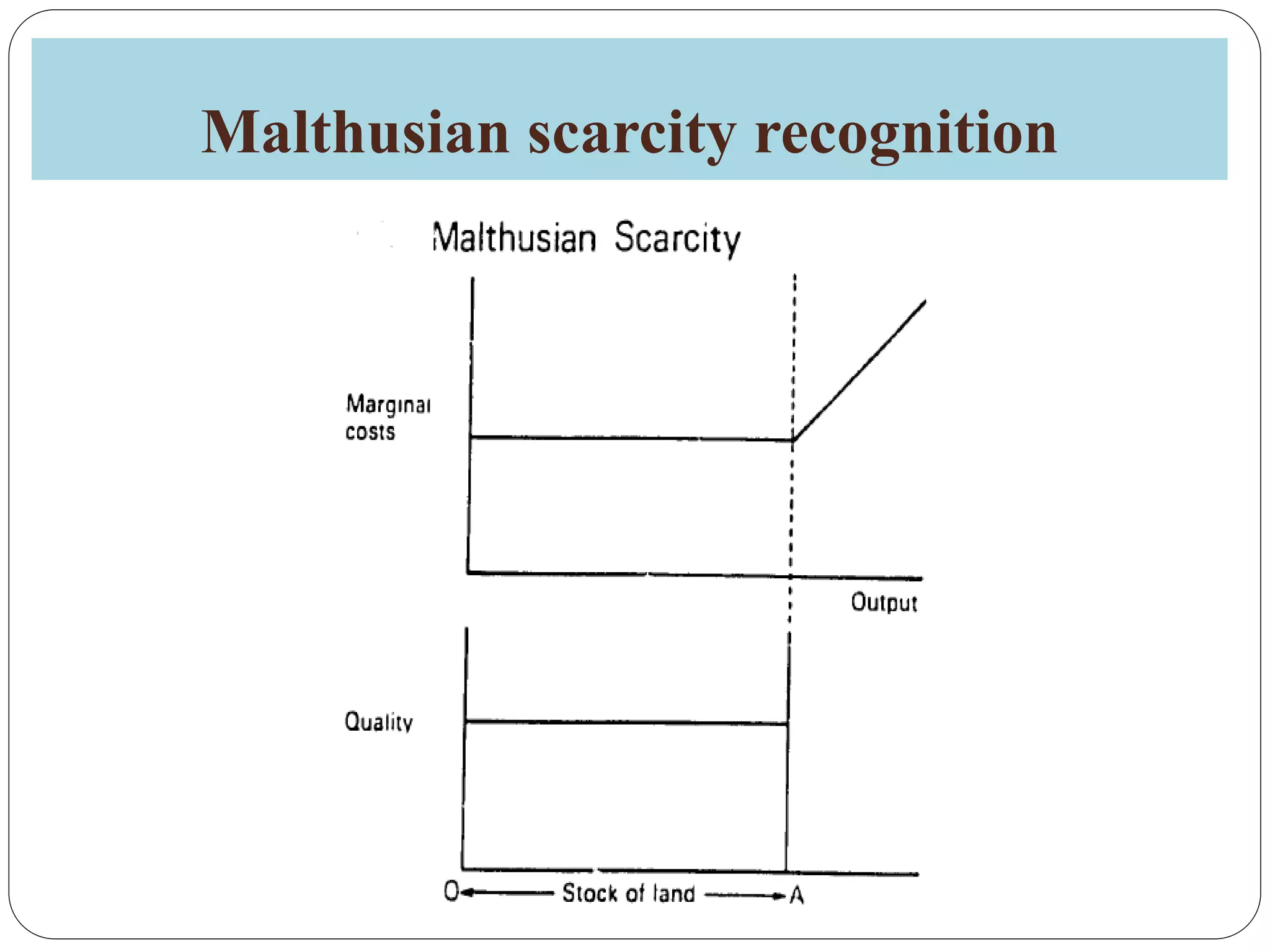
Malthusian scarcity recognition
 The stock of agricultural land is absolutely limited;
 Natural resources are homogeneous in quality;
 Malthusian scarcity is based upon absolute scarcity where fixed
input (land) which eventually leads to scarcity;
 Malthusians stock scarcity applies to resources of uniform quality
with an ultimate limit;
 Malthusian flow scarcity applies to resources for which average
extraction costs depend upon the rate of extraction.
Malthusian scarcity recognition
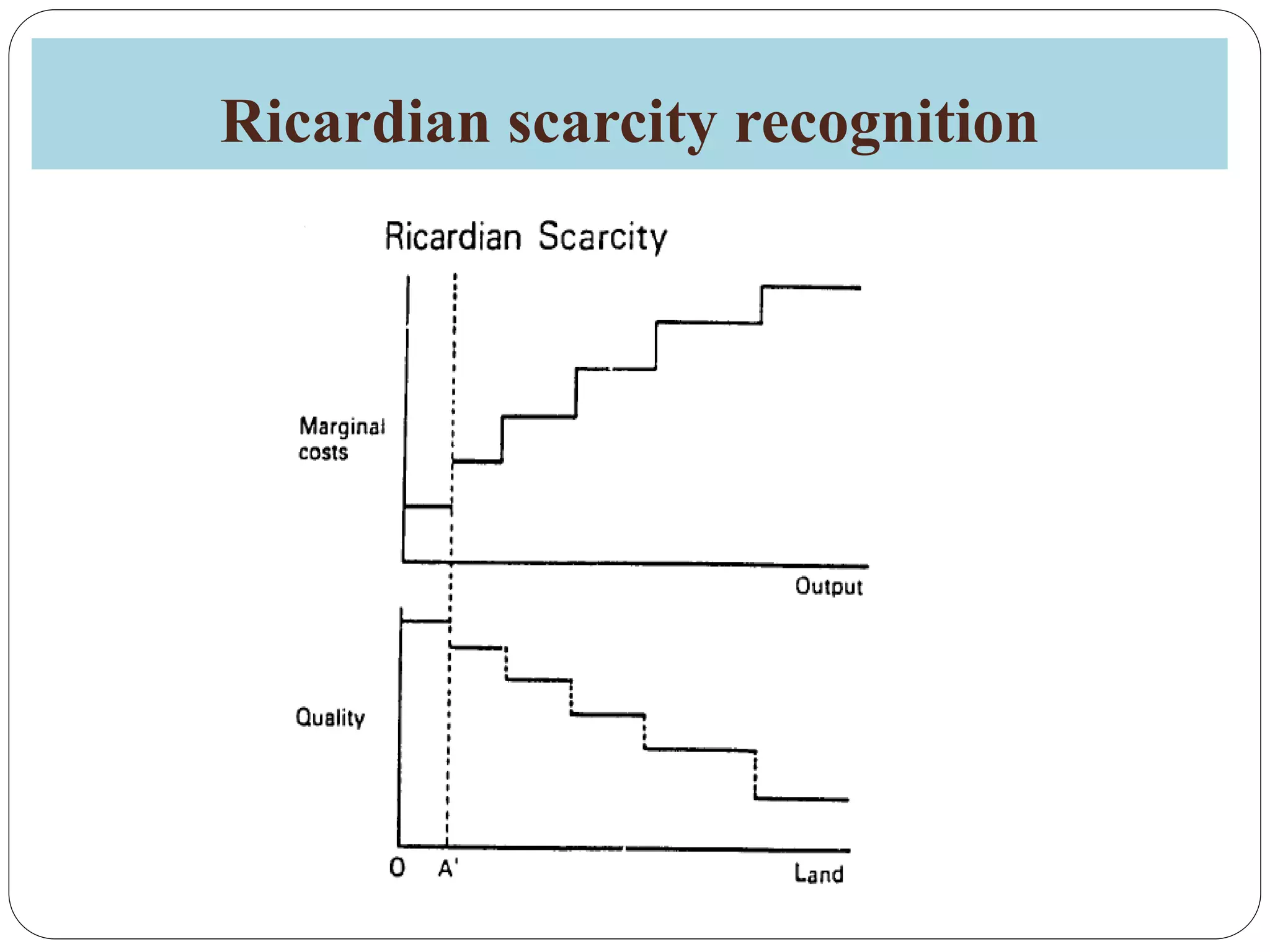
Ricardian scarcity recognition
 Ricardian Scarcity Recognition depends on the relative natural
resource scarcity
 Ricardian scarcity portrays agricultural land as varied in quality
 In the absence of technological change, this scarcity effects
eventually constrain economic activity
Ricardian scarcity recognition
 It differs both in method and timing.
 In terms of method and timing of diminishing returns, Ricardo
focused upon the differential fertility of the individual parcel of
lands
 He assumed that the better land used first
 Ricardo also found that declining quality to be the cause of
increasing resource scarcity.
Ricardian scarcity recognition
Resource price path patterns
Empirical Evidence on Resource Price Paths: Physical Indicators
 Physical measures of scarcity rely on looking at geological
estimates of reserves, and relating this in some way to the level of
demand.
 McKelvey explain about the reserves gradation and the concept of
the ‘ultimately recoverable resource’.
Resource price path patterns
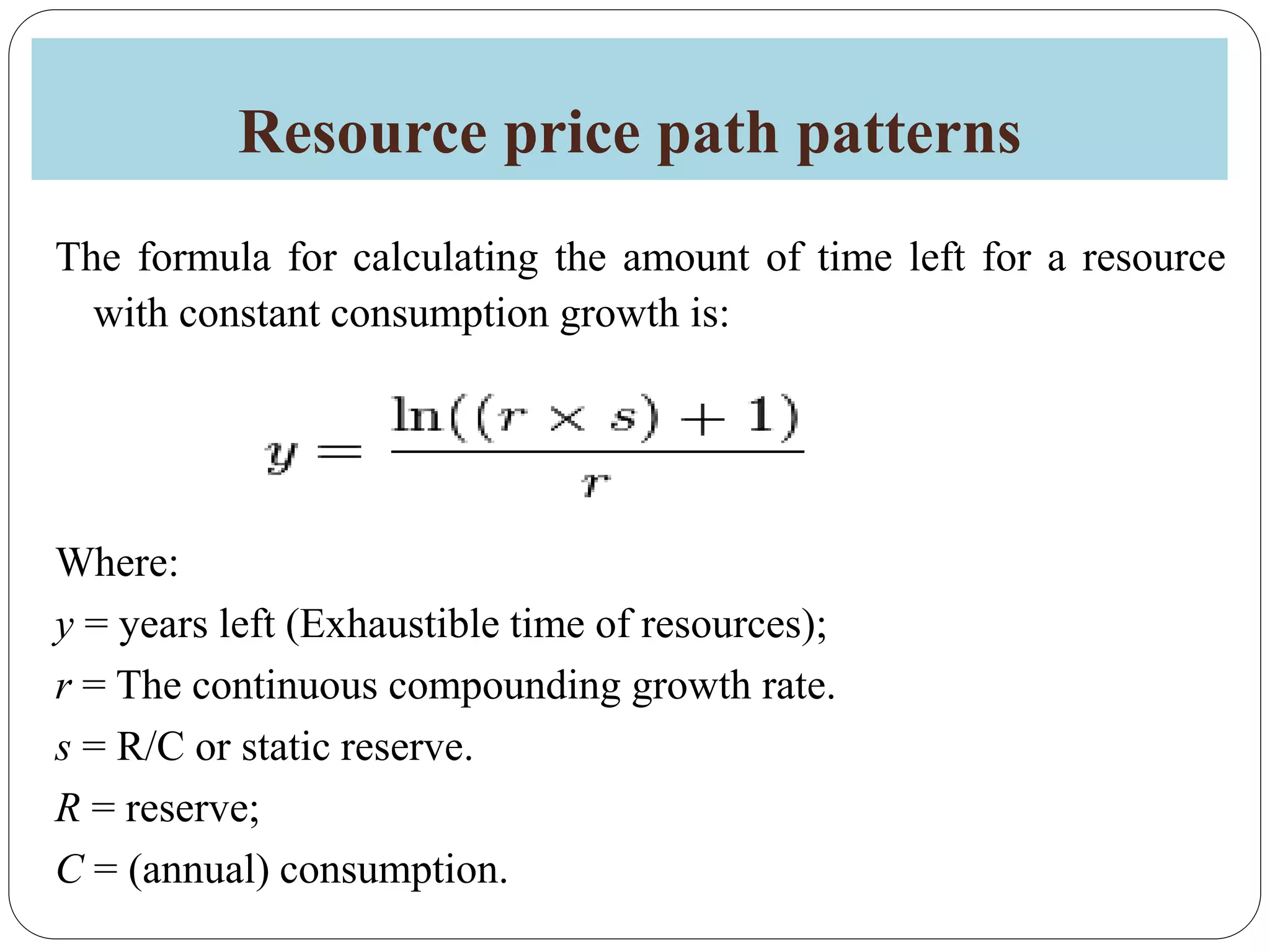
The formula for calculating the amount of time left for a resource
with constant consumption growth is:
Where:
y = years left (Exhaustible time of resources);
r = The continuous compounding growth rate.
s = R/C or static reserve.
R = reserve;
C = (annual) consumption.
Resource price path patterns
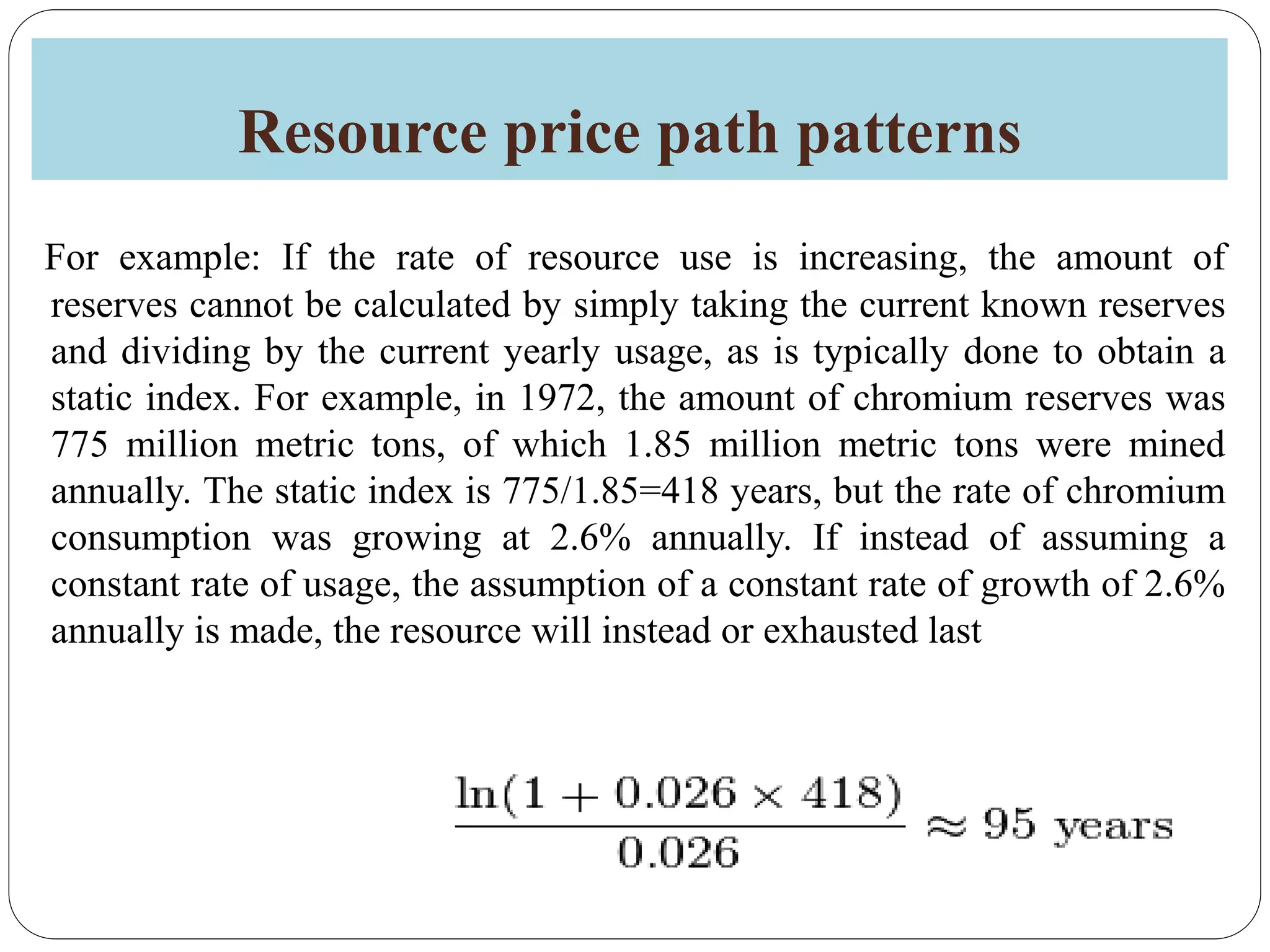
For example: If the rate of resource use is increasing, the amount of
reserves cannot be calculated by simply taking the current known reserves
and dividing by the current yearly usage, as is typically done to obtain a
static index. For example, in 1972, the amount of chromium reserves was
775 million metric tons, of which 1.85 million metric tons were mined
annually. The static index is 775/1.85=418 years, but the rate of chromium
consumption was growing at 2.6% annually. If instead of assuming a
constant rate of usage, the assumption of a constant rate of growth of 2.6%
annually is made, the resource will instead or exhausted last
Resource price path patterns
 A number of exhaustible resources face imminent exhaustion. Yet,
we hear of no such problems
It has two reasons:
 First reason is that the reserve figures in limit to growth are
themselves already out of data
Example: Nickel
 The second reason is that exponential indices fail
Resource price path patterns
These indices fail to account for:
 Variations in forecast demand;
 The effect of rising real prices on demand via reduced demand,
the substitution of other materials for the scarce ore and
conservation in terms of reduced resource requirements per unit
of output; and
 The effect of rising real prices on supplies in respect of increased
recycling and new exploitation/ discovery.
Resource scarcity mitigation
Separating the phrase, two words are identified. They Are ‘Resource
Scarcity’ and ‘Mitigation’. Resource scarcity concerns the availability of
natural resources needed to satisfy basic human needs for food, shelter, and
energy.
So, resource scarcity mitigation is the process of eliminating or reducing
the threat of unavailability of basic human needs. When it happens so in
case of Natural resource, it is called natural resource scarcity mitigation.
There are two way out to mitigate natural resource scarcity they are-
 Mitigation
 Recycling
Mitigation
Mitigation implies the elimination or reduction of the
frequency magnitude, or severity of exposure to risks, or
minimization of the potential impact of a threat or
warning.
Mitigation
How mitigation mitigates resource scarcity?
 Identify
 Recognize
 Mitigate
 Collaborate
 Integrate
 Control
 Promote
Recycling
Recycling is one of the most common of all environmentally
beneficial activities. It is relatively simple and painless and a great
way to involve staff at all levels in your company’s environmental
priorities. Recycling protects habitat and saves energy, water, and
resources such as trees and metal ores.
Recycling
Advantages of Recycling in mitigating resource scarcity-
 Reduce the Size of Landfills
 Conserve Natural Resources
 More Employment Opportunities
 Offers Cash Benefits
 Saves Money
 Reduces the amount of waste sent to landfills and incinerators
 Conserves natural resources such as timber, water, and minerals
Recycling
Steps to Recycling Materials-
 Step 1: Collection and Processing
 Step 2: Manufacturing
 Step 3: Purchasing New Products Made from Recycled
Materials
Recycling
Don’t stop with recycling-
As you become aware of the benefits of reduction to save natural
resources, you won’t be able to escape the easiest and most cost
effective method of reduction: driving less. When you reduce the
amount of miles you drive, you are reducing the need for gas
production and refining. The result is savings in your pocket, as
well as natural resources. You can take it a step further by buying a
hybrid or more fuel-efficient car.
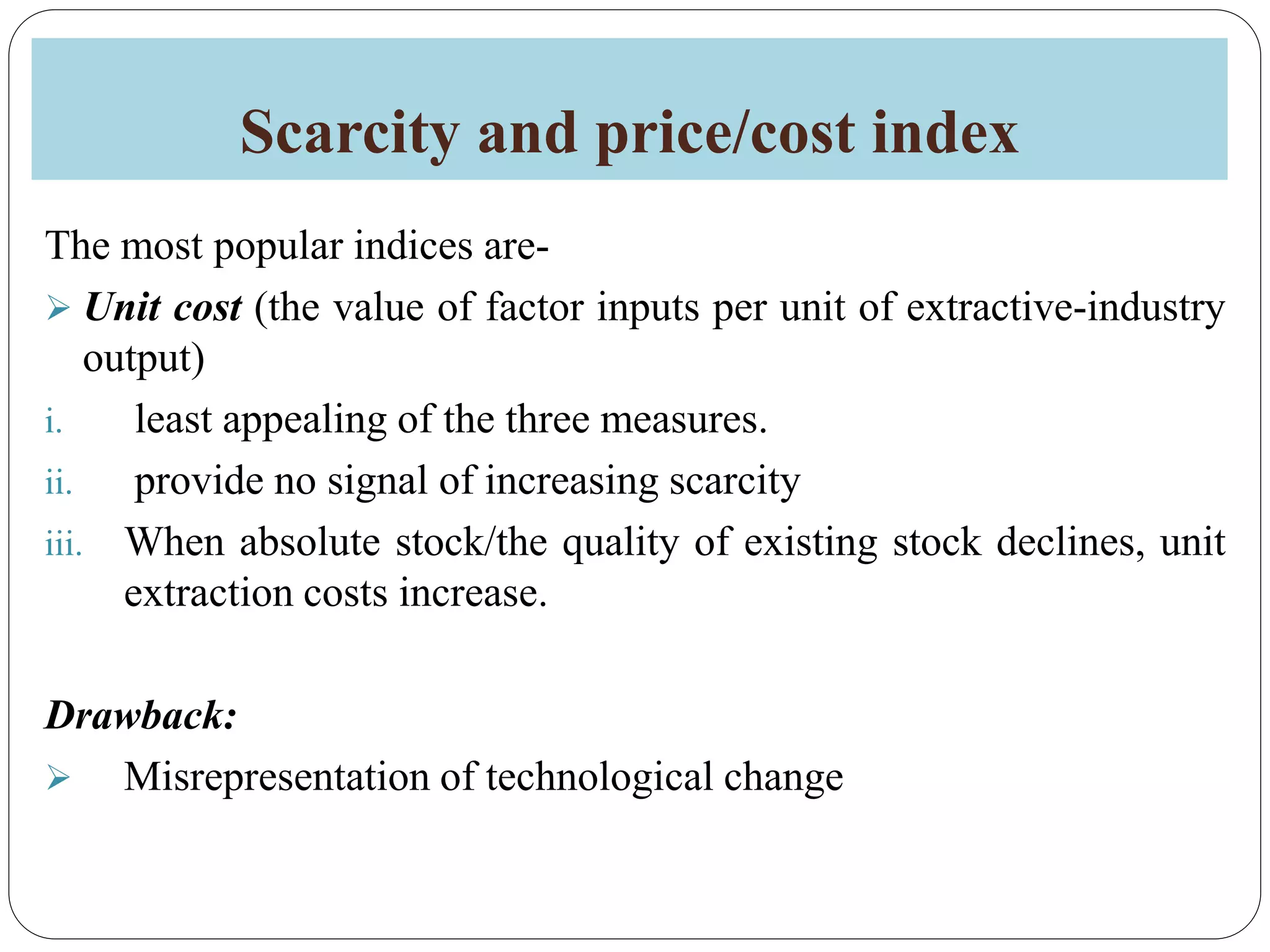
Scarcity and price/cost index
The most popular indices are-
 Unit cost (the value of factor inputs per unit of extractive-industry
output)
i. least appealing of the three measures.
ii. provide no signal of increasing scarcity
iii. When absolute stock/the quality of existing stock declines, unit
extraction costs increase.
Drawback:
 Misrepresentation of technological change
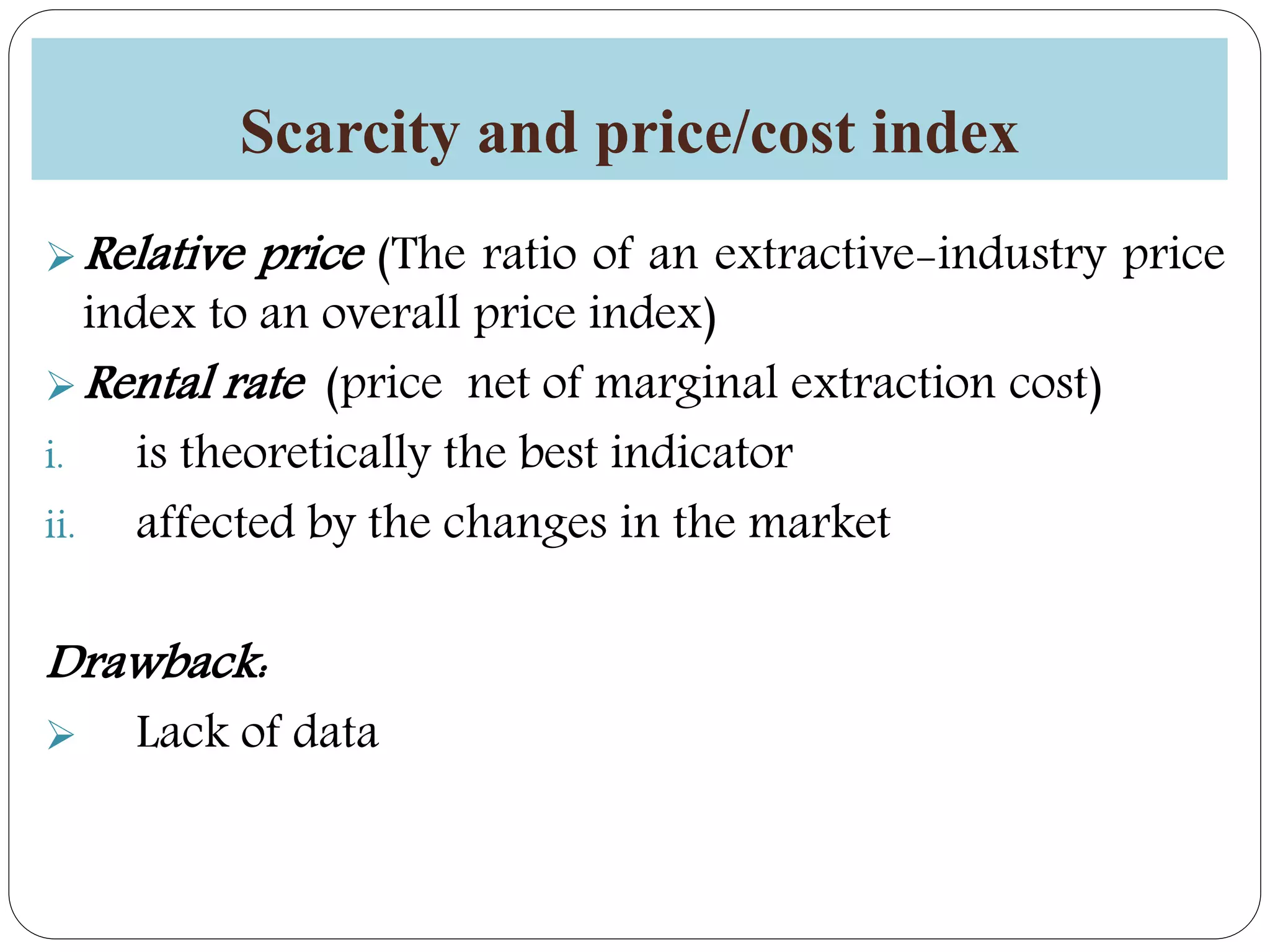
Scarcity and price/cost index
Relative price (The ratio of an extractive-industry price
index to an overall price index)
Rental rate (price net of marginal extraction cost)
i. is theoretically the best indicator
ii. affected by the changes in the market
Drawback:
 Lack of data
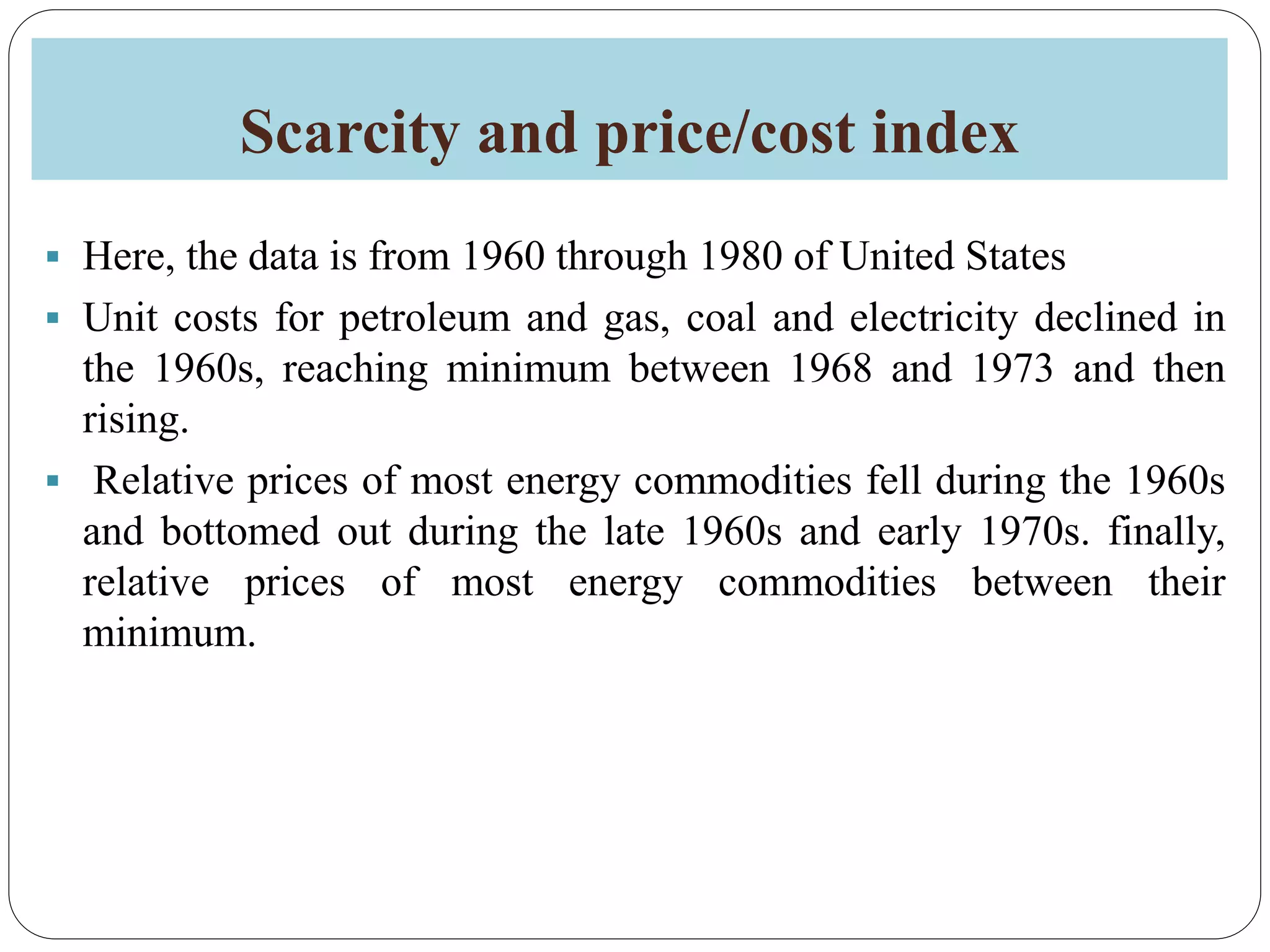
Scarcity and price/cost index
 Here, the data is from 1960 through 1980 of United States
 Unit costs for petroleum and gas, coal and electricity declined in
the 1960s, reaching minimum between 1968 and 1973 and then
rising.
 Relative prices of most energy commodities fell during the 1960s
and bottomed out during the late 1960s and early 1970s. finally,
relative prices of most energy commodities between their
minimum.
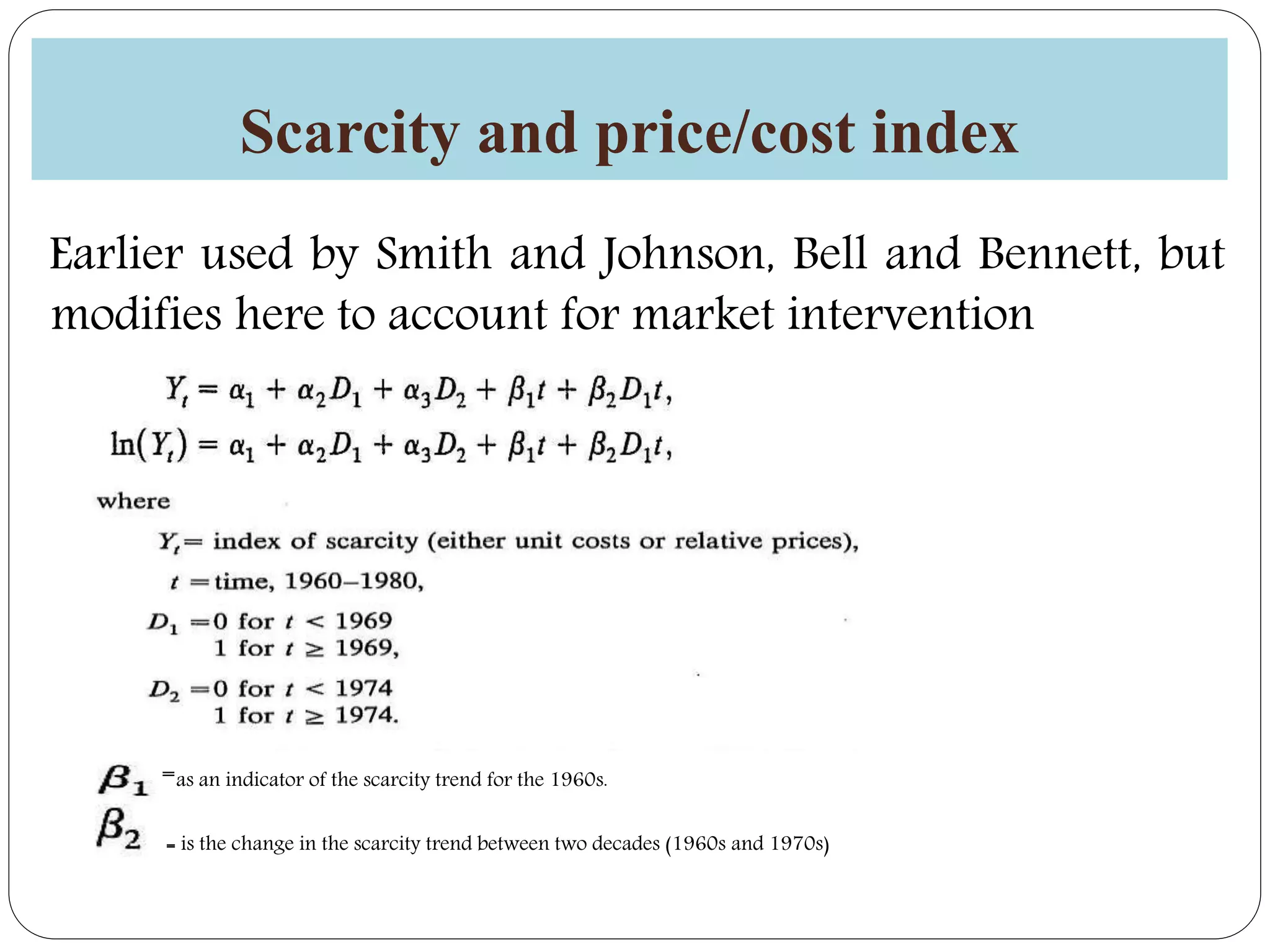
Scarcity and price/cost index
Earlier used by Smith and Johnson, Bell and Bennett, but
modifies here to account for market intervention
=as an indicator of the scarcity trend for the 1960s.
= is the change in the scarcity trend between two decades (1960s and 1970s)
Scarcity and price/cost index
Result-
From the analysis of the price and costs of 1960s to the 1970s, there
was a significant shift in the direction of scarcity. The change in the
trend of Ricardian flow scarcity was significantly positive for
agriculture and energy products. The change in the trend of
Ricardian Scarcity and/or Malthusian Scarcity, as measured by
relative prices, was significantly positive for energy prices.
Geochemical
The term "geochemical" tell us that geological and chemical factors are all included
in it. In Earth science, a geochemical cycle is the pathway that chemical
elements take in the surface and crust of the Earth.
The migration of heated and compressed chemical elements and compounds such
as silicon, aluminum, and general alkali metals through the means
of subduction and volcanism is known in the geological world as geochemical
cycles.
The geochemical cycle encompasses the natural separation and concentration of
elements and heat-assisted recombination processes. Changes may not be
apparent over a short term, such as with biogeochemical cycles, but over a long
term changes of great magnitude occur, including the evolution of continents and
ocean.
Geochemical
Flux in geochemical cycles is the movement of material between
the deep Earth and the surface reservoirs. This occurs through two
different processes: volcanism and subduction of tectonic plates.
Subduction is the process that takes place at convergent
boundaries by which one tectonic plate moves under another
tectonic plate and sinks into the mantle as the plates converge.
This leads to the sinking of one plate into the mantle which creates
a broad range of geochemical transformations or cycling.
Geochemical
Volcanism is the process that takes place at divergent boundaries by which
one tectonic plate separates from another creating a rift in which molten rock
(magma) erupts onto the surface of the Earth. This molten rock magma then
cools and crystallizes, forming igneous rocks. If crystallization occurs at the
Earth´s surface, extrusive igneous rocks are formed; if crystallization occurs
within the Earth´s lithosphere, intrusive igneous rocks are formed which can
then be brought to Earth´s surface by denudation.
Important cycles of geochemical cycle are:
 Carbon cycle
 Phosphorus cycle
 Sulfur cycle
 Rock cycle
Stock pollution constraints
Stock pollution refers to pollutants that cannot be absorbed and are
accumulated in the environment. Examples of stock pollutants are lead,
many chemicals such as dioxin, and so forth. Stock-damage pollution
describes the case in which damages depend only on the stock of the
pollutant in the relevant environmental system at any point in time.
Pollution stocks derive from the accumulation of emissions the life time of
which is more than merely instantaneous.
Stock pollution constraints
The presence of a latent constraint on pollution accumulation affects the net social
benefits of a society and its optimal emission policy even when current emissions
are far below the level where the constraint binds. It is argued that if the pollution
target is properly set, and if the emitters do not violate the relevant constraints,
then the target will be reached. This argument makes regulation very attractive to
environmentalists. Unfortunately, this approach has severe shortcomings.
Inefficiency about regulation when agents are heterogeneous, bureaucratic and
monitoring costs to obtain pollution permits or similar allowances, difficulties in
designing control regimes which are income-neutral, non-neutral technology
effects and credibility of environmental rules make the regulatory approach
difficult to implement.
Conclusion
Natural resource economics deals with the supply, demand,
and allocation of the Earth's natural resources. In economics, natural
resource scarcity is a relative concept. It implies that a natural resource is
scarce when its quantity is less than other inputs to the production process,
i.e., capital, labor and technical know-how. This ultimately causes the
supply of the good to decline or remain constant, while the demand for it
remains constant or increases, respectively. In other words, scarcity creates
diminishing returns to inputs. However, so long as demand for goods is
somehow met, the scarcity of resource inputs will not be crucial.

Measuring and mitigating natural resource scarcity

  • 2.
    Introduction In economics, naturalresource scarcity is a relative concept. It implies that a natural resource is scarce when its quantity is less than other inputs to the production process. The main objective of natural resource economics is to better understand the role of natural resources in the economy in order to develop more sustainable methods of measuring and mitigating those resources to ensure their availability to future generations.
  • 3.
    Types of Scarcity Absoluteor Physical resource scarcity It may occur if any economic activity or a whole system of economic activities depends upon an essential natural resource which has a finite limit on its physical availability. Example: Uranium
  • 4.
    Types of Scarcity Relativenatural-resource scarcity Economics is a science which studies human behavior as a relation between ends and scarce means which have alternative use. Thus there always exits the solution of relative scarcity as the resources are limited with respect to human demand and human wants are unlimited in relation to resources. Example: coal
  • 5.
    Malthusian & RicardianScarcity Recognition Theory of Natural-resource scarcity The theories of natural-resource scarcity have been traditionally classified as either “pessimistic Malthusian” model that suggests a long-term absolute natural-resource scarcity constraint or “optimistic Ricardian” model that do not assume any absolute limits but only admit that resources decline in quality and are therefore relatively scarce.
  • 6.
    Malthusian scarcity recognition The stock of agricultural land is absolutely limited;  Natural resources are homogeneous in quality;  Malthusian scarcity is based upon absolute scarcity where fixed input (land) which eventually leads to scarcity;  Malthusians stock scarcity applies to resources of uniform quality with an ultimate limit;  Malthusian flow scarcity applies to resources for which average extraction costs depend upon the rate of extraction.
  • 7.
  • 8.
    Ricardian scarcity recognition Ricardian Scarcity Recognition depends on the relative natural resource scarcity  Ricardian scarcity portrays agricultural land as varied in quality  In the absence of technological change, this scarcity effects eventually constrain economic activity
  • 9.
    Ricardian scarcity recognition It differs both in method and timing.  In terms of method and timing of diminishing returns, Ricardo focused upon the differential fertility of the individual parcel of lands  He assumed that the better land used first  Ricardo also found that declining quality to be the cause of increasing resource scarcity.
  • 10.
  • 11.
    Resource price pathpatterns Empirical Evidence on Resource Price Paths: Physical Indicators  Physical measures of scarcity rely on looking at geological estimates of reserves, and relating this in some way to the level of demand.  McKelvey explain about the reserves gradation and the concept of the ‘ultimately recoverable resource’.
  • 12.
    Resource price pathpatterns The formula for calculating the amount of time left for a resource with constant consumption growth is: Where: y = years left (Exhaustible time of resources); r = The continuous compounding growth rate. s = R/C or static reserve. R = reserve; C = (annual) consumption.
  • 13.
    Resource price pathpatterns For example: If the rate of resource use is increasing, the amount of reserves cannot be calculated by simply taking the current known reserves and dividing by the current yearly usage, as is typically done to obtain a static index. For example, in 1972, the amount of chromium reserves was 775 million metric tons, of which 1.85 million metric tons were mined annually. The static index is 775/1.85=418 years, but the rate of chromium consumption was growing at 2.6% annually. If instead of assuming a constant rate of usage, the assumption of a constant rate of growth of 2.6% annually is made, the resource will instead or exhausted last
  • 14.
    Resource price pathpatterns  A number of exhaustible resources face imminent exhaustion. Yet, we hear of no such problems It has two reasons:  First reason is that the reserve figures in limit to growth are themselves already out of data Example: Nickel  The second reason is that exponential indices fail
  • 15.
    Resource price pathpatterns These indices fail to account for:  Variations in forecast demand;  The effect of rising real prices on demand via reduced demand, the substitution of other materials for the scarce ore and conservation in terms of reduced resource requirements per unit of output; and  The effect of rising real prices on supplies in respect of increased recycling and new exploitation/ discovery.
  • 16.
    Resource scarcity mitigation Separatingthe phrase, two words are identified. They Are ‘Resource Scarcity’ and ‘Mitigation’. Resource scarcity concerns the availability of natural resources needed to satisfy basic human needs for food, shelter, and energy. So, resource scarcity mitigation is the process of eliminating or reducing the threat of unavailability of basic human needs. When it happens so in case of Natural resource, it is called natural resource scarcity mitigation. There are two way out to mitigate natural resource scarcity they are-  Mitigation  Recycling
  • 17.
    Mitigation Mitigation implies theelimination or reduction of the frequency magnitude, or severity of exposure to risks, or minimization of the potential impact of a threat or warning.
  • 18.
    Mitigation How mitigation mitigatesresource scarcity?  Identify  Recognize  Mitigate  Collaborate  Integrate  Control  Promote
  • 19.
    Recycling Recycling is oneof the most common of all environmentally beneficial activities. It is relatively simple and painless and a great way to involve staff at all levels in your company’s environmental priorities. Recycling protects habitat and saves energy, water, and resources such as trees and metal ores.
  • 20.
    Recycling Advantages of Recyclingin mitigating resource scarcity-  Reduce the Size of Landfills  Conserve Natural Resources  More Employment Opportunities  Offers Cash Benefits  Saves Money  Reduces the amount of waste sent to landfills and incinerators  Conserves natural resources such as timber, water, and minerals
  • 21.
    Recycling Steps to RecyclingMaterials-  Step 1: Collection and Processing  Step 2: Manufacturing  Step 3: Purchasing New Products Made from Recycled Materials
  • 22.
    Recycling Don’t stop withrecycling- As you become aware of the benefits of reduction to save natural resources, you won’t be able to escape the easiest and most cost effective method of reduction: driving less. When you reduce the amount of miles you drive, you are reducing the need for gas production and refining. The result is savings in your pocket, as well as natural resources. You can take it a step further by buying a hybrid or more fuel-efficient car.
  • 23.
    Scarcity and price/costindex The most popular indices are-  Unit cost (the value of factor inputs per unit of extractive-industry output) i. least appealing of the three measures. ii. provide no signal of increasing scarcity iii. When absolute stock/the quality of existing stock declines, unit extraction costs increase. Drawback:  Misrepresentation of technological change
  • 24.
    Scarcity and price/costindex Relative price (The ratio of an extractive-industry price index to an overall price index) Rental rate (price net of marginal extraction cost) i. is theoretically the best indicator ii. affected by the changes in the market Drawback:  Lack of data
  • 25.
    Scarcity and price/costindex  Here, the data is from 1960 through 1980 of United States  Unit costs for petroleum and gas, coal and electricity declined in the 1960s, reaching minimum between 1968 and 1973 and then rising.  Relative prices of most energy commodities fell during the 1960s and bottomed out during the late 1960s and early 1970s. finally, relative prices of most energy commodities between their minimum.
  • 26.
    Scarcity and price/costindex Earlier used by Smith and Johnson, Bell and Bennett, but modifies here to account for market intervention =as an indicator of the scarcity trend for the 1960s. = is the change in the scarcity trend between two decades (1960s and 1970s)
  • 27.
    Scarcity and price/costindex Result- From the analysis of the price and costs of 1960s to the 1970s, there was a significant shift in the direction of scarcity. The change in the trend of Ricardian flow scarcity was significantly positive for agriculture and energy products. The change in the trend of Ricardian Scarcity and/or Malthusian Scarcity, as measured by relative prices, was significantly positive for energy prices.
  • 28.
    Geochemical The term "geochemical"tell us that geological and chemical factors are all included in it. In Earth science, a geochemical cycle is the pathway that chemical elements take in the surface and crust of the Earth. The migration of heated and compressed chemical elements and compounds such as silicon, aluminum, and general alkali metals through the means of subduction and volcanism is known in the geological world as geochemical cycles. The geochemical cycle encompasses the natural separation and concentration of elements and heat-assisted recombination processes. Changes may not be apparent over a short term, such as with biogeochemical cycles, but over a long term changes of great magnitude occur, including the evolution of continents and ocean.
  • 29.
    Geochemical Flux in geochemicalcycles is the movement of material between the deep Earth and the surface reservoirs. This occurs through two different processes: volcanism and subduction of tectonic plates. Subduction is the process that takes place at convergent boundaries by which one tectonic plate moves under another tectonic plate and sinks into the mantle as the plates converge. This leads to the sinking of one plate into the mantle which creates a broad range of geochemical transformations or cycling.
  • 30.
    Geochemical Volcanism is theprocess that takes place at divergent boundaries by which one tectonic plate separates from another creating a rift in which molten rock (magma) erupts onto the surface of the Earth. This molten rock magma then cools and crystallizes, forming igneous rocks. If crystallization occurs at the Earth´s surface, extrusive igneous rocks are formed; if crystallization occurs within the Earth´s lithosphere, intrusive igneous rocks are formed which can then be brought to Earth´s surface by denudation. Important cycles of geochemical cycle are:  Carbon cycle  Phosphorus cycle  Sulfur cycle  Rock cycle
  • 31.
    Stock pollution constraints Stockpollution refers to pollutants that cannot be absorbed and are accumulated in the environment. Examples of stock pollutants are lead, many chemicals such as dioxin, and so forth. Stock-damage pollution describes the case in which damages depend only on the stock of the pollutant in the relevant environmental system at any point in time. Pollution stocks derive from the accumulation of emissions the life time of which is more than merely instantaneous.
  • 32.
    Stock pollution constraints Thepresence of a latent constraint on pollution accumulation affects the net social benefits of a society and its optimal emission policy even when current emissions are far below the level where the constraint binds. It is argued that if the pollution target is properly set, and if the emitters do not violate the relevant constraints, then the target will be reached. This argument makes regulation very attractive to environmentalists. Unfortunately, this approach has severe shortcomings. Inefficiency about regulation when agents are heterogeneous, bureaucratic and monitoring costs to obtain pollution permits or similar allowances, difficulties in designing control regimes which are income-neutral, non-neutral technology effects and credibility of environmental rules make the regulatory approach difficult to implement.
  • 33.
    Conclusion Natural resource economicsdeals with the supply, demand, and allocation of the Earth's natural resources. In economics, natural resource scarcity is a relative concept. It implies that a natural resource is scarce when its quantity is less than other inputs to the production process, i.e., capital, labor and technical know-how. This ultimately causes the supply of the good to decline or remain constant, while the demand for it remains constant or increases, respectively. In other words, scarcity creates diminishing returns to inputs. However, so long as demand for goods is somehow met, the scarcity of resource inputs will not be crucial.