Quantity Theory of Money
Dr. M. Abdul Jamal
Assistant Professor
Department of Economics
The New College (Autonomous), Chennai - 600014
Money
“Anything is generally acceptable as a
means of exchange and that at the
same time acts as a measure and as a
store of value”.
“Money is what Money does”.
Quantity Theory of Money
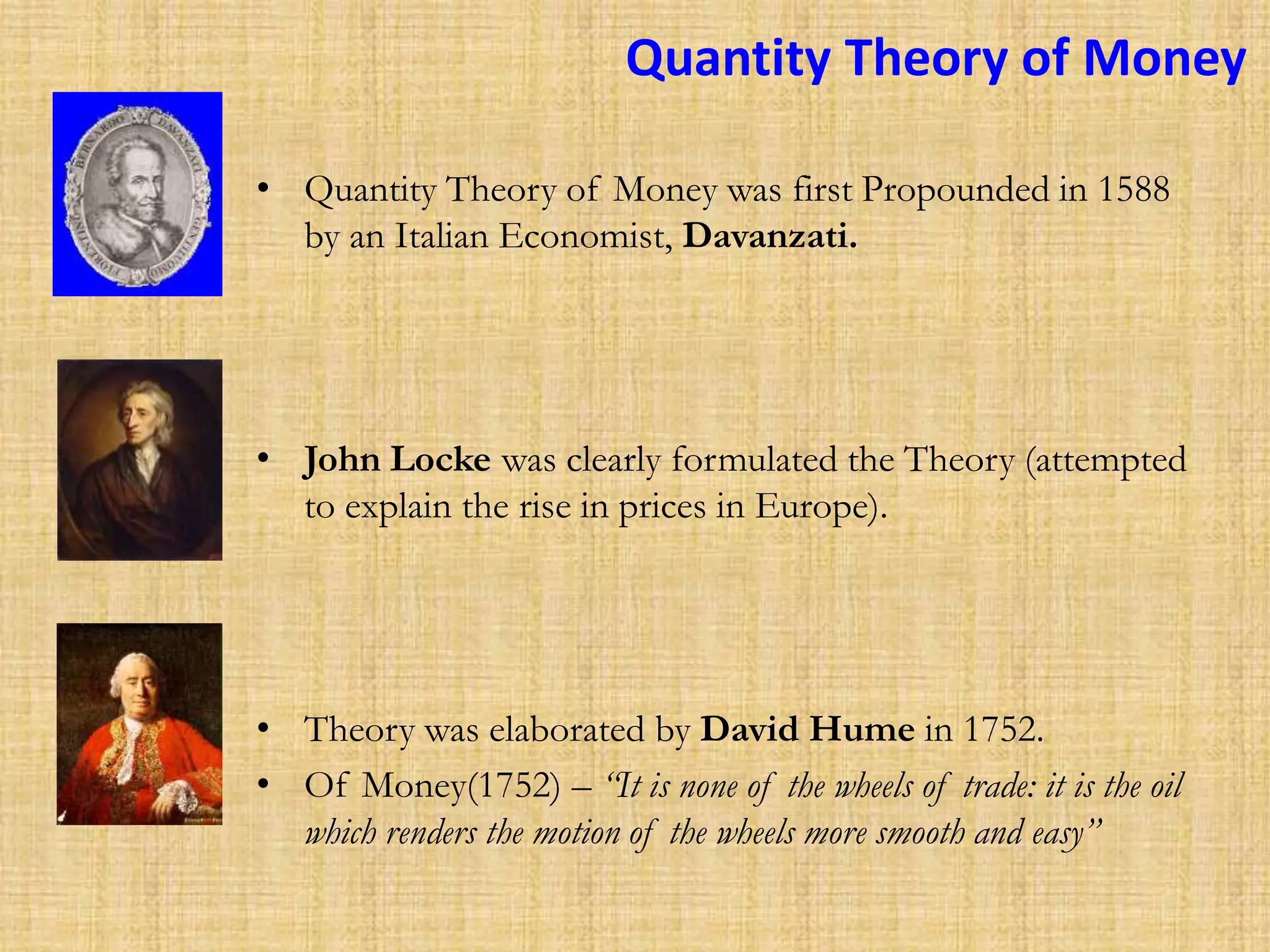
• Quantity Theory of Money was first Propounded in 1588
by an Italian Economist, Davanzati.
• John Locke was clearly formulated the Theory (attempted
to explain the rise in prices in Europe).
• Theory was elaborated by David Hume in 1752.
• Of Money(1752) – “It is none of the wheels of trade: it is the oil
which renders the motion of the wheels more smooth and easy”
Quantity Theory of Money
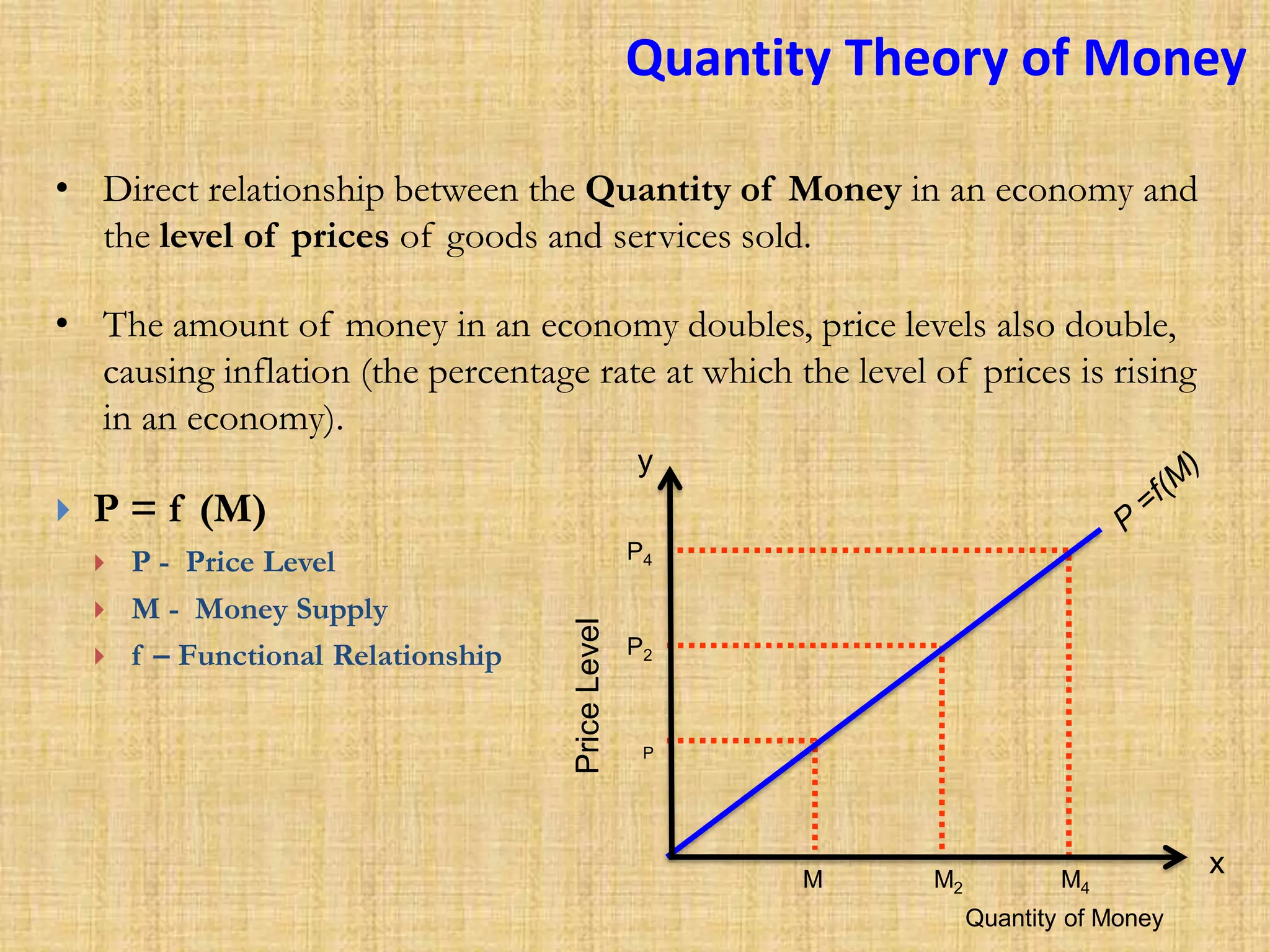
• Direct relationship between the Quantity of Money in an economy and
the level of prices of goods and services sold.
• The amount of money in an economy doubles, price levels also double,
causing inflation (the percentage rate at which the level of prices is rising
in an economy).
 P = f (M)
 P - Price Level
 M - Money Supply
 f – Functional Relationship
M M2 M4
P
P2
P4
PriceLevel
Quantity of Money
y
x
Quantity Theory of Money
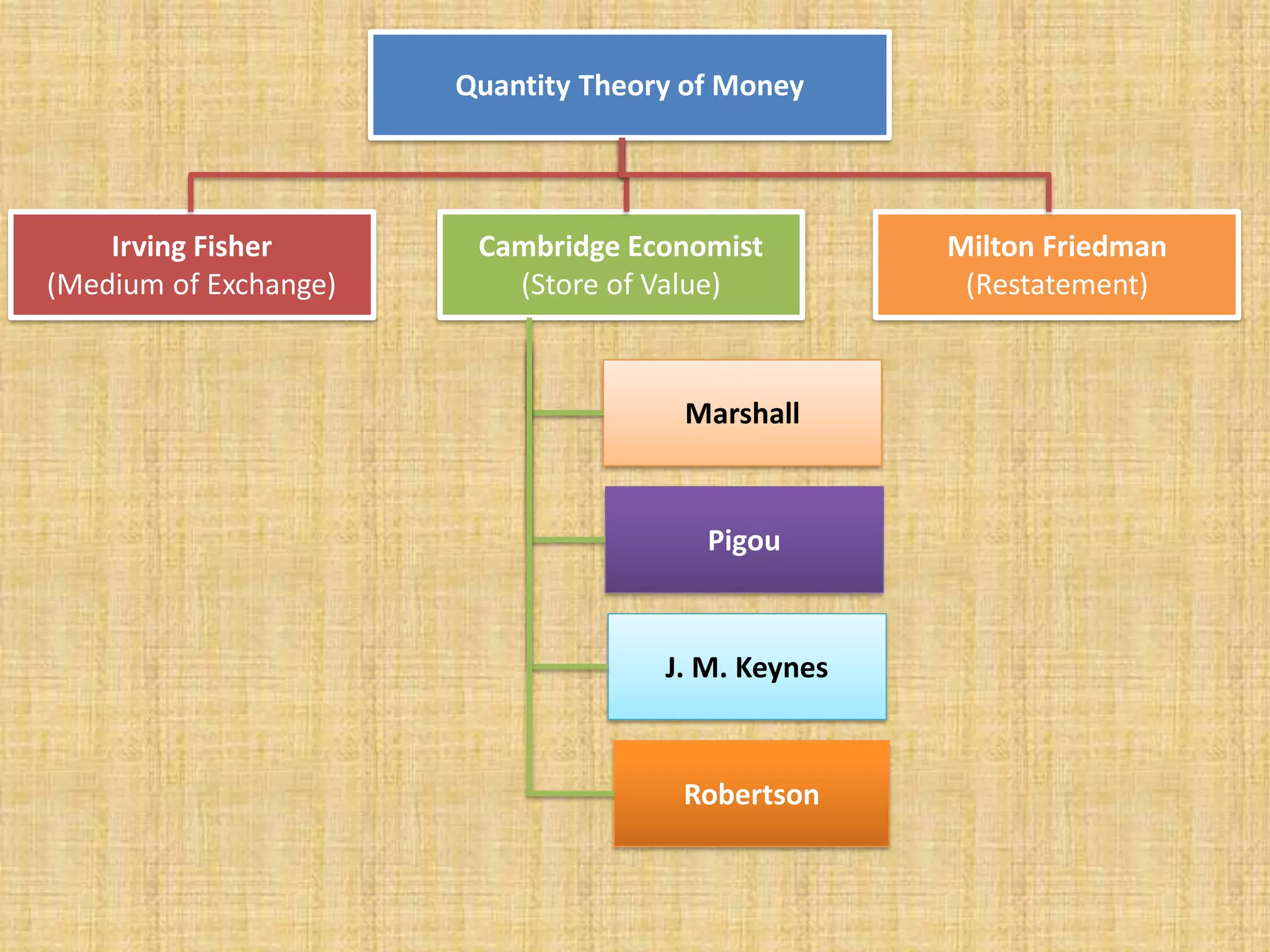
Irving Fisher
(Medium of Exchange)
Cambridge Economist
(Store of Value)
Milton Friedman
(Restatement)
Marshall
Pigou
J. M. Keynes
Robertson
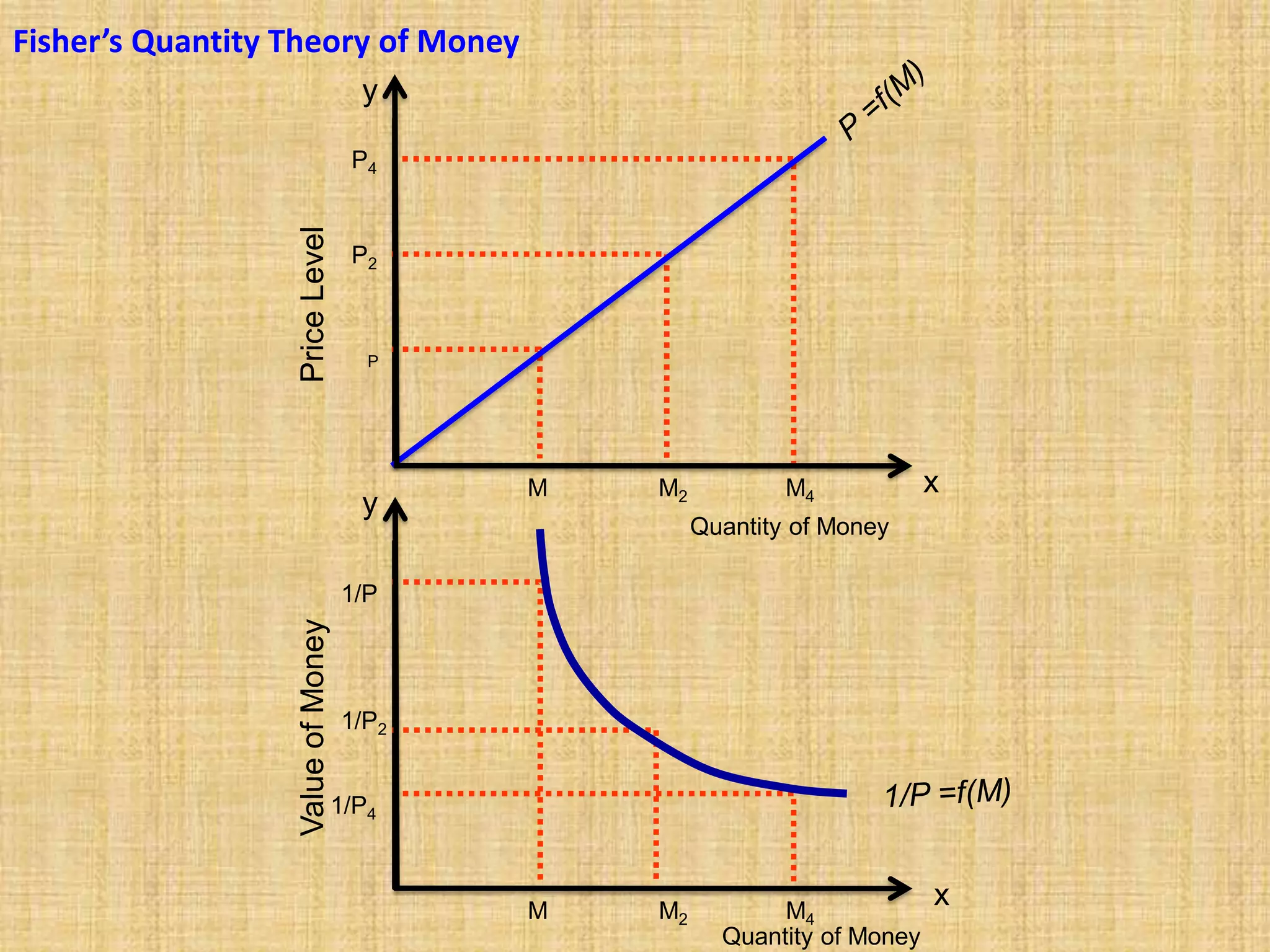
 Quantity of Money in circulation increases, the price level also increases in direct
proportion and the Value of money decreases and vice versa.
 Quantity of Money is reduced by one half, the price level will also be reduced by
one half and the value of money will be twice.
 M V + MˈVˈ = P T
 M - Money Supply
 V - Velocity of Circulation of M (Number of Transaction)
 P - Price Level
 Mˈ - Credit Money
 Vˈ - Velocity of Circulation of Mˈ (Number of Transaction)
 T - Transaction performed (Total no. of G/S exchanged for money)
Irving Fisher (1867 – 1947)
“Purchasing Power of Money” - 1911
M M2 M4
P
P2
P4
M M2 M4
1/P2
1/P4
1/P
PriceLevelValueofMoney
Quantity of Money
Quantity of Money
Fisher’s Quantity Theory of Money
x
x
y
y
Fisher’s Quantity Theory of Money
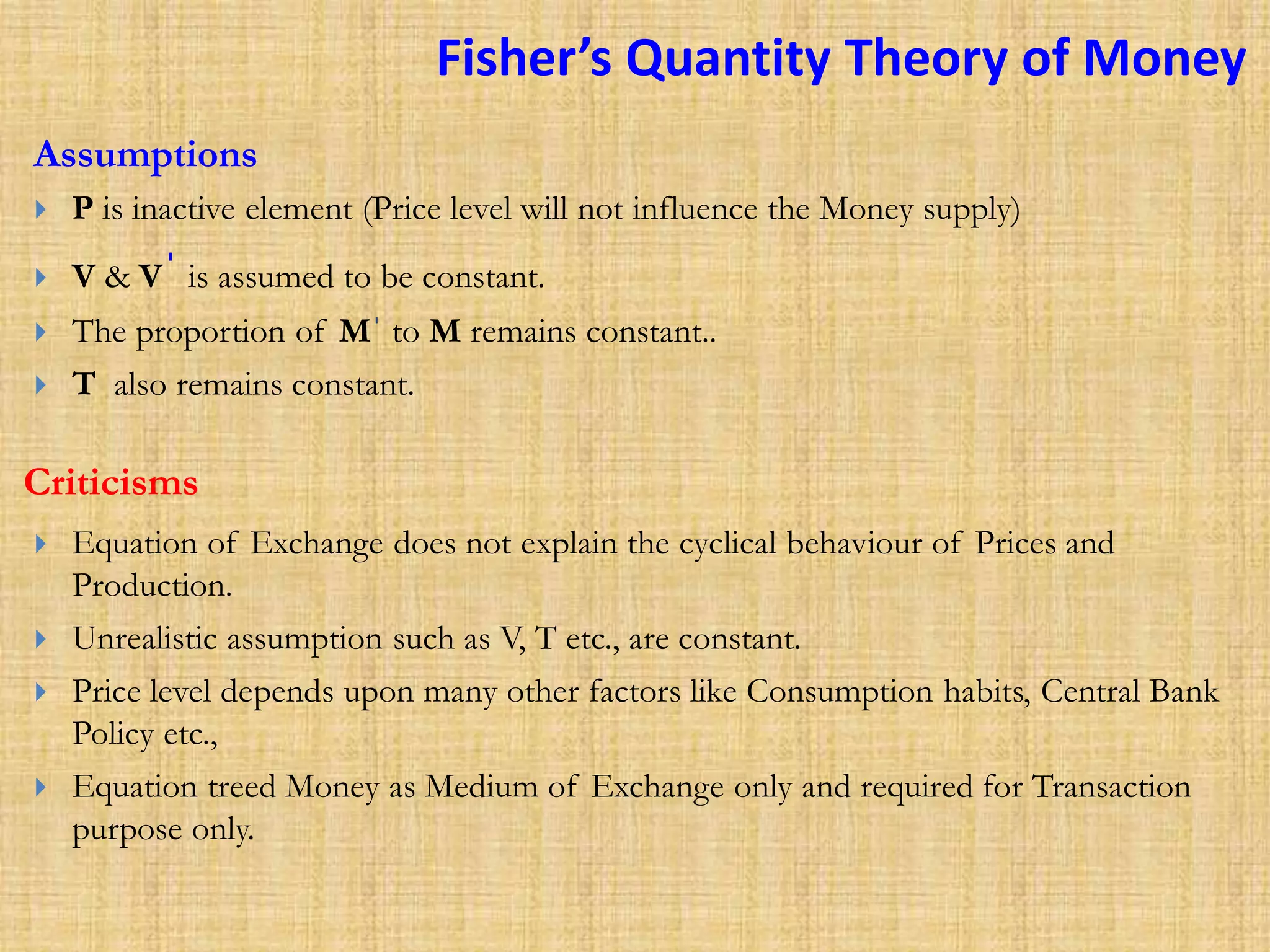
 P is inactive element (Price level will not influence the Money supply)
 V & Vˈ is assumed to be constant.
 The proportion of Mˈ to M remains constant..
 T also remains constant.
 Equation of Exchange does not explain the cyclical behaviour of Prices and
Production.
 Unrealistic assumption such as V, T etc., are constant.
 Price level depends upon many other factors like Consumption habits, Central Bank
Policy etc.,
 Equation treed Money as Medium of Exchange only and required for Transaction
purpose only.
Assumptions
Criticisms
Cambridge Version
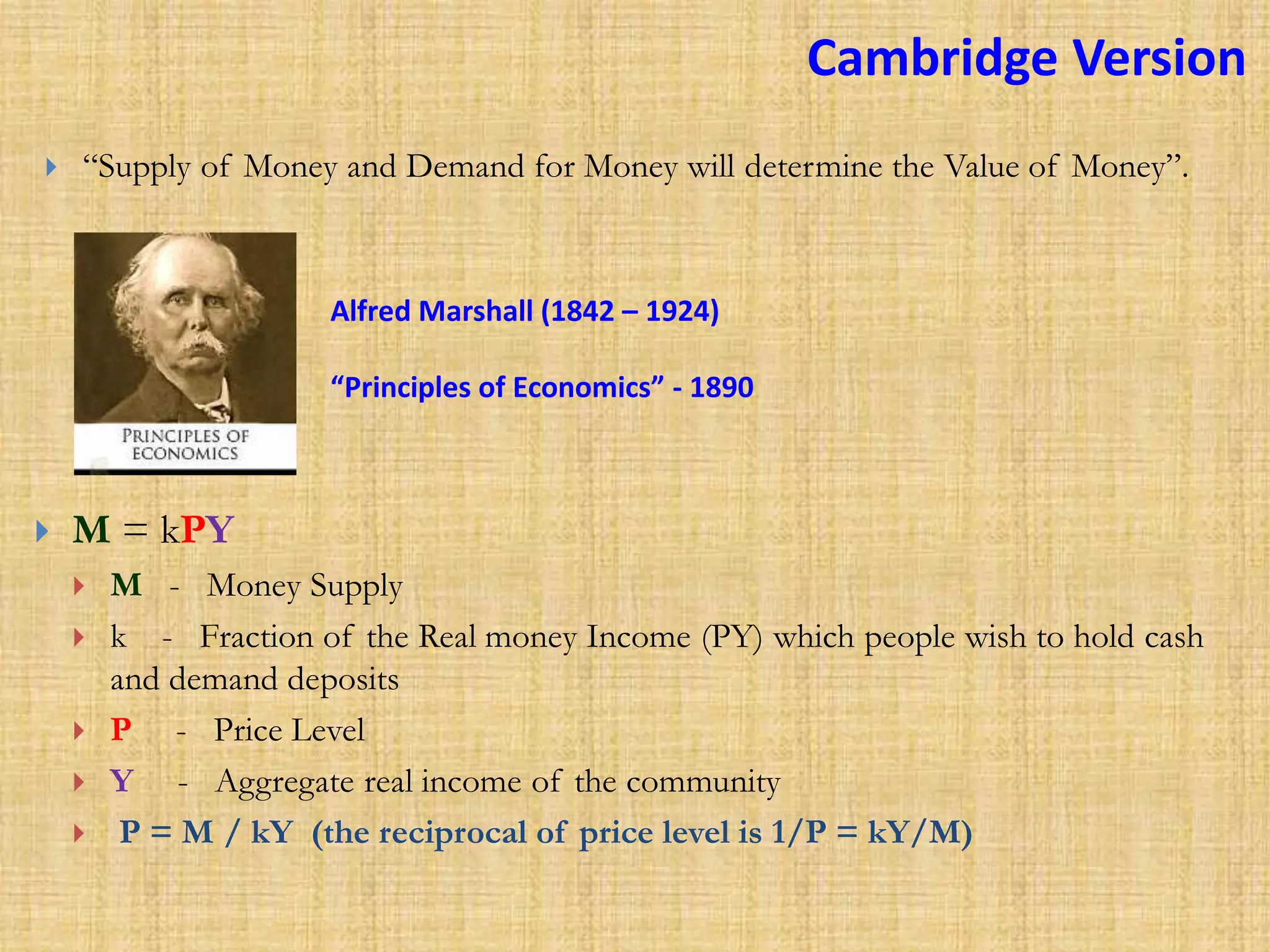
 M = kPY
 M - Money Supply
 k - Fraction of the Real money Income (PY) which people wish to hold cash
and demand deposits
 P - Price Level
 Y - Aggregate real income of the community
 P = M / kY (the reciprocal of price level is 1/P = kY/M)
Alfred Marshall (1842 – 1924)
“Principles of Economics” - 1890
 “Supply of Money and Demand for Money will determine the Value of Money”.
 P = kR/M
 P - Purchasing power of Money
 R - Aggregate real income expressed in terms of a particular commodity say
wheat, enjoyed by the community at given point of time.
 M - Total money stock or total cash held by a community.
 k - Proportion of total real resources or income which people wish to hold in
the form of titles to legal tender.
A.C. Pigou (1877– 1959)
“The Value of Money” – 1917
(Quarterly journal of Economics, 32 (1), pp. 38-65)
 Saving and Investment factors are neglected while determining the Purchasing power of
money.
 Neglected Medium of Exchange function.
 Single commodity explanation (Wheat).
Criticisms
Cambridge Version
J. M. Keynes (1877– 1959)
“A Tract on Monetary Reform” - 1923
 n = pk (or) p = n/k
 p - General Price level of prices of consumption goods.
 n - Total supply of money in circulation.
 k - Total quantity of consumption units which people decide to keep in the
form of cash.
 n = p(k+rkˈ) (or) p = n/(k+rkˈ)
 r - Ratio of banks’ cash reserves to their deposits
 kˈ - number of consumption units the community decides to hold in the
form of bank deposits.
Cambridge Version
Robertson (1890– 1963)
“Essays on Monetary Theory” - 1940
 P = M/KT
 P - Price Level
 M - Money Supply
 T - Total amount of goods and services bought during one year.
 K - Proportion of T which people desire to hold in the form of cash.
Cambridge Version
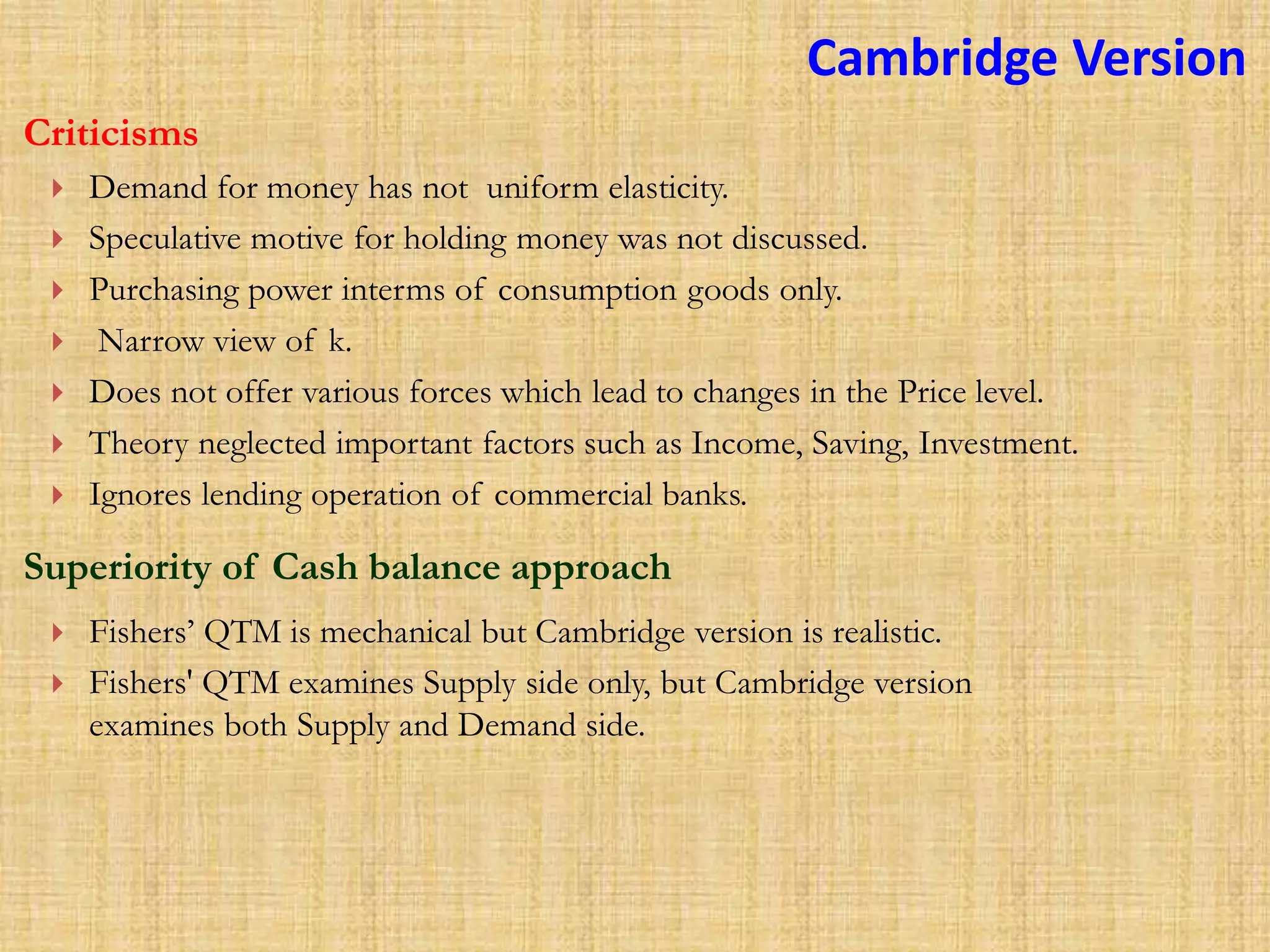
 Demand for money has not uniform elasticity.
 Speculative motive for holding money was not discussed.
 Purchasing power interms of consumption goods only.
 Narrow view of k.
 Does not offer various forces which lead to changes in the Price level.
 Theory neglected important factors such as Income, Saving, Investment.
 Ignores lending operation of commercial banks.
Criticisms
Superiority of Cash balance approach
 Fishers’ QTM is mechanical but Cambridge version is realistic.
 Fishers' QTM examines Supply side only, but Cambridge version
examines both Supply and Demand side.
Cambridge Version
Restatement Quantity Theory of Money
Milton Friedman (1890– 1963)
“Quantity Theory of Money – A Restatement” – 1956
“Monetary Trends in the United States and United Kingdom” - 1982
Wealth can be held in five forms
• Money – Currency, Demand Deposit and Time Deposits.
• Bonds – payments that are fixed in nominal units.
• Equities – payments that are fixed in real units.
• Physical Goods or non-human goods are inventories of producer and consumer durable.
• Human Capital is the productive capacity of human beings.
Economic agents (individuals, firms, governments) want to hold a certain
quantity of real, as opposed to nominal, money balances
Restatement Quantity Theory of Money
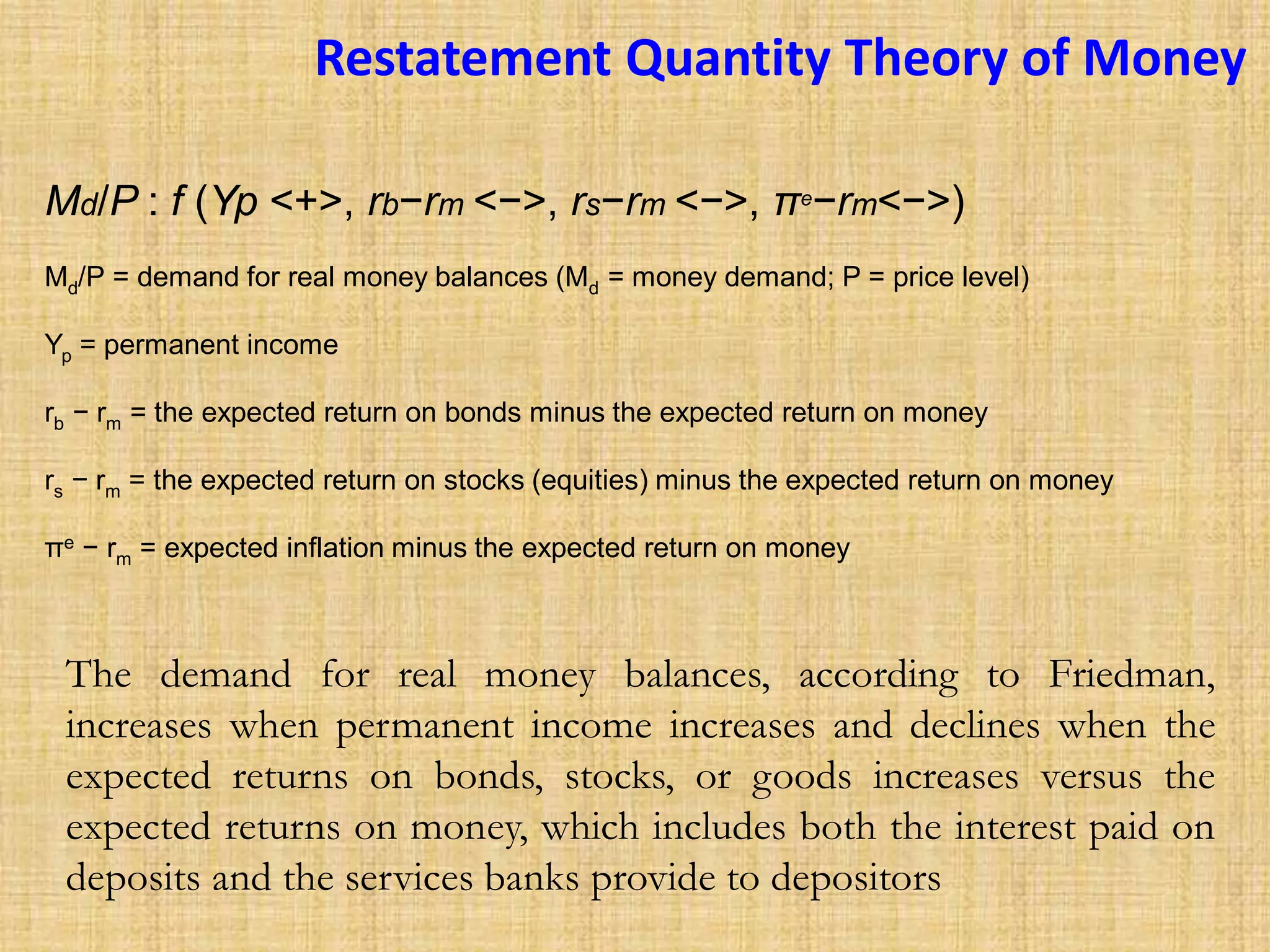
The demand for real money balances, according to Friedman,
increases when permanent income increases and declines when the
expected returns on bonds, stocks, or goods increases versus the
expected returns on money, which includes both the interest paid on
deposits and the services banks provide to depositors
Md/P : f (Yp <+>, rb−rm <−>, rs−rm <−>, πe−rm<−>)
Md/P = demand for real money balances (Md = money demand; P = price level)
Yp = permanent income
rb − rm = the expected return on bonds minus the expected return on money
rs − rm = the expected return on stocks (equities) minus the expected return on money
πe − rm = expected inflation minus the expected return on money

Quantity Theory of Money

  • 1.
    Quantity Theory ofMoney Dr. M. Abdul Jamal Assistant Professor Department of Economics The New College (Autonomous), Chennai - 600014
  • 2.
    Money “Anything is generallyacceptable as a means of exchange and that at the same time acts as a measure and as a store of value”. “Money is what Money does”.
  • 3.
    Quantity Theory ofMoney • Quantity Theory of Money was first Propounded in 1588 by an Italian Economist, Davanzati. • John Locke was clearly formulated the Theory (attempted to explain the rise in prices in Europe). • Theory was elaborated by David Hume in 1752. • Of Money(1752) – “It is none of the wheels of trade: it is the oil which renders the motion of the wheels more smooth and easy”
  • 4.
    Quantity Theory ofMoney • Direct relationship between the Quantity of Money in an economy and the level of prices of goods and services sold. • The amount of money in an economy doubles, price levels also double, causing inflation (the percentage rate at which the level of prices is rising in an economy).  P = f (M)  P - Price Level  M - Money Supply  f – Functional Relationship M M2 M4 P P2 P4 PriceLevel Quantity of Money y x
  • 5.
    Quantity Theory ofMoney Irving Fisher (Medium of Exchange) Cambridge Economist (Store of Value) Milton Friedman (Restatement) Marshall Pigou J. M. Keynes Robertson
  • 6.
     Quantity ofMoney in circulation increases, the price level also increases in direct proportion and the Value of money decreases and vice versa.  Quantity of Money is reduced by one half, the price level will also be reduced by one half and the value of money will be twice.  M V + MˈVˈ = P T  M - Money Supply  V - Velocity of Circulation of M (Number of Transaction)  P - Price Level  Mˈ - Credit Money  Vˈ - Velocity of Circulation of Mˈ (Number of Transaction)  T - Transaction performed (Total no. of G/S exchanged for money) Irving Fisher (1867 – 1947) “Purchasing Power of Money” - 1911
  • 7.
    M M2 M4 P P2 P4 MM2 M4 1/P2 1/P4 1/P PriceLevelValueofMoney Quantity of Money Quantity of Money Fisher’s Quantity Theory of Money x x y y
  • 8.
    Fisher’s Quantity Theoryof Money  P is inactive element (Price level will not influence the Money supply)  V & Vˈ is assumed to be constant.  The proportion of Mˈ to M remains constant..  T also remains constant.  Equation of Exchange does not explain the cyclical behaviour of Prices and Production.  Unrealistic assumption such as V, T etc., are constant.  Price level depends upon many other factors like Consumption habits, Central Bank Policy etc.,  Equation treed Money as Medium of Exchange only and required for Transaction purpose only. Assumptions Criticisms
  • 9.
    Cambridge Version  M= kPY  M - Money Supply  k - Fraction of the Real money Income (PY) which people wish to hold cash and demand deposits  P - Price Level  Y - Aggregate real income of the community  P = M / kY (the reciprocal of price level is 1/P = kY/M) Alfred Marshall (1842 – 1924) “Principles of Economics” - 1890  “Supply of Money and Demand for Money will determine the Value of Money”.
  • 10.
     P =kR/M  P - Purchasing power of Money  R - Aggregate real income expressed in terms of a particular commodity say wheat, enjoyed by the community at given point of time.  M - Total money stock or total cash held by a community.  k - Proportion of total real resources or income which people wish to hold in the form of titles to legal tender. A.C. Pigou (1877– 1959) “The Value of Money” – 1917 (Quarterly journal of Economics, 32 (1), pp. 38-65)  Saving and Investment factors are neglected while determining the Purchasing power of money.  Neglected Medium of Exchange function.  Single commodity explanation (Wheat). Criticisms Cambridge Version
  • 11.
    J. M. Keynes(1877– 1959) “A Tract on Monetary Reform” - 1923  n = pk (or) p = n/k  p - General Price level of prices of consumption goods.  n - Total supply of money in circulation.  k - Total quantity of consumption units which people decide to keep in the form of cash.  n = p(k+rkˈ) (or) p = n/(k+rkˈ)  r - Ratio of banks’ cash reserves to their deposits  kˈ - number of consumption units the community decides to hold in the form of bank deposits. Cambridge Version
  • 12.
    Robertson (1890– 1963) “Essayson Monetary Theory” - 1940  P = M/KT  P - Price Level  M - Money Supply  T - Total amount of goods and services bought during one year.  K - Proportion of T which people desire to hold in the form of cash. Cambridge Version
  • 13.
     Demand formoney has not uniform elasticity.  Speculative motive for holding money was not discussed.  Purchasing power interms of consumption goods only.  Narrow view of k.  Does not offer various forces which lead to changes in the Price level.  Theory neglected important factors such as Income, Saving, Investment.  Ignores lending operation of commercial banks. Criticisms Superiority of Cash balance approach  Fishers’ QTM is mechanical but Cambridge version is realistic.  Fishers' QTM examines Supply side only, but Cambridge version examines both Supply and Demand side. Cambridge Version
  • 14.
    Restatement Quantity Theoryof Money Milton Friedman (1890– 1963) “Quantity Theory of Money – A Restatement” – 1956 “Monetary Trends in the United States and United Kingdom” - 1982 Wealth can be held in five forms • Money – Currency, Demand Deposit and Time Deposits. • Bonds – payments that are fixed in nominal units. • Equities – payments that are fixed in real units. • Physical Goods or non-human goods are inventories of producer and consumer durable. • Human Capital is the productive capacity of human beings. Economic agents (individuals, firms, governments) want to hold a certain quantity of real, as opposed to nominal, money balances
  • 15.
    Restatement Quantity Theoryof Money The demand for real money balances, according to Friedman, increases when permanent income increases and declines when the expected returns on bonds, stocks, or goods increases versus the expected returns on money, which includes both the interest paid on deposits and the services banks provide to depositors Md/P : f (Yp <+>, rb−rm <−>, rs−rm <−>, πe−rm<−>) Md/P = demand for real money balances (Md = money demand; P = price level) Yp = permanent income rb − rm = the expected return on bonds minus the expected return on money rs − rm = the expected return on stocks (equities) minus the expected return on money πe − rm = expected inflation minus the expected return on money