Scaling
MySQLDave Stokes @Stoker david.stokes@oracle.com
slideshare.net/DavidMStokes
13 September 2016 Swanseason.co.uk
Scaling
MySQLDave Stokes @Stoker david.stokes@oracle.com
slideshare.net/DavidMStokes
"THE FOLLOWING IS INTENDED TO OUTLINE OUR GENERAL
PRODUCT DIRECTION. IT IS INTENDED FOR INFORMATION
PURPOSES ONLY, AND MAY NOT BE INCORPORATED INTO ANY
CONTRACT. IT IS NOT A COMMITMENT TO DELIVER ANY
MATERIAL, CODE, OR FUNCTIONALITY, AND SHOULD NOT BE
RELIED UPON IN MAKING PURCHASING DECISIONS. THE
DEVELOPMENT, RELEASE, AND TIMING OF ANY FEATURES OR
FUNCTIONALITY DESCRIBED FOR ORACLE'S PRODUCTS
REMAINS AT THE SOLE DISCRETION OF ORACLE."
Safe Harbor
3
Quick MySQL Catch Up
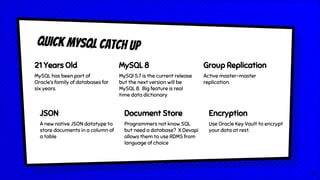
21 Years Old
MySQL has been part of
Oracle’s family of databases for
six years.
MySQL 8
MySQl 5.7 is the current release
but the next version will be
MySQL 8. Big feature is real
time data dictionary
Group Replication
Active master-master
replication.
JSON
A new native JSON datatype to
store documents in a column of
a table
Document Store
Programmers not know SQL
but need a database? X Devapi
allows them to use RDMS from
language of choice
Encryption
Use Oracle Key Vault to encrypt
your data at rest.
4
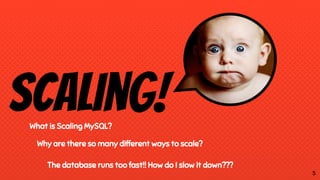
Scaling!What is Scaling MySQL?
Why are there so many different ways to scale?
The database runs too fast!! How do I slow it down???
5
How to grow your mysql instances
Your new amazing code started off on a Vagrant image and now
you want it to scale. The problem is that relational databases do
not easily scale. Do you need to scale for reads, or writes, or
both?? This session will cover the easy, low cost ways to move
from your development box where all is on one image to splitting
services, splitting reads/writes, basic sharding, highly available &
fault tolerant server farms, to clusters with 99.999% uptime. This
talk will cover the costs (financial, time, opportunity cost, and
sanity) as you scale with your data.
6
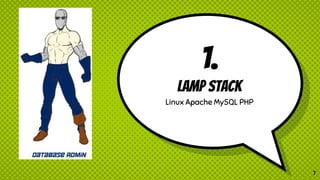
1.
LAMP Stack
Linux Apache MySQL PHP
7
“LAMP stack was one box
with all the services
running together at the
same time.”
8
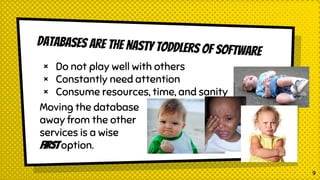
Databases are the nasty toddlers of software
× Do not play well with others
× Constantly need attention
× Consume resources, time, and sanity
Moving the database
away from the other
services is a wise
First option.
9
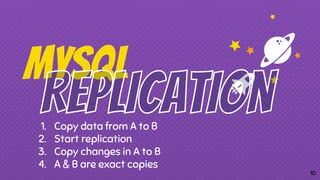
MySQL
1. Copy data from A to B
2. Start replication
3. Copy changes in A to B
4. A & B are exact copies
10
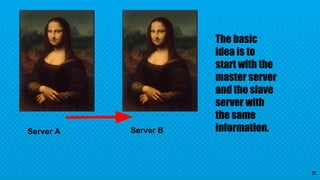
Server A Server B
The basic
idea is to
start with the
master server
and the slave
server with
the same
information.
11
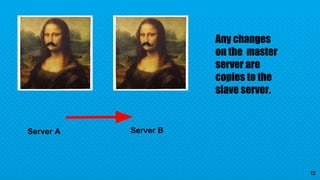
Server A Server B
Any changes
on the master
server are
copies to the
slave server.
12
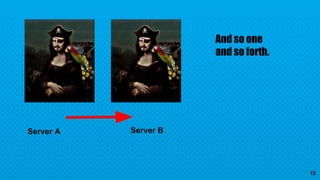
Server A Server B
And so one
and so forth.
13
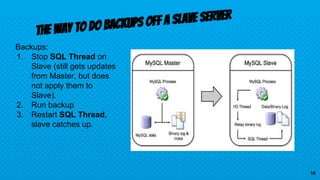
Backups:
1. Stop SQL Thread on
Slave (still gets updates
from Master, but does
not apply them to
Slave).
2. Run backup
3. Restart SQL Thread,
slave catches up.
The way to do backups off a slave server
14
Replication uses
Save data to slave
server and use it for
backups while
keeping main server
up for users.
Give developers their
own copy of data
where they can not
interfere with ‘real’
data.
Split reads/writes so
that reads go to a
pool of servers and
writes go to one
server. Great for
read heavy
circumstances. Does
not scale writes.
15
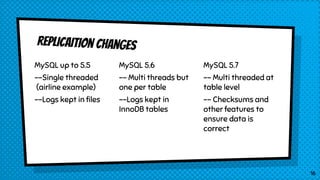
Replicaition changes
MySQL up to 5.5
--Single threaded
(airline example)

--Logs kept in files
MySQL 5.6
-- Multi threads but
one per table
--Logs kept in
InnoDB tables
MySQL 5.7
-- Multi threaded at
table level
-- Checksums and
other features to
ensure data is
correct
16
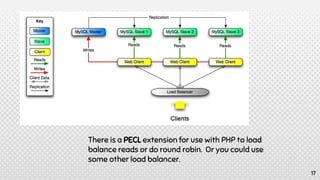
There is a PECL extension for use with PHP to load
balance reads or do round robin. Or you could use
some other load balancer.
17
18
Great presentation on
mysqlnd_ms load balance -
PECL Package
https://speakerdeck.com/dshafik/
phptek-2015-extending-mysql-wit
h-phps-native-driver
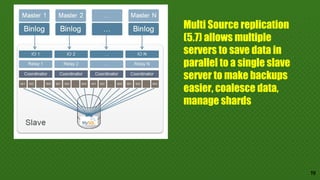
Multi Source replication
(5.7) allows multiple
servers to save data in
parallel to a single slave
server to make backups
easier, coalesce data,
manage shards
19
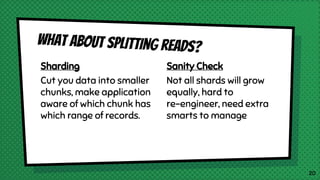
Sharding
Cut you data into smaller
chunks, make application
aware of which chunk has
which range of records.
What ABout splitting reads?
Sanity Check
Not all shards will grow
equally, hard to
re-engineer, need extra
smarts to manage
20
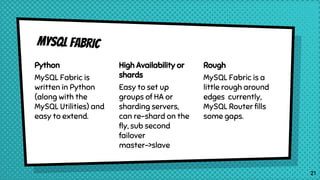
MySQL Fabric
Python
MySQL Fabric is
written in Python
(along with the
MySQL Utilities) and
easy to extend.
High Availability or
shards
Easy to set up
groups of HA or
sharding servers,
can re-shard on the
fly, sub second
failover
master->slave
Rough
MySQL Fabric is a
little rough around
edges currently,
MySQL Router fills
some gaps.
21
Galara Cluster for MySQL
Virtually synchronous replication for InnoDB
Bundled in MariaDB and Percona Cluster, Linux only
Codeship OY
22
MySQL Group Replication Library
Virtually Synchronous Replication 5.7+
Support on all MySQL platforms
Highly Available distributed database service
Removed need to manually handling server fail-over
Provides distributed fault tolerance
Enables active/active update anywhere
Automatic detects and handles conflicts
Automates reconfiguration (crashes, adding/removing nodes)
23
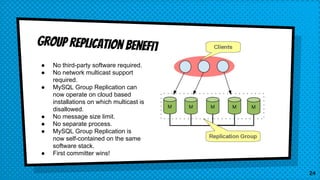
Group Replication benefits
● No third-party software required.
● No network multicast support
required.
● MySQL Group Replication can
now operate on cloud based
installations on which multicast is
disallowed.
● No message size limit.
● No separate process.
● MySQL Group Replication is
now self-contained on the same
software stack.
● First committer wins!
24
•Built on top of proven technology!
–Shares much of MySQL Replication
infrastructure –
thence does not feel alien!
–Multi-Master approach to replication.
•Built on reusable components!
–Layered implementation approach.
–Interface driven development.
–Decoupled from the server core.
–The plugin registers as listener to
server events.
–Reuses the capture procedure from regular
Replication. Provides further decoupling from the
communication infrastructure
25
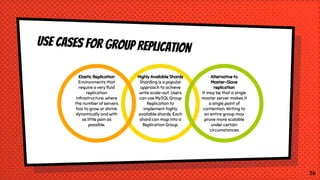
USe Cases for Group Replication
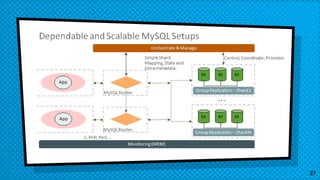
Highly Available Shards
Sharding is a popular
approach to achieve
write scale-out. Users
can use MySQL Group
Replication to
implement highly
available shards. Each
shard can map into a
Replication Group.
Elastic Replication
Environments that
require a very fluid
replication
infrastructure, where
the number of servers
has to grow or shrink
dynamically and with
as little pain as
possible.
Alternative to
Master-Slave
replication
It may be that a single
master server makes it
a single point of
contention. Writing to
an entire group may
prove more scalable
under certain
circumstances
26
27
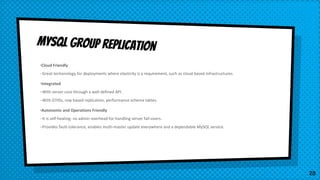
•Cloud Friendly
–Great techonology for deployments where elasticity is a requirement, such as cloud based infrastructures.
•Integrated
–With server core through a well defined API.
–With GTIDs, row based replication, performance schema tables.
•Autonomic and Operations Friendly
–It is self-healing: no admin overhead for handling server fail-overs.
–Provides fault-tolerance, enables multi-master update everywhere and a dependable MySQL service.
MySQL group replication
28
Proxy/router
29
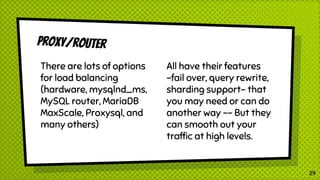
There are lots of options
for load balancing
(hardware, mysqlnd_ms,
MySQL router, MariaDB
MaxScale, Proxysql, and
many others)
All have their features
-fail over, query rewrite,
sharding support- that
you may need or can do
another way -- But they
can smooth out your
traffic at high levels.
Proxy/router continued
30
Be careful as some
proxies do not support
tracking schema, auto
commit / transactions, or
character encodings.
Try not to create more
work for yourself.
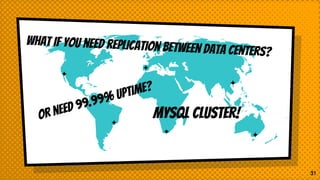
What if you need replication between data centers?
31
Or need 99.99% uptime?
MySQl Cluster!
32
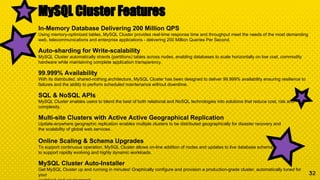
MySQL Cluster Features
In-Memory Database Delivering 200 Million QPS
Using memory-optimized tables, MySQL Cluster provides real-time response time and throughput meet the needs of the most demanding
web, telecommunications and enterprise applications - delivering 200 Million Queries Per Second.
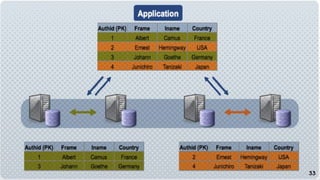
Auto-sharding for Write-scalability
MySQL Cluster automatically shards (partitions) tables across nodes, enabling databases to scale horizontally on low cost, commodity
hardware while maintaining complete application transparency.
99.999% Availability
With its distributed, shared-nothing architecture, MySQL Cluster has been designed to deliver 99.999% availability ensuring resilience to
failures and the ability to perform scheduled maintenance without downtime.
SQL & NoSQL APIs
MySQL Cluster enables users to blend the best of both relational and NoSQL technologies into solutions that reduce cost, risk and
complexity.
Multi-site Clusters with Active Active Geographical Replication
Update-anywhere geographic replication enables multiple clusters to be distributed geographically for disaster recovery and
the scalability of global web services.
Online Scaling & Schema Upgrades
To support continuous operation, MySQL Cluster allows on-line addition of nodes and updates to live database schema

to support rapidly evolving and highly dynamic workloads.
MySQL Cluster Auto-Installer
Get MySQL Cluster up and running in minutes! Graphically configure and provision a production-grade cluster, automatically tuned for
your
33
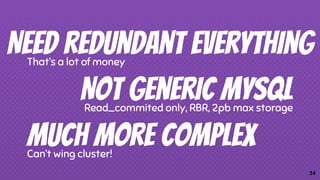
Need redundant everythingThat’s a lot of money
Much more complexCan’t wing cluster!
Not generic MySQLRead_commited only, RBR, 2pb max storage
34
35
So
Now
what?!?!
Basics (kihon)
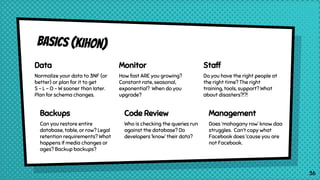
Data
Normalize your data to 3NF (or
better) or plan for it to get
S - L - O - W sooner than later.
Plan for schema changes.
Monitor
How fast ARE you growing?
Constant rate, seasonal,
exponential? When do you
upgrade?
Staff
Do you have the right people at
the right time? The right
training, tools, support? What
about disasters?!?!
Backups
Can you restore entire
database, table, or row? Legal
retention requirements? What
happens if media changes or
ages? Backup backups?
Code Review
Who is checking the queries run
against the database? Do
developers ‘know’ their data?
Management
Does ‘mahogany row’ know daa
struggles. Can’t copy what
Facebook does ‘cause you are
not Facebook.
36
THANKS!Any questions?
You can find me at @stoker or david.stokes@oracle.com
Slides at slideshare.net/davidmstokes
37

Scaling MySQL -- Swanseacon.co.uk

  • 1.
    Scaling MySQLDave Stokes @Stokerdavid.stokes@oracle.com slideshare.net/DavidMStokes 13 September 2016 Swanseason.co.uk
  • 2.
    Scaling MySQLDave Stokes @Stokerdavid.stokes@oracle.com slideshare.net/DavidMStokes
  • 3.
    "THE FOLLOWING ISINTENDED TO OUTLINE OUR GENERAL PRODUCT DIRECTION. IT IS INTENDED FOR INFORMATION PURPOSES ONLY, AND MAY NOT BE INCORPORATED INTO ANY CONTRACT. IT IS NOT A COMMITMENT TO DELIVER ANY MATERIAL, CODE, OR FUNCTIONALITY, AND SHOULD NOT BE RELIED UPON IN MAKING PURCHASING DECISIONS. THE DEVELOPMENT, RELEASE, AND TIMING OF ANY FEATURES OR FUNCTIONALITY DESCRIBED FOR ORACLE'S PRODUCTS REMAINS AT THE SOLE DISCRETION OF ORACLE." Safe Harbor 3
  • 4.
    Quick MySQL CatchUp 21 Years Old MySQL has been part of Oracle’s family of databases for six years. MySQL 8 MySQl 5.7 is the current release but the next version will be MySQL 8. Big feature is real time data dictionary Group Replication Active master-master replication. JSON A new native JSON datatype to store documents in a column of a table Document Store Programmers not know SQL but need a database? X Devapi allows them to use RDMS from language of choice Encryption Use Oracle Key Vault to encrypt your data at rest. 4
  • 5.
    Scaling!What is ScalingMySQL? Why are there so many different ways to scale? The database runs too fast!! How do I slow it down??? 5
  • 6.
    How to growyour mysql instances Your new amazing code started off on a Vagrant image and now you want it to scale. The problem is that relational databases do not easily scale. Do you need to scale for reads, or writes, or both?? This session will cover the easy, low cost ways to move from your development box where all is on one image to splitting services, splitting reads/writes, basic sharding, highly available & fault tolerant server farms, to clusters with 99.999% uptime. This talk will cover the costs (financial, time, opportunity cost, and sanity) as you scale with your data. 6
  • 7.
  • 8.
    “LAMP stack wasone box with all the services running together at the same time.” 8
  • 9.
    Databases are thenasty toddlers of software × Do not play well with others × Constantly need attention × Consume resources, time, and sanity Moving the database away from the other services is a wise First option. 9
  • 10.
    MySQL 1. Copy datafrom A to B 2. Start replication 3. Copy changes in A to B 4. A & B are exact copies 10
  • 11.
    Server A ServerB The basic idea is to start with the master server and the slave server with the same information. 11
  • 12.
    Server A ServerB Any changes on the master server are copies to the slave server. 12
  • 13.
    Server A ServerB And so one and so forth. 13
  • 14.
    Backups: 1. Stop SQLThread on Slave (still gets updates from Master, but does not apply them to Slave). 2. Run backup 3. Restart SQL Thread, slave catches up. The way to do backups off a slave server 14
  • 15.
    Replication uses Save datato slave server and use it for backups while keeping main server up for users. Give developers their own copy of data where they can not interfere with ‘real’ data. Split reads/writes so that reads go to a pool of servers and writes go to one server. Great for read heavy circumstances. Does not scale writes. 15
  • 16.
    Replicaition changes MySQL upto 5.5 --Single threaded (airline example) --Logs kept in files MySQL 5.6 -- Multi threads but one per table --Logs kept in InnoDB tables MySQL 5.7 -- Multi threaded at table level -- Checksums and other features to ensure data is correct 16
  • 17.
    There is aPECL extension for use with PHP to load balance reads or do round robin. Or you could use some other load balancer. 17
  • 18.
    18 Great presentation on mysqlnd_msload balance - PECL Package https://speakerdeck.com/dshafik/ phptek-2015-extending-mysql-wit h-phps-native-driver
  • 19.
    Multi Source replication (5.7)allows multiple servers to save data in parallel to a single slave server to make backups easier, coalesce data, manage shards 19
  • 20.
    Sharding Cut you datainto smaller chunks, make application aware of which chunk has which range of records. What ABout splitting reads? Sanity Check Not all shards will grow equally, hard to re-engineer, need extra smarts to manage 20
  • 21.
    MySQL Fabric Python MySQL Fabricis written in Python (along with the MySQL Utilities) and easy to extend. High Availability or shards Easy to set up groups of HA or sharding servers, can re-shard on the fly, sub second failover master->slave Rough MySQL Fabric is a little rough around edges currently, MySQL Router fills some gaps. 21
  • 22.
    Galara Cluster forMySQL Virtually synchronous replication for InnoDB Bundled in MariaDB and Percona Cluster, Linux only Codeship OY 22
  • 23.
    MySQL Group ReplicationLibrary Virtually Synchronous Replication 5.7+ Support on all MySQL platforms Highly Available distributed database service Removed need to manually handling server fail-over Provides distributed fault tolerance Enables active/active update anywhere Automatic detects and handles conflicts Automates reconfiguration (crashes, adding/removing nodes) 23
  • 24.
    Group Replication benefits ●No third-party software required. ● No network multicast support required. ● MySQL Group Replication can now operate on cloud based installations on which multicast is disallowed. ● No message size limit. ● No separate process. ● MySQL Group Replication is now self-contained on the same software stack. ● First committer wins! 24
  • 25.
    •Built on topof proven technology! –Shares much of MySQL Replication infrastructure – thence does not feel alien! –Multi-Master approach to replication. •Built on reusable components! –Layered implementation approach. –Interface driven development. –Decoupled from the server core. –The plugin registers as listener to server events. –Reuses the capture procedure from regular Replication. Provides further decoupling from the communication infrastructure 25
  • 26.
    USe Cases forGroup Replication Highly Available Shards Sharding is a popular approach to achieve write scale-out. Users can use MySQL Group Replication to implement highly available shards. Each shard can map into a Replication Group. Elastic Replication Environments that require a very fluid replication infrastructure, where the number of servers has to grow or shrink dynamically and with as little pain as possible. Alternative to Master-Slave replication It may be that a single master server makes it a single point of contention. Writing to an entire group may prove more scalable under certain circumstances 26
  • 27.
  • 28.
    •Cloud Friendly –Great techonologyfor deployments where elasticity is a requirement, such as cloud based infrastructures. •Integrated –With server core through a well defined API. –With GTIDs, row based replication, performance schema tables. •Autonomic and Operations Friendly –It is self-healing: no admin overhead for handling server fail-overs. –Provides fault-tolerance, enables multi-master update everywhere and a dependable MySQL service. MySQL group replication 28
  • 29.
    Proxy/router 29 There are lotsof options for load balancing (hardware, mysqlnd_ms, MySQL router, MariaDB MaxScale, Proxysql, and many others) All have their features -fail over, query rewrite, sharding support- that you may need or can do another way -- But they can smooth out your traffic at high levels.
  • 30.
    Proxy/router continued 30 Be carefulas some proxies do not support tracking schema, auto commit / transactions, or character encodings. Try not to create more work for yourself.
  • 31.
    What if youneed replication between data centers? 31 Or need 99.99% uptime? MySQl Cluster!
  • 32.
    32 MySQL Cluster Features In-MemoryDatabase Delivering 200 Million QPS Using memory-optimized tables, MySQL Cluster provides real-time response time and throughput meet the needs of the most demanding web, telecommunications and enterprise applications - delivering 200 Million Queries Per Second. Auto-sharding for Write-scalability MySQL Cluster automatically shards (partitions) tables across nodes, enabling databases to scale horizontally on low cost, commodity hardware while maintaining complete application transparency. 99.999% Availability With its distributed, shared-nothing architecture, MySQL Cluster has been designed to deliver 99.999% availability ensuring resilience to failures and the ability to perform scheduled maintenance without downtime. SQL & NoSQL APIs MySQL Cluster enables users to blend the best of both relational and NoSQL technologies into solutions that reduce cost, risk and complexity. Multi-site Clusters with Active Active Geographical Replication Update-anywhere geographic replication enables multiple clusters to be distributed geographically for disaster recovery and the scalability of global web services. Online Scaling & Schema Upgrades To support continuous operation, MySQL Cluster allows on-line addition of nodes and updates to live database schema to support rapidly evolving and highly dynamic workloads. MySQL Cluster Auto-Installer Get MySQL Cluster up and running in minutes! Graphically configure and provision a production-grade cluster, automatically tuned for your
  • 33.
  • 34.
    Need redundant everythingThat’sa lot of money Much more complexCan’t wing cluster! Not generic MySQLRead_commited only, RBR, 2pb max storage 34
  • 35.
  • 36.
    Basics (kihon) Data Normalize yourdata to 3NF (or better) or plan for it to get S - L - O - W sooner than later. Plan for schema changes. Monitor How fast ARE you growing? Constant rate, seasonal, exponential? When do you upgrade? Staff Do you have the right people at the right time? The right training, tools, support? What about disasters?!?! Backups Can you restore entire database, table, or row? Legal retention requirements? What happens if media changes or ages? Backup backups? Code Review Who is checking the queries run against the database? Do developers ‘know’ their data? Management Does ‘mahogany row’ know daa struggles. Can’t copy what Facebook does ‘cause you are not Facebook. 36
  • 37.
    THANKS!Any questions? You canfind me at @stoker or david.stokes@oracle.com Slides at slideshare.net/davidmstokes 37