<Insert Picture Here>


MySQL High Availability Options
Ryusuke Kajiyama
MySQL Principal Sales Consultant, Asia Pacific and Japan
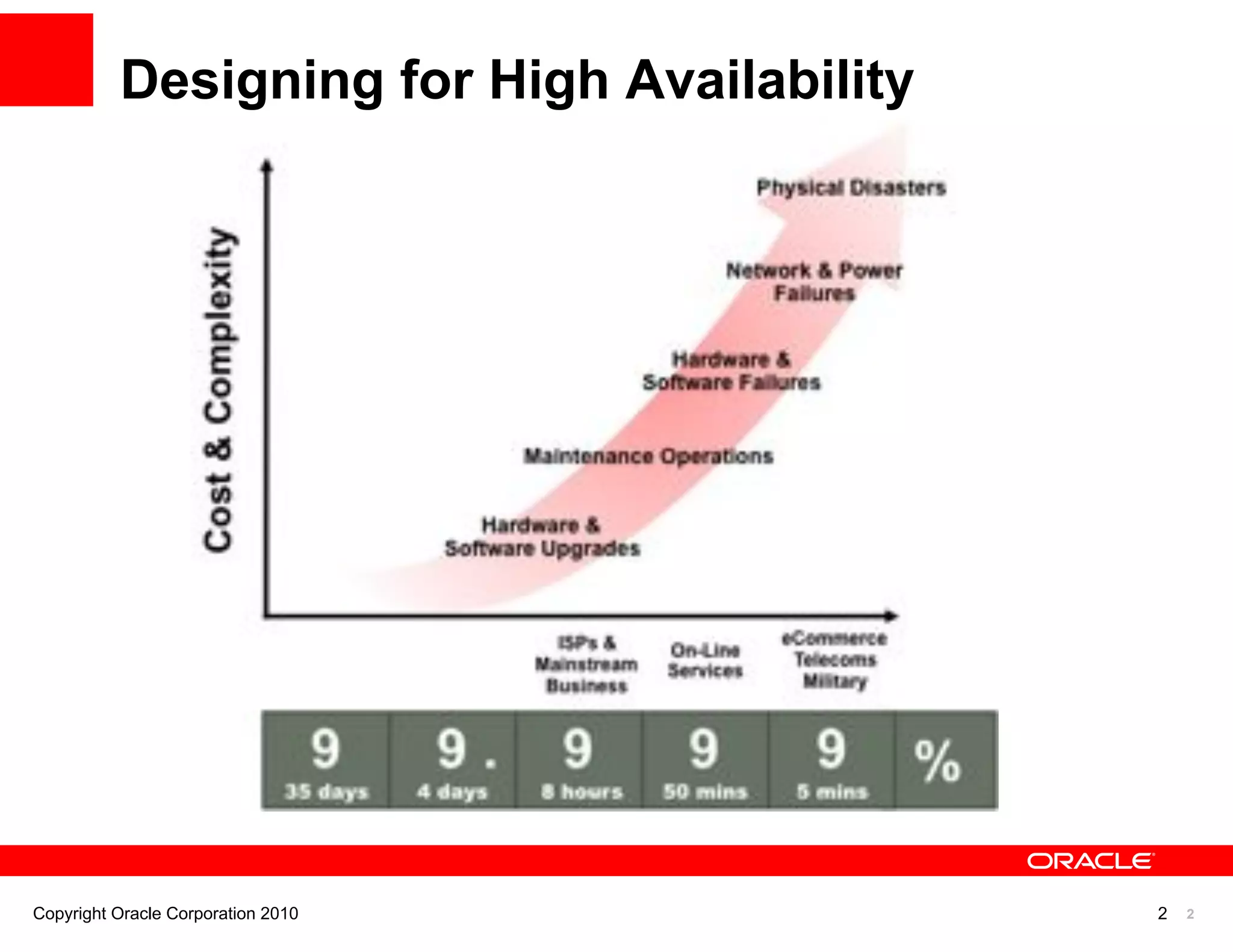
Designing for High Availability


Copyright Oracle Corporation 2010           2   2
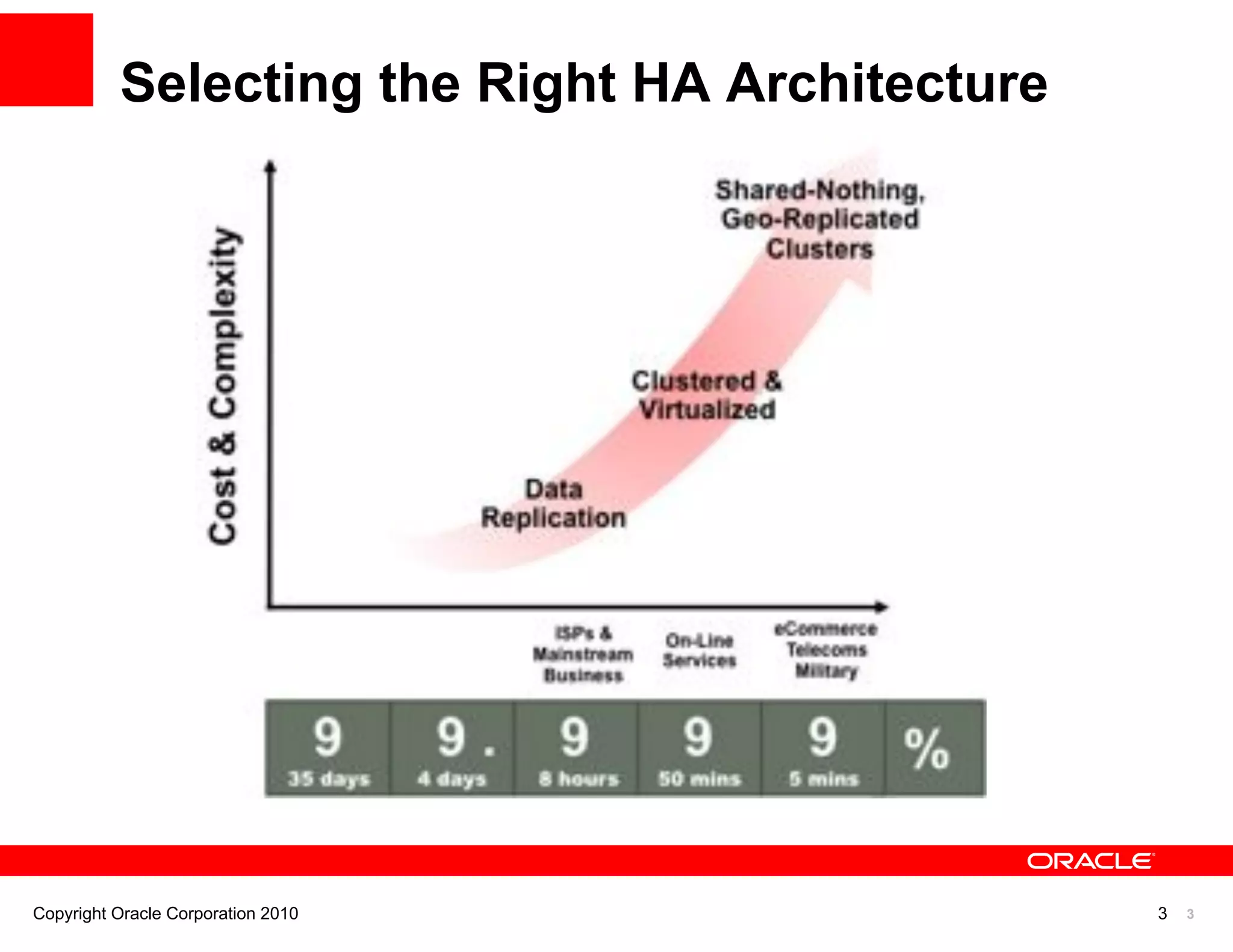
Selecting the Right HA Architecture


Copyright Oracle Corporation 2010               3   3
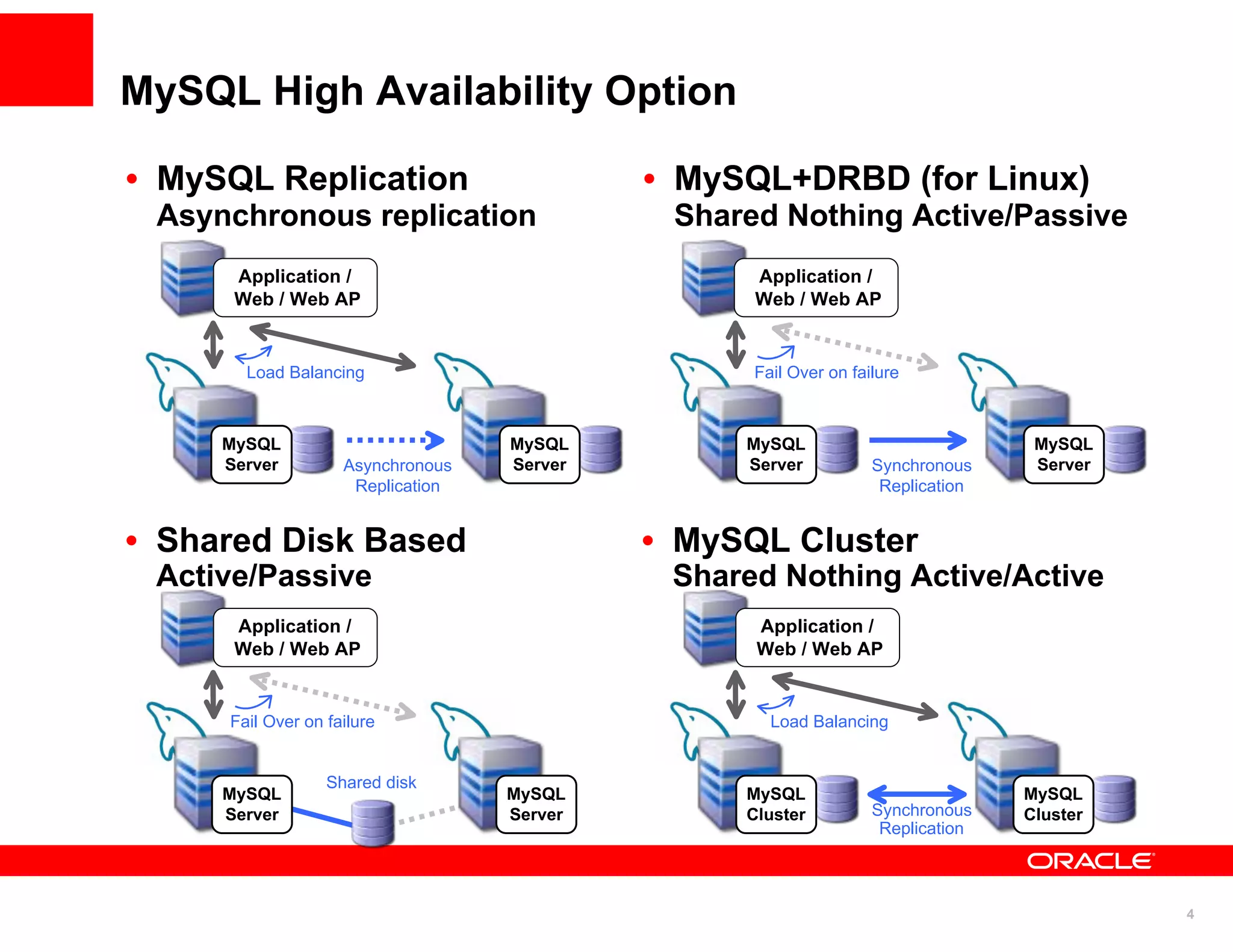
MySQL High Availability Option

• MySQL Replication                         • MySQL+DRBD (for Linux)
 Asynchronous replication                    Shared Nothing Active/Passive
      Application /                               Application /
      Web / Web AP                                Web / Web AP


       Load Balancing                             Fail Over on failure


     MySQL                         MySQL         MySQL                            MySQL
     Server         Asynchronous   Server        Server           Synchronous     Server
                     Replication                                   Replication


• Shared Disk Based                         • MySQL Cluster
 Active/Passive                              Shared Nothing Active/Active
      Application /                               Application /
      Web / Web AP                                Web / Web AP


     Fail Over on failure                           Load Balancing


                  Shared disk
     MySQL                         MySQL         MySQL                           MySQL
     Server                        Server        Cluster          Synchronous    Cluster
                                                                   Replication


                                                                                           4
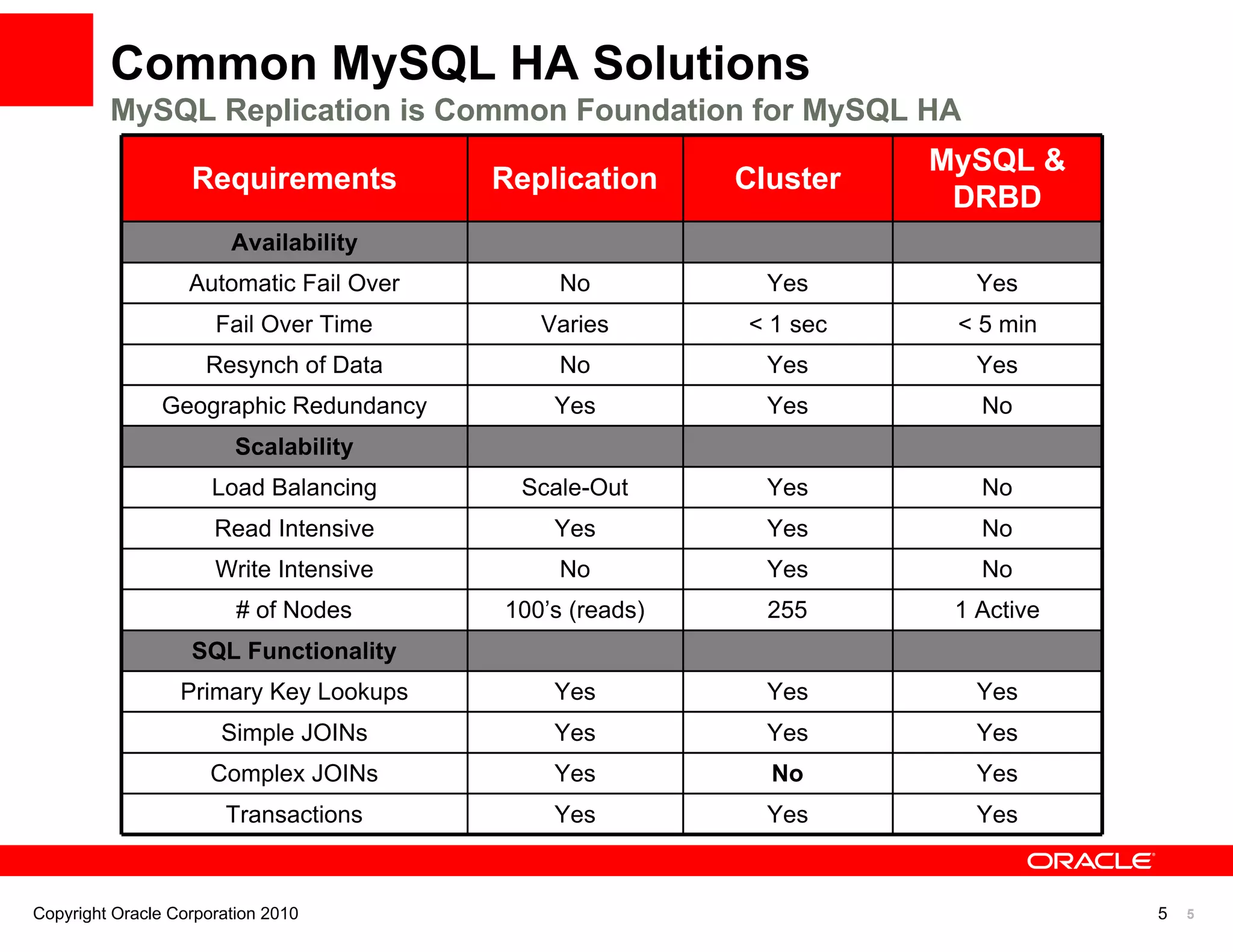
Common MySQL HA Solutions
         MySQL Replication is Common Foundation for MySQL HA
                                                                   MySQL &
                   Requirements          Replication     Cluster
                                                                    DRBD
                        Availability
                   Automatic Fail Over        No           Yes        Yes
                      Fail Over Time        Varies       < 1 sec    < 5 min
                     Resynch of Data          No           Yes        Yes
                Geographic Redundancy        Yes           Yes        No
                         Scalability
                      Load Balancing      Scale-Out        Yes        No
                      Read Intensive         Yes           Yes        No
                      Write Intensive         No           Yes        No
                         # of Nodes      100’s (reads)     255      1 Active
                   SQL Functionality
                  Primary Key Lookups        Yes           Yes        Yes
                       Simple JOINs          Yes           Yes        Yes
                      Complex JOINs          Yes           No         Yes
                       Transactions          Yes           Yes        Yes


Copyright Oracle Corporation 2010                                              5   5
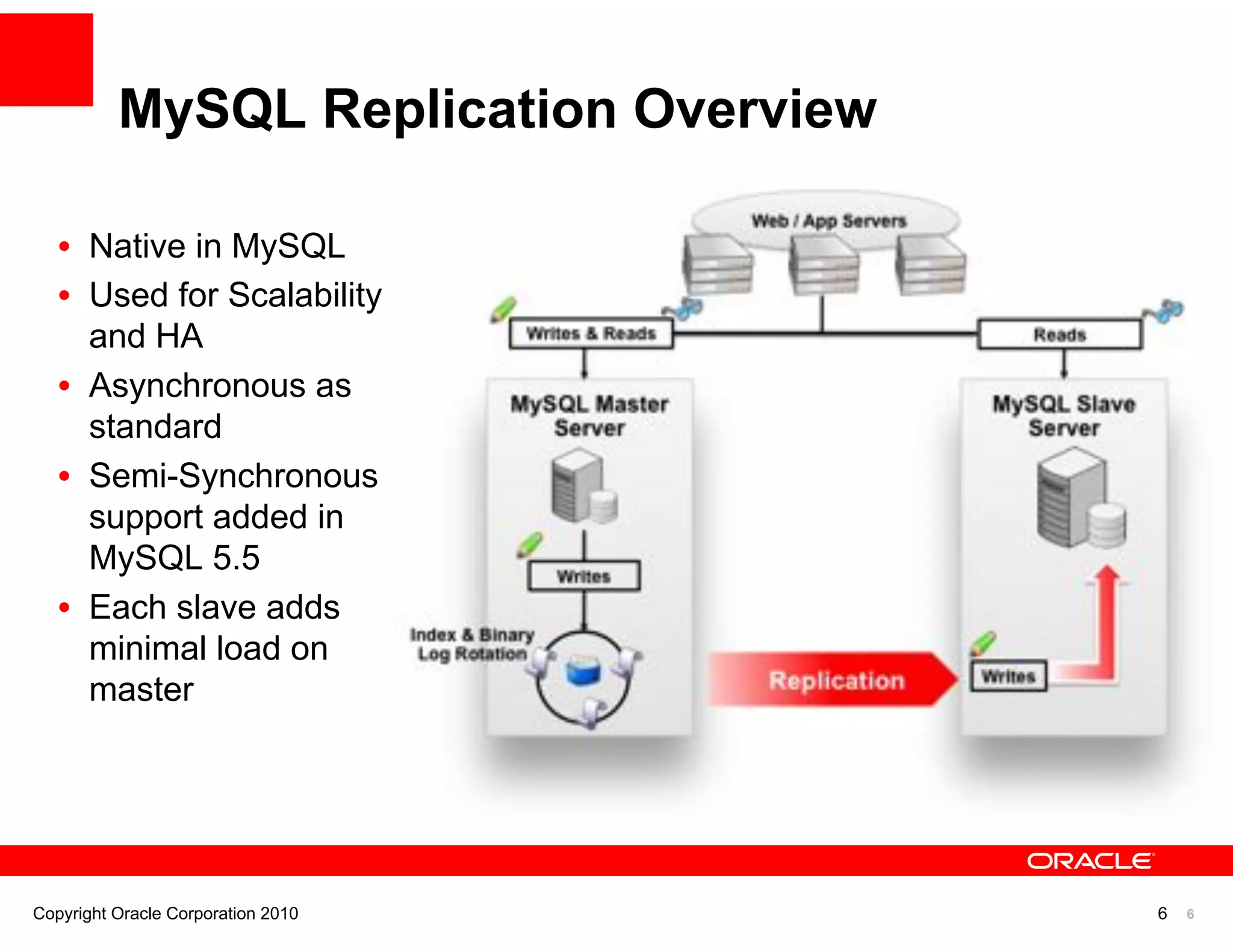
MySQL Replication Overview

   • Native in MySQL
   • Used for Scalability
     and HA
   • Asynchronous as
     standard
   • Semi-Synchronous
     support added in
     MySQL 5.5
   • Each slave adds
     minimal load on
     master


Copyright Oracle Corporation 2010      6   6
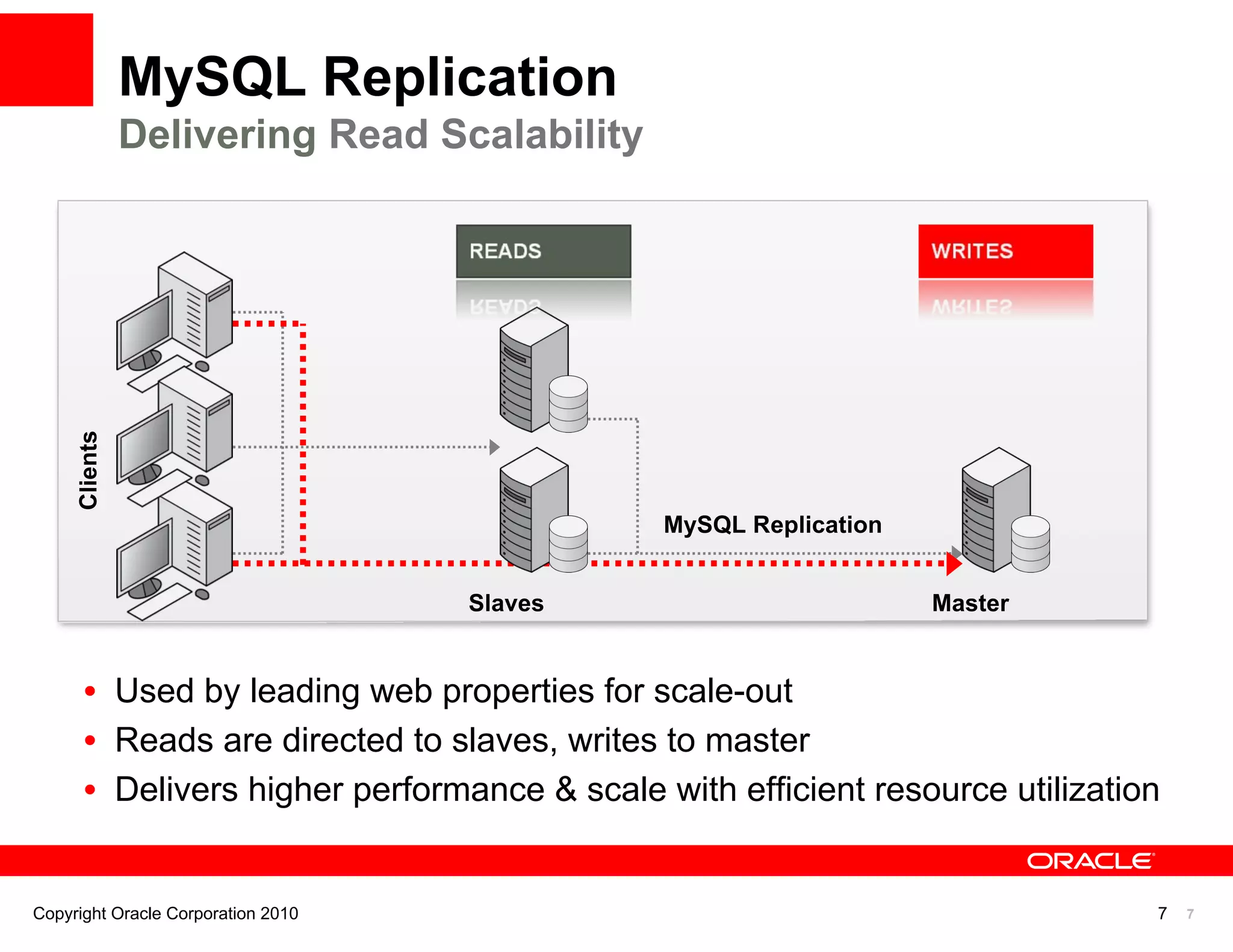
MySQL Replication
               Delivering Read Scalability
     Clients


                                              MySQL Replication


                                    Slaves                        Master


       • Used by leading web properties for scale-out
       • Reads are directed to slaves, writes to master
       • Delivers higher performance & scale with efficient resource utilization


Copyright Oracle Corporation 2010                                              7   7
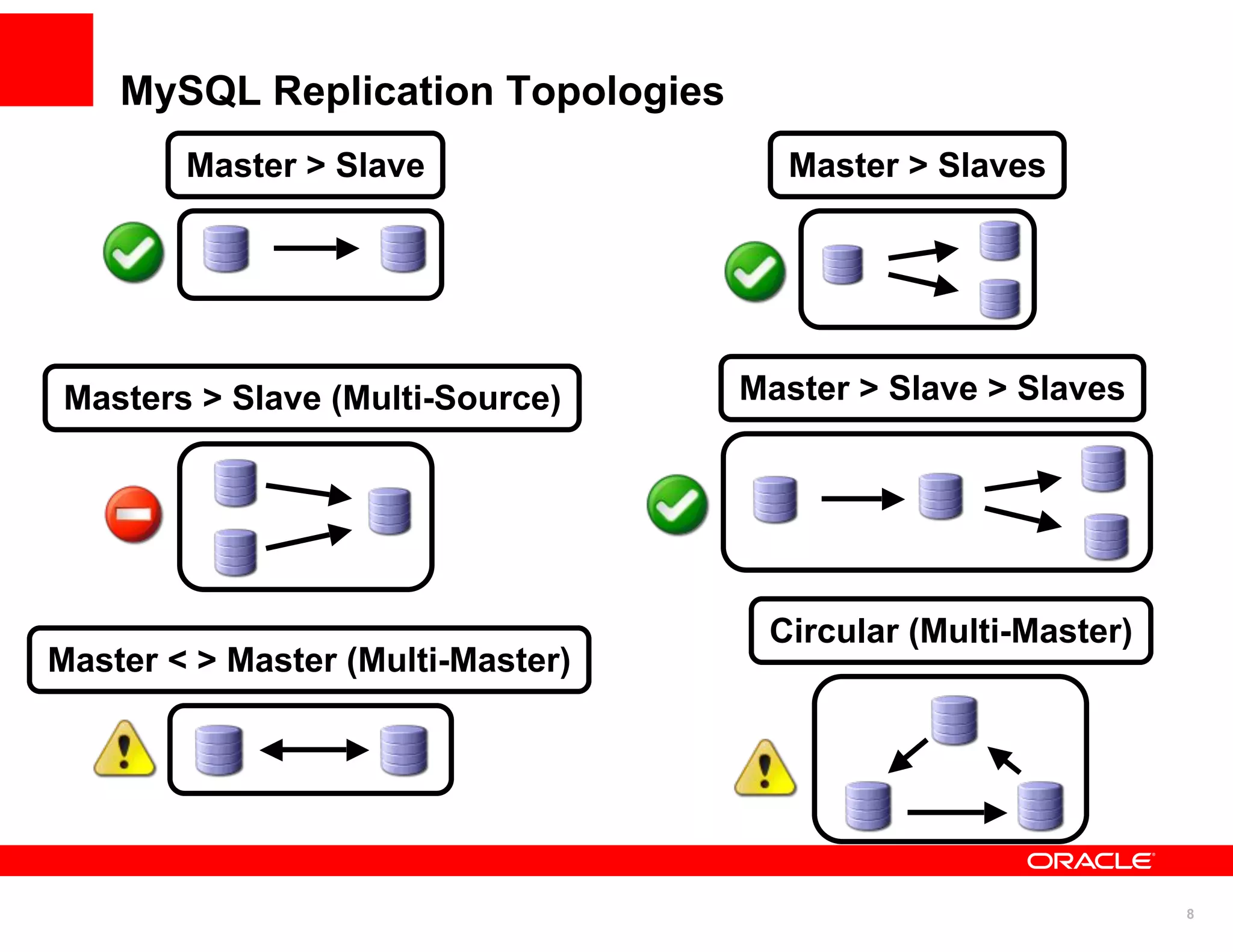
MySQL Replication Topologies
        Master > Slave               Master > Slaves


Masters > Slave (Multi-Source)     Master > Slave > Slaves


                                    Circular (Multi-Master)
Master < > Master (Multi-Master)


                                                              8
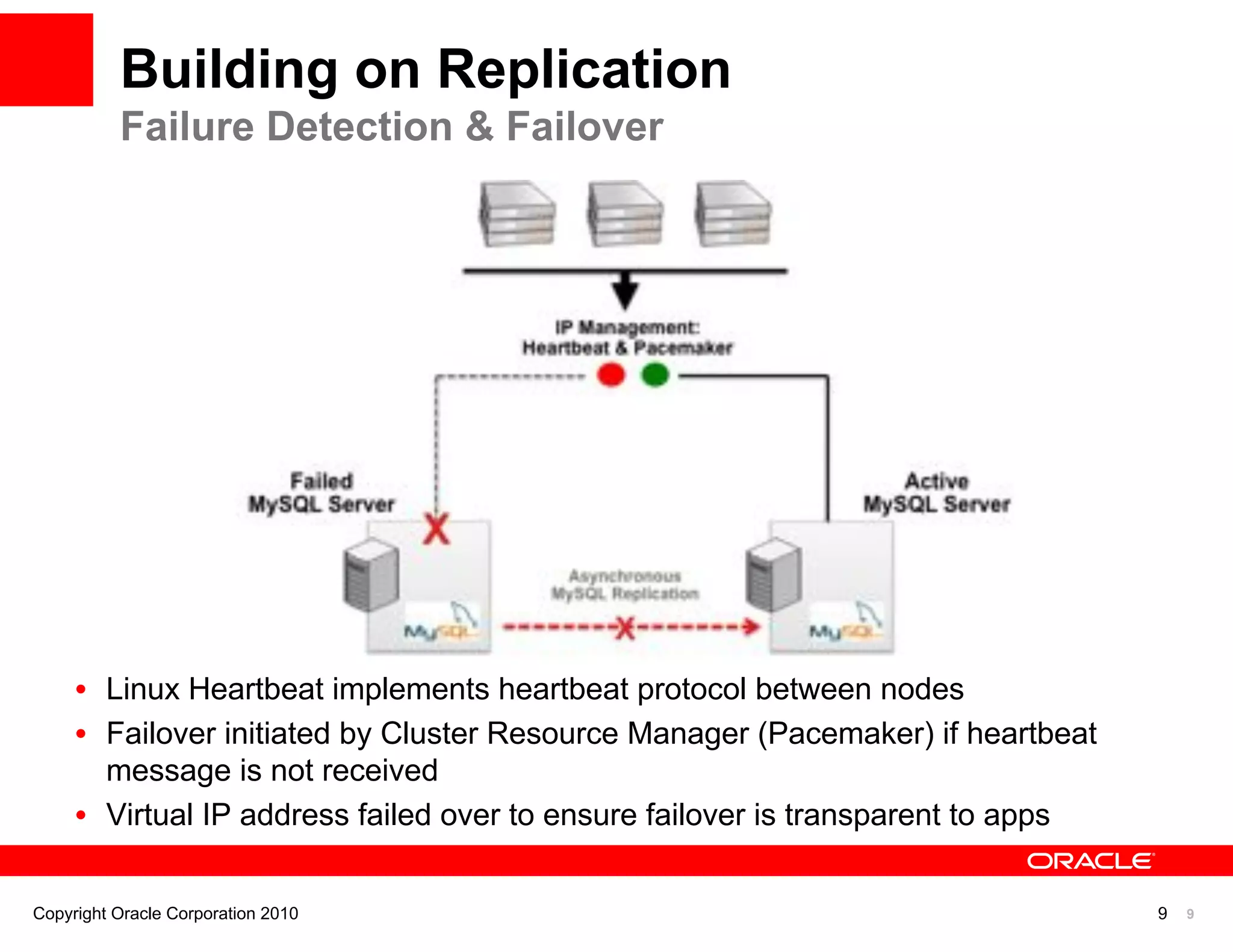
Building on Replication
          Failure Detection & Failover


     • Linux Heartbeat implements heartbeat protocol between nodes
     • Failover initiated by Cluster Resource Manager (Pacemaker) if heartbeat
       message is not received
     • Virtual IP address failed over to ensure failover is transparent to apps


Copyright Oracle Corporation 2010                                                 9   9
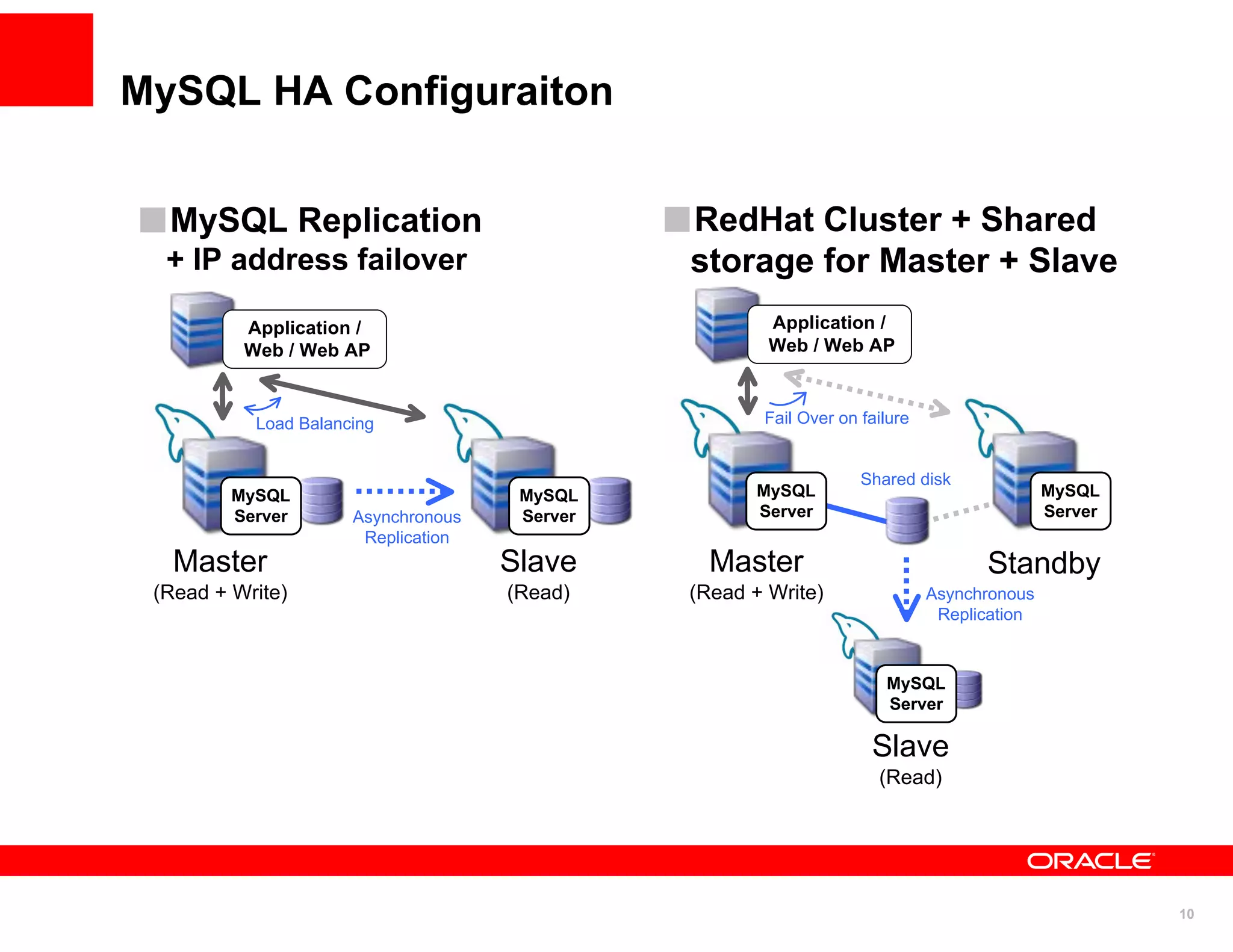
MySQL HA Configuraiton


  MySQL Replication                            RedHat Cluster + Shared
  + IP address failover                        storage for Master + Slave
          Application /                                Application /
          Web / Web AP                                 Web / Web AP


           Load Balancing                             Fail Over on failure


                                                                   Shared disk
         MySQL                        MySQL           MySQL                                 MySQL
         Server       Asynchronous    Server          Server                                Server
                       Replication
   Master                            Slave       Master                            Standby
 (Read + Write)                      (Read)    (Read + Write)                Asynchronous
                                                                              Replication


                                                                      MySQL
                                                                      Server

                                                                    Slave
                                                                     (Read)


                                                                                                     10
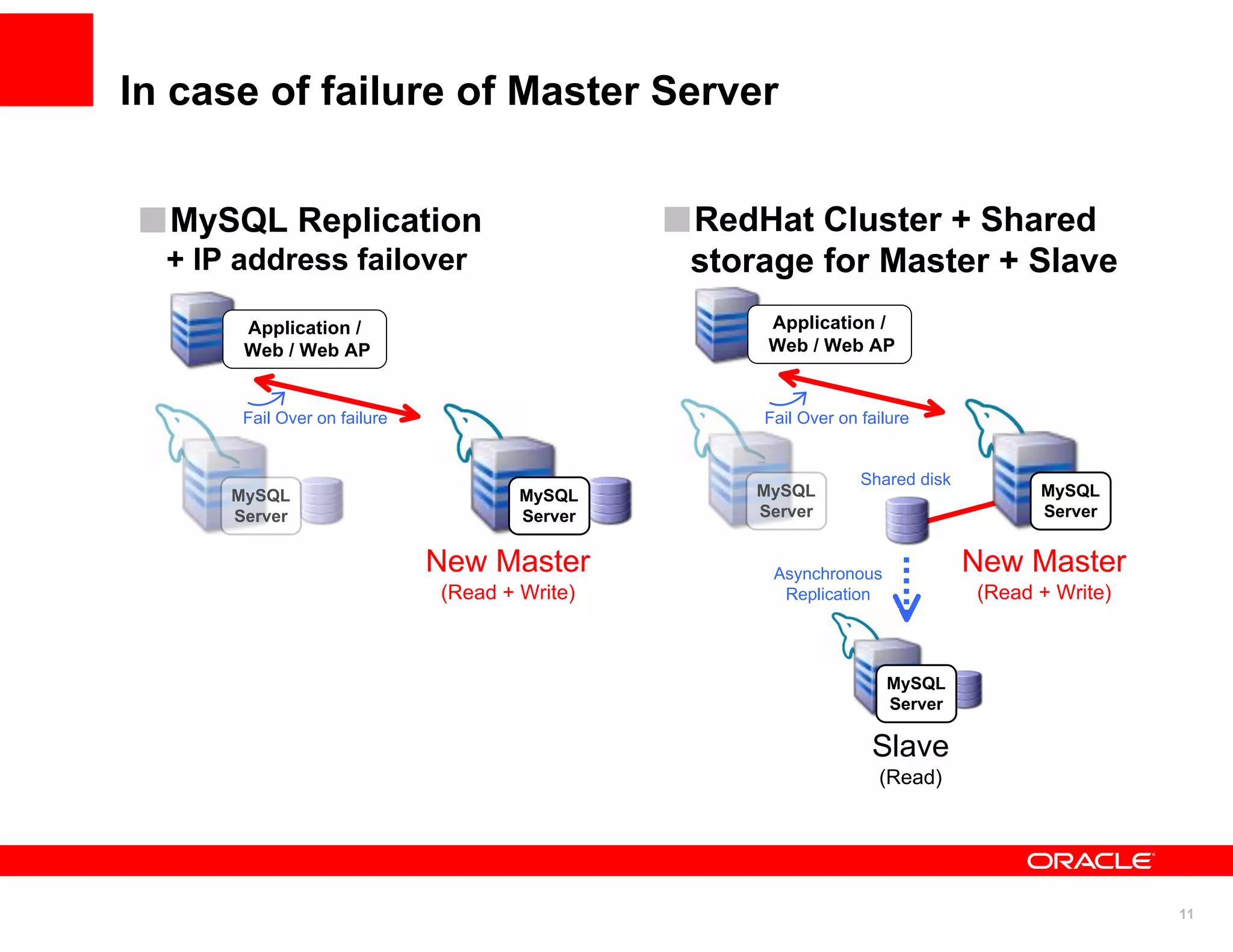
In case of failure of Master Server


  MySQL Replication                            RedHat Cluster + Shared
  + IP address failover                        storage for Master + Slave
       Application /                                Application /
       Web / Web AP                                 Web / Web AP


       Fail Over on failure                        Fail Over on failure


                                                                Shared disk
      MySQL                           MySQL        MySQL                            MySQL
      Server                          Server       Server                           Server


                              New Master            Asynchronous              New Master
                              (Read + Write)         Replication              (Read + Write)


                                                                   MySQL
                                                                   Server

                                                                 Slave
                                                                  (Read)


                                                                                               11
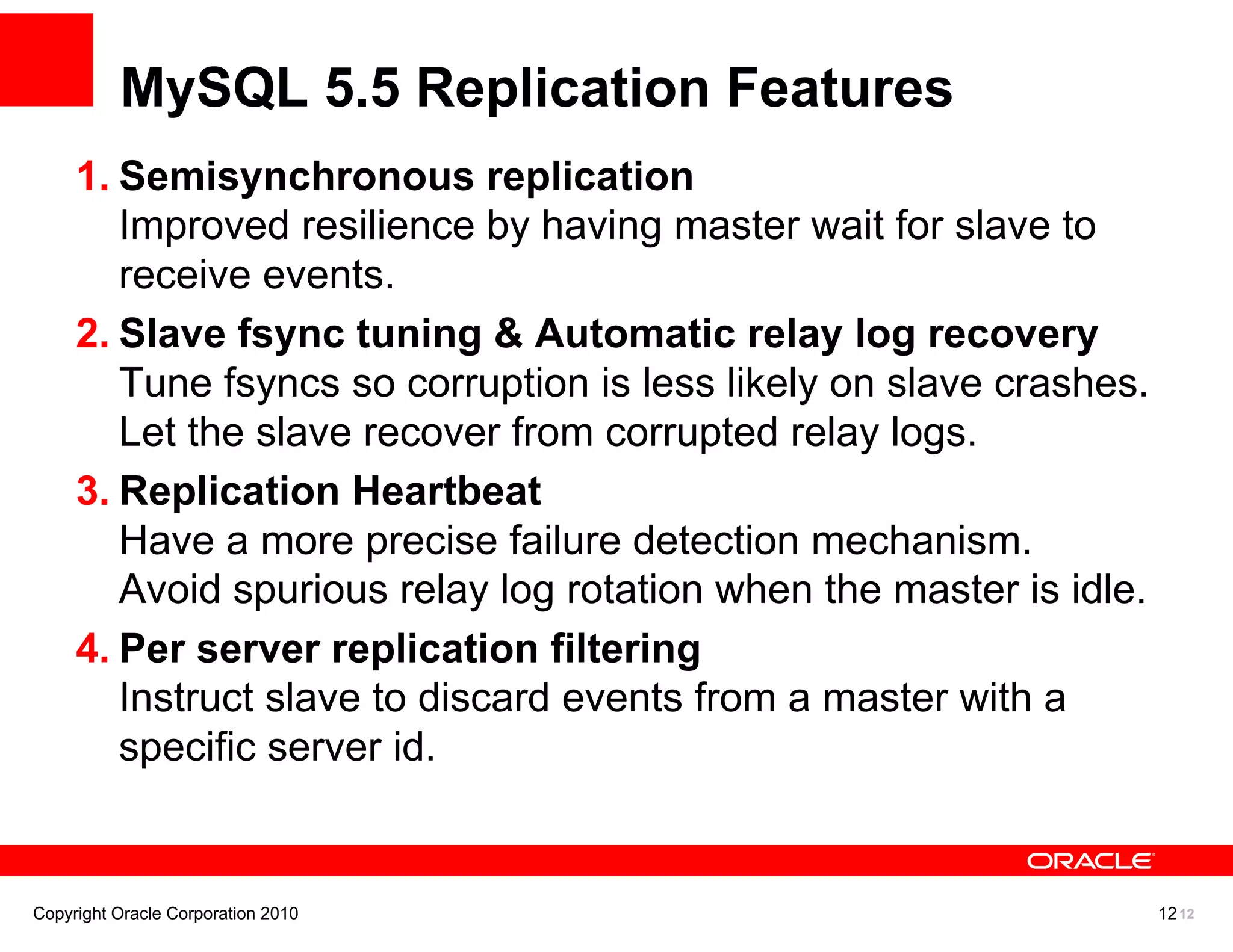
MySQL 5.5 Replication Features
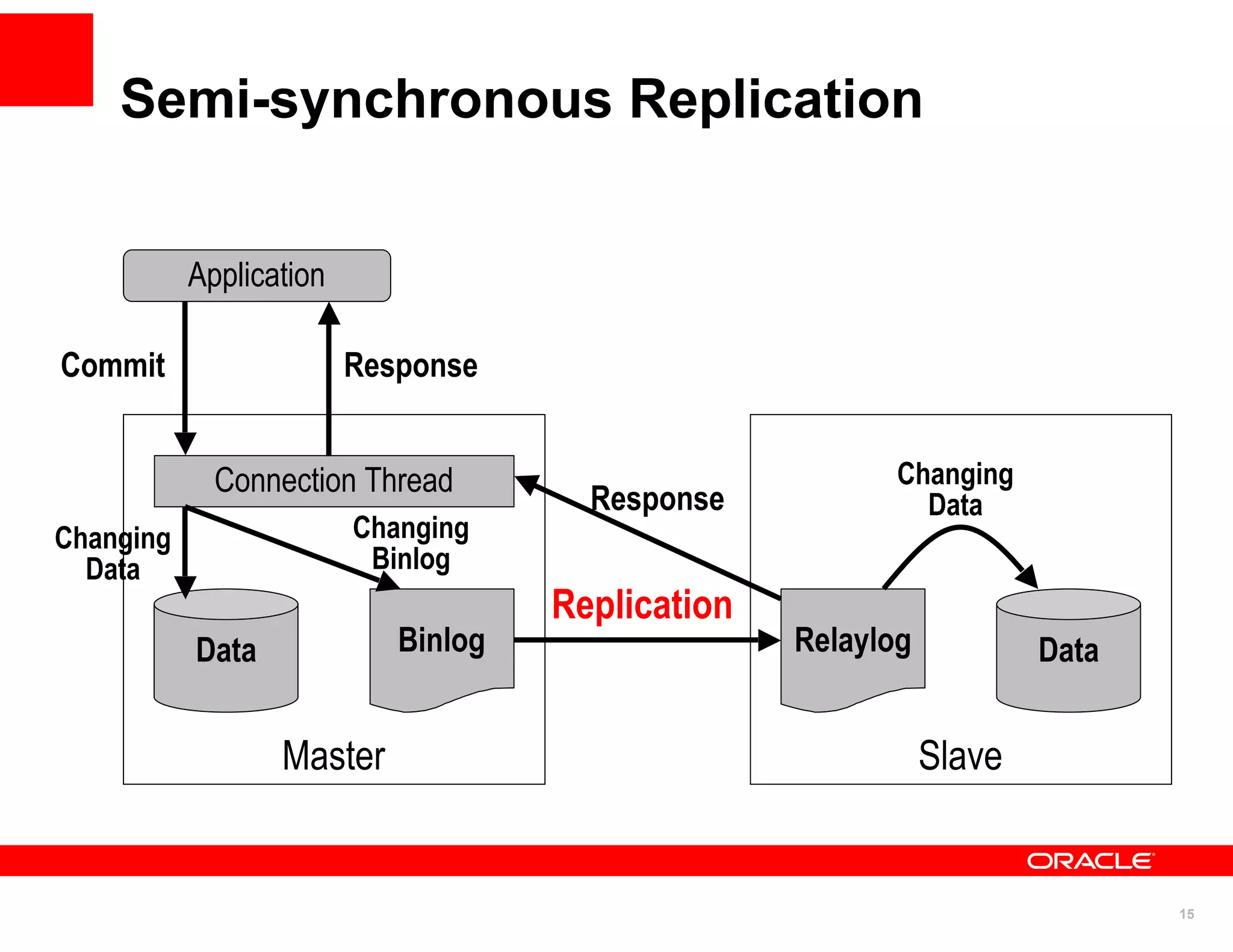
     1. Semisynchronous replication
        Improved resilience by having master wait for slave to
        receive events.
     2. Slave fsync tuning & Automatic relay log recovery
        Tune fsyncs so corruption is less likely on slave crashes.
        Let the slave recover from corrupted relay logs.
     3. Replication Heartbeat
        Have a more precise failure detection mechanism.
        Avoid spurious relay log rotation when the master is idle.
     4. Per server replication filtering
        Instruct slave to discard events from a master with a
        specific server id.


Copyright Oracle Corporation 2010                                    12 12
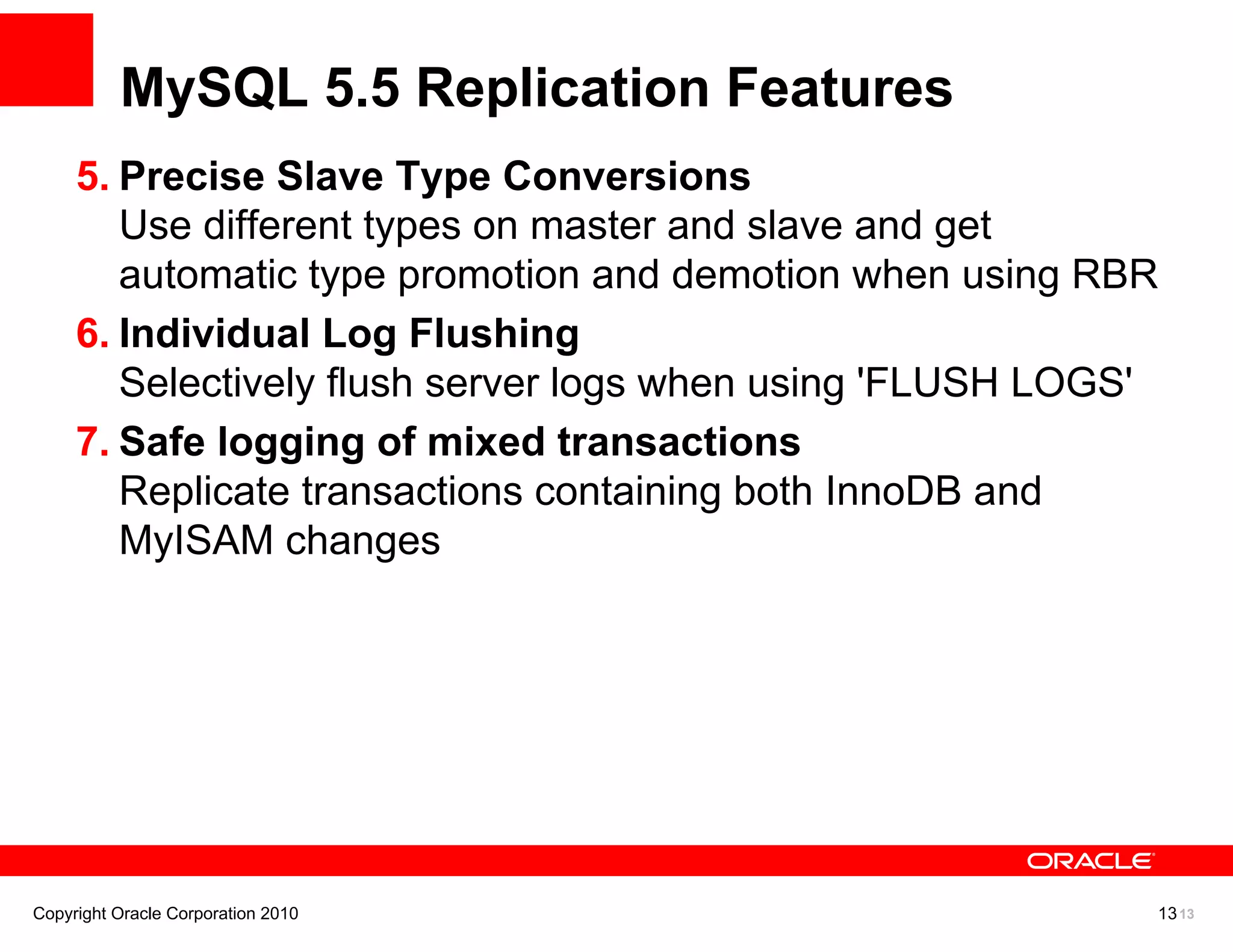
MySQL 5.5 Replication Features
     5. Precise Slave Type Conversions
        Use different types on master and slave and get
        automatic type promotion and demotion when using RBR
     6. Individual Log Flushing
        Selectively flush server logs when using 'FLUSH LOGS'
     7. Safe logging of mixed transactions
        Replicate transactions containing both InnoDB and
        MyISAM changes


Copyright Oracle Corporation 2010                           13 13
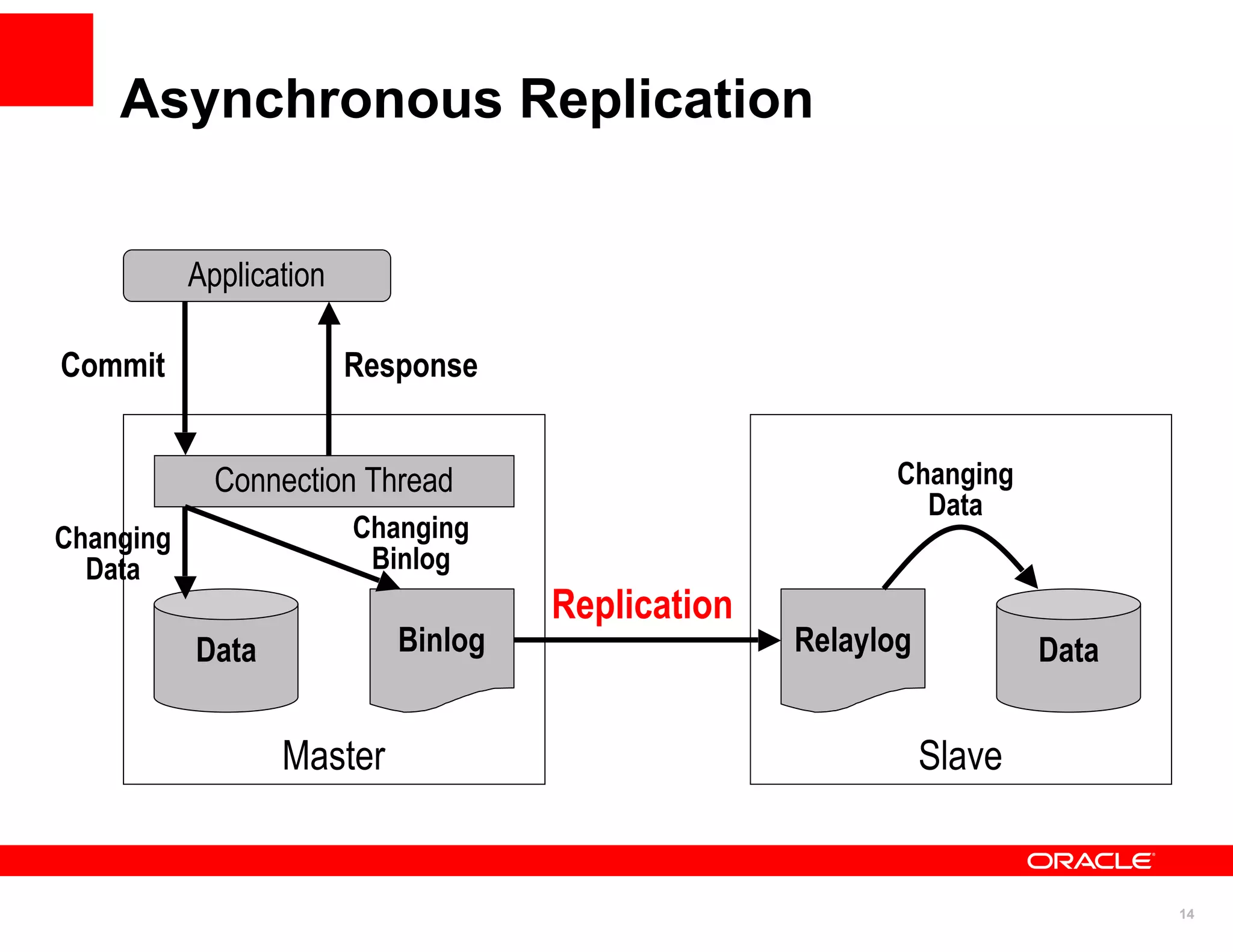
Asynchronous Replication


           Application

Commit                   Response


             Connection Thread                            Changing
                                                            Data
Changing                 Changing
  Data                    Binlog
                                     Replication
           Data             Binlog                 Relaylog           Data


                  Master                                      Slave


                                                                             14
Semi-synchronous Replication


           Application

Commit                   Response


             Connection Thread                            Changing
                                       Response             Data
Changing                 Changing
  Data                    Binlog
                                     Replication
           Data             Binlog                 Relaylog           Data


                  Master                                      Slave


                                                                             15
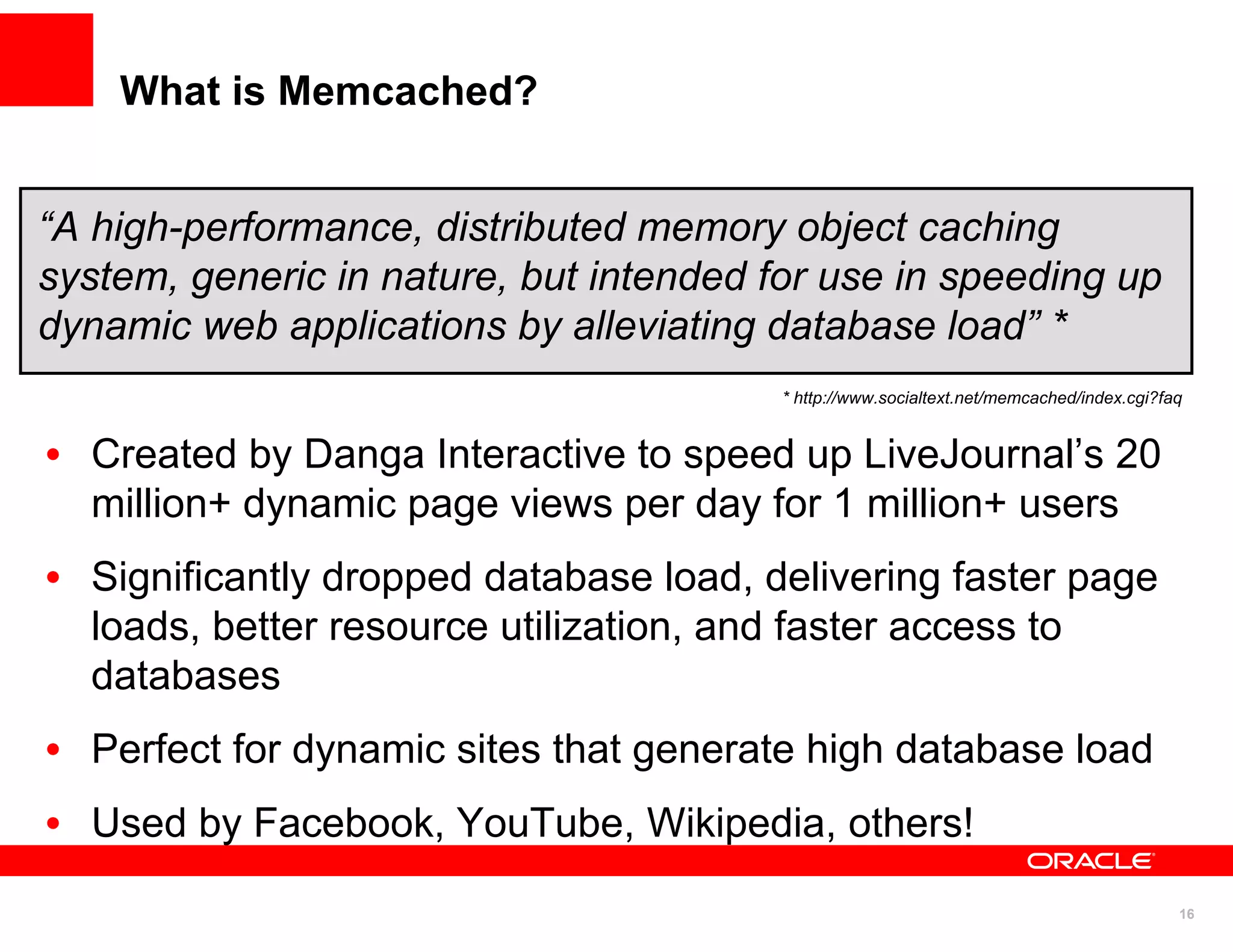
What is Memcached?


“A high-performance, distributed memory object caching
system, generic in nature, but intended for use in speeding up
dynamic web applications by alleviating database load” *
                                         * http://www.socialtext.net/memcached/index.cgi?faq


• Created by Danga Interactive to speed up LiveJournal’s 20
  million+ dynamic page views per day for 1 million+ users
• Significantly dropped database load, delivering faster page
  loads, better resource utilization, and faster access to
  databases
• Perfect for dynamic sites that generate high database load
• Used by Facebook, YouTube, Wikipedia, others!
                                                                                           16
Why was Memcached created?

• Created to speed up blogging site LiveJournal
   • 20 million+ dynamic page views per day
   • 1 million+ users

• Results…
   • Faster page loads
   • Lowered database load
   • Better resource utilization
   • Faster access to databases

• Perfect for dynamic sites that generate high database load

                                                               17
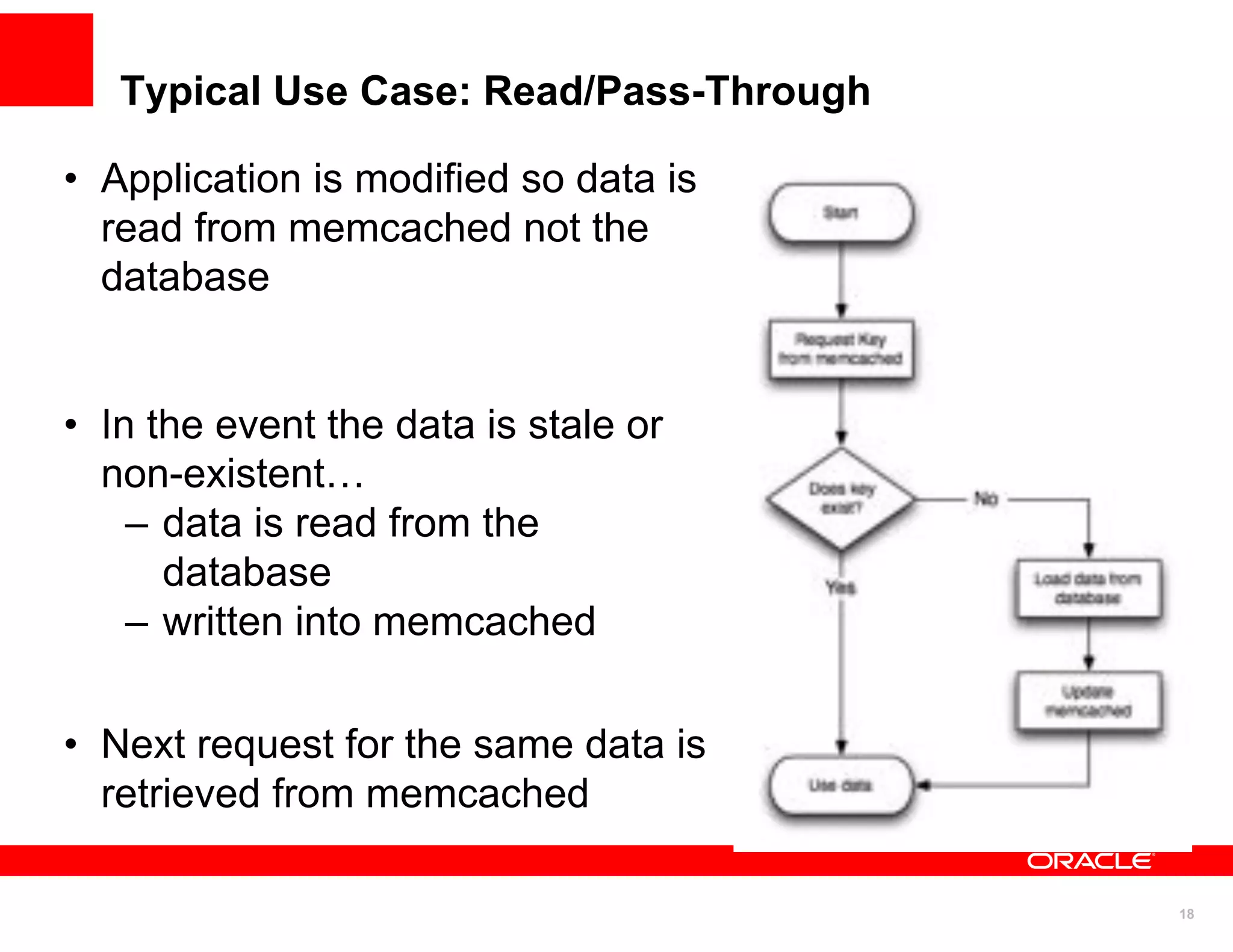
Typical Use Case: Read/Pass-Through

• Application is modified so data is
  read from memcached not the
  database


• In the event the data is stale or
  non-existent…
    – data is read from the
      database
    – written into memcached

• Next request for the same data is
  retrieved from memcached

                                         18
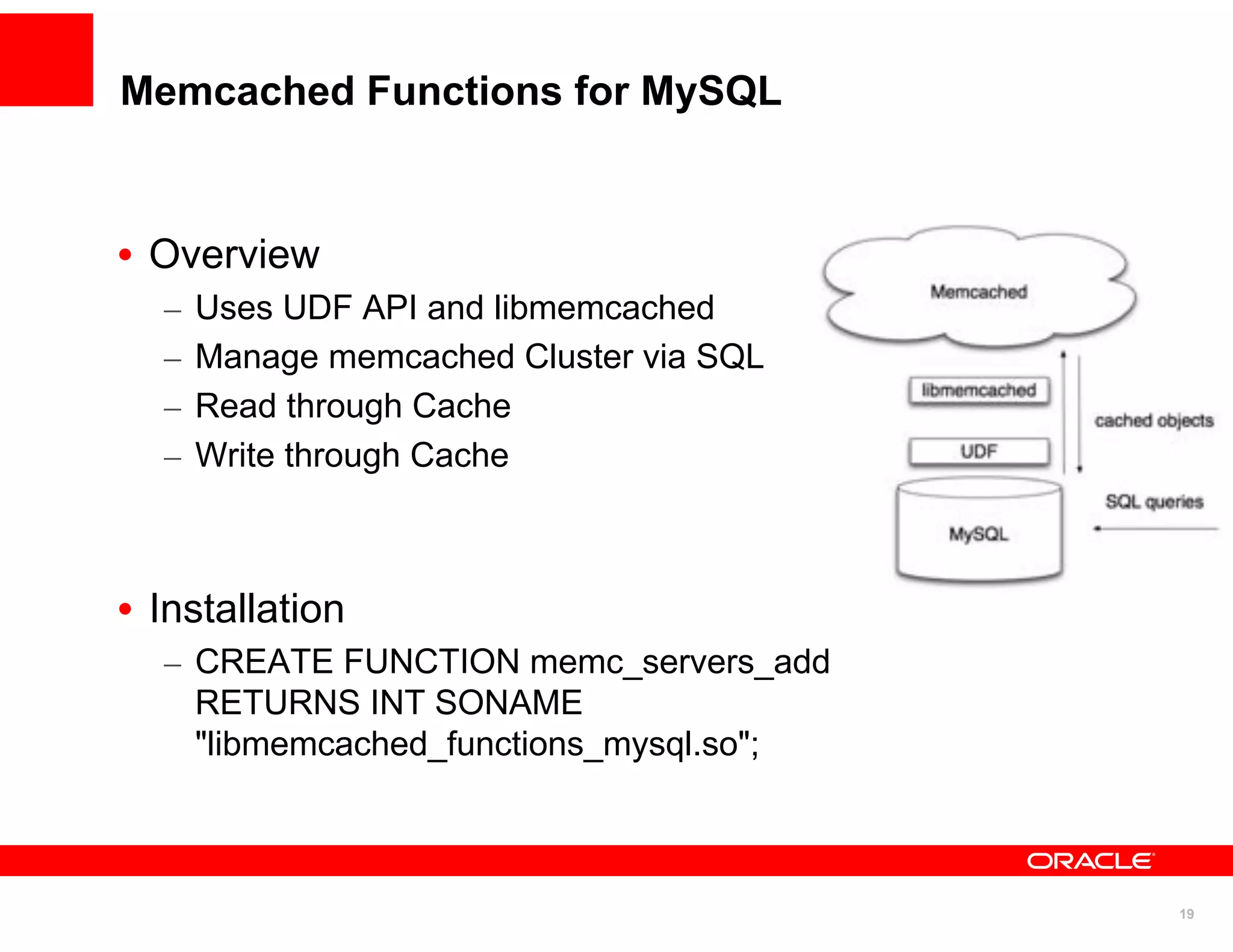
Memcached Functions for MySQL


• Overview
  –   Uses UDF API and libmemcached
  –   Manage memcached Cluster via SQL
  –   Read through Cache
  –   Write through Cache


• Installation
  – CREATE FUNCTION memc_servers_add
    RETURNS INT SONAME
    "libmemcached_functions_mysql.so";


                                         19
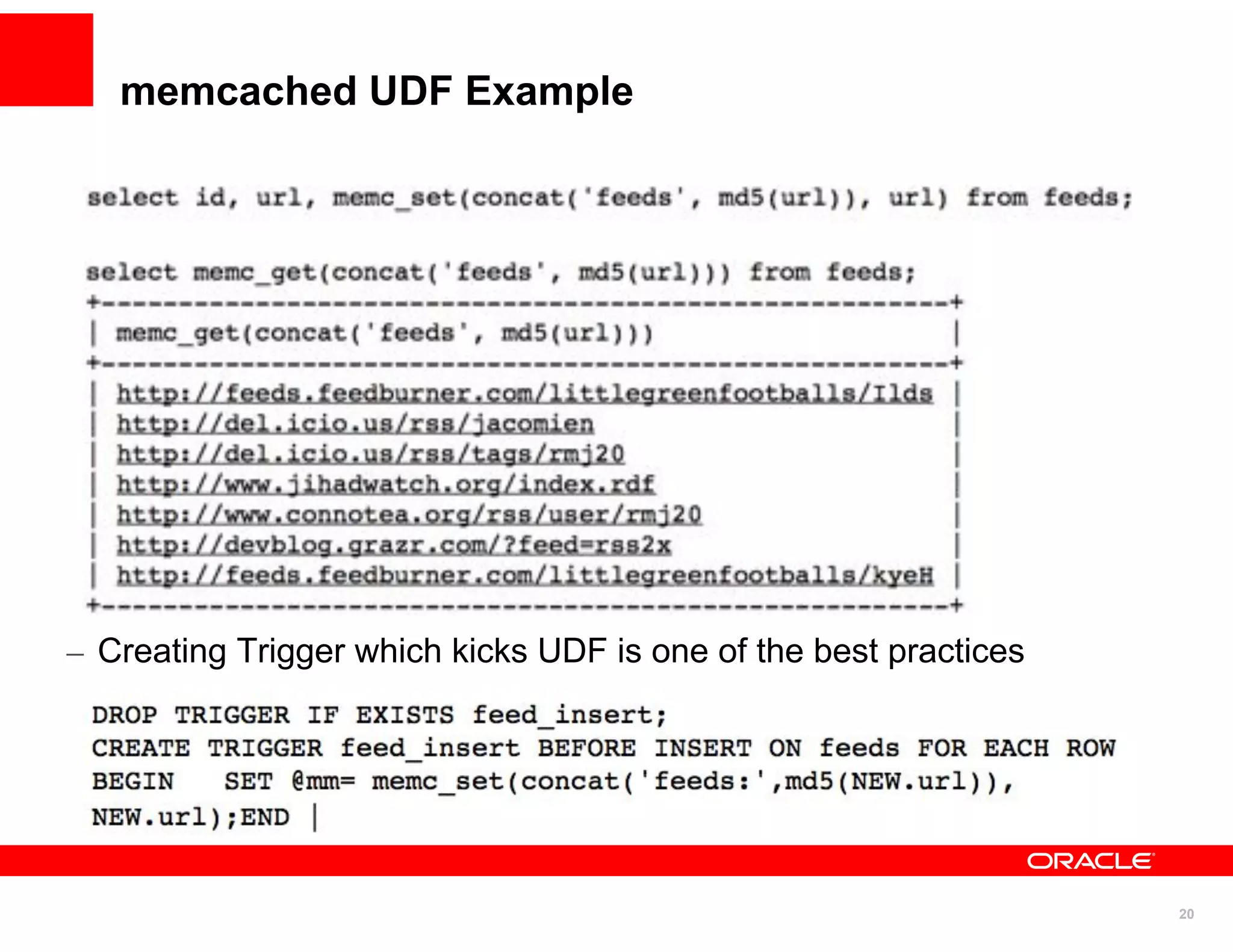
memcached UDF Example


– Creating Trigger which kicks UDF is one of the best practices


                                                                  20
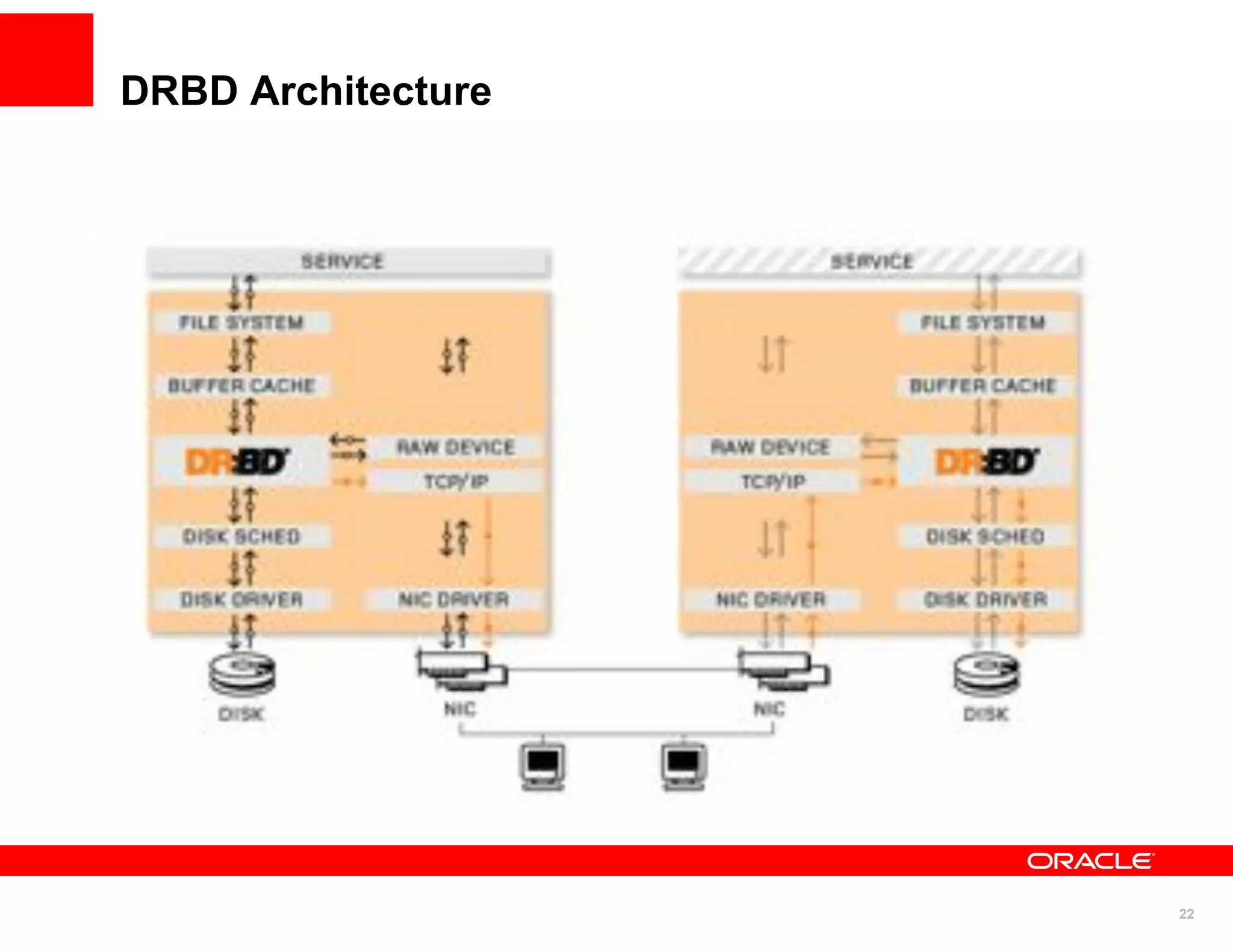
Linux Heartbeat, Block-Replication & MySQL

•    Distributed Replicated Block Device (DRBD)
     – Runs over standard IP networks
     – Distributed storage
     – Similar to network RAID
•    Synchronous
•    Characteristics
     –   Higher complexity to install and configure
     –   No special networking components (except Heartbeat)
     –   Excellent performance (blocks vs. rows of data)
     –   Manages inconsistencies of data during a failure
     –   Hides the complexity of many recovery actions
     –   Linux heartbeat manages fail over and virtual IPs


                                                               21
DRBD Architecture


                    22
MySQL w/ Shared Storage & Clustering Agents


•    Active/Passive likely configuration
     – Multiple instances not allowed concurrent access to same
       data files
•    Automated management
     –   Virtual IPs
     –   Fail over
     –   Data synchronization
     –   Mounting file systems
•    Characteristics
     –   High cost (storage, hardware, software)
     –   Idle resources
     –   Longer fail over times
     –   High initial complexity
     –   Many options and proven vendors

                                                                  23
MySQL Cluster

•    Shared-Nothing Clustering Solution
•    Synchronous (2-phase commit)
•    Fast Automatic Fail Over
•    High Performance
•    High Transactional Throughput
•    No Special Component Requirements
•    In-Memory & Disk Data Support
•    Heart-beat protocol


                                          24
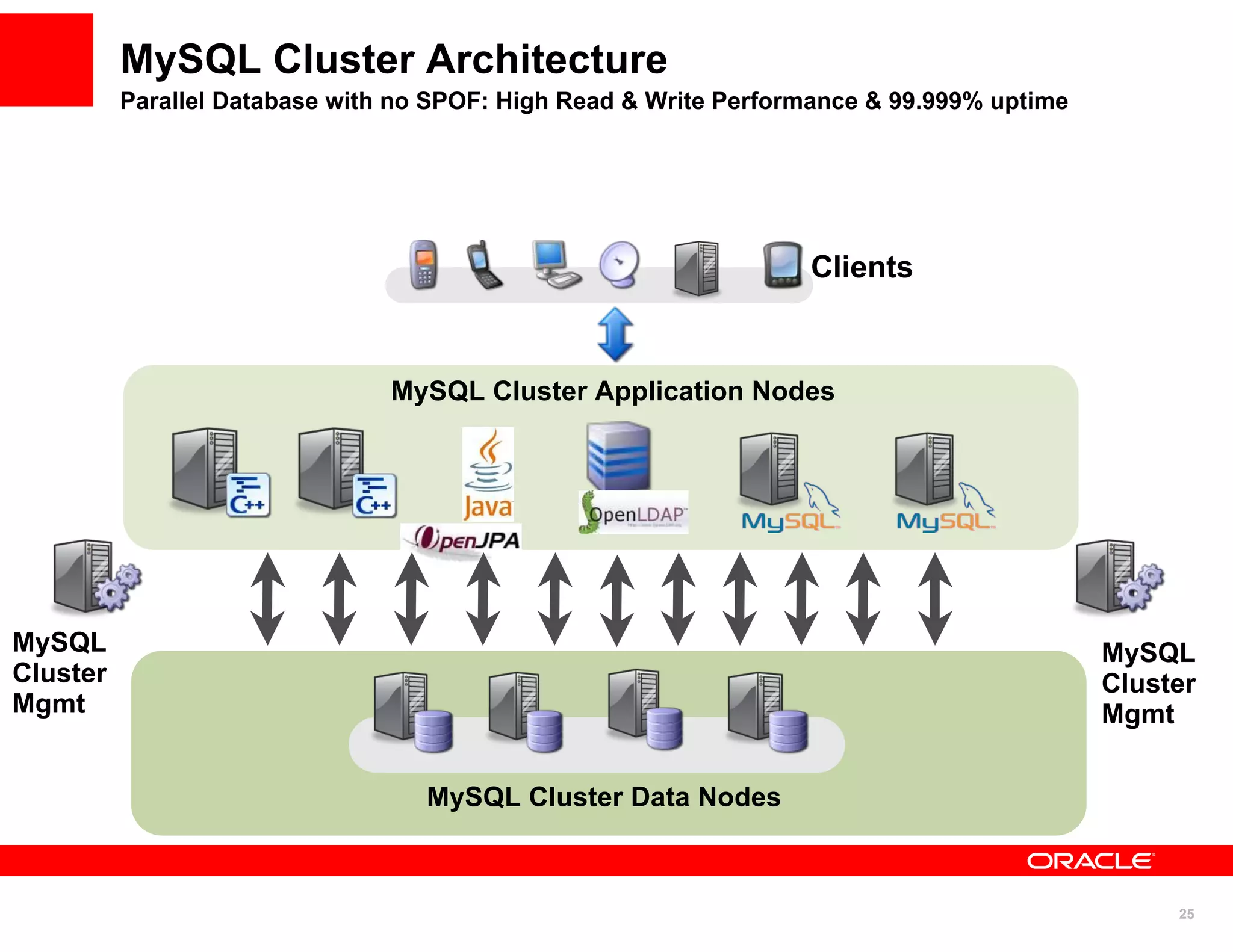
MySQL Cluster Architecture
          Parallel Database with no SPOF: High Read & Write Performance & 99.999% uptime


                                                                  Clients


                                MySQL Cluster Application Nodes


MySQL                                                                                      MySQL
Cluster                                                                                    Cluster
Mgmt                                                                                       Mgmt


                                   MySQL Cluster Data Nodes


                                                                                                25
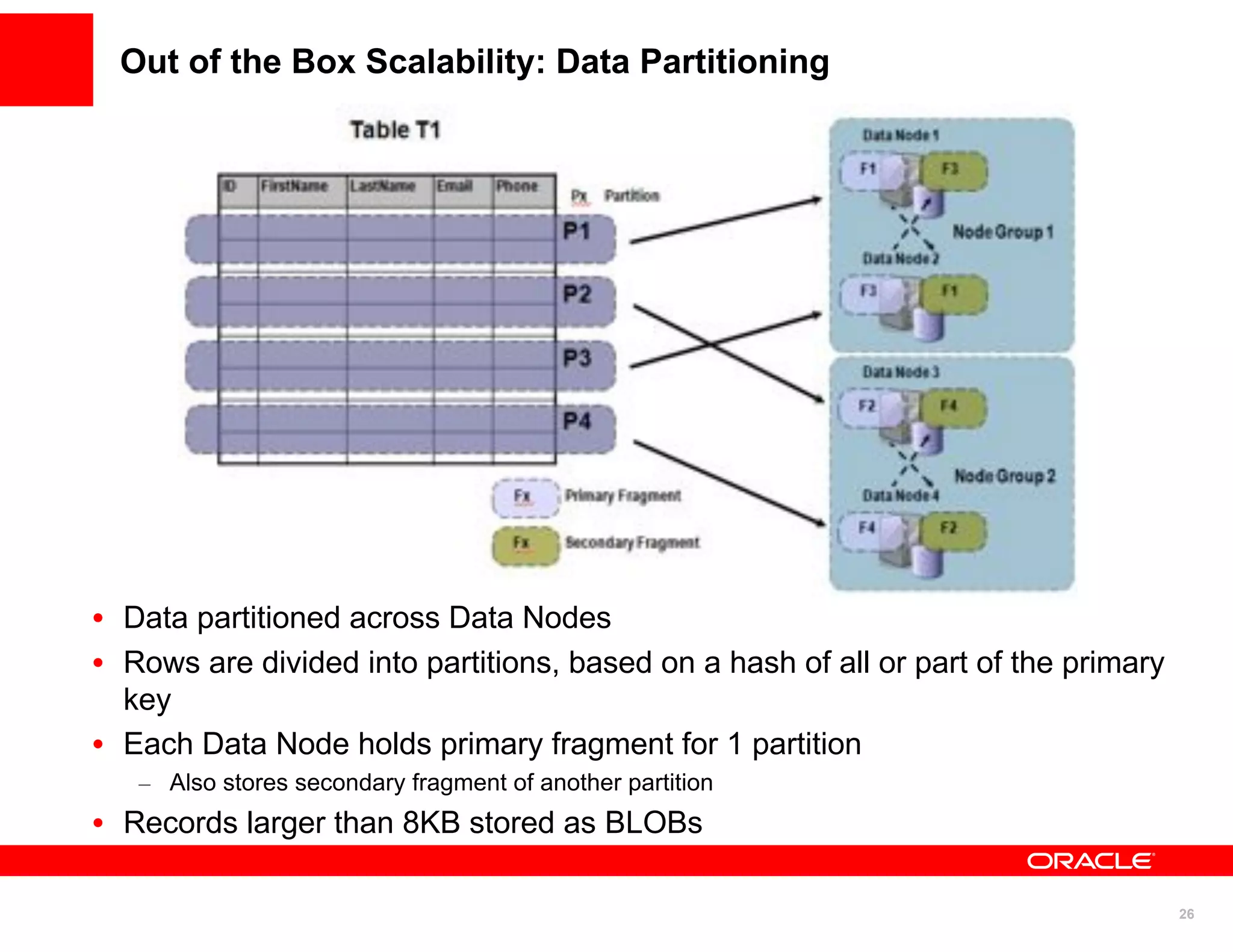
Out of the Box Scalability: Data Partitioning


• Data partitioned across Data Nodes
• Rows are divided into partitions, based on a hash of all or part of the primary
  key
• Each Data Node holds primary fragment for 1 partition
   – Also stores secondary fragment of another partition
• Records larger than 8KB stored as BLOBs

                                                                                    26
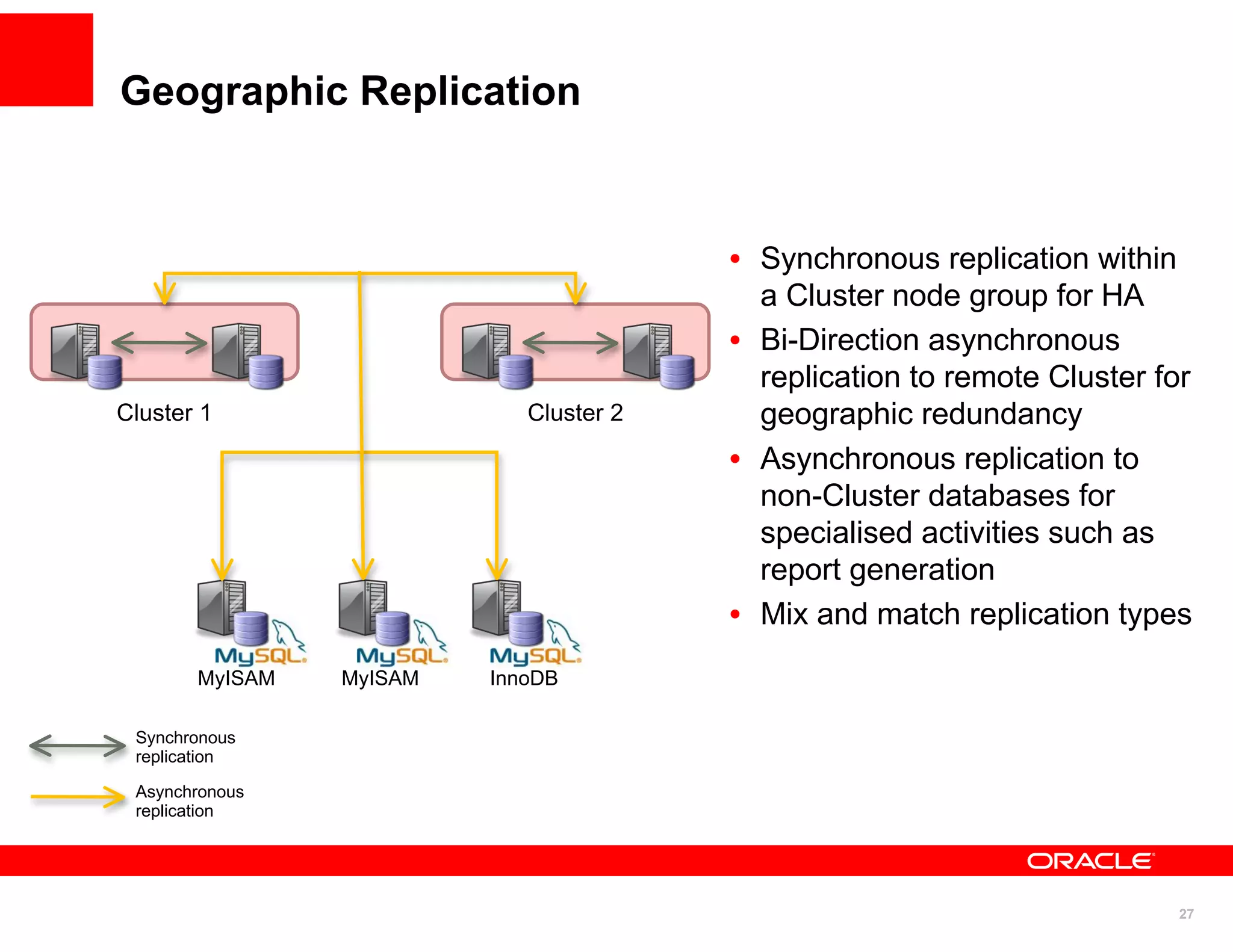
Geographic Replication


                                        • Synchronous replication within
                                          a Cluster node group for HA
                                        • Bi-Direction asynchronous
                                          replication to remote Cluster for
Cluster 1                   Cluster 2     geographic redundancy
                                        • Asynchronous replication to
                                          non-Cluster databases for
                                          specialised activities such as
                                          report generation
                                        • Mix and match replication types
       MyISAM   MyISAM   InnoDB

 Synchronous
 replication

 Asynchronous
 replication


                                                                          27
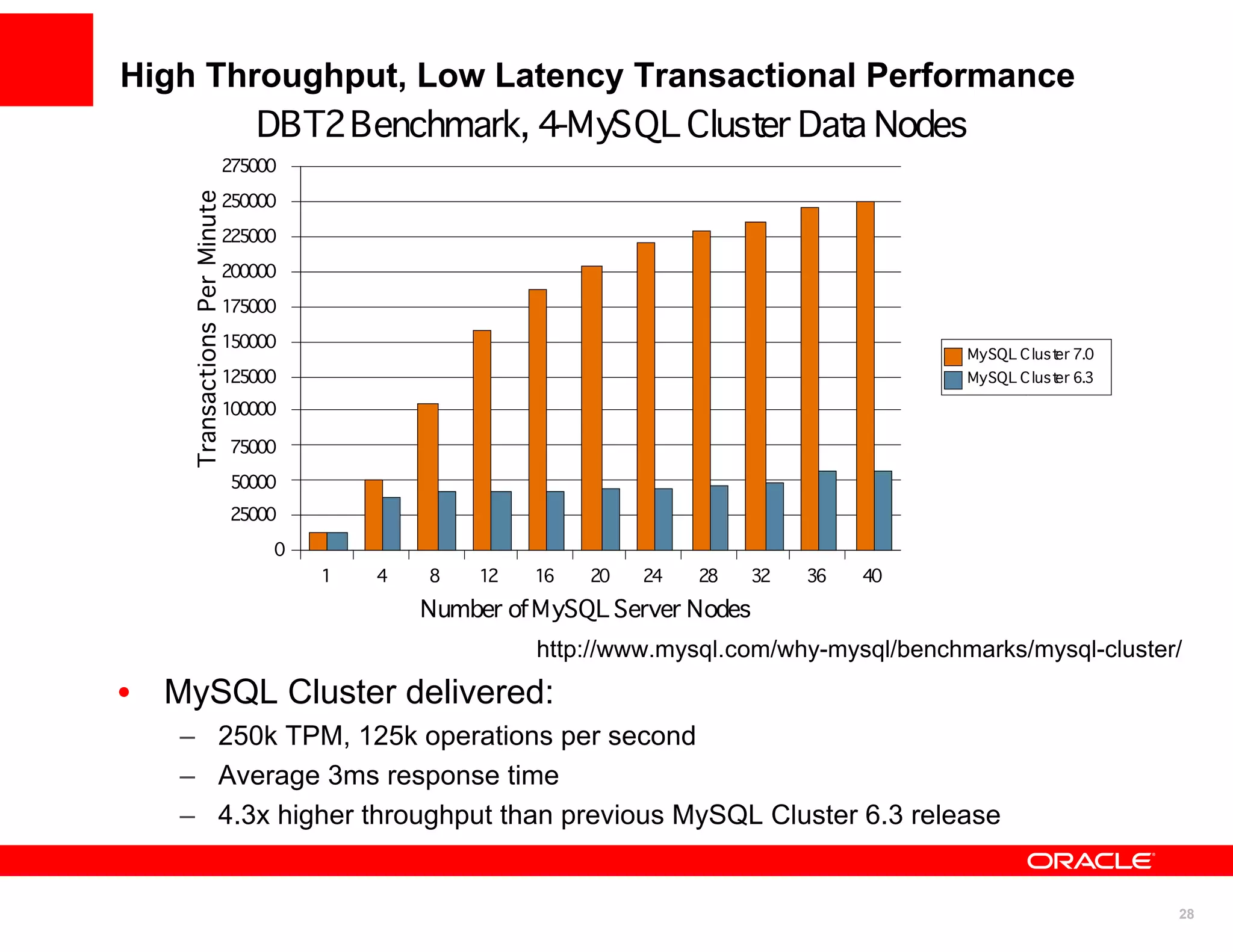
High Throughput, Low Latency Transactional Performance
        DBT2 Benchmark, 4-MySQL Cluster Data Nodes
                              275000

    Transactions Per Minute   250000
                              225000
                              200000
                              175000

                              150000
                                                                                             MySQL C lust 7.0
                                                                                                        er
                              125000                                                         MySQL C lust 6.3
                                                                                                        er

                              100000

                              75000
                              50000
                              25000

                                   0
                                       1   4   8   12   16   20   24   28   32   36   40

                                               Number of MySQL Server Nodes
                                                        http://www.mysql.com/why-mysql/benchmarks/mysql-cluster/
• MySQL Cluster delivered:
   – 250k TPM, 125k operations per second
   – Average 3ms response time
   – 4.3x higher throughput than previous MySQL Cluster 6.3 release


                                                                                                                28
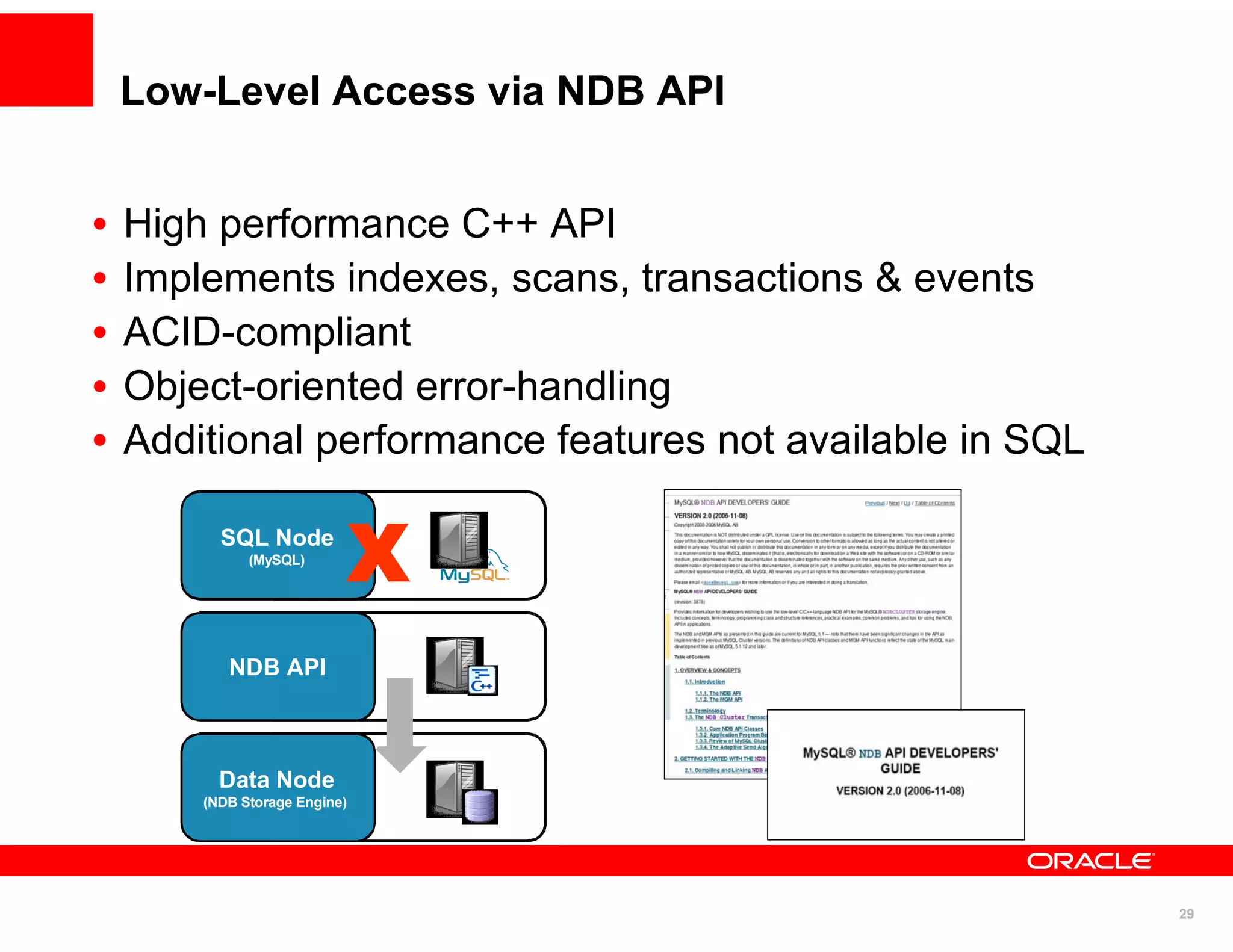
Low-Level Access via NDB API


•   High performance C++ API
•   Implements indexes, scans, transactions & events
•   ACID-compliant
•   Object-oriented error-handling
•   Additional performance features not available in SQL

          SQL Node
              (MySQL)
                               X
           NDB API


          Data Node
        (NDB Storage Engine)


                                                           29
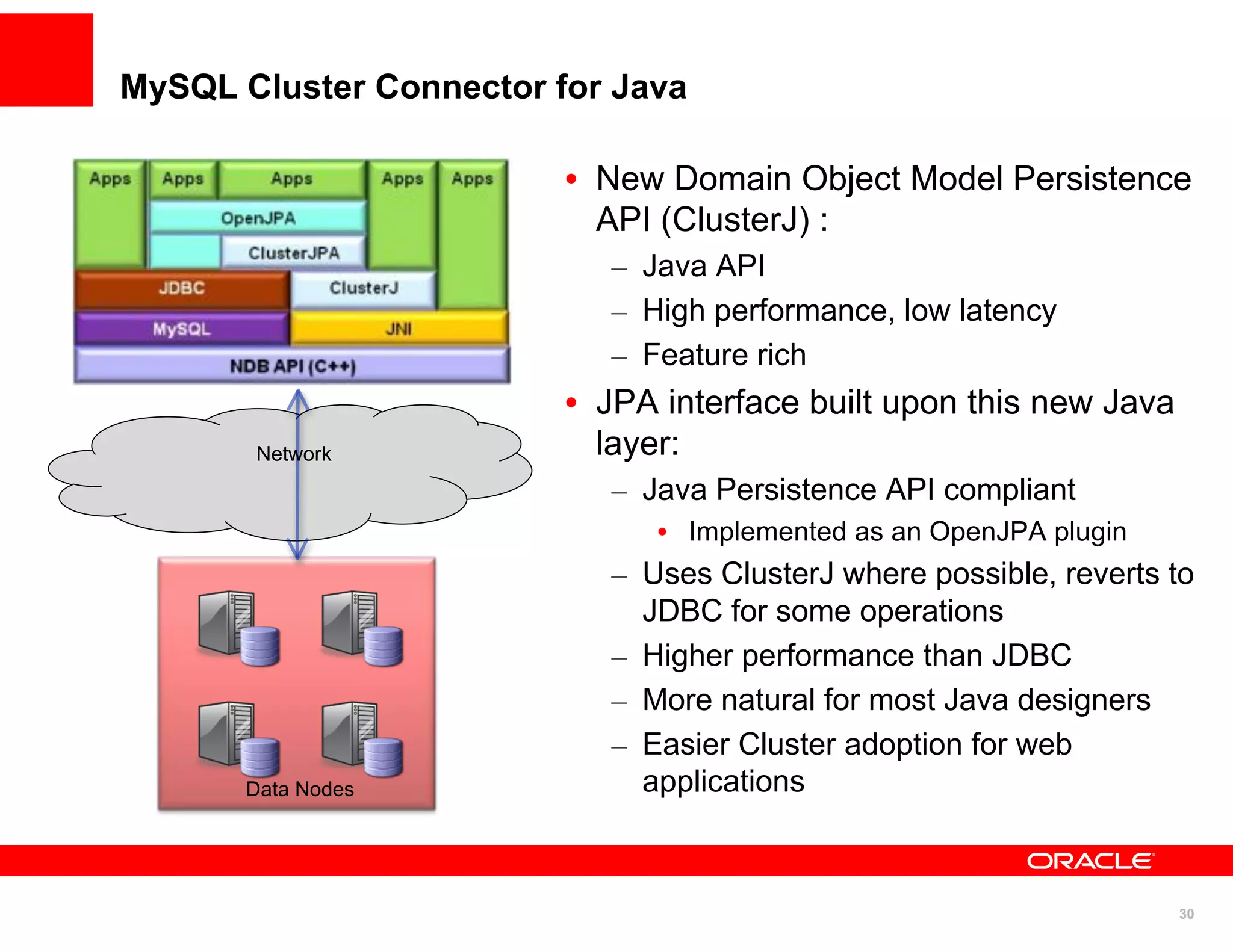
MySQL Cluster Connector for Java

                         • New Domain Object Model Persistence
                           API (ClusterJ) :
                            – Java API
                            – High performance, low latency
                            – Feature rich
                         • JPA interface built upon this new Java
       Network             layer:
                            – Java Persistence API compliant
                               • Implemented as an OpenJPA plugin
                            – Uses ClusterJ where possible, reverts to
                              JDBC for some operations
                            – Higher performance than JDBC
                            – More natural for most Java designers
                            – Easier Cluster adoption for web
       Data Nodes             applications


                                                                    30
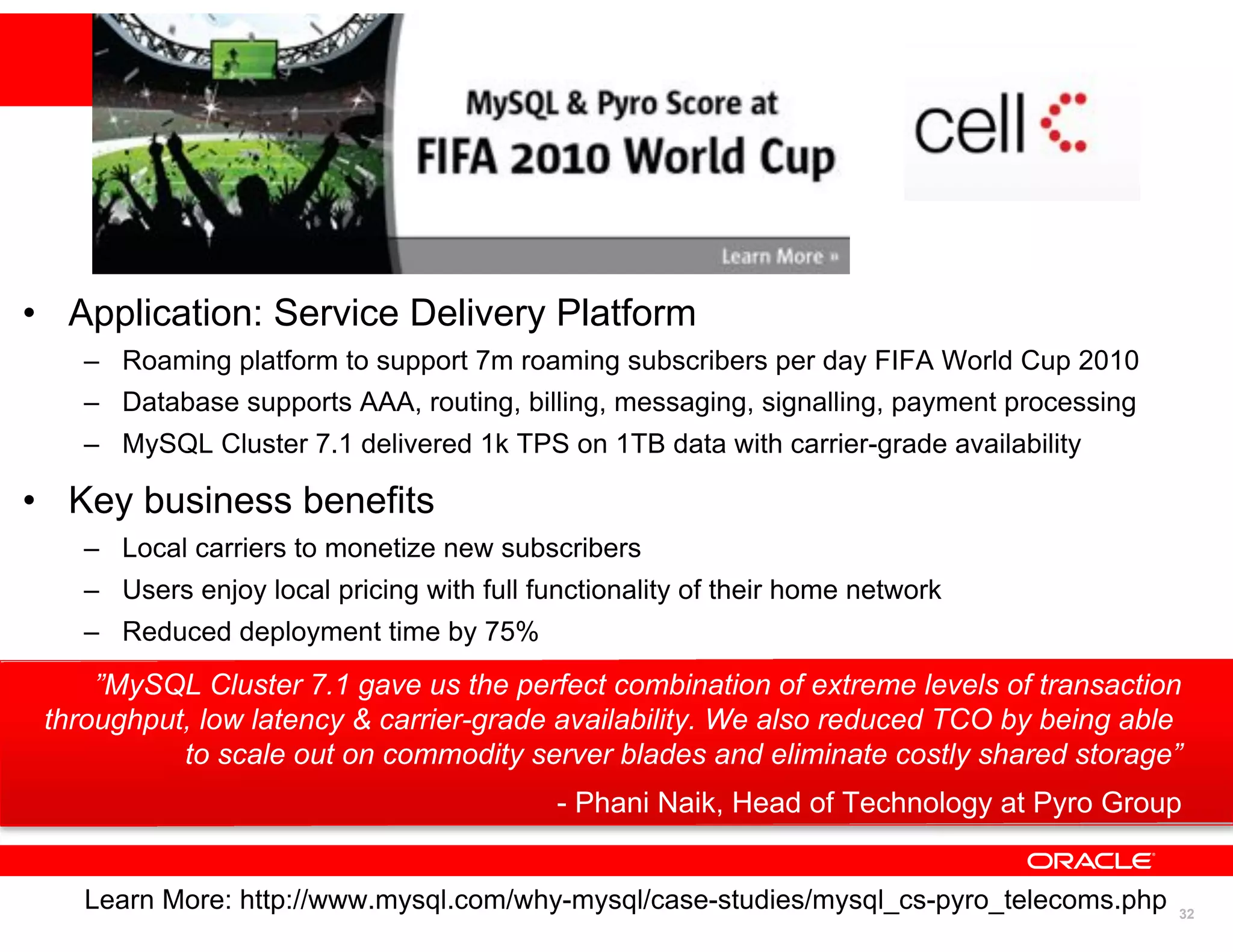
• Application: Service Delivery Platform
    – Roaming platform to support 7m roaming subscribers per day FIFA World Cup 2010
    – Database supports AAA, routing, billing, messaging, signalling, payment processing
    – MySQL Cluster 7.1 delivered 1k TPS on 1TB data with carrier-grade availability

• Key business benefits
    – Local carriers to monetize new subscribers
    – Users enjoy local pricing with full functionality of their home network
    – Reduced deployment time by 75%
     ”MySQL Cluster 7.1 gave us the perfect combination of extreme levels of transaction
 throughput, low latency & carrier-grade availability. We also reduced TCO by being able
           to scale out on commodity server blades and eliminate costly shared storage”
                                            - Phani Naik, Head of Technology at Pyro Group


    Learn More: http://www.mysql.com/why-mysql/case-studies/mysql_cs-pyro_telecoms.php
                                                                                    32
                                                                                           32
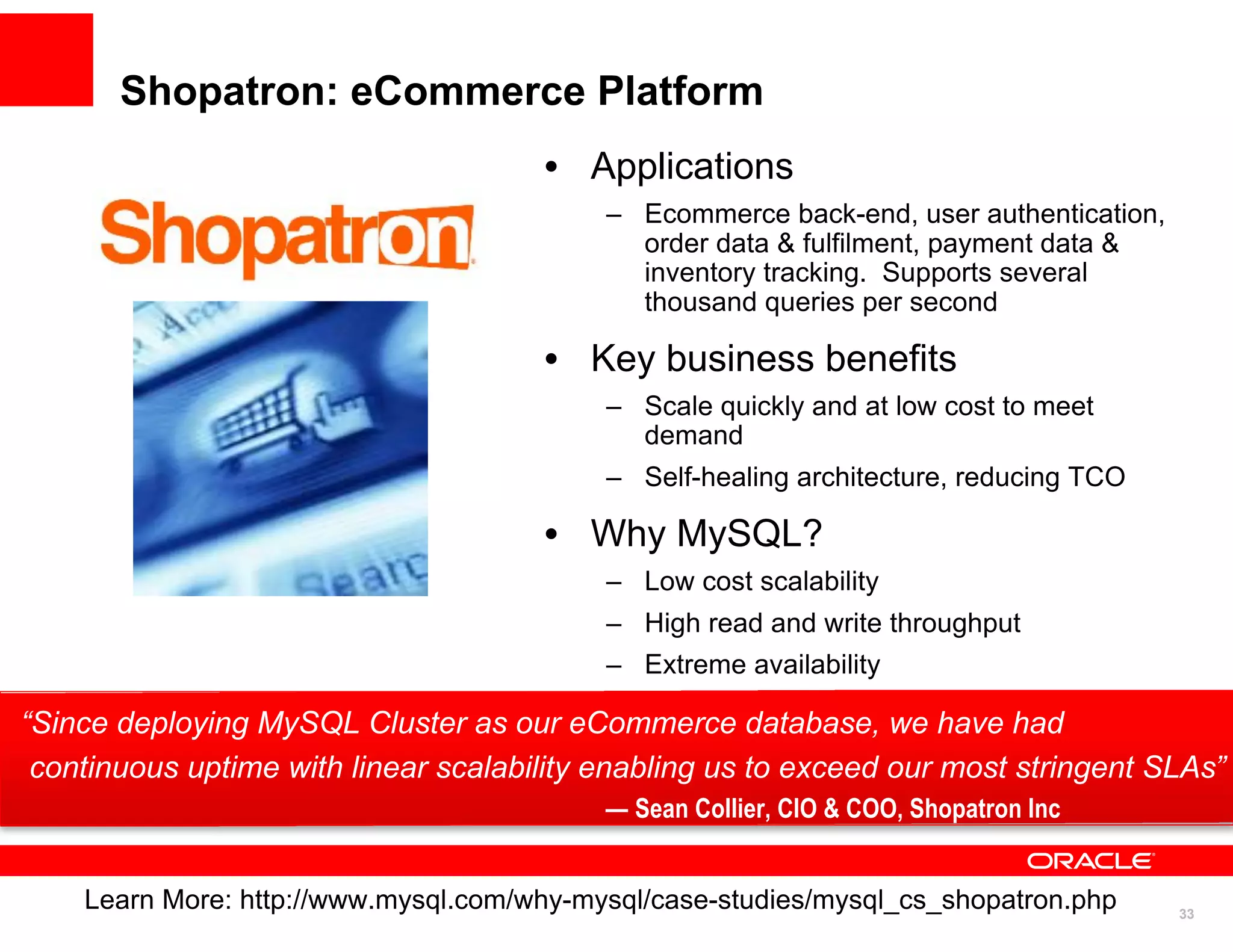
Shopatron: eCommerce Platform
                                      • Applications
                                           – Ecommerce back-end, user authentication,
                                             order data & fulfilment, payment data &
                                             inventory tracking. Supports several
                                             thousand queries per second

                                      • Key business benefits
                                           – Scale quickly and at low cost to meet
                                             demand
                                           – Self-healing architecture, reducing TCO

                                      • Why MySQL?
                                           – Low cost scalability
                                           – High read and write throughput
                                           – Extreme availability

“Since deploying MySQL Cluster as our eCommerce database, we have had
 continuous uptime with linear scalability enabling us to exceed our most stringent SLAs”
                                           — Sean Collier, CIO & COO, Shopatron Inc


    Learn More: http://www.mysql.com/why-mysql/case-studies/mysql_cs_shopatron.php     33
                                                                                            33
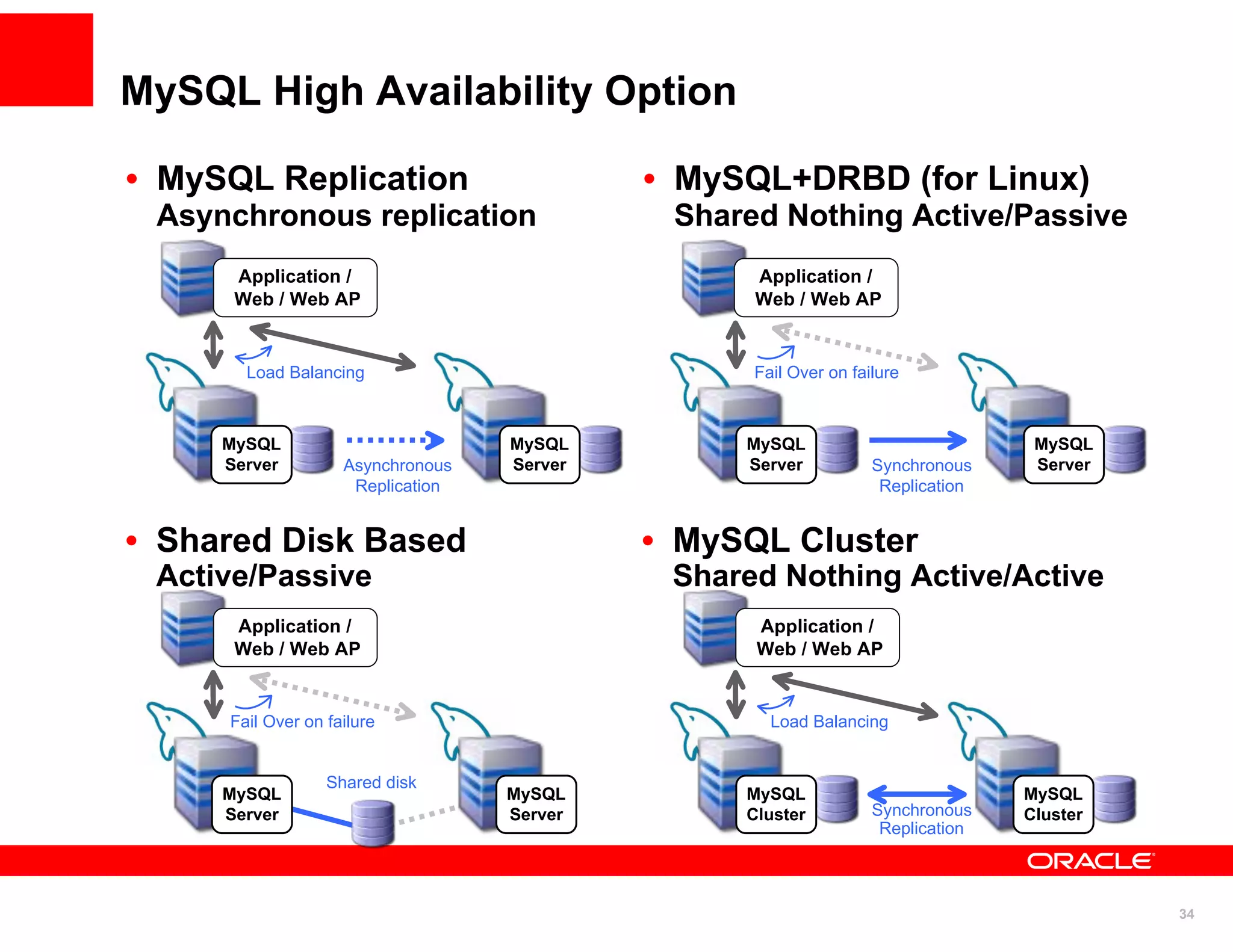
MySQL High Availability Option

• MySQL Replication                         • MySQL+DRBD (for Linux)
 Asynchronous replication                    Shared Nothing Active/Passive
      Application /                               Application /
      Web / Web AP                                Web / Web AP


       Load Balancing                             Fail Over on failure


     MySQL                         MySQL         MySQL                            MySQL
     Server         Asynchronous   Server        Server           Synchronous     Server
                     Replication                                   Replication


• Shared Disk Based                         • MySQL Cluster
 Active/Passive                              Shared Nothing Active/Active
      Application /                               Application /
      Web / Web AP                                Web / Web AP


     Fail Over on failure                           Load Balancing


                  Shared disk
     MySQL                         MySQL         MySQL                           MySQL
     Server                        Server        Cluster          Synchronous    Cluster
                                                                   Replication


                                                                                           34

Seminar : &quot;The Future of MySQL - Roadmap to Success&quot; session MySQL High Availability Options

  • 1.
    <Insert Picture Here> MySQLHigh Availability Options Ryusuke Kajiyama MySQL Principal Sales Consultant, Asia Pacific and Japan
  • 2.
    Designing for HighAvailability Copyright Oracle Corporation 2010 2 2
  • 3.
    Selecting the RightHA Architecture Copyright Oracle Corporation 2010 3 3
  • 4.
    MySQL High AvailabilityOption • MySQL Replication • MySQL+DRBD (for Linux) Asynchronous replication Shared Nothing Active/Passive Application / Application / Web / Web AP Web / Web AP Load Balancing Fail Over on failure MySQL MySQL MySQL MySQL Server Asynchronous Server Server Synchronous Server Replication Replication • Shared Disk Based • MySQL Cluster Active/Passive Shared Nothing Active/Active Application / Application / Web / Web AP Web / Web AP Fail Over on failure Load Balancing Shared disk MySQL MySQL MySQL MySQL Server Server Cluster Synchronous Cluster Replication 4
  • 5.
    Common MySQL HASolutions MySQL Replication is Common Foundation for MySQL HA MySQL & Requirements Replication Cluster DRBD Availability Automatic Fail Over No Yes Yes Fail Over Time Varies < 1 sec < 5 min Resynch of Data No Yes Yes Geographic Redundancy Yes Yes No Scalability Load Balancing Scale-Out Yes No Read Intensive Yes Yes No Write Intensive No Yes No # of Nodes 100’s (reads) 255 1 Active SQL Functionality Primary Key Lookups Yes Yes Yes Simple JOINs Yes Yes Yes Complex JOINs Yes No Yes Transactions Yes Yes Yes Copyright Oracle Corporation 2010 5 5
  • 6.
    MySQL Replication Overview • Native in MySQL • Used for Scalability and HA • Asynchronous as standard • Semi-Synchronous support added in MySQL 5.5 • Each slave adds minimal load on master Copyright Oracle Corporation 2010 6 6
  • 7.
    MySQL Replication Delivering Read Scalability Clients MySQL Replication Slaves Master • Used by leading web properties for scale-out • Reads are directed to slaves, writes to master • Delivers higher performance & scale with efficient resource utilization Copyright Oracle Corporation 2010 7 7
  • 8.
    MySQL Replication Topologies Master > Slave Master > Slaves Masters > Slave (Multi-Source) Master > Slave > Slaves Circular (Multi-Master) Master < > Master (Multi-Master) 8
  • 9.
    Building on Replication Failure Detection & Failover • Linux Heartbeat implements heartbeat protocol between nodes • Failover initiated by Cluster Resource Manager (Pacemaker) if heartbeat message is not received • Virtual IP address failed over to ensure failover is transparent to apps Copyright Oracle Corporation 2010 9 9
  • 10.
    MySQL HA Configuraiton MySQL Replication RedHat Cluster + Shared + IP address failover storage for Master + Slave Application / Application / Web / Web AP Web / Web AP Load Balancing Fail Over on failure Shared disk MySQL MySQL MySQL MySQL Server Asynchronous Server Server Server Replication Master Slave Master Standby (Read + Write) (Read) (Read + Write) Asynchronous Replication MySQL Server Slave (Read) 10
  • 11.
    In case offailure of Master Server MySQL Replication RedHat Cluster + Shared + IP address failover storage for Master + Slave Application / Application / Web / Web AP Web / Web AP Fail Over on failure Fail Over on failure Shared disk MySQL MySQL MySQL MySQL Server Server Server Server New Master Asynchronous New Master (Read + Write) Replication (Read + Write) MySQL Server Slave (Read) 11
  • 12.
    MySQL 5.5 ReplicationFeatures 1. Semisynchronous replication Improved resilience by having master wait for slave to receive events. 2. Slave fsync tuning & Automatic relay log recovery Tune fsyncs so corruption is less likely on slave crashes. Let the slave recover from corrupted relay logs. 3. Replication Heartbeat Have a more precise failure detection mechanism. Avoid spurious relay log rotation when the master is idle. 4. Per server replication filtering Instruct slave to discard events from a master with a specific server id. Copyright Oracle Corporation 2010 12 12
  • 13.
    MySQL 5.5 ReplicationFeatures 5. Precise Slave Type Conversions Use different types on master and slave and get automatic type promotion and demotion when using RBR 6. Individual Log Flushing Selectively flush server logs when using 'FLUSH LOGS' 7. Safe logging of mixed transactions Replicate transactions containing both InnoDB and MyISAM changes Copyright Oracle Corporation 2010 13 13
  • 14.
    Asynchronous Replication Application Commit Response Connection Thread Changing Data Changing Changing Data Binlog Replication Data Binlog Relaylog Data Master Slave 14
  • 15.
    Semi-synchronous Replication Application Commit Response Connection Thread Changing Response Data Changing Changing Data Binlog Replication Data Binlog Relaylog Data Master Slave 15
  • 16.
    What is Memcached? “Ahigh-performance, distributed memory object caching system, generic in nature, but intended for use in speeding up dynamic web applications by alleviating database load” * * http://www.socialtext.net/memcached/index.cgi?faq • Created by Danga Interactive to speed up LiveJournal’s 20 million+ dynamic page views per day for 1 million+ users • Significantly dropped database load, delivering faster page loads, better resource utilization, and faster access to databases • Perfect for dynamic sites that generate high database load • Used by Facebook, YouTube, Wikipedia, others! 16
  • 17.
    Why was Memcachedcreated? • Created to speed up blogging site LiveJournal • 20 million+ dynamic page views per day • 1 million+ users • Results… • Faster page loads • Lowered database load • Better resource utilization • Faster access to databases • Perfect for dynamic sites that generate high database load 17
  • 18.
    Typical Use Case:Read/Pass-Through • Application is modified so data is read from memcached not the database • In the event the data is stale or non-existent… – data is read from the database – written into memcached • Next request for the same data is retrieved from memcached 18
  • 19.
    Memcached Functions forMySQL • Overview – Uses UDF API and libmemcached – Manage memcached Cluster via SQL – Read through Cache – Write through Cache • Installation – CREATE FUNCTION memc_servers_add RETURNS INT SONAME "libmemcached_functions_mysql.so"; 19
  • 20.
    memcached UDF Example –Creating Trigger which kicks UDF is one of the best practices 20
  • 21.
    Linux Heartbeat, Block-Replication& MySQL • Distributed Replicated Block Device (DRBD) – Runs over standard IP networks – Distributed storage – Similar to network RAID • Synchronous • Characteristics – Higher complexity to install and configure – No special networking components (except Heartbeat) – Excellent performance (blocks vs. rows of data) – Manages inconsistencies of data during a failure – Hides the complexity of many recovery actions – Linux heartbeat manages fail over and virtual IPs 21
  • 22.
  • 23.
    MySQL w/ SharedStorage & Clustering Agents • Active/Passive likely configuration – Multiple instances not allowed concurrent access to same data files • Automated management – Virtual IPs – Fail over – Data synchronization – Mounting file systems • Characteristics – High cost (storage, hardware, software) – Idle resources – Longer fail over times – High initial complexity – Many options and proven vendors 23
  • 24.
    MySQL Cluster • Shared-Nothing Clustering Solution • Synchronous (2-phase commit) • Fast Automatic Fail Over • High Performance • High Transactional Throughput • No Special Component Requirements • In-Memory & Disk Data Support • Heart-beat protocol 24
  • 25.
    MySQL Cluster Architecture Parallel Database with no SPOF: High Read & Write Performance & 99.999% uptime Clients MySQL Cluster Application Nodes MySQL MySQL Cluster Cluster Mgmt Mgmt MySQL Cluster Data Nodes 25
  • 26.
    Out of theBox Scalability: Data Partitioning • Data partitioned across Data Nodes • Rows are divided into partitions, based on a hash of all or part of the primary key • Each Data Node holds primary fragment for 1 partition – Also stores secondary fragment of another partition • Records larger than 8KB stored as BLOBs 26
  • 27.
    Geographic Replication • Synchronous replication within a Cluster node group for HA • Bi-Direction asynchronous replication to remote Cluster for Cluster 1 Cluster 2 geographic redundancy • Asynchronous replication to non-Cluster databases for specialised activities such as report generation • Mix and match replication types MyISAM MyISAM InnoDB Synchronous replication Asynchronous replication 27
  • 28.
    High Throughput, LowLatency Transactional Performance DBT2 Benchmark, 4-MySQL Cluster Data Nodes 275000 Transactions Per Minute 250000 225000 200000 175000 150000 MySQL C lust 7.0 er 125000 MySQL C lust 6.3 er 100000 75000 50000 25000 0 1 4 8 12 16 20 24 28 32 36 40 Number of MySQL Server Nodes http://www.mysql.com/why-mysql/benchmarks/mysql-cluster/ • MySQL Cluster delivered: – 250k TPM, 125k operations per second – Average 3ms response time – 4.3x higher throughput than previous MySQL Cluster 6.3 release 28
  • 29.
    Low-Level Access viaNDB API • High performance C++ API • Implements indexes, scans, transactions & events • ACID-compliant • Object-oriented error-handling • Additional performance features not available in SQL SQL Node (MySQL) X NDB API Data Node (NDB Storage Engine) 29
  • 30.
    MySQL Cluster Connectorfor Java • New Domain Object Model Persistence API (ClusterJ) : – Java API – High performance, low latency – Feature rich • JPA interface built upon this new Java Network layer: – Java Persistence API compliant • Implemented as an OpenJPA plugin – Uses ClusterJ where possible, reverts to JDBC for some operations – Higher performance than JDBC – More natural for most Java designers – Easier Cluster adoption for web Data Nodes applications 30
  • 31.
    • Application: ServiceDelivery Platform – Roaming platform to support 7m roaming subscribers per day FIFA World Cup 2010 – Database supports AAA, routing, billing, messaging, signalling, payment processing – MySQL Cluster 7.1 delivered 1k TPS on 1TB data with carrier-grade availability • Key business benefits – Local carriers to monetize new subscribers – Users enjoy local pricing with full functionality of their home network – Reduced deployment time by 75% ”MySQL Cluster 7.1 gave us the perfect combination of extreme levels of transaction throughput, low latency & carrier-grade availability. We also reduced TCO by being able to scale out on commodity server blades and eliminate costly shared storage” - Phani Naik, Head of Technology at Pyro Group Learn More: http://www.mysql.com/why-mysql/case-studies/mysql_cs-pyro_telecoms.php 32 32
  • 32.
    Shopatron: eCommerce Platform • Applications – Ecommerce back-end, user authentication, order data & fulfilment, payment data & inventory tracking. Supports several thousand queries per second • Key business benefits – Scale quickly and at low cost to meet demand – Self-healing architecture, reducing TCO • Why MySQL? – Low cost scalability – High read and write throughput – Extreme availability “Since deploying MySQL Cluster as our eCommerce database, we have had continuous uptime with linear scalability enabling us to exceed our most stringent SLAs” — Sean Collier, CIO & COO, Shopatron Inc Learn More: http://www.mysql.com/why-mysql/case-studies/mysql_cs_shopatron.php 33 33
  • 33.
    MySQL High AvailabilityOption • MySQL Replication • MySQL+DRBD (for Linux) Asynchronous replication Shared Nothing Active/Passive Application / Application / Web / Web AP Web / Web AP Load Balancing Fail Over on failure MySQL MySQL MySQL MySQL Server Asynchronous Server Server Synchronous Server Replication Replication • Shared Disk Based • MySQL Cluster Active/Passive Shared Nothing Active/Active Application / Application / Web / Web AP Web / Web AP Fail Over on failure Load Balancing Shared disk MySQL MySQL MySQL MySQL Server Server Cluster Synchronous Cluster Replication 34