
High Availability Solutions for
           MySQL


Lenz Grimmer
<lenz@grimmer.com>
2008-08-29
DrupalCon 2008, Szeged, Hungary
Agenda
●   High Availability in General
●   MySQL Replication
●   MySQL Cluster
●   DRBD
●   Links/Tools
Why High Availability Matters
●   Downtime is expensive
●   You miss $$$
●   Your Boss complains
●   New Site visitors won't come back
What Is HA Clustering?

●   One service goes down → others take
    over its work
●   IP address takeover, service takeover
●   Not designed for high-performance
●   Not designed for high troughput (load
    balancing)
Split-Brain
●   Communications failures can lead to
    separated partitions of the cluster
●   If those partitions each try and take
    control of the cluster, then it's called a
    split-brain condition
●   If this happens, then bad things will
    happen
    http://linux-ha.org/BadThingsWillHappen
●   Use Fencing or Moderatation/Arbitration to
    avoid it
Eliminating the SPOF
●   Identify what will fail
    ●   Disks
●   Find out what can fail
    ●   Network cables
    ●   OOM
    ●   Power supplies
Rules of High Availability
●   Prepare for failure
●   Keep it simple, stupid (KISS)
●   Complexity is the enemy of reliability
●   Test your setup frequently
MySQL Replication
●   One-way, statement-based
●   One Master, many Slaves
●   Asynchronous – Slaves can lag
●   Master maintains binary logs & index
●   Easy to set up
●   Built into MySQL
●   Replication is single-threaded
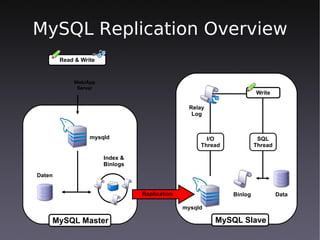
MySQL Replication Overview
        Read & Write


            Web/App
             Server
                                                                      Write

                                                 Relay
                                                  Log


                  mysqld                              I/O              SQL
                                                    Thread            Thread

                       Index &
                       Binlogs
Daten


                                 Replication                 Binlog            Data

                                               mysqld

    MySQL Master                                         MySQL Slave
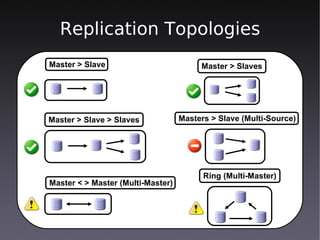
Replication Topologies
Master > Slave                          Master > Slaves


Master > Slave > Slaves            Masters > Slave (Multi-Source)


                                         Ring (Multi-Master)
Master < > Master (Multi-Master)
Replication & HA
●   Combined with Heartbeat
●   Virtual IP takeover
●   Slave gets promoted to Master
●   Side benefits: load balancing & backup
●   Tricky to fail back
●   No automatic conflict resolution
●   Proper failover needs to be scripted
Master-Master Replication
●   Useful for easier failover
●   Not suitable for load-balancing
    ●   Writes still end up on both machines
    ●   Neither machine has the authorative data
●   Don't write to both masters!
●   Use Sharding or Partitioning instead
    (e.g. MySQL Proxy)
MySQL Cluster

●   Shared nothing
●   Automatic partitioning
●   Distributed Fragments
●   Synchronous replication
●   Fast automatic fail-over of data nodes
●   Automatic resynchronization
●   Transparent to Application
●   Supports Transactions
MySQL Cluster
●   In-memory tables
●   Not suitable for all query patterns
●   Not suitable for large datasets
●   Latency matters
●   Can be combined with MySQL
    Replication
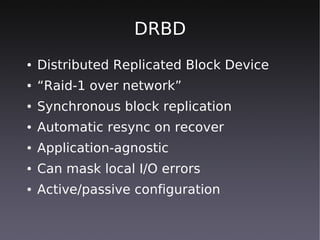
DRBD
●   Distributed Replicated Block Device
●   “Raid-1 over network”
●   Synchronous block replication
●   Automatic resync on recover
●   Application-agnostic
●   Can mask local I/O errors
●   Active/passive configuration
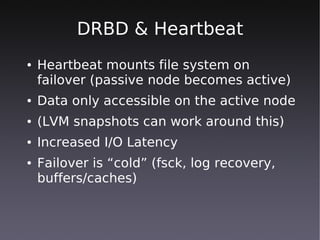
DRBD & Heartbeat
●   Heartbeat mounts file system on
    failover (passive node becomes active)
●   Data only accessible on the active node
●   (LVM snapshots can work around this)
●   Increased I/O Latency
●   Failover is “cold” (fsck, log recovery,
    buffers/caches)
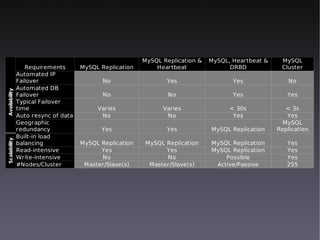
MySQL Replication &   MySQL, Heartbeat &    MySQL
                  Requirements       MySQL Replication       Heartbeat               DRBD            Cluster
               Automated IP
               Failover                     No                  Yes                   Yes               No
               Automated DB
Availability


               Failover                     No                   No                   Yes              Yes
               Typical Failover
               time                       Varies               Varies                < 30s             < 3s
               Auto resync of data         No                   No                    Yes              Yes
               Geographic                                                                             MySQL
               redundancy                  Yes                  Yes            MySQL Replication    Replication
               Built-in load
Scalability


               balancing             MySQL Replication   MySQL Replication     MySQL Replication       Yes
               Read-intensive              Yes                 Yes             MySQL Replication       Yes
               Write-intensive             No                  No                  Possible            Yes
               #Nodes/Cluster         Master/Slave(s)     Master/Slave(s)       Active/Passive         255
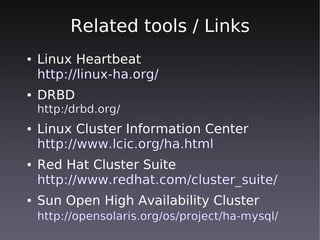
Related tools / Links
●   Linux Heartbeat
    http://linux-ha.org/
●   DRBD
    http:/drbd.org/
●   Linux Cluster Information Center
    http://www.lcic.org/ha.html
●   Red Hat Cluster Suite
    http://www.redhat.com/cluster_suite/
●   Sun Open High Availability Cluster
    http://opensolaris.org/os/project/ha-mysql/
Tools/Links
●   MySQL Multi-Master Replication
    Manager
    http://code.google.com/p/mysql-master-master/
●   Maatkit
    http://maatkit.sourceforge.net/
●   Mon – scheduler and alert management
    http://www.kernel.org/software/mon/
●   Continuent Tungsten Replicator
    https://community.continuent.com/community/tungsten-replicator
Q&A


Questions, Comments?
Thank you!
Lenz Grimmer <lenz@grimmer.com>

Drupal Con My Sql Ha 2008 08 29

  • 1.
    High Availability Solutionsfor MySQL Lenz Grimmer <lenz@grimmer.com> 2008-08-29 DrupalCon 2008, Szeged, Hungary
  • 2.
    Agenda ● High Availability in General ● MySQL Replication ● MySQL Cluster ● DRBD ● Links/Tools
  • 3.
    Why High AvailabilityMatters ● Downtime is expensive ● You miss $$$ ● Your Boss complains ● New Site visitors won't come back
  • 4.
    What Is HAClustering? ● One service goes down → others take over its work ● IP address takeover, service takeover ● Not designed for high-performance ● Not designed for high troughput (load balancing)
  • 5.
    Split-Brain ● Communications failures can lead to separated partitions of the cluster ● If those partitions each try and take control of the cluster, then it's called a split-brain condition ● If this happens, then bad things will happen http://linux-ha.org/BadThingsWillHappen ● Use Fencing or Moderatation/Arbitration to avoid it
  • 6.
    Eliminating the SPOF ● Identify what will fail ● Disks ● Find out what can fail ● Network cables ● OOM ● Power supplies
  • 7.
    Rules of HighAvailability ● Prepare for failure ● Keep it simple, stupid (KISS) ● Complexity is the enemy of reliability ● Test your setup frequently
  • 8.
    MySQL Replication ● One-way, statement-based ● One Master, many Slaves ● Asynchronous – Slaves can lag ● Master maintains binary logs & index ● Easy to set up ● Built into MySQL ● Replication is single-threaded
  • 9.
    MySQL Replication Overview Read & Write Web/App Server Write Relay Log mysqld I/O SQL Thread Thread Index & Binlogs Daten Replication Binlog Data mysqld MySQL Master MySQL Slave
  • 10.
    Replication Topologies Master >Slave Master > Slaves Master > Slave > Slaves Masters > Slave (Multi-Source) Ring (Multi-Master) Master < > Master (Multi-Master)
  • 11.
    Replication & HA ● Combined with Heartbeat ● Virtual IP takeover ● Slave gets promoted to Master ● Side benefits: load balancing & backup ● Tricky to fail back ● No automatic conflict resolution ● Proper failover needs to be scripted
  • 12.
    Master-Master Replication ● Useful for easier failover ● Not suitable for load-balancing ● Writes still end up on both machines ● Neither machine has the authorative data ● Don't write to both masters! ● Use Sharding or Partitioning instead (e.g. MySQL Proxy)
  • 13.
    MySQL Cluster ● Shared nothing ● Automatic partitioning ● Distributed Fragments ● Synchronous replication ● Fast automatic fail-over of data nodes ● Automatic resynchronization ● Transparent to Application ● Supports Transactions
  • 14.
    MySQL Cluster ● In-memory tables ● Not suitable for all query patterns ● Not suitable for large datasets ● Latency matters ● Can be combined with MySQL Replication
  • 16.
    DRBD ● Distributed Replicated Block Device ● “Raid-1 over network” ● Synchronous block replication ● Automatic resync on recover ● Application-agnostic ● Can mask local I/O errors ● Active/passive configuration
  • 17.
    DRBD & Heartbeat ● Heartbeat mounts file system on failover (passive node becomes active) ● Data only accessible on the active node ● (LVM snapshots can work around this) ● Increased I/O Latency ● Failover is “cold” (fsck, log recovery, buffers/caches)
  • 18.
    MySQL Replication & MySQL, Heartbeat & MySQL Requirements MySQL Replication Heartbeat DRBD Cluster Automated IP Failover No Yes Yes No Automated DB Availability Failover No No Yes Yes Typical Failover time Varies Varies < 30s < 3s Auto resync of data No No Yes Yes Geographic MySQL redundancy Yes Yes MySQL Replication Replication Built-in load Scalability balancing MySQL Replication MySQL Replication MySQL Replication Yes Read-intensive Yes Yes MySQL Replication Yes Write-intensive No No Possible Yes #Nodes/Cluster Master/Slave(s) Master/Slave(s) Active/Passive 255
  • 19.
    Related tools /Links ● Linux Heartbeat http://linux-ha.org/ ● DRBD http:/drbd.org/ ● Linux Cluster Information Center http://www.lcic.org/ha.html ● Red Hat Cluster Suite http://www.redhat.com/cluster_suite/ ● Sun Open High Availability Cluster http://opensolaris.org/os/project/ha-mysql/
  • 20.
    Tools/Links ● MySQL Multi-Master Replication Manager http://code.google.com/p/mysql-master-master/ ● Maatkit http://maatkit.sourceforge.net/ ● Mon – scheduler and alert management http://www.kernel.org/software/mon/ ● Continuent Tungsten Replicator https://community.continuent.com/community/tungsten-replicator
  • 21.
  • 22.
    Thank you! Lenz Grimmer<lenz@grimmer.com>