SUSHANT LABHASETWAR
MIEAust, CPEng
PROCESS ENGINEER
Contents
1. What do I offer to clients and employers
2. The role I play in Industry
3. Skills and Competencies
4. Samples of Problems Solved
5. Simulation Tools
6. Career Goal
Sushant Labhasetwar 2
What do I offer to clients and employers?
1. 10 years of core process design experience in diverse fields of chemical process industry
2. Help create business opportunities
3. Technical expertise to provide solutions to engineering problems
4. Skills and Competencies
5. In-depth understanding of EPCM business
6. Knowledge of codes and standards
7. Value to workplace
Sushant Labhasetwar 3
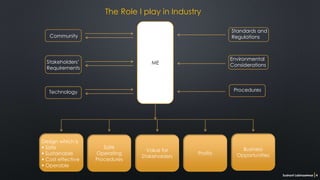
The Role I play in Industry
Community
Standards and
Regulations
Stakeholders’
Requirements
Procedures
Environmental
Considerations
Technology
ME
Safe
Operating
Procedures
Business
Opportunities
Value for
Stakeholders
Profits
Design which is
 Safe
 Sustainable
 Cost effective
 Operable
Sushant Labhasetwar 4
Onshore and offshore MMO contracts
Selection and Sizing of Equipments
Technical Evaluation and Study Reports
Compliance with international standards and regulations
such as API, ASME, NFPA, GPSA and Shell
Simulation Tools – HYSYS (steady state and dynamics),
HTRI, Aspen Flare Analyzer, PHAST
Vendor Technical Evaluation
HAZOP participation and close outs
Hazardous area classification
Compliance with Company's Quality Improvement
Programs
Multi-discipline coordination
Assistance in Procurement and Pre-commissioning
Activities
Preparation of Proposals
Operating Manual Preparation
Process Design and Development for Concept Stage, FEED,
Detail Engineering, EPCM Projects
Material and Energy Balance Calculations
Development of Process Flow Diagrams (PFD)
Piping and Instrumentation Diagrams (P&ID)
Process Design of Centrifugal and Positive Displacement Pumps
2-phase, 3-phase separator sizing based on GPSA standards
Process Design of Heat Exchangers by HTRI
Relief valves calculations and specification sheets
API tank sizing
Utility system design for cooling water, chilled water, instrument
air, plant air, steam systems, condensate collection, raw water,
filtered water, Demineralized water
Preparation of Instrument Data Sheets e.g. Control Valves
Preparation of Control Logic Philosophy
Interlock Schedule and SAFE charts based on API-14C
Preparation of Enquiry Specification for produced water system,
water treatment plant (WTP) & technical bid evaluation
Hazardous area classification
Preparation of conceptual plot plan and equipment layout
•
•
•
•
•
•
•
•
•
•
•
•
•
-
-
-
-
-
-
-
-
-
-
-
-
-
-
-
•
Sushant Labhasetwar 5
Skills and Competencies
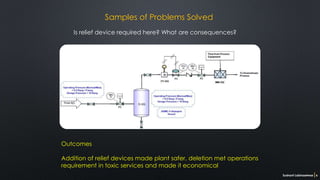
Is relief device required here? What are consequences?
Sushant Labhasetwar 6
Outcomes
Addition of relief devices made plant safer, deletion met operations
requirement in toxic services and made it economical
Samples of Problems Solved
Sushant Labhasetwar 7
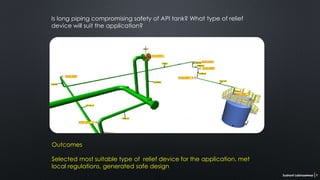
Is long piping compromising safety of API tank? What type of relief
device will suit the application?
Outcomes
Selected most suitable type of relief device for the application, met
local regulations, generated safe design
Sushant Labhasetwar 8
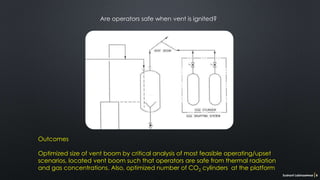
Are operators safe when vent is ignited?
Outcomes
Optimized size of vent boom by critical analysis of most feasible operating/upset
scenarios, located vent boom such that operators are safe from thermal radiation
and gas concentrations. Also, optimized number of CO2 cylinders at the platform
Sushant Labhasetwar 9
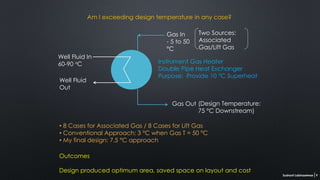
Gas In
- 5 to 50
°C
Gas Out
Well Fluid In
60-90 °C
Well Fluid
Out
Two Sources:
Associated
Gas/Lift Gas
(Design Temperature:
75 °C Downstream)
Am I exceeding design temperature in any case?
Outcomes
Design produced optimum area, saved space on layout and cost
• 8 Cases for Associated Gas / 8 Cases for Lift Gas
• Conventional Approach: 3 °C when Gas T = 50 °C
• My final design: 7.5 °C approach
Instrument Gas Heater
Double Pipe Heat Exchanger
Purpose: Provide 10 °C Superheat
Sushant Labhasetwar 10
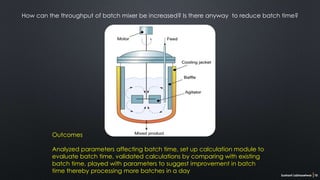
How can the throughput of batch mixer be increased? Is there anyway to reduce batch time?
Outcomes
Analyzed parameters affecting batch time, set up calculation module to
evaluate batch time, validated calculations by comparing with existing
batch time, played with parameters to suggest improvement in batch
time thereby processing more batches in a day
Sushant Labhasetwar 11
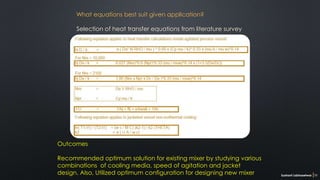
What equations best suit given application?
Selection of heat transfer equations from literature survey
Outcomes
Recommended optimum solution for existing mixer by studying various
combinations of cooling media, speed of agitation and jacket
design. Also, Utilized optimum configuration for designing new mixer
Sushant Labhasetwar 12
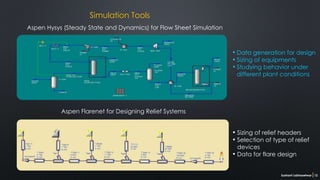
Aspen Hysys (Steady State and Dynamics) for Flow Sheet Simulation
Aspen Flarenet for Designing Relief Systems
Simulation Tools
Data generation for design
Sizing of equipments
Studying behavior under
different plant conditions
•
•
•
Sizing of relief headers
Selection of type of relief
devices
Data for flare design
•
•
•
Sushant Labhasetwar 13
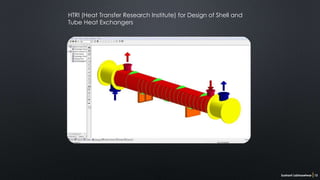
HTRI (Heat Transfer Research Institute) for Design of Shell and
Tube Heat Exchangers
Sushant Labhasetwar 14
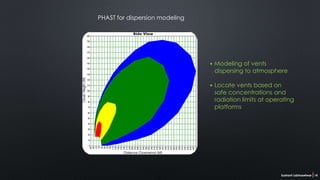
PHAST for dispersion modeling
Modeling of vents
dispersing to atmosphere
Locate vents based on
safe concentrations and
radiation limits at operating
platforms
•
•
Sushant Labhasetwar 15
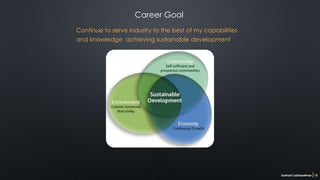
Career Goal
Continue to serve industry to the best of my capabilities
and knowledge achieving sustainable development
THANK YOU
Sushant Labhasetwar 16

My Role In Industry as Process Engineer

  • 1.
  • 2.
    Contents 1. What doI offer to clients and employers 2. The role I play in Industry 3. Skills and Competencies 4. Samples of Problems Solved 5. Simulation Tools 6. Career Goal Sushant Labhasetwar 2
  • 3.
    What do Ioffer to clients and employers? 1. 10 years of core process design experience in diverse fields of chemical process industry 2. Help create business opportunities 3. Technical expertise to provide solutions to engineering problems 4. Skills and Competencies 5. In-depth understanding of EPCM business 6. Knowledge of codes and standards 7. Value to workplace Sushant Labhasetwar 3
  • 4.
    The Role Iplay in Industry Community Standards and Regulations Stakeholders’ Requirements Procedures Environmental Considerations Technology ME Safe Operating Procedures Business Opportunities Value for Stakeholders Profits Design which is  Safe  Sustainable  Cost effective  Operable Sushant Labhasetwar 4
  • 5.
    Onshore and offshoreMMO contracts Selection and Sizing of Equipments Technical Evaluation and Study Reports Compliance with international standards and regulations such as API, ASME, NFPA, GPSA and Shell Simulation Tools – HYSYS (steady state and dynamics), HTRI, Aspen Flare Analyzer, PHAST Vendor Technical Evaluation HAZOP participation and close outs Hazardous area classification Compliance with Company's Quality Improvement Programs Multi-discipline coordination Assistance in Procurement and Pre-commissioning Activities Preparation of Proposals Operating Manual Preparation Process Design and Development for Concept Stage, FEED, Detail Engineering, EPCM Projects Material and Energy Balance Calculations Development of Process Flow Diagrams (PFD) Piping and Instrumentation Diagrams (P&ID) Process Design of Centrifugal and Positive Displacement Pumps 2-phase, 3-phase separator sizing based on GPSA standards Process Design of Heat Exchangers by HTRI Relief valves calculations and specification sheets API tank sizing Utility system design for cooling water, chilled water, instrument air, plant air, steam systems, condensate collection, raw water, filtered water, Demineralized water Preparation of Instrument Data Sheets e.g. Control Valves Preparation of Control Logic Philosophy Interlock Schedule and SAFE charts based on API-14C Preparation of Enquiry Specification for produced water system, water treatment plant (WTP) & technical bid evaluation Hazardous area classification Preparation of conceptual plot plan and equipment layout • • • • • • • • • • • • • - - - - - - - - - - - - - - - • Sushant Labhasetwar 5 Skills and Competencies
  • 6.
    Is relief devicerequired here? What are consequences? Sushant Labhasetwar 6 Outcomes Addition of relief devices made plant safer, deletion met operations requirement in toxic services and made it economical Samples of Problems Solved
  • 7.
    Sushant Labhasetwar 7 Islong piping compromising safety of API tank? What type of relief device will suit the application? Outcomes Selected most suitable type of relief device for the application, met local regulations, generated safe design
  • 8.
    Sushant Labhasetwar 8 Areoperators safe when vent is ignited? Outcomes Optimized size of vent boom by critical analysis of most feasible operating/upset scenarios, located vent boom such that operators are safe from thermal radiation and gas concentrations. Also, optimized number of CO2 cylinders at the platform
  • 9.
    Sushant Labhasetwar 9 GasIn - 5 to 50 °C Gas Out Well Fluid In 60-90 °C Well Fluid Out Two Sources: Associated Gas/Lift Gas (Design Temperature: 75 °C Downstream) Am I exceeding design temperature in any case? Outcomes Design produced optimum area, saved space on layout and cost • 8 Cases for Associated Gas / 8 Cases for Lift Gas • Conventional Approach: 3 °C when Gas T = 50 °C • My final design: 7.5 °C approach Instrument Gas Heater Double Pipe Heat Exchanger Purpose: Provide 10 °C Superheat
  • 10.
    Sushant Labhasetwar 10 Howcan the throughput of batch mixer be increased? Is there anyway to reduce batch time? Outcomes Analyzed parameters affecting batch time, set up calculation module to evaluate batch time, validated calculations by comparing with existing batch time, played with parameters to suggest improvement in batch time thereby processing more batches in a day
  • 11.
    Sushant Labhasetwar 11 Whatequations best suit given application? Selection of heat transfer equations from literature survey Outcomes Recommended optimum solution for existing mixer by studying various combinations of cooling media, speed of agitation and jacket design. Also, Utilized optimum configuration for designing new mixer
  • 12.
    Sushant Labhasetwar 12 AspenHysys (Steady State and Dynamics) for Flow Sheet Simulation Aspen Flarenet for Designing Relief Systems Simulation Tools Data generation for design Sizing of equipments Studying behavior under different plant conditions • • • Sizing of relief headers Selection of type of relief devices Data for flare design • • •
  • 13.
    Sushant Labhasetwar 13 HTRI(Heat Transfer Research Institute) for Design of Shell and Tube Heat Exchangers
  • 14.
    Sushant Labhasetwar 14 PHASTfor dispersion modeling Modeling of vents dispersing to atmosphere Locate vents based on safe concentrations and radiation limits at operating platforms • •
  • 15.
    Sushant Labhasetwar 15 CareerGoal Continue to serve industry to the best of my capabilities and knowledge achieving sustainable development
  • 16.