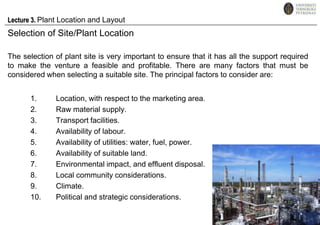
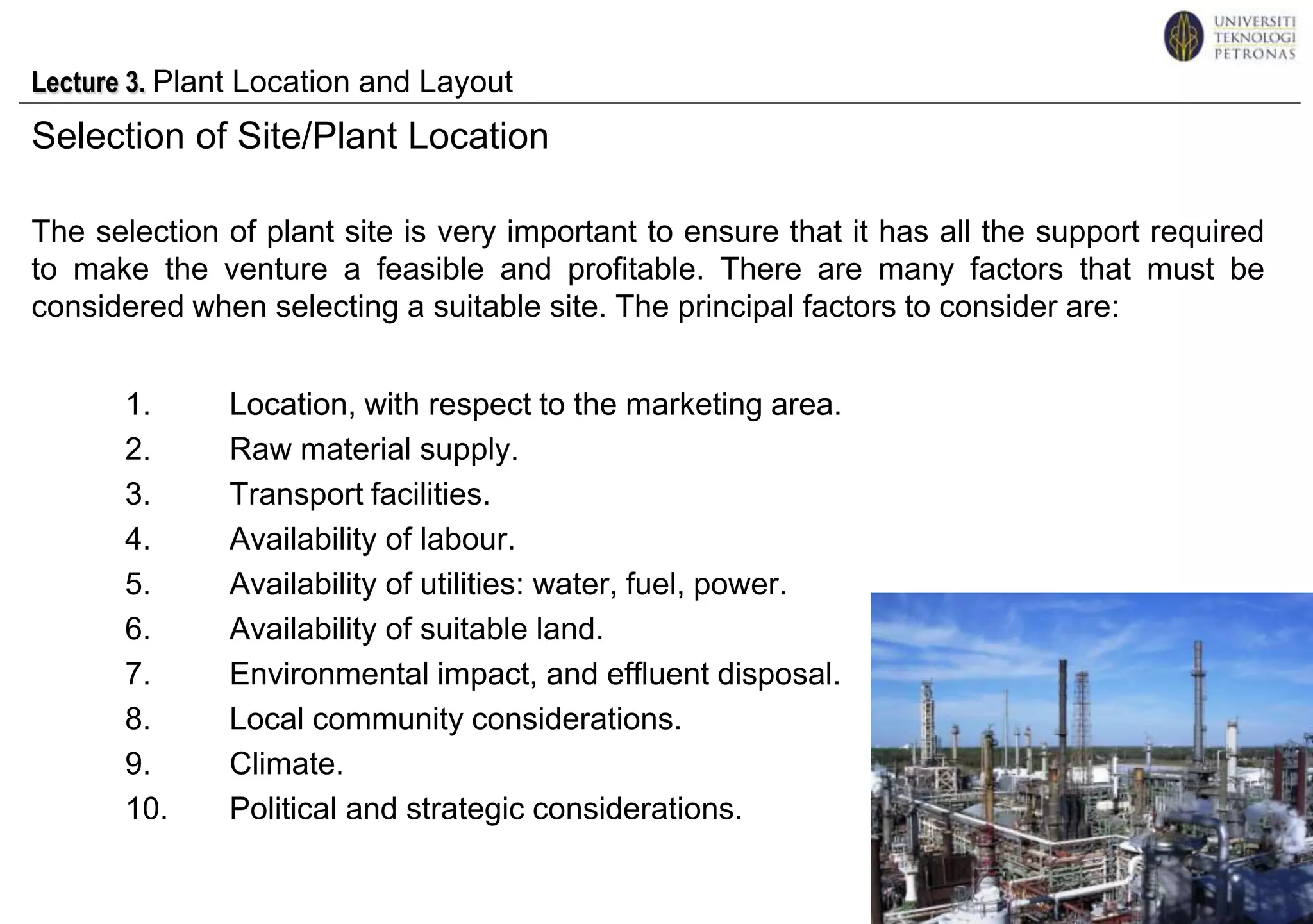
Lecture 3. Plant Location and LayoutSelection of Site/Plant LocationThe selection of plant site is very important to ensure that it has all the support required to make the venture a feasible and profitable. There are many factors that must be considered when selecting a suitable site. The principal factors to consider are:Location, with respect to the marketing area.Raw material supply.Transport facilities.Availability of labour.Availability of utilities: water, fuel, power.Availability of suitable land.Environmental impact, and effluent disposal.Local community considerations.Climate.Political and strategic considerations.
1. Location, with respect to the marketing areaThe selection of location with respect to the above criteria depends on the cost of production versus the cost of transportation. Most chemical/petrochemical process plant has significantly higher production cost compared to the cost for bulk transportation if the distance is within certain range. Therefore, most of the time the location selected is near to the transportation hub particularly sea port. This will enable the delivery of the finished products to customer as quickly and as cheaply possible.However, there are products that are produced in bulk quantities; such as cement, mineral acids, and fertilisers, where the cost of the product per tonne is relatively low compared to the cost of transportation which forms a significant fraction of the sales price. In such cases, the plant should be located close to the primary market. All the above consideration may not apply or less important for low volume production, high-priced products; such as pharmaceuticals.
2. Raw material supply.The supply of raw materials is one of the most important factors especially when large quantities are involved. It lead to savings in the storage facilities as well as transports.Thus the availability and price of suitable raw materials will often determine the site location.eg . Proximity of steelworks to the major coalfields in the UK, major petrochemical complexes around Kertih where supply of natural gas from offshore Terengganu. Plants producing bulk chemicals are best located close to the source of the major raw material; where this is also close to the marketing area.
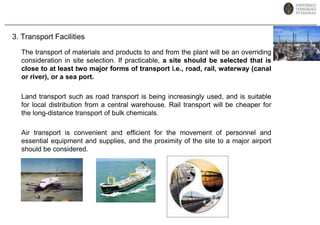
3. Transport FacilitiesThe transport of materials and products to and from the plant will be an overriding consideration in site selection.If practicable, a site should be selected that is close to at least two major forms of transport i.e., road, rail, waterway (canal or river), or a sea port. Land transport such as road transport is being increasingly used, and is suitable for local distribution from a central warehouse.Rail transport will be cheaper for the long-distance transport of bulk chemicals. Air transport is convenient and efficient for the movement of personnel and essential equipment and supplies, and the proximity of the site to a major airport should be considered.
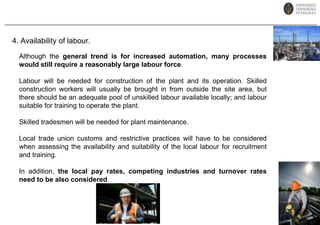
4. Availability of labour.Although the general trend is for increased automation, many processes would still require a reasonably large labour force.Labour will be needed for construction of the plant and its operation. Skilled construction workers will usually be brought in from outside the site area, but there should be an adequate pool of unskilled labour available locally; and labour suitable for training to operate the plant. Skilled tradesmen will be needed for plant maintenance. Local trade union customs and restrictive practices will have to be considered when assessing the availability and suitability of the local labour for recruitment and training.In addition, the local pay rates, competing industries and turnover rates need to be also considered.
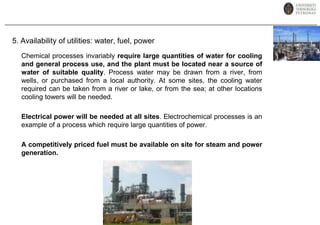
5. Availability of utilities: water, fuel, powerChemical processes invariably require large quantities of water for cooling and general process use, and the plant must be located near a source of water of suitable quality.Process water may be drawn from a river, from wells, or purchased from a local authority.At some sites, the cooling water required can be taken from a river or lake, or from the sea; at other locations cooling towers will be needed.Electrical power will be needed at all sites. Electrochemical processes is an example of a process which require large quantities of power.A competitively priced fuel must be available on site for steam and power generation.
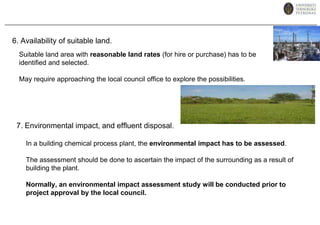
6. Availability of suitable land.Suitable land area with reasonable land rates (for hire or purchase) has to be identified and selected.May require approaching the local council office to explore the possibilities.7. Environmental impact, and effluent disposal.In a building chemical process plant, the environmental impact has to be assessed.The assessment should be done to ascertain the impact of the surrounding as a result of building the plant. Normally, an environmental impact assessment study will be conducted prior to project approval by the local council.
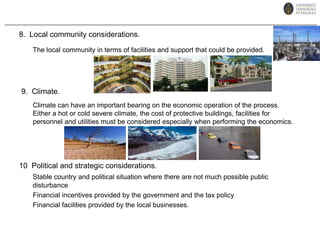
8.  Local community considerations.The local community in terms of facilities and support that could be provided.9.  Climate.Climate can have an important bearing on the economic operation of the process. Either a hot or cold severe climate, the cost of protective buildings, facilities for personnel and utilities must be considered especially when performing the economics. 10  Political and strategic considerations.Stable country and political situation where there are not much possible public disturbance 	Financial incentives provided by the government and the tax policy	Financial facilities provided by the local businesses.
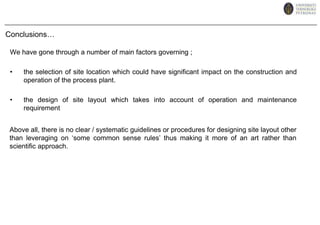
Site/Plant LayoutAs with so many aspects of design, the layout of a process plant is not an exact science but rather an art, as it embraces a high degree of experience coupled with the need to anticipate the human elements in both operation and maintenance. It is an important factor in that a carefully planned, functional arrangement of equipment, buildings and pipeworks is the key to economical construction and efficient operation. Some of the principles to consider;The process units and ancillary buildings should be laid out to give the most economical flow of materials and personnel around the site.
Hazardous processes must be located at a safe distance from other buildings. Consideration must also be given to the future expansion of the site.
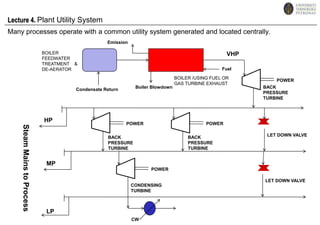
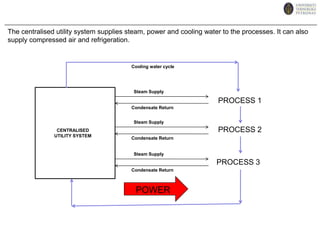
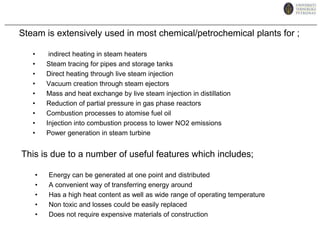
The ancillary buildings and services required on a site, in addition to the main processing units (buildings), will include; Storages for raw materials and products, tank farms and warehouses.	Maintenance workshops.	Stores, for maintenance and operating supplies.	Laboratories for process control.
The ancillary buildings and services required on a site, in addition to the main processing units (buildings), will include (cont); Fire stations and other emergency services.Utilities: steam boilers,compressed air, power generation, refrigeration, transformer stations.Effluent disposal plant.Offices for general administration.Canteens and other amenity buildings, such as medical centres.Car parks.There are two general methods which plant equipment could be positioned ;i. Group Pattern – vessels, exchangers, columns, pumps etc., are grouped together in separate areas for ease of operation and maintenanceii. Flowline Pattern -	equipment is laid out as arranged on the process flowsheet.In larger plants, the first method is always used due to large numbers of similar units being employed. However, in practise a compromise between the two methods is normally used.
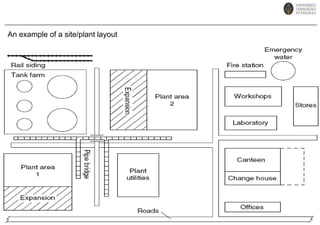
An example of a site/plant layout
The following guidelines may be employed in designing the site/plant layout ;i. Minimum Labour DemandsWhen labour cost is high, automation could result in significant reduction in labour demands. Therefore, a central control room is required. Nevertheless, some labour outside the control room is still required to perform certain manual operation but is kept to a low number.
For batch operation and start up/shut down operation of continuous plants where labour demands are high, considerable savings could be made by arranging the units in an integrated manner as much as possible. This will minimise movements required over all the unit and thus could reduce the labour required. This will also help in the case of maintenance provided proper spacing is allocated for the all the units.ii. Elevation of EquipmentElevation of equipments is expensive and should only be kept to the absolutely necessary ones to ensure efficient operation eg. units employing gravity flow. There are cases where heavy and bulky items are elevated such as reactor but to arrange it’s elevation with the rest of the process according to the process flow will enable advantage to be taken on using the gravity as the flow ‘force’ this eliminating pumps/compressors/conveyor belt thus cheaper on maintenance.
In general, heavy and bulky unit should be placed on the ground with proper support even at the expense of using pressure to force the flow unnaturally eg. pressure in distillation unit pushes the vapour flow down to almost ground level where condenser is located.iii. Operating ConvenienceEquipments requiring frequent attention should be grouped together to facilitate operation and maintenance. However, the safety clearance between the units have to be observed to ensure safest possible arrangement and the most hazard prone equipment is placed at the location most convenient for it to be removed.
A rectangular setup with a central over head pipe rack permits equipments to be installed along both sides of the pipe way with ease of access.  iv. Lay out of Specific Plant EquipmentsIt is convenient to locate pumps in line along each side of an access way with the motors aligned outwards for easy access – maintenance.
Equipments requiring large cranes for services should be located at the perimeter of the rectangular set up, adjacent to a main roadway.
Compressors (expensive items) should be installed to allow for rapid dismantling and reassembly thus avoiding from the needs to have a stand by unit. Use compressors with bottom suction and discharge connections and supporting it on a platform above ground level (approx 2.5 m or so)v. Layout of Process UnitsLarge individual process units should be separated for efficient operation and maintenance and to avoid possible spread of fire and explosion.
A master plan should be made for grouping these equipments together and for future expansion. Other useful factors to consider;The cost of construction can be minimised by adopting a layout that gives the shortest run of connecting pipe between equipment, and the least amount of structural steel work.However, this will not necessarily be the best arrangement for operation and maintenance.
Valves, sample points, and instruments should be located at convenient positions and heights.
Heat exchangers need to be sited so that the tube bundles can be easily withdrawn for cleaning and tube replacement.
Vessels that require frequent replacement of catalyst or packing should be located on the outside of buildings.
Equipment that requires dismantling for maintenance, such as compressors and large pumps, should be placed under cover.
Blast walls may be needed to isolate potentially hazardous equipment, and confine the effects of an explosion.
Equipment should be located so that it can be conveniently tied in with any future expansion of the process.
Space should be left on pipe alleys for future needs, and service pipes over-sized to allow for future requirements.Other useful factors to consider (cont.)  Services.;Buildings of an ancilliary nature such as offices, workshops, canteen and power supply should be located so as to afford maximum convenience with minimum interference with operation of the plant.
Relief devices that can vent inflammable and noxious fumes in an emergency should be located down wind of the administrative facility.
Storage areas should be positioned for ease of access from public roads and railways and remote from hazardous areas.
Facilities for generation and distribution of services (power supply, steam & water supply) should be located in a completely safe area.
For road used by all types of vehicles at all times, they should be surfaced and main two-way road should be at least 20ft (6.1 m) width with 30 ft (9.3 m) minimum centre line radius to permit the turning of 3-4 axle vehicles.Other useful factors to consider (cont.)  Piping;Overhead pipe network / yard piping which carries process materials and main utilities are normally long and should be sited at or below ground level using racks. In most cases, the power supply and instruments line are carried on the same structure.

3 4 chemplantdesign-general plant consideration

  • 1.
    Lecture 3. PlantLocation and LayoutSelection of Site/Plant LocationThe selection of plant site is very important to ensure that it has all the support required to make the venture a feasible and profitable. There are many factors that must be considered when selecting a suitable site. The principal factors to consider are:Location, with respect to the marketing area.Raw material supply.Transport facilities.Availability of labour.Availability of utilities: water, fuel, power.Availability of suitable land.Environmental impact, and effluent disposal.Local community considerations.Climate.Political and strategic considerations.
  • 2.
    1. Location, withrespect to the marketing areaThe selection of location with respect to the above criteria depends on the cost of production versus the cost of transportation. Most chemical/petrochemical process plant has significantly higher production cost compared to the cost for bulk transportation if the distance is within certain range. Therefore, most of the time the location selected is near to the transportation hub particularly sea port. This will enable the delivery of the finished products to customer as quickly and as cheaply possible.However, there are products that are produced in bulk quantities; such as cement, mineral acids, and fertilisers, where the cost of the product per tonne is relatively low compared to the cost of transportation which forms a significant fraction of the sales price. In such cases, the plant should be located close to the primary market. All the above consideration may not apply or less important for low volume production, high-priced products; such as pharmaceuticals.
  • 3.
    2. Raw materialsupply.The supply of raw materials is one of the most important factors especially when large quantities are involved. It lead to savings in the storage facilities as well as transports.Thus the availability and price of suitable raw materials will often determine the site location.eg . Proximity of steelworks to the major coalfields in the UK, major petrochemical complexes around Kertih where supply of natural gas from offshore Terengganu. Plants producing bulk chemicals are best located close to the source of the major raw material; where this is also close to the marketing area.
  • 4.
    3. Transport FacilitiesThetransport of materials and products to and from the plant will be an overriding consideration in site selection.If practicable, a site should be selected that is close to at least two major forms of transport i.e., road, rail, waterway (canal or river), or a sea port. Land transport such as road transport is being increasingly used, and is suitable for local distribution from a central warehouse.Rail transport will be cheaper for the long-distance transport of bulk chemicals. Air transport is convenient and efficient for the movement of personnel and essential equipment and supplies, and the proximity of the site to a major airport should be considered.
  • 5.
    4. Availability oflabour.Although the general trend is for increased automation, many processes would still require a reasonably large labour force.Labour will be needed for construction of the plant and its operation. Skilled construction workers will usually be brought in from outside the site area, but there should be an adequate pool of unskilled labour available locally; and labour suitable for training to operate the plant. Skilled tradesmen will be needed for plant maintenance. Local trade union customs and restrictive practices will have to be considered when assessing the availability and suitability of the local labour for recruitment and training.In addition, the local pay rates, competing industries and turnover rates need to be also considered.
  • 6.
    5. Availability ofutilities: water, fuel, powerChemical processes invariably require large quantities of water for cooling and general process use, and the plant must be located near a source of water of suitable quality.Process water may be drawn from a river, from wells, or purchased from a local authority.At some sites, the cooling water required can be taken from a river or lake, or from the sea; at other locations cooling towers will be needed.Electrical power will be needed at all sites. Electrochemical processes is an example of a process which require large quantities of power.A competitively priced fuel must be available on site for steam and power generation.
  • 7.
    6. Availability ofsuitable land.Suitable land area with reasonable land rates (for hire or purchase) has to be identified and selected.May require approaching the local council office to explore the possibilities.7. Environmental impact, and effluent disposal.In a building chemical process plant, the environmental impact has to be assessed.The assessment should be done to ascertain the impact of the surrounding as a result of building the plant. Normally, an environmental impact assessment study will be conducted prior to project approval by the local council.
  • 8.
    8. Localcommunity considerations.The local community in terms of facilities and support that could be provided.9. Climate.Climate can have an important bearing on the economic operation of the process. Either a hot or cold severe climate, the cost of protective buildings, facilities for personnel and utilities must be considered especially when performing the economics. 10 Political and strategic considerations.Stable country and political situation where there are not much possible public disturbance Financial incentives provided by the government and the tax policy Financial facilities provided by the local businesses.
  • 9.
    Site/Plant LayoutAs withso many aspects of design, the layout of a process plant is not an exact science but rather an art, as it embraces a high degree of experience coupled with the need to anticipate the human elements in both operation and maintenance. It is an important factor in that a carefully planned, functional arrangement of equipment, buildings and pipeworks is the key to economical construction and efficient operation. Some of the principles to consider;The process units and ancillary buildings should be laid out to give the most economical flow of materials and personnel around the site.
  • 10.
    Hazardous processes mustbe located at a safe distance from other buildings. Consideration must also be given to the future expansion of the site.
  • 11.
    The ancillary buildingsand services required on a site, in addition to the main processing units (buildings), will include; Storages for raw materials and products, tank farms and warehouses. Maintenance workshops. Stores, for maintenance and operating supplies. Laboratories for process control.
  • 12.
    The ancillary buildingsand services required on a site, in addition to the main processing units (buildings), will include (cont); Fire stations and other emergency services.Utilities: steam boilers,compressed air, power generation, refrigeration, transformer stations.Effluent disposal plant.Offices for general administration.Canteens and other amenity buildings, such as medical centres.Car parks.There are two general methods which plant equipment could be positioned ;i. Group Pattern – vessels, exchangers, columns, pumps etc., are grouped together in separate areas for ease of operation and maintenanceii. Flowline Pattern - equipment is laid out as arranged on the process flowsheet.In larger plants, the first method is always used due to large numbers of similar units being employed. However, in practise a compromise between the two methods is normally used.
  • 13.
    An example ofa site/plant layout
  • 14.
    The following guidelinesmay be employed in designing the site/plant layout ;i. Minimum Labour DemandsWhen labour cost is high, automation could result in significant reduction in labour demands. Therefore, a central control room is required. Nevertheless, some labour outside the control room is still required to perform certain manual operation but is kept to a low number.
  • 15.
    For batch operationand start up/shut down operation of continuous plants where labour demands are high, considerable savings could be made by arranging the units in an integrated manner as much as possible. This will minimise movements required over all the unit and thus could reduce the labour required. This will also help in the case of maintenance provided proper spacing is allocated for the all the units.ii. Elevation of EquipmentElevation of equipments is expensive and should only be kept to the absolutely necessary ones to ensure efficient operation eg. units employing gravity flow. There are cases where heavy and bulky items are elevated such as reactor but to arrange it’s elevation with the rest of the process according to the process flow will enable advantage to be taken on using the gravity as the flow ‘force’ this eliminating pumps/compressors/conveyor belt thus cheaper on maintenance.
  • 16.
    In general, heavyand bulky unit should be placed on the ground with proper support even at the expense of using pressure to force the flow unnaturally eg. pressure in distillation unit pushes the vapour flow down to almost ground level where condenser is located.iii. Operating ConvenienceEquipments requiring frequent attention should be grouped together to facilitate operation and maintenance. However, the safety clearance between the units have to be observed to ensure safest possible arrangement and the most hazard prone equipment is placed at the location most convenient for it to be removed.
  • 17.
    A rectangular setupwith a central over head pipe rack permits equipments to be installed along both sides of the pipe way with ease of access. iv. Lay out of Specific Plant EquipmentsIt is convenient to locate pumps in line along each side of an access way with the motors aligned outwards for easy access – maintenance.
  • 18.
    Equipments requiring largecranes for services should be located at the perimeter of the rectangular set up, adjacent to a main roadway.
  • 19.
    Compressors (expensive items)should be installed to allow for rapid dismantling and reassembly thus avoiding from the needs to have a stand by unit. Use compressors with bottom suction and discharge connections and supporting it on a platform above ground level (approx 2.5 m or so)v. Layout of Process UnitsLarge individual process units should be separated for efficient operation and maintenance and to avoid possible spread of fire and explosion.
  • 20.
    A master planshould be made for grouping these equipments together and for future expansion. Other useful factors to consider;The cost of construction can be minimised by adopting a layout that gives the shortest run of connecting pipe between equipment, and the least amount of structural steel work.However, this will not necessarily be the best arrangement for operation and maintenance.
  • 21.
    Valves, sample points,and instruments should be located at convenient positions and heights.
  • 22.
    Heat exchangers needto be sited so that the tube bundles can be easily withdrawn for cleaning and tube replacement.
  • 23.
    Vessels that requirefrequent replacement of catalyst or packing should be located on the outside of buildings.
  • 24.
    Equipment that requiresdismantling for maintenance, such as compressors and large pumps, should be placed under cover.
  • 25.
    Blast walls maybe needed to isolate potentially hazardous equipment, and confine the effects of an explosion.
  • 26.
    Equipment should belocated so that it can be conveniently tied in with any future expansion of the process.
  • 27.
    Space should beleft on pipe alleys for future needs, and service pipes over-sized to allow for future requirements.Other useful factors to consider (cont.)  Services.;Buildings of an ancilliary nature such as offices, workshops, canteen and power supply should be located so as to afford maximum convenience with minimum interference with operation of the plant.
  • 28.
    Relief devices thatcan vent inflammable and noxious fumes in an emergency should be located down wind of the administrative facility.
  • 29.
    Storage areas shouldbe positioned for ease of access from public roads and railways and remote from hazardous areas.
  • 30.
    Facilities for generationand distribution of services (power supply, steam & water supply) should be located in a completely safe area.
  • 31.
    For road usedby all types of vehicles at all times, they should be surfaced and main two-way road should be at least 20ft (6.1 m) width with 30 ft (9.3 m) minimum centre line radius to permit the turning of 3-4 axle vehicles.Other useful factors to consider (cont.)  Piping;Overhead pipe network / yard piping which carries process materials and main utilities are normally long and should be sited at or below ground level using racks. In most cases, the power supply and instruments line are carried on the same structure.