Profesora:Estela N. Braun
Estudiante: Yacopini Cristian
Materia:Práctica Educativa II
Año: 2021
Narrative
By following the first sevenquestions of the observation guide, I made the following
narrative of my first two observations.
First Observation
Before starting with this narrative, I’ll give you some background of the context.
It is 2021 in the middle/ending of the pandemic, as many people have already been
vaccinated twice. However, in my case, it is still a difficult situation as I cannot be
vaccinated due to my chronic disease. Currently, I am doing Educational Practice II with
Estela. And I have the fantastic opportunity to do my school observations by serving as
Valentina’s pedagogical partner. So, it is Tuesday, 24h of August and I had already
bought the mask from CONICET and a full-protection shield that covers all my face and
the sides of it. I still had a few more minutes to organize and calm myself as I was a little
nervous for the first encounter with my mentor teacher and her students. While I was
walking to school N°256, the two canvases of protection caused me to feel somewhat
agitated. I didn’t know whether it was the protection or nervousness, but I had to recover
some air before entering the school’s front door.
I pushed the electric porter’s button once and waited a few minutes to see if
someone would attend to the ring, but nobody came. I realized that the light that should
be green signaling that the porter was on was indeed off. After some minutes at the
entrance, a teacher saw me and allowed me to enter the institution. She asked my name
and if I needed something. I answered that I was a trainee from UNLPam and was
assigned to make my observations with Juliana Badillo, the English teacher. As she
recognized the name, she told me to wait for a second at the entrance. While I was waiting,
I saw some students talking to each other, laughing, screaming and walking to the
backyard, as they were in the middle of their leisure time. Some minutes later, she
returned with Juliana that led me to the classroom. She presented me to the whole students
while organizing the whiteboard and placing a chair next to it so that I could sit there. I
was pretty nervous as I was facing directly to the pupils’ table.
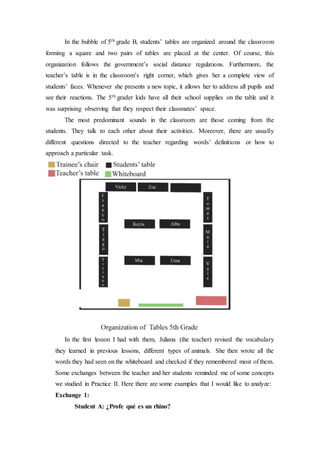
In the bubble of 5th grade B, students’ tables are organized around the classroom
forming a square and two pairs of tables are placed at the center. Of course, this
organization follows the government’s social distance regulations. Furthermore, the
teacher’s table is in the classroom’s right corner, which gives her a complete view of
students’ faces. Whenever she presents a new topic, it allows her to address all pupils and
see their reactions. The 5th grader kids have all their school supplies on the table and it
was surprising observing that they respect their classmates’ space.
The most predominant sounds in the classroom are those coming from the
students. They talk to each other about their activities. Moreover, there are usually
different questions directed to the teacher regarding words’ definitions or how to
approach a particular task.
In the first lesson I had with them, Juliana (the teacher) revised the vocabulary
they learned in previous lessons, different types of animals. She then wrote all the
words they had seen on the whiteboard and checked if they remembered most of them.
Some exchanges between the teacher and her students reminded me of some concepts
we studied in Practice II. Here there are some examples that I would like to analyze:
Exchange 1:
Student A: ¿Profe qué es un rhino?
Teacher: A rhino? What is a rhino, kids?
Some Students: Es un rinoceronte, teacher.
The teacher, in this case, does not answer him in Spanish but in English and does
not give him the answer directly. Still, she directed the question to her students so that
they could participate in the class. Juliana spent 5 minutes checking the previous
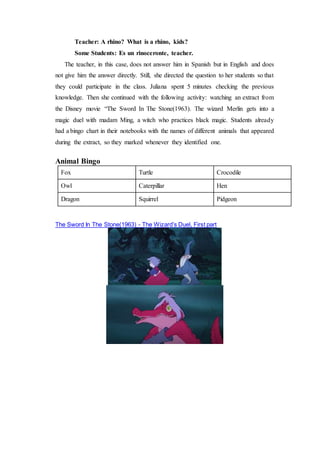
knowledge. Then she continued with the following activity: watching an extract from
the Disney movie “The Sword In The Stone(1963). The wizard Merlin gets into a
magic duel with madam Ming, a witch who practices black magic. Students already
had a bingo chart in their notebooks with the names of different animals that appeared
during the extract, so they marked whenever they identified one.
Animal Bingo
Fox Turtle Crocodile
Owl Caterpillar Hen
Dragon Squirrel Pidgeon
The Sword In The Stone(1963) - The Wizard’s Duel, First part
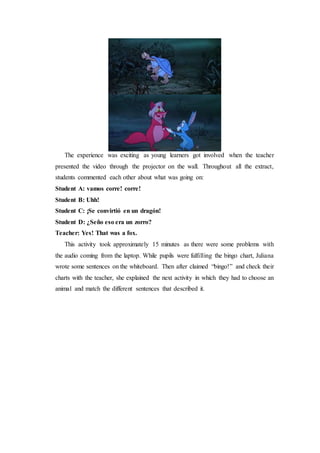
The experience was exciting as young learners got involved when the teacher
presented the video through the projector on the wall. Throughout all the extract,
students commented each other about what was going on:
Student A: vamos corre! corre!
Student B: Uhh!
Student C: ¡Se convirtió en un dragón!
Student D: ¿Seño eso era un zorro?
Teacher: Yes! That was a fox.
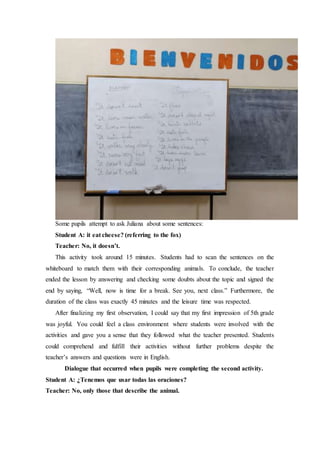
This activity took approximately 15 minutes as there were some problems with
the audio coming from the laptop. While pupils were fulfilling the bingo chart, Juliana
wrote some sentences on the whiteboard. Then after claimed “bingo!” and check their
charts with the teacher, she explained the next activity in which they had to choose an
animal and match the different sentences that described it.
Some pupils attempt to ask Juliana about some sentences:
Student A: it eat cheese? (referring to the fox)
Teacher: No, it doesn’t.
This activity took around 15 minutes. Students had to scan the sentences on the
whiteboard to match them with their corresponding animals. To conclude, the teacher
ended the lesson by answering and checking some doubts about the topic and signed the
end by saying, “Well, now is time for a break. See you, next class.” Furthermore, the
duration of the class was exactly 45 minutes and the leisure time was respected.
After finalizing my first observation, I could say that my first impression of 5th grade
was joyful. You could feel a class environment where students were involved with the
activities and gave you a sense that they followed what the teacher presented. Students
could comprehend and fulfill their activities without further problems despite the
teacher’s answers and questions were in English.
Dialogue that occurred when pupils were completing the second activity.
Student A: ¿Tenemos que usar todas las oraciones?
Teacher: No, only those that describe the animal.
Second Observation
In this second observation, some students were absent (Mia, Uma and Maia). The
teacher started the lesson by greeting her pupils and asking them what they had done
the previous day. They spent some minutes sharing their past day. Then Juliana said,
“Okay, now. Do you remember what we worked on yesterday?” and some students
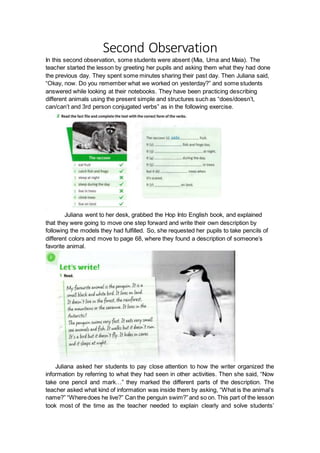
answered while looking at their notebooks. They have been practicing describing
different animals using the present simple and structures such as “does/doesn’t,
can/can’t and 3rd person conjugated verbs” as in the following exercise.
Juliana went to her desk, grabbed the Hop Into English book, and explained
that they were going to move one step forward and write their own description by
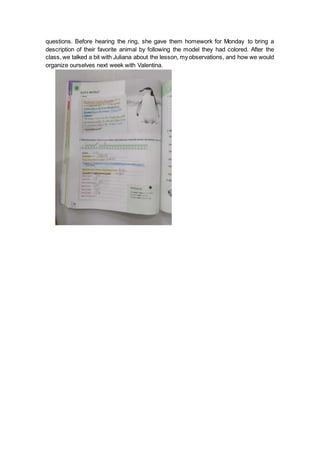
following the models they had fulfilled. So, she requested her pupils to take pencils of
different colors and move to page 68, where they found a description of someone’s
favorite animal.
Juliana asked her students to pay close attention to how the writer organized the
information by referring to what they had seen in other activities. Then she said, “Now
take one pencil and mark…” they marked the different parts of the description. The
teacher asked what kind of information was inside them by asking, “What is the animal’s
name?” “Wheredoes he live?” Can the penguin swim?”and so on. This part of the lesson
took most of the time as the teacher needed to explain clearly and solve students’
questions. Before hearing the ring, she gave them homework for Monday to bring a
description of their favorite animal by following the model they had colored. After the
class, we talked a bit with Juliana about the lesson, my observations, and how we would
organize ourselves next week with Valentina.

My Narrative

  • 1.
    Profesora:Estela N. Braun Estudiante:Yacopini Cristian Materia:Práctica Educativa II Año: 2021 Narrative By following the first sevenquestions of the observation guide, I made the following narrative of my first two observations. First Observation Before starting with this narrative, I’ll give you some background of the context. It is 2021 in the middle/ending of the pandemic, as many people have already been vaccinated twice. However, in my case, it is still a difficult situation as I cannot be vaccinated due to my chronic disease. Currently, I am doing Educational Practice II with Estela. And I have the fantastic opportunity to do my school observations by serving as Valentina’s pedagogical partner. So, it is Tuesday, 24h of August and I had already bought the mask from CONICET and a full-protection shield that covers all my face and the sides of it. I still had a few more minutes to organize and calm myself as I was a little nervous for the first encounter with my mentor teacher and her students. While I was walking to school N°256, the two canvases of protection caused me to feel somewhat agitated. I didn’t know whether it was the protection or nervousness, but I had to recover some air before entering the school’s front door. I pushed the electric porter’s button once and waited a few minutes to see if someone would attend to the ring, but nobody came. I realized that the light that should be green signaling that the porter was on was indeed off. After some minutes at the entrance, a teacher saw me and allowed me to enter the institution. She asked my name and if I needed something. I answered that I was a trainee from UNLPam and was assigned to make my observations with Juliana Badillo, the English teacher. As she recognized the name, she told me to wait for a second at the entrance. While I was waiting, I saw some students talking to each other, laughing, screaming and walking to the backyard, as they were in the middle of their leisure time. Some minutes later, she returned with Juliana that led me to the classroom. She presented me to the whole students while organizing the whiteboard and placing a chair next to it so that I could sit there. I was pretty nervous as I was facing directly to the pupils’ table.
  • 2.
    In the bubbleof 5th grade B, students’ tables are organized around the classroom forming a square and two pairs of tables are placed at the center. Of course, this organization follows the government’s social distance regulations. Furthermore, the teacher’s table is in the classroom’s right corner, which gives her a complete view of students’ faces. Whenever she presents a new topic, it allows her to address all pupils and see their reactions. The 5th grader kids have all their school supplies on the table and it was surprising observing that they respect their classmates’ space. The most predominant sounds in the classroom are those coming from the students. They talk to each other about their activities. Moreover, there are usually different questions directed to the teacher regarding words’ definitions or how to approach a particular task. In the first lesson I had with them, Juliana (the teacher) revised the vocabulary they learned in previous lessons, different types of animals. She then wrote all the words they had seen on the whiteboard and checked if they remembered most of them. Some exchanges between the teacher and her students reminded me of some concepts we studied in Practice II. Here there are some examples that I would like to analyze: Exchange 1: Student A: ¿Profe qué es un rhino?
  • 3.
    Teacher: A rhino?What is a rhino, kids? Some Students: Es un rinoceronte, teacher. The teacher, in this case, does not answer him in Spanish but in English and does not give him the answer directly. Still, she directed the question to her students so that they could participate in the class. Juliana spent 5 minutes checking the previous knowledge. Then she continued with the following activity: watching an extract from the Disney movie “The Sword In The Stone(1963). The wizard Merlin gets into a magic duel with madam Ming, a witch who practices black magic. Students already had a bingo chart in their notebooks with the names of different animals that appeared during the extract, so they marked whenever they identified one. Animal Bingo Fox Turtle Crocodile Owl Caterpillar Hen Dragon Squirrel Pidgeon The Sword In The Stone(1963) - The Wizard’s Duel, First part
  • 4.
    The experience wasexciting as young learners got involved when the teacher presented the video through the projector on the wall. Throughout all the extract, students commented each other about what was going on: Student A: vamos corre! corre! Student B: Uhh! Student C: ¡Se convirtió en un dragón! Student D: ¿Seño eso era un zorro? Teacher: Yes! That was a fox. This activity took approximately 15 minutes as there were some problems with the audio coming from the laptop. While pupils were fulfilling the bingo chart, Juliana wrote some sentences on the whiteboard. Then after claimed “bingo!” and check their charts with the teacher, she explained the next activity in which they had to choose an animal and match the different sentences that described it.
  • 5.
    Some pupils attemptto ask Juliana about some sentences: Student A: it eat cheese? (referring to the fox) Teacher: No, it doesn’t. This activity took around 15 minutes. Students had to scan the sentences on the whiteboard to match them with their corresponding animals. To conclude, the teacher ended the lesson by answering and checking some doubts about the topic and signed the end by saying, “Well, now is time for a break. See you, next class.” Furthermore, the duration of the class was exactly 45 minutes and the leisure time was respected. After finalizing my first observation, I could say that my first impression of 5th grade was joyful. You could feel a class environment where students were involved with the activities and gave you a sense that they followed what the teacher presented. Students could comprehend and fulfill their activities without further problems despite the teacher’s answers and questions were in English. Dialogue that occurred when pupils were completing the second activity. Student A: ¿Tenemos que usar todas las oraciones? Teacher: No, only those that describe the animal.
  • 6.
    Second Observation In thissecond observation, some students were absent (Mia, Uma and Maia). The teacher started the lesson by greeting her pupils and asking them what they had done the previous day. They spent some minutes sharing their past day. Then Juliana said, “Okay, now. Do you remember what we worked on yesterday?” and some students answered while looking at their notebooks. They have been practicing describing different animals using the present simple and structures such as “does/doesn’t, can/can’t and 3rd person conjugated verbs” as in the following exercise. Juliana went to her desk, grabbed the Hop Into English book, and explained that they were going to move one step forward and write their own description by following the models they had fulfilled. So, she requested her pupils to take pencils of different colors and move to page 68, where they found a description of someone’s favorite animal. Juliana asked her students to pay close attention to how the writer organized the information by referring to what they had seen in other activities. Then she said, “Now take one pencil and mark…” they marked the different parts of the description. The teacher asked what kind of information was inside them by asking, “What is the animal’s name?” “Wheredoes he live?” Can the penguin swim?”and so on. This part of the lesson took most of the time as the teacher needed to explain clearly and solve students’
  • 7.
    questions. Before hearingthe ring, she gave them homework for Monday to bring a description of their favorite animal by following the model they had colored. After the class, we talked a bit with Juliana about the lesson, my observations, and how we would organize ourselves next week with Valentina.