I.F.D.C. LENGUAS VIVAS
TALLER DE PRÁCTICA DOCENTE 2016
ALUMNO RESIDENTE: Gomez Antonella Belén
Período de Práctica: Nivel Inicial
Institución Educativa: Instituto Approaches
Dirección: Comodoro Rivadavia 279 – Carmen de Patagones
Sala / Grado / Año - sección: Pre-children
Cantidad de alumnos: 7
Nivel lingüístico del curso: Principiantes
Tipo de Planificación: Clase
Unidad Temática: Animales
Clase Nº: 01
Fecha: 09/05/2016
Hora: 10:30
Duración de la clase: 60 minutos
Fecha de entrega: 04/05/2016
Aims
During this lesson students will be able to:
 Use the present simple in affirmative and negative to describe animals.
 To recognize the structure in a song.
 Add and use a new word to their vocabulary (bird).
Teaching points: language focus
LEXIS FUNCTION STRUCTURE
REVISION Animals (lion,
giraffe, rhino, hippo,
elephant)
Colours
Numbers 1-5
Present simple.
Can
What is it?
It’s a lion.
What animals can
you see?
I can see a lion.
NEW Animals (Bird) Describing. What colour is it?
Comentado [A1]: First person? Third person? Singular or plural?
According to the teaching points, you will just work with the verb to
be. You should be more precise.
Comentado [A2]: The recognition of grammar structures in little
children is quite difficult to assess.
Comentado [A3]: What about pronunciation? Isn`t there
anything you should focus on?
Comentado [A4]: These are not language functions.
It’s yellow and
brown.
It isn’t grey.
Teaching approach
The lesson will be based on the Natural Approach and organized through PPP procedure.
Integration of skills: What skills will be integrated and how?
Listening and speaking skills will be integrated through oral practice.
Materials
Flashcards (animals and colours), Pupil’s book (New English Adventures – starter b), marker,
board, CD player, Pendrive with audio filesfrom the book.
Seating Arrangement
Regular seating arrangement with students sat on their chairs facing the board, with possible
movement for some activities (circle on the floor).
Possible problems/difficulties and their possible solutions during class
They might not feel entirely confident to work with a new teacher. I will try to ensure them that
everything is OK and they can trust me by responding immediately to their needs and encouraging
them during all the class.
Assessment
I will assess students’ use of the structures required to describe the animals.
Routine 5’
Purpose: To create a welcoming classroom environment.
I will greet students and we will sing the ‘good morning song’.
Good morning, good morning, how are you today?
I’m fine, I’m fine and you? How are you?
Then I ask them ‘how are you?’ to each one of them. Ss answer ‘I’m fine’.
Following this we copy the date and what the weather is like. I elicit the weather condition by
pointing outside from the window.
Warm-up 5’
Purpose: To revise colours
I will stick colours flashcards all over the classroom. I will say: Let’s revise colours. I will name a
colour and you run to it and touch it.
I will mime while giving them the instructions.
Comentado [A5]: Any posible problems as regards language?
Comentado [A6]: How will you do so?
Comentado [A7]: What will you mime? Probably you can
demonstrate what they have to do.
Comentado [A8]: You should think of classroom management
strategies in case they get too excited while running.
Transition: Excellent! Now, sit down and let’s use these colours to describe
animals.
Presentation 10’
Purpose: To recall learnt animals and introduce a new one.
I will say:
‘I have some pictures to show you.’ Showing them the flashcards.
‘I will show you a picture, and you tell me what it is’. Always miming while I explain them.
I will show them a flashcard and I will ask ‘what is it?’
Ss: It’s a (hippo).
T: Excellent! Now, tell me, what colour is the hippo?
Ss: Grey.
T: Yes! It’s grey. What colour is it?
Ss: It’s grey.
We will continue like this until we have reached the bird. I will say:
‘This is a new animal. What animal is it?’
Ss: Pájaro
T: Yes! It’s a bird. What is it?
Ss: It’s a bird.
T: Excellent! And what colour is it?
Ss: It’s blue.
Comentado [A9]: Again, what will you mime?
Comentado [A10]: If you are introducing new vocabulary, there
is no point in asking what it is.
Transition: Well done! Now, open your pupil’s book on page 14. (I write the
number on the board).
Development 30’
Activity 1 (5’)
Purpose: To describe animals using the simple present in affirmative form.
I will say: ‘Look at this pictures’. I point to them.
‘What animal is it?’
Ss: It’s a bird.
T: Very good! What colour is this bird? Pointing to the first one.
Ss: It’s black.
T: Great! And this bird? Pointing to the second one.
Ss: It’s white.
T: Excellent! And what colour is this bird? Pointing to the third one.
Ss: It’s grey.
T: Very good! Now, let’s listen to the CD. You are going to hear an animal and a colour. You are
going to draw the animal and then colour it’. Miming and pointing to the exercise while giving the
instructions.
I will play the CD and I will stop from bird to bird to give them time to draw and colour.
- NEA_GL_StrB_Tk1.35.mp3
Double click on the MP3 icon to reproduce.
Comentado [A11]: Have they had enough exposure and practice
to produce this utterance?
Transition: Very good! Now look at this picture.
Activity 2 (5’)
Purpose: To recognize colours and animals in a song.
I will say: ‘Look at this picture. What animals can you see?’
S1: I can see a lion.
T: Excellent! What else?
S2: I can see a giraffe.
We continue until they named all the animals.
T: Excellent. Now, stand up and let’s listen to a song (mimicking the actions). When you listen to an
animal name clap (I clap to show them), and when you listen to a colour word stomp your feet (I
stomp my feet).
- NEA_GL_StrB_Tk1.36.mp3
I might need to play the song twice.
Transition: Excellent job! Now let’s describe the animals. Let’s sit in a circle.
Comentado [A12]: Do you expect them to produce such a
sentence?
Comentado [A13]: You might encourage them to guess which
animal it is. They may also feel like singing the chorus.
Activity 3 (10’)
Purpose: To use the simple present in affirmative and negative form to describe animals.
I will take the book and I will keep it open for them to look at it. I will say: ‘I will describe an animal
and you are going to guess it.’
It isn’t grey. It isn’t blue. It’s yellow and brown! What is it? I will make signs with my hands to show
the negative and affirmative difference.
Ss: It’s a giraffe.
T: Excellent! It’s a giraffe. Now, (Ernestina) describe an animal.
(Ernestina): It isn’t white. It isn’t black. It’s grey. I will make signs to elicit her sentences. I might
repeat the structure for her to repeat it after me.
We continue until we have described all the animals in the picture.
Transition: Great job! Now let’s go back to the chairs. Sit down and open your
book again.
Activity 4 (5’)
Purpose: To listen a description and recognize the animal.
I will say: ‘Now we are going to listen to the CD again. You are going to listen to a description and
you will say the animal and tick the correct space.’ I will mime while giving the instructions and I
will draw a tick on the board to show them what to do.
- NEA_GL_StrB_Tk1.39.mp3
Transition: Excellent! Now let’s count animals!
Activity 5 (5’)
Purpose: To revise numbers 1-5
I will say: ‘Look at these animals here. How many animals can you see on these pages?’ I will point
to the pages.
‘Count how many you can see and write the number in the box’ I will point to signal and explain
the instruction.
Comentado [A14]: They may need some prompting at first.
Comentado [A15]: Which?
Comentado [A16]: How will you choose students? Will they all
have the chance to participate?
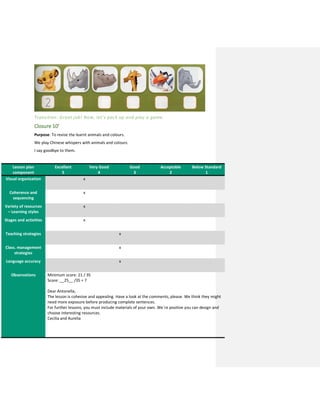
Transition: Great job! Now, let’s pack up and play a game.
Closure 10’
Purpose: To revise the learnt animals and colours.
We play Chinese whispers with animals and colours.
I say goodbye to them.
Lesson plan
component
Excellent
5
Very Good
4
Good
3
Acceptable
2
Below Standard
1
Visual organization x
Coherence and
sequencing
x
Variety of resources
– Learning styles
x
Stages and activities x
Teaching strategies x
Class. management
strategies
x
Language accuracy x
Observations Minimum score: 21 / 35
Score: __25__ /35 = 7
Dear Antonella,
The lesson is cohesive and appealing. Have a look at the comments, please. We think they might
need more exposure before producing complete sentences.
For further lessons, you must include materials of your own. We`re positive you can design and
choose interesting resources.
Cecilia and Aurelia
I.F.D.C. LENGUAS VIVAS
TALLER DE PRÁCTICA DOCENTE 2016
ALUMNO RESIDENTE: Gomez Antonella Belén
Período de Práctica: Nivel Inicial
Institución Educativa: Instituto Approaches
Dirección: Comodoro Rivadavia 279 – Carmen de Patagones
Sala / Grado / Año - sección: Pre-children
Cantidad de alumnos: 7
Nivel lingüístico del curso: Principiantes
Tipo de Planificación: Clase
Unidad Temática: Animales
Clase Nº: 02
Fecha: 11/05/2016
Hora: 10:30
Duración de la clase: 60 minutos
Fecha de entrega: 06/05/2016
Aims
During this lesson students will:
 Listen to a story to revise vocabulary and structures learnt on previous classes.
Teaching points: language focus
LEXIS FUNCTION STRUCTURE
REVISION Animals (lion, hippo,
bird, giraffe,
elephant, zebra)
Colours
Feelings (happy,
tired, angry)
Counting.
Talking about
feelings.
How many red birds
can you see?
I can see three red
birds.
Is the elephant
tired?
NEW
Teaching approach
The lesson will be based on the Natural Approach and organized through PPP procedure.
Integration of skills: What skills will be integrated and how?
Listening and speaking skills will be integrated through oral practice.
Materials
Student’s and Activity books (New English Adventure – starter B), board, marker, CD player,
animals’ flashcards, Pendrive with the audio for the story and bingo sheets.
Seating Arrangement
Regular seating arrangement with students sat on their chairs facing the board, and circle on the
floor for some activities.
Possible problems/difficulties and their possible solutions during class
They might have problems to understand the story. I’ll try to explain them while I mime for them
to understand.
Assessment
I will assess their use of the structures learnt by how they respond to the exercises.
Routine 5’
Purpose: To create a welcoming classroom environment.
I will greet students and we will sing the ‘good morning song’.
Good morning, good morning, how are you today?
I’m fine, I’m fine and you? How are you?
Then I ask them ‘how are you?’ to each one of them. Ss answer ‘I’m fine’.
Following this we copy the date and what the weather is like. I elicit the weather condition by
pointing outside from the window.
Transition: Very good! Now, don’t close you notebooks, let’s draw and colour!
Warm-up 10’
Purpose: To revise animals and colours.
T: I will name an animal and I will describe it. For example, I can see a brown lion. And will draw
the lion and colour it as I say. (I will demonstrate on the board so that they understand me better.)
They will draw:
 A grey elephant.
 A green bird.
 An orange giraffe.
 A blue rhino.
Comentado [A17]: You may take some binoculars and tell them
you are on safari. And describe what you see. So as to contextualize
the activity.
Transition: Great! Now, stand up, let’s play a game.
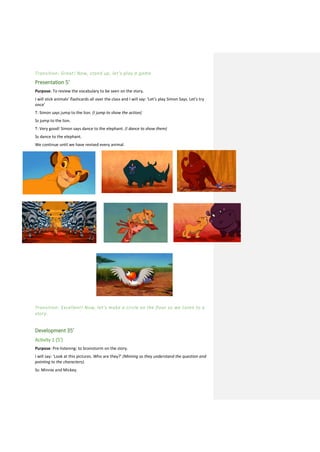
Presentation 5’
Purpose: To review the vocabulary to be seen on the story.
I will stick animals’ flashcards all over the class and I will say: ‘Let’s play Simon Says. Let’s try
once’
T: Simon says jump to the lion. (I jump to show the action)
Ss jump to the lion.
T: Very good! Simon says dance to the elephant. (I dance to show them)
Ss dance to the elephant.
We continue until we have revised every animal.
Transition: Excellent! Now, let’s make a circle on the floor so we listen to a
story.
Development 35’
Activity 1 (5’)
Purpose: Pre-listening: to brainstorm on the story.
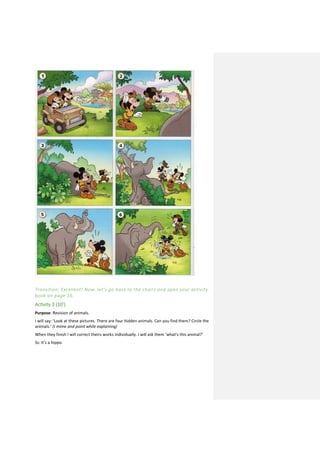
I will say: ‘Look at this pictures. Who are they?’ (Miming so they understand the question and
pointing to the characters).
Ss: Minnie and Mickey.
T: Yes! They are Minnie and Mickey. They are looking at the…
Ss: animals.
T: Yes! They are looking at the animals. Looks at picture 2 (pointing to the other picture) Look
at Minnie. She is… (I smile and point to my smile so that they understand what I want them to
say).
Ss: Happy.
T: Yes! She is happy. How is she?
Ss: She is happy.
T: Very good! How is she in picture two? She is… (I will mime the feeling)
Ss: Tired.
T: Very good! She is tired. Now look at picture 6. Is she happy?
Ss: No
T: No, she isn’t happy. She is… (I will mime the feeling)
Ss: Angry.
T: Very good!
Transition: Great! Now let’s listen to the story.
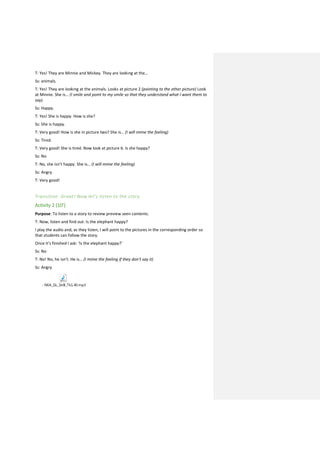
Activity 2 (10’)
Purpose: To listen to a story to review preview seen contents.
T: Now, listen and find out: Is the elephant happy?
I play the audio and, as they listen, I will point to the pictures in the corresponding order so
that students can follow the story.
Once it’s finished I ask: ‘Is the elephant happy?’
Ss: No
T: No! No, he isn’t. He is… (I mime the feeling if they don’t say it)
Ss: Angry
- NEA_GL_StrB_Tk1.40.mp3
Transition: Excellent! Now, let’s go back to the chairs and open your activity
book on page 16.
Activity 3 (10’)
Purpose: Revision of animals.
I will say: ‘Look at these pictures. There are four hidden animals. Can you find them? Circle the
animals.’ (I mime and point while explaining)
When they finish I will correct theirs works individually. I will ask them ‘what’s this animal?’
Ss: It’s a hippo.
T: Now, look here! I will ask: ‘What animal is it?’
Ss: It’s an elephant.
T: Great! It’s an elephant! And what colour is an elephant?
Ss: It’s grey.
T: Excellent! Let’s trace it and colour it!
Transition: Well done! Now, close your books, and we’ll play another game!
Activity 4 (10’)
Purpose: To review the vocabulary used during the class.
T: Let’s play bingo! I will give you these sheets and you will draw an animal, a colour or a
feeling. (I demonstrate on the board)
Comentado [A18]: Will you check understanding? Sometimes
demonstration is not enough for some children.
Comentado [A19]: What will you do if they take a lot of time to
draw?
You may provide them with a word list/ pictures to choose from.
 
Transition: Great Job! Now, let’s copy the homework.
Closure 5’
Purpose: For them to keep practising at home.
I will copy on the board:
Homework: Activity book. Page 15.
Then I will explain them ‘You have to look at the picture, count the birds, and write the
number into the correct box’ (I will demonstrate on the board.)
T: Very good! Now, you can pack up and go home. Goodbye!
Ss: Goodbye!
Lesson plan
component
Excellent
5
Very Good
4
Good
3
Acceptable
2
Below Standard
1
Visual organization x
Coherence and
sequencing
x
Variety of resources
– Learning styles
x
Stages and activities x
Teaching strategies x
Comentado [A20]: You should insist on their counting in English
when doing the homework.
Class. management
strategies
x
Language accuracy x
Observations Minimum score: 21 / 35
Score: ___23_ /35 = 6.5
Dear Antonella,
This was much better. Have a look at the suggestions. You should be careful with timing – there
are quite a lot of activities.
Cecilia and Aurelia
I.F.D.C. LENGUAS VIVAS
TALLER DE PRÁCTICA DOCENTE 2016
ALUMNO RESIDENTE: Gomez Antonella Belén
Período de Práctica: Nivel Inicial
Institución Educativa: Instituto Approaches
Dirección: Comodoro Rivadavia 279 – Carmen de Patagones
Sala / Grado / Año - sección: Pre-children
Cantidad de alumnos: 7
Nivel lingüístico del curso: Principiantes
Tipo de Planificación: Clase
Unidad Temática: Animales
Clase Nº: 03
Fecha: 16/05/2016
Hora: 10:30
Duración de la clase: 60 minutos
Fecha de entrega: 12/05/2016
Aims
During this lesson students will:
 Be able to acquire and use new vocabulary related to animals and their fur.
 Be able to work as a group to create a poster for their classroom.
 Recognize the written word for the animal vocabulary learnt.
Teaching points: language focus
LEXIS FUNCTION STRUCTURE
REVISION Animals (lion, hippo,
bird, giraffe,
elephant, zebra)
Colours
Answer to Wh-
questions.
What animal is this?
It’s an elephant.
Describing. What colour is it?
It’s grey
NEW Animals
((baby)leopard,
(baby)tiger)
Fur (stripes, spots,
mane)
Teaching approach
The lesson will be based on the Natural Approach and organized through PPP procedure.
Integration of skills: What skills will be integrated and how?
Listening and speaking skills will be integrated through oral practice. Also they will read labels
to be able to create a poster for their class.
Materials
Classroom decorated as the African Savanna (Using poster paper to create trees, some dry
weed, and animal posters), Pendrive with songs for the warm-up game, poster paper with
labels of animals, and black and white pictures of animals to be glued on the poster, student’s
book (New English Adventures – starter b).
Seating Arrangement
In their classroom, regular seating arrangement with all students facing the board.
When we move to the other classroom, all tables will be grouped together at the centre so
that they work as a big group and they can move easily around it.
Possible problems/difficulties and their possible solutions during class
They might not be willing to work with the book after the warm-up and presentation exercises.
In that case I’ll ask them to stand up and we’ll play another game. I will describe an animal
(preferably the new ones), for example: I’m big (using the arms to demonstrate the adjective,
although they know it), I’m yellow and I have got a brown mane. What am I? They answer. – I
will describe some animals.
We can also skip those exercises and make the poster. Then with the spare time they can cut
out some cards they have at the end of the book and play the game. In pairs, using both sets of
cards they play memory game. When they make a match they have to describe the animal.
Assessment
I will assess their use of the structures learnt and their use of the new vocabulary by how they
respond to the exercises.
Comentado [A21]: Being flexible is so important!
Comentado [A22]: You should start with the ones you are sure
they know, so that they feel confident from the onset.
Comentado [A23]: You should demonstrate the meaning of
mane.
Routine 5’
Purpose: To create a welcoming classroom environment.
We will start the class in their classroom, so that they do not get distracted by the setting in the
other classroom, and in order to create some suspense and they can imagine what they will
find in the other classroom.
I will greet students and we will sing the ‘good morning song’.
Good morning, good morning, how are you today?
I’m fine, I’m fine and you? How are you?
Then I ask them ‘how are you?’ to each one of them. Ss answer ‘I’m fine’.
Following this we copy the date and what the weather is like. I elicit the weather condition by
pointing outside from the window.
As they copy the date, I’ll pass and correct the homework from the previous class.
Transition: Very good! Now pack up and stand up, we are going to another
place!
Warm-up 10’
Purpose: To review animals and colours.
I will take students to another classroom that I have previously organized. I will set in this
classroom the African Savanna.
While we are on our way to the other classroom.
T: What is there in the other classroom? Can you imagine?
Ss give their ideas.
When we reach the door I will peep inside the classroom and I will look at them with an
amazed face.
T: Do you want to see?
Ss: Yes!
T: OK! Come on in!
They get into the classroom and take a look at it.
T: This is the Savanna! Where wild animals live! Leave your things and let’s play a game!
I will play some music (I play the music to demonstrate) and you are going to walk around the
classroom (I walk around). When I stop the music (I stop it) I will name an animal or a colour,
and you have to run and touch it (I do it to demonstrate). Ready?!
I start the game and we play for some minutes.
Comentado [A24]: It`s a good idea not to correct homework at
the very beginning of the lesson. You may do so while they are
working on something else.
Comentado [A25]: Are they supposed to take their things?
Comentado [A26]: You may tell them they are going on safari.
You can take some binoculars, for instance.
Image to illustrate the idea. I’ll upload pictures to the journal.
Songs to be played:
The lion sleeps tonight – The Tokens. https://www.youtube.com/watch?v=OQlByoPdG6c
I just can’t wait to be king – The Lion King. https://www.youtube.com/watch?v=ywjX6AF6oVc
Hakuna Matata – The lion King. https://www.youtube.com/watch?v=xB5ceAruYrI
Transition: Excellent! Now, let’s have a look at the animals. Come with me!
Presentation 10’
Purpose: to introduce new vocabulary (leopard, tiger, mane, spots and stripes)
T: Look at the animals! They are in the Savanna. What animal is this? (Pointing to the elephant)
Ss: It’s an elephant.
T: Yes! And what colour is it?
Ss: It’s grey.
T: Very good!
We will review all the animals and I will leave the lion, leopard and tiger for the end.
T: And what animal is this?
Ss: It’s a lion.
T: Very good! It’s a lion. The lion is yellow and the mane? (I will point to the lion’s mane or I will
mime having one myself)
Ss: It’s brown.
T: Very good! The mane is brown. What is this? (Pointing to the mane)
Ss: It’s the mane.
T: Excellent! Now look at this animal. (Pointing to the leopard) It’s a leopard! What is it?
Ss: It’s a leopard.
T: Yes! And what colour is the leopard?
Ss: It’s yellow and black.
T: Very good! The leopard is yellow with black spots! (Pointing to the spots). What colour are
the spots? (Pointing to the spots.)
Comentado [A27]: Beautiful songs!
Comentado [A28]: Is this a question?
Ss: black.
T: Yes! The spots are black! Now, look at this animal. It’s a tiger! What is it?
Ss: It’s a tiger.
T: Yes! And what colour is the tiger?
Ss: It’s yellow and black.
T: Yes! The tiger is orange with black stripes. What colour are the stripes?
Ss: Black.
T: Very good! The stripes are black. So, the lion has got a… (Pointing to the mane)
Ss: mane.
T: Very good! The… (Pointing to the leopard)
Ss: leopard.
T: The leopard has got… (Pointing to the spots)
Ss: spots.
T: Yes! And the… (Pointing to the tiger)
Ss: tiger.
T: The tiger has got… (Pointing to the stripes)
Ss: Stripes.
T: Excellent!
Transition: Well done! Now let’s sit down on the chairs! And open your
pupil’s book on page 18. (I write the number on the board)
Development 25’
Activity 1 (5’)
Purpose: to review the vocabulary recently learnt.
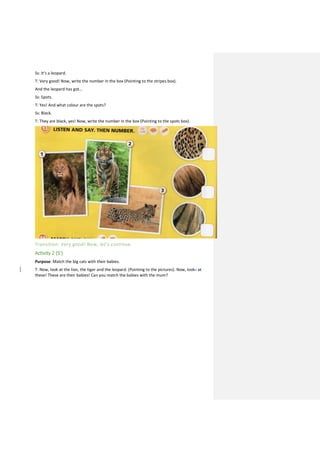
T: Look at the big cats! What is animal is this? (Pointing to the lion)
Ss: It’s a lion.
T: Very good! Has the lion got spots (pointing to the spots), a mane (pointing to the mane) or
stripes (pointing to them)?
Ss: A mane.
T: Very good! And what colour is the mane?
Ss: It’s brown.
T: Very good! Now, write the number in the box (Pointing to the mane box).
Now, What animal is this? (Pointing to the tiger)
Ss: It’s a tiger.
T: Yes! And has the tiger got spots (pointing to the spots) or stripes (pointing to the stripes)?
Ss: Stripes.
T: Very good! What colour are the stripes?
Ss: Black.
T: They are black, very good! And what animal is this? (Pointing to the leopard)
Comentado [A29]: They might need some drilling before
producing the words on their own.
Comentado [A30]: Elicit the number from students. You may
also write it on a board, or ask a volunteer to do so.
Ss: It’s a leopard.
T: Very good! Now, write the number in the box (Pointing to the stripes box).
And the leopard has got…
Ss: Spots.
T: Yes! And what colour are the spots?
Ss: Black.
T: They are black, yes! Now, write the number in the box (Pointing to the spots box).
Transition: Very good! Now, let’s continue.
Activity 2 (5’)
Purpose: Match the big cats with their babies.
T: Now, look at the lion, the tiger and the leopard. (Pointing to the pictures). Now, looks at
these! These are their babies! Can you match the babies with the mum?
I’ll pass and correct the exercise individually. I’ll ask them what animal it is and its colour.
Transition: Very good! Now, let’s make a poster!
Activity 3 (15’)
Purpose: To make a group project and to keep on working on animals.
I will take a poster paper labelled with animal names, and separately, pictures of animals.
We will work on the labels, so that I make sure they know what they say.
T: Now, You are going to colour the animals.
They colour them.
T: Very good! Now you are going to put the animals above the correct name. (I will exemplify
using one of the animals).
When they finish we will go to their classroom and we will stick it on the wall.
LION LEOPARD ELEPHANT
TIGER GIRAFFE RHINO
HIPPO BIRD ZEBRA
Comentado [A31]: It`s a good opportunity to revise colours. You
may give them instructions, for example.
Comentado [A32]: There are seven students and nine pictures
to be coloured. How are you planning to assign the pictures?
Transition: Excellent job! Now let’s copy the homework!
Closure 10’
Purpose: To give a closure to the lesson.
Homework: Activity Book, page 18.
I will copy the homework on their notebooks and then I will explain it to them. Then I’ll ask
them to pack up and then to sit in a circle to play Chinese whispers. I’ll encourage them to use
the new words learnt during the lesson.
I will say goodbye to them. And I’ll give them a lollypop as a gift, together with a small card
that says ‘Thank you for being part of my learning’ (I’ll translate it for them).
Lesson plan
component
Excellent
5
Very Good
4
Good
3
Acceptable
2
Below Standard
1
Visual organization x
Coherence and
sequencing
x
Variety of resources
– Learning styles
x
Stages and activities x
Teaching strategies x
Class. management
strategies
x
Language accuracy x
Observations Minimum score: 21 / 35
Score: _28___ /35 = 8
Dear Antonella,
This lesson is really appealing and entertaining. Take the comments into account and pay
attention to language when making questions.
Cecilia and Aurelia
Comentado [A33]: Are they used to copying homework?

Tpd kinder lesson plans

  • 1.
    I.F.D.C. LENGUAS VIVAS TALLERDE PRÁCTICA DOCENTE 2016 ALUMNO RESIDENTE: Gomez Antonella Belén Período de Práctica: Nivel Inicial Institución Educativa: Instituto Approaches Dirección: Comodoro Rivadavia 279 – Carmen de Patagones Sala / Grado / Año - sección: Pre-children Cantidad de alumnos: 7 Nivel lingüístico del curso: Principiantes Tipo de Planificación: Clase Unidad Temática: Animales Clase Nº: 01 Fecha: 09/05/2016 Hora: 10:30 Duración de la clase: 60 minutos Fecha de entrega: 04/05/2016 Aims During this lesson students will be able to:  Use the present simple in affirmative and negative to describe animals.  To recognize the structure in a song.  Add and use a new word to their vocabulary (bird). Teaching points: language focus LEXIS FUNCTION STRUCTURE REVISION Animals (lion, giraffe, rhino, hippo, elephant) Colours Numbers 1-5 Present simple. Can What is it? It’s a lion. What animals can you see? I can see a lion. NEW Animals (Bird) Describing. What colour is it? Comentado [A1]: First person? Third person? Singular or plural? According to the teaching points, you will just work with the verb to be. You should be more precise. Comentado [A2]: The recognition of grammar structures in little children is quite difficult to assess. Comentado [A3]: What about pronunciation? Isn`t there anything you should focus on? Comentado [A4]: These are not language functions.
  • 2.
    It’s yellow and brown. Itisn’t grey. Teaching approach The lesson will be based on the Natural Approach and organized through PPP procedure. Integration of skills: What skills will be integrated and how? Listening and speaking skills will be integrated through oral practice. Materials Flashcards (animals and colours), Pupil’s book (New English Adventures – starter b), marker, board, CD player, Pendrive with audio filesfrom the book. Seating Arrangement Regular seating arrangement with students sat on their chairs facing the board, with possible movement for some activities (circle on the floor). Possible problems/difficulties and their possible solutions during class They might not feel entirely confident to work with a new teacher. I will try to ensure them that everything is OK and they can trust me by responding immediately to their needs and encouraging them during all the class. Assessment I will assess students’ use of the structures required to describe the animals. Routine 5’ Purpose: To create a welcoming classroom environment. I will greet students and we will sing the ‘good morning song’. Good morning, good morning, how are you today? I’m fine, I’m fine and you? How are you? Then I ask them ‘how are you?’ to each one of them. Ss answer ‘I’m fine’. Following this we copy the date and what the weather is like. I elicit the weather condition by pointing outside from the window. Warm-up 5’ Purpose: To revise colours I will stick colours flashcards all over the classroom. I will say: Let’s revise colours. I will name a colour and you run to it and touch it. I will mime while giving them the instructions. Comentado [A5]: Any posible problems as regards language? Comentado [A6]: How will you do so? Comentado [A7]: What will you mime? Probably you can demonstrate what they have to do. Comentado [A8]: You should think of classroom management strategies in case they get too excited while running.
  • 3.
    Transition: Excellent! Now,sit down and let’s use these colours to describe animals. Presentation 10’ Purpose: To recall learnt animals and introduce a new one. I will say: ‘I have some pictures to show you.’ Showing them the flashcards. ‘I will show you a picture, and you tell me what it is’. Always miming while I explain them. I will show them a flashcard and I will ask ‘what is it?’ Ss: It’s a (hippo). T: Excellent! Now, tell me, what colour is the hippo? Ss: Grey. T: Yes! It’s grey. What colour is it? Ss: It’s grey. We will continue like this until we have reached the bird. I will say: ‘This is a new animal. What animal is it?’ Ss: Pájaro T: Yes! It’s a bird. What is it? Ss: It’s a bird. T: Excellent! And what colour is it? Ss: It’s blue. Comentado [A9]: Again, what will you mime? Comentado [A10]: If you are introducing new vocabulary, there is no point in asking what it is.
  • 4.
    Transition: Well done!Now, open your pupil’s book on page 14. (I write the number on the board). Development 30’ Activity 1 (5’) Purpose: To describe animals using the simple present in affirmative form. I will say: ‘Look at this pictures’. I point to them. ‘What animal is it?’ Ss: It’s a bird. T: Very good! What colour is this bird? Pointing to the first one. Ss: It’s black. T: Great! And this bird? Pointing to the second one. Ss: It’s white. T: Excellent! And what colour is this bird? Pointing to the third one. Ss: It’s grey. T: Very good! Now, let’s listen to the CD. You are going to hear an animal and a colour. You are going to draw the animal and then colour it’. Miming and pointing to the exercise while giving the instructions. I will play the CD and I will stop from bird to bird to give them time to draw and colour. - NEA_GL_StrB_Tk1.35.mp3 Double click on the MP3 icon to reproduce. Comentado [A11]: Have they had enough exposure and practice to produce this utterance?
  • 5.
    Transition: Very good!Now look at this picture. Activity 2 (5’) Purpose: To recognize colours and animals in a song. I will say: ‘Look at this picture. What animals can you see?’ S1: I can see a lion. T: Excellent! What else? S2: I can see a giraffe. We continue until they named all the animals. T: Excellent. Now, stand up and let’s listen to a song (mimicking the actions). When you listen to an animal name clap (I clap to show them), and when you listen to a colour word stomp your feet (I stomp my feet). - NEA_GL_StrB_Tk1.36.mp3 I might need to play the song twice. Transition: Excellent job! Now let’s describe the animals. Let’s sit in a circle. Comentado [A12]: Do you expect them to produce such a sentence? Comentado [A13]: You might encourage them to guess which animal it is. They may also feel like singing the chorus.
  • 6.
    Activity 3 (10’) Purpose:To use the simple present in affirmative and negative form to describe animals. I will take the book and I will keep it open for them to look at it. I will say: ‘I will describe an animal and you are going to guess it.’ It isn’t grey. It isn’t blue. It’s yellow and brown! What is it? I will make signs with my hands to show the negative and affirmative difference. Ss: It’s a giraffe. T: Excellent! It’s a giraffe. Now, (Ernestina) describe an animal. (Ernestina): It isn’t white. It isn’t black. It’s grey. I will make signs to elicit her sentences. I might repeat the structure for her to repeat it after me. We continue until we have described all the animals in the picture. Transition: Great job! Now let’s go back to the chairs. Sit down and open your book again. Activity 4 (5’) Purpose: To listen a description and recognize the animal. I will say: ‘Now we are going to listen to the CD again. You are going to listen to a description and you will say the animal and tick the correct space.’ I will mime while giving the instructions and I will draw a tick on the board to show them what to do. - NEA_GL_StrB_Tk1.39.mp3 Transition: Excellent! Now let’s count animals! Activity 5 (5’) Purpose: To revise numbers 1-5 I will say: ‘Look at these animals here. How many animals can you see on these pages?’ I will point to the pages. ‘Count how many you can see and write the number in the box’ I will point to signal and explain the instruction. Comentado [A14]: They may need some prompting at first. Comentado [A15]: Which? Comentado [A16]: How will you choose students? Will they all have the chance to participate?
  • 7.
    Transition: Great job!Now, let’s pack up and play a game. Closure 10’ Purpose: To revise the learnt animals and colours. We play Chinese whispers with animals and colours. I say goodbye to them. Lesson plan component Excellent 5 Very Good 4 Good 3 Acceptable 2 Below Standard 1 Visual organization x Coherence and sequencing x Variety of resources – Learning styles x Stages and activities x Teaching strategies x Class. management strategies x Language accuracy x Observations Minimum score: 21 / 35 Score: __25__ /35 = 7 Dear Antonella, The lesson is cohesive and appealing. Have a look at the comments, please. We think they might need more exposure before producing complete sentences. For further lessons, you must include materials of your own. We`re positive you can design and choose interesting resources. Cecilia and Aurelia
  • 8.
    I.F.D.C. LENGUAS VIVAS TALLERDE PRÁCTICA DOCENTE 2016 ALUMNO RESIDENTE: Gomez Antonella Belén Período de Práctica: Nivel Inicial Institución Educativa: Instituto Approaches Dirección: Comodoro Rivadavia 279 – Carmen de Patagones Sala / Grado / Año - sección: Pre-children Cantidad de alumnos: 7 Nivel lingüístico del curso: Principiantes Tipo de Planificación: Clase Unidad Temática: Animales Clase Nº: 02 Fecha: 11/05/2016 Hora: 10:30 Duración de la clase: 60 minutos Fecha de entrega: 06/05/2016 Aims During this lesson students will:  Listen to a story to revise vocabulary and structures learnt on previous classes. Teaching points: language focus LEXIS FUNCTION STRUCTURE REVISION Animals (lion, hippo, bird, giraffe, elephant, zebra) Colours Feelings (happy, tired, angry) Counting. Talking about feelings. How many red birds can you see? I can see three red birds. Is the elephant tired? NEW Teaching approach The lesson will be based on the Natural Approach and organized through PPP procedure.
  • 9.
    Integration of skills:What skills will be integrated and how? Listening and speaking skills will be integrated through oral practice. Materials Student’s and Activity books (New English Adventure – starter B), board, marker, CD player, animals’ flashcards, Pendrive with the audio for the story and bingo sheets. Seating Arrangement Regular seating arrangement with students sat on their chairs facing the board, and circle on the floor for some activities. Possible problems/difficulties and their possible solutions during class They might have problems to understand the story. I’ll try to explain them while I mime for them to understand. Assessment I will assess their use of the structures learnt by how they respond to the exercises. Routine 5’ Purpose: To create a welcoming classroom environment. I will greet students and we will sing the ‘good morning song’. Good morning, good morning, how are you today? I’m fine, I’m fine and you? How are you? Then I ask them ‘how are you?’ to each one of them. Ss answer ‘I’m fine’. Following this we copy the date and what the weather is like. I elicit the weather condition by pointing outside from the window. Transition: Very good! Now, don’t close you notebooks, let’s draw and colour! Warm-up 10’ Purpose: To revise animals and colours. T: I will name an animal and I will describe it. For example, I can see a brown lion. And will draw the lion and colour it as I say. (I will demonstrate on the board so that they understand me better.) They will draw:  A grey elephant.  A green bird.  An orange giraffe.  A blue rhino. Comentado [A17]: You may take some binoculars and tell them you are on safari. And describe what you see. So as to contextualize the activity.
  • 10.
    Transition: Great! Now,stand up, let’s play a game. Presentation 5’ Purpose: To review the vocabulary to be seen on the story. I will stick animals’ flashcards all over the class and I will say: ‘Let’s play Simon Says. Let’s try once’ T: Simon says jump to the lion. (I jump to show the action) Ss jump to the lion. T: Very good! Simon says dance to the elephant. (I dance to show them) Ss dance to the elephant. We continue until we have revised every animal. Transition: Excellent! Now, let’s make a circle on the floor so we listen to a story. Development 35’ Activity 1 (5’) Purpose: Pre-listening: to brainstorm on the story. I will say: ‘Look at this pictures. Who are they?’ (Miming so they understand the question and pointing to the characters). Ss: Minnie and Mickey.
  • 11.
    T: Yes! Theyare Minnie and Mickey. They are looking at the… Ss: animals. T: Yes! They are looking at the animals. Looks at picture 2 (pointing to the other picture) Look at Minnie. She is… (I smile and point to my smile so that they understand what I want them to say). Ss: Happy. T: Yes! She is happy. How is she? Ss: She is happy. T: Very good! How is she in picture two? She is… (I will mime the feeling) Ss: Tired. T: Very good! She is tired. Now look at picture 6. Is she happy? Ss: No T: No, she isn’t happy. She is… (I will mime the feeling) Ss: Angry. T: Very good! Transition: Great! Now let’s listen to the story. Activity 2 (10’) Purpose: To listen to a story to review preview seen contents. T: Now, listen and find out: Is the elephant happy? I play the audio and, as they listen, I will point to the pictures in the corresponding order so that students can follow the story. Once it’s finished I ask: ‘Is the elephant happy?’ Ss: No T: No! No, he isn’t. He is… (I mime the feeling if they don’t say it) Ss: Angry - NEA_GL_StrB_Tk1.40.mp3
  • 12.
    Transition: Excellent! Now,let’s go back to the chairs and open your activity book on page 16. Activity 3 (10’) Purpose: Revision of animals. I will say: ‘Look at these pictures. There are four hidden animals. Can you find them? Circle the animals.’ (I mime and point while explaining) When they finish I will correct theirs works individually. I will ask them ‘what’s this animal?’ Ss: It’s a hippo.
  • 13.
    T: Now, lookhere! I will ask: ‘What animal is it?’ Ss: It’s an elephant. T: Great! It’s an elephant! And what colour is an elephant? Ss: It’s grey. T: Excellent! Let’s trace it and colour it! Transition: Well done! Now, close your books, and we’ll play another game! Activity 4 (10’) Purpose: To review the vocabulary used during the class. T: Let’s play bingo! I will give you these sheets and you will draw an animal, a colour or a feeling. (I demonstrate on the board) Comentado [A18]: Will you check understanding? Sometimes demonstration is not enough for some children. Comentado [A19]: What will you do if they take a lot of time to draw? You may provide them with a word list/ pictures to choose from.
  • 14.
      Transition: GreatJob! Now, let’s copy the homework. Closure 5’ Purpose: For them to keep practising at home. I will copy on the board: Homework: Activity book. Page 15. Then I will explain them ‘You have to look at the picture, count the birds, and write the number into the correct box’ (I will demonstrate on the board.) T: Very good! Now, you can pack up and go home. Goodbye! Ss: Goodbye! Lesson plan component Excellent 5 Very Good 4 Good 3 Acceptable 2 Below Standard 1 Visual organization x Coherence and sequencing x Variety of resources – Learning styles x Stages and activities x Teaching strategies x Comentado [A20]: You should insist on their counting in English when doing the homework.
  • 15.
    Class. management strategies x Language accuracyx Observations Minimum score: 21 / 35 Score: ___23_ /35 = 6.5 Dear Antonella, This was much better. Have a look at the suggestions. You should be careful with timing – there are quite a lot of activities. Cecilia and Aurelia
  • 16.
    I.F.D.C. LENGUAS VIVAS TALLERDE PRÁCTICA DOCENTE 2016 ALUMNO RESIDENTE: Gomez Antonella Belén Período de Práctica: Nivel Inicial Institución Educativa: Instituto Approaches Dirección: Comodoro Rivadavia 279 – Carmen de Patagones Sala / Grado / Año - sección: Pre-children Cantidad de alumnos: 7 Nivel lingüístico del curso: Principiantes Tipo de Planificación: Clase Unidad Temática: Animales Clase Nº: 03 Fecha: 16/05/2016 Hora: 10:30 Duración de la clase: 60 minutos Fecha de entrega: 12/05/2016 Aims During this lesson students will:  Be able to acquire and use new vocabulary related to animals and their fur.  Be able to work as a group to create a poster for their classroom.  Recognize the written word for the animal vocabulary learnt. Teaching points: language focus LEXIS FUNCTION STRUCTURE REVISION Animals (lion, hippo, bird, giraffe, elephant, zebra) Colours Answer to Wh- questions. What animal is this? It’s an elephant. Describing. What colour is it? It’s grey NEW Animals ((baby)leopard, (baby)tiger) Fur (stripes, spots,
  • 17.
    mane) Teaching approach The lessonwill be based on the Natural Approach and organized through PPP procedure. Integration of skills: What skills will be integrated and how? Listening and speaking skills will be integrated through oral practice. Also they will read labels to be able to create a poster for their class. Materials Classroom decorated as the African Savanna (Using poster paper to create trees, some dry weed, and animal posters), Pendrive with songs for the warm-up game, poster paper with labels of animals, and black and white pictures of animals to be glued on the poster, student’s book (New English Adventures – starter b). Seating Arrangement In their classroom, regular seating arrangement with all students facing the board. When we move to the other classroom, all tables will be grouped together at the centre so that they work as a big group and they can move easily around it. Possible problems/difficulties and their possible solutions during class They might not be willing to work with the book after the warm-up and presentation exercises. In that case I’ll ask them to stand up and we’ll play another game. I will describe an animal (preferably the new ones), for example: I’m big (using the arms to demonstrate the adjective, although they know it), I’m yellow and I have got a brown mane. What am I? They answer. – I will describe some animals. We can also skip those exercises and make the poster. Then with the spare time they can cut out some cards they have at the end of the book and play the game. In pairs, using both sets of cards they play memory game. When they make a match they have to describe the animal. Assessment I will assess their use of the structures learnt and their use of the new vocabulary by how they respond to the exercises. Comentado [A21]: Being flexible is so important! Comentado [A22]: You should start with the ones you are sure they know, so that they feel confident from the onset. Comentado [A23]: You should demonstrate the meaning of mane.
  • 18.
    Routine 5’ Purpose: Tocreate a welcoming classroom environment. We will start the class in their classroom, so that they do not get distracted by the setting in the other classroom, and in order to create some suspense and they can imagine what they will find in the other classroom. I will greet students and we will sing the ‘good morning song’. Good morning, good morning, how are you today? I’m fine, I’m fine and you? How are you? Then I ask them ‘how are you?’ to each one of them. Ss answer ‘I’m fine’. Following this we copy the date and what the weather is like. I elicit the weather condition by pointing outside from the window. As they copy the date, I’ll pass and correct the homework from the previous class. Transition: Very good! Now pack up and stand up, we are going to another place! Warm-up 10’ Purpose: To review animals and colours. I will take students to another classroom that I have previously organized. I will set in this classroom the African Savanna. While we are on our way to the other classroom. T: What is there in the other classroom? Can you imagine? Ss give their ideas. When we reach the door I will peep inside the classroom and I will look at them with an amazed face. T: Do you want to see? Ss: Yes! T: OK! Come on in! They get into the classroom and take a look at it. T: This is the Savanna! Where wild animals live! Leave your things and let’s play a game! I will play some music (I play the music to demonstrate) and you are going to walk around the classroom (I walk around). When I stop the music (I stop it) I will name an animal or a colour, and you have to run and touch it (I do it to demonstrate). Ready?! I start the game and we play for some minutes. Comentado [A24]: It`s a good idea not to correct homework at the very beginning of the lesson. You may do so while they are working on something else. Comentado [A25]: Are they supposed to take their things? Comentado [A26]: You may tell them they are going on safari. You can take some binoculars, for instance.
  • 19.
    Image to illustratethe idea. I’ll upload pictures to the journal. Songs to be played: The lion sleeps tonight – The Tokens. https://www.youtube.com/watch?v=OQlByoPdG6c I just can’t wait to be king – The Lion King. https://www.youtube.com/watch?v=ywjX6AF6oVc Hakuna Matata – The lion King. https://www.youtube.com/watch?v=xB5ceAruYrI Transition: Excellent! Now, let’s have a look at the animals. Come with me! Presentation 10’ Purpose: to introduce new vocabulary (leopard, tiger, mane, spots and stripes) T: Look at the animals! They are in the Savanna. What animal is this? (Pointing to the elephant) Ss: It’s an elephant. T: Yes! And what colour is it? Ss: It’s grey. T: Very good! We will review all the animals and I will leave the lion, leopard and tiger for the end. T: And what animal is this? Ss: It’s a lion. T: Very good! It’s a lion. The lion is yellow and the mane? (I will point to the lion’s mane or I will mime having one myself) Ss: It’s brown. T: Very good! The mane is brown. What is this? (Pointing to the mane) Ss: It’s the mane. T: Excellent! Now look at this animal. (Pointing to the leopard) It’s a leopard! What is it? Ss: It’s a leopard. T: Yes! And what colour is the leopard? Ss: It’s yellow and black. T: Very good! The leopard is yellow with black spots! (Pointing to the spots). What colour are the spots? (Pointing to the spots.) Comentado [A27]: Beautiful songs! Comentado [A28]: Is this a question?
  • 20.
    Ss: black. T: Yes!The spots are black! Now, look at this animal. It’s a tiger! What is it? Ss: It’s a tiger. T: Yes! And what colour is the tiger? Ss: It’s yellow and black. T: Yes! The tiger is orange with black stripes. What colour are the stripes? Ss: Black. T: Very good! The stripes are black. So, the lion has got a… (Pointing to the mane) Ss: mane. T: Very good! The… (Pointing to the leopard) Ss: leopard. T: The leopard has got… (Pointing to the spots) Ss: spots. T: Yes! And the… (Pointing to the tiger) Ss: tiger. T: The tiger has got… (Pointing to the stripes) Ss: Stripes. T: Excellent! Transition: Well done! Now let’s sit down on the chairs! And open your pupil’s book on page 18. (I write the number on the board) Development 25’ Activity 1 (5’) Purpose: to review the vocabulary recently learnt. T: Look at the big cats! What is animal is this? (Pointing to the lion) Ss: It’s a lion. T: Very good! Has the lion got spots (pointing to the spots), a mane (pointing to the mane) or stripes (pointing to them)? Ss: A mane. T: Very good! And what colour is the mane? Ss: It’s brown. T: Very good! Now, write the number in the box (Pointing to the mane box). Now, What animal is this? (Pointing to the tiger) Ss: It’s a tiger. T: Yes! And has the tiger got spots (pointing to the spots) or stripes (pointing to the stripes)? Ss: Stripes. T: Very good! What colour are the stripes? Ss: Black. T: They are black, very good! And what animal is this? (Pointing to the leopard) Comentado [A29]: They might need some drilling before producing the words on their own. Comentado [A30]: Elicit the number from students. You may also write it on a board, or ask a volunteer to do so.
  • 21.
    Ss: It’s aleopard. T: Very good! Now, write the number in the box (Pointing to the stripes box). And the leopard has got… Ss: Spots. T: Yes! And what colour are the spots? Ss: Black. T: They are black, yes! Now, write the number in the box (Pointing to the spots box). Transition: Very good! Now, let’s continue. Activity 2 (5’) Purpose: Match the big cats with their babies. T: Now, look at the lion, the tiger and the leopard. (Pointing to the pictures). Now, looks at these! These are their babies! Can you match the babies with the mum?
  • 22.
    I’ll pass andcorrect the exercise individually. I’ll ask them what animal it is and its colour. Transition: Very good! Now, let’s make a poster! Activity 3 (15’) Purpose: To make a group project and to keep on working on animals. I will take a poster paper labelled with animal names, and separately, pictures of animals. We will work on the labels, so that I make sure they know what they say. T: Now, You are going to colour the animals. They colour them. T: Very good! Now you are going to put the animals above the correct name. (I will exemplify using one of the animals). When they finish we will go to their classroom and we will stick it on the wall. LION LEOPARD ELEPHANT TIGER GIRAFFE RHINO HIPPO BIRD ZEBRA Comentado [A31]: It`s a good opportunity to revise colours. You may give them instructions, for example. Comentado [A32]: There are seven students and nine pictures to be coloured. How are you planning to assign the pictures?
  • 23.
    Transition: Excellent job!Now let’s copy the homework! Closure 10’ Purpose: To give a closure to the lesson. Homework: Activity Book, page 18. I will copy the homework on their notebooks and then I will explain it to them. Then I’ll ask them to pack up and then to sit in a circle to play Chinese whispers. I’ll encourage them to use the new words learnt during the lesson. I will say goodbye to them. And I’ll give them a lollypop as a gift, together with a small card that says ‘Thank you for being part of my learning’ (I’ll translate it for them). Lesson plan component Excellent 5 Very Good 4 Good 3 Acceptable 2 Below Standard 1 Visual organization x Coherence and sequencing x Variety of resources – Learning styles x Stages and activities x Teaching strategies x Class. management strategies x Language accuracy x Observations Minimum score: 21 / 35 Score: _28___ /35 = 8 Dear Antonella, This lesson is really appealing and entertaining. Take the comments into account and pay attention to language when making questions. Cecilia and Aurelia Comentado [A33]: Are they used to copying homework?