PHASOR MEASUREMENT UNIT BASED
TRANSMISSION LINE PROTECTION
SCHEME DESIGN
Hassan Khorashadi Zadeh, Zuyi Li
(A PAPER SUMMARY)
BY
OKHUEGBE SAMUEL NOSAKHALE
EE300-0011/2018
INTRODUCTION
(WHY TRANSMISSION LINE)
 Transmission line protection is the most elaborate and challenging
function in power system protection.
 About two-thirds of faults in power systems occur on transmission line
network.
 Faults on the Transmission Network can cause catastrophic effects.
DISTANCE RELAYING PROTECTION
 It operates on the principle of measuring the impedance at a fundamental
frequency between relay location and the fault points.
 It also uses the measured impedance to determine if a fault is internal or external
to a protection zone
 The Impedance can be calculated from the Voltage and Current data, here Voltage
and current transformers assist
But the conventional distance relay protection is associated with a lot of disadvantages
and problems
PROBLEMS ASSOCIATED WITH DISTANCE
RELAY PROTECTION
The distance relay operates on the principle of the measured impedance, but
this measured impedance is affected by various factors;
Power Swings
Load Current
Mutual Coupling Effect caused by zero sequence current in
Double Circuit Transmission lines
Over Reaching and Under Reaching in Double Circuit
Transmission lines
SINGLE POLE AUTO-RECLOSER (SPAR)
 Transient Single-phase to ground faults are the most frequent faults that occur on
Extra-High-Voltage transmission systems. SPAR provides a means to improve transient
stability.
 But re-closing on a permanent fault is undesirable and can cause potential damage.
 Conventional SPARs re-closes circuit breaker after a set fixed time delay(dead time)
following a protection trip order.
 It is necessary to distinguish between permanent and transient faults and to use an
intelligent time varying auto reclosing scheme that can adaptively change the dead
time based on deionization of the fault path.
PHASE MEASUREMENT UNIT (PMU)
To help solve some of the challenges posed by the conventional distance relay and SPAR, a
phase measurement unit based solution where synchronized measurement data from both
ends of a transmission line is used to protect the line, is proposed. Also an adaptive SPAR
with variable dead time control in the case of transient fault by determining secondary arc
extinction.
 Based on the technology of synchronized phasor measurement.
 Provides an ideal measurement system for monitoring and controlling a power system.
 It measures the positive, negative and zero sequence of voltage and current.
 Provides real-time measurement with precise time synchronization (GPS).
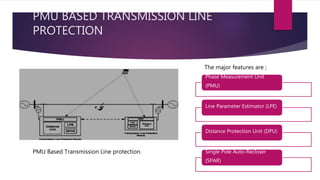
PMU BASED TRANSMISSION LINE
PROTECTION
PMU Based Transmission Line protection.
Phase Measurement Unit
(PMU)
Line Parameter Estimator (LPE)
Distance Protection Unit (DPU)
Single Pole Auto-Recloser
(SPAR)
The major features are ;
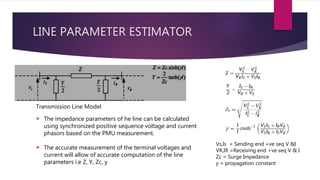
LINE PARAMETER ESTIMATOR
Transmission Line Model
 The impedance parameters of he line can be calculated
using synchronized positive sequence voltage and current
phasors based on the PMU measurement.
 The accurate measurement of the terminal voltages and
current will allow of accurate computation of the line
parameters i.e Z, Y, Zc, y
Vs,Is = Sending end +ve seq V &I
VR,IR =Receiving end +ve seq V & I
Zc = Surge Impedance
y = propagation constant
DISTANCE PROTECTION UNIT
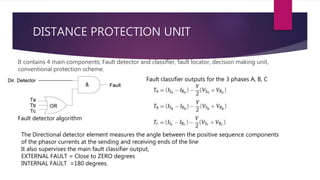
It contains 4 main components; Fault detector and classifier, fault locator, decision making unit,
conventional protection scheme.
Fault detector algorithm
Fault classifier outputs for the 3 phases A, B, C
The Directional detector element measures the angle between the positive sequence components
of the phasor currents at the sending and receiving ends of the line
It also supervises the main fault classifier output,
EXTERNAL FAULT = Close to ZERO degrees
INTERNAL FAULT =180 degrees.
FAULT LOCATOR AND DECISION MAKING
UNIT
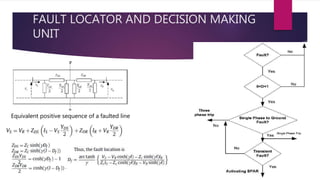
Equivalent positive sequence of a faulted line
SINGLE POLE AUTO-RECLOSER
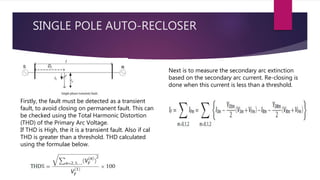
Firstly, the fault must be detected as a transient
fault, to avoid closing on permanent fault. This can
be checked using the Total Harmonic Distortion
(THD) of the Primary Arc Voltage.
If THD is High, the it is a transient fault. Also if cal
THD is greater than a threshold. THD calculated
using the formulae below.
Next is to measure the secondary arc extinction
based on the secondary arc current. Re-closing is
done when this current is less than a threshold.
SUITABLE FOR DOUBLE CIRCUIT
LINES/POWER SWINGS
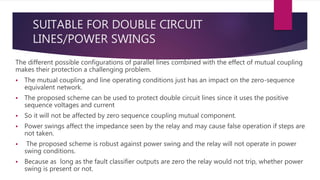
The different possible configurations of parallel lines combined with the effect of mutual coupling
makes their protection a challenging problem.
 The mutual coupling and line operating conditions just has an impact on the zero-sequence
equivalent network.
 The proposed scheme can be used to protect double circuit lines since it uses the positive
sequence voltages and current
 So it will not be affected by zero sequence coupling mutual component.
 Power swings affect the impedance seen by the relay and may cause false operation if steps are
not taken.
 The proposed scheme is robust against power swing and the relay will not operate in power
swing conditions.
 Because as long as the fault classifier outputs are zero the relay would not trip, whether power
swing is present or not.
RESULTS AND SIMULATION
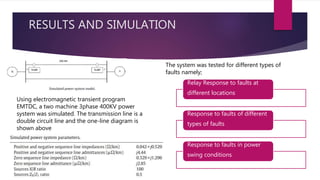
Using electromagnetic transient program
EMTDC, a two machine 3phase 400KV power
system was simulated. The transmission line is a
double circuit line and the one-line diagram is
shown above
The system was tested for different types of
faults namely;
Relay Response to faults at
different locations
Response to faults of different
types of faults
Response to faults in power
swing conditions
RESULTS
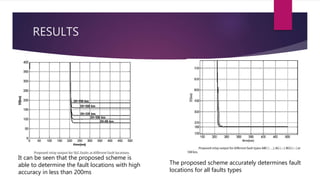
It can be seen that the proposed scheme is
able to determine the fault locations with high
accuracy in less than 200ms
The proposed scheme accurately determines fault
locations for all faults types
RESULTS CONTD
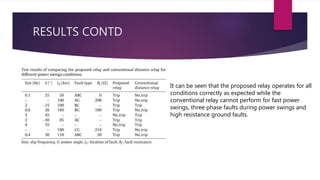
It can be seen that the proposed relay operates for all
conditions correctly as expected while the
conventional relay cannot perform for fast power
swings, three phase faults during power swings and
high resistance ground faults.
CONCLUSION
 The paper presents an adaptive transmission line protection scheme based on synchronized phasor
measurement
 The proposed scheme is applicable to protect both double and single circuit lines.
 The results show that the scheme is able to detect fault locations with different types of fault at
different locations.
 The results also show that this scheme is robust against power swing as opposed to the
conventional relay.
 Also a novel adaptive SPAR was introduced
THANK YOU

Summary Presentation on PMU Based Transmission Line Protection Scheme

  • 1.
    PHASOR MEASUREMENT UNITBASED TRANSMISSION LINE PROTECTION SCHEME DESIGN Hassan Khorashadi Zadeh, Zuyi Li (A PAPER SUMMARY) BY OKHUEGBE SAMUEL NOSAKHALE EE300-0011/2018
  • 2.
    INTRODUCTION (WHY TRANSMISSION LINE) Transmission line protection is the most elaborate and challenging function in power system protection.  About two-thirds of faults in power systems occur on transmission line network.  Faults on the Transmission Network can cause catastrophic effects.
  • 3.
    DISTANCE RELAYING PROTECTION It operates on the principle of measuring the impedance at a fundamental frequency between relay location and the fault points.  It also uses the measured impedance to determine if a fault is internal or external to a protection zone  The Impedance can be calculated from the Voltage and Current data, here Voltage and current transformers assist But the conventional distance relay protection is associated with a lot of disadvantages and problems
  • 4.
    PROBLEMS ASSOCIATED WITHDISTANCE RELAY PROTECTION The distance relay operates on the principle of the measured impedance, but this measured impedance is affected by various factors; Power Swings Load Current Mutual Coupling Effect caused by zero sequence current in Double Circuit Transmission lines Over Reaching and Under Reaching in Double Circuit Transmission lines
  • 5.
    SINGLE POLE AUTO-RECLOSER(SPAR)  Transient Single-phase to ground faults are the most frequent faults that occur on Extra-High-Voltage transmission systems. SPAR provides a means to improve transient stability.  But re-closing on a permanent fault is undesirable and can cause potential damage.  Conventional SPARs re-closes circuit breaker after a set fixed time delay(dead time) following a protection trip order.  It is necessary to distinguish between permanent and transient faults and to use an intelligent time varying auto reclosing scheme that can adaptively change the dead time based on deionization of the fault path.
  • 6.
    PHASE MEASUREMENT UNIT(PMU) To help solve some of the challenges posed by the conventional distance relay and SPAR, a phase measurement unit based solution where synchronized measurement data from both ends of a transmission line is used to protect the line, is proposed. Also an adaptive SPAR with variable dead time control in the case of transient fault by determining secondary arc extinction.  Based on the technology of synchronized phasor measurement.  Provides an ideal measurement system for monitoring and controlling a power system.  It measures the positive, negative and zero sequence of voltage and current.  Provides real-time measurement with precise time synchronization (GPS).
  • 7.
    PMU BASED TRANSMISSIONLINE PROTECTION PMU Based Transmission Line protection. Phase Measurement Unit (PMU) Line Parameter Estimator (LPE) Distance Protection Unit (DPU) Single Pole Auto-Recloser (SPAR) The major features are ;
  • 8.
    LINE PARAMETER ESTIMATOR TransmissionLine Model  The impedance parameters of he line can be calculated using synchronized positive sequence voltage and current phasors based on the PMU measurement.  The accurate measurement of the terminal voltages and current will allow of accurate computation of the line parameters i.e Z, Y, Zc, y Vs,Is = Sending end +ve seq V &I VR,IR =Receiving end +ve seq V & I Zc = Surge Impedance y = propagation constant
  • 9.
    DISTANCE PROTECTION UNIT Itcontains 4 main components; Fault detector and classifier, fault locator, decision making unit, conventional protection scheme. Fault detector algorithm Fault classifier outputs for the 3 phases A, B, C The Directional detector element measures the angle between the positive sequence components of the phasor currents at the sending and receiving ends of the line It also supervises the main fault classifier output, EXTERNAL FAULT = Close to ZERO degrees INTERNAL FAULT =180 degrees.
  • 10.
    FAULT LOCATOR ANDDECISION MAKING UNIT Equivalent positive sequence of a faulted line
  • 11.
    SINGLE POLE AUTO-RECLOSER Firstly,the fault must be detected as a transient fault, to avoid closing on permanent fault. This can be checked using the Total Harmonic Distortion (THD) of the Primary Arc Voltage. If THD is High, the it is a transient fault. Also if cal THD is greater than a threshold. THD calculated using the formulae below. Next is to measure the secondary arc extinction based on the secondary arc current. Re-closing is done when this current is less than a threshold.
  • 12.
    SUITABLE FOR DOUBLECIRCUIT LINES/POWER SWINGS The different possible configurations of parallel lines combined with the effect of mutual coupling makes their protection a challenging problem.  The mutual coupling and line operating conditions just has an impact on the zero-sequence equivalent network.  The proposed scheme can be used to protect double circuit lines since it uses the positive sequence voltages and current  So it will not be affected by zero sequence coupling mutual component.  Power swings affect the impedance seen by the relay and may cause false operation if steps are not taken.  The proposed scheme is robust against power swing and the relay will not operate in power swing conditions.  Because as long as the fault classifier outputs are zero the relay would not trip, whether power swing is present or not.
  • 13.
    RESULTS AND SIMULATION Usingelectromagnetic transient program EMTDC, a two machine 3phase 400KV power system was simulated. The transmission line is a double circuit line and the one-line diagram is shown above The system was tested for different types of faults namely; Relay Response to faults at different locations Response to faults of different types of faults Response to faults in power swing conditions
  • 14.
    RESULTS It can beseen that the proposed scheme is able to determine the fault locations with high accuracy in less than 200ms The proposed scheme accurately determines fault locations for all faults types
  • 15.
    RESULTS CONTD It canbe seen that the proposed relay operates for all conditions correctly as expected while the conventional relay cannot perform for fast power swings, three phase faults during power swings and high resistance ground faults.
  • 16.
    CONCLUSION  The paperpresents an adaptive transmission line protection scheme based on synchronized phasor measurement  The proposed scheme is applicable to protect both double and single circuit lines.  The results show that the scheme is able to detect fault locations with different types of fault at different locations.  The results also show that this scheme is robust against power swing as opposed to the conventional relay.  Also a novel adaptive SPAR was introduced THANK YOU

Editor's Notes

  • #9 Zc=surge impedance
  • #12 Vf is the voltage phasors of the nth harmonic at fault location